The manor court was a valued institution of local governance in post-medieval English society.Footnote 1 Ordinary people used these courts to punish petty violence, suppress disruptive behaviour, regulate economic life, protect common resources, and manage shared landscapes. This article highlights the remarkable resilience of these institutions in a constantly changing world. Whereas some historians have dismissed early modern manor courts as decaying relics of the middle ages, analysing some of the voluminous archival material produced by these courts reveals the vital role that they played in local life in the seventeenth and eighteenth centuries.Footnote 2 This investigation shows that many of them – rather than merely fading away after c. 1600 – actually shifted their focus away from violence, disorder, and victualling towards ‘infrastucture’ such as roads, drainage, and fences, while often remaining heavily involved in the management of common lands and local immigration.
The regulations issued by these courts and the records of their enforcement survive in great numbers, and these documents form the basis of this article. Specifically, I examined the by-laws and presentments produced at approximately 450 court sessions between c. 1550 and c. 1850, from more than 100 different manors, including a broad sample from Yorkshire and a smaller selection from more than two dozen other English counties. As will be seen, these documents present real methodological difficulties, but they can also tell us much about English society during this period and this article is partly a plea for further research into this undervalued source.
By analysing a large sample of court documents both qualitatively and quantitatively, this article reveals that householders in many communities met regularly as manorial jurors to set down local rules and then monitored their neighbours to ensure their implementation. After all, the manor was, in the words of one contemporary, ‘a little commonwealth’.Footnote 3 But they varied significantly by time and place. The circumstances of a particular locality could dramatically affect the strength and focus of its manor court. There were thus notable contrasts between uplands and lowlands, and between towns and villages. Broad regional differences may be detected as well, with the most active courts seemingly concentrated in the midlands and the north. Of course, there were also changes over time, but simply to dismiss the post-medieval manor court as an institution in decline would be extremely misleading. Instead, many of these courts probably handled more business (at least for certain categories of offences) in the seventeenth century than they had in earlier periods. Not only was Walter King right to argue that manor courts were ‘still needful and useful’ under the early Stuarts, these bodies often remained essential to local governance until the era of parliamentary enclosure in the late eighteenth and early nineteenth centuries.Footnote 4
This article has four main sections. The first briefly reviews the relatively small existing scholarly literature on post-medieval manor courts and the remarkable volume of manorial records that remain unexplored, as well as outlining the sample of documents used in this article and the methodological challenges they entail. The second section presents an overview of the functions of these courts, highlighting the balance between various categories of offences over the period as a whole. The third focuses on the geographical variations in the business handled by these institutions, illustrating the similarities and differences between the manors of lowland and upland Yorkshire and between those of urban and rural communities in the larger sample, while also suggesting possible regional contrasts in the courts’ strength and longevity. The fourth section addresses the issue of change over time by demonstrating their resilience in the seventeenth and eighteenth centuries, whereby many manors evolved to meet shifting circumstances rather than stagnating in their medieval form or rapidly falling into ruin. The first two sections are intended primarily for scholars who are relatively unfamiliar with these courts and their records, and with their potential value to early modernists. The next two sections will, I hope, be of use to all historians of English local governance and society, including those who have already discovered the value of post-medieval manorial documents.
I
Despite the fact that manor courts had a central place in the lives of many men and women in Stuart and Hanoverian England, they have been confined almost entirely to the margins of post-medieval historiography. The wealth of information about local government preserved in the manorial records of the seventeenth and eighteenth centuries remains largely undiscovered.
Medievalists have made very effective use of manorial regulations to investigate agrarian society during this earlier period, and their work on these sources can serve as a useful model for historians of early modern England. For example, W. O. Ault's pioneering study of medieval manorial by-laws showed how tenants regulated local agriculture, increasingly acting on their own initiative rather than relying on the authority of their lords.Footnote 5 More recently, Marjorie McIntosh offered an impressive survey of the efforts of hundreds of communities to police ‘misbehaviour’ using manor courts and other ‘lesser public courts’.Footnote 6 Her study, which extends from the late fourteenth century to the late sixteenth century, strongly challenged the many scholars who had ‘wrongly concluded’ that these sorts of records ‘are of little value’ for the Tudor period.Footnote 7 She demonstrates that, in most parts of country, they were actually handling more business by 1600 than ever before.Footnote 8 Likewise, Christopher Harrison provided additional evidence that Elizabethan manor courts were far from moribund, showing that they were in fact ‘the premier courts of the first instance in most villages and many towns’.Footnote 9
Yet, the voluminous manorial documents that date from beyond c. 1600 have received little sustained attention from historians, the chief exception being in scholarship on common land and enclosure. Several important studies of various types of ‘commons’ in the seventeenth and eighteenth centuries have made extensive use of these records, including the work of Eric Kerridge on common fields, Angus Winchester on northern upland pastures, and Jeanette Neeson on common land in Northamptonshire.Footnote 10 However, these authors only rarely discuss the other functions of the court. For that one must turn to the scattered research exploring ‘courts leet’. Those of early Stuart Lancashire have been analysed in several articles by Walter King, whose fruitful work on the material inspired him to publish an appeal for further research into the ways in which these institutions ‘satisfied the desire and need for local, inexpensive, “neighbourly” justice’.Footnote 11 The non-agricultural functions of eighteenth-century manorial courts were somewhat dismissively addressed by Sydney and Beatrice Webb over a hundred years ago, but since then the only published work on this topic has been Robert Dilley's short article on manorial prosecutions for slander and defamation in Cumberland.Footnote 12 Whilst all of this work is valuable, it is still quite restricted. Most of it focuses on the management of common land, and those authors who have examined the broader aspects of manorial governance and regulation (Winchester, King, and Dilley) have focused on the north-west, with special emphasis on the period before c. 1650. This has left a vast body of manorial records essentially untouched.
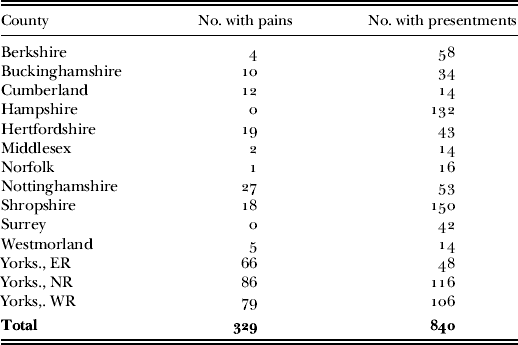
The sheer volume of material that has yet to be studied is intimidating. A search of the digitized portions of the Manorial Documents Register at The National Archives between 1550 and 1850 reveals 840 manors with lists of presentments and 329 with lists of ‘pains’ (by-laws).Footnote 13 Given that these figures exclude court books and other documents that frequently contain regulations, and that they include only the twelve English counties whose registers have been digitized, the actual number of communities with surviving evidence of post-medieval manorial government must surely number in the thousands.Footnote 14 Of course, in some cases this material consists of only one or two court meetings with perhaps no more than a dozen by-laws detailed, but for other manors the records run in largely unbroken series for decades or even centuries.Footnote 15 It would take many years to exhaust the research possibilities offered by the existent records for even a single county.
Nonetheless, this article seeks to examine a relatively broad (though admittedly shallow) selection of these documents by delving into the manorial records of 113 different communities, most of which fall outside the boundaries of previous scholarship (see Appendix). The first part of the sample consists of 77 manors from Yorkshire, the kingdom's largest and most diverse county. This includes evidence from the wetlands of the Humberhead Levels, the fertile plains of the Vales of York and Mowbray, the hilly pastures of the North York Moors, the industrializing landscape of the West Riding coalfield, and the stock-raising hamlets of the Yorkshire Dales. The second part of the sample comprises 36 manors from 26 other English counties. It is too small to be described as ‘representative’, but it at least encompasses manors from Cumberland and County Durham in the far north to Cornwall and Devon in the south-west to Kent and Middlesex in the south-east.Footnote 16 For each of the manors in this sample, I have recorded the number and type of rules and offences listed in the court records for one or more years.Footnote 17 Together, these amount to 6,529 by-laws, orders, presentments, or fines from 452 court meetings – an average of about 14 offences per meeting and 58 per manor.Footnote 18
It must be emphasized that measuring manorial regulation quantitatively is fraught with difficulties. As with all research into law-breaking and law-enforcement, the ‘dark figure’ of unreported crime makes it extremely difficult to distinguish changes in the number of actual offences from changes in number of prosecutions.Footnote 19 Furthermore, unlike official county or borough records, the survival of manorial documents is extremely haphazard as it depends largely on the record-keeping sensibilities of the various lords of the manor or their stewards, making survival more likely for manors with institutional owners and less likely for resident gentry families of modest wealth. Thus, a lack of records from a specific manor (or during a specific period) is not proof that its court was inoperative. Moreover, sometimes the documents contain a fairly complete record of all the business of the manor court, but more often they include only presentments (without noting the underlying set of rules) or only pains (without indicating how often they were violated or enforced). Finally, the extremely individualized nature of English manors makes any attempt at standardization or categorization difficult. Rules were designed to apply to local circumstances, often naming the specific landscape features or particular people to which they pertained, and on rare occasions the use of dialect or the assumption of local knowledge simply makes a regulation impossible to decipher. All these factors must be borne in mind when considering the assessments that follow.
In addition, there are many facets of post-medieval manorial government that might be illuminated by these records but which cannot be addressed within the limited scope of this article. The court was, after all, a tremendously versatile institution. Its jury of tenants might serve as not only a legislature and a judiciary, but also as an arbitrator of private disputes, a franchise for electing officers, and a recorder of tenure and property.Footnote 20 The court could also provide a forum for informal debates and an opportunity for convivial socializing.Footnote 21 However, this article focuses solely on its law-making and law-enforcement functions. Moreover, several other issues have had to be set aside. There is, for example, no direct discussion of the social status of the jurors, the influence of lords and their stewards, the gendered nature of some offences, or the role of court officers such as haywards, swineherds, aletasters, and constables.Footnote 22 These important aspects of local administration deserve an article of their own, which hopefully will soon emerge from further work on this extraordinarily underexploited class of documents.
II
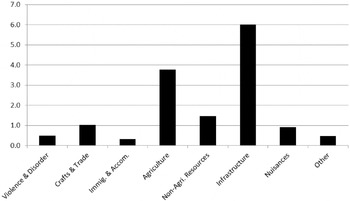
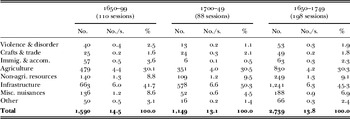
The legislative and judicial functions of the manor court can be roughly divided into seven broad categories of concern: (1) violence and disorder; (2) crafts and trade; (3) immigration and accommodation; (4) agriculture; (5) non-agricultural resources; (6) infrastructure; (7) miscellaneous nuisances (Figure 1).
Average number of offences per session, c. 1550–1850 Sources: Sample of 6,529 offences from 452 sessions for 113 manors (see Appendix).

Attempting to suppress and punish violence was never a substantial proportion of manor court business. Normally, the jurors only presented one or two people at any particular sitting for ‘assaults’, ‘affrays’, or ‘bloods’, and at many courts these crimes received no attention at all, especially by the eighteenth century.Footnote 23 Cases like that of Robert Wythes of Colton (Yorks.), who was fined 6 s 8d ‘for drawinge the blood of his man Thomas Dawton’ in 1628, represent just one in every fifty offences recorded in the sample.Footnote 24 Only in especially large or especially active manors does one find nine or ten violent offenders being punished in a single year.Footnote 25 Nonetheless, as Walter King has shown for early Stuart Lancashire, people in some parts of England were much more likely to prosecute ‘offences against the person’ at local courts leet (or at petty sessions) than at the county quarter sessions.Footnote 26 Much the same can be said about other types of disorderly behaviour, such as ‘scolding’, ‘night-walking’, and ‘unlawful gaming’.Footnote 27 These offences made up a similarly small proportion of the total sample and very rarely amounted to more than a couple of cases at any particular court.Footnote 28 Still, some manorial juries did indeed implement the sorts of ‘moral regulation’ that so excited many previous social historians.Footnote 29 At Lutterworth (Leics.), it was men ‘playing at the shovelabord’ and innkeepers encouraging ‘unlawfull games’ who faced prosecution, whereas at other manors it was bawdy houses or Sunday tippling that received attention.Footnote 30 However, the fear of disorder is most clearly revealed when the tenantry took action against assaults on the authority of manorial government itself. In the seventeenth and eighteenth centuries, several Yorkshire manors issued punishments for ‘Contempt & ill behaviour in Court’, ‘abusing the Jurey’, and ‘giving Eill Langu[ag]es to a By-law’.Footnote 31 This suggests that vocal resistance to the regulatory power of these local assemblies was not uncommon, but also shows that it might come at a serious cost.
Trade, manufacture, and commerce constituted the second broad category of issues subject to manorial supervision. These economic activities did not feature especially prominently in juries’ presentments, but they were addressed more often than violence and disorder, accounting for about 7 per cent of the offences recorded in the sample.Footnote 32 The most common complaints of this type focused on bakers and brewers who tried to sell their vital wares at unlawfully high prices, thus breaking the assize of bread and ale.Footnote 33 Also prosecuted were millers ‘for takinge excessive toll more than due’ and butchers for selling meat at inflated prices.Footnote 34 Moreover, some manor courts took a variety of other measures to regulate local traders and craftsmen. For instance, the jurors who governed the inland port town of Selby on the Yorkshire Ouse required that ‘searchers’ hunted out ‘corrupt victualls’ on market days, that corn dealers only sold their loads at the dock after they were ‘publickly Cryed’ by the bellman, that millers ‘grynde the freholders & tenants corne before anie forriners’, and that curriers sold only ‘well Tanned’ leather.Footnote 35 Yet the protection of consumers was not the only way in which manor courts intervened in commercial affairs – they also occasionally defended seigniorial interests by demanding that tenants only grind their corn at the lord's mill, and at least a few juries even tried to enforce religious prescriptions by prosecuting Sunday trading.Footnote 36
Alongside the security of a well-ordered market, tenants also prized a stable population and a fixed settlement pattern. Ordinances and prosecutions intended to maintain this stability were found somewhat more widely than those concerned with violence or trade, though they only comprised about 2 per cent of the sample.Footnote 37 The specific means employed by locals to exclude unwanted immigrants were essentially twofold. First, they prohibited current tenants from sub-letting to ‘undersettles’ or providing lodging to the mobile poor. The jurymen of West Tanfield (Yorks.), for example, imposed a 10 s fine on William Emerson in 1752 ‘for habouring Common Vagabonds contrary to Law and to [the] terror of the Inhabitants and the evil example of all others’.Footnote 38 Second, the tenantry used the Elizabethan law against the building of dwellings without four acres of land to restrict the erection of cottages that might accommodate poor incomers.Footnote 39 Hence, the manorial jurors of Riccall (Yorks.) regularly reaffirmed ‘that noe manner of person shall ericte or build anye house to dwell in Except it be upon [an already existing] front stead’, with offenders forfeiting the huge sum of 39 s 11d.Footnote 40 These sorts of by-laws ensured that established inhabitants could enforce a degree of control over any potentially disruptive immigration into their villages.
However, whilst the aforementioned issues received attention from many manorial juries, the management of agricultural land and livestock had a far more central place in the business of these courts. In fact, over a quarter of the sample consisted of pains and presentments that fell under this category, and this group would appear still larger if one included the ‘agricultural infrastructure’ discussed below.Footnote 41 Both arable and pastoral agriculture usually required some communal oversight and co-operation, though as will be seen in subsequent sections this varied greatly from place to place.Footnote 42 If a village had ‘townfields’ (i.e. ‘open’ or ‘common’ fields), the manor court was often used to co-ordinate the harvest and the grazing on the stubble that followed. Juries thus issued orders directing, for example, that everyone reaped ‘his Lande in the Fields within Foure days after notice given by the Fielde Reeves’, that no one began ‘gleaning till the stookes [corn-stacks] be taken away’, and that no tenants put their cattle into the harvested fields ‘before publike notice be given in the Church that the Inhabitants … shall agree to enter and feed the same fields’.Footnote 43 Similarly, if the settlement had common pastures or ‘wastes’, manorial ordinances were used to ensure these lands were not over-grazed. In many places, this meant setting out in detail the ‘stint’ allowed to different inhabitants, specifying the number and type of livestock permitted to each, and limiting grazing to particular times of the year.Footnote 44 Many manors also severely restricted the use of commons by non-residents. Tenants of Newton Longville (Bucks.) had to offer grazing rights to neighbours before letting them to foreigners, and the inhabitants of Thorpe in Balne (Yorks.) could not ‘gist any strangers Cattell upon Thorpe Marsh’ at all.Footnote 45 In addition, most communities had by-laws designed to protect agricultural land from the depredations of loose animals such as swine (which had to be ringed and sometimes yoked) and geese.Footnote 46 As a result of these manifold injunctions, vast numbers of people were presented and fined for the damage caused by their livestock, whether found wandering in the fields or over-stinted on the commons. Private encroachments upon manorial ‘wastes’ – or, in some cases, upon another tenant's holding – also elicited fines.Footnote 47 Rarely did those who attempted to expand their own fields by ploughing up a piece of the common escape notice.
The protection of non-agricultural resources – such as fuel, timber, earth, fish, and game – was another function of the manor court, and although previous historians have often bundled this with agricultural regulation it deserves closer attention.Footnote 48 Such regulations were very widespread, despite accounting for far fewer presentments than those related to crops and livestock.Footnote 49 About 7 per cent of the offences in the sample were cases of unlawfully cutting wood, breaking hedges, collecting furze, or graving turves, most of which must have been committed by men and women seeking supplies of winter fuel. Jurors rarely dealt with more than a couple of these cases each year, though there were exceptions, such as the fourteen people presented at Carthorpe (Yorks.) in 1620 for breaking hedges and taking the lord's wood.Footnote 50 Furthermore, the court was usually responsible for preventing individuals from damaging the commons by digging out soil, sand, or clay for use as building materials.Footnote 51 Even the use of manure was often regulated due to the value it added to local agricultural land – hence, villages like Burton Salmon (Yorks.) passed ordinances against gathering or carrying away any dung from the common without the consent of the lord and freeholders.Footnote 52 The prerogatives of the manor's owner had to be protected as well, and this led to a small number of people being fined at the court after having been caught fishing in seigniorial waters or catching rabbits on the moors.Footnote 53
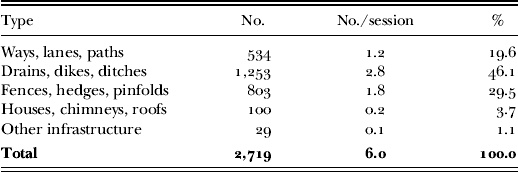
The largest group of offences handled by England's manor courts concerned local infrastructure, an issue unlikely to stir the hearts of many historians but one that has long been a crucial element in the lives of ordinary people. This category made up over 40 per cent of presentments and pains in the sample, and it was addressed in more than four-fifths of all court sittings.Footnote 54 As with offences relating to fuel and timber, previous discussions have often subsumed this type of offence under the general heading of agricultural regulation and many of these rules were indeed directly related to protecting crops and managing livestock, but it is worth looking at the specific offences here in slightly more detail (Table 1).Footnote 55 The infrastructure mentioned in these records varied significantly between different manors and over time, but three types stand out. First, the roads and paths essential to the movement of goods and people had to be maintained, necessitating innumerable presentments for those who neglected to repair the lanes adjoining their land, who obstructed the streets with dunghills or sandpits, who failed to attend the ‘common days work’ for mending the highways, or who removed the stiles and bridges on their footpaths. Second, the drainage system used to prevent floods and waterlogged fields required communal oversight, and this led to hundreds of fines for not cleaning out ditches, not fixing broken embankments, not trenching common fields, and not digging sufficient dikes. Third, the network of enclosures and boundaries used to manage livestock and define holdings could not be ignored, so manorial juries frequently issued penalties for allowing fences to fall down, leaving pinfolds unrepaired, and ploughing the baulks that separated furrows in open fields. Finally, in addition to supervising these three major parts of local infrastructure, the manor courts also occasionally dealt with tenants who refused to maintain the fabric of their houses (especially the chimneys) and officers who neglected to provide the community with adequate ‘amenities’ such as village wells, cucking stools, or whipping posts.Footnote 56
Infrastructure offences by type
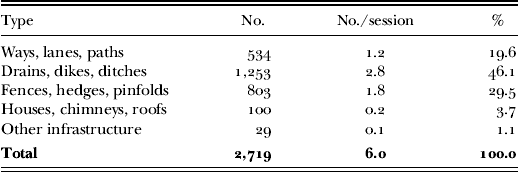
Sources: See Appendix.
Notes: Figures may not sum due to rounding.
Finally, tenants also concerned themselves with a variety of other miscellaneous nuisances. Punishments were meted out for unlawfully tipping waste or fouling water supplies, as evidenced in presentments ‘for making a dunghill to the anoyance of his neighbours’ and penalties for inhabitants who ‘Raite [i.e. soak] aney Line or hempe in the maine dam.’Footnote 57 In an age of wooden buildings, reducing the risk of fire was also important, so juries frequently issued orders against ‘carrying … any fire from one House to Another uncovered’ or ‘smock[ing] any Tobaco in any of the Town Streets … without a Convenant Covering for the same’.Footnote 58 Likewise, juries sought to maintain the health and quality of the village's livestock by prohibiting tenants from putting ‘scabbed’, ‘mangy’, or ‘stoned’ (uncastrated) animals on shared pastures.Footnote 59 These sundry annoyances, when combined with the small number of minor offences that cannot be categorized, comprised about one in ten of the by-laws and presentments in the sample.Footnote 60
III
The range of concerns addressed by post-medieval manor courts testifies to their potentially broad jurisdiction. However, treating them as a uniform bloc would be deeply problematic, as it would overlook the occasionally stark contrasts between the manor courts of different regions and localities. Variations in function and strength meant that the manorial governance of an upland village in the north-west might be quite unlike that of a small market town in the south-east.
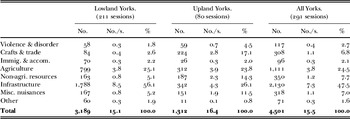
The diverse geography of the sprawling county of Yorkshire offers an insight into the practical impact of these variations. A clear split emerges within the sample's seventy-two Yorkshire manors between those situated in the alluvial plains or marshy estuaries of the county's lowlands, and those found on the elevated ridges, rolling hillsides, or steep slopes of the industrial and upland areas (see Table 2).Footnote 61 Some of these differences are predictable. For example, the huge contrast in the proportion of manorial business focused on local infrastructure was almost entirely due to the fact that lowland manors dealt with an average of four or five times as many drainage-related offences per session as their upland equivalents. Whereas tenants of flood-prone villages like Owston, Drax, and Fulford sometimes made twenty or thirty presentments about dikes and embankments at a single session, most of those at higher elevations made no presentments of this sort at all.Footnote 62 Likewise, the stark difference in the regulation of non-agricultural resources is mostly the result of upland manors focusing much more closely on potential fuel supplies such as bracken, turf, wood, and hedges. At the edge of the North York Moors, for instance, the manorial jurors of Sproxton and Beadlam fined numerous offenders for ‘graving turffs having no right’ on their common moorland.Footnote 63
Categories of offences by topography in Yorkshire, c. 1550–1850

Notes: ‘No./s.’=number per session. Figures may not sum due to rounding. ‘Lowland’ includes the Vale of York, the Vale of Mowbray, the Humberhead Levels, and Holderness; ‘Upland’ includes the North York Moors, the Yorkshire Dales, the Pennine Fringe, the Yorkshire Coalfield, and the Magnesian Limestone Ridge. For a discussion of these regions, see D. Hey, ‘Yorkshire and Lancashire’, in J. Thirsk, ed., The agrarian history of England and Wales, v:1640–1750 (Cambridge, 1985), pt 1, pp. 59–86.
Sources: See Appendix.
Other differences are less self-explanatory, especially the disparity in presentments for violence and disorder. In this sample, more than twice as many prosecutions for this type of behaviour were made in upland manors as in lowland ones, both for ‘affrays’ and for other ‘disorders’. The bulk of these cases came from the industrializing neighbourhoods in and around Sheffield and Leeds, so it seems that socio-economic factors may provide at least a partial explanation, but the contrast is also partly caused by the chronological biases of the sub-samples.Footnote 64 The limits of the data also contribute to the differences in the proportions recorded under the headings of ‘crafts and trade’ and ‘miscellaneous nuisances’: in both cases, an extraordinary number of these offences were presented at a single manor court, skewing figures that would be otherwise unremarkable.Footnote 65 More interesting is the fact that the distribution of court business across several categories was actually very similar in these two regions. Despite extremely different landscapes and economies, the manors of lowland, upland, and industrial Yorkshire all attended to a comparable number of cases concerning immigrants, new cottages, open fields, common grazing, straying livestock, fences, highways, food selling, and minor nuisances. Even the contrast that one would expect to see between offences relating to arable and pastoral agriculture is not apparent in the data.Footnote 66 This suggests that, at least within Yorkshire, geographic variations were important and noteworthy, but hardly overwhelming.
In the rest of the England, the pattern may have been much the same, though the smaller size of the sample of courts outside Yorkshire means that establishing firm conclusions is beyond the scope of this article. Simple comparisons hint at the expected results. Thus, low-lying manors in the fenny parts of Lincolnshire, Cambridgeshire, and Middlesex devoted much more energy to managing their drainage systems than did the upland settlements in Cumberland and Derbyshire.Footnote 67 Common resources were also geographically specific. Regulations concerning the right of ‘turbary’, for example, were concentrated in places where the scarcity of wood made alternatives such as peat and turf more valuable.Footnote 68 Somewhat surprisingly, the offence with the clearest regional limit was the ‘retting’ (soaking) of hemp and flax, which formed an important step in processing this fibre for use in rope and cloth but which also risked polluting the local water supply. With the single exception of Dowdeswell (Glos.), the only manors in the sample that sought to restrict ‘retting’ were in Yorkshire, perhaps indicating that this particular cottage industry required a type of alluvial soil that was not found everywhere.Footnote 69
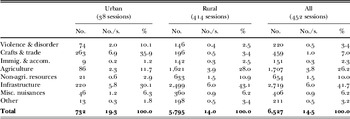
Categories of offences by geography, c. 1550–1850

Notes: ‘No./s.’ = number per session. Figures may not sum due to rounding. ‘Urban’ includes Clare, Leeds, Lutterworth, Northallerton, Selby, Sheffield, and the Savoy in the Strand; ‘Rural’ includes all others.
Sources: See Appendix.
At least one important geographical variation in patterns of regulation had little to do with topography or climate – this was the division between urban manors and their rural counterparts (Table 3).Footnote 70 The courts leet of urban boroughs and small market towns often dealt with many issues particular to their larger, more diversified economies.Footnote 71 Pre-eminent among these was trade and manufacturing, which accounted for about one in three offences here, well over tenfold more than in villages.Footnote 72 Indeed, whilst bakers and brewers in the countryside were very rarely punished for sharp dealing, those of the towns were fined relatively often. The same is true of assaults and other disorderly conduct, which made up about one in every ten offences presented by urban juries.Footnote 73 Townspeople also used their manor courts to focus on a few other specific issues, namely the maintenance of streets and paving, the digging of clay and gravel pits on commons, and the limiting of potential fire hazards. Yet, overall, the regulation of non-agricultural resources and miscellaneous nuisances featured less prominently in urban manors than in rural ones. So too did agricultural affairs, and for understandable reasons there were almost no mentions of crops or harvests. Still, as Henry French has recently shown, most towns controlled at least some local common pastures.Footnote 74 As a result, by-laws and presentments relating to livestock were recorded fairly frequently, including dozens of fines for over-stinting and grazing ‘without right’ that were imposed by the leet jurors of Northallerton in the 1630s in an effort to govern the use of the market town's shared pastureland.Footnote 75 In other words, urban courts still had a significant impact on communal grazing and road maintenance whilst taking a much more active role in the suppression of predatory trading and unruly behaviour.
Manors with extant manorial documents, 1550–1850
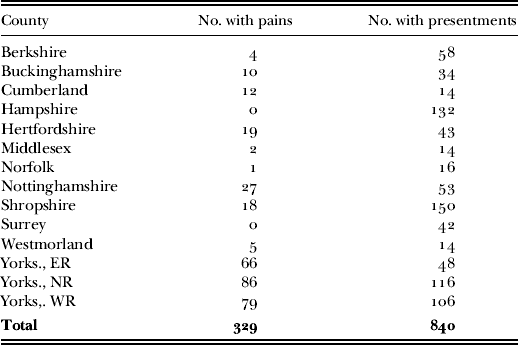
Source: Manorial Documents Register, www.nationalarchives.gov.uk/mdr/, accessed on 13 Nov. 2011.
Assessing geographical variations in the strength of manor courts is rather more difficult than analysing differences in their function.Footnote 76 The Manorial Documents Register might appear to be a promising source, but many of the figures for particular counties seem more likely to be the result of differences in archival cataloguing practices than indications of actual patterns of regulation (Table 4). For example, although the three Ridings of Yorkshire together included 270 manors with recorded sets of presentments and Hampshire had 132 of the same, the counties of Cumberland and Westmorland each included only 14 such manors, a disparity too large to be plausible.Footnote 77 Until further research comparing particular regions is undertaken, one must rely on reasoned speculation.Footnote 78 Logic suggests that the extent of common lands – both arable and pastoral – correlated relatively closely to the vibrancy of manorial regulation because such resources required communal oversight. Thus, the most active manors were probably concentrated in the open-field counties of the Midlands and in the common-pasture counties of the northern uplands and the eastern fenlands. In contrast, less active manors must have predominated in places characterized by extensive early enclosure such as Kent, Essex, and Cornwall.Footnote 79 Similarly, manor courts probably handled more local business in areas where other institutions were weak or non-existent. This pattern can be seen most clearly in the case of urban centres that lacked a borough government – Manchester, for instance, had a powerful and long-lasting court leet.Footnote 80 Such a tendency may also have led to more active manors in the parts of England (namely the counties of Shropshire, Staffordshire, Derbyshire, and those further north) where the prevalence of large, multi-township parishes made parochial administration impractical.Footnote 81 Matters that were dealt with elsewhere by the parish vestry would here be the responsibility of manorial juries.Footnote 82 If, as seems likely, the distribution of common lands and of rival governing institutions was the key factor, then England's most active post-medieval manor courts were to be found outside the south-east, especially in certain central and northern areas such as the Midland plain, the fenlands, and much of the north.
IV
In the middle ages, manors served as the principal organ of local government for the vast majority of the English people. By the time copyhold tenure was abolished in 1922, these institutions were mere shells of their former selves. Understanding the chronology of this shift is important if we hope to make sense of the history of local justice and regulation.
Most historians who have discussed the manor courts of the seventeenth and eighteenth centuries have depicted them as institutions in decline. For Sidney and Beatrice Webb, who first surveyed the subject, these ‘feudal’ jurisdictions were severely shaken by the ‘persistent hostility’ of the early Stuarts and the commonwealth regime, ‘from which they never recovered’.Footnote 83 By 1689, the institution was a ‘court in ruins’, ‘in every instance falling into decay’.Footnote 84 Much the same sentiment is expressed by P. D. A. Harvey in his recently revised introduction to these sorts of records: ‘After the late sixteenth century, … the history of the manor courts is one of gradual but unrelenting decay. Their practical function dropped away and they ceased to meet or degenerated into mere jollifications or antiquarian play-acting.’Footnote 85 Several other scholars have offered equally pessimistic assessments.Footnote 86 Both Christopher Harrison and Jim Sharpe have been less negative and have noted that manors remained a vital force in local communities in the early seventeenth century, but they too have suggested that at the Restoration their regulatory power was appropriated by the county magistrates and by the parish vestry.Footnote 87 Robert Dilley and Angus Winchester, by contrast, date the diminution somewhat later, placing it in the first decades of the eighteenth century.Footnote 88
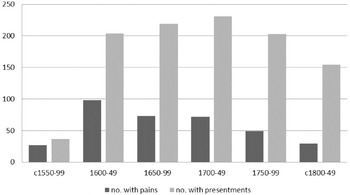
Manors with extant lists of pains and presentments, 12 counties Notes: Totals include only records that were confined to the specific date ranges, thus excluding at least 165 records with dates that crossed multiple ranges. The minimal figures for c. 1550–99 might be attributable to the fact that sixteenth-century pains and presentments tended to be recorded in composite court rolls or court books rather than in stand alone lists. Source: See Table 4.

These narratives of the collapse of manorial governance are based on solid research and cannot be cursorily dismissed. Yet, it is not difficult to find evidence suggesting that the rate of ‘decay’ may have been considerably overstated.Footnote 89 The Manorial Documents Register, for instance, shows that extant records of regulation in the form of pains and presentments do not markedly decline in number at the expected dates (Figure 2). Instead, the number of presentment lists initially increases and then remains roughly the same between c. 1600 and c. 1800, before falling substantially thereafter. Lists of pains have a slightly different pattern, with a peak in the early seventeenth century, though they too remain relatively common until the late eighteenth century. In fact, this chronological trend in the issuing of by-laws may align with the multiplication of litigation and intensification of governance in other jurisdictions in the early seventeenth century that historians have already noted.Footnote 90 So, while the extraordinarily small number of pains and presentments surviving from the late sixteenth century suggests that these figures must be interpreted with extreme caution, the overall pattern implies that manorial regulation was hardly ‘in ruins’ before the spread of parliamentary enclosure. Likewise, some individual manors witnessed little change in the quantity of regulation that they undertook. The tenantry of Acomb (Yorks.), for example, dealt with about fifteen or twenty offences per court session in the Elizabethan and early Stuart period, a rate that was often matched at courts held here over a century later.Footnote 91 Several other manors with long series of records – such as Riccall, Bishopthorpe, Dowdeswell, and Lowestoft – show similar patterns.Footnote 92 Although this was not the case in every community, the amount of business handled by many manorial juries does not appear to have dropped dramatically over the course of the early modern period.
Average number of offences per session over time, c. 1550–1850 Sources: See Appendix.

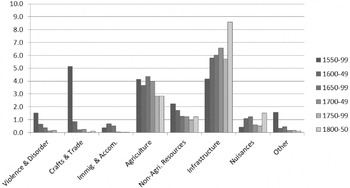
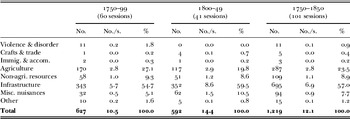
So, rather than merely regarding these centuries as a period witnessing the gradual disintegration of the English manor, it would be more useful to think of this era as one in which communities adapted the role of these courts to suit their evolving needs. It is certainly true that some functions were ceded to other institutions, but others became increasingly important as local circumstances changed. The long-term shifts in the proportion of attention devoted to specific groups of offences in the sample of 113 manors can be seen in Figure 3 and Tables 5–7. If one examines the patterns of enforcement chronologically, there appear to have been three distinct periods.
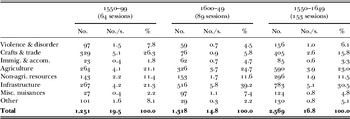
Categories of offences by period, c. 1550–1649

Notes: ‘No./s.’ = number per session. Figures may not sum due to rounding.
Sources: See Appendix.
During the first era, stretching from c. 1550 to 1649, both the enforcement of the king's peace and the regulation of local trade were relatively common. However, both were seen less often by the end of the period, with an especially sharp decline in the prosecution of bakers, brewers, and butchers for marketing offences.Footnote 93 In addition, attempts to control immigration through restrictions on taking ‘inmates’ and building cottages actually grew as a proportion of the sample, probably as a result of rising demographic pressures.Footnote 94 Together, these three concerns – violence, trade, and immigration – each comprised about 5 per cent of the offences punished by early Stuart manors. The management of agriculture and of other local resources comprised about a third of the courts’ business, a proportion which seems to have been gradually increasing at this time. The most significant changes, however, occurred in prosecutions for neglecting infrastructure or committing petty nuisances, both of which appeared more frequently in the early seventeenth century than in previous decades. Even in a period of growing poverty, social polarization, and moral anxiety, most manorial juries devoted a large and increasing amount of energy to the workaday affairs of wandering livestock, broken fences, unrepaired roads, and fouled water supplies.Footnote 95
Categories of offences by period, 1650–1749

Notes: ‘No./s.’ = number per session. Figures may not sum due to rounding.
Sources: See Appendix.
The second century, 1650 to 1749, witnessed the continuation of some, but not all, of the previous trends in manorial government. Agricultural concerns, especially the control of common grazing, remained central, as did the maintenance of fencing and drainage systems. Indeed, about three-quarters of all offences in the sample were related to these issues during this period. This may have been partly due to the relative stability of population levels and food prices, which probably made the supervision of victuallers less common, although concerns about poor migrants appear to have remained salient throughout the seventeenth century before declining sharply thereafter.Footnote 96 Cases of assault, scolding, and playing ‘unlawful games’ became steadily rarer.Footnote 97 Still, a few later Stuart manors continued to deal with them regularly. For example, the courts leet of Shrewsbury and Prescott dealt with hundreds of cases of ‘affrays and bloods’ in the seventeenth century and, although the annual average may have peaked in the 1630s, at least some were tried each year until the end of the century.Footnote 98 Indeed, some contemporaries noted the institution's continued efficacy in such matters. The charge to the jury of Dringhouses, near York, in 1734, reminded the tenants ‘how useful and advantagious both to the Kingdome and to yourselves these Courts Leet and Baron are which bring Justice to your own Doors with so little trouble or expence’, for they are ‘without all doubt sufficient not only to secure and preserve the Peace of the King but also the Rights and Properties of every Persons with these Mannors’.Footnote 99
Categories of offences by period, 1750–1850

Notes: ‘No./s.’ = number per session. Figures may not sum due to rounding.
Sources: See Appendix.
From 1750, the long-term reorientation of manorial business was unmistakable. Presentments relating to violence, disorder, trade, and immigration now occurred very rarely, amounting to merely about one in every hundred in the sample. By this time, locals presumably brought complaints about such offences directly to the justices of the peace at quarter sessions, petty sessions, or magistrates sitting individually.Footnote 100 Manorial supervision of grazing remained relatively important despite a noticeable decline in the numbers handled at each session, and these still comprised more than a quarter of the total in the late eighteenth century. Even as late as 1907, one finds the tenants of Acaster Malbis using their manor to set out rules for grazing the common meadows, forbidding access to outsiders, and setting a stint according to each tenant's acreage.Footnote 101 However, the waves of parliamentary enclosure that began to spread across the country from c. 1750 reduced the demand for such regulations and, in some places, effectively extinguished manorial governance.Footnote 102 The intervention of common law courts into matters such as gleaning that were previously the purview of ‘custom’ may have hastened this shift.Footnote 103 By the nineteenth century, the core of the court's business was protecting wastes from fuel and gravel scavengers; punishing tenants who failed to repair their dikes, fences, and roadways; and fining any who annoyed their neighbours with dunghills or rubbish tips. Such offences accounted for over three-quarters of those handled by manorial juries by the early nineteenth century. Despite the renewed population growth and increasingly widespread poverty that characterized this period, the courts did not return to their Tudor role as guardians of the social order, instead serving as convenient mechanisms for protecting agricultural land and preserving shared infrastructure.Footnote 104
It must be emphasized that the quantification of general trends often hides the specific situations that arose in particular communities. In the eighteenth century, for example, many manors were much like that of Beechill (Yorks.), where the jurors regularly fined tenants for nuisances such as loose swine and collapsed fences, but by the 1780s had lost even this relatively minor role.Footnote 105 Yet, atypical cases are not difficult to find. For instance, the court leet of the London liberty of the Savoy in the Strand was an energetic force of moral activism until at least the 1750s. The jurors here regularly inflicted fines of £2 or more on publicans and landladies ‘for keeping a suspected Bawdy house’, ‘for keeping a Common Ninepin yard & ill house’, and ‘for keeping a Common Gameing Table’.Footnote 106 The two manor courts of Whittlesey in Cambridgeshire became the vehicle for a similar crusade in 1788 when the tenants ordered that ‘the Churchwardens and Constables do acert themselves in Suppressing Tippling in Inns and Ale Houses and the Practice of Carting and Barrowing on the Lords Day’ on pain of forfeiting £1 each.Footnote 107 Even more conspicuous was the detailed charge to the leet jury of Bury St Edmunds (Suffolk) in 1769. It called for the building of ‘a Cage & a Pair of Stockes’, being ‘Things very usefull as the World now goes’ for suppressing ‘idle and disorderly Persons’, as well as demanding the punishment of alehouse-keepers who allowed unlawful games, idlers who robbed hen-coops and orchards, victuallers who conspired to raise prices, labourers who ‘combined’ to raise wages, tradesmen who used false weights or measures, corn-dealers who forestalled the market, and any inhabitant who neglected to repair their roadways.Footnote 108 Each of these cases was unusual, but they remind us that individual manors frequently faced unique circumstances and they might react to these in ways that ran contrary to the broader shifts of the era.
V
The picture of the manor court that emerges from these records may be unfamiliar to many students of English history. Here is an institution that allowed local people to create their own rules to govern many aspects of daily life, from land use and food retailing to immoral behaviour and violent brawling. It could be found in every part of the country, not merely in the northern uplands, and it did not fade rapidly to irrelevance over the course of the seventeenth century. A few keen scholars have already highlighted some important features of this legislative and judicial body, but it deserves to be much more widely known amongst historians who focus on the seventeenth and eighteenth centuries. Parishes and urban corporations already feature prominently in many detailed monographs and key textbooks – it seems that manors merit a place here too.Footnote 109 Put bluntly, if one hopes to understand how England was governed in the seventeenth and even eighteenth centuries, one must take account of manor courts.
Much work remains to be done. A clear picture of the place of these institutions in early modern society will only emerge once we have learned far more about the social status of jurors and about the various roles played by lords, stewards, officers, and tenants.Footnote 110 Further research is also needed on the court's role in much of central and southern England, as the research undertaken for this article can only hint at possible national patterns.Footnote 111 Nonetheless, it should now be clear that the reams of documents produced by these bodies can yield considerably more information about governance, social relations, and everyday life than current scholarship would suggest. Jim Sharpe, writing of the early Stuart manor courts, made this case eloquently. According to him, the cases they handled ‘may seem far removed from the serious felonies, matters of life and death, tried in the majestic splendour of the assizes’, but their records ‘can provide us with a uniquely intimate impression of crime, conflict and control at the village level’.Footnote 112 He is undoubtedly right, though one must hasten to add that they offer glimpses of co-operation as well as conflict and that they can also illuminate later eras.
For the multitudes of people who rarely had any dealings with a justice of the peace and who never voted for a member of parliament, the semi-annual meeting of the manorial jury could be their primary encounter with the business of government.Footnote 113 It was here where the tenantry made decisions about the management of common pastures and local fuel supplies. Here too they judged and punished most of those who disrupted the peace of the neighbourhood, over-exploited shared resources, or neglected to fulfil their many other duties as members of the community. As such, manor courts functioned as policy-making bodies and as judicial arbiters, analogous to both parliaments and judges. The ever-expanding jurisdiction of the magistracy and the shifts in land management brought about by enclosure had an undeniable impact on the remit of manorial government – yet this impact should not be exaggerated. Often the users of these courts adapted them to suit changing circumstances, allowing them to remain relevant throughout the early modern period and beyond. The innumerable people who participated, whether as jurors or offenders or both, experienced first-hand the strength of these ‘little commonwealths’.
Appendix: manors used in the sample

- BIA
Borthwick Institute for Archives (York)
- BL
British Library
- CA
Cambridgeshire Archives
- DA
Doncaster Archives
- HHC
Hull History Centre
- JGC
John Goodchild Collection (Wakefield)
- NA
Nottinghamshire Archives
- NYCRO
North Yorkshire County Record Office
- TNA
The National Archives
- WYAS-B
West Yorkshire Archive Service at Bradford
- YAS
Yorkshire Archaeological Society (Leeds)
- YCA
York City Archives
- YMA
York Minster Archives
- Ault, ‘Open-field.’
W. O. Ault, ‘Open-field husbandry and the village community: a study of agrarian by-laws in medieval England’, Transactions of the American Philosophical Society, n.s., 55 (1965), pp. 11–54
- Clemesha, ‘Bramhall.’
H. W. Clemesha, ‘The new court book of the manor of Bramhall, 1632–1657’, Chetham Miscellanies, n.s., 4 (1921), pp. 1–35
- Garratt, Eckington
H. J. H. Garratt, ed., Eckington: the court rolls (3 vols., Huddersfield, 1997–2003)
- Fenton, Tottenham
F. H. Fenton, ed., Court rolls of the manor of Tottenham, Middlesex (5 vols., London, 1956–63)
- Hall, Sheffield
T. W. Hall, ed., Sheffield, Hallamshire: a descriptive catalogue of Sheffield manorial records (3 vols., Sheffield, 1926–34)
- Hill, ‘Dowdeswell.’
M. C. Hill, ‘Dowdeswell court book, 1577–1673’, Transactions of the Bristol and Gloucestershire Archaeological Society, 67 (1949), pp. 119–216
- Hone, Manor
N. J. Hone, The manor and manorial records (London, 1906)
- Jessup, ‘Chilham.’
F. W. Jessup, ed., ‘Court rolls of the manor of Chilham, 1654–56’, in A seventeenth-century miscellany (Maidstone, 1960), pp. 1–34
- Purton, ‘Stanton Lacy.’
R. C. Purton, ‘A manor court at Stanton Lacy in 1609’, Transactions of the Shropshire Archaeological Society, 53 (1950), pp. 207–11
- Richardson, Acomb
H. Richardson, ed., Court rolls of the manor of Acomb (2 vols., Leeds, 1969–78)
- Winchester, Harvest
A. Winchester, The harvest of the hills: rural life in northern England and the Scottish borders, 1400–1700 (Edinburgh, 2000)