I. INTRODUCTION
Fe-based amorphous alloys have received great attention due to their high strength, excellent soft magnetic properties, and high corrosion resistance. Reference Shen and Shwarz1–Reference Hono, Hiraga, Wang, Inoue and Sakurai8 They were served in the field of functional materials, such as magnetic core, electrical devices, switch transformer, and electronic microcomponents. Therefore, great endeavor has been devoted to the development of new Fe-based amorphous ribbons or bulk metallic glasses (BMG) with high glass forming ability (GFA) and good magnetic properties to extend their industrial applications.
As early as in 1988, Yoshizawa et al. Reference Yoshizawa, Oguma and Yamauchi9 firstly reported the FINEMET-type soft magnetic material with a high saturation magnetization of about 1.2–1.3 T. Later, studies on ternary Fe–M–B (M: Zr, Hf, Nb) alloys Reference Suzuki, Makino, Inoue and Masumoto10–Reference Makino, Hatanai, Inoue and Masumoto13 exhibited excellent soft magnetic properties and good GFA. These alloys exhibited a high saturation induction reaching 1.7 T due to the formation of a mostly single bcc structure consisted of α-Fe grains with 10–20 nm in size. The ternary Fe66Nb4B30 BMG with a critical diameter of 2 mm in the high-boron-content region was firstly reported by Stoica et al. Reference Stoica, Hajlaoui, Lemoulec and Yavari14 Recently, Yao et al. Reference Yao, Wang and Li5,Reference Yao, Yang, Zhang, Wang and Li15 pointed out that the best glass former was pinpointed at Fe71Nb6B23 with a critical diameter of 1.5 mm, which exhibits ultrahigh fracture strength reaching 4.85 GPa and compressive plastic strain up to 1.6%. To enhance thermal stability and GFA, different transition metals Reference Park, Wang, Li, Mattern, Eckert and Kim16–Reference Zhao, Dun, Man and Shen19 and/or rare earth Reference Park, Park, Kim, Kim and Fleury18,Reference Song, Kim, Fleury, Kim and Kim20,Reference Zhang, Tan, Feng and Li21 elements are included as additives. Since Ni has a higher Poisson's ratio (ν = 0.31) and a lower G/K (0.42) compared with Fe and a very moderate negative enthalpy of mixing for Fe–Ni pairs, the replacement of Fe by Ni was found to increase the GFA and compressive plasticity. Reference Park, Wang, Li, Mattern, Eckert and Kim16 The Fe56.04Co13.45Nb5.5B25 BMG exhibited a larger supercooled region of 58 K and a compressive strength of about 4.5 GPa. Reference Chang, Huang, Chen, Ge, Jiang, Nie and Jiang17
Traditionally, high-purity elements and high vacuum are required for the production of metallic glasses. The high cost and low productivity become a key problem restricting their wide industrial applications. Therefore, to solve this problem, some researchers attempted to develop Fe-based metallic glasses using industrial raw materials. Reference Zhang, Tan, Feng and Li21–Reference Gan, Yi, Pu, Wang and Xiao24 These Fe-based metallic glasses not only possess large GFA, high thermal stability, and other desirable properties, but also have the advantage of low cost. In this article, by selecting Fe71Nb6B23 alloy as the starting material, the melt-spun Fe–Nb–B–Ni and (Fe, Ni, Co)–Nb–B ribbons were fabricated using industrial grade raw materials. The composition dependence of the thermal properties and magnetic properties for the Fe–Nb–B–Ni and (Fe, Ni, Co)–Nb–B alloy systems is studied. In addition, the effect of Ni and Co substitution for Fe on the GFA and thermal stability is also discussed.
II. EXPERIMENTAL
Two series of master alloy ingots with a nominal composition of Fe71−x Nb6B23Ni x (x = 1, 3, and 5) and (Fe1−x−y Ni x Co y )71Nb6B23 (x = 0.1, y = 0.1; x = 0.1, y = 0.2; x = 0.2, y = 0.1) were arc-melted under the Ti-gettered argon atmosphere. During this process, the alloy ingots were re-melted for six times to ensure the compositional homogeneity. The industrial grade raw materials, i.e., Fe (99.8%), Nb (99.8%), Ni (99.8%), Co (99.8%), and Fe-17.5 wt% B master alloy were used. The master alloy ingots were firstly purified with B2O3 by a fluxing method to remove the impurities as much as possible, and then the melt-spun ribbons were prepared by injecting the molten alloys contained in a quartz tube on the surface of a single copper roller with a linear velocity of 40 m/s and ejection pressure of 20 kPa under the argon protective atmosphere. The resulting ribbons have a thickness of 20–30 μm and a width of 2–4 mm.
The Bruker D8 advance x-ray diffractometer (XRD; Karlsruhe, Germany) with Cu Kα radiation was used to identify the phase constitution. Thermal behaviors of the amorphous ribbons were studied using a Mettler-Toledo TGA/DSC1 differential scanning calorimetry (DSC; Zurich, Switzerland) at a continuous heating rate of 40 K/min. To achieve the accurate values, the DSC result for each sample was examined for three times, and the errors of characteristic temperatures are within ±3 K. Room temperature magnetic hysteresis loops were measured using a vibrating sample magnetometer at a magnetic field of 10,000 Oe.
III. RESULTS
A. Structure analysis
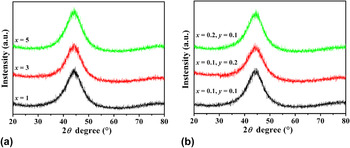
Figures 1(a) and 1(b) show the XRD patterns taken from Fe71−x Nb6B23Ni x (x = 1, 3, and 5) and (Fe1−x−y Ni x Co y )71Nb6B23 (x = 0.1, y = 0.1; x = 0.1, y = 0.2; and x = 0.2, y = 0.1) alloys, respectively. All the XRD patterns showed that only a broad diffraction halo in the 2θ range of 35–55° for the compositions with different Ni or Co contents was detected and no other sharp diffraction peaks corresponding to a crystalline phase were found. Thus, it can be concluded that fully amorphous structure was obtained for all the compositions with different Ni or Co contents. The XRD results indicated that the substitution of Fe by an appropriate amount of Ni or Co extends considerably the composition region for glass formation.
XRD patterns taken from the melt-spun Fe-based alloys. (a) Fe71−x Nb6B23Ni x (x = 1, 3, and 5); (b) (Fe1−x−y Ni x Co y )71Nb6B23 (x = 0.1, y = 0.1; x = 0.1, y = 0.2; and x = 0.2, y = 0.1).

B. GFA and thermal stability
1. The quaternary Fe–Nb–B–Ni alloys
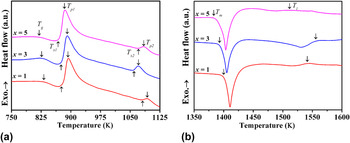
Figure 2 illustrates the DSC traces taken from the Fe71−x Nb6B23Ni x (x = 1, 3, and 5) amorphous ribbons at a constant heating rate of 40 K/min. It is observed that a distinct glass transition followed by the appearance of a supercooled liquid region and then crystallization events is clearly observed, as shown in Fig. 2(a). Two exothermic peaks are detected in the DSC thermograms for all alloys containing different Ni contents, indicating that the crystallization event takes place through a two-stage exothermic reaction. Table I summarizes the glass transition temperature T g, onset crystallization temperatures T x1 and T x2, crystallization peak temperatures T p1 and T p2, melting temperature T m, liquidus temperature T l, supercooled liquid region ∆T x , and other GFA parameters T rg and γ. As the Ni content increases from 1 to 5 at.%, the values of T g and T x1 decrease from 830 to 822 K and from 879 to 872 K, respectively, suggesting that the thermal stability is decreased with increasing Ni content. Figure 2(b) depicts the melting behavior of alloys with different Ni contents. The melting temperature, T m, decreases slightly from 1400 to 1388 K as the Ni content increases. The supercooled liquid region, ∆T x , is in the range 48–51 K, and it reaches the maximum value of 51 K for the alloys containing 5 at.% Ni.
DSC traces of the melt-spun Fe71−x Nb6B23Ni x (x = 1, 3, and 5) ribbons at a constant heating rate of 40 K/min: (a) glass transition and crystallization behaviors; and (b) melting behavior.

Thermal properties for the melt-spun Fe71−x Nb6B23Ni x and (Fe1−x−y Ni x Co y )71Nb6B23 ribbons.

2. The (Fe, Ni, Co)–Nb–B alloy system
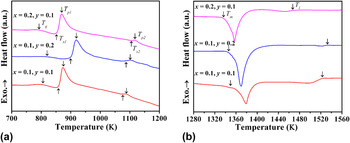
The DSC traces of the (Fe1−x−y Ni x Co y )71Nb6B23 (x = 0.1, y = 0.1; x = 0.1, y = 0.2; and x = 0.2, y = 0.1) alloys are shown in Fig. 3, and the characteristic temperatures are summarized in Table I. Similar to that in quaternary Fe–Nb–B–Ni alloys, there exist two exothermic peaks and two melting events in the DSC thermograms for all alloys containing different Ni and Co contents. This phenomenon indicates that they also undergo a two-stage crystallization event. The value of T g ranges from 792 to 818 K for the (Fe, Ni, Co)–Nb–B alloy system. For the alloys with x = 0.1 and y = 0.1, the values of T g and T x1 are 805 and 860 K, respectively. Among the three studied alloys, the (Fe0.7Ni0.1Co0.2)71Nb6B23 ribbons exhibit the highest thermal stability and largest ∆T x (=78 K), while the (Fe0.7Ni0.2Co0.1)71Nb6B23 ribbons show the lowest thermal stability and moderate ∆T x (=63 K). The T m in the (Fe, Ni, Co)–Nb–B alloy system ranges from 1335 to 1347 K, which is slightly lower than that in the Fe–Nb–B–Ni alloy system.
DSC traces of the melt-spun (Fe1−x−y Ni x Co y )71Nb6B23 (x = 0.1, y = 0.1; x = 0.1, y = 0.2; x = 0.2, y = 0.1) alloys at a constant heating rate of 40 K/min: (a) glass transition and crystallization behaviors; and (b) melting behavior.

C. Soft magnetic properties
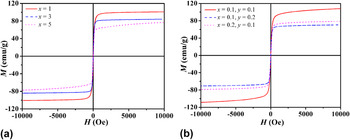
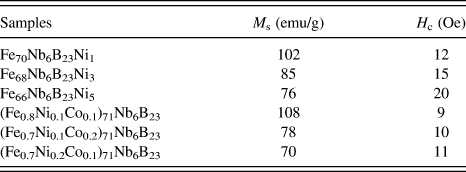
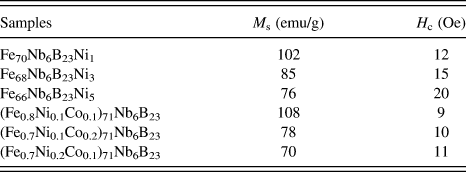
Figures 4(a) and 4(b) show magnetic hysteresis loops (M–H) taken from the Fe71−x Nb6B23Ni x (x = 1, 3, and 5) and (Fe1−x−y Ni x Co y )71Nb6B23 (x = 0.1, y = 0.1; x = 0.1, y = 0.2; and x = 0.2, y = 0.1) amorphous ribbons fabricated using the industrial grade raw materials. The saturation magnetization (M s) and coercivity (H c) of the ribbons are dependent on the alloy composition, and their values are listed in Table II. For the Fe71−x Nb6B23Ni x ribbons, as the Ni content increases from 1 to 5 at.%, the M s value decreases from 102 to 76 emu/g, and the H c value increases from 12 to 20 Oe. For the (Fe1−x−y Ni x Co y )71Nb6B23 ribbons, as the Ni or Co content increases, the M s value decreases from 108 to 70 emu/g, while the H c value increases from 9 to 11 Oe. The M s value reaches the maximum of 108 emu/g for the alloys with x = 0.1 and y = 0.1.
Magnetic hysteresis loops (M versus H) for the melt-spun ribbons at room temperature. (a) Fe71−x Nb6B23Ni x and (b) (Fe1−x−y Ni x Co y )71Nb6B23.

Magnetic properties for the melt-spun Fe71−x Nb6B23Ni x and (Fe1−x−y Ni x Co y )71Nb6B23 ribbons.
IV. DISCUSSION
A. Glass formation ability
The parameters, T rg Reference Lu, Li and Ng25 and γ, Reference Lu and Liu26 were calculated and their values are listed in Table I. For the Fe–Nb–B–Ni alloy system, although T g and T x1 decrease from 831 to 821 K and from 879 to 872 K, respectively, the extension of the supercooled liquid region, ΔT x , increases gradually from 48 to 51 K. Partial substitution of Fe by Ni makes T rg and γ to be in the range of 0.533–0.544 and 0.368–0.374, respectively. This indicates that the thermal stability decreases, while the GFA is enhanced with increasing Ni content in the Fe–Nb–B–Ni alloy system, which is in agreement with the previous study on (Fe0.5Co0.5)71−x Nb6B23+x (x = 0, 2, 3, 4, and 5) alloy systems. Reference Zhao, Dun, Man and Shen19 However, the values of T g and T x1 are found to be in the range of 792–818 and 855–896 K for the (Fe, Ni, Co)–Nb–B alloy system, respectively. The values of T rg and γ range from 0.519–0.536 and 0.369–0.382 for the alloys substituted by Ni and Co together. The supercooled liquid region, ranging from 55 to 78 K, in the (Fe, Ni, Co)–Nb–B alloy system is larger than that in the Fe–Nb–B–Ni alloy system. The (Fe, Ni, Co)–Nb–B amorphous ribbons show higher GFA and wider supercooled liquid region than that in the Fe–Nb–B–Ni system. The (Fe0.7Ni0.1Co0.2)71Nb6B23 amorphous ribbons exhibit the highest GFA with the largest ΔT x . This result is in accordance with the reported data in the literature. Reference Chang, Huang, Chen, Ge, Jiang, Nie and Jiang17,Reference Zhao, Dun, Man and Shen19,Reference Park, Kim and Eckert27 The GFA of both Fe–Nb–B–Ni and (Fe, Ni, Co)–Nb–B alloy systems is superior to that of the Fe71Nb6B23 BMG reported by Yao et al. Reference Yao, Yang, Zhang, Wang and Li15
The enhancement of GFA can be explained by the empirical criteria suggested by Inoue et al. Reference Inoue, Takeuchi and Zhang28,Reference Takeuchi and Inoue29 First, four or five components can be found in the present alloy system. On the basis of the “confusion principle” suggested by Greer, Reference Greer30 the more elements involved, the lower the chance that the alloy can select viable crystal structures, and the greater the chance of glass formation. Second, the atomic sizes of Nb, Co, Ni, Fe, and B were 0.14290, 0.12510, 0.12459, 0.12412, and 0.08200 nm, respectively. Reference Senkov and Miracle31 Thus, there is a significant difference in atomic size ratios above 12% among the main constituent elements. Third, negative heats of mixing among the main constituent elements should exist. For the Fe–Nb–B–Ni alloy system, the mixing enthalpy values of the main constituent elements for Fe–Nb, Fe–B, and Fe–Ni pairs are −16, −11, and −2 kJ/mol, whereas those of additional elements for Nb–B, Nb–Ni, and B–Ni are −27, −30, and −9 kJ/mol, Reference de Boer, Boom, Mattens, Miedema, Niessen, de Boer and Pettifor32 respectively. It can be seen that the negative mixing enthalpy of the atomic pairs between Ni–Nb and Nb–B is larger than that between Fe–Nb, Fe–B, and Fe–Ni pairs. It has been pointed out by Park et al. Reference Park, Wang, Li, Mattern, Eckert and Kim16 that the substitution of Fe by Ni is effective to modulate the atomic bonding and configuration due to a moderately negative enthalpy of mixing for Fe–Ni pairs.
For the (Fe, Ni, Co)–Nb–B alloy system, the mixing enthalpy values of the main constituent elements for Fe–Co pairs are equal to −1 kJ/mol, whereas the other constituent elements have stronger negative values (e.g., Co–Nb: −25 kJ/mol, Co–Ni: 0 kJ/mol, and Co–B: −9 kJ/mol). Reference Senkov and Miracle31 It can be seen that the negative mixing enthalpy of the Co–Nb pair is larger than that of the Fe–Nb and Fe–B pairs, while those of Fe–Ni, Fe–Co, and Co–Ni pairs exhibit a moderately negative enthalpy of mixing. It is believed that the Ni and Co addition increases the atomic packing density of the liquid structure and causes the suppression of nucleation of a crystalline phase and the difficulty of atom rearrangement. When the thermodynamic and kinetic requirements are satisfied, the key factor affecting the GFA is the existence of the impurities present in the melt. Reference Stoica, Hajlaoui, Lemoulec and Yavari14,Reference Kui, Greer and Turnbull33 Because the existence of impurities in the Fe-based alloys can act as nucleation sites for heterogeneous nucleation. An alternate approach to remove the nucleating heterogeneities is to purify the melt using the fluxing method, and this method is applied to purify Fe-based alloys in the present study. After fluxing, most oxide impurities are dissolved, deactivated or removed by the molten B2O3 fluxes. Therefore, the GFA in Fe–Nb–B–Ni and (Fe, Ni, Co)–Nb–B alloy systems is enhanced.
B. Magnetic properties
The magnetic properties including M s and H c depend on the alloy composition. As the Ni or Co content increases, the M s decreases and the H c is enhanced for both Fe–Nb–B–Ni and (Fe, Ni, Co)–Nb–B alloy systems. The Fe70Nb6B23Ni1 and (Fe0.8Ni0.1Co0.1)71Nb6B23 alloys are found to achieve the maximum M s value of 102 and 108 emu/g, respectively.
The large variations of the saturation magnetization are ascribed to the partial substitution of Fe by Ni or Co, which modify the atomic environment around the Fe atoms, thus affecting the local moment. On the basis of the Slater–Pauling curve, the substitution of Fe by Co does not change the first-neighbour structure but only the mean magnetic moment. Reference McHenry, Willard and Laughlin34 And the mean magnetic moment tends to increase in the region of low Co content. Whether the saturation magnetization enhanced or not is dependent on the alloy composition. The partial substitution of Fe by Co results in a marked enhancement of saturation magnetization in Fe–Co–Ni–Zr–B, Reference Inoue, Zhang, Itoi and Takeuchi35 Fe–Nb–B–Y–Co, Reference Park, Park, Kim, Kim and Fleury18 and Fe–Co–Ti–Zr–B Reference Han, Kim and Choi-Yim36 alloys. Wu et al. Reference Wu, Guo, Li and Liu37 found that the saturation magnetization first increases and then decreases with increasing Co content in [(Fe1−x Co x )71.2B24Y4.8]96Nb4 (x = 0.1–0.4) amorphous alloys. Yang et al. Reference Yang, Liu, Xue, Li, Dun, Zhang, Zhao and Shen38 found that saturation magnetization is decreased with increasing Ni content for the (Fe1−x Ni x )72B20Si4Nb4 alloy system.
The magnetic properties (Fig. 4) show that the coercivity increases with increasing Ni or Co content for both Fe–Nb–B–Ni and (Fe, Ni, Co)–Nb–B alloy systems. The increase of the coercivity might result from the modification of the local atomic environment and a magnetoelastic effect. Reference Park, Park, Kim, Kim and Fleury18 All the Fe–Nb–B–Ni and (Fe, Ni, Co)–Nb–B amorphous alloys showed high H c value, which is consistent with that reported in Fe69Nb6B17Y3Co5 (=310 A/m) Reference Park, Park, Kim, Kim and Fleury18 alloys. The H c value depends mostly on surface and pinning effect of magnetic domain walls. Because of surface irregularities, the H c value is proportional to the ratio of the surface roughness amplitude to the specimen thickness. This contribution to H c should be high for ribbons, because the surface after casting is not very smooth and its width is several orders of magnitude larger than the thickness. Reference Stoica, Hajlaoui, Lemoulec and Yavari14 Besides, the H c value is directly associated with the inclusions existed in the alloys. In the present study, there exists more inclusions in the industrial grade raw materials than those in the high-purity raw materials, and these inclusions would form structural inhomogeneities, which act as pinning sites for magnetic domain walls inside amorphous alloys. Reference Li, Gao, Wang, Yi and Lu22,Reference Betancourt and Landa39
From Fig. 4 and Table II, it is concluded that both Fe–Nb–B–Ni and (Fe, Ni, Co)–Nb–B alloy systems show a good combination of excellent magnetic softness and high GFA. These glassy ribbons are promising new soft magnetic materials due to their superior magnetic properties, large GFA, and low cost.
V. CONCLUSIONS
In the present study, the substitution of Fe by Ni or Co can significantly affect the GFA, thermal stability, and magnetic properties of the Fe-based multicomponent amorphous alloys. The main conclusions can be drawn:
-
(1) XRD results confirmed that the fully amorphous structure can be obtained for Fe–Nb–B–Ni and quinary (Fe, Ni, Co)–Nb–B alloy system, which extends considerably the composition range for glassy formation.
-
(2) The Ni or Co substitution for Fe enhances the GFA but decreases the thermal stability in Fe–Nb–B–Ni and (Fe, Ni, Co)–Nb–B alloy systems. For the Fe–Nb–B–Ni alloys, the thermal properties such as T g, T x1, and ΔT x were in the range of 821–831, 872–879, and 48–51 K, respectively, while the values of T g, T x1, and ΔT x were in the range of 792–818, 855–896, and 55–78 K for (Fe, Ni, Co)–Nb–B alloys. The (Fe, Ni, Co)–Nb–B alloys exhibit lower glass transition temperature and wider supercooled liquid region than that in the Fe–Nb–B–Ni alloys. The Fe66Nb6B23Ni5 and (Fe0.7Ni0.1Co0.2)71Nb6B23 alloys are found to achieve the maximum supercooled liquid region of 51 and 78 K, respectively.
-
(3) Increasing Ni or Co content is found to decrease the saturation magnetization and increase the coercivity in Fe–Nb–B–Ni and (Fe, Ni, Co)–Nb–B alloys. Minor Ni or Co substitution for Fe is benefit to gain good soft magnetic properties with high saturation magnetization and low coercivity. The (Fe0.8Ni0.1Co0.1)71Nb6B23 amorphous ribbons exhibited the best soft magnetic properties such as the high saturation magnetization of 108 emu/g and the low coercivity of 9 Oe.
ACKNOWLEDGMENTS
This work was supported by the Major State Basic Research Development Program of China (973 Program) (Grant No. 2011CB610403) and the National Natural Science Foundation of China (Grant Nos. 51071115, 51171136, 51301125, and 51401156). We also expressed our thanks to Natural Science Basic Research Plan in Shaanxi Province of China (Grant No. 2012JM6010) and Scientific Research Program Funded by Shaanxi Provincial Education Department (Grant No. 2013JK0907). One of the authors (M. Zhu) expressed their great thanks to Mr. Wei Yang in Nanchang Hangkong University and Mr. Liang Qiao in Lanzhou University for their fruitful help.