Introduction
Cancer is a powerful word which can inflict a whole range of emotions upon someone diagnosed with it. Unfortunately, recent statistics suggest that as many as one in three people will be diagnosed with cancer in his/her lifetime 1, with the incidence thought to be increasing. Approximately 50% of these people will undergo radiation treatment for the disease.2
A diagnosis of cancer brings with it incredible loss of personal identity and bodily integrity.Reference Thompson, Spanier and Vogel3 There is also the fear and anxiety that comes with the unknown. Furthermore, cancer is greatly associated with mortality,Reference Rennie4 the incidence of which is said to be one in four of those affected.1 Unfortunately, this emotional turmoil is common and an expected reaction to cancer diagnosis. The two most reported emotions associated with a cancer diagnosis are depression, followed by anxiety.Reference Van't Spiker, Trijsberg and Duivenvoorden5 Thus, the diagnosis and management of these two psychiatric disorders needs to be addressed.
Background
Anxiety and depression
According to the Online Medical Dictionary,6 anxiety is defined as:
The unpleasant emotional state consisting of psychophysiology responses to anticipation of unreal or imagined danger, ostensibly resulting from intrapsychic conflict. Psychological concomitants include feelings of impending danger, powerlessness, apprehension and tension.
To distinguish between these two terms, depression can be described as:
A mental state of depressed mood characterised by feelings of sadness, despair and discouragement. There are often feelings of low self esteem, guilt and self reproach, withdrawal from interpersonal contact and somatic problems such as eating and sleep disturbances.
Absolute definitions of mental illness cannot be made as they are subject to interpretationReference Weiner7 relative to individual cultural contexts. Nevertheless, these two definitions manage to encompass the main aspects of the two psychological disorders.
The exact incidence of anxiety and depression in cancer populations is inconsistent and reportedly ranges from 0 to 49% in literature.Reference Parle, Jones and Maguire8, Reference Nordin, Berglund and Glimelius9 Furthermore, it has been proposed that as much as 80% of psychiatric disorders go undetected and subsequently remain untreated.Reference Forcina10 This figure highlights the importance and need for the development and utilisation of psychosocial screening programmes in radiotherapy, an area historically neglected by researchers.
The implications of anxiety and depression remaining undiagnosed
Depression is potentially a co-morbid, disabling syndrome,Reference Raison and Nemeroff11 which can impede a cancer patient’s prognosis and functional status and may lead to poor adherence to treatment recommendations.Reference Massie12 Studies have demonstrated a reduced prognosis in women with breast cancer, supporting the need for further identification and study.Reference Massie12 Furthermore, depression is an expensive psychopathology and when combined with medical illness, health care costs are elevated as a result of longer hospital stays which incur monetary expense.Reference Lovejoy and Matteis13
Methodology
Research design
This study can be described as a non-randomised, cross-sectional survey of 100 eligible cancer patients—within their first 2 weeks of a radical course of radiotherapy—over the age of 18 years and with an outpatient status. A questionnaire was used to identify how the independent variables (age, diagnosis, levels of pain and adjuvant medication) correlated with the dependant variables (anxiety and depression) in an attempt to support or refute current literature. A convenience sample was used to expedite collection of data. Although this sampling method is non-probability, suggesting less representative data and even possible bias, it was deemed to be the most feasible and practical method with regard to time constraints.
Questionnaire
Section A: patient demographics
Section ‘A’ of the questionnaire aimed to gather personal, demographic data from each respondent. It contained a mixture of both open- and closed-type questions, a format frequently used by researchers to obtain both quantitative and qualitative data which is suggested to increase the validity of a study.Reference Seale and Barnard14 Three of the independent variables—age, adjuvant medication and diagnosis, were chosen to establish continuity as current findings prove to be inconsistent in these areas of research. The fourth independent variable, pain had been studied explicitly and a strong positive correlation between this and psychological dysfunction was well documented.Reference Ciaramella and Poli15 Therefore, a correlation was expected between pain and psychological status to be able to maintain some level of validity and reliability within this study. It is acknowledged by the researcher that the response to this question is subjective and relies heavily on personal interpretation of pain. Consequently, only four set answers were available to be able to provide some structure to the response and caution was applied when interpreting the research findings.
Section B: the hospital anxiety and depression (HAD) scale
Section ‘B’ of the questionnaire contained the well-established HAD scale, which consists of a series of 14 multiple choice questions, where the patient is asked to circle one of the four set answers that best describes how they are feeling. There is a maximum score of 21 for each psychological state. The scale is composed of two sub-sections: one which measures anxiety, and the other depression. A score of > 11 on either sub-section indicates significant levels of anxiety and/or depression, which is when psychological intervention may be necessary. This cut-off point has been traditionally used in literature to achieve a sensitivity of 70–95% for identifying a case of anxiety disorder or depression.16 This screening tool is quick and easy to complete in this format and is self-explanatory which was thought to raise the appeal of the questionnaire and hence increase response rate. The scale also generates numerical data to facilitate data analysis.
However, the results of the pilot study revealed that one participant felt the options in the HAD scale were inconsistent and assumed some level of anxiety and depression, which may not be present. This was seen as a fault of the scale, and manipulation of it could jeopardise the validity of the psychometric screening tool, so this point unfortunately could not be addressed but was certainly accounted for during data analysis.
Patient anonymity
The researcher made a list of the first 100 patients who adhered to the eligibility criteria. Their names where then securely stored in a log book and each questionnaire coded to preserve patient anonymity. All one hundred potential participants were approached by the researcher and encouraged to take the information home to read to fully understand the implications of the study. All completed questionnaires and consent forms were returned to a collection box placed in the waiting room of each radiotherapy treatment machine within 5 days. During data analysis, if the researcher identified any score above 11 on either sub-section of the HAD scale, the code on the questionnaire was used to reveal the patient’s identity and clinical oncologist (both stored in the log book). The researcher personally disclosed the patient’s name and score to the consultant clinical oncologist and relevant members of the team. Thus, the patient’s data was no longer anonymous. All patients had agreed to this disclosure when signing the consent form and it was verbally reiterated when the potential participants were introduced to the researcher.
Ethical considerations
Approval from the Local Research and Ethics Committee (LREC) as well as the Hospital Research and Development Committee (R&D) has to be sought before conducting any study on patients in the hospital setting. Written permission was also required from the head of department, and the consultant clinical oncologists also had to sign to consent to their patient’s participation in the research as they are responsible for their safety and welfare.
Results
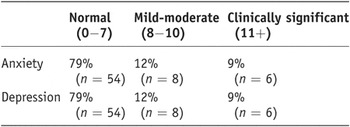
The Statistical Package for Social Sciences (SPSS) was utilised to analyse the data. The study identified six respondents with clinically significant levels of anxiety (9%) and six with depression (9%) (Table 1). However, it is important to acknowledge all patients with raised levels of anxiety and depression, even those whose symptoms are not clinically significant.Reference Matsushita, Matsushima and Maruyama17 Subsequently, the incidence of anxiety considered to exceed normal levels has been identified as 21% (n = 14) for anxiety and 21% for depression (n = 14). The large majority of respondents (79%, n = 54) expressed levels of anxiety and depression that were considered normal.
Summary of the incidence of anxiety and depression

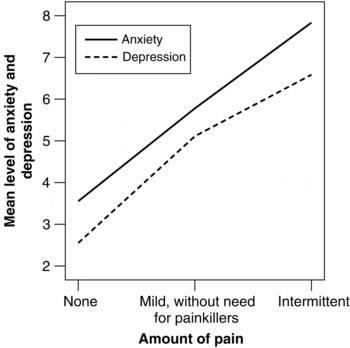
Figure 1 displays a linear correlation between anxiety and the independent variable: pain and a less linear but still positive correlation between pain and depression. Differences between the two can be observed; anxiety levels display a steady exponential increase and are greater than depression in the participants of this study. Depression only follows this linear trend until the pain becomes mild, without the need for painkillers, it then proceeds to increase at a slower rate.
Positive correlation between pain and anxiety and depression.

One tailed Spearman’s Rank Correlation Coefficient tests were performed to establish the statistical significance of the correlation between pain and anxiety and depression. The results suggest that the relationship between pain and anxiety is statistically significant (ρ = 0.406, p = 0.000). For the results to be statistically significant to a 99% confidence interval, the p value should be <0.01 and the minimum ρ value for this sample size is 0.2782 at the levels of 0.01 to be significant.Reference Attwood, Dyer and Skipworth18 The correlation between depression and pain is also statistically significant (ρ = 0.357, p = 0.001) to the level of 0.01, giving a 99% confidence interval that the results were not due to chance.
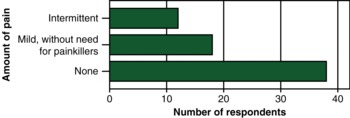
The majority of respondents [n = 38 (56%)] are experiencing no pain, as illustrated in Figure 2. There was also the option to describe the pain as ‘severe, continual/long lasting’. However, none of the respondents selected this option so it has been omitted from analysis.
The amount of pain experienced by the respondents.

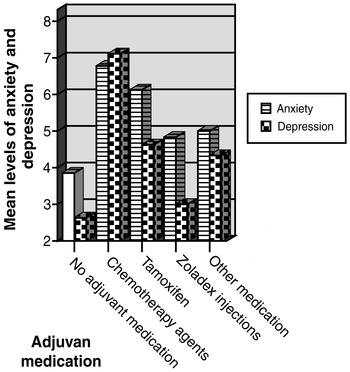
Figure 3 looks at the effect that adjuvant medication has on mean levels of anxiety and depression within the sample population. The bar graph shows that, overall, anxiety and depression levels are greater in respondents taking adjuvant medication. The graph represents a rapid mean increase in levels of anxiety after the administration of chemotherapy agents. Levels of depression were less affected. From the graph, it can be assumed that anxiety levels are generally greater than depression levels. The exception is respondents undergoing chemotherapy regimes who appear to be slightly more depressed than anxious.
The effect of adjuvant medication on psychological distress.

Most of the respondents (n = 27; 40%) were receiving no adjuvant medication. n = 18 participants (27%) did not receive any other medication. n = 9 (13%) respondents were undergoing various adjuvant chemotherapy regimes. n = 8 (12%) respondents have adjuvant tamoxifen intervention and n = 6 (9%) respondents were undergoing adjuvant zoladex injections.
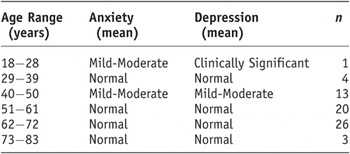
It can be seen in Table 2 that most respondents experience normal levels of anxiety and depression, regardless of their age. The exceptions are patients in the 40–50 year age range and respondents aged 18–28. Mild to moderate levels were seen in these age ranges and clinically significant levels of depression were identified in the 18–28 age range.
Relationship between age and mean levels of anxiety and depression

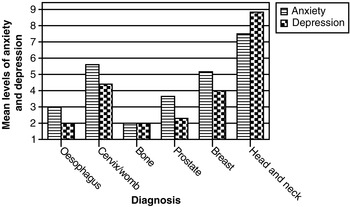
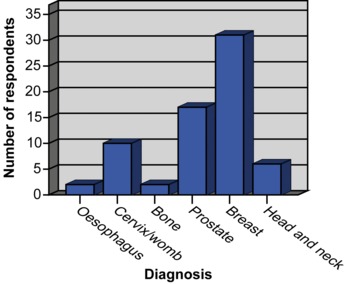
Figure 4 illustrates that the respondents with cancer of the head and neck suffer the greatest amount of anxiety and depression. Once again, respondents can be identified as suffering from more anxiety than depression; the only exception is head and neck respondents. However, Figure 5 below shows the different sample sizes for each diagnosis. As there were only four respondents with cancers of the bone and oesophagus, these two diagnoses were omitted from analysis.
The effect of diagnosis on psychological distress.

Bar graph showing respondents by diagnosis.

Discussion
The three diagnoses found to exhibit clinically significant levels of anxiety and depression, all shared two common predisposing characteristics; they all reportedly suffered the greatest amounts of pain, concurring with previous literature.Reference Ciaramella and Poli15 They also each contained patients currently undergoing adjuvant chemotherapy regimes, supporting YarbroReference Yarbro, Frooge and Goodman19 who proposed that concurrent therapy exacerbates treatment toxicity and subsequent psychological morbidity.
Pain
Pain can be debilitating, limiting normal functioning and subsequently hindering quality of life.Reference Ciaramella and Poli15, Reference Spiegel20 Subsequently, pain has been frequently linked to depression in literature,Reference Spiegel20–Reference Mcmanamy22 but interestingly, the effect of pain on levels of anxiety is not documented. On the contrary, pain was found to have a stronger correlation with anxiety than depression in this current research. This may be a consequence of the subjectivity of self-reported pain,Reference Ohayon23 in addition to overall heightened levels of anxiety exhibited by the participants of this study. Nevertheless, the correlation between anxiety, depression and pain was found to be statistically significant in this research.
Cervical participants
The other group of respondents seen to exhibit significant levels of anxiety and depression were cervical patients. These findings of this study are consistent with reports that gynaecological patients suffer more modest, but still significant, levels of anxiety and depression.Reference Zabora, Brintzenhofezoc and Curbow24 The one cervical patient who was identified as clinically anxious and depressed was in the age range of 18–28 years, concurring with Hann et al.’s Reference Hann, Baker and Denniston25 findings. It seems likely that younger cervical patients may suffer greater levels of psychological distress than those of an older age range as radiotherapy side effects such as infertility and inability to fulfil sexual relationships may be more relevant to them. However, the small sample size means caution must be applied when interpreting this finding as the sample could quite possibly be unrepresentative, giving an anomalous result.
Head and neck participants
In this study, head and neck patients were found to suffer the greatest mean levels of anxiety and depression than any other diagnosis. This finding supports previous research into this psychological area which links higher levels of anxiety and depression to patients with cancer of the head and neck.Reference Mcdaniel, Musselman and Nemeroff26
The physical side effects of radiotherapy in patients with cancer of the head and neck (xerostomia, dysphagia, mucositis and adverse pain) Reference Feber27 can be disabling and a great hindrance to quality of life. With the addition of concurrent chemotherapy, treatment toxicity is enhanced and patients are most at risk of developing psychological illness.Reference Feber27, Reference Holland28 However, only one head and neck patient underwent adjuvant chemotherapy intervention in this research, so this study is unlikely to display a true reflection of this effect.
Depression and anxiety were both raised in the head and neck respondents of this research; however, depression appeared more potent and prevailed. The reliability of the finding is maintained by Anderson and Franke Reference Anderson and Franke29 who propose that patients with cancer of the head and neck are more prone to depression than any other psychiatric disorder. It has been suggested that the majority of these patients are likely to have a history of excessive tobacco and alcohol consumption and may feel guilty for their health risk behaviours.Reference Moadel, Ostroff and Schantz30 Levels of depression were only just found to exceed anxiety for this group of patients in this research so the reliability of this finding is uncertain. Caution should be applied especially as the sample consisted of only six head and neck respondents. This limitation may also be responsible for the low incidence of clinically significant levels of anxiety and depression (n = 1) detected in this study. However, the one head and neck patient identified with clinically significant symptoms reported the highest levels of anxiety and depression in the whole study, scoring 19 for anxiety and 17 for depression. This may be an anomalous result as the lack of control over extraneous variables means their influence cannot be undermined. Nevertheless, this finding cannot be disregarded as there is always the possibility that it is valid.
Breast participants
Sixty-seven percent (n = 8/12) of respondents identified as exhibiting clinically significant levels of anxiety and depression were breast patients, supporting findings from current research.Reference Rae31
Even though tamoxifen is renowned for its numerous hormonal side effects which can induce menopausal symptoms such as depression Reference Marcus32 the use of tamoxifen did not appear to increase mean levels of depression in the breast cancer patients sampled, when compared to those taking other medication. This concurred with findings from a much larger nationwide study which found no distinct difference in levels of anxiety or depression between the experimental group (those administered tamoxifen) and the control group (those administered a placebo drug).Reference Day, Ganz and Constantino33 However, anxiety levels did appear to be heightened. Overall, only 26%(n = 8/31) of patients with breast cancer were taking adjuvant medication, subsequently, other predisposing factors must have been present to heighten levels of psychological distress in the breast cancer respondents. The psychological impact of surgical disfigurement cannot be underestimated in breast cancer patients.Reference Fox34 The subsequent feelings of loss of femininity, shame and embarrassment can induce depressive and anxious symptoms. However, this could not be determined by this research.
The six (19%) patients with breast cancer who were also undergoing adjuvant chemotherapy treatment were found to be more anxious and depressed than those undergoing any other adjuvant medication. Once again, the onset of psychological distress has been attributed to the side effects of chemotherapy—alopecia, fatigue, nausea and vomiting and loss of libido can undoubtedly hinder quality of life.Reference Pirl and Roth35
Prostate patients
Interestingly, prostate patients were found to be least at risk of developing abnormal levels of anxiety and depression, which can be attributed to the patient characteristics of this population of cancer patients. They are all male, 76% (n = 13) are aged between 62 and 72 years and 82% (n = 14) are experiencing no pain; hence, the majority of this sample were not exposed to any previously identified predisposing characteristics of psychological distress. Older prostate patients are less likely to suffer psychological disturbances than their younger counterparts.Reference Bisson, Chubb and Bennett36 This has been attributed to the greater amounts of social support available to older patients.Reference Novotny, Sloan and Guse37 However, the effect of social support cannot be established by this study as the researcher felt that the different aspects of this variable make it too complicated and subjective to be able to justify its inclusion.
Gender
Eighty-three percent (10/12) of the patients identified as being clinically anxious and/or depressed were females. Even though gender was not one of the independent variables which the researcher chose to study, it could not be ignored as its influence on levels of anxiety and depression appeared significant in this research. The exact cause of the gender divide is uncertain in literature although hormonal imbalances as well as women’s willingness to express emotions has been suggested,Reference Schultz, Beck and Stava38 making them more open to psychiatric identification.
Validity and reliability
The data from this current study is obtained from cancer patients within their first 2 weeks of radiotherapy, before the onset of physical radiation side effects, a potential precursor of psychological dysfunction.Reference Stieglis, Ranchor and Sanderman39 Thus, the cross-sectional design limits the generalisability of the results to only those patients who are within their first few weeks of radiation treatment. It may also suggest that these results only modestly reflect the suffering of patients at later stages. On the contrary it has been suggested that anxiety levels may be at their greatest at this early stage,Reference Shepherd and Fisher40 offering a possible explanation for why anxiety levels tend to exceed depression in the results of this cross-sectional survey.
As predicted, convenience sampling was a limiting factor in the results and a methodological flaw to the study. This limitation has been highlighted above when unrepresentative sample sizes were obtained making the strength and presence of correlations difficult to establish and resulted in the data presented largely as frequencies in the results section of this study as this was deemed the more representative option.
The sensitivity of the HAD scale is largely determined by the cut-off point chosen by the researcher.Reference Love, Kissane and Bloch41 However, the cut off point of 11 used in this study has been extensively utilised by other researchers using the HAD scale and is the traditional cut-off score achieving 70–95% sensitivity and an 83% reliability.Reference Bjelland, Dahl and Haug42 Patients who scored above 8 were also noted as this increases the sensitivity of the scale to 81+%.Reference Love, Kissane and Bloch41 Overall, the HAD screening tool is a reliable measure of anxiety and depression among cancer patients with good internal consistency.Reference Montazeri, Vahndanania, Ebrahimi and Jarvandi43
Conclusion
The research confirmed the under-diagnosis of anxiety and depression within cancer patients in their first 2 weeks of a radical course of radiotherapy. It also identified specific patient characteristics which make them more at risk of developing these psychiatric disorders—breast diagnosis, adjuvant chemotherapy regimes, pain and age range 40–50 years. Pain, in particular, was found to be a significant precursor to the development of such disorders. However, as with all psychological research, extraneous variables can impact heavily on the findings as they prove difficult for the researcher to identify and thus control.
The study can be considered a pilot on which to base future research as it has identified many areas which require further study. Further large-scale research with similar aims and objectives would be necessary to confirm the findings of this small-scale research and their subsequent generalisability, particularly the findings suggesting that patients with cancer of the cervix and head and neck may also be at high risk of developing psychological dysfunction. Overall, the results highlight the efficacy of psychiatric screening and its urgent utility required. This identification can be used to facilitate future screening for these patients.