Introduction
Unemployment in older age is a great concern for policy makers and individuals. As chances of re-employment are decreasing with age, some policies facilitate entry to retirement to withdraw older unemployed persons from the labour market. Particularly in times of recession, older workers can be pushed from the labour market in cases of mass unemployment and closures of companies. However, the government could also encourage entry into retirement through attractive unemployment benefits, disability pensions or early retirement schemes (Ebbinghaus Reference Ebbinghaus2006; Kyyrä Reference Kyyrä2015; Tatsiramos Reference Tatsiramos2010). The withdrawal of older jobless persons then serves as a way to disburden social expenditure in the short term. Population ageing and fiscal sustainability puts this practice under scrutiny. Apart from the macro-economic implications, the question remains whether unemployment disadvantages are eliminated by retirement. On the one hand, unemployed persons are no longer under pressure to fit the social norm of working. On the other hand, they are also deprived of employment-related benefits or have to accept exiting the labour market with less accumulated pension wealth.
The short- and long-term negative effects of unemployment, also known as scarring effects, are well-known in the literature. Researchers focused mostly on youth or the mid-aged population to show that scarring effects lead to a multitude of disadvantages during the working life. However, not much is known about whether scarring effects of unemployment extend beyond retirement. This is particularly important to determine if the disadvantages of careers influence the quality of retirement. Some studies agree that retirement in general leads to improvements in subjective wellbeing. We test if this hypothesis also applies to those who faced unemployment and inactivity before their retirement.
In particular, our study investigates if retiring is experienced differently by persons who have been employed, unemployed or inactive before retirement. Therefore, we use two waves of the Survey of Health, Ageing and Retirement in Europe (SHARE) and follow individuals through the retirement transition. We extend the work of Hetschko, Knabe and Schöb (Reference Hetschko, Knabe and Schöb2014), who applied a similar research design with data from the German Socio-Economic Panel (SOEP). However, SHARE observes more than one country and we can draw larger conclusions for European older persons. We also include the reasons for unemployment and hence can address endogeneity of unemployment. This might be of importance in the light of different pathways to retirement. Additionally, we look on economic inactivity before retirement, which is also often neglected in the study of retirement transitions. The comparison between unemployment and inactivity could indicate under which circumstances joblessness is a harmful state. The paper proceeds as follows. Based on existing evidence, we develop two hypotheses about the changes in life satisfaction of the formerly unemployed. First, we argue why scarring effects could be relevant in retirement. Second, we provide current theoretical and empirical explanations why the retirement transition could be perceived differently on the basis of the pre-retirement labour market situation. In the section thereafter, we present our data and analytical strategy. We then display the empirical results and end the paper with a discussion about the results and the implication to further research.
Scarring effects of unemployment and wellbeing
The first strand of research relevant for our research question is focusing on the scarring effects of trauma and negative life events. It suggests that negative events extend their consequences well beyond the life phase in which the event occurs. This notion is closely related to the theory of cumulative disadvantages, which assumes that early disadvantages will have a long-term irreversible negative effect across the lifecourse (Arulampalam, Gregg and Gregory Reference Arulampalam, Gregg and Gregory2001; Dannefer Reference Dannefer1987; DiPrete and Eirich Reference DiPrete and Eirich2006; Merton Reference Merton1988). Following this assumption, initial disadvantage prevents access to future resources and therefore leads to inequalities between individuals. This concept has been widely applied to unemployment, because (especially involuntary) unemployment could be a break in a career, possibly increasing the risk of future unemployment (Brandt and Hank Reference Brandt and Hank2014; Chauvel Reference Chauvel2010; Ellwood Reference Ellwood, Freeman and Wise1982), downward job or income mobility (Arulampalam Reference Arulampalam2001; Chauvel and Schröder Reference Chauvel and Schröder2014; Gangl Reference Gangl2006) and stigmatisation or social exclusion (Blau, Petrucci and McClendon Reference Blau, Petrucci and McClendon2013). According to this literature, unemployment scarring should be mainly relevant in the working ages, because unemployment decreases future employment possibilities by stigmatising and signalling low skills and productivity to potential employers. A consequence could be re-employment in under-qualified jobs with wage penalties. These disadvantages could be accumulating over time. Hence, unemployment and associated re-employment difficulties bear the risk of employment-related monetary disadvantages in the long run. Further, unemployment also has negative impact on health and subjective wellbeing. Numerous studies have demonstrated the detrimental effects of unemployment on physical and mental health (Alavinia and Burdorf Reference Alavinia and Burdorf2008; Berchick et al. Reference Berchick, Gallo, Maralani and Kasl2012; Clark and Oswald Reference Clark and Oswald1994; Daly and Delaney Reference Daly and Delaney2013; Gallo et al. Reference Gallo, Bradley, Dubin, Jones, Falba, Teng and Kasl2006; Jefferis et al. Reference Jefferis, Nazareth, Marston, Moreno-Kustner, Ángel Bellón, Svab, Rotar, Geerlings, Xavier, Goncalves-Pereira, Vicente, Saldivia, Aluoja, Kalda and King2011; Mandemakers and Monden Reference Mandemakers and Monden2013; Strandh et al. Reference Strandh, Winefield, Nilsson and Hammarström2014). Firstly, this could be a result of the immediate income loss or scarring-related wage penalty. On the other hand, non-monetary disadvantages like loss of social network, stigmatisation or loss of identity can diminish wellbeing as well. Prior research revealed negative effects of unemployment on wellbeing proxied by life satisfaction, depression or happiness (Abolhassani and Alessie Reference Abolhassani and Alessie2013; Clark, Georgellis and Sanfey Reference Clark, Georgellis and Sanfey2001; Riumallo-Herl et al. Reference Riumallo-Herl, Basu, Stuckler, Courtin and Avendano2014; Winkelmann and Winkelmann Reference Winkelmann and Winkelmann1998). In several studies, this effect was still persistent even if the respondents overcame the situation of unemployment and were re-employed (Clark, Georgellis and Sanfey Reference Clark, Georgellis and Sanfey2001; Strandh et al. Reference Strandh, Winefield, Nilsson and Hammarström2014). These negative consequences equal a true scarring effect, because it cannot be reversed and could possibly cumulate over time.
In line with the theory of scarring effects and cumulative disadvantages, negative effects of unemployment are reinforced with multiple periods of unemployment and extend beyond working age, as they increase prevalence of depression and anxiety in retirement (Zenger et al. Reference Zenger, Brähler, Berth and Stöbel-Richter2011). While future job prospects might not be relevant for the subjective wellbeing of the older population, an unemployment scar might lead to both monetary and non-monetary disadvantages. First, disadvantages in pension accumulation might affect level of living in retirement. Second, unemployment experiences are deviating from the social norm of work, which provides social status, identity and social participation (van der Noordt et al. Reference van der Noordt, IJzelenberg, Droomers and Proper2014).
The effects of the transition to retirement should differ with regard to the reasons for unemployment, specifically if one retires from voluntarily chosen unemployment compared to involuntary unemployment. Here, studies are scarce although several have investigated the wellbeing effects of voluntarily chosen retirement compared to forced retirement. Involuntary retirement is associated with lower wellbeing levels in two studies of the SOEP (Abolhassani and Alessie Reference Abolhassani and Alessie2013; Bonsang and Klein Reference Bonsang and Klein2012), with the second study including unemployed persons with involuntary retirement, but both studies come to the same conclusions. Data of the United States Health and Retirement Study show that retirees forced to retire display lower wellbeing compared to voluntarily retiring persons (Bender Reference Bender2012). Therefore, we first hypothesise that the wellbeing in retirement of unemployed persons will be lower compared to the wellbeing of retired, formerly employed persons.
The beneficial effects of the transition to retirement
The wellbeing effect of the retirement transition has been under scrutiny for a long time in ageing research. Several competing theories are employed to analyse the transition to retirement and its effect on wellbeing. Role theory assumes that social status is connected with a role that defines the socially normalised behaviour of the role owner (George Reference George1993). According to role theory, the transition to retirement might have negative effects for the individual. It assumes that the loss of the worker role, and therewith connected roles as provider and professional, decreases social status and impacts identity. Upon retirement, the individual takes up a new role, which could be a substitution for the lost role. However, as a retiree, a decrease in status could be anticipated (Wang Reference Wang2007). Additionally, the future role is unknown and unclear, which creates uncertainty and hence decreases subjective wellbeing. On the other hand, for persons who deviate from the social norm of work, like the unemployed, the entry to retirement means a return to the mainstream role among age peers and might trigger an increase in subjective wellbeing.
Furthermore, continuity theory is often applied when analysing the retirement transition (Atchley Reference Atchley1989). Continuity theory is at first concerned with the accommodation of change and concentrates on the adjustment process that follows retirement (Atchley Reference Atchley1989; Wang Reference Wang2007). It claims that one's identity and self-perception is quite constant and that individuals will try to maintain similar structures and a similar lifestyle compared to the time before retirement. Therefore, continuity theory projects that adjustment to retirement will lead to maintenance of psychological wellbeing. Only maladjustment can impair wellbeing after retirement. The third approach that is often called upon is the lifecourse theory. Originating in child development studies, it assumes that transitions in life depend on the ‘historical time and place, the timing of lives, linked or interdependent lives and human agency’ (Elder Reference Elder1998: 4). For the retirement transition, this means that the transition will depend on the lifecourse context of the individual, especially earlier transitions in childhood and adolescence (Elder, Kirkpatrick Johnson and Crosnoe Reference Elder, Kirkpatrick Johnson, Crosnoe, Mortimer and Shanahan2003). Foremost, the success of transition could be dependent on the employment history, the marital situation and the timing of the transition (Kim and Moen Reference Kim and Moen2002). Moen, Kim and Hofmeister (Reference Moen, Kim and Hofmeister2001) further stressed the gendered context of the retirement transition as employment history varies substantially for men and women of older cohorts.
The following studies put these theories to the test and find differential effects of retirement with regard to gender, labour market status and retirement timing. Whereas men seem to benefit from the retirement transition in terms of subjective wellbeing, women did not show statistically significant increases in wellbeing after retiring (Antonova et al. Reference Antonova, Belloni, Meschi and Pasini2015; Kim and Moen Reference Kim and Moen2002). The strongest increase was found for men with particularly low wellbeing prior to retirement. Kim and Moen (Reference Kim and Moen2002) did not find evidence that linked lives, i.e. conjoint employment status of a couple, is associated with changes of wellbeing in the transition to retirement. Pinquart and Schindler (Reference Pinquart and Schindler2007) identified an overall increase in life satisfaction, which varies by pre-retirement trajectories. An increase in wellbeing was associated with being unemployed before retirement. With a similar model, Wang (Reference Wang2007) found that early retired persons first experience a decrease in wellbeing, but an increase after some time. In sum, these studies show that the transition to retirement is rather an adaptive process with non-linear patterns and with different trajectories for different groups (Pinquart and Schindler Reference Pinquart and Schindler2007; Wang Reference Wang2007). They show that role theory, continuity theory and lifecourse theory all have their merit in explaining sub-group behaviour. Persons, who leave the labour market under unfavourable conditions, express an increase in wellbeing, although it might not be stable. Persons, who are prepared for the retirement transition, experience largely no change in wellbeing. Therefore, it is important to make a distinction between groups of retirees.
While many studies show that entry to retirement is largely beneficial for individual wellbeing, most studies do not control for the endogeneity of retirement, hence whether retirement is anticipated and therefore appreciated. However, a short list of studies uses an Instrumental Variables approach to control for endogeneity of retirement and they confirm that retirement increases financial and subjective wellbeing of older persons, controlling for legal retirement incentives (Fonseca et al. Reference Fonseca, Kapteyn, Lee, Zamarro and Feeney2014; Latif Reference Latif2011; Mokyr Horner Reference Mokyr Horner2014). While the discussed evidence suggests that retirement is a beneficial process, few studies focus on the unemployed as a specific group. As outlined in the introduction, our study relies on a similar strategy as Hetschko, Knabe and Schöb (Reference Hetschko, Knabe and Schöb2014). The authors argued, in line with role theory, that loss of social role and identity through unemployment cause a reduction in life satisfaction. They assumed that the return to a conformal social role by retirement decreases disadvantages of subjective wellbeing. The authors found a significant increase in life satisfaction upon retirement for both retiring groups, formerly employed and formerly unemployed. Nevertheless, the initial life satisfaction levels of the formerly unemployed are lower compared to the formerly employed person and stay lower. We therefore hypothesise that the transition to retirement is beneficial for unemployed persons, and wellbeing increases after transitioning to retirement of formerly unemployed persons.
Negative effects of labour market inactivity
We discussed the negative effects of unemployment and involuntary retirement for subjective wellbeing. In this study, we also include another jobless population which could be affected by early or forced retirement. Labour market inactivity includes all persons who are not classified as employed or unemployed (Eurostat 1999). We will consider home-makers and persons on sick or disability leave as labour market inactive persons and exclude retirees from this definition. Labour market inactivity is not equal to unemployment in general, because inactivity could be desired. Nonetheless, having a job is a major source of identity formation, social status, participation in society and access to material resources and, therefore, crucial for wellbeing (Hagler et al. Reference Hagler, Hamby, Grych and Banyard2015; van der Noordt et al. Reference van der Noordt, IJzelenberg, Droomers and Proper2014). Thus, joblessness might also be negative for wellbeing outside the active labour force. Erlinghagen and Knuth (Reference Erlinghagen and Knuth2010) emphasised that the study of labour market inactive persons allows more precise conclusions about the effects of voluntary and involuntary joblessness to be drawn. Following this argument, persons who label themselves not working due to permanent disability or sickness (and have been employed at least once in their life) are also included in the analyses. We assume that joblessness plays a role in lower wellbeing in this group of respondents, even when health is controlled for. Economically inactive persons are, like unemployed persons, excluded from the labour market, and this could be associated with stigmatisation or identity incompleteness. Nevertheless, only a few studies have investigated the negative effects of labour market inactivity on subjective wellbeing. Economic inactivity besides unemployment had a negative impact on the mental health of prime-age workers in five countries (Organisation for Economic Co-operation and Development 2008). Economically inactive and disabled men and women as well as female home-makers reported lower wellbeing levels compared with employed men and women (Stam et al. Reference Stam, Sieben, Verbakel and de Graaf2015). However, two studies examining (mostly female) home-makers and their happiness and life satisfaction showed higher happiness levels of home-makers compared to employed women (Mikucka Reference Mikucka2011; Treas, van der Lippe and ChloeTai Reference Treas, van der Lippe and ChloeTai2011). It is unclear in these latter cross-sectional studies, however, whether women have worked prior to their current status as a home-maker, and there might be a selection bias among home-makers (Mikucka Reference Mikucka2011).
Since there is scant research on this group, making assumptions about their retirement transition is not straightforward. On one hand, the evidence suggested that the inactive display lower health and subjective wellbeing, very much like the unemployed. On the other hand, inactive persons are not actively seeking employment like the unemployed and hence are probably detached from the labour market. The transition from inactivity to retirement would then be no change in daily habits or self-perception. Following these studies with mixed evidence, wellbeing changes of economically inactive persons in the transition to retirement will be investigated without specific assumptions.
Method
Data
The SHARE is a longitudinal survey examining the lives of the older European population at age 50+ and has been described in detail elsewhere (Börsch-Supan and Jürges Reference Börsch-Supan and Jürges2005). Since 2004, six waves have been published with more than 85,000 respondents and their partners in 19 countries. This study is following persons who participated in Wave 2 (2006/07) and Wave 4 (2011/12).Footnote 1 To provide answers to the research question postulated, a very specific sample was retained. Individuals who categorised themselves as in employment or non-employment (excluding retirement) at the first observed period (Wave 2) and who categorised themselves as retired at Wave 4 were included in the analysis. Thus, all individuals who were and stayed retired, employed or non-employed to begin with, i.e. did not undergo a transition from labour market to retirement, were excluded. Only persons with an employment record were included. Hence, even the inactive persons in Wave 2 can retire and have pension claims. The panel structure of the data-set allows it to obtain data before and after retirement of the respondents. For the present analysis, the sample consists of 2,163 participants with non-missing information aged between 50 and 70 (at Wave 2) from 12 different countries of the SHARE survey. The remainder of the section will introduce and describe the dependent and independent variables.
Life satisfaction Footnote 2 was used as dependent variable and mirrors the general evaluative aspect of wellbeing. On an 11-point scale, where 0 is the lowest and 10 the most positive value, the respondent is asked to evaluate his or her life satisfaction in general without a specific time-frame. Labour market status before retirement is constructed via the self-assessed ‘current job situation’ (retirement, employment or self-employment, unemployment (and looking for work), permanently sickness/disability, home-maker). Consequently, retirement was also self-reported. Results were overall stable when retirement was defined by pension receipt. Participants who have never worked have been excluded from the sample.
We include several control variables that have been shown to be related to subjective wellbeing as well as the experience of unemployment or inactivity. Based on the literature review, we include gender and education as time-invariant variables. Women typically show lower wellbeing scores, as well as lower-educated persons (Kim and Moen Reference Kim and Moen2002; Mandemakers and Monden Reference Mandemakers and Monden2013). In the data, educational levels are recoded from the International Standard Classification of Education 97 to low (no education, primary, lower secondary), medium (upper secondary, post-secondary) and high (first- and second-stage tertiary). Since we study change, we also obtain time-variant control variables at t = 0 and t = 1. These are financial resources, chronic conditions and partnership. All three variables have been shown to be associated with wellbeing levels (e.g. Gallo et al. Reference Gallo, Bradley, Dubin, Jones, Falba, Teng and Kasl2006; Moen, Kim and Hofmeister Reference Moen, Kim and Hofmeister2001; Riumallo-Herl et al. Reference Riumallo-Herl, Basu, Stuckler, Courtin and Avendano2014; Schröder Reference Schröder2013). Unlike prior studies, we do not only include household income as type of financial resources, but also household wealth, since wealth is a more stable indicator of accumulated resources. Household wealth is composed of real and financial assets minus mortgage and liabilities. Real assets comprise the value of the main residence, other real estate, own business and cars. Financial assets are included in the form of bank accounts, bonds, stocks, mutual funds, retirement accounts, savings and life insurance. The values are purchasing power parity- (PPP) adjusted to the levels of interview year. Household income is the sum of all individual net incomes in the household, including benefits, rent and assets. We include household income in its logarithmised, equivalised and PPP-adjusted version. Chronic conditions Footnote 3 is a proxy for objective health. It is included because it is both related to life satisfaction and joblessness. We generated the variable by summing the number of chronic conditions for which a respondent has a diagnosis. The items to choose from are heart attack, hypertension, high cholesterol, stroke, diabetes, chronic lung disease, arthritis, cancer, ulcer, Parkinson disease, cataracts, hip fractures, other fractures, Alzheimer's disease (or dementia) or another condition.Footnote 4 The same items are retained for both waves. Living with partner shows whether a partner, married or co-habitating, is present in the household.
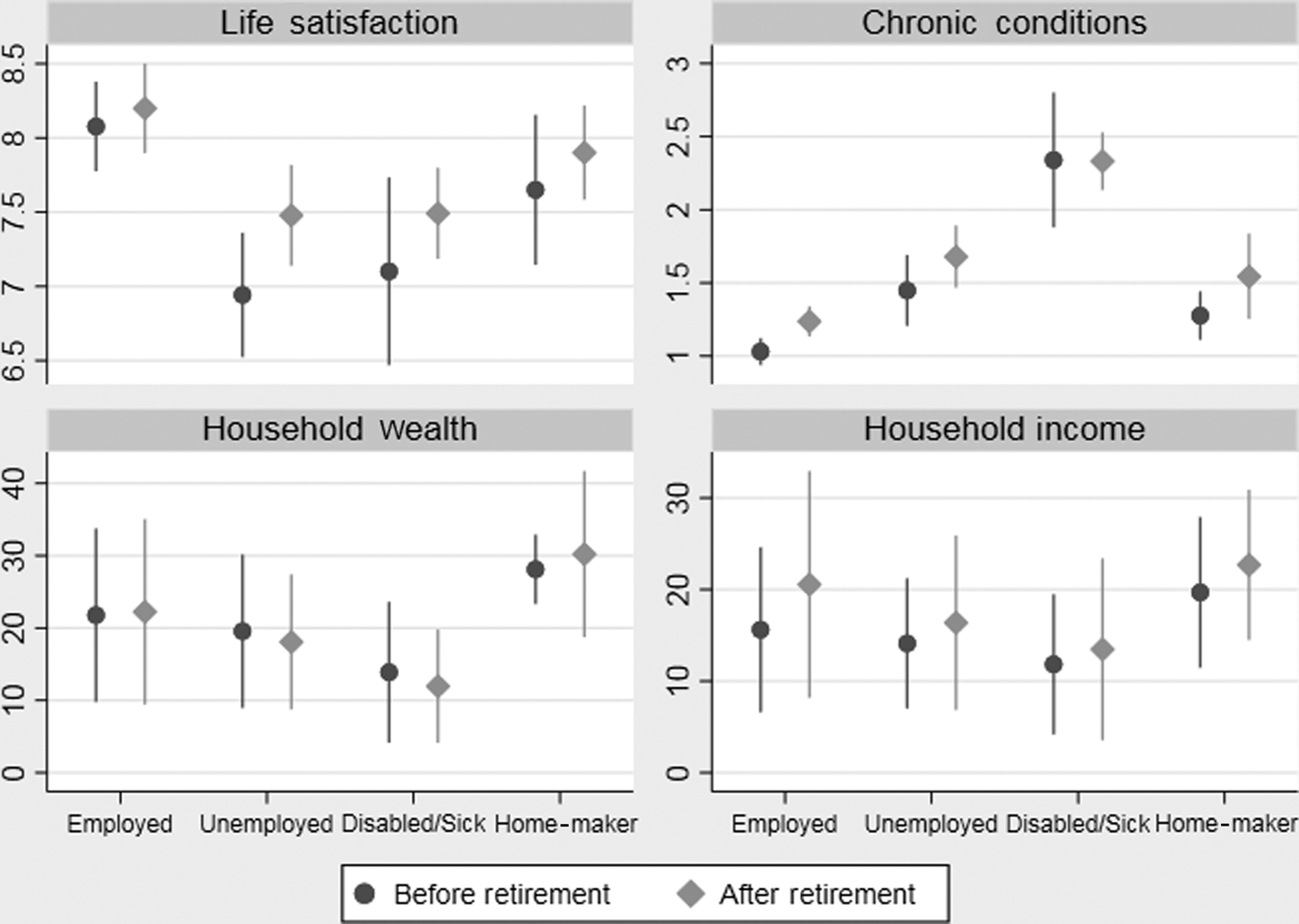
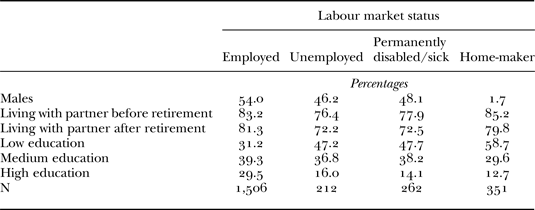
Means and percentages in the analyses are shown in Figure 1 and Table 1. They are pooled for the 12 countries (Austria, Germany, Sweden, The Netherlands, Spain, Italy, France, Denmark, Switzerland, Belgium, Czech Republic and Poland). In Figure 1 we compare the change in means of the dependent and control variables at the first observation t = 0 (Wave 2) and at the following observation t = 1 (Wave 4), when respondents had already retired. The first descriptive results show that life satisfaction of the formerly non-employed is lower than that of employed persons before and after retirement. Secondly, life satisfaction is higher for all groups after retirement. Confirming earlier studies, life satisfaction is lowest for unemployed persons before retirement, but increases the most.
Changes of different indicators by labour market status before and after retirement.

Descriptive statistics by employment status

The number of reported chronic conditions is the highest for persons that are permanently disabled/sick and for the unemployed. These groups exhibit higher health disadvantage compared to employed and home-makers. In all other groups, this number is higher after retirement. The mean value of household wealth and income is highest for employed persons and home-makers and lowest in the group of respondents that identify themselves as permanently disabled/sick. This could be due to failure to accumulate wealth because of lack of regular income or higher spending on health costs. Household income has increased for all groups upon retirement. Regarding the distribution of educational levels, fewer employed persons have a lower educational degree compared to non-employees, where almost 60 per cent of the older home-makers only have a primary school certificate. Next to higher risk of non-employment of lower-educated persons, this could be a cohort effect because females belonging to the 1920s to 1950s cohorts probably received less schooling than their male peers. In addition, the groups of unemployed persons, disabled persons and home-makers have the lowest share of higher educational levels. Women constitute the larger share of the non-employed group, and almost all home-makers are women. Economically inactive persons initially express lower wellbeing than their employed peers, and this difference remains stable after retirement.
Analytical strategy
In a first step, we determine the wellbeing disadvantage of non-employed persons before and after retirement. To assess the difference in life satisfaction between employed and non-employed and across time, we perform two linear ordinary least squares regressions using specification Equation (1):
 $$\eqalign{LS_{it} & = \,\propto + \beta _1UNEM_{i,t = 0} + \beta _2DIS_{i,t = 0} + \beta _3HOME_{i,t = 0} \cr & \quad + {\delta} ^{\prime}X_{it} + {\varepsilon} ^{\prime}Y_i + c_j\; + \varepsilon _i.}$$
Our specification includes on the left-hand side of the equation LS it, which is life satisfaction of the respondent i at time t. On the right side, dummy variables indicate whether a person has been unemployed or labour market inactive before retirement compared to employment. Time-variant variables are subsumed under the vector X it and refer to financial resources, health level and partnership at time t. Vector Y i combines time-invariant information on gender and educational level. Lastly, c j denotes the country fixed effects and εi the individual error term.
Although Equation (1) offers insights about the average differences of life satisfaction between labour market statuses, the estimates are probably influenced by individual and country-level heterogeneity. A potential bias of reporting heterogeneity (Kok et al. Reference Kok, Avendano, Bado d'Uva and Mackenbach2012) can be addressed with a First Difference (FD) approach since we dispose of two waves of a panel study. In a FD specification, only individual change of the outcome y between t and t − 1 is observed, thus before and after retirement. The advantage of this procedure is capturing the transition to retirement and eliminating unobserved heterogeneity of life satisfaction levels. To analyse the change of subjective wellbeing of the non-employed, we employ the same dummy variables which show the change of wellbeing for each non-employment group. We model the change upon retirement by subtracting life satisfaction at t = 0 (employed or non-employed) from life satisfaction at t = 1 (retired). Additionally, we need to control for changes that might affect wellbeing between these two time-points, e.g. worsening health or income situation. Therefore, we control for any changes in wealth, income, marital status and health upon retirement. The FD transformation requires time-variant variables to be present in deltas (i.e. changes). This concerns the dependent variable, as well as household wealth, household income and chronic conditions. The delta of living with a partner indicates change in two directions. Either a person reported being single in the first observation and reported being in a partnership in the second observation or the other way around. The latter was experienced in 99 cases, where the first was experienced in 26 cases. Therefore, ∆living with a partner has been recoded to a dummy equal to 1 if a person left the household and equal to 0 if no change occurred or a partner joined the household. Time-invariant variables are differenced out.
 $$\eqalign{\Delta LS_i & = \, \propto + \beta _1UNEM_{i,t = 0} + \beta _2DIS_{i,t = 0} + \beta _3HOME_{i,t = 0} + {\delta} ^{\prime}\Delta X_i \cr & \quad + \Delta v_i.}$$
Equation (2) is therefore the first differenced equivalent of (1). The change in life satisfaction of respondent i is ΔLS i. On the right side, the constant ∝ captures the trend effect of the change to retirement. The dummy variables of non-employment are included to identify differences between labour market statuses, differenced time-variant variables are subsumed under the vector ΔX i and Δv i is now the error term. In order to achieve more robust results, we include some configurations of Equation (2). First, we differentiate between reasons of non-employment to determine potential endogeneity of being jobless. Secondly, since Equation (2) cannot include country fixed effects, we apply interaction effects to obtain information on country variation of the results.
Results
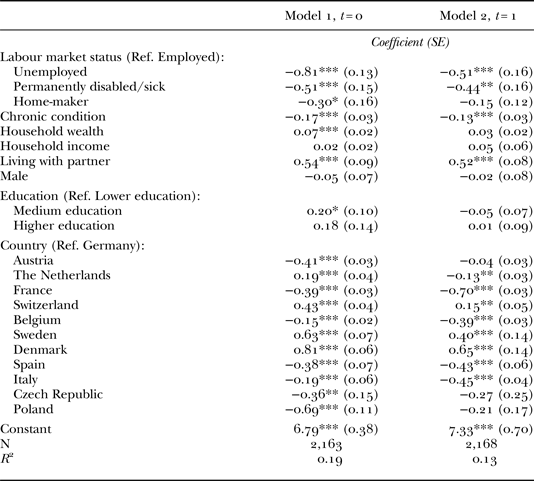
In Table 2, we contrast the estimates of life satisfaction before (t = 0) and after retirement (t = 1). We include the labour market status and all time-variant and time- invariant control variables as well as country indicators. This way we can control for the major confounding factors of subjective wellbeing. The results of Models 1 and 2 show a strong disadvantage in life satisfaction for non-employed individuals before and after retirement. The highest disadvantage in life satisfaction, but also the strongest reduction, is displayed by unemployed respondents. Although the coefficients are almost halved in the second model, unemployed persons experience the largest negative coefficient among the non-employed. Individuals who are sick or disabled also report significantly lower life satisfaction than employed, however, not lower than for unemployed persons. Earlier research was not able to find consistent effects of inactivity for subjective wellbeing. Models 1 and 2 suggest that this could be due to very different reasons for being inactive. They also reiterate results from past research in that life satisfaction levels are quite different for persons with health problems, married or co-habitating partners, educational and financial resources. We further observe considerable level differences between countries. The results show a clear disadvantage of being non-employed before retirement, but we can only obtain average estimates. In Table 3, we apply the FD analyses (Model 3 to 7) to evaluate the change in life satisfaction that happened in the retirement transition itself.
Ordinary least squares analyses of disadvantages in life satisfaction before and after retirement
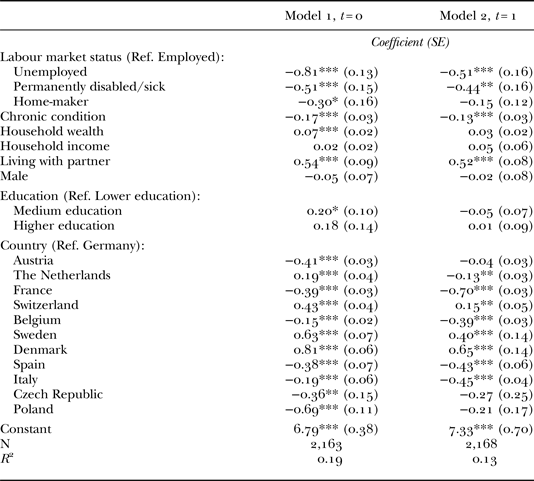
Notes: t = 0: before retirement. t = 1: after retirement. SE: robust standard errors clustered by country. Ref.: reference category.
Significance levels: * p < 0.10, ** p < 0.05, *** p < 0.01.
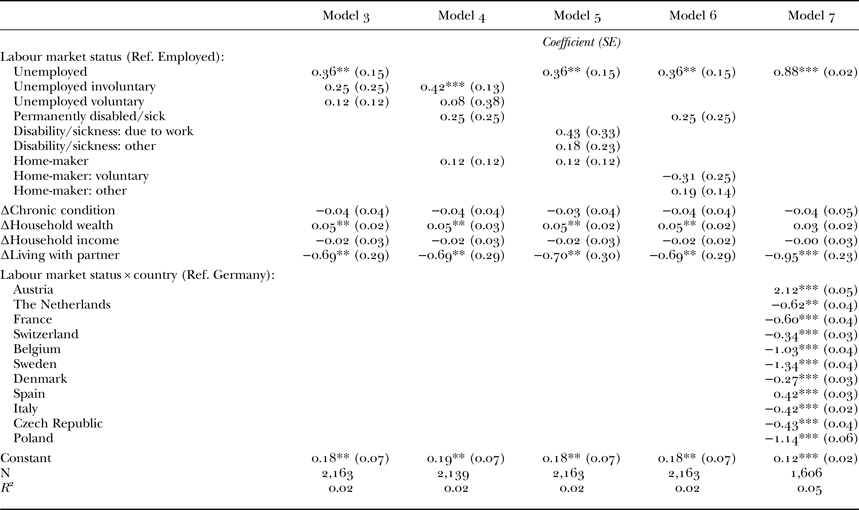
First Difference analysis of change in life satisfaction upon retirement

Notes: SE: robust standard errors clustered by country. Ref.: reference category. Model 7 also includes main effects of country.
Significance levels: ** p < 0.05, *** p < 0.01.
For the same respondents, Model 3 shows the change in life satisfaction between the two observations. The model includes only the time-variant control variables, since gender, education and country have been differenced out. In Model 3, we assess if life satisfaction is changing upon retirement or if disadvantages of the formerly non-employed are scarring into the retirement. In fact, formerly unemployed persons experience a significant increase in life satisfaction if compared to the formerly employed when both retire. This effect size of 0.36 is very similar to the increase in life satisfaction of formerly unemployed in Hetschko, Knabe and Schöb (Reference Hetschko, Knabe and Schöb2014). The labour market inactive home-makers and jobless seniors due to disability or sickness, however, show non-significant but positive coefficients. So while entering retirement decreases the individual disadvantage of the formerly unemployed, retiring is not leading to significant changes of wellbeing for the inactive. The change in time-variant variables has no significant effect on the change in wellbeing, except for a slight increase in wealth and a change of living with partner. The loss of a partner (possibly due to mortality or separation) leads to a large drop in life satisfaction. Even though the descriptive results demonstrate minor changes of all time-variant variables, only the loss of a partner has a pronounced effect on subjective wellbeing. This underlines earlier evidence that subjective wellbeing is strongly related to partnership status and that widowhood leads to a significant drop in wellbeing (see also Clark et al. Reference Clark, Diener, Georgellis and Lucas2008).
Robustness of the results
Models 1 and 2 showed that unemployed persons report lower wellbeing compared to employed persons before and after retirement. However, they also experience significantly higher wellbeing gains than other groups. Since we cannot rule out potential endogeneity – unemployment could be voluntary or involuntary and voluntarily unemployed could differ significantly from involuntarily unemployed persons – we split the group of unemployed into involuntary unemployment (‘closing of the workplace’, ‘laid off’ or ‘temporary job finished’) and voluntary unemployment (‘voluntarily resigned’, ‘mutual agreement’ or ‘moved town’) to approach unemployment as an exogenous event (Schröder Reference Schröder2013). Model 4 shows the same change effects as Model 3, with the only difference being the split in reasons of unemployment. The differentiation of reasons of unemployment matters in the magnitude of the effect, but not in the direction. The involuntarily unemployed express an even higher increase in life satisfaction. The effect of being voluntarily unemployed is not significant and very small, indicating that the change to retirement is not affecting those who left the labour market on purpose. Although, the other results are significant and plausible, caution is warranted here as the cell sizes of voluntary unemployment (43 cases) and involuntary unemployment (139 cases) are quite small. The attempt to identify causes of disability and reasons for being a home-maker leads to small cell sizes also, as these variables are not available for all inactive persons in this sample. In 72 of 190 cases, work is the reason for a disability or permanent sickness. The separation into work-induced disability and other shows similar-sized coefficients as for the unemployed, but they are not significant. Home-makers are a highly selective group. They are almost exclusively females and being a home-maker depends as well on the personal traits and on the financial and health situation. To control for this partially, home-makers are grouped into voluntary home-makers if the respondent replied being a home-maker due to duties as a care-giver or having enough family income to stay out of the labour market (50 cases) and other (301 cases). Although numbers are low, for completeness, models were also run with these samples. Voluntary home-makers show a non-significant decrease in life satisfaction after retirement, but home-makers, due to health issues, displacement or other, show a non-significant increase in life satisfaction. Models 4–6 validate that change of wellbeing is only relevant for persons that were unemployed before retirement. Hence, the next robustness test includes only persons retiring from unemployment.
Like individual-level difference, country-level effects are eliminated by the first differencing and hence the increase in life satisfaction of the formerly unemployed could vary among countries. Although Models 1 and 2 include country fixed effects, it could be the case that the change in wellbeing varies in magnitude or even direction and hence impacts the average means. Multi-level regression models could be used to account for country variation; however, they will be probably biased due to the small N on the country level as well as the non-random selection of countries. As the individual-level and country-level samples are very small, a multi-level regression is not recommended here. However, Möhring (Reference Möhring2015) demonstrated how the advantages of multi-level models to retrieve a random intercept can be easily replicated with micro–macro interactions that control for country-level heterogeneity without violating the independency assumption. Therefore, in Model 7, Equation (2) is enhanced by interactions of the formerly unemployed with country. This way we can obtain country differences in the FD model. The interpretation of the country variation requires the addition of the main effect of being unemployed and the interaction between country and being unemployed. The coefficients show that in the majority of countries the change in life satisfaction of the formerly unemployed point in the same direction. This means that, although to a varying degree, the change is perceived positively in eight countries. This is not the case in Sweden, Belgium and Poland. Here retirement of unemployed persons is not related to wellbeing gains.
Discussion
Explanation of findings
Past research has indicated that unemployment has long-term negative effects, but it has been only rarely questioned whether the scarring effects of joblessness extend beyond working age and can still be found in retirement. This paper analysed the possible persistence of negative effects of non-employment on wellbeing after retirement. Using data available from the panel sample of two waves of the SHARE, we tested if the experience of retirement is different for employed and non-employed persons. Thus, the present analyses included only those persons who were active or inactive in the labour market at the first observation and in retirement at the following observation. The results support the literature claiming a beneficial role of retirement transitions. We replicated the findings by Hetschko, Knabe and Schöb (Reference Hetschko, Knabe and Schöb2014) and find that life satisfaction of unemployed persons is initially lower compared to the employed, but increases upon retirement. The present study extends those findings by using a European sample and differentiating by reasons of joblessness. Persons who have been involuntarily unemployed experience a significant increase in wellbeing after retirement. These results support role theory, showing that transitioning from a non-conformist identity (being unemployed when the majority is employed) to a more conformist identity (i.e. all people are retired; see Hetschko, Knabe and Schöb Reference Hetschko, Knabe and Schöb2014) will be beneficial. Economically inactive persons do not show the same increase. Their disadvantage, even if smaller in size, does not improve upon retirement. Earlier studies have shown that unemployment and ‘permanently sick or disabled’ are categories with similar demographic profiles and that self-identification of being economically inactive or unemployed in survey data could be dependent on institutional settings, leading to under- or over-estimating the frequency of these concepts in a country (Erlinghagen and Knuth Reference Erlinghagen and Knuth2010). Our study suggests that those permanently sick or disabled are disadvantaged in subjective wellbeing, but unlike the formerly unemployed they do not gain life satisfaction after retirement. This could be either because they do not perceive the transition as a change in daily habits or the reasons for lower wellbeing are not eliminated after retirement. Also both could apply. We can deduct from this difference that it is not only joblessness that is disadvantaging the non-employed, although non-employment is associated with monetary and health disadvantages. More so, it is the identity or role that is connected with this joblessness. Voluntary non-employment presumably does not cause a person's own negative perception. Hence, the change of labour market status does not change much. Involuntary joblessness, however, has a strain on the subjective wellbeing and returning to a socially accepted role is a relief. Including monetary and health factors, the increase in wellbeing can be a result of status gain in a setting where social norms to work might not apply anymore (Stam et al. Reference Stam, Sieben, Verbakel and de Graaf2015).
The entry into retirement could be a relief for unemployed persons at first, but one has to bear in mind non-employment is associated with lower earnings, fewer possibilities for social participation, less wealth and lower health. These factors can have lasting effects on wellbeing during the retirement phase. It is therefore advisable to consider economic and health outcomes beyond wellbeing when examining the effects of the transition to retirement of unemployed persons. This study looks on two time-points, but could not follow individuals closely and well into retirement. It would be beneficial to follow retirees several years into retirement to study whether this increase is stable or only a honeymoon phase, as suggested by Mokyr Horner (Reference Mokyr Horner2014). Therefore, retirement of unemployed persons might not be the first solution for policy makers to combat the negative effects of unemployment and labour market inactivity for older workers.
Limitations and strengths of the study
Although our study adds to the literature on retirement transition and scarring effects, the results should be interpreted with caution in some respects. We do follow individuals into retirement and show that those who retired experience a gain in subjective wellbeing. However, with our research design we do not study individuals who did not retire. Even though the results are plausible, we cannot exclude that the rise in wellbeing would be also true for the non-retired population. Hence, a causal interpretation is not possible. A further limitation of the study poses the availability of only two waves that include life satisfaction indicators, preventing the possibility of addressing wellbeing levels more closely and for a longer period after retirement. This also leads to a very small sample population per country: only 2,163 persons from 12 countries. As Pinquart and Schindler (Reference Pinquart and Schindler2007) showed, the increase in post-retirement wellbeing could be due to a dip before retirement and could be followed by a dip sometime after retirement. With a panel followed over a longer period of time, retirement trajectories and associated wellbeing patterns could be examined, thereby both acknowledging non-linear trajectories and the increasing de-standardisation of retirement transitions (Fasang Reference Fasang2012). Additionally, specifying the exact time of retirement is not easily accomplished. As we observe a window of almost five years, we cannot catch the peak of wellbeing increase after retirement. However, it is likely that this increase might not be durable. Therefore, we cannot replicate the development of wellbeing scores as the study by Pinquart and Schindler (Reference Pinquart and Schindler2007). We differentiated by reasons of non-employment, but the length of the last non-employment period could have been crucial for the retirement transition. Further research with larger samples should test the effect of the duration of unemployment (i.e. if there is a dose–response relationship with wellbeing before and after retirement) and possible interaction effects of duration of unemployment with gender, and longer-term effects (greater than two years) of the transition to retirement. A considerable factor that might have influence on the results is the macro-economic background during the years 2006–2011. In this time, the global economic crisis took place and could have enforced both the prevalence of unemployment and difficulty re-entering the labour market. Hence, a labour market exit at this time could exaggerate positive effects. The study of Antonova et al. (Reference Antonova, Belloni, Meschi and Pasini2015) indeed demonstrated that mental health gains were particularly strong in regions that have been hit by the crisis. Therefore, the wellbeing gains could be different in other economic developments. It would be necessary to compare retirement transitions at other points in time. However, in SHARE the comparability of waves poses a restriction to this right now.
The study contributed in several ways to the research on scarring. First, we observe not only unemployed but also the inactive population, showing that prior inconclusive results could be due to heterogeneity of the non-employed. We show that unemployed and inactive persons are both disadvantaged in subjective wellbeing, but different mechanisms are responsible for it. Second, we test the implicit assumption that scarring is life-long and irreversible. In the main analyses, we retrieve wellbeing scores before and after retirement and confirm that unemployed and inactive persons exhibit lower wellbeing. However, the unemployed are, at least some years after retirement, catching up with formerly employed retirees. In this study we use the FD approach that exploits the panel design of SHARE. First differencing eliminates time-invariant heterogeneity. Hence, we obtain transition scores unbiased of individual-level differences. The latter are further diversified by reasons for joblessness. While FD models can be useful to study transitions, they cannot identify the country variation. As the SHARE is composed of different countries, we used interaction effects with the country variable to account for country heterogeneity. Interactive effects confirmed that in almost all countries the unemployed gain wellbeing and catch up to wellbeing levels of the employed.
Acknowledgements
This paper uses data from SHARE Waves 2, 4, 5 and 6 (DOIs: 10.6103/SHARE.w2.600, 10.6103/SHARE.w4.600, 10.6103/SHARE.w5.600, 10.6103/SHARE.w6.600). The SHARE data collection has been primarily funded by the European Commission through FP5 (QLK6-CT-2001-00360), FP6 (SHARE-I3: RII-CT-2006-062193, COMPARE: CIT5-CT-2005-028857, SHARELIFE: CIT4-CT-2006-028812) and FP7 (SHARE-PREP: No. 211909, SHARE-LEAP: No. 227822, SHARE M4: No. 261982). Additional funding from the German Ministry of Education and Research, the US National Institute on Aging (U01_AG09740-13S2, P01_AG005842, P01_AG08291, P30_AG12815, R21_AG025169, Y1-AG-4553-01, IAG_BSR06-11, OGHA_04-064) and from various national funding sources is gratefully acknowledged (see www.share-project.org). This work was supported by the Fonds National de la Recherche Luxembourg (FNR/AFR-PHD, FNR/P11/05 and FNR/P11/05bis). The authors declare no conflicts of interest.