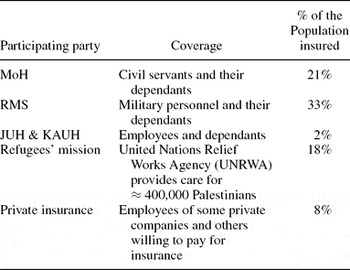
Jordan spends 9 percent of its GDP on health care, a relatively high percentage for a lower middle-income country (23). Approximately 80 percent of the Jordanian population is insured through a variety of schemes, including the Ministry of Health (MoH), the Royal Medical Services (military), the University sector, private insurance, and the refugees’ mission (see Table 1). The government's commitment to universal coverage, combined with the fact that 3 percent of the country's GDP currently goes toward drugs, has made equitable access to affordable drugs an increasingly important policy priority. The rising burden of chronic disease in Jordan places additional pressure on the government's pharmaceutical budget. Fourteen percent of Jordanians now suffer from diabetes (Reference Ajlouni, Jaddou and Batieha1) and one in four have high blood pressure (11).
Health Insurance Coverage in Jordan

Note. Source: National Accounts of the Public Health Sector in Jordan. Amman, Jordan: Health Insurance Directorate; 2006.
As in other countries, there is variation in clinical practice, with implications for equity, health outcomes, and efficiency. For example, a recent survey of physicians in Jordan revealed that they were not all managing hypertension according to international standards, and approximately 40 percent were unaware of American JNC VII guidelines, despite these being the guidelines adopted by the university sector (Reference Al-Azzam, Najjar and Khadar2).
The absence of a streamlined process for the development, implementation, monitoring and regular review of national standards for best clinical practices, may contribute to such variations. Furthermore, the lack of a national informatics system to retrieve or track patient care information, and the lack of a tradition of professional societies, makes the production of and adherence to national standards a challenging task.
In response to these pressures, the Jordanian government has launched a series of national pharmaceutical policy initiatives, with the support of large donors such as the World Bank (WB), World Health Organisation (WHO), United States Agency for International Development (USAID), and the UK's Department for International Development (DFID). It established the Jordanian Food and Drug Administration (JFDA) (12) in 2003, which makes both regulatory and pricing decisions. In 2004, the Joint Procurement Department (JPD) (9) was established in Jordan, with responsibility for procuring low-cost high-quality drugs (for governmental clinics and hospitals, army hospitals, and public university hospitals) and for encouraging their rational use through the Rational Drug List (RDL) (20). However, further support was necessary to spearhead action plans to promote cost-effective and evidence-based clinical practice.
Thus, in 2008, Jordan became a pilot country for the Medicines Transparency Alliance (MeTA), an initiative sponsored by DFID and supported by the WHO and WB. MeTA is an international multi-stakeholder initiative to promote increased transparency in the supply of essential medicines, with a particular focus on equitable access for low-income populations within low and middle-income countries (16). As part of this initiative, Jordan set up the MeTA Council, with representatives from government, drug manufacturers, civil society, health professional organizations, and academia as well as international bodies, such as WHO and the World Bank.
In their 2008 MeTA Jordan National Workplan (13), the Council identified seven key policy priorities for action, including: (a) “Developing and using medical evidence as the main criterion for the removal and addition of medicines to the RDL . . .” and (b) “Improving rational use of medicines, [through the] consolidation and implementation of Standard Treatment Guidelines [STG] and working with physicians to improve prescribing behavior . . .”
In response to a request by MeTA Jordan, and with the support of DFID and the World Bank, The National Institute for Clinical Excellence (NICE) International (www.nice.org.uk/niceinternational) and its partners worked between 2008 and 2009 to support Jordanian health policy makers with their reform efforts. The NICE team made a series of visits to meet with key stakeholders, raise awareness of NICE's role in the British National Health Service and draw lessons for the Jordanian setting. Together with Jordanian colleagues, they piloted the development of an evidence-informed algorithm for the treatment of a high burden condition, adapted to the Jordanian setting. This study, authored jointly by the UK and Jordanian teams, describes the process and methodology followed for the pilot, the challenges faced and lessons learned, and sets out activities for supporting the implementation of the care pathway and further development of evidence-informed guidelines in resource limited settings, as in Jordan.
OVERVIEW OF THE NICE-JORDAN ACTIVITIES
The Dead Sea Prioritization Workshop
Following two fact-finding, awareness-raising trips, NICE ran a 3-day technical workshop and strategic policy meeting bringing together over thirty key stakeholders, including senior clinicians from leading Jordanian Health Institutions, the High Health Council (HHC) (6), the Jordanian Food and Drug Administration (JFDA), the Royal Medical Services, University and specialised tertiary hospitals, academia, the Ministry of Health (MoH)—including its health insurance directorate—the Jordanian Medical Association, Joint Procurement Department (JPD), civil society, and patient organizations, WHO, pharmaceutical (local and international) manufacturers, and the World Bank.
The workshop had three major objectives: (i) to provide an outline of the basic principles and methods for developing new or adapting existing health technology assessments and best clinical practice care pathways; (ii) to discuss the governance framework for applying these evidence-informed products to policy making; (iii) to set out a realistic plan of action for implementing such methods and processes in Jordan
The workshop's conclusion was to conduct a pragmatic hands-on pilot to test out the methods and process of using evidence to inform policy, adapted to the Jordanian system and using existing institutions, but based on internationally accepted methods and processes as well as local and international evidence. The pilot would be used to describe the strengths and weaknesses of the Jordanian system and to develop an informed plan of action for addressing them.
Based on data presented at the workshop and the ensuing discussions, two high burden of disease areas, diabetes and hypertension, were identified as possible candidates for the pilot.
THE PILOT: OBJECTIVES, PROCESS, AND METHODS
The pilot had several objectives, including to: (i) Develop and test a framework—including structures, methods, and processes—for developing evidence-informed guidelines, using an international guideline as a starting point; (ii) Engage with/raise awareness among leading clinical communities and senior policy makers of methods and processes for using evidence, including efficiency considerations, to inform healthcare policy and practice; (iii) Help identify training needs and deliver training to support sustainable evidence-informed policy making; and (iv) Engage with civil society, patients and the general public and support longer-term implementation strategies and public awareness campaigns.
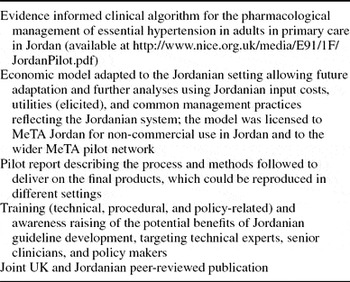
A list of key deliverables is given in Table 2. The pilot was split into two phases, each one focused around a field trip to Jordan, with a series of technical, administrative, and consensus-building activities taking place before and during each visit. All activities were planned and carried out jointly between the Jordanian and UK project teams.
Pilot Deliverables

PHASE I
Previsit Preparation
Compiling of Relevant Material. This material includes systematic reviews and economic analyses conducted for the NICE guideline (18) on the pharmacological treatment of hypertension; major relevant clinical studies published since the NICE guideline; and other major international guidelines such as the American JNC VII (Reference Chobanian, Bakris and Black4) and the European ESH/ESC (5).
Convening of the Guideline Development Group (GDG) and the Project Team, Including Technical and Administrative Leads. Two groups of Jordanian experts were convened: (i) The first group was the GDG chair and eighteen members. The final GDG members represented a variety of clinical specialities (internists, nephrologists, cardiologists, family medicine practitioners, nurses, pharmacists) from the major clinic and hospital systems in the country. The GDG also included representatives from the main drug procurement authorities (JPD, JFDA, MOH). (ii) The second group was Jordanian systematic reviewers and health economists supporting the group and a project manager and administrator. The identification and convening of the experts was led by MeTA Jordan.
First GDG Meeting in Amman
The first set of meetings in Amman spanned 3 days. Day 1 was a preparatory meeting during which the Jordanian and UK project teams met to review and discuss materials to be presented to the GDG. The first GDG meeting was held during Days 2 and 3 and included a range of activities:
Hands-on Training on Methods and Processes. These include procedural aspects of evidence-informed decision making such as stakeholder engagement and public consultation; managing conflicts of interest; incorporating social values and expert opinion and methods for supporting the implementation of the recommendations and assessing their overall budget impact. High-level technical training in systematic reviewing, critical appraisal and economic evaluation was also provided.
Framing the Clinical Problem. Deliberations included assessment of local data on prevalence and current management practices of hypertension in Jordan, the variation between different healthcare providers and insurers, and possible cost implications. Although hypertension management in the secondary care setting is of a relatively high standard across the major academic, public, private, and military institutions in the country, the patient population in these settings is not representative of primary care, making the management of essential hypertension in primary care/rural settings the priority for the guideline pilot.
Scoping and Developing the Clinical Question. Building on the framing discussions, the following clinical question was agreed: “What is the clinical and cost-effective pharmacological management of essential hypertension in adults presenting in a primary care setting in Jordan?” Treatment initiation with single and combination therapy and the choice of first-line monotherapy and in particular the role of β-blockers as first line treatment in patients with no other compelling indication for their use, were included as sub-questions.
Identification of Evidence and Data Sources. The evidence reviewed included clinical and cost-effectiveness studies and analyses underpinning the NICE guideline on hypertension management (2006) as well as major trials published in the past 3 years as identified by clinicians on the GDG and the NICE team (e.g., ACCOMPLISH trial) (Reference Jamerson, Weber and Bakris8). Potential sources for Jordan-specific data on clinical effectiveness of hypertension drugs, resource use costs in hypertension management and quality of life measures were also discussed.
PHASE II
Previsit Preparation
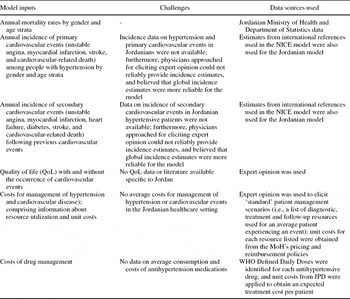
Data Collection in Jordan. A team of four Jordan-based experts with training in pharmacoeconomics, biostatistics, and epidemiology, drove the data collection, which then informed the updated analysis of the clinical and economic evidence. Although some estimates, such as Jordan disease-specific mortality, were available, the epidemiological, resource use and quality of life data available through published literature, clinical registries, or administrative databases, were very limited. As the limited time and resources available did not allow prospective evidence collection, missing parameters were elicited from experts through focus groups. In the absence of data, the use of expert judgment is recommended by international experts in heath technology assessment (7). Two meetings were conducted with physicians from the public, military and university provider sectors. The types and sources of the parameters used for the economic model are described in Table 3.
Parameters needed for the economic analysis, challenges encountered and approaches taken to retrieving the necessary data

Analytical Work in the United Kingdom. Using the feedback from the first GDG and the data retrieved by the Jordanian team, the clinical evidence review and economic analysis were updated to inform the Jordanian guideline.
The clinical evidence (in English and Arabic) was updated using major trials that had been published since the last update of the NICE hypertension guideline, as identified by the lead clinicians and a targeted literature search (Reference Jamerson, Weber and Bakris8;Reference Wiysonge, Bradley and Mayosi22;Reference Yusuf, Teo and Pogue24). In addition to NICE's focus on first-line monotherapy, the Jordanian analysis also included trials (such as ACCOMPLISH) comparing first-line combination therapies. All studies were critically appraised, and the results summarized for the GDG.
The NICE economic model was adapted for use in the Jordanian context: (i) Its presentation was improved to enable easy use by Jordanian health economists, including simplifying data input screens. (ii) It was adapted to allow estimation of the cost-effectiveness of the combination treatments compared in the ACCOMPLISH trial, in addition to the comparison of first-line treatments in the NICE clinical guideline. (iii) Jordanian data inputs were used and the model was amended to allow “live” exploration, with the Jordanian technical team and with the GDG, of important uncertainties over model parameters.
Second GDG Meeting in Amman
During the second series of meetings in Amman, the development of an evidence-based clinical algorithm for the pharmacological treatment of hypertension was completed, through the following steps.
Presentation and Discussion of Clinical Evidence, Model Inputs, and Economic Evaluation Findings. In addition to the clinical evidence, the GDG reviewed the model inputs and areas of uncertainty such as quality of life (QoL) and resource utilization data, which had been collected earlier through focus groups. Weaknesses of the evidence base, key uncertainties, and evidence gaps to which the model was most sensitive were identified for targeting in future research. Based on the updated model results: (i) drug treatment for essential hypertension is highly cost-effective, with long-term savings on the treatment of cardiovascular disease outweighing initial drug expenditures; (ii) β-blockers are relatively less cost-effective than other major classes of antihypertensive medication for patients without major co-morbidities; (iii) differences in savings and health gains between all the other drug classes are much smaller and difficult to predict, varying with the cost of the specific drug used, and risk profile for the individual patient; and (iv) use of more expensive, branded drugs is likely to increase costs with little (or no) benefit for patients.
Translation of the Evidence into Policy Recommendations. With clinician input, an algorithm for managing hypertension in rural Jordan was developed, taking account not only of the clinical and economic evidence but also of local context-specific values and practicalities of implementation (Supplementary Figure 1, which can be viewed online at www.journals.cambridge.org/thc2011009).
DEVELOPING AN IMPLEMENTATION STRATEGY
Throughout the various meetings, the need for an effective implementation strategy was frequently reiterated by clinicians, policy makers, and technical experts. They cited previous attempts to promote guidelines in Jordanian primary care, mostly supported by international aid programs, which had not led to change. The following key priorities for supporting implementation were identified: (i) launch of a dissemination workshop, in conjunction with NICE and UK clinicians, to raise awareness among stakeholders and receive feedback; (ii) official endorsement of the guideline by the MoH and dissemination to key stakeholders as an official Ministry position paper; (iii) incorporation into a broader implementation strategy led by MeTA Jordan, which may include additional technical training, awareness-raising events and budgetary impact analysis to inform procurement by JPD as well as sharing with other MeTA countries; (iv) linkage of guideline recommendations with procurement and rational drug use policies and with the update of RDL; (v) funding of research to collect Jordan-specific epidemiological parameters, utilities, unit costs and baseline data on prescribing practices to allow updating of the guideline; (vi) establishment of a specialist society—for example, Jordanian Hypertension Society—and an affiliated patient/service user society to promote awareness among patients and the general population, possibly with the support of UK equivalents (British Hypertension Society); (vii) launch of a national campaign, sharing knowledge, and learning from other successful ongoing local awareness campaigns such as the National Jordan Breast Cancer program (10); (vii) launch of a streamlined Jordan-funded process to develop standards for screening, primary prevention, diagnosis, nonpharmacological treatment, and follow-up for CVD and other chronic diseases (e.g., diabetes); (ix) publication of one or more peer-reviewed papers and presentations at national and international conferences to show-case Jordan as an example of a middle-income country with a commitment to evidence-based policy making; and (x) development of a lay version of the guideline accessible to patients.
Strengths and Weaknesses
Placed in the broader context of NICE's engagement in Jordan, mostly through MeTA, this pilot marked the beginning of a concerted, government-supported, longer-term effort to develop and implement Jordanian guidelines addressing chronic disease. It helped highlight weaknesses and possible obstacles to formalizing such a process. The pilot process was an opportunity for senior policy makers and clinicians in the country to engage in a deliberative process to develop a best treatment pathway in a high priority disease area, taking account of cost-effectiveness as well as clinical evidence. The major objectives of the pilot were largely achieved (see Table 2: Pilot deliverables).
However, during the pilot process a series of challenges and obstacles were identified, some of which were anticipated and some of which were not. The strengths and weakness of the process are outlined below, with a view to informing similar future efforts, both in Jordan and in other middle-income countries.
Strengths
Strengths involved the following: (i) the high-level political support on behalf of the Jordanian MoH/HHC and the commitment by large funders, namely the World Bank and DFID, to making rational drug use and evidence-informed decision making a key priority, reflected in streamlined funding over 18 months for the UK and Jordanian teams; (ii) the comprehensive approach to guideline development, including convening local technical and administrative teams; (iii) the engagement of senior local professionals; and (iv) the identification and prioritization of data requirements and key evidence gaps which could be integrated into a framework for future prospective data collection.
Weaknesses – How Can We do Better Next Time?
Data. One of the most significant limitations to developing a treatment pathway of relevance to the local setting was the lack of local epidemiological, health service use and QoL data. Preparation for future projects should therefore include an allocation of resources to collect primary data.
Capacity. The limited availability of experts in systematic reviewing and economic modeling, although not a major obstacle for this pilot, may limit future efforts to scale up similar activities. Endorsement of health economics as an important field by the MoH and JFDA (as well as other professional associations) can provide the impetus for young researchers and professionals to pursue the profession through graduate or training courses. In addition, senior clinicians may benefit from more exposure to issues of efficiency as well as to the technical aspects of guideline development.
Process and Institutional Capacity-building. Currently there is a weak link between evidence-informed guideline development and procurement, tendering and RDL listing and delisting decisions. There is little track record of stakeholder engagement and consultation with civil society, patients and clinicians. The structures for declaring, recording and managing conflict of interest among the decision makers are only just being set up.
However, the institutional capacity for driving the guideline development process is slowly improving in Jordan by the gradual strengthening of the role of legitimate structures that will drive the process, prioritize the work program based on local needs, and target the reviews and economic analyses where the disease burden and potential to benefit are the greatest.
Early Indications of Impact
As of September 2010, there have been 12 months since the conclusion of the pilot. In this period: (i) His Excellency, the Minister of Health of Jordan, has formally endorsed the algorithm for the management of essential hypertension in primary care settings; (ii) The London based technical team, with input from Jordanian colleagues, have completed a budget impact analysis quantifying the potential savings and health gains of implementing best practice in the management of hypertension; (iii) The Jordanian team has presented the guideline pilot to the MeTA countries annual meeting in London, in July 2010 (17); (iv) Members of the UK/Jordan team have presented aspects of the pilot in international conferences including the Guidelines International Network and ISPOR; (v) And, possibly most importantly, the Jordanian authorities have set up a multistakeholder steering committee to drive the institutionalization of health technology assessment at a national level in Jordan, currently seeking funding to pursue its objectives.
CONCLUSION: GENERALIZABLE LESSONS
Global donors and developing country governments increasingly view evidence-informed policy making as a priority for investment. This requires the establishment of “home-grown” and legitimate, that is, transparent, accountable and inclusive, structures for: (i) identifying high priority areas for action in the form of investment in quality improvement and healthcare provision; (ii) making evidence-informed decisions about resource allocation within budgetary constraints based on scientific evidence of clinical and cost effectiveness and societal values; (iii) highlighting evidence and data gaps and initiating research to fill these. Such structures can empower decision makers to work toward better and more equitably distributed health outcomes and a more efficient use of scarce resources. High-income countries with relevant experience in evidence-informed policy making in health care working together with academic experts and donors can help developing countries build capacity; establish new structures and strengthen existing institutions (Reference Chalkidou, Levine and Dillon3). But advice and support must be adapted to the local setting and needs of each country, it must be sustainable, and it must respond to changing economic and political circumstances.
Helping institutionalize evidence-informed decision making by adapting methods, processes and final products to local settings, are becoming increasingly popular among low and middle-income countries (Reference Lavis and Panisset14;Reference Marquez, Chalkidou and Cutler15;Reference Oxman and Hanney19). With the rise of noncommunicable disease in poorer countries (Reference Venkat Narayan, Ali and Koplan21), increasing pressures from healthcare technologies and the drive for more accountable donor investment, rational prioritization mechanisms based on evidence of effectiveness and efficiency are likely to become a requirement for all healthcare systems. We hope that our pilot, whereas in the form of a case study, offers some empirical evidence as to the value and challenges of doing evidence-based policy in poorer countries.
CONFLICT OF INTEREST
J Lord and her institute have received funding for this work from NICE International. N Obeidat's institute has received funding from the World Health Organization and the World Bank. I Alabbadi has received funding from MeTA. R O'Mahony's institute has received grants or other support from DoH, DfiD, and the World Bank. A Stanley, R Bader, and A Momani have not provided information about potential conflicts of interest. The other authors do not report any potential conflicts of interest.
CONTACT INFORMATION
Kalipso Chalkidou, MD, PhD (kalipso.chalkidou@nice.org.uk), Director, NICE International, National Institute for Health and Clinical Excellence, MidCity Place, 71 High Holborn, London, WC1V 6NA, UK
Joanne Lord, PhD (joanne.lord@brunel.ac.uk), Reader, Health Economics Research Group, Brunel University, Uxbridge UB8 3PH, UK
Nour A. Obeidat, PhD (nour.obeidat2@gmail.com), Head, Center for Health Economics and Outcomes Research, Office of Science, Research and Health Policy, King Hussein Institute for Biotechnology and Cancer, 160 Mecca Street, Amman, Jordan
Ibrahim A. Alabbadi, MBA, PhD (i.abbadi@ju.edu.jo), Assistant Professor, Department of Biopharmaceutics and Clinical Pharmacy, University of Jordan, Amman 11942, Jordan
Adrian G. Stanley, PhD, FRCP (as90@le.ac.uk), Senior Lecturer, Department of Medical Education, University of Leicester, University Road, Leicester LE1 7RH, UK; Consultant Physician in Cardiovascular Medicine, Division of Acute Medicine, University Hospitals of Leicester NHS Trust, Infirmary Square, Leicester LE1 5WW, UK
Rania Bader, BSc, MSc (raniasb2002@yahoo.com, rania.bader@ehs.com.jo), Pharmacy Manager, Pharmaceutical Policy Consultant, Department of Pharmacy, King Abdullah II Bin A1 Hussein Street, Mecca Street Cross Circle, P.O. Box 4408, Amman 11953, Jordan
Aiman Momani, PhD (aymanm@pharmanet-jo.com), CEO, PharmaNet, 22 Queen Rania Street, P.O. Box 3168, Amman 11953, Jordan
Rachel M. O'Mahony, PhD (rachel.o'mahony@rcplondon.ac.uk), Senior Research Fellow, National Clinical Guidelines Centre, Royal College of Physicians, 11 St. Andrews Place, Regents Park, London NW1 4LE, UK
Lara Qatami, MBA, BSc (laraqatami@hotmail.com), Assistant Director General for Strategic Affairs, King Hussein Cancer Center, Queen Rania A1 Abdullah Street, P.O. Box 1269, Al-Jubeiha, Amman l194l, Jordan
Derek Cutler, BSc (derek.cutler@nice.org.uk), Coordinator, NICE International, National Institute for Health and Clinical Excellence, MidCity Place, 71 High Holborn, London WC1V 6NA, UK