





Event Description
Event Type: Military Helicopter Crash; 2025 ISC Hazard Definition and Classification Code TL0401 – Air Transportation Accident, Transportation Accidents Technological Hazard
Event Date: June 11, 2023
Location: United States Central Command (US CENTCOM) Area of Responsibility [Middle East, Central Asia, and parts of South Asia and Northeast Africa]
Response Type: First Responder, Aeromedical Transport
Introduction
Event Description and Damage Occurred
Upon attempted landing to a Forward Air Refueling Point (FARP), a MH-47 Chinook helicopter carrying 22 personnel onboard crashed due to environmental factors. All the passengers had been wearing combat load, including body armor. 1
Military Treatment Facilities (MTFs)
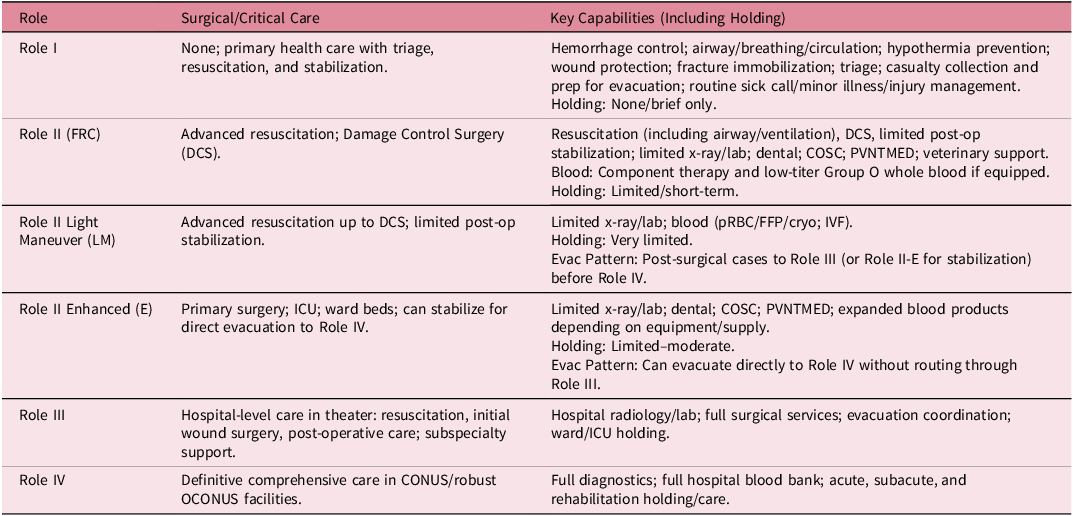
Military Treatment Facilities (MTFs) are outlined in Table 1. Role I MTFs handle primary health care with triage, resuscitation, and stabilization. Role II adds primary surgery to advanced resuscitation before transport. Role III and Role IV provide hospital-level, comprehensive care.
Roles of Military Treatment Facilities (MTF) and Key Capabilities

Table 1. Long description
A table with five columns and six rows, including a header row. The columns are labeled Role, Surgical/Critical Care, and Key Capabilities (Including Holding). The rows describe different roles of Military Treatment Facilities (MTFs) and their capabilities. Row 1: Role I, None; primary health care with triage, resuscitation, and stabilization., Hemorrhage control; airway/breathing/circulation; hypothermia prevention; wound protection; fracture immobilization; triage; casualty collection and prep for evacuation; routine sick call/minor illness/injury management. Holding: None/brief only. Row 2: Role II (FRC), Advanced resuscitation; Damage Control Surgery (DCS)., Resuscitation (including airway/ventilation), DCS, limited post-op stabilization; limited x-ray/lab; dental; COSC; PVNTMED; veterinary support. Blood: Component therapy and low-titer Group O whole blood if equipped. Holding: Limited/short-term. Row 3: Role II Light Maneuver (LM), Advanced resuscitation up to DCS; limited post-op stabilization., Limited x-ray/lab; blood (pRBC/FFP/cryo; IVF). Holding: Very limited. Evac Pattern: Post-surgical cases to Role III (or Role II-E for stabilization) before Role IV. Row 4: Role II Enhanced (E), Primary surgery; ICU; ward beds; can stabilize for direct evacuation to Role IV., Limited x-ray/lab; dental; COSC; PVNTMED; expanded blood products depending on equipment/supply. Holding: Limited-moderate. Evac Pattern: Can evacuate directly to Role IV without routing through Role III. Row 5: Role III, Hospital-level care in theater: resuscitation, initial wound surgery, post-operative care; subspecialty support., Hospital radiology/lab; full surgical services; evacuation coordination; ward/ICU holding. Row 6: Role IV, Definitive comprehensive care in CONUS/robust OCONUS facilities., Full diagnostics; full hospital blood bank; acute, subacute, and rehabilitation holding/care.
Note: Including Role II variants2.
Abbreviations: FRC, Forward Resuscitative Care; DCS, Damage Control Surgery; COSC, Combat and Operational Stress Control; PVNTMED, preventive medicine; pRBC, packed red blood cells; FFP, fresh frozen plasma; IVF, intravenous fluids; ICU, intensive care unit; CONUS, Continental United States; OCONUS, Outside Continental United States.
Authors’ Role (Initial Response)
By virtue of his presence on the crashed aircraft, one of the authors (AS) was first on the disaster site and was senior medical provider until arriving at a Role III MTF. The mission’s Tactical Medical Officer (TMO), a Special Operations Forces (SOF) physician associate (PA) who was staged on the Casualty Evacuation (CASEVAC) platform, assumed oversight for care delivery of six urgent patients, along with the injured EM physician who was also providing care (seven patients total). Other authors (RB, SZ, SC, and JA) were receiving providers, caring for 15 patients during two fixed-wing transports and at a secondary Role II and a Role III MTF.
Author’s Role (Patient)
This author/patient’s experiences include initial management at the Role II and observations of aerospace physiologic effects on their injuries during the Critical Care Air Transport Team (CCATT) transport.
Source
Sources of the information in this report are from the authors (who were participants and patients in the disaster) and de-identified patient records.
Ethics Approval
This disaster report was reviewed by the Mike O’Callaghan Military Medical Center (Nellis Air Force Base, Nevada USA), which determined that it did not constitute human subject research; institutional review board (IRB) review was therefore not required. All patient information was derived from the authors’ first-hand accounts and de-identified records. The patient whose clinical course is described in detail is an author of this report and provided consent for publication of his experience.
Observations
Provider on the Ground
Initial evaluation and management in the mass-casualty incident (MASCAL) was mostly conducted according to Tactical Combat Casualty Care (TCCC) protocol. The EM physician made the decision to triage patients in a binary “stable or unstable” model based on a perceived lack of time to perform more deliberate and specific triage. Within twenty minutes, all patients were evacuated by ground vehicles of opportunity to a Forward Resuscitative Surgical Detachment (FRSD) after appropriate triage and point-of-injury (POI) life-saving interventions were performed.
The FRSD contained one surgeon, anesthetist, PA, EM Physician, and medics. On arrival at the FRSD, deliberate triage was performed to separate patients into urgent, priority, routine, and expectant. Given the volume/severity of patients, the senior provider deemed that this was a mass-casualty situation requiring rapid decompression of these patients to appropriate facilities (Table 1 2 ).
Various considerations included a second, larger Role II with additional surgical capabilities and a Role III with orthopedic and neurosurgery capabilities. Estimated time of transport to the Role III was 70 minutes by fixed-wing CASEVAC or 150 minutes by rotary CASEVAC; prioritization was based on injury severity with potential need for surgical care capable of managing unstable pelvic fractures with potential on-going hemorrhage.
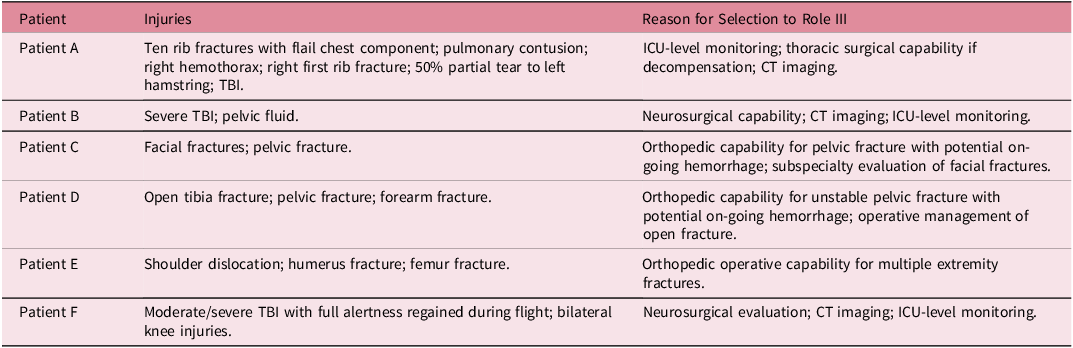
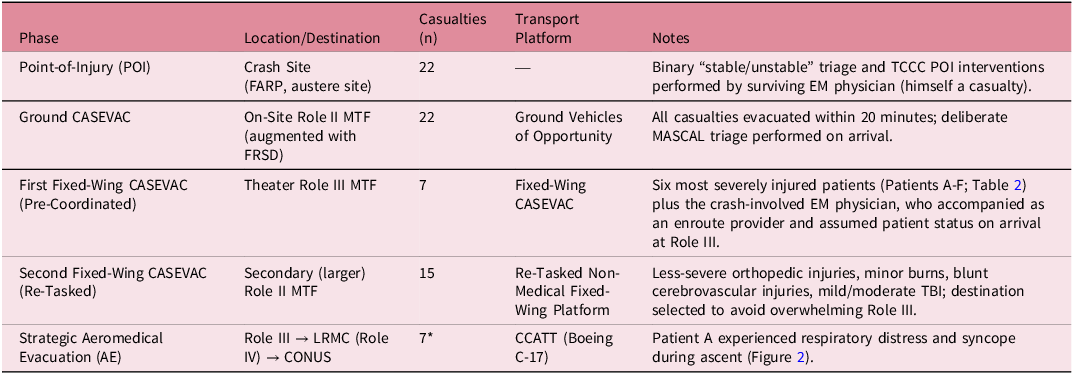
In conjunction with the senior medic, the EM provider selected the six most severely injured patients for fixed-wing CASEVAC movement to a theater Role III (Table 2). The remaining 15 patients with less-severe orthopedic injuries, minor burns, blunt cerebrovascular injuries, or mild/moderate traumatic brain injury (TBI) required a CASEVAC of opportunity; a decision was made to evacuate the remaining 15 patients to the secondary Role II using a second re-tasked fixed-wing platform to prevent overwhelming the Role III MTF that was receiving the six critical patients. After initial stabilization at the “on-site” Role II, the treatment team prepared and packaged the six most-severe trauma casualties, with the crash-involved EM physician volunteering to accompany them due to the critical status of the patients involved. At the Role III, the EM physician handed over care and assumed patient status for his own injuries. Figure 1 and Table 3 outline the casualty flow and disposition of all 22 casualties.
Patients Selected for Transport to Role III

Table 2. Long description
A table with six rows and three columns. The columns are labeled Patient, Injuries, and Reason for Selection to Role III. Row 1: Patient A, Ten rib fractures with flail chest component; pulmonary contusion; right hemothorax; right first rib fracture; 50 percent partial tear to left hamstring; TBI, ICU-level monitoring; thoracic surgical capability if decompensation; CT imaging. Row 2: Patient B, Severe TBI; pelvic fluid, Neurosurgical capability; CT imaging; ICU-level monitoring. Row 3: Patient C, Facial fractures; pelvic fracture, Orthopedic capability for pelvic fracture with potential on-going hemorrhage; subspecialty evaluation of facial fractures. Row 4: Patient D, Open tibia fracture; pelvic fracture; forearm fracture, Orthopedic capability for unstable pelvic fracture with potential on-going hemorrhage; operative management of open fracture. Row 5: Patient E, Shoulder dislocation; humerus fracture; femur fracture, Orthopedic operative capability for multiple extremity fractures. Row 6: Patient F, Moderate/severe TBI with full alertness regained during flight; bilateral knee injuries, Neurosurgical evaluation; CT imaging; ICU-level monitoring.
Abbreviations: TBI, traumatic brain injury; ICU, intensive care unit; CT, Computed Tomography.
Patient Flow During and Throughout Disaster Event.
Abbreviations: CASEVAC, Casualty Evacuation; MTF, Military Treatment Facility; EM, Emergency Medicine.

Casualty Flow and Disposition of All 22 Casualties

Table 3. Long description
The table has six rows and five columns. The columns are labeled Phase, Location/Destination, Casualties (n), Transport Platform, and Notes. The rows are labeled as follows: Point-of-Injury (POI) with 22 casualties at Crash Site (FARP, austere site) and notes on triage and interventions; Ground CASEVAC with 22 casualties transported by Ground Vehicles of Opportunity to On-Site Role II MTF (augmented with FRSD) with notes on evacuation time and triage; First Fixed-Wing CASEVAC (Pre-Coordinated) with 7 casualties transported by Fixed-Wing CASEVAC to Theater Role III MTF with notes on the most severely injured patients; Second Fixed-Wing CASEVAC (Re-Tasked) with 15 casualties transported by Re-Tasked Non-Medical Fixed-Wing Platform to Secondary (larger) Role II MTF with notes on less severe injuries; Strategic Aeromedical Evacuation (AE) with 7 casualties transported by CCATT (Boeing C-17) to Role III -> LRMC (Role IV) -> CONUS with notes on a patient’s respiratory distress.
*Total casualties (n = 22): six severely injured patients + one EM physician casualty (seven to Role III) + 15 to secondary Role II. The seven Role III casualties were subsequently evacuated to LRMC via CCATT and then to CONUS.
Abbreviations: FARP, Forward Air Refueling Point; TCCC, Tactical Combat Casualty Care; EM, Emergency Medicine; CASEVAC, Casualty Evacuation; MTF, Military Treatment Facility; FRSD, Forward Resuscitative Surgical Detachment; MASCAL, mass-casualty incident; TBI, traumatic brain injury; LRMC, Landstuhl Regional Medical Center; CONUS, Continental United States; CCATT, Critical Care Air Transport Team.
Providers in Re-Tasked Aircraft
The team was composed of two flight critical care paramedics and one receiving EM physician. Due to the ad hoc tasking of a non-medical fixed-wing asset, the medical team faced several logistical challenges including configuring the aircraft cabin for the care of 15 patients. The medical team was from a rotary-wing organization and the physiologic stressors (ie, significant G-force, reduced cabin pressurization) of flight differed, requiring significant teamwork to ensure safe patient loading and appropriate analgesia/sedation were achieved. Notably, Bluetooth-enabled headsets allowed for clear communication across the cabin and were instrumental in treatment. Arrival at the destination Role II presented additional challenges, including offloading, tracking, and providing handover of 15 patients near simultaneously to a multi-national coalition team.
Patient
At the immediate Role II to the crash site, Patient A was found to have a right hemopneumothorax, confirmed with a positive extended Focused Assessment with Sonography in Trauma (eFAST), prompting close monitoring with supplemental oxygen. Despite the patient’s flail chest, thoracostomy was not performed as the patient continued to maintain adequate oxygen saturations and additional considerations in the MASCAL took precedence.
At the Role III, the patient received a computed tomography (CT) scan confirming diagnosis; however, due to his stable presentation and other patients requiring more urgent surgical intervention (Patients C and D), the decision was made to place him under close observation with supplemental oxygen in the intensive care unit (ICU) for 48 hours. Following discharge, the patient was transported to Landstuhl Regional Medical Center (LRMC; Landstuhl, Germany) via CCATT on a Boeing C-17. Notably, the patient was loaded onto the top level of a litter stanchion, head aft, supine, and without head elevation. Pre-takeoff, vital signs were normal, with oxygen saturations at approximately 95% on room air.
During takeoff, the patient (who was supine) experienced significant respiratory distress, ultimately losing consciousness. Upon regaining consciousness, the patient observed two providers preparing for needle decompression and applying oxygen by mask. Following this, CCATT configured a headrest which elevated his thorax. Additional pain medication was given and supplemental oxygen was initiated via non-rebreather mask. Symptoms improved and landing occurred without complication.
Analysis
Provider on the Ground
Due to the large volume of patients and chaotic nature of the crash site, it was determined that four-category triage systems were too slow to rapidly identify patients with acute life threats under extreme time pressure. Instead, patients were triaged into “stable” and “unstable” (ie, “dying now” or “dying later”) with more deliberate triage at Role II. This is consistent with recent experience of both military and civilian medics performing MASCAL triage. Reference Rush, Lauria and DeSoucy3,Reference Kamler, Taube and Koch4
Transport considerations to off-load the initial Role II became complex. 5 The first major transport decision was to determine evacuation priority, evacuation platform, and patient destination. During this process, priority for transport was centered around the injury severity (life, limb, eyesight) and those with injury patterns requiring specialty surgical care. Patients who required immediate intervention would stay at the Role II for Damage Control Surgery (DCS). Whether for treatment or evacuation, triage is a complex and dynamic process, and patient priority can quickly change as patients either respond to treatments or decompensate; this protean nature is not adequately reflected in contemporary guidance or training regarding triage. 5
Decisions in selecting evacuation platforms and destinations required consideration of capabilities and capacity at both origin (small Role II) and destination (Role III versus larger Role II), time of transport, and patient injury patterns. While often thought of as a medical problem, this is a leadership-driven problem supported and informed by medical providers. During this event, the assault force senior medic assumed responsibility for communication between the medical providers and leadership - a critical action for patient fidelity and controlling CASEVAC priorities that saved an injured patient from being transported to the wrong facility following a breakdown in communication.
Providers in Additional Aircraft
The dynamic triage played an additional role in the second CASEVAC aircraft as additional injuries were identified, changing triage categories and required interventions. Reference Sigle, Berliner and Richter6 The initial crash-involved EM physician executed a plan for Role II decompression, though speculation from non-medical personnel nearly undid this plan, highlighting the importance of communication to the air commanders of various platforms. Given the multi-leg duration of these fixed-wing evacuations from POI to Role II to a Role III, medical equipment power management became an additional issue, utilizing power from fixed-wing platform; however, greater power limitations exist in larger fixed-wing assets. Reference Martin-Gill, Doyle and Yealy7
Patient Perspective
It was hypothesized that the significant respiratory distress and syncope was due to the gravitational forces and suboptimal patient positioning encountered during the C-17’s ascent. Positioning a patient on the top level of a litter stanchion with feet facing the cockpit (direction of flight) and elevated relative to the head may have caused cephalad displacement of his abdominal and thoracic contents, further compromising the patient’s respiratory flail chest mechanics, worsening pain from increased intrathoracic pressure, restricting diaphragmatic excursion, and decreasing tidal volume. Reference Martin8 His subsequent syncope suggests a possible hypoxic component, potentially compounded by his TBI lowering the threshold for cerebral hypoperfusion (Figure 2). Reference Len and Neary9–Reference Sours, Zhuo, Roys, Shanmuganathan and Gullapalli11 The noisy aircraft environment and his inability to vocalize his worsening status due to pain created a communication barrier, delaying crew response until clinical deterioration was overtly evident. Reference Martin8
Hypothesized Impact of G-Forces during Takeoff on Patient A.
Abbreviation: TBI, traumatic brain injury.

This mechanism remains hypothetical, however, and alternative or contributory explanations must be acknowledged: reduced cabin pressurization decreasing alveolar oxygen tension in a patient with pulmonary contusions and a recent hemothorax, pain-limited ventilation, progression of underlying thoracic injuries, effects of analgesic medications on respiratory drive, relative hypovolemia, or a combination of these factors. Because repositioning, supplemental oxygen, and additional analgesia were administered near-simultaneously, the patient’s subsequent improvement cannot confirm any single mechanism.
Regardless of the precise etiology, the event underscores the importance of deliberate patient positioning, anticipation of aerospace physiologic stressors in thoracic trauma, and reliable patient-to-crew communication during strategic aeromedical evacuation (AE). The noisy aircraft environment and his inability to vocalize his worsening status due to pain created a communication barrier, delaying crew response until clinical deterioration was overtly evident.
Of note, many features of this effort – tiered Role II-Role IV care, CCATT, and specialized evacuation assets – are specific to the deployed United States Military Medical System. Civilian systems rarely possess an equivalent evacuation or unified command capacity. Nevertheless, some core lessons of this event can be applied broadly:
Initial triage under extreme time pressure may require simplified sorting schemes, with deliberate multi-category triage deferred to the first stabilization point — a pattern equally relevant to a rural ambulance service, a humanitarian field hospital, or an urban mass casualty with delayed Emergency Medical Services (EMS) access.
The decision to split casualties between two receiving facilities to avoid overwhelming a higher-capability center is directly analogous to civilian destination-selection dilemmas between trauma centers and community hospitals during mass-casualty events and should remain a tenant of mass-casualty management incident command.
Triage is dynamic; patients change category during transport, and receiving systems should anticipate that enroute reassessment will alter needs on arrival.
A designated liaison between medical providers and transport decision makers, as well as reliable patient-to-crew communication in noisy environments, are inexpensive, technology-light interventions applicable in any resource setting.
Aeromedical physiologic stressors (ie, acceleration, cabin pressure, noise-induced communication barriers, and positioning constraints) apply to air transport of thoracic trauma patients, whether by military airframe, civilian helicopter EMS, or fixed-wing medical repatriation, and should be accounted for.
Conclusion
This disaster report of a 2023 United States military helicopter crash MASCAL in an austere deployed setting provides a unique perspective of providers and a selected patient who is a board-certified trauma surgeon. In particular, it highlights the complexity of MASCAL triage and AE in disaster and austere situations. This case illustrates the need for adaptive protocols that account for dynamic patient conditions and resource constraints, especially in future contested environments without secure airspace. The patient’s experience during aeromedical transport underscores critical aerospace physiology challenges. Overall, the successful management of 22 casualties, with no mortality (and several returning to active duty with additional deployments as of 2026), reflects the resilience of the United States Military Medical System in the face of complex and challenging circumstances.
Author Contributions
JD: Manuscript drafting and review; critical care and aerospace physiology.
RB: Case data; manuscript drafting and review.
SZ: Case data; manuscript drafting and review.
SC: Case data; manuscript drafting and review.
JL Case data; manuscript drafting and review.
JA Case data; manuscript drafting and review.
MS: Case data; manuscript drafting and review.
AS: Case data; manuscript drafting and review.
All authors approved the final manuscript.
Competing Interests
Jason David declares no financial, personal, or professional conflicts of interest. Rachel E. Bridwell declares no financial, personal, or professional conflicts of interest. Steven Zesati declares no financial, personal, or professional conflicts of interest. Shawn Cecil declares no financial, personal, or professional conflicts of interest. Joshua B. Lowe declares no financial, personal, or professional conflicts of interest. Jason Auchincloss declares no financial, personal, or professional conflicts of interest. Maxwell Sirkin declares no financial, personal, or professional conflicts of interest. Andrew Schaffrinna declares no financial, personal, or professional conflicts of interest.
Use of AI Technology
The following AI tools were used: (1) ChatGPT (OpenAI; San Francisco, California USA) was used to proofread the manuscript and offer suggestions for clarity, generation of Table 1 and Table 2 based on inputted data, and generation of APA-style; and (2) Claude AI (Anthropic PBC; San Francisco, California USA) was used to generate Figure 1 and Figure 2.



 Open access

