Chinese reading involves both single-character reading and multicharacter word reading. Chinese is a morphosyllabic writing system; the character is the minimal unit of reading. In most cases, each Chinese character represents a morpheme as well as a syllable (Wang, Cheng, & Chen, Reference Wang, Cheng and Chen2006). Most Chinese words are compound words, composed of two or more characters. For example, the word 冰箱 (refrigerator) consists of two morphemes: 冰 (ice) and 箱 (box). According to Sun, Sun, Huang, Li, and Xing (Reference Sun, Sun, Huang, Li, Xing, Luo and Yuan1996), over 65% of the words used in modern Chinese are two-morpheme disyllabic compounds, and about 10% are three-morpheme compounds. To date, in many studies of early Chinese literacy development, character recognition and word reading were interchangeably used to measure children's reading skills (Chen, Hao, Geva, Zhu, & Shu, Reference Chen, Hao, Geva, Zhu and Shu2008; Ho & Bryant, Reference Ho and Bryant1999; Li, McBride-Chang, Wong, & Shu, 2012; McBride-Chang & Ho, Reference McBride-Chang and Ho2005; Shu, McBride-Chang, Wu, & Liu, Reference Shu, McBride-Chang, Wu and Liu2006). In order to understand the nature of Chinese reading, it is important to explore similarities and differences in characterFootnote 1 reading and wordFootnote 2 reading for beginners.
Chinese characters are square-shaped orthographic forms composed of strokes. Although the complex shapes enable learners to use more visual skills to learn and memorize characters, more than 80% of modern Chinese characters are ideophonetic compound characters, which have internal structures based on orthographic rules. Each compound character contains a phonetic component and a semantic radical (Kang, Reference Kang and Chen1993; Zhu, Reference Zhu1987). The phonetic component indicates the pronunciation, and the semantic component indicates the meaning. For example, the character “清” (clear) has two components: the right part, which is a phonetic 青 pronounced qīng, signifies the sound of the character, qīng; the left part comprises the semantic component 氵(water), representing the meaning of the character, which is “clear.” The stroke patterns are placed in specific positions to form characters according to the orthographic rules. For example, a semantic component氵can only be placed on the left side. Previous studies of Chinese reading development have indicated that orthographic awareness, conceptualized as children's understanding of the conventions of positional and functional regularities used in the Chinese writing system (Li, Fu, & Lin, Reference Li, Fu and Lin2000; Li, Shu, McBride-Chang, Liu, & Peng, Reference Li, Shu, McBride-Chang, Liu and Peng2012), are important in learning to read Chinese characters (e.g., Huang & Hanley, Reference Huang and Hanley1995; Li et al., Reference Li, Fu and Lin2000; Li, Peng, & Shu, Reference Li, Peng and Shu2006; Tong, McBride-Chang, Shu, & Wong, Reference Tong, McBride-Chang, Shu and Wong2009). In a character production task, two-thirds of third-grade Chinese children could create new characters that follow the correct orthographic structures (Ho, Yau, & Au, Reference Ho, Yau, Au, McBride-Chang and Chen2003). These findings indicate that, for character reading, orthographic awareness tends to be quite important because children rely on knowledge of the position of radicals or types of radicals within characters. In addition, Anderson et al. (2013) found that beginning learners as young as first grade had some orthographic awareness of Chinese characters.
The other important level of Chinese reading is word reading. Although some characters can stand alone as words, more than 70% of Chinese words are compounds formed from two or more morphemes (Institute of Language Teaching and Research [of China], 1986). This requires children to combine morphemes for word reading. Thus, morphological awareness, defined as “children's conscious awareness of the morphemic structure of words and their ability to reflect on and manipulate that structure” (Carlisle, Reference Carlisle and Feldman1995, p. 194), might also play an important role in word reading, especially in cases in which only one character within the word can be recognized. Morphological awareness in the form of lexical compounding may help children to determine what those unfamiliar characters within orally familiar words might be from oral language knowledge and contextual cues. For example, even in cases in which children do not recognize or are not sure of the character “汽” (steam), they might be able to read the word “汽车” (automobile) by making use of the other familiar morpheme “车” (vehicle) because the word “汽车” is orally familiar to them. In this way, children apply morphological knowledge to combine morphemes together, which helps them to recognize new word forms. The contribution of morphological awareness to Chinese word reading has been demonstrated in a few studies (Ku & Anderson, Reference Ku and Anderson2003; Li, Anderson, Nagy, & Zhang, Reference Li, Anderson, Nagy, Zhang, Li, Gaffney and Packard2002; Shu et al., Reference Shu, McBride-Chang, Wu and Liu2006). Morphological awareness enables children to sensibly combine morphemes when they read multicharacter words.
In a comparative study of character and word processing, Liu, Chung, McBride-Chang, and Tong (Reference Liu, Chung, McBride-Chang and Tong2010) found that for character stimuli, Hong Kong children's reaction times were the longest for pseudocharacters (in which phonetic and semantic radicals in the character were combined following orthographic rules) in judging real characters or not, while for word stimuli, reaction times were longest in reversed situations (by reversing left and right components). They suggested that children might use a more holistic strategy at the word level to process words and an analytical strategy at the character level to process characters. Li and McBride-Chang (Reference Li, McBride-Chang, Chen, Wang and Luo2013) examined Hong Kong third and fifth graders’ performances on Chinese character reading. They found that reading accuracy of the same characters embedded in words was significantly higher than that of the characters presented individually. These findings underscore the fact that character and word reading likely constitute somewhat different processes.
Previous studies of character and word reading processes largely focused on traditional Chinese characters. In the present study, we targeted younger children from Mainland China to test whether the same simplified characters would be read more accurately in the context of a word than in isolation. The simplified Chinese script is used in Mainland China and Singapore and is comparatively less visually complex than the traditional script, which is used in Hong Kong and Taiwan. For the question of differences between character reading and word reading, we reasoned that character and word reading might involve some different processes in both traditional and simplified Chinese scripts.
The main purpose of the present study was to compare the difference between reading characters and words and, further, to examine what the correlates of character versus word reading are for children from Mainland China in order to explore this idea that recognizing each constitutes different processes in more depth.
In the first study, we tested character reading and word reading in Mainland Chinese kindergartners. We hypothesized that children should perform better in reading characters within words than in reading individual characters, partly as a replication and extension of another study on character and word reading done on Hong Kong school children (Li & McBride-Chang, Reference Li, McBride-Chang, Chen, Wang and Luo2013).
STUDY 1: CHILDREN’S CHARACTER READING AND WORD READING
Method
Participants
Participants were 63 third-year kindergarten children (34 girls, 29 boys; mean age = 66.72 months, SD = 0.31) from Mainland China. All the children, from a single school, were typically developing and were native Mandarin speakers. The children were taught to read Chinese characters mainly using the “look and say” method in kindergarten.
Procedures
Both single-character reading and two-character word reading were administered individually and lasted approximately 10 min. Information about children's ages was collected from teachers. The word reading task was administered after the character reading task, but the characters involved were arranged in random order in each reading task. The results, thus, could represent children's actual reading ability in the two tasks.
Measures
CHINESE CHARACTER READING
This measure required children to read aloud a list of 70 Chinese single characters (e.g., 朋,汽), which were arranged according to approximate difficulty level. All the words were selected from kindergarten and first-grade textbooks, and all were orally familiar to children. One point was given per character that was correctly identified, and the maximum score was 70 points. The internal consistency reliability for this task was 0.96.
CHINESE WORD READING
This measure required children to read aloud a list of 35 Chinese two-character words, which were arranged according to approximate difficulty level. The 35 two-character words contained the 70 characters from the character reading task. In this case, they were embedded in the words (e.g., 朋友,汽车). One point was given per character (despite the fact that the children's task was to read words as two-character units), and the maximum score for this task was again 70 points. Its internal consistency reliability was 0.98.
Results and discussion
To determine whether character reading and word reading involved different levels of difficulty, we compared the reading accuracy in character reading and word reading by using a paired t test. The results showed that children achieved significantly higher scores in reading characters that were embedded within whole words (M = 46.30, SD = 23.07), than they did in reading single characters (M = 42.24, SD = 22.24), t (62) = 8.63, p < .001, d = 0.18. The results suggested that Chinese character reading and word reading are somewhat different acquisition processes for beginning Mainland learners. Specifically, the same characters were read more accurately in the context of words than in isolation.
Having demonstrated a concrete difference in reading performance in Chinese kindergartners for characters versus words, in Study 2, we moved one step further to examine the unique correlates of character reading and word reading for children from Mainland China. We hypothesized that orthographic awareness should be a stronger correlate of single-character reading as compared to word reading. This is because the internal structures and positions of components within characters are important for recognition of Chinese characters (Shu, Chen, Anderson, Wu, & Xuan, Reference Shu, Chen, Anderson, Wu and Xuan2003). In addition, because the phonological coding system known as Pinyin is used to introduce new characters in Chinese and tends to be associated with better reading over time (e.g., Lin et al., Reference Lin, McBride-Chang, Shu, Zhang, Li and Zhang2010; Pan et al., Reference Pan, McBride-Chang, Shu, Liu, Zhang and Li2011), we expected that Pinyin knowledge might be more strongly associated with character, as compared to word, reading. In contrast, word reading may rely more on morphological construction and vocabulary knowledge, because these both make use of morpheme building skills.
We included two additional reading-related skills in our battery as well. One was a task of phonological awareness, which has been linked to word and character reading across numerous studies of Chinese kindergartners (e.g., Chen et al., Reference Chen, Hao, Geva, Zhu and Shu2008; Lei et al., Reference Lei, Pan, Liu, McBride-Chang, Li and Zhang2011; Li, McBride-Chang, et al., Reference Li, Shu, McBride-Chang, Liu and Peng2012). The other was a task of rapid automatized naming (RAN), which tends to be associated with reading for children both in Hong Kong (McBride-Chang, Liu, Wong, Wong, & Shu, Reference McBride-Chang, Liu, Wong, Wong and Shu2011; Tong et al., Reference Tong, McBride-Chang, Shu and Wong2009) and in Mainland China (e.g., Lei et al., Reference Lei, Pan, Liu, McBride-Chang, Li and Zhang2011; Wang & McBride, Reference Wang and McBride-Chang2013).
To summarize, in Study 2, we focused on correlates of character and word reading separately. We tested core skills in Mainland Chinese kindergartners. The correlates tested included measures of orthographic awareness, Pinyin letter-name knowledge and invented spelling, morphological awareness, vocabulary knowledge, phonological awareness, and RAN. All of these have been examined in some previous studies of Chinese reading acquisition.
STUDY 2: UNIQUE CORRELATES OF CHILDREN’S CHARACTER READING AND WORD READING
Methods
Participants
Participants were 142 third-year kindergarten children from Mainland China (70 girls, 72 boys, mean age = 75.36 months, SD = 0.47). Children begin to learn Chinese character recognition from the third kindergarten year. Their parents’ education levels were on average at the college level. More than 90% of these mothers spoke Mandarin at home. In addition, all the children were native Mandarin speakers. Children were included in the study after their parents gave consent to have their children participate. Pinyin knowledge has not been formally taught to children in Mainland kindergartens, but children often learn some aspects of Pinyin knowledge from their parents or storybooks before that. The present study used Pinyin letter-name knowledge and invented Pinyin spelling to capture children's initial knowledge of the phonological coding system.
Procedures
All tasks described below were administered individually and lasted approximately 60 min. Information about children's age, parents’ education levels, and the languages spoken by parents to their children at home were collected from parents via a short demographics questionnaire sent to parents.
Measures
RAVEN’S STANDARD PROGRESSIVE MATRICES (RSPM)
Sets A and B from RSPM (Raven, Court, & Raven, Reference Raven, Court and Raven1996) were administered to test for nonverbal reasoning ability. There were 24 items. For each item, children were asked to identify the missing element that completed a pattern from among six choices. The maximum score was 24 points.
CHINESE CHARACTER READING
This measure required children to read aloud a list of 50 Chinese single-character words one by one. Characters were arranged according to the approximate level of difficulty (Lin et al., Reference Lin, McBride-Chang, Shu, Zhang, Li and Zhang2010). One point was given per character, and the maximum score was 50 points. Its internal consistency reliability was 0.97.
CHINESE WORD READING
This measure required children to read aloud a list of 50 Chinese two-character words one by one. These were arranged according to approximate level of difficulty. One point was given per word, and the maximum score was 50 points. Its internal consistency reliability was 0.99.
ORTHOGRAPHIC AWARENESS
The orthographic judgment task was used to measure orthographic awareness of Chinese children (Shu & Anderson, Reference Shu, Anderson, Wang, Inhoff and Chen1998). The task consisted of 70 items, and children were asked to decide whether each of them could be a real character or not. One point was given for each correct answer, and the maximum score was 70 points. Its internal consistency reliability was 0.83.
RAN
The task of rapid digit naming was used to assess RAN. In this task, children were asked to read aloud five single-digit numbers (5, 3, 1, 4, and 8) placed in a 5 × 5 array and randomly ordered by row as quickly as possible, and the experimenter recorded the total time taken for this. The task was administered twice, and the average of the two scores was used to represent a final naming speed ability (McBride-Chang, Shu, Zhou, Wat, & Wagner, Reference McBride-Chang, Shu, Zhou, Wat and Wagner2003). The test–retest reliability for this task was 0.91.
PINYIN LETTER-NAME KNOWLEDGE
Pinyin letter-name knowledge was used to measure children's basic Pinyin knowledge. Children were asked to name each randomly selected Pinyin letter. The 12 letters used in this task were k, m, a, h, p, f, u, c, t, i, g, and s. A single letter name in Chinese Pinyin is the same as the letter sound it represents. Each item was scored as incorrect (0) or correct (1), for a maximum score of 12 possible points. The internal consistency reliability for this task was 0.96.
INVENTED PINYIN SPELLING
Invented Pinyin spelling was conceptualized as a task of Chinese children's phonological coding ability of Pinyin knowledge. Following Lin et al. (Reference Lin, McBride-Chang, Shu, Zhang, Li and Zhang2010), we measured invented pinyin spelling using six one-syllable words and six two-syllable words (e.g., 花 huā [flower], 奶牛 nǎiniú [cow]). Children were encouraged to do their best to write down orally presented words in Pinyin, including both letters and tones within the words. All the letters of the Pinyin alphabet (without lexical tones) were printed on the top of the answer sheet for children's reference. Each item was scored from 0 to 12 following the guidelines from a coding scheme developed originally for English (Tangel & Blachman, Reference Tangel and Blachman1992) and later adapted for Chinese (Lin et al., Reference Lin, McBride-Chang, Shu, Zhang, Li and Zhang2010). The coding system included four dimensions: onset, rime, lexical tone, and order. Both onset and rime were each scored on a 5-point scale (0–4). No point was awarded for writing nothing, writing a Chinese character, or drawing a picture. One point was given for writing a random letter or letters; 2 points were awarded for writing a combination of closely related and unrelated letters together; 3 points were given when the children wrote only a closely related letter or letters, without any unrelated letters; and 4 points were given for writing the correct letter or letters. Lexical tone was scored on a 4-point scale (0–3). Among them, 0, 1, 2, and 3 represented no tone, random tone, close tone (tones 2 and 3 are the most easily confused in Mandarin), and correct tone, respectively. Order of onset and rime was rated as incorrect (0 points) or correct (1 point). The maximum possible score for this task was 216 and the interrater reliability was 0.95.
PHONOLOGICAL AWARENESS
Phonological awareness was measured in a task combining syllable and phoneme onset detection. Syllable deletion consisted of nine three-syllable Mandarin phrases orally presented by an experimenter; children were asked to delete one of the syllables in each phrase and then to say the new phrase following this deletion (Shu, Peng, & McBride-Chang, Reference Shu, Peng and McBride-Chang2008). For example, dàménkǒu would become dàkǒu after deleting the middle syllable, mén. Phoneme onset detection consisted of eight trials, with each containing four syllables. All the items were orally administered by the experimenter. For each item, children were asked to identify which onset of the four syllables sounded different from the other three. For example, among the four syllables bà, bài, bàn, and hào, the onset of hào should be identified as different from that of the others. One point was awarded for a correct answer. The maximum possible score of phonological awareness was 17, and the internal consistency reliability for this task was 0.76.
MORPHOLOGICAL AWARENESS
A morphological construction task was used to measure children's morphological awareness. For this task, children were asked to combine familiar morphemes to come up with 27 new compound words by using conventional language structure; each item was scored as incorrect (0) or correct (1), and the total score was 27 (Lei et al., Reference Lei, Pan, Liu, McBride-Chang, Li and Zhang2011; Liu et al., Reference Liu, Chung, McBride-Chang and Tong2010). The internal consistency reliability for this task was 0.89.
VOCABULARY KNOWLEDGE
The vocabulary definitions task, based on the Stanford–Binet Intelligence Scale vocabulary subtest (Thorndike, Hagen, & Sattler, Reference Thorndike, Hagen and Sattler1986), was used to measure children's expressive vocabulary knowledge. Thirty-two vocabulary words arranged in order of increasing difficulty levels were orally presented by experimenters, and children were asked to explain the words one by one. The answers were scored by referring to a standardized marking scheme. Two points were given for a synonym or a clear description of the target word, whereas one point was given for an ambiguous answer or an example given to describe the target word. No points were given for repetition of the target word or a wrong description. Testing stopped when the children failed to give the correct answer across five consecutive words. The maximum possible score was 64. The internal consistency reliability for this task was 0.83.
Results and discussion
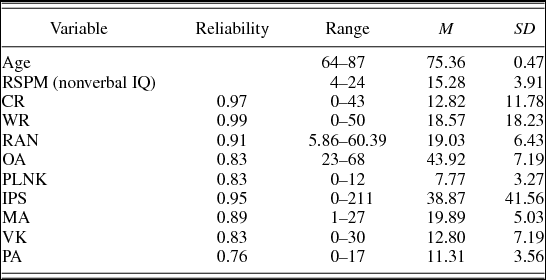
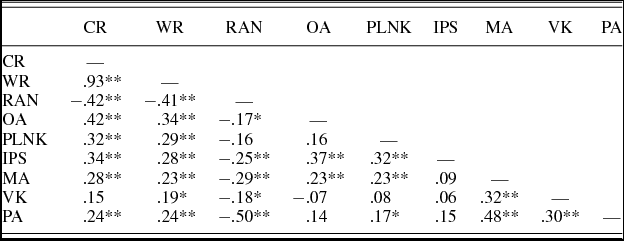
The reliabilities, ranges, means, and standard deviations for all variables are displayed in Table 1. Table 2 shows all correlations among included variables. After statistically controlling for age and RSPM, character reading and word reading were significantly correlated (r = .93). RAN, orthographic awareness, Pinyin letter-name knowledge, invented Pinyin spelling, morphological awareness, and phonological awareness were significantly correlated with both character reading and word reading, though vocabulary knowledge was only significantly associated with word reading (correlations of vocabulary knowledge with character and word reading did not differ statistically from one another, however). Orthographic awareness was significantly more highly correlated with character reading (r = .42) than with word reading (r = .34; Z = 2.75, p < .01). A similar pattern was reflected in the relations of invented Pinyin spelling with character reading (r = .34), and word reading (r = .28; Z = 2.00, p < .05.)
Reliabilities, ranges, means, and standard deviations for variables (N = 142)

Note: RSPM, Raven's Standard Progressive Matrices, CR, character reading; WR, word reading; RAN, rapid automatized naming; OA, orthographic awareness; PLNK, Pinyin letter-name knowledge; IPS, invented Pinyin spelling; MA, morphological awareness; VK, vocabulary knowledge; PA, phonological awareness.
Pearson correlations among variables after controlling for age and Raven's Standard Progressive Matrices
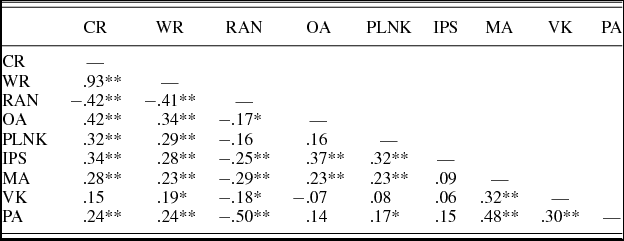
Note: N = 142. CR, Character reading; WR, word reading; RAN, rapid automatized naming; OA, orthographic awareness; PLNK, Pinyin letter-name knowledge; IPS, invented Pinyin spelling; MA, morphological awareness; VK, vocabulary knowledge; PA, phonological awareness.
*p < .05. **p < .01.
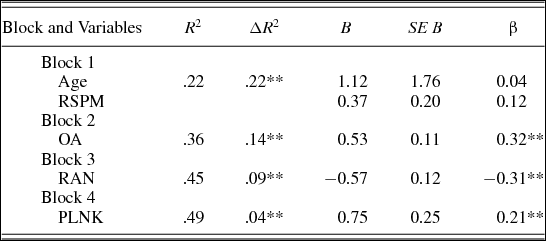
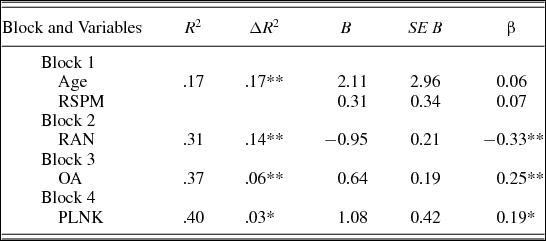
In order to examine the unique correlates of character reading and word reading, we then conducted stepwise regression analyses with all significant correlates from Table 2 included. We entered children's age and RSPM at Step 1, and then entered RAN, orthographic awareness, Pinyin letter-name knowledge, invented Pinyin spelling, morphological awareness, and phonological awareness stepwise at Step 2. After statistically controlling for age and RSPM, as indicated in Table 3 and Table 4, orthographic awareness, RAN, and Pinyin letter-name knowledge independently explained 14%, 9%, and 4% unique variance in character reading and 6%, 14%, and 3% unique variance in word reading, respectively.
Stepwise regression explaining Chinese character reading with age and RSPM controlled
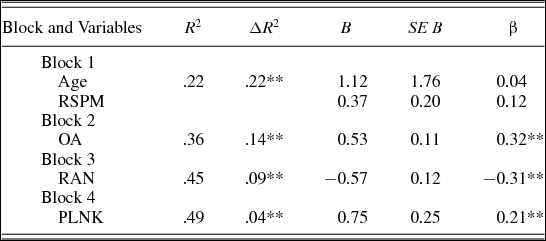
Note: N = 142. RSPM, Raven's Standard Progressive Matrices; OA, orthographic awareness; RAN, rapid automatized naming; PLNK, Pinyin letter-name knowledge.
**p < .01.
Stepwise regression explaining Chinese word reading with age and RSPM controlled
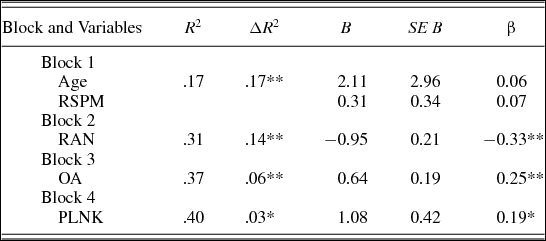
Note: N = 142. RSPM, Raven's Standard Progressive Matrices; RAN, rapid automatized naming; OA, orthographic awareness; PLNK, Pinyin letter-name knowledge.
*p < .05. **p < .01.
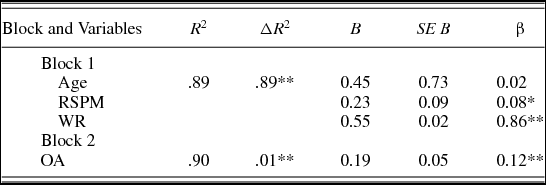
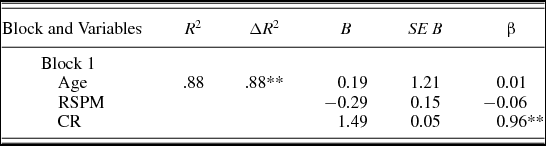
Because we sought to understand independent correlates of character reading and word reading given the high correlations between them, we further statistically controlled for each in the analyses for explaining the other (i.e., word reading was statistically controlled for when character reading was the dependent variable, and vice versa). As shown in Table 5, with age, RSPM, and word reading statistically controlled for, only orthographic awareness still explained 1% unique variance in character reading. For word reading, however, no unique skill emerged after controlling for character reading, as shown in Table 6.
Stepwise regression explaining Chinese character reading with age, RSPM, and WR controlled
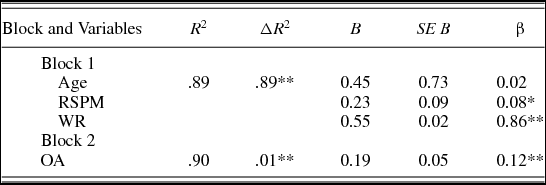
Note: N = 142. RSPM, Raven's Standard Progressive Matrices; WR, word reading; OA, orthographic awareness.
*p < .05. **p < .01.
Stepwise regression explaining Chinese word reading with age, RSPM, and CR controlled
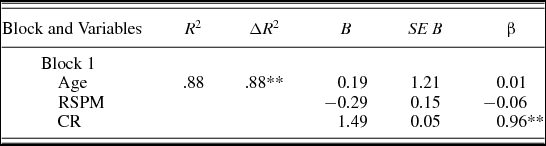
Note: N = 142. RSPM, Raven's Standard Progressive Matrices; CR, character reading.
**p < .01.
Overall, the results demonstrated that, for beginning learners, Chinese character reading and word reading are closely related; but in terms of correlations with other reading-related skills, they are not the same thing. Although orthographic awareness, RAN, and Pinyin letter-name knowledge contributed unique variance to both character reading and word reading, only orthographic awareness contributed uniquely to character reading even after statistically controlling for word reading. RAN is a traditional literacy-related skill that may facilitate children's accurate and efficient access to lexical awareness in both character and word reading, which has been linked to Chinese reading in many studies (e.g., Lei et al., Reference Lei, Pan, Liu, McBride-Chang, Li and Zhang2011; Liao, Georgiou, & Parrila, Reference Liao, Georgiou and Parrila2008; McBride-Chang et al., Reference McBride-Chang, Liu, Wong, Wong and Shu2011). Orthographic awareness and Pinyin knowledge also emerged as unique predictors of character reading and word reading. Despite the close relations between character reading and word reading and some common correlates of them, some component skills that are associated with character reading and word reading are different. For example, the associations of both orthographic and Pinyin tasks were somewhat higher for character than for word reading. More striking was the unique contribution of orthographic awareness to character reading even after statistically controlling for word reading.
The significant contribution of orthographic awareness to character reading implies that children likely focus on the internal orthographic structures of characters, including the positions of components and the linguistic function of each component. Our results were consistent with previous findings that analytic processing tends to be predominant on the character level, and children tend to focus more on the processing of orthographic information (Liu et al., Reference Liu, Chung, McBride-Chang and Tong2010). In Siok and Fletcher's (Reference Siok and Fletcher2001) study, visual–orthographic skill played a role in Chinese reading only at later stage of reading development. The current findings suggest that visual–orthographic analysis skill can help children to build a strong association between a character's visual graphic form and the pronunciation for it that has been stored in children's mental lexicon. As a phonological transcription method, Pinyin knowledge assists in facilitating memorization of characters and in stabilizing phonological representations, especially for young children. Our hypothesis that orthographic awareness and Pinyin knowledge might be more strongly associated with character as compared to word reading for this reason was partly supported. We found less evidence for our ideas about morphological awareness and vocabulary knowledge and word reading. Morphological awareness was modestly associated with both character and word reading, but it was not uniquely associated with either when other significant correlates were included in analyses. It is possible that the association between reading and morphological awareness may be stronger in the direction of reading promoting subsequent morphological knowledge. Longitudinal studies could help to tease apart such associations. At the same time, however, we know from previous work on very young Mainland Chinese children that morphological awareness explains subsequent variability in word reading with development (Lei et al., Reference Lei, Pan, Liu, McBride-Chang, Li and Zhang2011). Future work should compare correlations of morphological awareness with word and character recognition at different ages for Chinese children. In addition, although vocabulary knowledge was significantly associated with word reading but not with character recognition, the correlations did not differ significantly from one another. We had initially hypothesized that vocabulary knowledge would be more strongly associated with word than with character recognition. It may be that with development, as children acquire more vocabulary knowledge, the association of vocabulary knowledge with word reading is stronger than the association of it with character recognition. However, to examine this possibility, longitudinal studies are required. Admittedly, evidence for this idea is so far relatively weak.
GENERAL DISCUSSION
Our two studies of young children from Mainland China suggest that Chinese character reading and word reading involve somewhat different acquisition processes. Study 1 showed that children performed differently in the reading processes of individual characters and characters within words, and Study 2 further demonstrated that the correlates of character reading and word reading were not the same, although they were highly correlated.
Because Chinese is a meaning-based writing system and most Chinese words are compounds, multicharacter words tend to be easier for children to access than are the same characters in isolation. Based on children's knowledge of how characters can be compounded with other morphemes in oral language, knowing one character within the word can help children in reading the other new ones. As one important aspect of morphological awareness, lexical compounding awareness, focused on the ability to combine morphemes legally for words, might facilitate children's reading of new words, especially in the early learning years. When children encounter words that consist of two characters, one that they do recognize and one that they do not recognize, lexical compounding awareness can potentially help children to make educated guesses about the unfamiliar characters within the new words from their oral language experience and the context. This was one initial idea that motivated the present study.
In alphabetic languages, letters are the smallest units and make up words. Letter sounds and word reading are highly associated across alphabetic orthographies (Caravolas, Lervag, Defior, SeidlováMálková, & Hulme, Reference Caravolas, Lervåg, Defior, SeidlováMálková and Hulme2013). In Chinese, characters are the basic units of writing Chinese, and words are composed of one or more characters. Character reading and word reading seem closely related to each other, with some analogy to alphabetic orthographies. The present study showed a strong correlation between character reading and word reading. Previous studies on Chinese adults have indicated that constituent characters play a significant role in Chinese compound-word recognition (e.g., Zhou & Marslen-Wilson, Reference Zhou and Marslen-Wilson1995; Zhou, Marslen-Wilson, Taft, & Shu, Reference Zhou, Marslen-Wilson, Taft and Shu1999). The processing of initial characters activates the semantic representations of whole compound words. This is likely a bidirectional association between children's character reading and word reading. Character reading and word reading reinforce one another in the reading process in Chinese children. Those who can recognize more characters are more likely to read more compound words; in turn, they may also make use of morphological construction and vocabulary knowledge to learn more new characters.
As shown in Study 2, Chinese character reading and word reading involve some common core skills. RAN, orthographic awareness, and Pinyin letter-name knowledge independently contributed to both character reading and word reading, although orthographic awareness was particularly strongly associated with character reading. These findings revealed somewhat different correlates of character reading and word reading in Chinese kindergarteners, highlighting particularly the unique importance of orthographic awareness for character reading. If future research replicates and extends these findings, we suggest that orthographic and Pinyin skills may particularly facilitate character recognition. Future work should focus more on the extent to which such patterns hold up across different Chinese societies and different developmental levels. Practically, the findings reported here suggest that an instructional approach to character recognition in school can focus more on orthographic knowledge.
Our hypotheses about the important component skills that facilitate word recognition were not clearly supported. Although we could point out that the correlation between vocabulary knowledge and word reading was significant and the correlation between vocabulary knowledge and character recognition was not, it is also the case that the two correlations were relatively low in magnitude and did not differ from one another. The strategy of using morphological awareness and oral vocabulary knowledge to read Chinese words has been discussed elsewhere as a strategy developed by a second language learner of Chinese (McBride-Chang, Shu, Ng, Meng, & Penney, Reference McBride-Chang, Shu, Ng, Meng, Penney, Wagner, Muse and Tannenbaum2007). Thus, practically, and at an individual level, it has been the case that some learners of Chinese reflect that they do make use of the understanding of lexical compounding structures and vocabulary knowledge to read words in context. Perhaps correlational tasks, such as the ones included in the present study, do not capture such strategy use adequately. Correlations may not reflect such trends the way experiments might. There is some sense in which Study 1 did show a tendency for readers to capitalize on contextual information for reading. However, in order to capture this trend more carefully, it may be that a more specific (rather than general) test of vocabulary knowledge and another one of morphological awareness might be needed at different ages to test for associations of such tasks with both character and word reading.
There are, thus, specific critiques that should be noted related to this research in the aspects of design. The character reading task was administered before the word reading task. We did this to cut down on what we expected would be contextual effects if the reading tasks had been reversed. However, in future work, the two tasks should be administered in counterbalanced orders to ensure less bias in this aspect. In addition, given that we found no strong evidence for either morphological awareness or vocabulary knowledge being more strongly associated with word, as compared to character, reading we may have to rethink what measures of morphological awareness and vocabulary knowledge might be better to capture these constructs. Our purpose here would be to retest this hypothesis that morphological awareness and vocabulary knowledge might more strongly influence word reading, at least in some age groups. One suggestion for a different type of task might be, rather than asking children to define words as a representative construct of vocabulary knowledge (expressive vocabulary), we might learn more from asking children to identify words in context to count numbers of words known in a simpler way (to tap receptive vocabulary, perhaps a clearer measure for the hypothesis put forward). This is not easy to do, but for the purpose of this study, it might be a better measure.
Despite these design constraints, however, the present study has demonstrated some potentially important aspects of reading in Chinese. First, although children's performances on Chinese character and word recognition overlap highly, they are not the same thing. For example, it is significantly easier for children to read characters in the context of words than alone. Second, for Mainland Chinese kindergartners, early Pinyin knowledge and orthographic awareness are particularly important for learning to recognize characters. Third, there are likely to be different correlates, suggesting potentially different strategies, for character and word reading in Chinese. We have offered only a very preliminary step in examining these. Most important, we have pointed out that these two processes might be different. Future research should continue our preliminary quest to determine what abilities, suggestive of different strategies, might influence each.