


INTRODUCTION: MEMOIRS OF FILIALFootnote 1 MEN IN DYNASTIC HISTORIES
Tales about filial men are an important part of Chinese literatureFootnote 2 and the genre is also closely linked to historiography. From Shen Yue's 沈約 (441–513) Song shu 宋書 onward, the majority of the collective chapter sections found in the dynastic histories include a chapter with biographies of men who are remembered for the unusual devotion they showed in nurturing their parents and relatives. In all, 16 of the 24 dynastic histories—exactly two-thirds—contain such a chapter.Footnote 3 It has, therefore, to be considered one of the standard components of the annals-biographies style (jizhuan ti 紀傳體).Footnote 4
Judging by the earliest appearance of such a collective chapter, one could assume that the origins of the close link between the genre of tales of filial piety and this style of historiography lie somewhere in the second half of the Six Dynasties period.Footnote 5 In light of how important filiality was for the selection of officials during the Western Han (207 BCE–9 CE) and the Eastern Han dynasty (25–220 CE) this seems late.Footnote 6 One would rather expect the histories of dynasties that selected candidates for their filiality to contain some form of historiographical representation of this fact. And, as this paper will demonstrate, it is indeed misleading to look only at the collective chapter sections at the end of the dynastic histories. Fan Ye's 范曄 (398–446) history of the Later Han dynasty, the Hou Han shu 後漢書, does contain a forerunner of the later memoirs of filial and righteous men. But the way it was inserted into the Hou Han shu does not immediately point to it being a collection of biographies of filial men. This is due to two reasons: for one, the title does not suggest any relationship with filial piety. The chapter is usually not called a xiaoyi 孝義, xiaoyou 孝友, or xiaoxing 孝行 liezhuan like the ones in later histories. It is instead referred to in accordance with the family names of the men it contains: Memoirs of Liu, Zhao, Chunyu, Jiang, Liu, Zhou and Zhao 劉趙淳于江劉周趙列傳第二十九. It consists of seven main biographies for Liu Ping 劉平, Zhao Xiao 趙孝, Chunyu Gong 淳于恭, Jiang Ge 江革, Liu Ban 劉般, Zhou Pan 周磐, and Zhao Zi 趙咨, and eight subordinated biographies that were included because of some form of tie to the main biographies. These treat Wang Wang 王望 and Wang Fu 王扶, who were recommended along with Liu Ping; Liu Kai 劉愷, who was included because of his father Liu Ban; and Cai Shun 蔡順, Wei Tan 魏譚, Wang Lin 王琳, Ermeng Ziming 兒萌子明, and Checheng Ziwei 車成子威, about each of whom the historian tells one or more short tales of filial piety or righteousness that are similar to the ones seen in the life descriptions of the main biography holders. In addition to these fifteen biographies of varying length, the chapter briefly relates the stories of Mao Yi 毛義 and Xue Bao 薛包 in the preface, in order to give the reader short examples of what kind of biographies he can expect to read in the Chapter.Footnote 7
The second deviation from the latter norm that keeps readers from immediately connecting the chapter to the later Xiaoyi chapters is its placement. Fan Ye did not group it together with the other collective chapters with biographies of scholars, literati, eunuchs, magicians, etc., which are found at the end of his work.Footnote 8 Instead, he inserted it at the end of the section with biographies of officials who served under the Emperors Ming 明帝 (r. 57–75) and Zhang 章帝 (r. 75–88).Footnote 9 The reason for this is unclear. It might be that Fan Ye wanted to stress the important role filial office holders played during the reigns of these two emperors. It might also be that he simply chose this arrangement because the majority of the people in the chapter lived during these reigns.Footnote 10
Despite these two misleading factors, however, the chapter's structure and content make it clear that Fan Ye collected biographies that revolve around the value of filial piety (xiao 孝). The chapter opens with a discussion of filiality and the biographies contain roughly twenty anecdotes in which filial acts are described. Fan Ye was not the first to compile such a chapter but rather followed the example given by his predecessor Hua Qiao 華嶠 (?–293).Footnote 11 Hua Qiao compiled a Han Hou shu 漢後書 during the Western Jin dynasty and thus about 150 years prior to Fan Ye. Although this work is no longer available, thanks to the quotation of Hua's chapter preface on the value of filial piety (which will be analyzed in the next section) in Yuan Hong's 袁宏 Hou Han ji 漢後紀Footnote 12 and discussions of his history in works like the Shitong 史通, we know that it already contained a chapter about filial men. Fan Ye seems to have stuck closely to this predecessor. He copied Hua Qiao's preface and used it as an opening for his own chapter.Footnote 13 As far as we can tell today, he also included mostly the same historical figures that Hua did in his version.Footnote 14
This leads to many questions. Why did historians who worked a long time after the fall of the Later Han start to gather biographies of filial exemplars? What was the nature of their sources? What role did filiality play for the biographies? What is the relationship between the chapter and the society in which it was compiled? Much about this early historiographical representation of filiality is still unclear, as, so far, Chapter 39 has not been analyzed in detail. Donald HolzmanFootnote 15 and Keith KnappFootnote 16 used it to varying extents for their works on filial piety tales and the Hua Qiao quotation that acts as a preface attracted some attention,Footnote 17 but as yet, there is no study dedicated to its content and textual history. The following pages are an attempt to fill that gap and, in particular, they pursue three goals: Firstly, the paper wants to analyze the textual basis of Fan Ye's chapter and try to reconstruct the compilation process as far as possible. In order to see what Hua Qiao and Fan's roles were in the creation of the text, it will take a look at the various fragments from preceding works on the Later Han dynasty. Secondly, it wants to assess the nature of the role filial piety plays in the chapter. As we will see, this is the key to understanding what sets the precursor apart from the later, more standardized representatives of Xiaoyi chapters. Thirdly and lastly, it wants to answer the question of just what it meant to be an exemplar of these values according to Fan Ye and Hua Qiao. Careful analysis of the preface and of the most common motives used in the individual biographies will hopefully shed some light on the many open questions surrounding the chapter.
THE TEXTUAL HISTORY OF CHAPTER 39
The first question to be addressed is the one of the textual history and the compilation process of Chapter 39. If Fan Ye had authored all the content of his Hou Han shu, this would place it in the first half of the fifth century CE, and, thus, close to the first known collective chapter on filial men by Shen Yue. But the Hou Han shu is a relatively young recompilation of earlier histories of the Later Han dynasty and all the biographies it contains have predecessors. As described in the introduction, through fragments and information contained in the Shitong Fan Ye's chapter can be relatively safely traced back to Hua Qiao's chapter on filial men compiled during the Western Jin dynasty. Therefore, the idea to gather a collective chapter on filial men precedes Fan Ye by more than 150 years. Usually, the research into the compilation history of the chapter ends here. But with our knowledge of the historiography of the Later Han dynasty, we can trace the source of the contents that Hua and Fan used a little further back and learn more about when these biographies were written.
The most important source for the content of the Hou Han shu and all its predecessors—including, therefore, Hua Qiao's workFootnote 18—was the Dongguan Han ji 東觀漢記, a history in the annals-biography style that was started by Ban Gu 班固 (32–92) and that was extended in several steps during the Later Han dynasty (25–220).Footnote 19 Owing to the tumultuous times after the fall of the Later Han and the repeated change of capitals, the original documents in the archives were lost, which quickly turned the government-sponsored enterprise Dongguan han ji Footnote 20 into the main source for the events of most of the dynasty. Bai Shouyi, therefore, once called it a “treasury for historical materials on the Later Han dynasty” 东汉历史材料的宝库 and concluded that “the histories of the Later Han dynasty by the succeeding authors all made it the basis for their materials” 此后诸家后汉史著作,基本都以它为主要材料来源.Footnote 21 This was also most probably what Liu Xie 劉勰 (465?–521?) had in mind, when he remarked in his Wenxin diaolong 文心雕龍 that “the annals and biographies on the Later Han had their source in the Eastern Watchtower” 至於後漢紀傳,發源東觀.Footnote 22
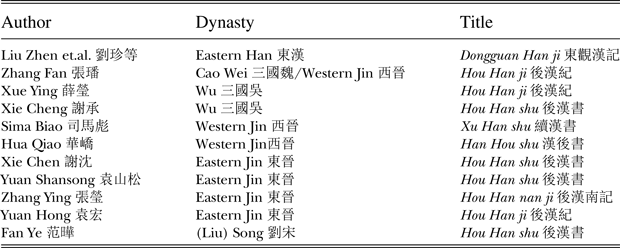
The quality of the compilation, however, did not meet the standards of many literati and the widespread dissatisfaction it caused led to a boom of recompilations during the Six Dynasties.Footnote 23 Pulleyblank writes: “The work of the government-sponsored historians in the Tung-kuan Library in the second century CE provided basic material for the history of the Later Han, but the work which they produced was not considered very satisfactory and there were numerous attempts by private persons to write histories of that dynasty […].”Footnote 24 The results of these attempts are the two still extant works—Fan Ye's Hou Han shu and Yuan Hong's Hou Han ji—as well as seven works, now lost, which are together with the Dongguan Han ji collectively known as the Eight Authors of Later Han histories 八家後漢書.Footnote 25 Table 1 shows the histories in roughly the order of compilation
Histories of the Later Han dynasty.
The fact that the Dongguan Han ji was one of the main sources, or perhaps the main source, for all later works on the Eastern Han dynasty naturally also affects Chapter 39 of Fan Ye's Hou Han shu. While Hua Qiao's work was a predecessor, it was certainly not the only one, and neither Hua nor Fan wrote the contents of their chapters from scratch. From our theoretical knowledge of the Later Han historiography we rather have to assume that the Dongguan Han ji was the original source for their materials.
Keith Knapp has already traced the origins of individual biographies back to the Dongguan Han ji:
Han Records of the Eastern Pavilion (Dongguan Han ji)… was the first state-sponsored history that devoted biographies to people who were important solely because of their outstanding filiality.… Thus perhaps by the beginning of the second century AD, court historians were already devoting biographies to individuals who were noteworthy solely because of their filial piety.Footnote 26
The question that still needs to be addressed is how many biographies of filial men the Dongguan Han ji already contained. Only fragments remain of the workFootnote 27 and the other preceding histories of the Later Han, but these still allow us to make at least a rough estimate of how much material was already included in the older work.Footnote 28 Table 2 marks the availability of fragments for the biographies of Chapter 39 in the various works on the Later Han dynasty with an “x”:
The biographies of Chapter 39 in the older histories.
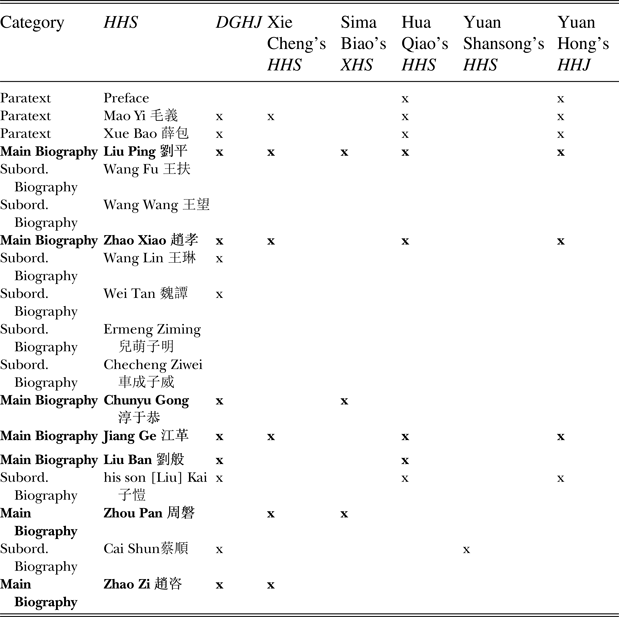
Table 2 strongly suggests that the majority of the men in Chapter 39 already had a biography somewhere in the Dongguan Han ji and that the materials were then used by the other authors of Later Han histories. It seems to be slightly more difficult to find fragments for the subordinated biographies, but this is probably a result of their brevity rather than their being based on later materials. Considering the relative scarcity of the fragments, it is safe to assume that some of the unaccounted biographies, too, were already included in the work.
But the fragments prove more than the mere existence of biographies for most of these historical figures already during the Later Han dynasty. They also suggest that their form and content did not change much since the initial versions in the Dongguan Han ji. Bielenstein writes on Fan Ye's way of compiling his work that “in rearranging the material, Fan Ye did not rewrite it. He copied his sources so closely as actually sometimes to make the HHS inconsistent.”Footnote 29 This is both true for his compilation of Chapter 39 and for the other historians of the Later Han dynasty. If one compares the various fragments with today's Hou Han shu, it becomes apparent that the historians who worked after the fall of the Later Han dynasty mostly compiled and adjusted existing materials and only rarely created new content. A telling example is the biography of Mao Yi, which served both Fan Ye and Hua Qiao as an introductory example for their chapters. It is also included in the Hou Han ji and there are fragments of the Dongguan Han ji, Hua Qiao's Han Hou shu and Xie Cheng's Hou Han shu. These are the versions found in Dongguan Han ji and Hou Han shu:
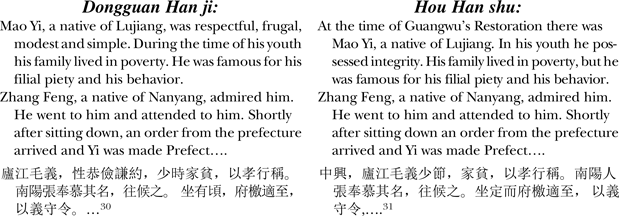
The textual version of the Hou Han shu is longer, and the passage of the Dongguan Han ji ends rather abruptly,Footnote 32 but the close relationship between the fragments is still visible. The other fragments are virtually identical.Footnote 33
Finding that many fragments of the same anecdote is rare, but there are many other less complete examples that clearly point in the same direction. One more should suffice here to give a good impression of the similarities. This is the beginning of the first anecdote in Xue Bao's biography, the second introductory example of Chapter 39:
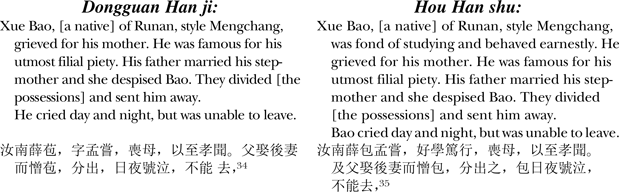
It is again obvious that the common ancestor of all the versions is the Dongguan Han ji.Footnote 36
These were just two examples of the filial piety tales in Chapter 39 that can be traced back to the Dongguan Han ji. In all, more than a third of the roughly twenty filial piety anecdotes that will be analysed in detail in Section Five of this paper can be proven to have been written during the Later Han dynasty through the help of fragments.Footnote 37 These are: Wang Lin offers to sacrifice himself (HHS 39.1300 - DGHJ 15.645), Liu Ping offers to sacrifice himself (HHS 39.1296 - DGHJ 15.639), Zhao Xiao offers to sacrifice himself (HHS 39.1299 - DGHJ 15.641), Jiang Ge pulls the cart for his mother (HHS 39.1302 - DGHJ 15.648), Zhao Zi welcomes thieves (HHS 39.1313 - DGHJ 15.654), Liu Kai yields his fief to his younger brother (HHS 39.1306 - DGHJ 15.652), Liu Ping sacrifices his own son for his brother's daughter (HHS 39.1295f - DGHJ 15.639), Wei Tan offers to sacrifice himself (HHS 15.645- DGHJ 15.643), and Wang Lin grieves for his parents (HHS 39.1300 - DGHJ 15.645). For all these anecdotes we can find fragments that strongly suggest that they had been written long prior to the time Fan Ye and Hua Qiao worked with them.
Taken together, the fragments therefore prove that the roots of most of Fan Ye's and Hua Qiao's contents go back all the way to the Dongguan Han ji, which was compiled during the Eastern Han dynasty.Footnote 38 This should not be mistaken to mean that all the Later Han historians told the same stories. Through selecting and adapting their sources they were able to express their own opinions. But the materials they used in doing so can be traced back to the same source. Therefore, the content of these chapters precedes Shen Yue's first proper Xiaoyi chapter in the Song shu by three centuries and already during the Later Han dynasty exemplars of filial piety played an important role for the historiographical tradition. They just had not yet found their later typical place in a collective chapter and were instead most probably still spread over the whole work. For reasons that we will look at now, Hua Qiao decided to gather them in a chapter devoted specially to filiality and Fan Ye later accepted his solution.
PREFACE AND CONTENTS OF THE CHAPTER
Why did Hua Qiao and Fan Ye decide to change the structure of their source and compile a chapter on filial men? The answer to this is given in the preface of Chapter 39, in which filial piety is introduced as the leitmotif.Footnote 39 The piece starts with a collection of quotations from classical sources, in which the connection between filiality (xiao 孝) and nourishing (yang 養) is touched upon (translations of the three quotations: Legge):
Master Kong said: “In filiality nothing is greater than being in awe of one's father. In being in awe of one's father nothing is greater than matching him with Heaven. The duke of Zhou was such a man.”Footnote 40 Zilu said: “Alas, the poor! While [their parents] are alive, they have nothing to nourish them. When they are dead, they have nothing to bury them with.” The master said: “Sipping bean [soup] and drinking water; that is filiality.”Footnote 41
孔子曰:「夫孝莫大於嚴父,嚴父莫大於配天,則周公其人也。」子路曰:「傷哉貧也!生無以養,死無以葬。」子曰:「啜菽飲水,孝也。」
The first quotation establishes the necessity to take care of the parents. The latter two revolve around the means necessary to do so and Hua Qiao picks up this point in the next paragraph, in which he expresses his own thoughts on the nature of the relationship of nourishing and filiality:
Bell and drum are [only instruments and] not the origin of music, but the instruments can't be neglected.Footnote 42 [Nourishing with the flesh of the] three domestic animals is not the most important part of filial piety, but for nourishing it can't be neglected. Keeping the instruments [in mind] but forgetting about the origins lets the music get out of control. [But] tuning the instruments in order to harmonize their sound leads to the perfection of music. Venerating and nourishing [by means obtained] through harmful behavior weakens one's filial piety. [But] cultivating oneself in order to attain the salary of an official post augments one's nourishing.
夫鍾鼓非樂云之本,而器不可去;三牲非致孝之主,而養不可廢。存器而忘本,樂之遁也;調器以和聲,樂之成也。崇養以傷行,孝之累也;脩己以致祿,養之大也。
Hua Qiao thus explains the close connection of proper behavior, holding an official position and being able to nurture one's relatives in the correct way. He compares the meaning of holding an official post for filial piety with the one of instruments for music and of meat for a proper diet.Footnote 43
The preface then continues to elaborate what was already hinted at in the last sentence of the preceding paragraph: that simply attaining an office is not enough. To be considered filial it is not sufficient to simply obtain the resources necessary to nourish one's relatives via an official post. In order to truly fulfill the ideal the office holder must also do his best to cultivate himself and to serve the state to the fullest:
If we therefore speak about the ability of nourishing in a grand way, then the sacrifices made by the Duke of Zhou [may serve as an illustration], as these sacrifices reached the entire world. If we speak about nourishing in a righteous way, then the beans of Zhongyou (Zilu 子路) tasted sweater than the [ox] sacrificed by the eastern neighbor.Footnote 44 As to worries about the lacking quality of water and beans: he who [only] strives for an official salary because he wants to nourish brings disgrace [to the idea] of nourishing relatives with a salary. He who maintains his honesty in order to perfect his behavior, who amasses filial piety and whose salary for a government position is generous is able to nourish righteously.
故言能大養,則周公之祀,致四海之祭;言以義養,則仲由之菽,甘於東鄰之牲。夫患水菽之薄,干祿以求養者,是以恥祿親也。存誠以盡行,孝積而祿厚者,此能以義養也。Footnote 45
Hua Qiao and Fan Ye were therefore interested in biographies of men who had the quality of filial piety and, at the same time, excelled in government positions through their high level of self-cultivation. This in return provided them with the means to nourish their parents.
In order to further elaborate this point, the two historians included two short examples,Footnote 46 the above already partially quoted biographies of Mao Yi and Xue Bao.Footnote 47 They both describe highly filial sons who eventually take up offices, display appropriate behavior, and are heavily rewarded by the emperor for this.Footnote 48 After the two short accounts, Fan Ye and Hua Qiao finish their introduction with the following words:
These two sons applied the utmost honesty when they acted. In their behavior they trusted their hearts and [through this] they moved others. Because of their accomplished reputations they obtained an official salary and received gifts [from the emperor]. This can be called being able to nourish by means of [possessing the value of] filial piety. The correct behavior of Jiang Ge, Liu Pan and many other excellences also [displays] this will. I therefore gathered their deeds in this chapter.
若二子者,推至誠以為行,行信於心而感於人,以成名受祿致禮,斯可謂能以孝養也。若夫江革、劉般數公者之義行,猶斯志也。撰其行事著于篇。Footnote 49
In this preface Fan Ye and Hua Qiao explain that they saw a close connection between filiality and an official career and that they therefore set themselves the goal of collecting biographies of successful filial office holders.
We do not know exactly how Hua Qiao continued his chapter, as the fragments for his biography section are very few. But that at least Fan Ye stuck closely to this leitmotif becomes clearer when looking at the careers of the seven main individuals he described. Table 3 shows the recommendations and offices that were offered to them.
The careers of the filial exemplars in Chapter 39.
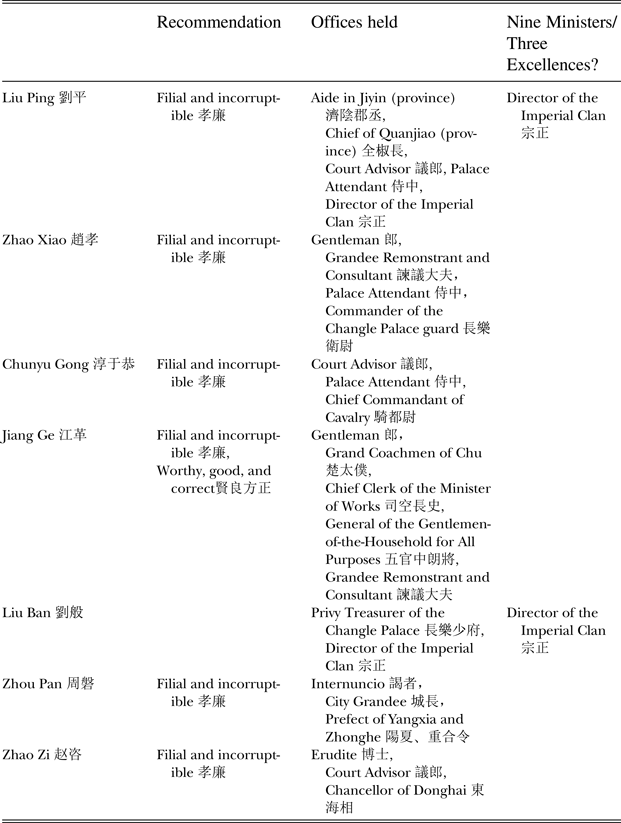
Table 3 shows several things: Firstly, the majority of the main biography holders were recommended as filial and incorruptible (xiaolian 孝廉). Secondly, the careers of the men were quite similar. Most of them held consulting offices like Court Advisor 議郎 or Grandee Remonstrant and Consultant 諫議大夫. Thirdly, two even made it into the ranks of the Three Officials 三公 and Nine Ministers 九卿 and became Directors of the Imperial Clan 宗正. The biographies thus mirror Fan Ye's and Hua Qiao's explanations and focus on men who were revered for their filiality, obtained an office and, in a few cases, gained considerable political importance.
To conclude this section: Hua Qiao and later Fan Ye included a preface in which the close connection of filial piety and official positions is explained and then selected biographies of men who were exemplars of that. The subjects of the biographies were, in most cases, recommended as filial and incorruptible, and many of them attained high offices. Keith Knapp suggested that “in History of the Han's Later [Half], filial heroes were still not so significant that their chapter merited a special name or place within the history.”Footnote 50 However, the careers of the men make it clear that Fan Ye did not mean filing the biographies among the other important officials of the reigns of emperors Ming and Zhang and not giving it a name typical for a collective chapter to be derogatory. What Hua Qiao and he actually did was to compile a chapter on important officials of this time who were known and selected for their filial piety and whose biographies had previously been arranged according to different criteria in the Dongguan Han ji.
THE CONNECTION BETWEEN CHAPTER 39 AND THE RECOMMENDATION SYSTEM OF THE LATER HAN
In order to understand the reason behind this we have to briefly turn to the recommendation system of the Later Han and especially the category of “filial and incorruptible” (xiaolian 孝廉), through which almost all the officials in Chapter 39 had begun their official careers. A recommendation was one of the most important ways to achieve an office during the Later Han dynasty. As Holcombe in his study In the Shadow of the Han writes: “There were… three specific ways to be recommended for government office. These were ‘local recommendation’ (hsüan-chü), direct summons either by the emperor himself or by a ranking official, and inheritance—the ‘appointment of sons’ (jen-tzu). Among the three, inheritance did not lead directly to any significant office, and direct summons were of limited application, leaving ‘local recommendation’ to become a kind of standard channel into the imperial bureaucracy.”Footnote 51
There were several categories according to which a candidate could be recommended for office,Footnote 52 but “filial and incorruptible” was the most common one in the Later Han dynasty. In all, we find the phrase “was recommended as filial and incorruptible” (ju xiaolian 擧孝廉) a staggering 120 times in the Hou Han shu. Already the emperors of the Western Han dynasty started to appoint candidates for office according to their filiality and this way of selecting officials gained steadily in importance throughout the course of the dynasty.Footnote 53 In one of his edicts Emperor Huan 桓 (r. 146–68) summarizes his high esteem for the category in the following words: “Filial and incorruptible men and incorruptible officials are the ones who ought to administer cities and tend to the people and who ought to restrict the criminals and recommend good [men]. They are the root of prosperity and reform and they always have to be made the foundation” 丙戌,詔曰:「孝廉、廉吏皆當典城牧民,禁姦舉善,興化之本,恆必由之.Footnote 54 For most times there were fixed annual quotas for people that had to be recommended according to this category, but the emperors could increase or decrease the amount of recommended men according to the current needs of the state, as it happened for example in the year 102 CE, when the following edict was issued: “The border commanderies with more than a hundred thousand inhabitants should each recommend one filial and incorruptible man per year. The ones with less than a hundred thousand inhabitants should recommend one man every second year and those with less than fifty thousand inhabitants one every three years.” 其令緣邊郡口十萬以上歲舉孝廉一人,不滿十萬二歲舉一人,五萬以下三歲舉一人.Footnote 55
Hans Bielenstein analyzed and described the recommendation system in his study on the bureaucracy of the Han, but there are still some aspects of the process that are not clear. One of the biggest open questions is what the two values “filial” (xiao) and “incorruptible” (lian) actually meant during the Later Han dynasty. We can at least partially address this problem by analyzing the short stories or anecdotes that are occasionally provided by Fan Ye to explain the reason for a recommendation. From looking at these it becomes clear that the described acts usually fall either in the category of “filial” or in the one of “incorruptible.” Many of them have little to no connection to filiality and instead rather tell us stories that demonstrate that somebody could not be influenced or tempted by wealth and riches, like in the following examples:
Feng later met bandits. All his possessions were taken from him and only seven bolts of silk remained whose whereabouts the bandits did not know about. Feng thereupon chased after them and handed the [bolts] to them, saying: “I know that you gentlemen are in need. Therefore I leave these to you as a present.” The bandits were surprised and said: “This is a worthy man.” They returned all his goods to him. Later he was recommended as filial and incorruptible.
封後遇賊,財物悉被略奪,唯餘縑七匹,賊不知處,封乃追以與之,曰:「知諸君乏,故送相遺。」賊驚曰:「此賢人也。」盡還其器物。後舉孝廉,Footnote 56
This story contains no mention of relatives; instead it demonstrates that Feng would not be corrupted by possessions. If this was the reason for his recommendation—which Fan Ye's order of the events strongly suggests—, we have to assume that this act somehow fulfilled the requirements for somebody who was considered incorruptible (lian). The next example is very similar:
Yu was sincere, generous and frugal. His father died and the officials and inhabitants of Ji supported him with huge sums of money, but he would not accept any of it. He also gave his fields and his house to his uncle and went to live somewhere else. In the eighth year he was recommended as filial and incorruptible. He was gradually promoted.
禹性篤厚節儉。父卒,汲吏人賻送前後數百萬,悉無所受。又以田宅推與伯父,身自寄止。永平八年,舉孝廉,稍遷;Footnote 57
Again, we find the description of a man who willingly gave up everything, also for people outside of his family, and in return was recommended as filial and incorruptible. The Hou Han shu contains many more of these stories, some also very short, like the following example:
Tan Bao, style Wenyou, was a native of Xiaqiu in Shanyang. In his youth he became a scholar. His family was poor but his intentions were pure. He would not accept any alms from his home village. He was recommended as filial and incorruptible and repeatedly summoned by the Offices of the Excellences, but he did not go to any of them.
檀 字文有,山陽瑕丘人也。少為諸生,家貧而志清,不受鄉里施惠。舉孝廉,連辟公府,皆不就。Footnote 58
These men were not interested in possessions and demonstrated that they could not be corrupted, which qualified them for office.
The anecdotes that describe a candidate's filiality are more in accordance with our notions of the value. We find, for example, the well-known trope of the son who grieves himself to the verge of death over his parents’ grave:
Biao's filial behavior was pure. His parents died and he ruined [his body] for three years. He did not leave the grave hut. When the funeral service was finished, he was weak and emaciated. Only after several years of medical treatment was he able to get up again…. At the end of the Jianwu period he was recommended as filial and incorruptible.
彪孝行純至,父母卒,哀毀三年,不出廬寑。服竟,羸瘠骨立異形,醫療數年乃起。[…] 建武末,舉孝廉,[…].Footnote 59
Extreme acts were not necessary. One version of filiality seems to have been the transmission of the family's teachings, as we see in the following example:
Dian, style Gongya, again transmitted his family's teachings. As a Master of Writing he taught in Yingchuan and had several hundred disciples. He was recommended as filial and incorruptible and became a Gentleman.
典字公雅,復傳其家業,以尚書教授潁川,門徒數百人。舉孝廉為郎。Footnote 60
Chapter 39 abounds in filiality anecdotes and as Section Five of this paper is an attempt to categorize them, these two examples are sufficient for now. From the observations made so far we can conclude the following: a recommendation as filial and incorruptible was one of the most important ways into office during the Later Han and the value of filiality was one of the cornerstones of the state ideology. People who committed either filial or incorruptible acts gathered local fame, were recommended and then received offices. The stories surrounding the recommendation made their way into the historiographical material.
This leads to the second open question surrounding these materials. As Section Five will demonstrate in more detail, the literary depiction of filiality is often both highly stereotypical and exaggerated, which throws some doubt on its authenticity. The question of the historical accuracy or truth behind the filiality anecdotes is therefore still debated. Donald Holzman argues for the truthfulness and reliability of the described acts. He compares them to phenomena like religious fundamentalism (“I believe they are true accounts of life in the Latter Han dynasty”). Hans Bielenstein, on the other hand, is very skeptical and believes them to be rhetorical tropes to describe circumstances or formalized praise for historical figures.Footnote 61 We will never know the answer, but in light of the political role filiality played I would argue that it is too rash to discard the stories as mere rhetorical devices or tales made up by the subjects themselves, their families, or the historians. Let's look, for example, at the motive of somebody being willing to be eaten by hungry bandits in order to make them spare the life of a relative (this will be analyzed in more detail in Section Five). Hans Bielenstein interpreted these and other tales about cannibalism found in the Hou Han shu as a way to give the reader a clearer picture of difficult living conditions: “One should not literally understand that people now and then resorted to cannibalism. The historian is not interested in recording that cases of cannibalism perchance had occurred. He only wants to stress that the famine was serious.”Footnote 62 Bielenstein himself has impressively demonstrated that the Later Han dynasty experienced many calamities and famines, especially in its beginning, where many of the tales in Chapter 39 are situated.Footnote 63 But the formalized and detailed way in which the tales are told suggests a function that exceeds Fan Ye's wish to describe times of famine. Otherwise, he could have simply written that the times were so bad that cannibalism happened repeatedly. This is indeed something the historian occasionally did. The Hou Han shu contains twelve references to “people eating one another” 人相食.Footnote 64 Instead, Fan Ye decided to give his readers these highly standardized and quite complex stories about people, who through outstanding behavior and a high level of self-cultivation influenced society. It seems more plausible to me that the main function of the tales was to characterize their protagonist and that the records reflect what the government had heard about a candidate from officials or the population. These stories about filiality and incorruptibility seem to be the reasons the candidates were recommended, rumors that reached the ears of local officials and were later written down by court officials to be kept in the archives. What makes the filiality stories so hard to believe is that they seem strange and stereotypical from a modern point of view, but that does not mean that they never happened. Holzman makes the convincing argument that the demand for people in certain categories triggered such actions in the society: “There can be no doubt whatever that one of the main incentives to filial behavior was the rewards the Han government was willing to give to filial sons. Even more important than rewards, the government created an official title that was often the first step for an otherwise unknown man of the provinces to be promoted to an official post.”Footnote 65
The exact procedure of how the filiality tales came to be written down and combined with the other information about the historical individual is not clear. But with the Dongguan Han ji and the other Later Han histories Fan Ye and Hua Qiao had access to a big collection of biographies in which filiality played an important role. The importance of the category “filial and incorruptible” seems, however, to have suffered strongly by the time they compiled their works. The history about Hua Qiao's own times, the Jin shu, contains only twenty-three cases in which somebody was recommended in it and the Song shu about Fan Ye's (Liu) Song dynasty only three.Footnote 66 Shen Yue also observed this change in society. In the appraisal at the end of his own Xiaoyi chapter, he wrote: “I, the chronicler and subject, say: In the time of the Han the noblemen took care of cultivating themselves and therefore loyalty and filial piety became customs. Thereupon they mounted the chariots and wore the caps [of officials]…” 史臣曰:漢世士務治身,故忠孝成俗,至乎乘軒服冕,….Footnote 67 Keith Knapp in his Selfless Offspring writes: “By the Eastern Jin (317–420), the ‘filial and incorrupt’ recommendation category became a secondary means for obtaining public office, to the extent that only members of lesser elite families, often called ‘cold gate [families]’ (hanmen), would deign to enter government by this means.”Footnote 68 Society had changed and for the two later historians studying the materials of the Dongguan Han ji and its various reworkings the recommendation as filial and incorruptible must have seemed to be a typical characteristic of the Later Han state. Therefore they might have seen the need to create a separate chapter in order to demonstrate this to their readers. As Zhong Shulin writes on the collective chapters at the end of the Hou Han shu, “Fan Ye specifically added collective chapters… in accordance with the particularities of the Eastern Han society” 范晔根据东汉社会的特点,特意增设了[…] 类专.Footnote 69 This is very much true also for filial office holders during the Later Han dynasty. Hua Qiao and Fan Ye selected the biographies that were the most fit to describe the phenomenon—the ones with the most detailed filiality stories—and gathered them. For the historians of the Later Han itself, on the other hand, an official career that had started with a recommendation as filial and incorruptible and led to important offices was nothing special. Therefore they most probably used different criteria to arrange their biographies in the Dongguan Han ji.
EXTENT AND ROLE OF THE CHAPTER'S FILIAL PIETY CONTENT
After analyzing the textual history and the historical context it is time to focus on the filial piety content of the biographies in Chapter 39. All the accounts contain at least one longer anecdote in which the men demonstrate exemplary behavior. With very few exceptions these are told right after the introduction and thus explain how the men were recommended and how their official careers started. As Keith Knapp observes, “almost all of these men spent their early lives outside of government and gained office only as a reward for their filial behaviour.”Footnote 70 But the similarities of the tales by no means end here. Their contents are also highly similar. This is true to some extent for all medieval filial piety tales. Knapp writes, that “the feats attributed to filial offspring are extremely stereotyped and limited in number. In fact, early medieval authors credit many different filial sons and daughters with performing the exact same exemplary act—that is, examples of the same story having different protagonists abound.”Footnote 71 In Chapter 39, within the rough dozen biographies sometimes as many as half contain basically the same anecdote, which makes it possible to identify motives that were connected to filiality. The last section of this paper is an attempt to identify the most common ones and to assess the role they played for the official careers of the men.
One of the elements of Chapter 39's filiality is devotion to dead parents—especially mothers. It is attributed to a whole series of men and the motive with which this is most commonly expressed is excessive behavior during the funeral and/or mourning period. Zhou Pan's biography contains the following brief description:
Later he missed his mother. He left his office and returned to his village. Thereupon his mother perished. His grief went so far that he almost died himself. After the funeral services were finished, he built a hut next to the grave mound.
後思母,弃官還鄉里。及母歿,哀至幾 於毀滅,服終,遂廬于冢側。Footnote 72
Pan thus decided to stay close to his mother's grave. The following is written about Wang Lin and his brothers:
At this time, in Runan there was Wang Lin, [style] Juwei. When he was older than ten he mourned his parents. Because great disorder happened, the hundred families fled. Only Lin and his brothers guarded the graves and huts. They screamed and cried without pausing.
時汝南有王琳巨尉者,年十餘歲喪父母。因遭大亂,百姓奔逃,唯琳兄弟獨守塚廬,號泣不絕。Footnote 73
The brothers thus accepted the risk of meeting bandits and stayed at the grave of their parents in order to guard it. A similar, but a bit more fleshed-out anecdote can be found in Jiang Ge's biography:
The governor invited him politely, but Ge did not respond because of his mother's age. When his mother died, he followed his nature [up to the point where he] was in danger of dying. He once lay down on the ground in the grave hut and after the services were finished, he could not endure leaving. The governor of the region sent his deputy, in order to release him from the funeral services, and used the opportunity to beg him to become an official.
太守嘗備禮召,革以母老不應。及母終,至性殆滅,嘗寢伏冢廬,服竟,不忍除。郡守遣丞掾釋服,因請以為吏。Footnote 74
In this case, we are explicitly told that the excessive behavior of the biography's subject triggered a reaction of the society and improved Jiang Ge's career perspective.
There are also less formalized versions of this motive. Cai Shun's biography describes him as facing lightning out in the open for his diseased mother:
The Governor Han Chong recruited him…. His mother had been afraid of thunder all her life. Ever since she had passed away, Shun had, whenever there was the rumble of thunder, immediately circled the grave mound. Crying, he had said: “I am here.” Chong heard of this and whenever there was thunder, he immediately sent a carriage and a horse to the grave. Later the Governor Bao Zhong recommended him as filial and incorruptible. But Shun was unable to leave the grave and as a result did not go.
太守韓崇召[…]。母平生畏雷,自亡後,每有雷震,順輒圜冢泣,曰:「順在此。」崇聞之,每雷輒為差車馬到墓所。後太守鮑眾舉孝廉,順不能遠離墳墓,遂不就。Footnote 75
Earlier in the biography, Cai Shun is described as protecting the unburied corpse of his mother with his own flesh:
His mother was 90 years old and died of old age. He had not yet managed to bury her when a fire broke out in his village. The fire was closing in on his mansion. Shun lay on the casket and embraced it. He screamed, cried and shouted at Heaven. The fire thereupon sprang over them and burned the other mansions. Shun alone managed to evade it.
母年九十,以壽終。未及得葬,里中災,火將逼其舍,順抱伏棺柩,號哭叫天,火遂越 燒它室,順獨得免。Footnote 76
Cai Shun, therefore, is described as facing fire and lightning in order to protect his mother's corpse. Like in Jiang Ge's biography, this behavior is said to have improved his career perspectives and to have led to his recommendation as filial and incorruptible. In all, five anecdotes in Chapter 39 deal with the strong devotion the men showed for their dead parents, even when it meant physical harm for them. As we already saw above, this motive is by no means confined to Chapter 39 and shows up numerous times all through the Hou Han shu.Footnote 77
The second motive we can identify in Chapter 39 is showing the willingness to sacrifice oneself in order to prevent living relatives from being killed. Donald Holzman already stated that the chapter contains many anecdotes that “tell of brothers who sacrifice themselves so their elder or younger brothers will not be killed.”Footnote 78 There is a certain degree of variation: sometimes it is about the mother and not about brothers, and the biography's subject might either want to take care of a relative before being eaten or offer himself to replace one that is about to be eaten by bandits. But all these anecdotes contain the basic narrative of somebody who is willing to die for a cause related to brothers or mothers and who, by this behavior, influences the people around him. Here is the first example from Liu Ping's biography:
Ping went out in the morning, searching for food. He met hungry bandits and they were about to cook him. Ping kowtowed before them and said: “This morning I am searching for vegetables for my old mother. Her life depends on me. I hope you will allow me to first return to her. When I am done feeding my mother, I will return to you and die.” Tears were streaming down his face. When the bandits saw his utmost honesty, they were compassionate and sent him away. Ping returned home and after he was done feeding his mother, he explained to her: “I made an appointment with bandits. Righteousness must not be deceived.” Thereupon he went back to the bandits. They were all greatly surprised and said to each other: “We always heard about exemplary gentlemen. Today we have seen one. Master, go away! We can't eat you.” As a result he managed to survive.
平朝出求食,逢餓賊,將亨之,平叩頭曰:「今旦為老母求菜,老母待曠為命,願得先歸,食母異,還就死。」因涕泣。賊見其至誠,哀而遣之。平還,既食母訖,因白曰:「屬與賊期,義不可欺。」遂還詣賊。眾皆大驚,相謂曰:「常聞烈士, 乃今見之。子去矣,吾不忍食子。」於是得全。Footnote 79
Liu Ping's willingness to sacrifice himself impressed the bandits so much that they acknowledged his moral superiority and refused to eat him. This might at first seem to be an unusual event, but the motive also makes an appearance in the biography of Zhao Xiao:
Thereupon the realm fell into disorder and people ate each other. [Zhao] Xiao's younger brother Li was captured by hungry bandits. When Xiao heard about this, he tied himself and went to the bandits. He told them: “Li has been starving for a long time and is skinny now. I am fatter.” The bandits were greatly surprised and released them. They told them: “You can go home. Grab rice and provisions and return to us.” Xiao searched [for food], but he was unable to obtain any. He went back and reported this to the bandits. He wished to be cooked by them [instead]. They thought that he was extraordinary and thus did not harm him. In his home village he was admired for his righteousness. The regions and provinces summoned him and his every step was done in accordance with the rules of propriety. He was recommended as filial and incorruptible, but did not answer [the call].
及天下亂,人相食。孝弟禮為餓賊所得,孝聞之,即自縛詣賊,曰:「禮久餓羸瘦,不如孝肥飽。」賊大驚,並放之,謂曰:「可且歸,更持米糒來。」孝求不能得,復往報賊,願就亨。眾異之,遂不害。鄉黨服其義。州郡辟召,進退必以禮。舉孝廉,不應。Footnote 80
This time the man wants to sacrifice himself in order to save his younger brother.Footnote 81 In the middle section the reader is given more details, while the end of the anecdote is shorter and the bandits do not explain their decision to let the brothers go. But overall, the motive is strikingly similar. Again we are told that the behavior led to a reputation and later on to a recommendation for an official post.
The biography of Jiang Ge then contains yet another version of the motive. This time, it is the mother who is in danger:
It happened that the realm fell into disorder and thieves and bandits rose [in rebellion]. Ge carried his mother away to evade the difficulties. He was prepared to go through hardships and dangers and always collected [food] in order to feed her. They encountered bandits many times and on one occasion [they] seized him and were about to leave [with him]. Ge immediately started crying and pled for mercy. He told them that he had an old mother [depending on him] and his way of speaking was honest. It was sufficient to move the others. The bandits thus could not assault him. Some of them pointed out to him the methods of how to evade soldiers and thereupon they managed to evade the difficulties unharmed.
遭天下亂,盜賊並起,革負母逃難, 備經阻險,常採拾以為養。數遇賊,或劫欲將去,革輒涕泣求哀,言有老母,辭氣愿款,有足感動人者。賊以是不忍犯之,或乃指避兵之方,遂得俱全於難。Footnote 82
Again, the bandits are moved by the subject's upright character and ultimately refrain from causing him harm.
The motive is so common in the chapter that the historians could describe it in fewer and fewer words, because the reader is already able to supplement details with the help of his imagination. In the biography of Chunyu Gong, it is reduced to one sentence:
At the end [of the time] of Wang Mang there were crop failures and soldiers rose [in rebellion]. Gong's younger brother Chong was about to be cooked by thieves. Gong begged them to replace him and they both managed to get away.
王莽末,歲飢兵起,恭兄崇將為盜所亨,恭請代,得俱免。Footnote 83
Three of the subordinated biographies were included into Chapter 39 solely for containing this motive. In Wang Lin's biography, it is the younger brother who is about to be eaten:
His younger brother Ji went out and met the Red Eyebrows. They were about to eat him. Lin bound himself and begged them to die before Ji. The bandits took pity on them and thereupon they released them [both] and sent them away. Because of this his name became famous in their village.
弟季,出遇赤眉,將為所哺,琳自縛,請先季死,賊矝而放遣,由是顯名鄉邑。Footnote 84
Here, again, the historian remarks that the reward for the courage was a good reputation. About Ermeng Ziming and Checheng Ziwei we read:
There were also Ermeng Ziming, [a native of] the kingdom of Qi, and Checheng Ziwei, [a native of] the province of Liang. Their brothers were caught by the Red Eyebrows. They were about to be eaten. Meng and Cheng kowtowed and begged to substitute them. The bandits pitied them and released them both.
又齊國兒萌子明、梁郡車成子威二人,兄弟並見執於赤眉,將食之,萌、成叩頭,乞以身代,賊亦哀而兩釋焉。Footnote 85
In all, the motive of showing the willingness for self-sacrifice shows up six times in Chapter 39. In this case, the majority of these stories are contained in Chapter 39. There are cases outside of the chapter, but they are very few.Footnote 86
The third distinguishable motive in Chapter 39 is the high degree of selflessness and devotion shown by the men in order to comfort their living mothers. Jiang Ge's biography alone tells two stories about his attempts:
Whenever it was time for the harvest, the counties registered the population. Ge, because of the old age of his mother, did not want her to be shaken by the movement [of the cart]. He therefore put himself into the yoke of the cart and did not use a cow or a horse. Thereupon his village praised him and called him “Jing the vastly filial.”
每至歲時,縣當案比,革以母老,不欲搖動,自在轅中輓車,不用牛馬,由是鄉里稱之曰「江巨孝」。Footnote 87
We are told that the subject of the biography readily accepted the pain of a strenuous task in order to help a relative. The already well-known threefold partition is again very visible. After the description of the situation, the subject of the biography is described as having certain behavior and this triggers a reaction from society, in this case gaining a reputation in the village. Elsewhere in Ge's biography, we are told that:
Ge moved to Xiapi and stayed there as a guest. He was poor, naked and barefoot. He let himself be hired [as a worker] in order to provide for his mother. Of the goods that made her more comfortable there was nothing that he would not give her.
革轉客下邳,窮貧裸跣,行傭以供母,便身之物,莫不必給。Footnote 88
Ge was thus willing to let himself be hired as a laborer, thereby accepting a low social role in order to be able to provide for his mother.Footnote 89 The biography of Zhao Zi contains the following anecdote about him comforting his mother:
Once during the night thieves came in order to rob them. Zi was afraid, that his mother would become scared. Thereupon he reached the gate first and welcomed the thieves. They asked him to prepare food for them. He excused himself and said: “My old mother is eighty years old. She is sick and needs to be nourished. We live in poverty. From morning to evening I have nothing I could save. But please take some clothes and provisions.” [He was willing to give them] his wife, his children, his things and everything else. There was nothing he begged [to keep] for [himself]. The thieves were ashamed and sighed. Kneeling [before him], they excused themselves, saying: “Our violation was insolent. We tyrannized a worthy man.” After they finished speaking, they fled. Zi pursued them in order to give them his things, but couldn't reach them. Because of this he became more famous. He was summoned and made Court Advisor. He excused himself because of illness and did not go.
盜嘗夜往劫之,咨恐母驚懼,乃先至門迎盜,因請為設食,謝曰:「老母八十,疾病須養, 居貧,朝夕無儲,乞少置衣糧。」妻子物餘,一無所請。盜皆慙歎,跪而辭曰:「所犯無狀,干暴 賢者。」言畢奔出,咨追以物與之,不及。由此益知名。徵拜議郎,辭疾不到,Footnote 90
Here, the motive of doing everything to comfort one's mother is tightly interwoven with another very common one in the Hou Han shu: that of not being attached to material possessions. Zhao Zi is described as being willing to sacrifice not only all his possessions but even his wife and children in order to reach his goal. Again, this high level of devotion is said to have increased his reputation and his prospects for an official career.
Cai Shun's biography contains the most extreme example of how the men paid attention to their mothers:
Shun became an orphan when he was still young and he nourished his mother. Once he went out in search of firewood, when a travelling soldier arrived [at his home]. When his mother saw that Shun was not back yet she bit her finger. Shun was thereupon moved in his heart. He dropped the firewood and hurried home. On his knees he asked her for the reason. The mother said: “A guest in an urgent situation arrived, so I bit my finger in order to make you aware of this.” At the age of 90 his mother died of old age.
順少孤,養母。嘗出求薪,有客卒至,母望順不還,乃噬其指,順即心動,弃薪馳歸,跪問其故。母曰:「有急客來,吾噬指以悟汝耳。」母年九十,以壽終。Footnote 91
Four anecdotes, therefore, deal with the various attempts of the men to comfort their mothers. The actual deeds vary, but the basic idea is the same: all of them reduced their own comfort in order to improve the condition of their mothers. By this, they gained a reputation.
It is not just the mothers who are the targets of the filial acts. As with the bandit anecdotes, it can also be a brother or his offspring that receives special attention. Raising or supporting male relatives in need is a fourth discernible motive of Chapter 39. In an anecdote about Liu Ban's ancestor, we read the following:
Yu was especially benevolent and sincere. Early on he lost his mother and at this time Ping, his younger brother born by the same mother and the Marquis of Pengcheng, was still very young. Yu therefore personally raised and nourished him. He always went to bed with him and rose with him and ate and drank with him. Until he was full grown he never left his side. Ping then died of illness and Yu cried and spit blood. A few months later he perished, too.
而紆尤慈篤。早失母,同產弟原鄉侯平尚幼,紆親自鞠養,常與共臥起飲食。及成人,未嘗離左右。平病卒,紆哭泣歐血,數月亦歿。Footnote 92
In Chunyu Gong's biography, it is the son of a brother:
Later [his brother] Chong died. Gong nourished the young orphan [he had left behind]. He taught him [classical] learning. When [the orphan] violated the rules, [Gong] immediately turned him around, used a rod and gave himself a beating, in order to move him and make him comprehend. The boy [would then] be ashamed and correct his mistakes.
後崇卒,恭養孤幼,教誨學問,有不如法,輒反用杖自箠,以感悟之,兒慙而改過。Footnote 93
Liu Kai refuses to inherit his father's possessions and positions and wants his younger brother to receive them. Stylistically, this anecdote differs from the other tales, as it includes extensive speech acts of Jia Kui and Emperor He. Because of its length, the version given here is slightly shortened:
[Liu] Kai, style Boyu, was in line to succeed to Ban's noble rank. He yielded it to his younger brother Xian and ran away in order avoid [his own] enfeoffment. After a long time, in the Zhanghe reign (87–88), the officials handed in a memorial in which they asked to split up Kai's state. [But] Suzong was fond of [Kai's] righteousness and he was very worried of doing him wrong. Kai had still not come forth. After more than ten years had passed, in the tenth year of the Yongyuan reign (99), the officials again submitted a memorial. The Palace Attendant Jia Kui used the opportunity to hand the following letter to the emperor: “…I observed that Kai, son and heir of Liu Ban, the Marquee of Juchao, has always acted filial and companionable. He is humble, modest and pure. He yielded his fief to his younger brother Xian and hid himself far from the path.… He has the integrity of Boyi and it is adequate to show him sympathy and mercy and to [let him] complete his former merits, in order to increase the beauty of this court's esteemed virtue.” Emperor He accepted this and gave the following order: “Kai, the heir and son of Liu Ban, the former Marquis of Juchao, ought to inherit his father's noble rank. But he says that his father entrusted him with his wish of giving the state to the younger brother Xian and has been in hiding for seven years, where he protects his complete sincerity. Now, worshiping the way of the kings brings the admirable qualities of a man to perfection. He thus shall be heard and Xian is to inherit the noble rank.…” Thereupon he summoned Kai and made him a Gentleman. He was slowly promoted to Palace Attendant.
愷字伯豫,以當襲般爵,讓與弟憲,遁逃避封。久之,章和中,有司奏請絕愷國,肅宗美其義,特優假之,愷猶不出。積十餘歲,至永元十年,有司復奏之,侍中賈逵因上書曰:[…]竊見居巢侯劉般嗣子愷,素行孝友,謙遜絜清,讓封弟憲,潛身遠迹。[…]有伯夷之節,宜蒙矜宥,全其先功,以增聖朝尚德之美。」和帝納之,下詔曰:「故居巢侯劉般嗣子愷,當襲般爵,而稱父遺意,致國弟憲,遁亡七年,所守彌篤。蓋王法崇善,成人之美。其聽憲嗣爵。[…]」乃徵愷,拜為郎,稍遷侍中。Footnote 94
Liu Kai therefore gave up his position and even went against the law to improve his brother's situation. He had to stand his ground for years before the emperor finally granted his wish. The result, however, justified the means. The emperor is said to have recognized his qualities and his insistence opened up the way to a career that would climax in the position of one of the Nine Ministers.Footnote 95 Liu Kai's biography—despite its considerable length—does not contain another filial piety anecdote, but the value is nevertheless central to it, as he plays a role in a court discussion about the appropriate mourning period. His biography also briefly says: “He was given 300,000 coins and with his salary of a thousand piculs he went home and nourished [his relatives]” 加賜錢三十萬,以千石祿歸養,….Footnote 96
The most extreme version of brotherly affection is contained in Liu Ping's biography. He sacrifices his own child for the one of his brother:
At the time of the Gengshi emperor the realm fell into disorder. Ping's younger brother Zhong was killed by bandits. Afterwards the bandits suddenly returned and Ping steadied his mother and they escaped the difficulties on foot. Zhong had left behind a newborn girl in her first year of life. Ping bundled up Zhong's daughter and abandoned his [own] son. His mother wanted him to return to get him, but Ping did not listen to her. He said: “My physical strength leaves me unable to keep them both alive. Zhong's line must not be cut off.” Thereupon they fled and did not look back. Together with the mother they hid in the wilderness and marshes.
更始時,天下亂,平弟仲為賊所殺。其後賊復忽然而至,平扶侍其母,奔走逃難。仲遺腹女始一歲,平抱仲女而弃其子。母欲還取之,平不聽,曰:「力不能兩活,仲不可以絕類。」遂去不顧,與母俱匿野澤中。Footnote 97
Liu Ping is described as valuing his brother's daughter more than his own son and as therefore sacrificing him.
To conclude, four anecdotes describe the length to which some of the men went in order to nourish their male relatives. Again, the content varies from anecdote to anecdote, but the basic aim of the men is always to improve the situation of male relatives at their own expense.
The four categories we saw so far clearly fall under the category “filiality.” What is surprisingly rare in Chapter 39 are “incorruptibility” stories, i.e. stories in which the men demonstrate that they cannot be moved by wealth and power struggles. We saw that people gave away their possessions for their relatives, but so far we have not encountered a typical incorruptibility story where the addressee of the act is somebody outside of the family. Chunyu Gong's account contains one of them, in which he is described as routinely helping thieves that are stealing from his possessions. He does so in order to prevent them from feeling ashamed:
His family owned mountains, fields, and fruit-trees. People sometimes trespassed and stole and he would immediately help them gather and pluck. Furthermore, when he saw that somebody was stealing mowed grain, Gong was worried that they might feel ashamed and because of this he would lie low in the grass. Only when the thief had left did he get up again. His village was reformed by him.
家有山田果樹,人或侵盜,輒助為收採。又見偷刈禾者,恭念其愧,因伏草中,盜去乃起,里落化之。Footnote 98
One of the subordinated biographies also consists solely of an anecdote about incorruptibility. Wang Wang is said to have nourished starving commoners, despite the risk of being punished for acting without authority:
At this time disasters and droughts hit the regions and provinces. The common people fell into poverty. [Wang] Wang inspected his district and on his way he saw hungry people. They wandered around naked and made grass their food. They were more than 500 people and he had sympathy for them and pitied them. On his own authority, he declared it appropriate to issue cloth and grain from local supplies. He gave them the provisions from the government granary and had coarse clothes made for them.
是時州郡災旱,百姓窮荒,望行部,道見飢者,裸行草食,五百餘人,愍然哀之,因以便宜出所在布粟,給其稟糧,為作褐衣。Footnote 99
In all, only two anecdotes deal with such incorruptible behavior. Compared to the eighteen tales about filial deeds, they are surprisingly rare. This suggests that Fan Ye and Hua Qiao emphasized filiality when they compiled the chapter.
There is a sixth category of anecdotes that somewhat breaks the boundaries between filiality and incorruptibility. It is behavior that is very similar to the behavior shown in the filiality anecdotes, but instead of being targeted towards close family members, i.e. mother, father and brothers, it is non-relatives that are being helped by the biography's subject. Keith Knapp refers to them as “righteousness tales.”Footnote 100 Chapter 39 contains three of them and they are all versions of the bandit motive seen above. Liu Ping's biography describes how he would have willingly died for his superior:
At the beginning of the Jianwu period Peng Meng, the General-who-Pacifies-the-Di-Barbarians, rebelled in Pengcheng. He attacked Sun Meng, the governor of the region, and defeated him. At that time, Ping had again been made an official of the province. He drew his sword, threw himself on Meng's body and took seven wounds. He was in difficulties and did not know what to do. Crying, he begged them: “I wish to replace the lord of my prefecture [and die in his stead].” The bandits thereupon held back their weapons and paused. They said: “This is a righteous gentleman. He is not to be killed.” Thereupon, they released them and let them go.
建武初,平狄將軍龐萌反於彭城,攻敗郡守孫萌。平時復為郡吏,冒白刃伏萌身上,被 七創,困頓不知所為,號泣請曰:「願以身代府君。」賊乃斂兵止,曰:「此義士也,勿殺。」遂解去。Footnote 101
This is very similar to the bandit anecdotes above, with the difference that this time Liu Ping would sacrifice his life for a non-relative. The bandits explicitly call this behavior “righteous.” Later on, in the same biography, Liu Ping is described as diligently nourishing his wounded superior with his own blood:
Meng's wounds were critical and he passed out. After a while, he regained consciousness and asked for something to drink. Ping poured out blood from his wounds and gave it to him to drink. A few days later Meng finally died. Ping thereupon wrapped his wounds and brought back Meng's dead body to his native province.
萌傷甚氣絕,有頃蘇,渴求飲。平傾其創血以飲之。後數日萌竟死,平乃裹創,扶送萌喪,至其本縣。Footnote 102
Wei Tan's biography also tells the already well-known self-sacrifice story in connection with non-relatives:
In Langye [there was] Wei Tan, [style] Shaoxian. It happened that he was captured by hungry bandits. Together with several tens of others he was tied up and they were to be cooked according to their hierarchy. The bandits saw that Tan seemed to be diligent and generous. They therefore ordered him to be the master [of the cooking activities]. In the evening they immediately tied him up again. Among the bandits there was one Yi Changgong, who took extreme pity on Tan. He secretly untied the ropes and told him: “Your officials will all be eaten. Escape from here immediately.” He replied: “I was made their lord. If I am allowed to remain, then the others will be treated like roots and grass and it will seem better to eat me.” Changgong thought of him as righteous. At dawn he pardoned them and sent them away. Together they managed to get away. Tan became Prefect of Zhujia in the Yongping reign (58–75).
琅邪魏譚少閒者,時亦為飢寇所獲,等輩數十人皆束縛,以次當亨。賊見譚似謹厚,獨令主,暮輒執縛。賊有夷長公,特哀念譚,密解其縛,語曰:「汝曹皆應就食,急從此去。」對曰:「譚為諸君,恆得遺餘,餘人皆茹草萊,不如食我。」長公義之,相曉赦遣,並得俱免。譚永平中為主家令。Footnote 103
Again, the behavior is called “righteous.” The historian also directly connects it to receiving an office.
To conclude this section, Chapter 39 contains many anecdotes about filial behavior towards relatives that can be sorted into four broad categories or motives: excessive behavior after the death of a relative, showing the willingness to sacrifice one's own life for a relative, comforting one's mother and raising a male relative. In their core, they are all variations of the same idea: that someone is willing to make significant sacrifices for his family at his own expense. The object of sacrifice might be one's own life, one's energy or one's material sources, and it might be directed toward both the living and the dead. Many of these stories are said to have had a great influence on the reputation and/or career of the men. That these tales, besides their somewhat broad spectrum, for Fan Ye were indeed manifestations of filiality becomes clear from his appraisal (zan) to the chapter. Here, the historian summarizes the biographies in the following way:
The appraisal says: Gongzi (Liu Ping) and Changping (Zhao Xiao) encountered robbers, yielded [their lives for relatives] and survived. Chunyu (Chunyu Gong) was humane and brotherly, the Vastly Filial (Jiang Ge) received his name for this [behavior]. Juchao (fief of Liu Pan) studied well and thereupon took up an official salary for his family. Boyu (Liu Kai) hesitated [to accept his father's fief] and followed in the steps of [Boyi and Shuqi from] Guzhu [in order to benefit his younger brother]. Wenchu (Zhao Zi) [wanted a] simple end [so that] his corpse would rot away quickly [and not waste resources]. Zhou (Zhou Pan) was able to miss his mother. He “cherished the gods and nourished” his fortune.Footnote 104
贊曰:公子、長平,臨寇讓生。淳于仁悌,「巨孝」以名。居巢好讀,遂承家祿。伯豫逡巡,方迹孤竹。文楚薄終,喪朽惟速。周能感親,嗇神養福。Footnote 105
Fan Ye praises the seven men for either sacrificing their lives in the face of robbers, being brotherly, nourishing their relatives with an official salary, being frugal for the sake of the family, or considering their parents. The close connection between holding an official post and filiality that was explained in the preface is stressed again. To a much lesser extent, the chapter also contains stories about incorruptibility and anecdotes where similar motives are found in connection with non-relatives. But these categories seem to have played only a minor role for the compilation of the chapter.
In the above quoted appraisal Fan Ye attributed one motive to each of the biography holders. But as this section has shown, many biographies contain more than just one of them. Table 4 shows the distribution of the characters for the main biographies and contrasts them with the total length.
Filiality and incorruptibility anecdotes in the main biographies of Chapter 39.
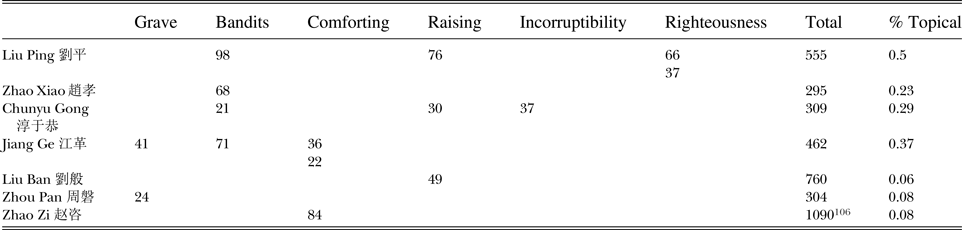
Table 4 shows that some men are described as being willing to sacrifice in several of the four ways connected to filiality. But the figures also show that their biographies are not dominated by the stories of filial piety. In most cases, significantly more space is used for the description of their official careers.Footnote 107 The anecdotes, therefore, serve as a kind of connector between the biographies of important officials. They describe character traits the men share and that qualified them for their posts, but are not the main information to be conveyed.
The subordinated biographies of Chapter 39 show a far more diverse picture, as seen in Table 5.
Filiality and incorruptibility anecdotes in the subordinated biographies of Chapter 39.
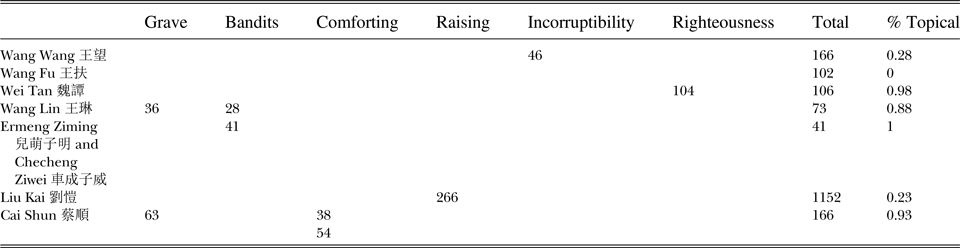
While some of the subordinated accounts do not contain any filial piety tales, others consist purely of them. This can be explained by the different reasons for including the biographies in the chapter. The two accounts of Wang Fu and Wang Wang were included because the men were recommended together with Liu Ping, not because they themselves were exemplars for filiality. Cai Shun, Wei Tan, Ermeng Ziming, and Checheng Ziwei, on the other hand, were included in the chapter only for being exemplars of the four motives; hence, almost their entire short biographies are concerned with their filiality or righteousness.
CONCLUSION
This paper was an attempt to analyze the textual history and content of Hou Han shu's Chapter 39 and to see what sets it apart from the later more standardized filial piety chapters. The detailed analysis of the textual history and sources led to the following conclusions:
While it is well established that Fan Ye was heavily inspired by Hua Qiao, by analyzing the fragments of older histories on the Later Han dynasty it could be shown that Hua did not author the biographies himself but mostly recompiled already existing content and arranged it according to the criterion of filiality. The biographies he and Fan Ye chose can in almost every case be traced back all the way to the Dongguan Han ji and thus to the Later Han dynasty itself.
The reason why Hua Qiao and Fan Ye were the first to compile such a chapter and why the Dongguan Han ji authors did not do so is probably related to the change of importance of the recommendation category of “filial and incorruptible.” Judging by the number of people who received this honor during the Later Han dynasty, the connection of filiality and office holding must have been a commonplace for the historians of that time. Therefore they probably did not see the necessity to arrange a chapter solely for filial office holders, but instead chose to categorize the biographies according to different criteria. For Hua Qiao and Fan Ye, on the other hand, writing in times when the recommendation as filial and incorruptible had already become somewhat exotic or antiquated, it must have seemed to be one of the main characteristics of the Later Han state. From their perspective it therefore made sense to arrange such a chapter out of the older materials in order to demonstrate this to their readers.
Because of the importance of the recommendation as filial and incorruptible, the Chapter's subjects were influential political figures, unlike many of the later representatives of filiality whose biographies were included in Xiaoyi chapters. As a result of this, the filial piety tales do not make up the majority of the text. The chapter contains much more extensive materials about the careers of the men. Far from being a simple collection of filial piety tales like many of the later Xiaoyi chapters, it is first and foremost a collection of official biographies, within which filiality plays the key role for the character description of the individuals. Chapter 39 is therefore definitely a precursor to the later collective chapters on filiality, but the particularities of the Later Han society give it a very distinct appearance.



