Nectonema agile is one of five marine species within the taxon Nematomorpha, commonly known as horsehair worms. The remaining about 350 described species live in freshwater and parasitize mainly terrestrial and few aquatic hosts (Hanelt et al., Reference Hanelt, Thomas and Schmidt-Rhaesa2005). Nectonema agile was described from the Atlantic coast of North America (Woods Hole area, Newport) by Verrill (Reference Verrill1879). Further records from the Bay of Fundy (Canada) (Leslie et al., Reference Leslie, Campbell and Daborn1981; Brattey et al., Reference Brattey, Elner, Uhazy and Bagnall1985; Skaling & MacKinnon, Reference Skaling and MacKinnon1988) were not determined to species level, but are surely also N. agile. Further records of this species come from the eastern side of the Atlantic, from the channel region (Fewkes, Reference Fewkes1883; Rauther, Reference Rauther1914; Perez, Reference Pérez1927a, Reference Pérezb, Reference Pérez1934; Mouchet Reference Mouchet1931; Nouvel & Nouvel, Reference Nouvel and Nouvel1934, Reference Nouvel and Nouvel1938; Feyel, Reference Feyel1936, Gallien, Reference Gallien1949; Arvy, Reference Arvy1963; Born, Reference Born1967), the Mediterranean Sea (Pintner, Reference Pintner1899) and the Black Sea (Kirjanova & Zakutsky, Reference Kirjanova and Zakutsky1967). Further species are known from isolated locations: N. munidae from fjords around Bergen, Norway (Brinckmann, Reference Brinkmann1930; Huus, Reference Huus1932; Nielsen, Reference Nielsen1969; Greve. Reference Greve1972; Schmidt-Rhaesa, Reference Schmidt-Rhaesa1996); N. melanocephalum from the Balabalagan Islands (as Paternoster Islands) and Indonesia (Nierstrasz, Reference Nierstrasz1907); N. svensksundi from Svalbard (North Atlantic: Bock, Reference Bock1913); and N. zealandica from New Zealand (Poinar & Brockerhoff, Reference Poinar and Brockerhoff2001).
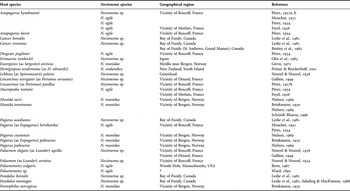
All hosts reported so far for Nectonema species are decapod crustaceans (see Table 1). Nectonema is found in the body cavity, mainly in the thorax region. Mature females are usually up to 320 mm long, males are shorter (Skaling & MacKinnon, Reference Skaling and MacKinnon1988).
Reported hosts of Nectonema species. Actual host names are adopted after Poinar & Brockerhoff (Reference Poinar and Brockerhoff2001).

During a size-at-maturity study on female lobsters, Homarus americanus, we found one specimen of Nectonema agile in the body cavity of a lobster (Figure 1). The parasite was located in the cavity of the abdomen and cephalothorax beneath the internal organs. The parasitized lobster was an immature female of 84 mm carapace length, collected during an out-of-season trapping survey in the southern region of Grand Manan Island (approximate location: 44°36′50″N 66°47′00″W), New Brunswick, Canada, in mid-September 2011. Among the 427 female lobsters dissected in 2011 from the region that ranged in size from 35 to 153 mm carapace length, this was the only lobster thus infected (0.2%). The specimen was preserved in 95% ethanol and later transferred to 70% ethanol. The N. agile specimen is deposited at the Atlantic Reference Centre of the Huntsman Marine Science Centre in St Andrews, New Brunswick, under accession number 79094.
Female specimen of Nectonema agile within the dorsally opened body cavity of the lobster Homarus americanus after the internal organs (hepatopancreas, digestive tract and gonads) were removed.

The worm is about 590 mm long. This represents the first record of Nectonema parasitizing a lobster, or any astacidean. All previous records were among other Pleocyemata, i.e. anomurans (hermit crabs and galatheids), brachyurans (true crabs) and caridean shrimps, with the sole exception of the sergestid dendrobranchiate shrimp Eusergestes (Table 1). Because this is the first record in a common species which is regularly investigated and dissected, we assume that the lobster is either a quite unusual host or that parasitization rates are very low.
Reported rates of parasitization differ substantially. For example, in the Bay of Fundy, rates ranged from 1.5% in Cancer borealis to 21.4% in Cancer irroratus (Leslie et al., Reference Leslie, Campbell and Daborn1981; see also Brattey et al., Reference Brattey, Elner, Uhazy and Bagnall1985 for further rates within this range).
Some authors found Nectonema specimens to cause damage in their hosts. According to Mouchet (Reference Mouchet1931), males of Eupagurus bernhardus and Anapagurus hyndmanni become castrated by Nectonema agile. Leslie et al. (Reference Leslie, Campbell and Daborn1981) reported that Nectonema agile caused minor degeneration in the reproductive organs of some male Cancer irroratus. Other authors did not find any organ damage to the host (Brinkmann, Reference Brinkmann1930; Nouvel & Nouvel, Reference Nouvel and Nouvel1934; Nielsen, Reference Nielsen1969). Because Homarus americanus is a relatively large host species, we assume that Nectonema causes no or only minor damage. Internal organs of the infested lobster were showing no sign of damage, with gonads within the normal size range for an immature lobster of this size.
ACKNOWLEDGEMENTS
We thank Monica Finley and Neil Davis for their support in the project, Susan Waddy for bringing this case to our attention, and Nathaniel Feindel for taking the photograph.