Previous research has systematically explored the cognitive correlates of childhood bilingualism with many studies reporting positive effects on aspects of nonverbal cognitive functioning and negative effects on measures of language proficiency (e.g., Akhtar & Menjivar, Reference Akhtar and Menjivar2012; Barac, Bialystok, Castro, & Sanchez, Reference Barac, Bialystok, Castro and Sanchez2014; Bialystok, Craik, Green, & Gollan, Reference Bialystok, Craik, Green and Gollan2009; Bialystok, Luk, Peets, & Yang, Reference Bialystok, Luk, Peets and Yang2010; Oller & Elliers, Reference Oller and Eilers2002). Regarding language, research comparing bilingual and monolingual children has shown delays for bilingual children in vocabulary development when each of their languages is considered separately and in the acquisition of certain complex aspects of morphosyntax (e.g., Bialystok et al., Reference Bialystok, Luk, Peets and Yang2010; Nicoladis, Palnmer, & Marentette, Reference Nicoladis, Palmer and Marentette2007; Oller & Elliers, Reference Oller and Eilers2002; Oller, Pearson, & Cobo-Lewis, Reference Oller, Pearson and Cobo-Lewis2007; Paradis, Reference Paradis2010).
At the same time, many studies have reported a beneficial effect of bilingualism on executive control (EC; see, e.g., Adesope, Lavin, Thompson, & Ungerleider, Reference Adesope, Lavin, Thompson and Ungerleider2010; Akhtar & Menjivar, Reference Akhtar and Menjivar2012; Barac et al., Reference Barac, Bialystok, Castro and Sanchez2014; de Abreu, Cruz-Santos, Tourinho, Martin, & Bialystok, Reference de Abreu, Cruz-Santos, Tourinho, Martin and Bialystok2012). EC is a domain-general cognitive system, which, according to an influential account proposed by Miyake et al. (Reference Miyake, Friedman, Emerson, Witzki, Howerter and Wager2000), comprises three major processes: switching (the ability to flexibly switch attention between rules, representations, or perspectives), working memory (the ability to simultaneously maintain and manipulate task-relevant information in mind), and inhibition (the ability to suppress dominant, automatic, prepotent responses and resolve conflict by suppressing irrelevant information).
Note, though, that there has been a recent spread of studies that failed to replicate the bilingual EC advantage, casting doubt on the very validity of the finding (see, e.g., Antón et al., Reference Antón, Duñabeitia, Estévez, Hernández, Castillo, Fuentes and Carreiras2014; Duñabeitia et al., Reference Duñabeitia, Hernández, Antón, Macizo, Estévez, Fuentes and Carreiras2014; Gathercole et al., Reference Gathercole, Thomas, Kennedy, Prys, Young, Guasch and Jones2014; Klein, Reference Klein2015; Paap, Johnson, & Sawi, Reference Paap, Johnson and Sawi2014). It is yet not clear, though, why the effect is (or is not) found in some studies (see, among others, Bialystok, Craik, & Luk, Reference Bialystok, Craik and Luk2012; Bialystok, Poarch, Luo, & Craik, Reference Bialystok, Poarch, Luo and Craik2014; Blom, Küntay, Messer, Verhagen, & Leseman, Reference Blom, Küntay, Messer, Verhagen and Leseman2014; Green & Abutalebi, Reference Green and Abutalebi2013; Kroll & Bialystok, Reference Kroll and Bialystok2013; Paap, Reference Paap2014; Paap et al., Reference Paap, Johnson and Sawi2015; Paap & Sawi, Reference Paap and Sawi2014; Valian, Reference Valian2015).
Although language and executive functions have been the focus of research on bilingualism for many years, other areas of bilingual cognitive development, particularly pragmatic–communicative skills, have so far received little attention. Furthermore, most of previous research has focused on bilingual children and little is known about how bidialectalism or, rather (to use the term introduced by Rowe and Grohmann, Reference Rowe and Grohmann2013), bilectalism affects children's cognitive skills. Bilectal speakers, that is, speakers of two linguistic varieties that are typologically close, show a high degree of structural and lexical similarity, and are considered to be dialects of the same language, remain a vastly underresearched population, even though bilectalism is prominent worldwide, and particularly so in Europe (see, e.g., Auer, Reference Auer, Delbecque, van der Auwera and Geeraerts2005).
The aim of this study is threefold. First, the goal is to establish whether multilingualism confers an advantage in a specific aspect of pragmatics, the ability to understand pragmatically implied meanings (implicatures). Second, we investigate the effect of bilectalism on this pragmatic–communicative skill by focusing on bilectal children speaking Cypriot Greek (CG) and Standard Modern Greek (SMG) in the diglossic sociolinguistic landscape of Greek-speaking Cyprus (see Appendix A for a description of the sociolinguistic situation in Greek-speaking Cyprus). Third, we aim to examine the linguistic and nonlinguistic cognitive factors that underpin implicature understanding in children.
In the next sections, we sketch the theoretical framework on which our investigation of children's pragmatic–communicative development is based: Grice's theory of implicature; we discuss studies that previously examined aspects of bilingual children's pragmatic–communicative competence and other sociocognitive skills; and we examine theoretical and empirical reasons that suggest a link between implicature understanding and EC.
GRICE'S THEORY OF IMPLICATURE
Philosopher Paul Grice (Reference Grice, Cole and Morgan1975, Reference Grice1989) argued for a division between the contents of an utterance that depend on the literal meaning of words and the structural relationships between them (syntax and semantics), and the aspects of an utterance that depend on context-sensitive inferential processes about speakers’ intentions (pragmatics).
Grice (Reference Grice, Cole and Morgan1975) suggested that a good deal of what is communicated in everyday conversation relies on the appreciation of certain conversational expectations. According to his account, speakers design their utterances with respect to the cooperative principle and maxims, and listeners expect their interlocutors to adhere to these conversational principles. Grice's (Reference Grice, Cole and Morgan1975, p. 45) maxims enjoin communicators to be no less and no more informative than is required for the purpose of the talk exchange (maxims of quantity I and II), to tell the truth and avoid statements for which they have not adequate evidence (maxim of quality), to be relevant (maxim of relation), and to be brief, orderly, and avoid ambiguity and obscurity (maxim of manner; Grice, Reference Grice, Cole and Morgan1975, pp. 44–45).
In many communicative situations consideration of the maxims prompts interlocutors to draw inferences through which they attribute to speakers an implicit meaning, which goes beyond what they literally said. These inferences are what Grice (Reference Grice, Cole and Morgan1975, p. 45) called conversational implicatures. For example, consider the following minidiscourse:
-
(1) A: Did all of his students fail the exam?
B: Some of his students failed the exam.
-
(2) Not all of his students failed the exam.
B's utterance in (1) will be understood as implying (2) even though this has not been stated explicitly. This implied proposition is an inference known as a scalar implicature (SI). According to Grice's account, this implicature is derived through a reasoning process about the speaker's intentions, which involves taking into account a rich array of information: (a) what the speaker explicitly said; (b) the linguistic and nonlinguistic context; (c) the assumption that B is cooperative; (d) sensitivity to the maxim of quantity I, that is, sensitivity to the fact that there exists a more informative proposition with the term all that could have been used but was not; (e) the assumption that the speaker is knowledgeable of the situation and that she would assert the more informative proposition with all if she knew it to be true; and (f) the assumption that all the above information is available to both interlocutors and that both interlocutors assume this to be the case.
Grice (Reference Grice, Cole and Morgan1975, p. 56) also introduced a distinction between particularized and generalized conversational implicatures. For instance, given a different question, Is he a promising teacher?, B's answer in (1) would still imply (2), but will also imply the proposition in (3) or a related one. The implied proposition in (2) represents a case of a generalized conversational implicature (GCI), and (3) is a case of a particularized conversational implicature (PCI).
-
(3) It is not certain that he is a promising teacher.
GCIs are associated with a specific form of words and seem to be stable across contexts. PCIs, in contrast, seem to be more context dependent and are not associated with specific linguistic items. The example above illustrates the difference between the two types of implicature: while the GCI in (2) arises in both linguistic contexts, the PCI in (3) emerges only in the second as a result of the specific question asked.
For Grice (Reference Grice1989) and other so-called contextual theories of implicature (e.g., Geurts, Reference Geurts2010; Sperber & Wilson, Reference Sperber and Wilson1995/1986), the generalized-particularized distinction is not necessarily of particular theoretical importance. Other theories of implicature (Chierchia, 2006; Chierchia, Fox, & Spector, 2011; Levinson, Reference Levinson2000), however, suggest that GCIs are distinguished from PCIs in that the former arise by default mechanisms, which are distinct from the processes involved in PCIs. According to Levinson's (Reference Levinson2000) view, GCIs are part of the lexical meaning of words and are generated automatically without reference to the speaker's intentions or the communicative context. Chierchia's (2006, 2009) related proposal suggests that GCIs are derived by the grammar, through a covert focus operator O, which has similar properties to the word only. This silent grammatical operator O takes scope over the scalar term some, and this leads to the negation of the alternative proposition with all and, hence, to the computation of the SI.
BILINGUALISM AND PRAGMATIC–COMMUNICATIVE SKILLS
Three studies conducted by Michael Siegal and colleagues (Siegal, Iozzi, & Surian, Reference Siegal, Iozzi and Surian2009; Siegal & Surian, Reference Siegal, Surian, Hoff and Shatz2007; Siegal et al., Reference Siegal, Surian, Matsuo, Geraci, Iozzi, Okumura and Itakura2010) explored the extent to which bilingualism confers an advantage on preschool children's competence with pragmatics. Siegal, Matsuo, Pond, and Otsu (Reference Siegal, Matsuo, Pond, Otsu and Otsu2007) sought to determine whether 4- to 6-year-old English–Japanese bilingual children would outperform their monolingual (English or Japanese) peers in their ability to understand SIs. They used a task where a puppet described a situation and the children were asked to judge whether the puppet could have described the event better. In critical trials, the descriptions were underinformative utterances (e.g., Teddy put some of the hoops on the pole, as a description of a situation where Teddy had put every hoop on the pole), and rejection of these utterances was taken as evidence that the children had generated a SI. The results of the Siegal et al. (Reference Siegal, Matsuo, Pond, Otsu and Otsu2007) study showed that, despite their lower vocabulary scores in the language of testing, bilingual children were more advanced than their monolingual peers in rejecting the critical utterances and hence in computing SIs.
In two subsequent studies, Siegal et al. (Reference Siegal, Iozzi and Surian2009, Reference Siegal, Surian, Matsuo, Geraci, Iozzi, Okumura and Itakura2010) employed a Conversational Violations Test (CVT) in order to examine whether preschool-aged bilingual children also excel in their ability to detect utterances that violate Grice's conversational maxims (maxims of quantity I and II, and maxims of quality, relation, manner, and politenessFootnote 1 ). In the CVT, children were presented with two doll speakers who answered a question. One answer violated a conversational maxim while the other was pragmatically appropriate. For example, in one of the items for the maxim of quality, the question was Have you seen my dog?, the pragmatically inappropriate answer was Yes, he's in the sky, and the pragmatically felicitous answer was Yes, he's in the garden. Children were asked to indicate the doll that said something silly or rude. Siegal et al. (Reference Siegal, Iozzi and Surian2009, their experiment 2) found that, although comparatively delayed in their vocabulary in the language of testing, bilingual children performed significantly better than their monolingual counterparts in the CVT. Similar results were obtained in their 2010 study.
Siegal et al. (Reference Siegal, Iozzi and Surian2009) propose two possible explanations for the observed bilingual advantages in their experiments. According to the first explanation, bilingual children's precocious pragmatic development is linked to their enhanced EC skills, which allow them to “consider simultaneously the appropriateness of alternative responses to questions” (Siegal et al., Reference Siegal, Iozzi and Surian2009, p. 121). The second explanation is that bilingual children develop heightened pragmatic abilities as compensation for their weaker knowledge of core language.
Other studies have examined additional aspects of bilingual children's wider pragmatic–communicative and sociocognitive development in comparison to monolinguals. Genesee, Tucker, and Lambert (Reference Genesee, Tucker and Lambert1975) reported that very young bilinguals were more sensitive to their listeners’ communication needs when providing verbal information. Two studies by Yow and Markman (Reference Yow and Markman2011a, Reference Yow and Markman2011b) showed that preschool-aged bilingual children were better able to understand referential gestures (such as eye gaze) in order to infer a person's referential intent and to use paralinguistic cues to judge the speaker's emotional state. Both of these advantages were evident in situations where conflicting information was available. Finally, a few studies have compared bilingual and monolingual children's performance in various theory of mind (ToM) tasks (for reviews, see Akhtar & Menjivar, Reference Akhtar and Menjivar2012; and Barac et al., Reference Barac, Bialystok, Castro and Sanchez2014). All these have consistently reported a bilingual advantage. Once more, advanced bilingual performance in ToM tasks has been attributed to bilingual children's enhanced EC skills by some researchers (Bialystok & Senman, Reference Bialystok and Senman2004; Kovács, Reference Kovács2008).
THE RELATION BETWEEN IMPLICATURE UNDERSTANDING AND EC
Several theoretical and empirical factors suggest that EC might be positively associated to implicature understanding. First, a processing instantiation of Grice's account of implicature suggests that implicature understanding is a process that involves taking into account information from various linguistic and other contextual sources. This requirement to coordinate linguistic and nonlinguistic information while interpreting language raises the likelihood that understanding implicatures is an EC demanding process (see Bergen & Grodner, Reference Bergen and Grodner2012; Breheny, Ferguson, & Katsos, Reference Breheny, Ferguson and Katsos2013b; Breheny, Katsos, & Williams, Reference Breheny, Katsos and Williams2006; Grodner & Sedivy, Reference Grodner, Sedivy, Pearlmutter and Gibson2005; Huang & Snedeker, Reference Huang and Snedeker2009a; Tomlinson, Bailey, & Bott, Reference Tomlinson, Bailey and Bott2013, for some experimental evidence that, in deriving implicatures, interlocutors consider some of the types of information proposed by Grice).
Similarly, according to relevance theory (Sperber & Wilson, Reference Sperber and Wilson1995/1986), the interpretation of implicatures involves extra cognitive effort (as opposed to literal meaning). Sperber and Wilson (Reference Sperber and Wilson1995/1986) do not explicitly characterize the specific cognitive–psychological nature of this additional cognitive effort. However, several researchers have interpreted it either in terms of extra processing time (e.g., Bott & Noveck, Reference Bott and Noveck2004; Breheny et al., Reference Breheny, Katsos and Williams2006) or in terms of employing additional cognitive resources (such as working memory; e.g., de Neys & Schaeken, Reference de Neys and Schaeken2007; see Huang & Snedeker, Reference Huang and Snedeker2009b; Siegal & Surian, Reference Siegal, Surian, Hoff and Shatz2007, who explicitly suggest a link between executive functions and the ability to generate implicatures in children).
Second, several experimental investigations with adults have documented that the time course of SIs is associated with an additional processing cost relative to conventional meaning (see, e.g., Bergen & Grodner, Reference Bergen and Grodner2012; Bott, Bailey, & Grodner, Reference Bott, Bailey and Grodner2011; Bott & Noveck, Reference Bott and Noveck2004; Breheny et al., Reference Breheny, Katsos and Williams2006; Huang & Snedeker, Reference Huang and Snedeker2009a; Panizza, Chierchia, & Clifton, Reference Panizza, Chierchia and Clifton2009; Tomlinson et al., Reference Tomlinson, Bailey and Bott2013; but see Breheny, Ferguson, & Katsos, Reference Breheny, Ferguson and Katsos2013a; Degen & Tanenhaus, Reference Degen and Tanenhaus2015; Grodner, Klein, Carbary, & Tanenhaus, Reference Grodner, Klein, Carbary and Tanenhaus2010). This in turn suggests that computing SIs and, perhaps, implicatures in general is a nonautomatic controlled process, which possibly relies on EC resources. Third, empirical data in studies with adults documents that comprehending SIs specifically involves working memory (WM) resources. De Neys and Schaeken (Reference de Neys and Schaeken2007), Dieussaert, Verkerk, Gillard, and Schaeken (Reference Dieussaert, Verkerk, Gillard and Schaeken2011), and Marty and Chemla (Reference Marty and Chemla2013) have shown that burdening adults’ WM with a secondary task before judging underinformative utterances leads to a decrease in their SI responses.
Note that the three experimental studies by Siegal et al. (Reference Siegal, Matsuo, Pond, Otsu and Otsu2007, Reference Siegal, Iozzi and Surian2009, Reference Siegal, Surian, Matsuo, Geraci, Iozzi, Okumura and Itakura2010) directly tested for a link between pragmatic ability and EC in children, but failed to find any supporting evidence for a positive relation. Some methodological concerns, though, related to both the pragmatic and the EC tasks used by Siegal et al. do not allow for strong conclusions to be extracted. First, the three studies were limited in that they employed only two measures of EC (the card sort task and the day/night task) and did not include any measures of WM. Second, the selection of the EC tasks in their studies was not eventually felicitous in several respects. For the card sort task, Siegal et al. (Reference Siegal, Matsuo, Pond, Otsu and Otsu2007, Reference Siegal, Iozzi and Surian2009) reported a near ceiling level of performance in both studies in which this test was used. The day/night task is generally considered to measure a type of inhibition (response inhibition) for which bilingual advantages are often not reported (Carlson & Meltzoff, Reference Carlson and Meltzoff2008; Martin-Rhee & Bialystok, Reference Martin-Rhee and Bialystok2008). The choice of these specific tasks in Siegal et al.’s (Reference Siegal, Matsuo, Pond, Otsu and Otsu2007, Reference Siegal, Iozzi and Surian2009, Reference Siegal, Surian, Matsuo, Geraci, Iozzi, Okumura and Itakura2010) studies might have actually masked possible EC differences between the language groups and potential relations between pragmatic ability and EC.
Third, the CVT employed in the Siegal et al. (Reference Siegal, Iozzi and Surian2009, Reference Siegal, Surian, Matsuo, Geraci, Iozzi, Okumura and Itakura2010) studies is a test of fairly simple pragmatic abilities: it only required children to detect whether an utterance violated a conversational maxim or not. In this respect, it is likely that it did not pose any significant burden on children's EC resources. Implicature understanding, in contrast, might be considered a more difficult, complex, and resource-demanding pragmatic ability, which involves, but is not exhausted by, the skill to detect maxim violations.
THE PRESENT STUDY
In the following study a multilingual, a bilectal, and a monolingual group of Greek-speaking children were administered a novel test on the ability to understand several types of implicature. Various other EC and vocabulary tests were administered as part of another study (Antoniou, Grohmann, Kambanaros, & Katsos, Reference Antoniou, Grohmann, Kambanaros and Katsos2016).
For the pragmatics task, each implicature type was based on one of four of Grice's (Reference Grice, Cole and Morgan1975, Reference Grice1989) conversational maxims (relevance, quality, manner, and quantity I). Specifically, the task included one subtest on relevance implicatures (testing whether children could comprehend, e.g., the utterance You are ill as meaning No, you can't buy an ice cream because you are ill); one on quality implicatures (metaphors; testing whether children could understand, e.g., the metaphorical utterance George's father was a melting snowman as meaning that George's father was feeling sad); one on manner implicatures (examining whether children could make the inference from, e.g., The man made the door open to The man opened the door in an atypical way); and two subtests on quantity I (scalar) implicatures (examining whether children could make the inference from, e.g., There are stars on some of the cards to There are stars on not all of the cards). In sum, there were five implicature subtests in the pragmatics task with three critical items each (where the generation of an implicature was required for accurate responding).
The implicatures included in the test can be further categorized in terms of the generalized–particularized distinction. Specifically, for the researchers who subscribe to this distinction, the manner and quantity I (scalar) implicatures can be considered cases of the generalized type, while the relevance and quality (metaphor) implicatures are exemplars of the particularized type.
The comparison between multilingual and monolingual children will provide evidence regarding the effect of mutilingualism on implicature understanding. We also decided to include a bilectal group of children and contrast their performance to that of monolinguals for various reasons. First, this comparison provides the opportunity to understand the cognitive effects of childhood bilectalism per se. To date, there is little research on bilectal children's linguistic and nonlinguistic cognitive skills (at least from a comparative perspective that contrasts their performance to that of monolinguals and bilinguals; but see, e.g., Antoniou et al., Reference Antoniou, Grohmann, Kambanaros and Katsos2016; Kambanaros, Grohmann, Michaelides, & Theodorou, Reference Kambanaros, Grohmann, Michaelides and Theodorou2012; Theodorou, Kambanaros, & Grohmann, Reference Theodorou, Kambanaros and Grohmann2013), and to our knowledge, there is no work on bilectal children's pragmatic–communicative abilities. Second, the linguistic profile of bilectals as speakers of two different but minimally distant linguistic varieties allows us to examine the issue of close language similarity (between the language pairs spoken by bilinguals) and how it modulates the outcomes of bilingualism. Third, it enables us to examine the interplay between language proficiency and implicature understanding. It has been argued, for instance, that bilingual children learning two very similar languages may show less of a (or no) delay in their vocabulary skills because their languages likely share many cognates (e.g., Bialystok & Feng, Reference Bialystok, Feng, Durgunoglu and Goldenberg2011). To the extent that this prediction is met in our study, the comparison between bilectal and monolingual children provides the opportunity to examine implicature comprehension in a group of children who have better-developed language skills than bilingual children. Fourth and finally, the contrast between bilectals and monolinguals controls for various background factors that are often confounded with bilingualism: immigration status (the bilectal and monolingual groups came from local indigenous families in Cyprus and Greece, respectively, but the multilingual group was more heterogeneous with many children having at least one immigrant parent), ethnicity and culture (Greek Cypriots and Hellenic Greeks differ minimally in these respects, but multilinguals were exposed to two cultures and many of them had a parent of a different nationality), and language of education (both bilectal and monolingual children were educated entirely in SMG, but multilinguals were educated in English with only a few hours of instruction in SMG).
Bilectal children were also tested in both their dialects (CG and SMG). This allowed us to examine how their pragmatic performance compared to that of monolinguals in both their dominant, native variety (CG) and their second, nonnative dialect (SMG).
Furthermore, the study offers an opportunity for a more careful investigation of the relation between implicature understanding and EC. First, as described in Antoniou et al. (Reference Antoniou, Grohmann, Kambanaros and Katsos2016), a wider range of EC tasks was administered measuring all components of EC. Second, Antoniou et al. (Reference Antoniou, Grohmann, Kambanaros and Katsos2016) reported that all EC measures revealed adequate variability in children's performance. Third, they found that multilingual and bilectal children outperformed their monolingual peers in EC performance after accounting for their lower language abilities in Greek. Fourth, the pragmatics test in the current study focuses on a pragmatic–communicative ability (implicature understanding) that from both a theoretical and an experimental perspective has been associated to EC skills.
Fifth and finally, this study may also provide data with respect to the psychological validity of the distinction between GCIs and PCIs.
METHOD
Participants
Participants included 64 bilectal children (speakers of CG and SMG; 32 boys, 32 girls, aged 4 years, 5 months [4;5]–12;2, mean age = 7;8, SD = 1;6); 47 multilingual children (bilectal in CG and SMG, also speakers of English and in some cases an additional language; 24 boys, 23 girls, ages 5;0–11;5, mean age = 7;8, SD = 1;8), and 25 monolingual children (speakers of SMG only; 15 boys, 10 girls, aged 6;2–9, mean age = 7;4, SD = 0;9). Four additional children were excluded from the bilectal group because they were exposed to a second language apart from the two dialects of Greek at home.
Multilingual children attended English-instruction private schools in the Republic of Cyprus. In these schools, they were taught SMG as a separate subject for 6 hr per week. Bilectal children were recruited from three different schools (two private, one public) where SMG was the language of instruction. None of the children included in the analyses had any exposure to or use of a language other than the two Greek dialects at home.
All the monolingual children were recruited from a private primary school in Athens, Greece. They were instructed exclusively in SMG, and their parents reported speaking only SMG to them at home.
Materials and procedure
All children were tested in two sessions taking approximately 50–60 min each. Seventeen of the bilectal children received additional tests in a third session, which took place at least a week after the second session.
In the first session, all children were administered the implicatures test (bilectals and multilinguals in CG and monolinguals in SMG), the Word Finding Expressive Vocabulary Test—Greek, the matrix reasoning test of the Wechsler Abbreviated Scale of Intelligence (WASI; Wechsler, Reference Wechsler1999), the Simon task, and the backward digit span task. The second session included the color–shape task, Corsi blocks test, soccer task, and the Peabody Picture Receptive Vocabulary Test—Greek (PPVT-Greek; adapted from Dunn & Dunn, 1981). The PPVT-Greek was given only to the monolingual children and a group of 17 bilectal children and was administered in SMG to the former group and in CG to the latter group. The third session, taken only by the same subset of 17 bilectal children who also received the PPVT-Greek, included the implicatures test and the PPVT, both administered in SMG. Thus, 17 bilectals took the implicatures test and the PPVT in both their dialects.
From the EC tasks, the following measures were used (the task from which each measure was taken is given in parentheses): Simon effect (Simon task), switch cost (color–shape task), stop-signal reaction time (soccer task), and number of correctly recalled trials (in the backward digit span task, the forward, and backward versions of the Corsi blocks task; for a detailed description of the EC tests and how these measures were calculated, see Antoniou et al., Reference Antoniou, Grohmann, Kambanaros and Katsos2016).
Implicatures test
This was a novel task testing children's comprehension of four types of implicatures: quantity I (scalar), relevance, manner, and quality (metaphors) implicatures. The quality, manner, and relevance implicature subtests had a picture-selection format where children had to respond by choosing one of two pictures. For SIs, two subtests were used: an action-based task (where children had to make a display match a target utterance) and a binary judgment task (where they had to judge whether an utterance was a correct or an incorrect description of a picture). In total, there were 15 implicature items (3 items in each implicature subtest), 48 filler items, and 1 practice item.
As already noted above, there were two language versions (CG and SMG) of the implicatures test. The same items were used in each language version, but recorded in a different dialect (CG or SMG) by native speakers. All multilingual and bilectal children took the test in CG, and monolinguals in SMG. A subset of 17 bilectal children received the test in both CG and SMG. Multilingual and bilectal children were tested in CG because this was the variety spoken in the community. This ensured that the children had adequate exposure in and knowledge of the language of testing (multilingual children had minimal exposure to SMG, mainly through a few hours of instruction at school and possibly through other sources, such as the media).
Moreover, there were two task versions of the pragmatics test. Each child was randomly given one of the two task versions so that an approximately equal number of children (overall and across language groups) were tested in each version. For the subtests that had a picture-selection design, two task versions were created in order to counterbalance various factors across the two versions: attractiveness of pictures provided as potential responses (Picture 1 or 2), target emotion expressed by the metaphors (sadness or anger), polarity of response in relevance implicatures (yes or no), and markedness in manner implicatures (marked or unmarked; see description of each subtest below for more details). This ensured that level of performance in these tasks would reflect children's pragmatic understanding of the target utterances and not irrelevant (to pragmatics) factors (as listed above). For the two SI subtests, the same items were used in both task versions.
As described in Antoniou et al. (Reference Antoniou, Grohmann, Kambanaros and Katsos2016), children's performance on the 48 filler items of the implicatures test was considered a measure of their language comprehension skills in the language of testing (language comprehension score). A total comprehension score was calculated for each child by transforming the child's scores on the filler items of each implicature subtest into z scores and then averaging the three z scores.
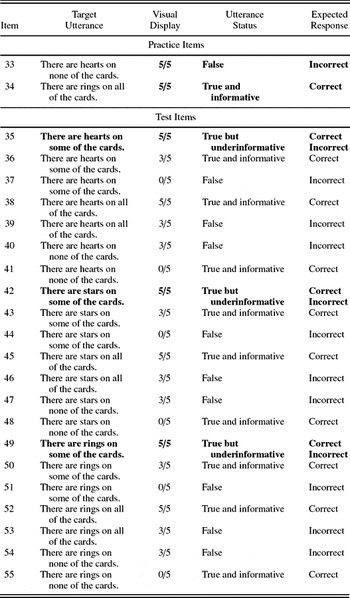
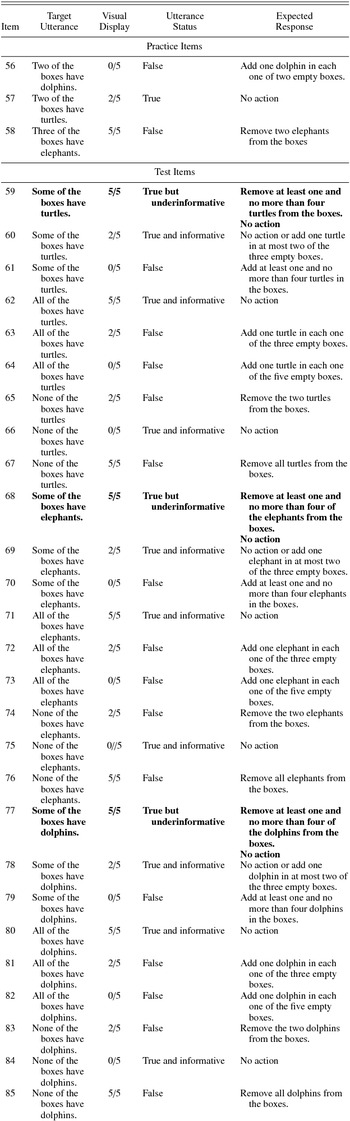
All implicature parts, except for the binary judgment task on SIs, were designed and administered using Microsoft PowerPoint software. The binary judgment task on SIs was implemented using the E-Prime psychology software. All implicature subtests are described in detail in the following sections. The complete list of linguistic material used in each part of the implicatures test can be found in Tables B.1 to B.3 Appendix B.
Practice and relevance implicature items
For the practice and relevance implicature items, children were instructed that they would hear stories about a young male character named George and his mother, and that at the end of each story, they had to point to a picture that showed how the story ended. All items were based on a previous study with children conducted by Bernicot, Laval, and Chaminaud (Reference Bernicot, Laval and Chaminaud2007). A practice item did not require the generation of an implicature for accurate performance.
Each item was composed of two slides. In the first slide, children were shown a picture that visually established the story's interaction setting, and the target story was heard. Target stories in the three critical items were of the following format: George asked his mother a question (e.g., Mom, can I buy an ice cream?) and his mother replied with an utterance that implied either a negative or a positive answer (You are ill or I've got money in my wallet, respectively). The same was true for the practice item, but in this case the reply was either explicitly negative or explicitly positive. In the second slide, the experimenter asked What happened at the end of the story? and introduced two pictures as possible endings (e.g., by saying George bought an ice cream or George did not buy an ice cream and pointing to the relevant pictures). One of the pictures depicted a situation compatible with a positive response (e.g., George eating an ice cream) and the other showed a situation compatible with a negative response (e.g., George doing something else).
There were two task versions for each story. One version of the story ended with an utterance that implied a negative response (or that explicitly stated a negative response for the practice item) and the other with an utterance that implied a positive response.
Quality implicatures (metaphors)
The subtest was designed based on a previous study by Waggoner and Palermo (Reference Waggoner and Palermo1989). Children were told that they would hear stories about George and his father, and that at the end of each story, they should point to a picture that showed how George's father felt.
They heard three stories ending in metaphors describing either the emotion of sadness (e.g., When George's father returned home, he was a melting snowman) or the emotion of anger (e.g., When George's father returned home, he was a thundering cannon). Again, each critical trial was composed of two slides. In the first slide, children were presented with a picture relevant to the story and the target story was heard. In the second slide, the experimenter asked How did George's father feel at the end of the story? and presented two pictures: a picture of a sad man and a picture of an angry man. All metaphorical expressions were embedded in contexts that introduced the two emotions, but did not give away which of the two emotions was expressed by the metaphorical sentence. This was achieved by including a text such as the following in all story contexts (where X was a reason for feeling sad and Y was a reason for feeling angry): He [George] wondered how his father would feel when coming back home. He didn't know whether his father would feel sad because X or whether he would feel angry because Y.
Finally, only novel and apt metaphors were used. Fifteen metaphors generated by the authors were rated by 28 adult native speakers of CG and 36 native speakers of SMG on a 5-point scale. All metaphors included in the test received a mean rating of over 2.5 out of 5 for both novelty and aptness and by both Greek Cypriots and Hellenic Greeks.
Manner implicatures
The general design of this subtest was a sentence-to-picture matching task. Participants were informed that they would hear George describing a picture from a book and that they had to point to a picture that matched George's description. There were six items in total, of which three were critical items and three were filler items.
Critical items were causatives for which a lexicalized and an opposed periphrastic alternative are available (e.g., Opened the door as opposed to Made the door open). Lexicalized causatives are associated with a direct, normal, more frequent, stereotypical causation, while their periphrastic alternatives are associated with an indirect, nonnormal, less frequent, nonstereotypical causation (Levinson, Reference Levinson2000). Manner implicatures associated with causatives arise as a result of Grice's submaxim of manner Be brief, avoid unnecessary prolixity (Levinson, Reference Levinson2000). For instance, the utterance The man made the door open implies that The man opened the door in an atypical way. The additional meaning in an atypical way comes about because the speaker used a more prolix and complex sentence instead of the simpler statement The man opened the door. Filler items were literal expressions for which the correct picture could be identified on the basis of their explicit content.
Again, each item was composed of two slides. In the first slide, George was displayed holding a book and the target sentence was heard. The second slide featured two pictures as possible matches to the description. In the critical items, the two pictures contrasted an unmarked, stereotypical way of causation (e.g., a picture depicting a man opening a door using the handle) with a marked, nonstereotypical way of causation (e.g., a picture displaying a man opening a door by kicking it). There were two task versions for each item. In one version, the unmarked, lexicalized expression was used, and in the other, its corresponding marked, periphrastic expression was employed.
Scalar implicatures act-out task
This subtest was a PowerPoint version of the action-based task used by Pouscoulous, Noveck, Politzer, and Baside (Reference Pouscoulous, Noveck, Politzer and Bastide2007). Participants were presented with slides depicting five boxes and a selection of animals (five elephants, five turtles, five dolphins, and five hippopotamuses). There were three scenarios: in the 5/5 scenario, all boxes contained the same kind of animal, in the 2/5 scenario, two of the five boxes contained the same kind of animal, and in the 0/5 scenario, none of the boxes had any animals. For each scenario, children heard statements constructed with the quantifiers all, some, and none and three types of animals (elephants, turtles, and dolphins). This resulted in a total of 27 test items. There were also 3 practice items using numerals.
Children were told that they would hear George describing the display and that they had to make the display match the description, by putting animals inside the boxes, by taking animals out of the boxes, or by leaving the display as it was without making any modifications (using the mouse as appropriate). There were 3 critical items. Critical items were statements with the quantifier some (e.g., There are turtles in some of the boxes) in the 5/5 scenario (e.g., in which all five boxes contained a turtle).
Scalar implicatures binary judgment task
In each trial of this test, the participant saw a depiction of five cards face down. An auditory stimulus was then played, There are <X> on <Q> of the cards, where X was the item type (rings, hearts, or stars) and Q the quantifier (all, some, or none). When the auditory stimulus ended, the cards were immediately “turned over” to reveal the items. Participants were instructed to press a green-labeled key if the utterance were true and a red-labeled key if it were false, responding as quickly and accurately as possible.
The task included 23 trials comprising a practice block with two items and three test blocks of 7 trials. There were three critical underinformative cases using the quantifier some, each presented in one of three test blocks. The rest of the items comprised an equal number of true and informative, and semantically false utterances with the quantifiers some, all, and none.
Socioeconomic status (SES) and language background questionnaire
This questionnaire was formed based on three questionnaires designed by other researchers: the Alberta Language Environment Questionnaire (Paradis, Reference Paradis2011), the Alberta Language Development Questionnaire (Paradis, Emmerzael, & Duncan, Reference Paradis, Emmerzael and Duncan2010), and the Family Affluence Scale (Currie et al., Reference Currie, Molcho, Boyce, Holstein, Torsheim and Richter2008).
Besides the items on the child's language use and exposure, the questionnaire also required information regarding the child's date of birth, gender, and the child's and parents’ places of birth, among other topics.
Finally, three scores of the family's SES could be extracted from the questionnaire: the family's wealth as measured by the Family Affluence Scale and each parent's level of education. Regarding maternal and paternal level of education, completion of junior high school was scored as 1, senior high school as 2, professional training in addition to completing senior high school as 3, and higher education as 4.
Language measures
PPVT—REVISED (PPVT)
An SMG version of the test adapted from English (Dunn & Dunn, Reference Dunn and Dunn1981) was administered as a measure of receptive vocabulary. The test was further adapted to and recorded in CG by the first author, who is a native CG speaker. The adaptations in the CG version were minimal and included phonetic changes in the pronunciation of words and also the substitution of SMG words with the corresponding CG words in cases where a more widely used CG word existed. This test was administered only to the monolingual children and a subset of 17 bilectal children. The former group received the task in SMG while the latter in both CG and SMG.
WORD FINDING VOCABULARY TEST (WFVT)
The standardized SMG version (Vogindroukas, Protopapas, & Sideridis, Reference Vogindroukas, Protopapas and Sideridis2009) of the test (Renfrew, Reference Renfrew1995) was administered to assess expressive vocabulary. For the bilectal and multilingual children, words in both CG and SMG were accepted as correct.
Nonverbal fluid intelligence test
THE WASI MATRIX REASONING TEST (IQ)
In this test (Wechsler, Reference Wechsler1999), participants were presented with pictures depicting a matrix from which a section was missing. They were required to complete the matrix by pointing at or stating the number corresponding to the correct response from five possible choices.
RESULTS
Preliminary analyses
Principal component analyses (PCA)
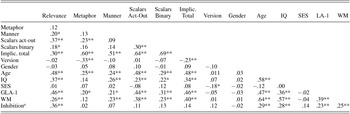
A PCA was conducted on the implicature measures extracted from the various parts of the implicatures test (number of accurate responses in each implicature subtest). These scores indicated performance in the CG language version of the test for bilectals and multilinguals, and in the SMG language version for monolinguals. However, because there was a ceiling level of performance for all children in the relevance implicature subtest, scores from this part were not included in further analyses. Correlations between the various implicature measures are presented in Table 1.
Bivariate correlations (Spearman rho) between implicature scores, executive control, and background variables

Note: All implicature and language scores are from tests taken in Cypriot Greek by multilinguals and bilectals and in Standard Modern Greek by monolinguals. Relevance, scores in the subtest on relevance implicatures; Metaphor, scores in the subtest on metaphors; Manner, scores in the subtest on manner implicatures; Scalars act-out, scores in the act-out subtest on scalar implicatures; Scalars binary, scores in the binary judgment subtest on scalar implicatures; Implic. total, implicature composite score; Version, task version of the implicatures test; Age, participants’ age (years); IQ, scores in the matrix reasoning test of the Wechsler Abbreviated Scale of Intelligence; SES, socioeconomic status composite score; GLA-1, general language ability 1 composite score; WM, working memory.
a Measure was reversed scored so that a higher value indicates better performance.
*p = .05 (two tailed). **p = .01 level (two tailed).
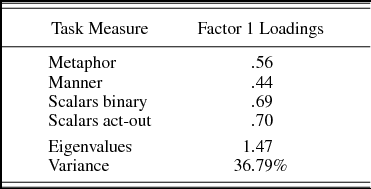
The PCA on the four implicature indicators revealed only one factor with an eigenvalue above Kaiser's criterion of 1. This factor explained 36.8% of the variance. Table 2 summarizes the PCA results.
Summary results of exploratory factor analysis on the four implicature measures

Note: The task measures are the number of correct responses. The factor loadings are for Factor 1: pragmatics. Metaphor, scores in the implicature subtest on metaphors; Manner, scores in the implicature subtest on manner implicatures; Scalars binary, scores in the binary judgment task on scalar implicatures; Scalars act-out, scores in the act-out task on scalar implicatures.
Composite scores
A composite score was computed for overall performance in the implicatures test (overall implicature score—Greek). The overall score was calculated by averaging participants’ scores in each subtest of the implicature task except for the relevance part in which ceiling performance was observed for all groups. The overall implicature—Greek score reflected performance in CG for bilectals and multilinguals and in SMG for monolinguals. Furthermore, for 17 of the bilectal children, a second overall implicature composite score was calculated based on their performance in the SMG version of the test (overall implicature score—SMG).
The following composite scores were also used: general language ability 1 (GLA-1), general language ability 2 (GLA-2), general language ability SMG (GLA-SMG) and SES. GLA-1 and GLA-2 were measures of language proficiency in CG for bilectals and multilinguals and in SMG for monolinguals. The former was computed by transforming into z scores and then averaging the WFVT score GreekFootnote 2 and the language comprehension score Greek (indicating performance in the filler items of the implicatures test taken in CG by bilectals and multilinguals and in SMG by monolinguals). The latter was calculated for the sample of children who also took the PPVT, by collapsing the PPVT score Greek (indicating performance in the CG version of the PPVT for bilectals and in the SMG version for monolinguals) and the GLA-1 score into a new single indicator of language ability in Greek. Moreover, the GLA-SMG score was created for the bilectal and monolingual children who also took the SMG version of the PPVT by averaging participants’ z transformed scores in the WFVT, the filler items of the implicatures test (taken in SMG), and the PPVT (also taken in SMG). Finally, maternal level of education, paternal level of education, and Family Affluence Scale score were also collapsed into a single score (in the same way as above) indicating SES.
Main analyses
Between-group analyses on implicature understanding were performed in two stages. In the first step, the performance of the three groups of children was compared to each other. To this end, the three groups were matched in age by excluding from the analyses all multilingual and bilectal children who were above 9 years or below 6 years of age.
In the second stage, the performance of a subset of 17 bilectal children was contrasted to that of the monolingual group. This second comparison provided the opportunity to (a) contrast the pragmatic performance of the two groups when more reliably controlling for language proficiency in the language of testing (CG or SMG; since both groups in this comparison were further given the PPVT); (b) compare the performance of bilectal and monolingual children in each of the bilectals’ varieties (since the bilectal children in this comparison further took the implicatures test in SMG); and (c) obtain a more reliable and robust test of potential group differences in implicature performance (since the two groups were comparable in several important background factors such as age, gender, IQ, SES, language comprehension in the language of testing and in SMG, ethnicity/culture, language of education, and immigration history).
Where between-group analyses of covariance (ANCOVAs) were conducted, the following variables were included as covariates: any background measures for which statistically significant differences were found between the groups compared and background variables that significantly correlated with the outcome variable. This allowed us to partial out the effect of any of the background measures on the dependent variables and thus to obtain a purer measure of the effect of interest (language group) and also ensured that any group differences in the background variables were not responsible for the presence or absence of group effects on the outcome variables.Footnote 3
Task version (1 vs. 2) for the implicatures test was also included as a between-subjects factor in the analyses in the cases where a significant correlation was found with implicature performance.
Comparison 1: Multilinguals versus bilectals versus monolinguals (matched in age)
Participants
In the following analyses, the performance of 44 bilectal children (21 boys, 23 girls; ages 6;3–9, mean age = 7;6, SD = 0;9 years), 26 multilinguals (15 boys, 11 girls; ages 6;2–9, mean age = 7;7, SD = 0;9 years), and 25 monolinguals (15 boys, 10 girls; ages 6;2–9, mean age = 7;4, SD = 0;9 years) was compared.
Background measures
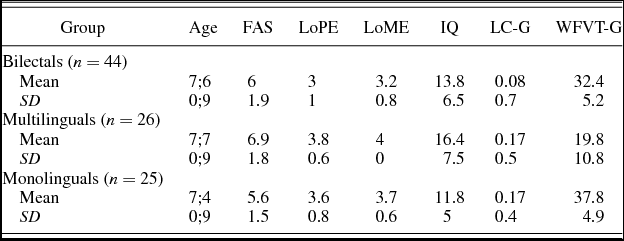
Background information for the three language groups in this comparison is presented in Table 3. Language characteristics of the multilingual group as based on the Language Background Questionnaire are summarized in Table 4.
Descriptive statistics (means and standard deviations) on background measures (raw values) in comparison 1 by language group

Note: Age, participants’ age (years;months); IQ, scores in the matrix reasoning test of the Wechsler Abbreviated Scale of Intelligence; LC-G, scores in the language comprehension test (taken in Cypriot Greek by bilectals and multilinguals and in Standard Modern Greek by monolinguals); FAS, Family Affluence Scale scores; LoPE, level of paternal education; LoME, level of maternal education; WFVT-G, scores in the Word Finding Expressive Vocabulary Test (taken in Greek).
Language characteristics of the multilingual group based on the Language Background Questionnaire in comparison 1

Note: AoO CG, age (months) of onset of exposure to Cypriot Greek; AoO En, age (months) of onset of exposure to English; CG Home, amount of exposure to/use of CG at home (maximum score = 4); En Home, amount of exposure to/use of English at home (maximum score = 4); SMG, total amount of exposure to/use of Standard Modern Greek (maximum score = 4); DoBB, degree of balanced exposure to/use of CG and English (range = 0–1, with a higher value indicating more balanced exposure to/use of two languages).
Bilectal, multilingual, and monolingual children did not statistically differ in age, F (2, 92) = 0.696, p >.05, gender, F (2, 92) = 0.587, p >.05, or language comprehension—Greek (in CG for bilectals and multilinguals, and in SMG for monolinguals), F (2, 92) = 0.319, p > .05. Nevertheless, there were significant differences in SES, F (2, 89) = 9.622, p < .05, IQ, F (2, 92) = 3.377, p < .05, partial η2 = 0.07, and expressive vocabulary, F (2, 92) = 44.183, p < .05, partial η2 = 0.5.
Regarding SES, there was a significant difference between bilectals and multilinguals, in that bilectal children were of a lower SES than multilingual children (p < .05, multiple comparisons with Bonferroni correction applied). For IQ, a multilingual advantage over monolinguals was found (p < .05, Bonferroni correction for multiple comparisons applied). Finally, with respect to expressive vocabulary, monolingual children had a significantly higher expressive vocabulary score than both bilectal and multilingual children, and bilectal children were significantly better than multilinguals (all ps < .05, Bonferroni correction applied). Within the multilingual group, CG-dominant children exhibited better vocabulary skills than their English-dominant multilingual peers, although their scores were still significantly lower than bilectal and monolingual participants (all ps < .05, Bonferroni correction applied). Further analyses indicated that the scores of both multilingual and bilectal children were within the normal monolingual range: bilectal scores were significantly higher than the 20th percentile, t (26) = 5.698, p < .05, and multilingual scores did not significantly differ from the 20th percentile, t (14) = 1.024, p > .05. The same was true for both the CG-dominant, t (9) = 1.612, p > .05, and English-dominant, t (4) = –1.3600, p > .05, multilinguals’ expressive vocabulary performance.Footnote 4 In general, the results on expressive vocabulary are in line with existing research (e.g., Bialystok et al., Reference Bialystok, Luk, Peets and Yang2010; Oller & Eilers, Reference Oller and Eilers2002; Oller et al., Reference Oller, Pearson and Cobo-Lewis2007) and validate accounts that attribute lower vocabulary or grammatical performance in bilinguals to environmental factors related to bilingual children's language input rather than to deficits of any kind (cognitive, perceptual, or other; see, e.g., Ahtar & Menjivar, Reference Akhtar and Menjivar2012; Hoff et al., Reference Hoff, Core, Place, Rumiche, Señor and Parra2012; Oller et al., Reference Oller, Pearson and Cobo-Lewis2007; Thordardottir, Reference Thordardottir2011). They also corroborate previous suggestions and experimental evidence in the bilingualism literature that high language proximity between the language pairs spoken by bilinguals (or bilectals) closes the gap in their vocabulary development relative to monolinguals (e.g., Barac & Bialystok, Reference Barac and Bialystok2012; Bialystok & Feng, Reference Bialystok, Feng, Durgunoglu and Goldenberg2011).
Implicatures test—Greek
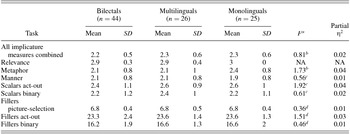
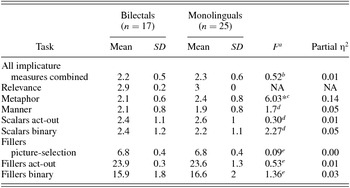
Implicature scores included in the following analyses reflected performance in CG for bilectals and multilinguals and in SMG for monolinguals. Mean scores and SDs for the various measures from the implicatures test by language group are reported in Table 5. Correlations between implicature scores and background variables can be found in Table 1.
Descriptive statistics on measures from the implicatures test (raw values) in comparison 1 by language group

Note: All implicature scores are from the implicatures test received in Cypriot Greek by multilinguals and bilectals and in Standard Modern Greek by monolinguals. The results of between-group analyses of covariance (multilinguals vs. bilectals vs. monolinguals) on these measures are also reported. Relevance, scores in the subtest on relevance implicatures; Metaphor, scores in the subtest on metaphors; Manner, scores in the subtest on manner implicatures; Scalars act-out, scores in the act-out task on scalar impicatures; Scalars binary, scores in the binary judgment task on scalar implicatures; Fillers picture-selection, scores in the filler items of the picture-selection part of the implicatures test; Fillers act-out, scores in the filler items of the act-out task on scalar implicatures; Fillers binary, scores in the filler items of the binary judgment task on scalar implicatures.
a The degrees of freedom for the error term range from 79 to 83, depending on the analysis.
b The F ratio resulting from an analysis of covariance (ANCOVA) with age, IQ, socioeconomic status (SES), and general language ability as covariates and Task Version and Group as between-subjects factors.
c The F ratio resulting from an ANCOVA with age, IQ, SES, and general language ability as covariates and Group as a between-subjects factor.
d The F ratio resulting from an ANCOVA with age, IQ, and SES as covariates and Group as a between-subjects factor.
Overall Implicature composite score
An ANCOVA was conducted with group (multilinguals vs. bilectals vs. monolinguals) and task version (1 vs. 2) as between-subjects factors, and IQ, GLA-1, age, and SES as covariates. The results of this analysis were as follows. The effect of group was not significant, F (2, 82) = 0.808, p > .05, partial η2 = 0.02. Moreover, there was a significant effect of task version, F (1, 82) = 11.678, p < .05, in that version 1 was easier than version 2. Finally, a significant Group × Task Version interaction emerged, F (2, 82) = 3.111, p = .05, partial η2 = 0.07.
In order to further investigate this interaction, two follow-up ANCOVAs (with the same covariates as above) were conducted separately for each version of the implicatures test. These ANCOVAs showed a clearly nonsignificant effect of group in version 2 of the test, F (2, 38) = 0.59, p > .05, and a marginally nonsignificant effect of group in version 1 of the test, F (2, 40) = 3.15, p = .054, partial η2 = 0.14. The marginally nonsignificant effect of group in version 1 was due to a numerical advantage for multilinguals and monolinguals over bilectals. However, post hoc pairwise comparisons with Bonferroni correction applied showed that neither the multilingual nor the monolingual advantage was statistically significant (both ps > .09).
To determine whether multilingual and bilectal children exhibited equivalent to monolinguals implicature performance despite their lower core language proficiency, a similar ANCOVA as above was conducted with the language comprehension score—Greek instead of the GLA-1 score included as a covariate. Remember that, contrary to expressive vocabulary, the three groups did not differ in terms of the language comprehension score—Greek. The language comprehension score, though, significantly and positively correlated with overall implicature performance, Spearman ρ = 0.51, p < .05 (two tailed), and for this reason it was covaried in the analysis. Results were the same as in the previous ANCOVA, for the effect of group: F (2, 82) = 0.340, p > .05, apart from the Group × Task Version interaction, which was marginally nonsignificant in this analysis, F (2, 82) = 3.03, p = .054.
Finally, to establish whether amount of exposure to/use of the language of testing (CG) had an effect on implicature performance, a further analysis was conducted on the implicature composite score with the multilingual group divided in terms of language dominance. A 4 (Group: CG-dominant multilinguals vs. English-dominant multilinguals versus bilectals versus monolinguals) × 2 (Task Version: 1 vs. 2) ANCOVA with IQ, age, SES, and language ability—1 as covariates, returned a nonsignificant effect of group, F (3, 79) = 1.029, p > .05, partial η2 = 0.04, and a significant effect of task version, F (1, 79) = 10.64, p > .05.
Comparison 2: Bilectals versus monolinguals
We start by reporting the analyses comparing bilectal and monolingual children's implicature performance in their native dialect (CG for bilectals and SMG for monolinguals), when a more reliable control over children's language ability was performed. Then, we describe how bilectals’ and monolinguals’ implicature performance compared when both groups were tested in SMG. We note that preliminary analyses comparing bilectal children's pragmatic performance in CG and SMG indicated no significant differences, t (16) = –1.509, p > .05.
Participants
Seventeen bilectal (10 boys, 7 girls; ages 6;3–8;9, mean age = 7;6, SD = 0;9 years) and 25 monolingual children (15 boys, 10 girls; ages 6;2–9, mean age = 7;4, SD = 0;9 years) were included in the following analyses.
Background measures
Table 6 outlines background information about the two groups. The two groups did not differ in age, t (40) = 0.868, p > .05, gender, t (40) = –0.074, p > .05, language comprehension—Greek, t (40) = –0.48, p > .05, language comprehension—SMG, t (40) = 0.77, p > .05, IQ, t (40) = 1.246, p > .05, or SES, t (38) = –1.373, p > .05.
Descriptive statistics (means and standard deviations) on background measures (raw values) in comparison 2 by language group

Note: Age, Age (years;months); FAS, Family Affluence Scale scores; LoPE, level of paternal education; LoME, level of maternal education; IQ, scores in the matrix reasoning test of the Wechsler Abbreviated Scale of Intelligence; LC-G, language comprehension test scores (taken in Cypriot Greek by bilectals and multilinguals and in Standard Modern Greek by monolinguals); WFVT, Word Finding Expressive Vocabulary Test score (taken in Greek); PPVT-G, Peabody Picture Receptive Vocabulary Test score (taken in Cypriot Greek by bilectals and in Standard Modern Greek by monolinguals).
However, monolingual children significantly outperformed bilectal children in both expressive (WFVT), t (40) = –4.365, p < .05, and receptive vocabulary (PPVT; when each group took the test in their native variety: t (40) = –2.212, p < .05, r = .3; and when both groups took the test in SMG: t (40) = –1.907, p = .06, r = .3.
Implicatures test—Greek
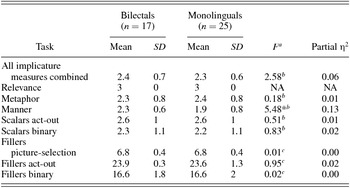
Descriptive statistics for all measures from the implicatures test by language group for this comparison can be found in Table 7.
Descriptive statistics (means and standard deviations) on measures from the implicatures test (raw values) in comparison 2 by language group

Note: The results of between-group analyses of covariance (ANCOVAs; bilectals vs. monolinguals) on the implicature measures are also reported. All implicature scores are from the implicatures test received in Cypriot Greek by bilectals and in Standard Modern Greek by monolinguals. Relevance, scores in the subtest on relevance implicatures; Metaphor, scores in the subtest on metaphors; Manner, scores in the subtest on manner implicatures; Scalars act-out, scores in the act-out task on scalar impicatures; Scalars binary, scores in the binary judgment task on scalar implicatures; Fillers picture selection, scores in the filler items of the picture-selection part of the implicatures test; Fillers act-out, scores in the filler items of the act-out task on scalar implicatures; Fillers binary, scores in the filler items of the binary judgment task on scalar implicatures.
a Degrees of freedom for the error term range from 34 to 38, depending on the analysis.
b F ratio resulting from an ANCOVA with age, IQ, and general language ability 2 as covariates and Task Version and Group as between-subjects factors.
c F ratio resulting from an ANCOVA with age and general language ability 2 as covariates and Task Version and Group as between-subjects factors.
d F ratio resulting from an ANCOVA with age, IQ, and general language ability 2 as covariates and Group as a between-subjects factor.
e F ratio resulting from an ANCOVA with age and IQ as covariates and Group as a between-subjects factor.
*p < .05.
Overall implicature composite score (after more reliably controlling for group differences in language proficiency)
An ANCOVA on the overall implicature measure, with group (bilectals vs. monolinguals) and task version (1 vs. 2) as between-subjects factors, language ability—2, age, and IQ as covariates indicated a nonsignificant effect of group, F (1, 35) = 0.52, p > .05, partial η2 = 0.02, and a significant Group × Task Version interaction, F (1, 35) = 7.38, p < .05, partial η2 = 0.17.
Follow-up ANCOVAs on overall implicature performance for each version separately (with the same covariates as in the previous analysis) revealed a clearly nonsignificant effect of group in version 1 of the test, t (17) = 0.17, p > .05, and a significant effect of group in version 2 of the test, t (15) = 2.33, p < .05, r = .5, indicating a bilectal advantage.
Implicatures test—SMG
Mean scores and standard deviations for children's performance in the SMG version of the implicatures test are reported by language group in Table 8.
Descriptive statistics (means and standard deviations) on measures from the implicatures test (raw values) in comparison 2 by language group

Note: All implicature scores are from the implicatures test received in Standard Modern Greek by both bilectals and monolinguals. The results of between-group analyses of covariance (ANCOVAs; bilectals vs. monolinguals) on these measures are also reported. Relevance, scores in the subtest on relevance implicatures; Metaphor, scores in the subtest on metaphors; Manner, scores in the subtest on manner implicatures; Scalars act-out, scores in the act-out task on scalar impicatures; Scalars binary, scores in the binary judgment task on scalar implicatures; Fillers picture selection, scores in the filler items of the picture-selection part of the implicatures test; Fillers act-out, scores in the filler items of the act-out task on scalar implicatures; Fillers binary, scores in the filler items of the binary judgment task on scalar implicatures.
a Degrees of freedom for the error term range from 38 to 40, depending on the analysis.
b F ratio resulting from an ANCOVA with general language ability—SMG as a covariate and Group as a between-subjects factor.
c F ratio resulting from an ANOVA with Group as a between-subjects factor.
*p < .05.
Overall Implicature composite score
An ANCOVA on the implicature—SMG score with group as a between-subjects factor (bilectals vs. monolinguals) and GLA-SMG as a covariate showed no significant differences between the two groups, t (39) = 1.61, p = .116, r = .26. The results were the same when including the language comprehension score—SMG instead of the GLA-SMG score as a covariate, t (39) = 0.268, p > .05, r = .04.
Were the children included in the between-group analyses too competent with implicature for significant differences between the three language groups to emerge?
In order to examine this possibility, we divided the whole sample of children tested as part of this study (including the children not included in the between-group analyses above) into three age groups: (a) very young children (n = 19, mean age = 5;2, SD = 0;4, age range = 4;3–5;8); (b) middle-aged children (n = 97, mean age = 7;6, SD = 0;9, age range = 6;2–9); and (c) older children (n = 23, mean age = 10;1, SD = 0;9, age range = 9;01–12;2). Middle-aged children were the participants included in the between-group analyses on implicature performance reported in the previous sections. We then conducted a between-group analysis on overall implicature performance in Greek with age group as a between-subjects factor. This analysis indicated a significant effect of age group, F (2, 136) = 25.182, p < .05. Planned contrasts indicated that the younger age group (mean performance = 1.33, SD = 0.7) performed significantly worse than the middle-aged group (mean performance = 2.22, SD = 0.5; p < .05) and that the middle-aged group performed significantly worse than the older group (mean performance 2.49, SD = 0.5; p < .05). These results indicate a developmental trend in children's implicature understanding skills. More important, they show that the children included in the between-group analyses on implicature performance (the middle-aged group) were yet not at the peak of their implicature understanding skills. This suggests that there was still room in children's pragmatic skills for further improvement, if bilingualism had a positive effect on children's implicature understanding performance.
Power of statistical analyses for the effect of language group
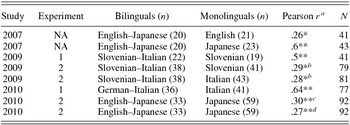
To examine the power of our statistical comparisons to detect an effect of language group on overall implicature performance, we first calculated the likely magnitude of the bilingualism effect on pragmatic ability based on the three previous studies by Siegal et al. (Reference Siegal, Matsuo, Pond, Otsu and Otsu2007, Reference Siegal, Iozzi and Surian2009, Reference Siegal, Surian, Matsuo, Geraci, Iozzi, Okumura and Itakura2010), which tested similar skills in preschool-aged children. To do so, we conducted a basic meta-analysis on SPSS using the syntax files provided by Field and Gillett (Reference Field and Gillett2010). Table 9 shows the included studies, the effect sizes from each study (by comparison), and the sample size for each comparison.
Summary of Siegal et al. (2007, 2009, 2010) studies included in the basic meta-analysis and associated effect sizes
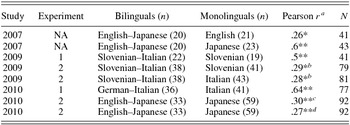
a Effect size for the comparison between bilinguals and monolinguals on overall performance in the Conversational Violations Test. A positive effect indicates better bilingual performance.
b Effect size calculated by averaging the effect sizes for the between-group comparisons on each individual maxim.
c Effect size for the comparison between bilinguals and monolinguals when bilinguals took the test in English and monolinguals in Japanese (and verbal mental age in English for bilinguals and in Japanese for monolinguals was covaried in the analysis).
d Effect size for the comparison between bilinguals and monolinguals when both groups took the test in Japanese (and verbal mental age in Japanese was covaried in the analysis).
*p < .05. **p < .01.
The results of the meta-analysis showed that the mean effect size based on Hedges and Vevea's (1998) random-effects model was r = .39; the 95% confidence interval was 0.27 (lower) and 0.49 (upper), which had a significant associated z score (z = 6.24, p < .001). This represents a medium to large effect size according to Cohen (Reference Cohen1988). We thus calculated the power of our between-group statistical tests to detect an effect of the magnitude found by the Siegal et al. studies (Reference Siegal, Matsuo, Pond, Otsu and Otsu2007, Reference Siegal, Iozzi and Surian2009, Reference Siegal, Surian, Matsuo, Geraci, Iozzi, Okumura and Itakura2010) in combination (see O'Keefe, Reference O'Keefe2007; Sun, Pan, & Wang, Reference Sun, Pan and Wang2011). We focus here on the first comparison that included the larger samples from each group, since both comparisons yielded similar results.
A power calculation using G*Power (Faul, Erdfelder, Lang, & Buchner, Reference Faul, Erdfelder, Lang and Buchner2007) indicated that the first comparison had a power of 0.96 for the main effect of group (for an ANOVA with three groups and a total sample of 95 children), which is well above Cohen's (Reference Cohen1988) recommended level of 0.8.Footnote 5 We further calculated the power of our statistical comparison to detect a group effect of moderate size (f = 0.25; to allow for a more conservative estimate of the effect size than that expected based on the studies by Siegal et al.). This power calculation indicated that the first comparison had a power of 0.56 for the main effect of group, which is well below the recommended level of 0.8 (Cohen, Reference Cohen1988). Nevertheless, these power calculations do not take into account two aspects of our statistical analyses that are known to have a positive effect on power. The first is the use of ANCOVA, which allows removing the effect of factors that correlate with the dependent measure of interest (and hence reduces error variance and improves the relationship between group and the dependent variable). The second is the measurement of implicature understanding skill through multiple indicators that leads to more reliable estimates of this ability (Cohen, Reference Cohen1988, pp. 535–542; Rushton, Brainerd, & Pressley, Reference Rushton, Brainerd and Pressley1983).
Regarding the first aspect, in our between-group comparisons we included three factors that correlated with pragmatic performance (see Table 1): language ability, IQ, and age. A regression analysis of language ability—1, IQ, and age on overall implicature performance showed that these three variables accounted collectively for 32% of the total variance in the dependent measure. Using the formula in Cohen (Reference Cohen1988, pp. 540–541), this means that an ANCOVA comparison with these three factors as covariates would need only 68% of participants to achieve a power of 0.8 compared to a comparison without these variables covaried. In essence, this means a gain of 50 participants, which brings the power level of the group comparison in this study to 0.76, just below the required level of 0.8.
We would expect, however, that the above estimates of power are even higher. When multiple measures of a target construct are tested, and these measures show some degree of convergent validity and are combined into a single indicator of that component, variance idiosyncratic to each task is averaged out and general variance accumulates (see Carlson, Reference Carlson2003; Rushton et al., Reference Rushton, Brainerd and Pressley1983). This leaves a less biased, more stable, more reliable, and purer estimator of the relevant component (Rushton et al., Reference Rushton, Brainerd and Pressley1983) and achieves “more psychometric precision” (Carlson, Reference Carlson2003, p. 42). This reduction in error in the dependent measure and consequent increase in reliability is also salutary for power as noted by Cohen (Reference Cohen1988, p. 537).
The relation among implicature performance, children's language proficiency, and EC
In order to explore the verbal and nonverbal cognitive skills that potentially predict children's implicature performance, correlational analyses were conducted. These analyses were performed on the overall implicature composite score that reflected implicature performance in CG for multilinguals and bilectals, and in SMG for monolinguals.
Antoniou et al. (Reference Antoniou, Grohmann, Kambanaros and Katsos2016) reported that a PCA on six indicators of EC ability revealed two distinct components of EC, which they interpreted as representing inhibition and WM (with the Simon effect, stop-signal reaction time, and the switching cost loading on the first factor and the rest on the second factor). Following the PCA, Antoniou et al. (Reference Antoniou, Grohmann, Kambanaros and Katsos2016) formed composite scores from the measures that loaded on each factor by transforming into z scores and then averaging the relevant scores. Thus, the correlational analyses reported here were conducted with these two EC composite scores: inhibition and WM.
For all groups, measures of theoretical interest included the two EC composite scores. Age and language ability are also two factors that have been found in some studies to affect children's implicature understanding skills, and for this reason, correlations with these aspects were also considered (GLA-1 was included as a measure of children's language proficiency in the language of testing; see, e.g., Johnson, Reference Johnson1991; Norbury, Reference Norbury2005; Rundblad & Annaz, Reference Rundblad and Annaz2010, and references therein for effects of language ability and Guasti et al., Reference Guasti, Chierchia, Crain, Foppolo, Gualmini and Meroni2005; Noveck, Reference Noveck2001; Pouscoulous et al., Reference Pouscoulous, Noveck, Politzer and Bastide2007; Winner, Reference Winner1997; Winner, Levy, Kaplan, & Rosenblatt, Reference Winner, Levy, Kaplan and Rosenblatt1988, for effects of age). Correlations between these measures and implicature performance are presented in Table 1 for the whole sample of children in this experimental study. Independent variables that significantly correlated with implicature performance were included in the regression analyses as predictors.
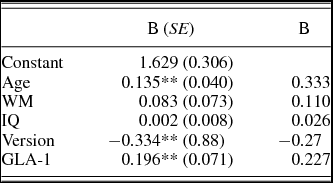
The first regression analysis was conducted on the whole sample of participants in this study with age, GLA-1, WM, IQ, and task version as predictors. Overall, this regression model was significant, F (5, 127) = 15.465, p < .05, accounting for 38% of the variance in the dependent measure. When looking at the coefficients, only age, GLA-1, and task version significantly predicted overall implicature performance, the association with the first two measures being positive and the association with version being negative, t (127) = 3.400, p < .05, t (127) = 2.745, p < .05, t (127) = –3.793, p < .05, respectively. The results of this linear regression analysis are presented in Table 10.
Results of multiple regression analysis on implicature performance based on the whole sample of children

Note: Age, Age (years); WM, working memory composite score; IQ, scores in the matrix reasoning test of the Wechsler Abbreviated Scale of Intelligence; Version, task version of implicatures test; GLA-1, general language ability 1 composite score. R 2 = .38; F (5, 127) = 15.465 (p < .05).
*p < .05. **p < .01.
Similar regression analyses were conducted for each group of participants separately (monolinguals, bilectals, and multilinguals). The regression analysis for the monolingual group included GLA-1 and task version as predictors and revealed only a significant negative effect of version, t (22) = –2.60, p < .05, and a positive effect of GLA-1, t (22) = 2.69, p < .05. The regression analysis for the bilectal group included age, GLA-1, WM, inhibition, and IQ as predictors. When looking at the individual predictors, there was only a significant positive effect of GLA-1, t (54) = 2.93, p < .05. Finally, the regression analysis for the multilingual group included age, GLA-1, WM, IQ, and task version and revealed only a significant positive effect of age, t (39) = 3.38, p < .05, and a significant negative effect of version, t (37) = –4.589, p < .05.
DISCUSSION
The present research investigated how growing up with two languages or two different varieties of the same language affects the ability to understand implicatures in children. We were also interested in potential relations between pragmatic language understanding and EC. There were several interesting findings of this study, and these are discussed in the following sections.
The components of implicature understanding skill
A PCA on children's scores from four implicature subtests (on metaphor, manner, and SI comprehension) revealed only a single factor of implicature performance. This was not a trivial result given that the scores for each implicature type were extracted from different subtests that varied methodologically (e.g., in terms of instructions, method of response, and verbal demands). In terms of the generalized–particularized implicature debate, this finding provides support to pragmatic theories (e.g., Geurts, Reference Geurts2010; Grice, Reference Grice, Cole and Morgan1975; Sperber & Wilson, Reference Sperber and Wilson1995/1986) that treat all types of pragmatically inferred meanings as the outcome of a single pragmatic interpretation process that involves uncovering the speaker's intentions behind an utterance. On the contrary, this result is not easily accommodated by theories that postulate a categorical distinction in the mechanisms involved in deriving PCIs and GCIs (Chierchia, Reference Chierchia and Belletti2004; Levinson, Reference Levinson2000).
The effects of childhood multilingualism and bilectalism on implicature understanding
Our study did not provide any hard evidence for differences in multilingual, bilectal, and monolingual children's implicature understanding skills. When considering the more reliable indicators of pragmatic ability (the overall implicature composite scores), some differences emerged, but these differences were not robust and not in the direction of one group of children consistently outperforming the others. Comparison 1 indicated better multilingual and monolingual performance relative to bilectals. However, this advantage was evident in only one of the two task versions of the implicatures test and was not significant in the follow-up analyses and post hoc pairwise comparisons between the three groups. Furthermore, there were some indications for a bilectal advantage relative to monolinguals in overall implicature performance when children's language proficiency was more reliably controlled in Comparison 2. However, again, this difference in performance favoring bilectals was evident only in one version of the implicatures task when bilectals and monolinguals were tested in their native dialects (bilectals in CG and monolinguals in SMG) and was not significant when bilectal and monolingual children's implicature performance in SMG was considered. Thus, it seems fair to conclude that there was no strong evidential basis in this study on which to maintain that the three groups differed in their implicature understanding skills.
Furthermore, multilingual children exhibited monolingual-like implicature understanding whether considering children who were dominant in the language of testing (CG) or children who were dominant in English. Similarly, bilectals performed comparably to monolinguals whether they were tested in their dominant, native variety (CG) or in their second, nonnative variety (SMG). Finally, multilingual and bilectal children exhibited comparable to monolinguals implicature performance even when no statistical control was performed on their lower formal language proficiency.
These results in combination show that multilingual and bilectal children exhibit comparable to monolinguals level of implicature understanding regadless of factors such as level of language proficiency or language dominance.
Toward reconciling the null multilingual effect on implicature understanding with previous positive reports
However, the above conclusion stands in contrast to the findings of the studies by Siegal et al. who reported precocious bilingual development either in similar (2007) or closely related pragmatic–communicative skills (2009, 2010), and even in the face of bilingual children's lower language abilities. Here, we consider several explanations that might help reconcile the discrepancy in the findings.
To start with, Siegal et al.’s (Reference Siegal, Matsuo, Pond, Otsu and Otsu2007) finding of a bilingual advantage in generating SIs is a single finding in the literature and it is possible that it is not replicable (a Type I error).Footnote 6 The present study provides some evidence in support of this position since it included a similar (albeit not fully identical) task, but obtained no evidence for enhanced multilingual performance. Both the Siegal et al. (Reference Siegal, Matsuo, Pond, Otsu and Otsu2007) task and the binary judgment task in the current study required children to judge the accuracy of sentences using the quantifiers some and all as descriptions of various scenarios, and both tasks required the generation of a SI in order to reject the critical underinformative sentences. Yet the two studies obtained different results. Furthermore, the present study did not document a multilingual advantage in understanding SIs in a second task that tested the same type of implicature, but had a different format (action-based task). This observation makes it unlikely that the present study gave rise to a Type II error in two tasks compared to the likelihood of a Type I error in Siegal et al. (Reference Siegal, Matsuo, Pond, Otsu and Otsu2007) who used just one task.
Two additional explanations are related to the particular test employed in the Siegal et al. (Reference Siegal, Iozzi and Surian2009, Reference Siegal, Surian, Matsuo, Geraci, Iozzi, Okumura and Itakura2010) studies. First, Siegal et al.’s (Reference Siegal, Iozzi and Surian2009, Reference Siegal, Surian, Matsuo, Geraci, Iozzi, Okumura and Itakura2010) CVT examined the ability to detect utterances that violated conversational rules, while the pragmatic test in the present study investigated the skill to interpret implicatures. It is likely that the documented bilingual advantage in detecting violations of Gricean maxims does not extend to the ability to understand implicatures. We can see only one reason why this might not be the case. As described earlier, experimental evidence shows that bilingual children excel in almost all components that have been theoretically and/or experimentally linked to the process of implicature understanding (e.g., EC, detecting violations of Gricean maxims, ToM) but lag behind in core language knowledge. It is conceivable that superior implicature performance was not obtained in this study because the pragmatic task used posed more demands on children's language proficiency than the test employed in Siegal et al. (Reference Siegal, Iozzi and Surian2009, Reference Siegal, Surian, Matsuo, Geraci, Iozzi, Okumura and Itakura2010). This might have neutralized any potential multilingual advantages in other implicature-related facets. In support of this view, the regression analyses conducted on the whole sample of children indicated that core language ability was the primary factor affecting children's implicature understanding performance.
Second, Katsos, Roqueta, Estevan, and Cummins (Reference Katsos, Roqueta, Estevan and Cummins2011) have questioned the CVT's validity as a test of pragmatic ability. Specifically, they argued that the CVT falls short of being a real test of pragmatic sensitivity, at least as far as the maxims of quality, relation, and politeness are concerned. As Katsos et al. (Reference Katsos, Roqueta, Estevan and Cummins2011, p. 44) note, given the question Have you seen my dog?, children can reject an answer such as Yes, he's in the sky on the grounds of it being an implausible statement, just by drawing on their encyclopedic knowledge about the world and the likelihood of dogs being in the sky, and not because they were sensitive to the maxim of quality. Katsos et al. (Reference Katsos, Roqueta, Estevan and Cummins2011) express similar concerns about the statements used to investigate children's sensitivity to the maxim of relation (e.g., I know your name as a response to the question What game do you like?). Finally, they contend that identification of rude utterances such as the ones used by Siegal et al. (Reference Siegal, Iozzi and Surian2009, Reference Siegal, Surian, Matsuo, Geraci, Iozzi, Okumura and Itakura2010) to test children's sensitivity to the maxim of politeness (No, it's disgusting as a response to the question Do you like my dress?) depends on culture-specific social norms rather than on “culture-independent considerations of communicative efficiency that underpin the maxims of quantity, relation and manner” (Katsos et al., Reference Katsos, Roqueta, Estevan and Cummins2011, p. 44). Nevertheless, it should be noted that Siegal et al. did report a bilingual advantage for the items on the maxims of manner (Siegal et al., Reference Siegal, Iozzi and Surian2009, Reference Siegal, Surian, Matsuo, Geraci, Iozzi, Okumura and Itakura2010) and quantity II (Siegal et al., Reference Siegal, Iozzi and Surian2009, Reference Siegal, Surian, Matsuo, Geraci, Iozzi, Okumura and Itakura2010) that unequivocally tested pragmatic sensitivity.
Third, another explanation for the contrast in the results might be that this study included children of an older age (school-aged children between 6 and 9 years old) than the children tested in Siegal et al. (Reference Siegal, Matsuo, Pond, Otsu and Otsu2007, Reference Siegal, Iozzi and Surian2009, Reference Siegal, Surian, Matsuo, Geraci, Iozzi, Okumura and Itakura2010; preschoolers between 4 and 6 years old). It is possible that the impact of bilingualism is more profound during the preschool years, a period during which pragmatic understanding is at the very early stages of development and children present difficulties in a range of pragmatic tasks (see, e.g., Guasti et al., Reference Guasti, Chierchia, Crain, Foppolo, Gualmini and Meroni2005; Noveck, Reference Noveck2001; Pouscoulous et al., Reference Pouscoulous, Noveck, Politzer and Bastide2007; Vosniadou, Reference Vosniadou1987; Winner, Reference Winner1997). Alternatively, one might argue that monolingual children catch up with their bilingual peers as they become older and accumulate more experience in interpreting pragmatic language. Thus, even though our data shows that a multilingual/bilectal benefit is not found in early school-aged children, it cannot exclude the possibility that such an advantage might be found when testing younger children.
It should be clarified that the lack of significant differences between the language groups cannot be attributed to lack of variability in children's pragmatic performance or to the fact that the children in our study were too competent with implicature for significant differences to emerge. Overall implicature performance across the three groups was at 73% in the current study, which is far from ceiling. Furthermore, this level of performance is lower than the 79.5% and 74.4% overall performance obtained in the CVT by Siegal et al. (Reference Siegal, Iozzi and Surian2009, their experiments 1 and 2, respectively) and the 80% and 79% obtained by Siegal et al. (Reference Siegal, Surian, Matsuo, Geraci, Iozzi, Okumura and Itakura2010, their experiments 1 and 2, respectively). This shows that our task had more variability in children's performance than the CVT in Siegal et al. (Reference Siegal, Iozzi and Surian2009, Reference Siegal, Surian, Matsuo, Geraci, Iozzi, Okumura and Itakura2010). Furthermore, the fact that significant differences between bilinguals and monolinguals were found in the experiments by Siegal et al. but not in the present one, suggests that the null effect in our experiment cannot be attributed to a high level of performance or a lack of sufficient variability. Finally, the implicature understanding skills of the children included in the between-group analyses on implicature comprehension (aged 6;2–9;0 years) were not yet at a peak level, but were still developing, as indicated by the fact that the implicature performance of these children was significantly lower than that of a group of older children (aged 9;01–12;2, whose data were discarded in the between-group analyses due to the matching in age).
The cognitive foundations of implicature understanding in children
Another purpose of this study was to investigate the cognitive factors that affect implicature understanding in children. A regression analysis on the data from the whole sample of children indicated that language proficiency in the language of testing, as well as age, were the critical predictors of implicature understanding. The findings of this analysis suggest that implicature understanding is a pragmatic–communicative skill that largely depends on children's language abilities.
Further regression analyses, however, on each of the three groups of children individually revealed an interesting divide. While for monolingual and bilectal children general language ability emerged as the decisive factor, for multilingual children there was a clearly nonsignificant effect of language proficiency and only a significant positive contribution of age.
How is it possible to account for this pattern of results? One interpretation might be that multilingual, bilectal, and monolingual children achieve the same ends when interpreting pragmatic language but through a different route. The findings of the present study indicate that, in general, implicature understanding is a pragmatic–communicative ability that primarily draws on children's language proficiency. This of course might be particularly true for children with better-developed language skills such as monolingual and bilectal children. The well-documented delays in bilingual children's language development, however, suggest that bilingual children might be less able to rely on their core language knowledge when comprehending implicatures. In this respect, they need to accomplish the implicature interpretation process in a different way. This possibility is further reinforced by the fact that age was a significant predictor of pragmatic performance only within the multilingual group, suggesting that other nonlinguistic factors, besides EC, that develop with age are possibly involved in and sustain the process of computing implicatures in multilinguals.
Exactly what these other nonlinguistic cognitive resources or this alternative way of understanding implicatures might be is beyond the reach of this study, and such a discussion can only be speculative. One possibility is that bilingual children compensate for their disadvantage in language ability by being more attentive and sensitive to contextual aspects of an utterance, as suggested by Siegal et al. (Reference Siegal, Surian, Matsuo, Geraci, Iozzi, Okumura and Itakura2010). Another option might be that bilinguals engage to a greater degree their (potentially better-developed) ToM skills.
The role of confounding factors
In the current study, we controlled for several factors that correlate with bilingualism and/or that affect implicature performance by matching the groups in the relevant variables and/or by measuring these variables and excluding them as potential confounds through the use of ANCOVA. Ethnicity, culture, and immigration status were also controlled by default given the groups of children compared.
Language proficiency was carefully measured via two measures in Comparison 1 and three measures in Comparison 2. Thus, we can be fairly confident that the language proficiency composite scores calculated from these measures were reliable indicators of the target skill and that the ANCOVA adequately adjusted for differences between the groups. No significant differences in overall implicature performance emerged even when comparing bilectal and monolingual children (who showed smaller differences in language proficiency as seen in the analyses on expressive vocabulary in Comparison 1) or even when more robustly controlling for differences in language proficiency by covarying a composite score of three language measures in Comparison 2.
Similarly, for SES, three different indicators were aggregated into a single composite measure, which was covaried in the between-group analyses. Again, it seems reasonable to assume that this composite score precisely and reliably measured this sociodemographic facet and that the ANCOVA led to appropriate adjustments of differences between the three groups. Furthermore, SES cannot confound the results of the between-group analyses because it did not significantly correlate with implicature performance in this study. In addition, significant differences in SES were found only between the multilingual and bilectal children. Thus, in the critical comparisons between multilingual and monolingual children, and between bilectal and monolingual children that tested for the effects of main interest, the groups were of comparable SES.
Between-group differences in nonverbal fluid intelligence were controlled for by covarying performance in the WASI matrix reasoning test in all the between-group analyses on overall implicature understanding skill. According to Miller and Chapman (Reference Miller and Chapman2001, p. 45), the application of ANCOVA is acceptable when the between-group differences on the covariate do not reflect true population differences, but can be attributed to chance. A review of the literature reveals that there is no expectation for a bilingual advantage in nonverbal fluid intelligence, and the majority of studies that tested this aspect of cognition in bilingual and monolingual children reported a null bilingual effect (see Barac et al., Reference Barac, Bialystok, Castro and Sanchez2014; but see Marzecova, Asanowicz, Krivá, & Wodnicka, Reference Marzecova, Asanowicz, Krivá and Wodniecka2013; Tao, Marzecová, Taft, Asanowicz, & Wodniecka, Reference Tao, Marzecová, Taft, Asanowicz and Wodniecka2011). This raises the possibility that the positive effect of multilingualism on IQ in this study was not a true effect and was due to chance.
However, even if the multilingual advantage in IQ performance is real, does this pose any challenges on our interpretation of the results in this study? Our answer is again no, and several different arguments can be offered to ground this response. If between-group differences in IQ reflect a true effect, then the only error that could possibly be committed in our analyses is a Type II error against monolinguals (i.e., that there is a monolingual advantage over multilinguals that was not detected because the between-group difference in IQ was not adequately controlled). This by itself is a novel finding given that one would expect, not a monolingual advantage, but a medium to large multilingual advantage based on previous research. However, we do not think that this scenario is plausible. First, the WASI matrix reasoning test is part of a widely used cognitive battery whose psychometric characteristics have been investigated and established. For participants’ scores in the matrix reasoning test, Wechsler (Reference Wechsler1999) reports split-half reliability of 0.96 and test–retest reliability of 0.72 for the age range in this sample. Second, we also calculated the reliability of this score based on the sample of children in our study. Cronbach α for the IQ score is 0.956, which is quite high (see Field, Reference Field2013, p. 715). Third, even though IQ significantly correlated with implicature understanding skill, the regression analyses indicated that it does not actually affect pragmatic performance and that the significant correlation can be explained in terms of third factors (age, EC, or language proficiency). Fourth, it is possible that the multilingual advantage in the WASI matrix reasoning test was due to multilinguals’ enhanced EC skills. If this is true, then this would justify treating IQ as an EC measure. Again, differences in EC cannot explain the between-group results as indicated by the nonsignificant effect of EC on implicature understanding in the regression analyses. Fifth and finally, in the second comparison of the current study, bilectal and monolingual subgroups were used that did not statistically differ in terms of either SES or fluid intelligence performance. Yet, again, no significant differences between the two groups were obtained in overall implicature understanding.
APPENDIX A
The (socio)linguistic situation in Greek-speaking Cyprus and the relation between CG and SMG
The sociolinguistic terrain in Greek-speaking Cyprus has been often described as diglossic with CG being the low variety and SMG the high variety (Arvaniti, Reference Arvaniti2010; Rowe & Grohmann, Reference Rowe and Grohmann2013; but see Auer, Reference Auer, Delbecque, van der Auwera and Geeraerts2005; Karyolemou, Reference Karyolemou and Muhr2006). CG and SMG are both dialects of Greek. CG is natively acquired and used in everyday communication. SMG is acquired sequentially, mainly through formal education (from kindergarten onward, around the age of 5), it is the language of education, and it is also the language used in formal situations, particularly writing, public speaking, and in the media. It is also the official language of the Republic of Cyprus and the language spoken by Hellenic Greeks in the Republic of Greece.
CG and SMG exhibit a high degree of language similarity. To begin with, the two varieties are genetically related. According to the traditional comparative method, the two dialects are classified as parts of the Greek language family of Indo-European languages (Lewis, Gary, & Fennig, Reference Lewis, Gary and Fennig2014, see Classification under Greek Language entry; see also Lyovin, Reference Lyovin1997). Furthermore, the Ethnologue (Lewis et al., Reference Lewis, Gary and Fennig2014, see Dialects under Greek Language entry) reports a lexical similarity of 84%–93% between the two varieties, with an 85% similarity being the cutoff point for two variants being dialects of the same languageFootnote 7 (see Newton, Reference Newton1972, pp. 111–112; Terkourafi, Reference Terkourafi2005, p. 316). Finally, there is some degree of intelligibility between the two dialects as spoken by native speakers among themselves with some varieties of CG being more easily understood by SMG native speakers than others.
Nevertheless, the two dialects also show differences in both grammar and the lexicon (see, e.g., Terkourafi, Reference Terkourafi2005): morphology (e.g., CG has verbs that are formed with the suffix –isko, as in CG [miˈnisko], I stay, instead of the SMG [ˈmeno]), syntax (e.g., CG uses a clefting strategy for forming wh-questions, which does not exist in SMG, as in the CG [ˈinda mbu ˈkamnis?], meaning what is it that you are doing, opposed to the SMG [ti ˈkaneis]; Grohmann, Panagiotidis, & Tsiplakou, Reference Grohmann, Panagiotidis, Tsiplakou, Janse, Joseph and Ralli2006), phonetics and phonology (e.g., in CG the voiced fricatives [v], [ð], [γ] are sometimes deleted intervocalically, so the SMG [tiγaˈnizo], meaning I fry, becomes [tiaˈnizo] in CG), semantics (e.g., the word [laˈlo] means I crow in SMG and I say in CG), pragmatics (Greek Cypriots and Hellenic Greeks often use different politeness strategies; e.g., Terkourafi, Reference Terkourafi1997), and lexis (e.g., for the word run, SMG speakers use the word [ˈtrexo], while CG speakers frequently use the word [vuˈɾo]).
APPENDIX B
Linguisitc material used in the picture-selection part of the implicatures test

Linguistic material used in the binary judgment part of the implicatures test

Linguistic material used in the act-out part of the implicatures test

ACKNOWLEDGMENTS
Parts of this research have been funded by an ESF Experimental Pragmatics Network (Euro-XPrag) collaborative grant and an ESRC Experimental Pragmatics Network in the United Kingdom (XPrag-UK; RES-810-21-0069) to both authors, and an Alexander Onassis Foundation scholarship for graduate studies and a postdoctoral fellowship from the Wiener–Anspach Foundation to the first author.