Introduction
Children with specific language impairment (SLI) are known to show poor language abilities. However, an increasing amount of studies reveal that they also show poor performances in non-linguistic domains, such as attention, dual-tasking, inhibition, or working memory (Archibald & Gathercole, Reference Archibald and Gathercole2007; Bishop & Norbury, Reference Bishop and Norbury2005; Gathercole, Reference Gathercole2006; Hoffman & Gillam, Reference Hoffman and Gillam2004; Im-Bolter, Johnson, & Pascual-Leone, Reference Im-Bolter, Johnson and Pascual-Leone2006; Montgomery, Reference Montgomery2008; Weismer, Plante, Jones, & Tomblin, Reference Weismer, Plante, Jones and Tomblin2005). Recently, the specificity of SLI has been questioned, leading to the sometimes preferred nomenclature of ‘primary’ language impairment (Edwards & Munson, Reference Edwards and Munson2009; Windsor & Kohnert, Reference Windsor and Kohnert2004). Some authors have proposed that these children may suffer from general processing capacity limitations leading to poor performance in both the verbal and nonverbal domains (e.g., Leonard et al., Reference Leonard, Weismer, Miller, Francis, Tomblin and Kail2007; Miller, Kail, Leonard, & Tomblin, Reference Miller, Kail, Leonard and Tomblin2001; Weismer & Hesketh, Reference Weismer and Hesketh1996). In this view, as the complexity and the processing demands of the task increase, the performance in these children decreases. Previous studies have shown this pattern of results in verbal tasks such as sentence comprehension, word recognition or listening span tasks (e.g., Evans, Reference Evans2002; Marton & Schwartz, Reference Marton and Schwartz2003; Montgomery, Reference Montgomery2005). The current study aims at assessing this hypothesis in the visual domain, by assessing whether the complexity of the visual processes required could be at the root of the poor performances observed in some visual short-term memory (VSTM) tasks in children with SLI. If these children suffer from a limitation in general processing capacities, over and above their linguistic problem, they should show problems in the processing of complex items, even in the visual domain.
VSTM in SLI: Where Do We Stand?
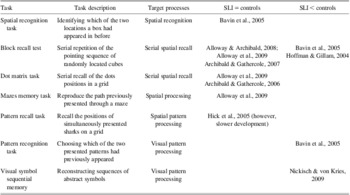
Many studies have explored VSTM in children with SLI but results have been conflicting. In some studies, chronological age-appropriate performances were observed (Alloway & Archibald, Reference Alloway and Archibald2008; Alloway, Rajendran, & Archibald, Reference Alloway, Rajendran and Archibald2009; Archibald & Gathercole, Reference Archibald and Gathercole2006, Reference Archibald and Gathercole2007). These studies mainly explored spatial STM using simple visual stimuli and/or recognition memory designs. On the other hand, some tasks have led to rather conflicting results. Serial block/dot reconstruction tasks have led to preserved performances in children with SLI in some studies (Alloway & Archibald, Reference Alloway and Archibald2008; Alloway et al., Reference Alloway, Rajendran and Archibald2009; Archibald & Gathercole, Reference Archibald and Gathercole2006, Reference Archibald and Gathercole2007), but not in others (Bavin, Wilson, Maruff, & Sleeman, Reference Bavin, Wilson, Maruff and Sleeman2005; Hoffman & Gillam, Reference Hoffman and Gillam2004). The most consistent deficits, relative to age controls, have been observed for tasks probing VSTM for complex visual stimuli (see Table 1). These tasks include pattern recognition tasks (Bavin et al., Reference Bavin, Wilson, Maruff and Sleeman2005) and visual symbol sequence tasks (Nickisch & von Kries, Reference Nickisch and von Kries2009).
Summary of Studies Having Explored Visual Short-Term Memory in Children with SLI

It thus seems that children with SLI show impaired performance when the VSTM task necessitates fine-grained visual processing. In the pattern recognition task, children have to process and store precise visual patterns to compare a stored pattern with two newly presented patterns. In the visual symbol sequence task, the low opportunity for verbal recoding requires the ability to precisely process unusual symbols, to differentiate them from one another and to precisely store them in their accurate order. Our study aims at providing direct evidence for the importance of visual complexity as underlying poor VSTM performance in children with SLI.
Complexity in VSTM
In previous VSTM studies, the manipulation of visual complexity referred at least to two different things: feature count and visual similarity. On the one hand, Forsythe (Reference Forsythe2009) considered visual complexity to refer to the number of lines within a symbol, that is, to feature count. Alvarez and Cavanagh (Reference Alvarez and Cavanagh2004) defined the visual complexity of an object in terms of information load, in terms of the number of visual features or details stored for this object. The feature count effect in VSTM is reflected by an inverse relation between the information load per object and the number of objects that can be held in memory (e.g., Alvarez & Cavanagh, Reference Alvarez and Cavanagh2004; Eng, Chen, & Jiang, Reference Eng, Chen and Jiang2005; Luria, Sessa, Gotler, Jolicoeur, & DellAcqua, Reference Luria, Sessa, Gotler, Jolicoeur and DellAcqua2010). These studies suggest that VSTM capacity is limited by the amount of information that has to be processed. On the other hand, another complexity factor that influences VSTM performance is visual similarity. Visual similarity refers to the overlap of visual features between two objects. The similarity of visual information is also inversely associated with VSTM success. In typically developing children and adults, a visual similarity effect has been observed on several VSTM tasks (Avons & Mason, Reference Avons and Mason1999; Logie, Della Sala, Wynn, & Baddeley, Reference Logie, Della Sala, Wynn and Baddeley2000; Poirier, Saint-Aubin, Musselwhite, Mohanadas, & Mahammed, Reference Poirier, Saint-Aubin, Musselwhite, Mohanadas and Mahammed2007).
Aims
The present study assessed to what extent the complexity of visual information to be processed underlies the poor performance observed during VSTM tasks in children with SLI. VSTM was assessed via a serial reconstruction task of visual sequences of increasing length. The stimuli were unfamiliar, difficult to verbalize symbols. The children had to reconstruct the sequences by using cards depicting the presented symbols. This task was chosen as it provides a sensitive assessment of fine-grained VSTM representations, especially when manipulating similarity. Although short-term memory tasks maximizing the recall of item information are generally considered to provide the most direct measure of the quality of underlying item short-term memory representations, item similarity is in fact known to facilitate recall at the item level (Mate & Baques, Reference Mate and Baques2009). Given that the aim of the present study is to determine whether visual complexity disproportionately impairs VSTM performance in children with SLI, a serial order reconstruction task was chosen. Serial recall for similar items has indeed been shown to lead to the classical similarity effect: poorer recall performance for similar items. This effect has been attributed to poorer distinctiveness of VSTM traces across the different serial positions (Avons & Mason, Reference Avons and Mason1999; Lin & Luck, Reference Lin and Luck2008; Mate & Baques, Reference Mate and Baques2009). Consequently, if VSTM traces are less fine-grained in children with SLI than in controls, a larger negative effect on performances for processing similar than dissimilar symbols should be observed relative to controls.
Task complexity was varied along two dimensions: the feature count and the degree of similarity of the symbols to process. Hindi (low-feature-count symbols) and Chinese (high-feature-count symbols) characters were used and visual similarity was varied for each set of characters. Following the limited processing capacity hypothesis, we hypothesized that the increase in processing demands for these tasks will lead to a larger decrease in performances in children with SLI as compared to controls.
Children with SLI were compared to two different groups of participants. A first group was matched for chronological age and nonverbal reasoning abilities. However, given that we wanted to explore the impact of visual similarity and feature count on VSTM performance, it was important that for the baseline condition (low-similarity-and-low-feature-count symbols), performance in the SLI group was comparable to that of the control group. If children with SLI show already poorer performance for the baseline condition, an increased impact of similarity and feature count on VSTM in the SLI group would be difficult to interpret. For this reason, a second group matched for baseline performance on the VSTM task was included in this study. Moreover, using a VSTM-matched group enabled us to explore whether the processes targeted by our study (i.e., similarity and feature count) are disproportionately impaired in SLI. This strategy is often used to identify core deficits in SLI (Bishop, Reference Bishop1997). If the complexity of the visual information that has to be held in memory is to explain poor performances in children with SLI, these children should be especially impaired in maintaining symbols containing a high number of features and of high similarity. If they do even more poorly than VSTM-matched controls, then we cannot just dismiss this deficit as secondary.
Methods
Participants
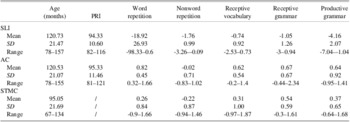
Fifteen French-speaking children with SLI aged 6 to 13 years (4 girls; mean age = 10;0 years; SD = 1;8; range = 6;6–13;1), 15 typically developing children matched for chronological age and nonverbal reasoning (10 girls; mean age = 10;0 years; SD = 1;7; range = 6;6–12;11), and 15 younger typically developing children matched to the SLI group based on their performances on the low-feature-count-and-low-similarity VSTM condition (12 girls; mean age = 7;9 years; SD = 1;8; range: 5;5–11;0) participated in the study. The SLI group and the age control (AC) group did not significantly differ in terms of age, t (28) < 1, n.s., and nonverbal reasoning abilities (Perceptual Reasoning Index of the WISC-IV, Wechsler, Reference Wechsler2005), t(28) < 1, n.s. The SLI group and the VSTM control (STMC) group did not differ on their performance levels for the low-feature-count-and-low-similarity VSTM condition (t (28) < 1, n.s.) (see task description below).
The children were recruited in schools in the neighborhood of the city of Liege. All data were obtained in compliance with regulations of ethics review committee. Informed consent was obtained from the parents of all participating children. All children came from families with low or middle-class socioeconomic background, as determined by their parents’ profession. The parents answered to a medical history questionnaire, allowing us to ensure that they were French native speakers, had no history of psychiatric or neurological disorders, and no neurodevelopmental delay or sensory impairment (including visual problems). Children with SLI were recruited from specific language classes in special needs schools. They were diagnosed as children with SLI before the study by certified speech-language pathologists. Moreover, by using standard clinical tests we ensured that they met the following criteria. First, they demonstrated normal range on the Perceptual Reasoning Index (⩾80) from the WISC-IV (Wechsler, Reference Wechsler2005). Second, they scored more than −1.25 SD below expected normative performance in at least two of the following language domains (Leonard et al., Reference Leonard, Weismer, Miller, Francis, Tomblin and Kail2007): (1) phonological abilities were assessed using the word repetition task of the Evaluation du Langage Oral that measures repetition performance for late acquired phonemes, complex phonological patterns and multisyllabic words (Khomsi, Reference Khomsi2001); (2) lexical abilities were measured by the French adaptation of the Peabody Picture Vocabulary Test (Dunn, Thériault-Whalen, & Dunn, Reference Dunn, Thériault-Whalen and Dunn1993); (3) receptive grammatical abilities were measured by the French adaptation of the TROG (Lecocq, Reference Lecocq1996) and productive grammatical abilities were measured by the sentence production task of the Evaluation du Langage Oral (Khomsi, Reference Khomsi2001) (Table 2). Control children scored in the normal range on all language tests. Moreover, children with SLI showed poorer performance on nonword repetition than AC (t(28) = −4.91; p < .001) and STMC (t(28) = -3.04; p < .01), as assessed by a French nonword repetition task (Poncelet & van der Linden, Reference Poncelet and van der Linden2003).
Descriptive summary data for children with specific language impairment (SLI), age control children (AC) and visual short-term memory control children (STMC)

Note. PRI, Perceptual Reasoning Index of the WISC-IV (Wechsler, Reference Wechsler2005): standard score with M = 100, SD = 15. The other scores are Z-scores with M = 0, SD = 1. The very low word repetition performances observed in children with SLI are due to the lack of errors expected in older children.
Materials and Procedure
Children performed four VSTM conditions, with stimuli varying in similarity and feature count. Order of presentation of the four VSTM conditions was counterbalanced within each group (except for STMC whose VSTM capacity was screened using the low-feature-count-and-low-similarity VSTM condition; once retained for the study, the other three VSTM conditions were administered, the order of these conditions being counterbalanced between participants). Each condition included 24 trials varying in length from two to seven stimuli, with 4 trials at each list length and a maximum possible score of 108. Each task was split into two equal parts (each containing 2 items at each symbol length), administered over a period of 1 week to optimize the reliability of the estimate of a given child's performance level. We reasoned that performance measures at two time points for the same task give a more reliable estimate of performance on this task than does a unique measure at a single time point.
Number of Features
Like in other studies on VSTM (Andrade, Kemps, Werniers, May, & Szmalec, Reference Andrade, Kemps, Werniers, May and Szmalec2002; Romani, Ward, & Olson, Reference Romani, Ward and Olson1999), we used Chinese and Hindi symbols for their lack of familiarity and their abstract shapes, minimizing the possibility to use a verbalization strategy which may support VSTM performance. Feature count was manipulated by presenting either Chinese or Hindi symbols. Chinese symbols, as compared to Hindi symbols, are more complex to process because they contain more lines to analyze and maintain. This was assessed by a counting of the number of continuous lines in each symbol, without direction change: low-feature-count-and-low-similarity symbols showed an average number of lines of 4.44 (SD = 1.13), while high-feature-count-and-low-similarity symbols contained an average number of lines of 17.67 (SD = 3.43), t(16) = 10.99, p < .001. Low-feature-count-and-high-similarity symbols had an average number of lines of 5.22 (SD = 0.97), while high-feature-count-and-high-similarity symbols showed an average number of lines of 14.44 (SD = 4.56), t(16) = 5.94; p < .001. Moreover, high-similarity symbols did not have a higher feature count than low-similarity symbols (low-feature-count symbols: t(16) = 1.57; p = .14; high-feature-count symbols: t(16) = 1.69; p = .11)) (see Figure 1).
The symbols used in the task: (a) Symbols of low feature count and low similarity; (b) symbols of low feature count and high similarity; (c) symbols of high feature count and low similarity; (d) symbols of high feature count and high similarity.

Feature Overlap
For both Hindi and Chinese symbols, nine symbols were a priori chosen for their feature overlap and nine for their feature distinctiveness. The higher similarity for symbols of high than low feature overlap was then confirmed based on the judgments by 26 adults who were presented stimulus pairs sampled from the set of 18 Hindi symbols on the one hand, and 18 Chinese symbols on the other hand. These participants were asked to rate the visual similarity of the two stimuli in each pair using a Likert scale ranging from 1 (highly distinct) to 4 (highly similar). Similar stimuli had an average rating of 3.09 (SD = 0.94) for Hindi symbols, and of 2.62 (SD = 1.09) for Chinese symbols; for dissimilar stimuli, the average ratings were, respectively, of 1.37 (SD = 0.71) and of 1.66 (SD = 0.93). The Wilcoxon statistic assessing the difference of similarity judgment, for each subject, between similar and dissimilar items, was significant for both Hindi (Z = 4.46; p < .001) and Chinese symbols (Z = 4.43; p < .001).
Procedure
The task was presented using E-Prime 1.0 Psychology Software (Schneider, Eschmann, & Zuccolotto, Reference Schneider, Eschmann and Zuccolotto2002). The stimuli were separated in four conditions: low-feature-count-and-low-similarity symbols, low-feature-count-and-high-similarity symbols, high-feature-count-and-low-similarity symbols, high-feature-count-and-high-similarity symbols. In each condition, the symbols were combined in lists ranging from two to seven symbols. No symbol was repeated within a sequence. At the beginning of each condition, the nine symbols used in the task were first individually presented to the child by asking him to pay attention because these were the symbols he would encounter in the task. Moreover, two practice items were administered to familiarize the child with the task, and feedback was provided during practice- but not experimental-trials. In each condition, the child was informed when list length increased. All the symbols of a given sequence were presented simultaneously, organized horizontally along a one-line grid; presentation time was proportional to sequence length (by allowing a theoretical time of 1.5 s spent per symbol). After the presentation of the sequence, the child was given in a random order the cards depicting the symbols that had just appeared on the screen, and he/she was asked to put them in the empty grid, in the same order as in the target sequence.
Results
The descriptive statistics are shown in Table 3. The four VSTM conditions showed moderate to high test–retest reliability estimates, as reflected by the correlation of the participant scores on the first and second administration of the tasks.
Descriptive statistics and test-retest reliability estimates for the number of symbols replaced in their correct serial position for each experimental condition (list lengths 3 to 6), as a function of participant group for children with specific language impairment (SLI), age controls (AC) and visual short-term memory controls (STMC)

The number of symbols placed in the correct order for each task was subjected to a mixed analysis of variance (ANOVA). We restricted our analysis to the list lengths that yielded no ceiling or floor effects (i.e., lists for which performance accuracy ranged between .20 and .75). This was achieved by retaining list length 3 to 6, that is, corresponding to mean span level in the SLI and STMC groups (list length 3 and 4) and the AC group (list length 5 and 6) for the low-similarity-and-low-feature-count condition. The between-subjects factor was participant group (SLI, STMC, or AC), the within-subjects factors were feature count (high or low) and similarity (high or low).
Group Effect
ANOVA analysis yielded a main effect of group (F(2,42) = 3.59; p < .05; partial η2 = .15). Newman-Keuls post hoc analyses revealed that the SLI group performed significantly worse than the AC group (p < .05). The STMC group differed neither from the SLI (p = .25) nor from the AC group (p = .14). Given that our three groups differed in their sex distribution, the possible impact of sex on performance was checked to be sure that group differences were not confounded by sex. An ANOVA analysis with the same within-subjects factors (feature count – high or low – and similarity – high or low) and sex as the between-subjects factor revealed that the main effect of sex was not significant (F(1,43) = 1.09; p = .30; partial η2 = .02), nor were the feature count-by-sex interaction effect (F(1,43) < 1; p = .55; partial η2 = .01), the similarity-by-sex interaction effect (F(1,43) < 1; n.s.; partial η2 = .02), or the feature count-by-similarity-by-sex effect (F(1,43) = 3.12; p = .09; partial η2 = .06).
Feature Count Effect
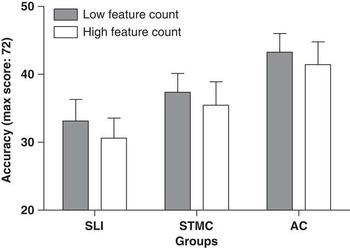
A main effect of feature count was also found, performances being better for low- than high-feature-count symbols (F(1,42) = 5.46; p < .05, partial η2 = .12) (see Figure 2). The group-by-feature count interaction was not significant (F(2,42) < 1, n.s.; partial η2 = .00).
Feature count effect: number of symbols replaced in their correct serial position in each group (SLI, children with specific language impairment; STMC, visual short-term memory controls; AC, age controls) for list length 3 to 6, by pooling over the two similarity conditions. Bars represent the standard errors of the means (SEM).

Visual Similarity Effect
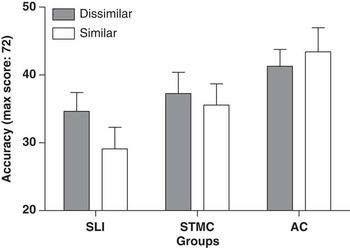
The main effect of visual similarity was marginally significant (F(1,42) = 3.41; p = .07, partial η2 = .08). However, the group-by-similarity interaction effect was significant (F(2,42) = 5.66; p < .01; partial η2 = .21). Newman-Keuls post hoc analyses revealed that similarity affected mostly children with SLI (p < .01), performances being better for dissimilar than similar symbols; but much less the STMC (p = .29) and AC groups (p = .19) (see Figure 3).
Similarity effect: Number of symbols replaced in their correct serial position in each group (SLI, children with specific language impairment; STMC, visual short-term memory controls; AC, age controls) for list length 3 to 6, by pooling over the two feature count conditions. Bars represent the standard errors of the means (SEM).

To verify that a similarity impact could be observed in controls for list length that were most sensitive to their performance level (i.e., corresponding to their span level), we performed a separate ANOVA on list length 3 and 4 for the STMC group only. A significant similarity impact was observed (F(1,14) = 8.23; p < .05; partial η2 = .37). Moreover, the initial group-by-similarity interaction was confirmed when performing an ANOVA including all groups for list length 3 and 4 (F(2,42) = 7.04; p < .01, partial η2 = .25). Newman-Keuls post hoc analyses revealed that both the SLI (p < .001) and STMC groups (p < .05) were affected by similarity, while this was not the case in the AC group (p = .37). Furthermore, performance decrement was larger in SLI children (partial η2 = .30) than in STMC children (partial η2 = .14). The main effect of similarity was not significant when performing a separate ANOVA on list lengths 5 and 6 for the AC group only (F(1,14) < 1; n.s.; partial η2 = .06). Our results thus show that when targeting the list length corresponding to their respective span level, an impact of similarity was present in younger controls (STMC), but not in the AC group. At the same time, the STMC group was less sensitive to the similarity manipulation relative to the SLI group.
Feature Count by Similarity Interaction Effect
A significant similarity-by-feature count interaction effect was found (F(1,42) = 5.71; p < .05; partial η2 = .12). Newman-Keuls post hoc analyses showed that visual similarity only affected performances for low-feature-count symbols (p < .01) but not high-feature-count symbols (p = .92). Likewise, feature count only affected performances for low-similarity symbols (p < .01) but not high-similarity symbols (p = .81). Hence, there were no additive effects between the two complexity factors. Finally, the group-by-similarity-by-feature count interaction effect was also significant (F(2,42) = 8.52; p < .001; partial η2 = .29). Tukey post hoc analyses revealed that similarity affected SLI children's performances for low-feature-count symbols (p < .001), but not for high-feature-count symbols (p = 1.00). Performance in neither AC (high-feature-count symbols: p = 1.0; low-feature-count symbols: p = .59) nor STMC groups (high-feature-count symbols: p = 1.0; low-feature-count symbols: p = .84) were affected by similarity. Furthermore, Tukey post hoc analyses revealed that feature count also affected SLI children's performances for low-similarity symbols (p < .01), but not for high-similarity symbols (p = .84). On the other hand, performance in neither AC (high-similarity symbols: p = .69; low-similarity symbols: p = 1.0) nor STMC groups (high-similarity symbols: p = 1.0; low-similarity symbols: p = .78) were affected by feature count. No complexity effect is thus observed in controls when assessing each condition separately, but note that we have previously shown that by pooling together both similarity conditions, the feature count effect was significant in the AC and STMC groups. Likewise, our analyses showed that by pooling together both feature count conditions, the similarity effect was significant in the STMC group. This corroborates the fact that the similarity and feature count had a weaker impact in controls than in children with SLI. No other effect was significant.
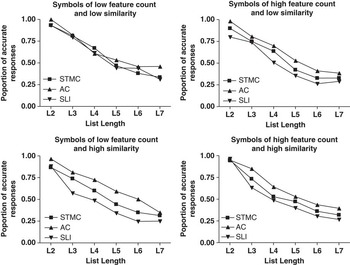
Shortest List Trials
We further determined whether difficulties at the level of visual processing may underlie the specific difficulties in VSTM observed for the SLI group. If that is the case, they should also be impaired for the shortest trials, that is, list length 2, especially for sequences containing the visually most similar items. Since performance for the shortest list lengths was not normally distributed, non-parametric Kruskal-Wallis analyses were performed for each trial length and each VSTM condition, with participant group as the between-subject factor (see Figure 4). For list length 2, the Kruskal-Wallis statistic was significant for only one condition: the low-similarity-and-high-feature-count condition: H = 6.36, p = .04. This effect was due to poorer performance in the SLI group relative to the AC group but not relative to the STMC group [Adjusted Mann-Whitney tests for ex aequo: SLI vs. AC (Z = 2.49; p < .05), SLI vs. STMC (Z = 1.19; p = .24)].
Proportion of symbols replaced in their correct serial position in each group (SLI, children with specific language impairment; AC, age controls; STMC, visual short-term memory controls) as a function of sequence length, for each symbol type.

Discussion
This study explored to what extent the complexity of the visual information determines poor performance in VSTM in children with SLI. Overall children with SLI performed worse than the AC group but not worse than the STMC group. However, children with SLI were more strongly affected by similarity and feature count, relative to both control groups. A first main result of this study is that children with SLI performed poorer than their age-matched peers, even for the least complex VSTM condition presenting low-feature-count-and-low-similarity symbols. Our results consequently corroborate previous studies showing problems in VSTM in these children (Bavin et al., Reference Bavin, Wilson, Maruff and Sleeman2005; Hoffman & Gillam, Reference Hoffman and Gillam2004; Nickisch & von Kries, Reference Nickisch and von Kries2009). Our VSTM tasks were mainly visual in nature: children had to process horizontally presented series of black abstracts symbols, for which virtually no verbal recoding was possible. Our results thus confirm that children with SLI show impaired performances in VSTM tasks requiring a detailed visual analysis and storage of the symbols, such as it is the case in the tasks in which children with SLI have proved to be poorer than their age peers: pattern recognition tasks (Bavin et al., Reference Bavin, Wilson, Maruff and Sleeman2005) and visual symbol sequence tasks (Nickisch & von Kries, Reference Nickisch and von Kries2009). Poor performances in VSTM tasks are likely to be explained, at least partially, by this necessity of a detailed processing of the items’ visual primitives. Importantly, it is interesting to underline that even our low-feature-count-and-low-similarity symbols require more complex visual processes than stimuli used in tasks showing no VSTM problems in children with SLI, such as the spatial recognition task, the block recall task, the dot matrix task, and the pattern recall task (Alloway & Archibald, Reference Alloway and Archibald2008; Alloway et al., Reference Alloway, Rajendran and Archibald2009; Archibald & Gathercole, Reference Archibald and Gathercole2006, Reference Archibald and Gathercole2007; Bavin et al., Reference Bavin, Wilson, Maruff and Sleeman2005; Hick, Botting, & Conti-Ramsden, Reference Hick, Botting and Conti-Ramsden2005).
The second main result of this study is the larger impact of similarity and of feature count on VSTM performance in SLI children as compared to both age-matched and VSTM-matched controls. Our data show that both similarity effect and visual feature count effect did indeed work in controls: a main effect of feature count was observed in all children, and a main impact of visual similarity was observed in younger controls when restricting our analyses to the list length corresponding to their visual span in the low-feature-count-and-low-similarity condition. However, these effects are still larger in children with SLI, reinforcing the view that they are more affected than controls by visual feature count and similarity. The necessity to store a large number of precise visual features appears to be more difficult for children with SLI than for non-impaired controls. As compared to previous studies, our study provides further information about the problems underlying poor VSTM performances in children with SLI. Our results show that these children are impaired to a greater extent by the complexity of the visual symbols to be processed than controls matched on VSTM performance for simple visual information. These results support the hypothesis that visual complexity is to explain, at least partially, poor results in VSTM in SLI.
At the same time, the effects of feature count and similarity were not cumulative. A possible explanation is that the stored traces for similar-and-high-feature-count symbols contain more distinctive features than the traces for similar-and-low-feature-count symbols. During storage, memory traces undergo decay. There will remain several features in the stored traces for the symbols of high feature count to distinguish between them. However, it is likely that there will remain fewer features to distinguish between similar memory traces for low-feature-count symbols. The higher number of features contained in the high-feature-count symbols may consequently help to distinguish between highly similar memory traces, and compensate for the feature load.
Visual Processing Deficit or VSTM Deficit?
The question that arises is why children with SLI are more sensitive to visual feature count and similarity in a VSTM task. At least two potential factors have to be considered: (1) difficulties in the detailed processing of visual information (i.e., visual processing deficit), or (2) poor distinctiveness of VSTM traces (i.e., VSTM deficits). Although children with SLI are generally considered to show preserved visual processing abilities, some data suggest that they might show discrete problems in visual processing. Powell and Bishop (Reference Powell and Bishop1992) showed that these children were poorer at discriminating lines varying in length. Other data suggest that they could be slower at processing the visual information, especially young children (Fazio, Reference Fazio1998; Schul, Stiles, Wulfeck, & Townsend, Reference Schul, Stiles, Wulfeck and Townsend2004; Tallal, Stark, Kallman, & Mellits, Reference Tallal, Stark, Kallman and Mellits1981). Nevertheless, Lum, Conti-Ramsden, and Lindell (Reference Lum, Conti-Ramsden and Lindell2007) suggest that the deficits in rapid processing sometimes described in these children may arise from attentional shifting problems, rather than broader problems in rapid visual processing.
In the present study, we indirectly assessed the hypothesis of poor visual processing abilities by exploring group differences for the VSTM trials with the lowest VSTM load, that is, list length 2, assessing visual encoding and discrimination abilities rather than memory abilities. If poor VSTM performances in children with SLI had to be explained by a visual processing deficit rather than by a VSTM deficit, then significant impairment in these children should be observed for the VSTM trials with the lowest VSTM load. Results show that at list length 2, children with SLI showed no impairment in any condition relative to the STMC group, and only impairment for the high-feature-count-but-low-similarity condition relative to the AC group. Hence the important difficulties observed in the SLI group, in particular for maintaining similar symbols, cannot be explained by difficulties in visual processing (at least as far as concerns visual processing involved in discriminating stimuli with a strong feature overlap).
Moreover, the negative effect of similarity on serial recall is generally explained by poorer trace distinctiveness for visually similar items (Avons & Mason, Reference Avons and Mason1999; Lin & Luck, Reference Lin and Luck2008; Mate & Baques, Reference Mate and Baques2009). Such data are congruent with what is observed in the verbal domain: phonological similarity impairs the storage of order information (i.e., the sequential order in which the different items of a list are presented), but enhances the retention of item information (i.e., the phonological and semantic properties of the items) (e.g., Nairne & Kelley, Reference Nairne and Kelley2004; Poirier & Saint-Aubin, Reference Poirier and Saint-Aubin1996). Information load impact on VSTM performances has also been attributed to the memory storage process than to perceptual process in both behavioral (Eng et al., Reference Eng, Chen and Jiang2005; Luria et al., Reference Luria, Sessa, Gotler, Jolicoeur and DellAcqua2010) and neuroimaging studies (Xu & Chun, Reference Xu and Chun2006). Hence, our data lend stronger support to the hypothesis of poor memory storage of visual stimuli. It does seem that the precise analysis, encoding, and/or storage of the primitives of the visual information are to explain, at least partially, VSTM problems in children with SLI.
A Processing Capacity Limitation in Children With SLI
More generally, these data are congruent with previous studies showing a larger performance decrease in children with SLI as compared to their peers as task complexity increases (e.g., Evans, Reference Evans2002; Marton & Schwartz, Reference Marton and Schwartz2003; Montgomery, Reference Montgomery2005). Our results are thus in line with an explanation of poor VSTM performances in children with SLI in terms of capacity limitations (e.g., Leonard et al., Reference Leonard, Weismer, Miller, Francis, Tomblin and Kail2007; Miller et al., Reference Miller, Kail, Leonard and Tomblin2001; Weismer & Hesketh, Reference Weismer and Hesketh1996).
Indeed, VSTM capacity is affected by visual object complexity (i.e., Alvarez & Cavanagh, Reference Alvarez and Cavanagh2004; Xu & Chun, Reference Xu and Chun2009). Our results showing a larger performance decrease as visual complexity increases in children with SLI are thus consistent with a capacity limitation in VSTM.
Nevertheless, the precise mechanism at the root of this processing capacity limitation is not yet clear. Some studies have shown that common attentional networks are involved in both visual and verbal short-term memory tasks (Majerus et al., Reference Majerus, D'Argembeau, Perez, Belayachi, Van der Linden, Collette and Maquet2006, Reference Majerus, Poncelet, Van Der Linden, Albouy, Salmon, Sterpenich and Maquet2010). A first possible explanation could thus be that a general limitation in attentional capacity leads to short-term memory problems in both the verbal and visual domains in SLI. Previous studies have documented visual attentional problems in these children (Finneran, Francis, & Leonard, Reference Finneran, Francis and Leonard2009; Noterdaeme, Amorosa, Mildenberger, Sitter, & Monow, Reference Noterdaeme, Amorosa, Mildenberger, Sitter and Minow2001). However, recent theoretical models and neuroimaging data show that the brain regions that are sensitive to the complexity of visual information are those that are dedicated to the encoding and maintenance processes in VSTM (Xu, Reference Xu2007; Xu & Chun, Reference Xu and Chun2006, Reference Xu and Chun2009; Wood, Reference Wood2011). Using functional magnetic resonance imaging, Xu and Chun (Reference Xu and Chun2006) revealed that dissociable neural mechanisms support the individuation of multiple, spatially segregated objects on the one hand, and the encoding and maintenance of complex visual objects on the other hand. While activation in the more superior part of the intraparietal sulcus as well as in the lateral occipital cortex increased with increasing feature complexity of the items, activation deep into the intraparietal sulcus reacted to the number of objects that had to be attended to, regardless of their complexity. An alternative explanation is that children with SLI encounter difficulties in the precise encoding and maintenance of multiple simultaneous feature information in complex visual shapes. Difficulties in simultaneous processing have already been proposed to explain problems in complex verbal tasks (Marton, Reference Marton2006). More studies are needed to further explore the visual encoding and storage problems in children with SLI.
Finally, whatever the precise mechanism at the root of poor performances in VSTM in children with SLI, these problems will possibly interfere with language acquisition. Following Baddeley (Reference Baddeley2003), good VSTM abilities could play a critical role in the acquisition of the semantic characteristics of concrete words, their visual representation and usual usage. VSTM could also play a role in the matching of the lexical-semantic characteristics of an item and its visual representation, by enabling the temporary activation of its visual-semantic features along with its lexical-semantic representations (Della Sala & Logie, Reference Della Sala and Logie2002).
Acknowledgments
Anne-Lise Leclercq is funded by the Belgian Fund of Scientific Research (F.R.S.-FNRS) as a F.R.S.-FNRS Research Fellow. Steve Majerus is also funded by the F.R.S.-FNRS as a Research Associate. The authors report no financial or other conflicts of interest.