Introduction
Specimens described here are poorly preserved, but they are important in providing new information on the history of the class Asteroidea, which is only scantily represented in the fossil record; further, the new faunule adds to the somewhat limited diversity of the fossil record of the marine Jurassic of the North American continental interior. A number of Jurassic asteroid occurrences are known from Europe (e.g., Breton, Reference Breton1992; Villier et al., Reference Villier, Kutscher and Mah2004; Rousseau and Nakrem, Reference Rousseau and Nakrem2012), as well as a comparatively few from North America (e.g., Clark and Twitchell, Reference Clark and Twitchell1915; Miller and Unklesbay, Reference Miller and Unklesbay1943; Blake, Reference Blake1981), and elsewhere in the world (e.g., Fell, Reference Fell1954; Rao, Reference Rao1957; Eagle, Reference Eagle2001). Occurrences represented by more than a single taxon are particularly sparse; of these, the comparatively large faunule described by Hess (Reference Hess1972) is unique.
Geologic setting
The geologic setting of the asteroid faunule was summarized by Gunderson (Reference Gunderson2015). The fossils were collected from the Oxfordian Swift Formation (lower Upper Jurassic), on the western flank of the Pryor Mountains, south-central Montana. The Swift Formation represents the last major regression of the Sundance Sea (Imlay, Reference Imlay1980; Johnson, Reference Johnson1992). In the local area, the Swift consists of glauconitic mudstones, siltstones, and sandstones deposited in relatively shallow water toward the western margins of the Sundance Sea (Brenner and Davies, Reference Brenner and Davies1973). The Swift Formation is locally fossiliferous, with abundant, taxonomically diverse bivalves, crinoids, cephalopods, and corals (Imlay, Reference Imlay1956).
Most of the asteroids were extracted from a relatively small, elongate, dip-slope outcrop of approximately 200 m2; a few individuals were collected as float at near-by outcrops, at the same or essentially the same stratigraphic horizon. The fossiliferous horizon is <1 m thick, and consists of flaggy, thin-bedded glauconitic calcareous sandstones and siltstones that immediately overlie a comparatively massive, unfossiliferous, cliff-forming siltstone and sandstone interval. Current and interference ripple marks are common in the fossiliferous interval, but obvious channeling and other indicators of local ongoing active depositional events are lacking. Trace fossils are not apparent. Many infaunal bivalves are present, none recognized in living orientations, and most opened or disarticulated during apparent earlier periods of reworking and transport.
Superficially, Swift asteroids are intact, with portions of some individuals preserved slightly beneath the surface of the containing bed. The dorsal surfaces of all specimens are directed upward and the arms are extended laterally in approximately living orientations; no specimens are distorted into bud-like configurations as to suggest softening of tissues and decay and transport prior to final burial. Ossicles of some specimens were partially displaced from living positions (e.g., offset of marginal series), reflecting decay and displacement following burial. No specimens exhibit evidence of damage from scavenging. The Swift Formation occurrence favors an abrupt event with any transport and burial beneath the ability of living asteroids to escape.
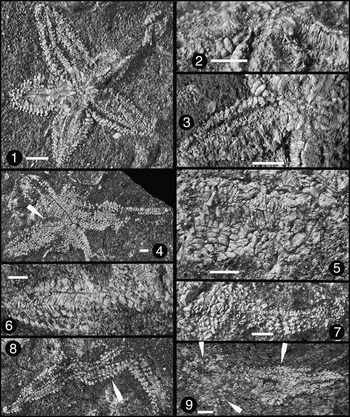
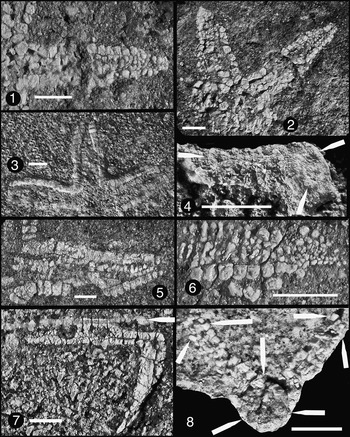
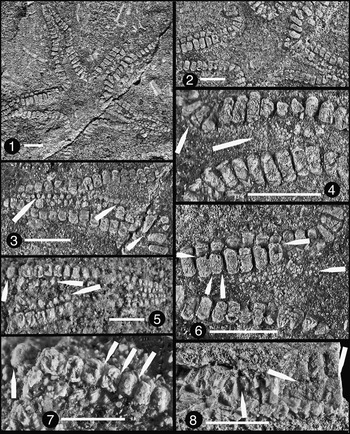
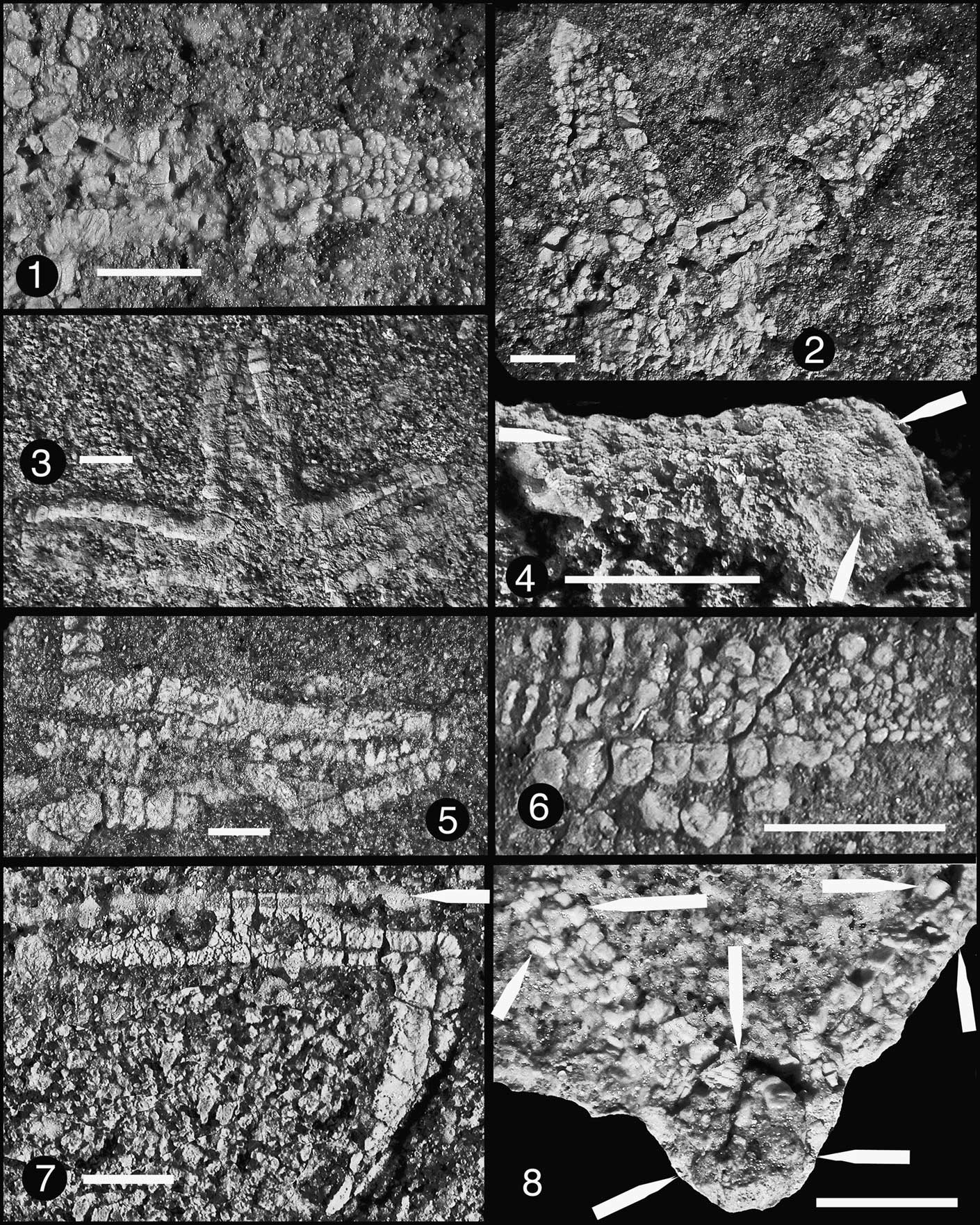
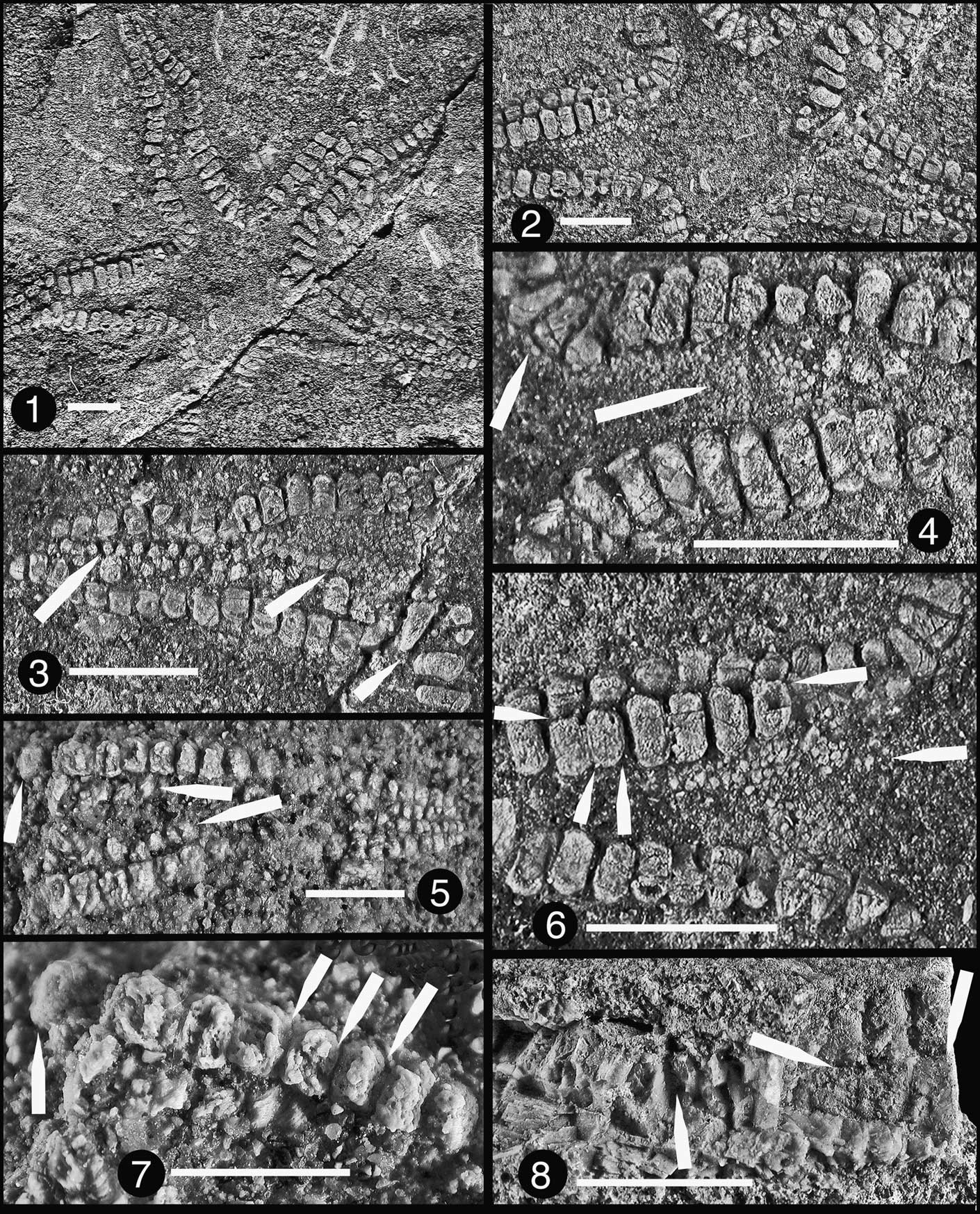
Significant specimen damage resulted from weathering at the outcrop, therefore it is unclear how many (if any) of the incomplete specimens might have been broken apart prior to final burial. Ossicular surface expressions and some ossicular boundaries have been lost (e.g., Fig. 1.3, 1.5) due to breakage (e.g., Fig. 2.5, 2.7), leaching, and recrystallization (e.g., Fig. 3.7, 3.8), leaving little more than overall skeletal configurations. Poor preservation limits taxonomic evaluation.
Atalopegaster gundersoni n. gen. n. sp., all pictures in dorsal aspect: (1–3) Field Museum of Natural History, holotype, FMNH PE 81402: (1) overall form; although partially compacted and the arms are somewhat distorted, the disk retains some arching; rectangular marginal series ossicles overlap next-proximal marginal; subspherical-appearing accessory? ossicles border marginals and arms; (2) inclined view toward disk of interbrachium to lower right of (1), the marginal series converging, demonstrating presence of forcipulate arm fusion; ambulacrals to right retaining podial pores?; (3) converging marginal series to upper left, vaulted ambulacral series to lower right is that to right of (2), some disk plating remains; (4) FMNH PE 81413, overall view, disk region arched, arms variously disrupted, bivalve shell appears to lie within disk (arrow), unlike extraoral feeding typical of asteriids; (5–7) FMNH PE 81403: (5) proximal interval of arm, disk to right, retaining aligned abactinal arm series and vaulted ambulacrals; (6) overlapping marginals (left side of arm), possibly two marginal series to right; ambulacral series remains vaulted although podial pores are obscure; interbrachial area, (upper right) retains closely spaced interbrachial ossicles, although unlike those of (2), the series are obscured; (7) regularly aligned abactinal series remain to right and at disk to left; small, rectangular series above distal abactinals might be adambulacrals; (8) FMNH PE 81412, arm disrupted at burial, only part of disk remains with part of arm (lower right); marginal and abactial series (arrow) remain aligned, foreshortened ambulacrals medial on arm, arm appears nearly complete; (9) FMNH PE 81411, disk to right with arm interval; most ossicles lost from central portion of disk (below upper left arrow), but suggesting concentric arrangement (above lower left arrow); dorsal skeleton is folded back (right arrow), documenting decay and partial disruption at time of burial. Scales=5 mm.

All pictures in dorsal aspect: (1–6), Goniasteridae? sp. indet.: (1, 2) Field Museum of Natural History, FMNH PE 81414, (1) NE arm of (2), marginals square, fasciolar fractures that would identify Eokainaster lacking; abactinals preserved distally, the dorsal surface partially disrupted and lost proximal of the fracture at the middle of the photograph; marginals remain defined, the interior of the arm with disrupted ossicles of different series; (2) overall form; some enlarged disk ossicles remain, although series are disrupted; (3) FMNH PE 81417, disk and arms approximating life configurations, marginals are approximately square and closely fitted; marginal fascioles are not developed, distal arm ossicles are abutted at the midline indicating these are probably ambulacrals, the carinal series not preserved; (4) FMNH PE 81415, a small individual, a ring of enlarged ossicles circles the disk axis (right arrows) as in (2); approximately three rows of dorsal arm ossicles, left arrow at probable carinal series; (5) FMNH PE 81419, marginal series approximately square and closely fitted, a partial abactinal series might remain within the lower marginal row; to right, ambulacrals are distal to abactinals and abutted at arm midline; (6) FMNH PE 81416, inferomarginal series with three similar, displaced, superomarginals below; wasp-shaped ambulacrals to left, small disrupted distal arm ossicles to far right exposing ossicles of different series. (7, 8) Asteroidea sp. indet.: (7) FMNH PE 81424, portions of two arms and the disk margin; a small vein along the midarm is filled by clear calcite crystals (arrow); (8) the arched form of the disk (lower two arrows) is preserved although little ossicular material remains; a single interbrachial marginal remains (unpaired arrow); marginals (upper arrows) identify positioning of the arms. Scales=5 mm.
Eokainaster sp. indet., all pictures in dorsal aspect: (1–4, 6) Field Museum of Natural History, FMNH PE 81422; (1) overall form typical of many astropectinids; (2) central disk area, oriented as (1), abactinal disk skeleton lost, the disk filled with sand; abactinals remain on arms; (3) lower right arm of (1), distally, the arm is contracted to expose the vaulted adradial edges of probable ambulacral ossicles (left arrow); poorly preserved abactinals above the medial arrow; cuneate interbrachial superomarginals (right arrow), series identification based on alignment; points of the left and medial arrows are immediately above superomarginals, these aligned with the cuneate interbrachial superomarginals and offset from the inferomarginal series below; (4) upper left arm of (1), disk to left; interbrachial marginals (left arrow); more proximal marginals retaining approximate life outlines, more distal marginals more deeply weathered; abactinal ossicles retain some alignment (right arrow); (6) left arm of (1), superomarginal series taphonomically separated from inferomarginals (upper arrows); fascioles are indented, their margins skeletally slightly differentiated and marked by a dark boundary (two closely space arrows to lower left); abactinal series (lower right arrow); (5, 7) FMNH PE 81423, deeply weathered superomarginal series, left arrow in both figures at inferomarginal offset and below superomarginal series; (5) probable adambulacrals (arrows to right), based on form and positioning; series toward arm tip also are adambulacral; (7) abradial edges of fascioles (arrows to right), superomarginals deeply leached; ossicular debris within marginal frame includes possible granules and adambulacrals; (8) FMNH PE 81421, interior of arm, left arrow at podial pore between successive ambulacrals; interior surfaces of aligned marginal series to right, the two arrows to right mark plane of contact between the series showing ossicles of the two marginal series to be of similar width; disrupted debris below are adambulacrals. Scale for (1–4, 6, 8)=10 mm; (5, 7)=5 mm.
Materials and methods
Asteroid taxonomy and paleoecology
In recent years, molecular studies of diverse crown-group invertebrates, including those of Asteroidea (Mah and Foltz, Reference Mah and Foltz2011a, Reference Mah and Foltz2011b), have led to major reevaluation of earlier classification schemes and phylogenetic interpretations that were based primarily on morphologic criteria. A fundamental subdivision that has endured reevaluation is the separation of the Forcipulatacea (primarily asteriids, zoroasterids, and brisingids, sensu Spencer and Wright,Reference Spencer and Wright1966) from the remaining asteroids (e.g., Fisher, Reference Fisher1911, p. 4; Clark and Downey, Reference Clark and Downey1992). The Swift Formation sampling includes representatives of both subdivisions; however, because of incomplete preservation, available data are limited, and taxonomic assessment must be fitted into traditional concepts rather than in accord with the most recent molecular work. Terminological usage follows Spencer and Wright (Reference Spencer and Wright1966) and Blake (Reference Blake2013).
Many Jurassic asteroids from all global localities are readily assigned to extant families, but such interpretation can be misleading. Thirty-seven extant asteroid families were recognized in a recent compilation (Mah and Blake, Reference Mah and Blake2012). Many families, however, include few taxa, and familial morphologic ranges and abundances surely have changed through geologic time. Assigning ancient specimens to an inferred most-similar extant taxon imposes contemporary concepts on potentially significant evolutionary change (Blake and Reboul, Reference Blake and Reboul2011; Blake et al., Reference Blake, Donovan, Mah and Dixon2015), thereby misleading interpretation of taxon history.
Insofar as can be determined, the environmental setting of the Swift faunule is comparable to extant occurrences of similar overall taxonomic diversity. Asteroids today are feeding generalists (Sloan, Reference Sloan1980; Jangoux, Reference Jangoux1982). Astropectinids and goniasterids are detritivores and predators, whereas asteriids are important predators on shellfish. Assumption of similar behaviors appears reasonable for the Swift exemplars.
Repository and locality
Repository for the new specimens is the Field Museum of Natural History, Chicago; abbreviation FMNH. The locality is on public land with surface access managed through the Bureau of Land Management field office in Billings, Montana. Collection was under permit MTM 107991-e1.
Systematic paleontology
Superorder Forcipulatacea Blake, Reference Blake1987
Order Forcipulatida Perrier, Reference Perrier1884
Family Stichasteridae Perrier, Reference Perrier1885
Remarks
Atalopegaster n. gen. (see below) is assigned to the Forcipulatacea based on overall form, presence of wide, strongly foreshortened ambulacral ossicles, and probable presence of four podial rows. Growth of many members of the superorder is distinctive in that adjacent arms abut and join as growth proceeds (Viguier, Reference Viguier1878, p. 66); arms of Atalopegaster specimens exhibit this growth pattern (Fig. 1.2, 1.3). The coelom of many forcipulataceans is large, the body vaulted, and ossicles are relatively small and comparatively uniform. Because of these expressions, emphasis in the taxonomy of the extant has been on arrangement of ossicular series and accessories rather than details of ossicular morphology. Collapse and distortion with death and burial obscure overall configurations, and as a result, relatively few fossil forcipulataceans have been described in detail, although those of the Asteriidae sensu Spencer and Wright (Reference Spencer and Wright1966) are among the more common fossil asteroids.
Forcipulate subdivisions of Spencer and Wright (Reference Spencer and Wright1966) are broadly typical of traditional morphology-based arrangements, whereas the recent molecular phylogeny of Mah and Foltz (Reference Mah and Foltz2011b) introduces significant changes. Based on the presence of more-or-less uniform series of relatively robust and uniform body-wall ossicles, Atalopegaster is suggestive of the Zoroasteridae (now Zorocallina; Mah, Reference Mah2007; see also Downey, Reference Downey1970) and the Neomorphasterinae (now encompassed by the Stichasteridae; see Mah and Foltz, Reference Mah and Foltz2011b; illustrations of Neomorphaster, see Mah, Reference Mah2015). Based on overall shape, ossicular expression, and fusion of the arms, Atalopegaster is aligned with Neomorphaster and the fossil genera Argoviaster Hess, Reference Hess1972, and Pegaster Blake and Peterson, Reference Blake and Peterson1993, in the Stichasteridae sensu Mah and Foltz (Reference Mah and Foltz2011b). Phylogeny and historical biogeography of forcipulates have been reviewed in detail (Mah and Foltz, Reference Mah and Foltz2011b).
Genus Atalopegaster new genus
Type species
Atalopegaster gundersoni n. gen. n. sp., only species, from the Oxfordian Swift Formation (lower Upper Jurassic), south-central Montana.
Diagnosis
As for the type species.
Etymology
Greek, atalos, tender, delicate; for arrangement of the ossicles of the extraxial skeleton, which is similar to that of Pegaster, differing in that the ossicles of Atalopegaster are comparatively delicate.
Occurrence
As for type species.
Remarks
Well-aligned series of uniform body-wall ossicles have been recognized in other Mesozoic asteriids, including Asterias? dubium Whitfield, Reference Whitfield1877 (see Remarks under the species description). Body-wall ossicles of Argoviaster Hess, Reference Hess1972 are more robust than those of Atalopegaster, with well-defined papular pores that produced a subtriangular ossicular outline. Although Atalopegaster specimens are difficult to interpret, ossicles of abactinal series in Argoviaster appear to be smaller than those of Atalopegaster. Arm margins of Argoviaster are straight-sided, whereas those of Atalopegaster are subpetaloid—an expression subject to distortion in preservation, but nevertheless likely retained at least in part because it is ultimately based on ossicular arrangement. The uniform and aligned body-wall series of Cretaceous Pegaster are also comparatively robust, and lateral carinals are differentiated. In Pegaster, as in Atalopegaster, arms are subpetaloid. Ossicular series also appear comparatively well aligned in other Jurassic (Blake, Reference Blake1990) and Cretaceous (Blake et al., Reference Blake, Breton and Gofas1996) asteriids, although ossicular outlines are more complex, with basal ossicular faceting creating papular pores. Body-wall ossicles of extant Neomorphaster Sladen, Reference Sladen1889 also are relatively enlarged and aligned.
Atalopegaster gundersoni new species
Holotype
FMNH PE 81402.
Diagnosis
Forcipulatacean with abactinal series of rectangular, closely fitted, delicate, plate-like ossicles. Inferomarginals? relatively small, robust, elliptical, their abradial extremities overlapping proximally. Ambulacrals strongly foreshortened, podial pores weakly defined, probably in four series.
Occurrence
Swift Formation, lower Upper Jurassic, Carbon County, Montana. Exact locality information is available from the Field Museum of Natural History to qualified researchers.
Description
Disk comparatively small, dorsum arched in life (Fig. 1.2), interbrachia angular; arms elongate, arm outline weakly petaloid. Radius of largest (incomplete) specimen, FMNH PE 81413, ~70 mm. Disk size increasing by joining of adjacent arms (Fig. 1.2, 1.3). Abactinal skeleton of arm consisting of uniform transverse and longitudinal rows of similar, thin, rectangular plate-like ossicles (Fig. 1.5, 1.7, 1.8). Disk ossicles as preserved similar to those of arm, their arrangement appearing to lie in irregular, approximately circular series, including the primary circlet (Fig. 1.9). Carinal series, if differentiated, not preserved. Madreporite not recognized. Marginals quite small, rectangular in outline, abradial margins of successive ossicles overlapping proximally (Fig. 1.1, 1.6, 1.8, 1.9). Ambulacrals and adambulacrals strongly foreshortened. Ambulacrals wide, appearing quite strongly articulated across the arm midline; podial pores probably in four rows (Fig. 1.2). Adambulacrals narrow, edges of furrow margins overlapping distally (Fig. 1.7). Ambulacral series narrowing toward mouth frame, domed disk suggesting presence of actinostome (Fig. 1.1). Presence of ossicular debris suggests accessory granules and small spinelets.
Etymology
The species is named for Jay A. Gunderson, Montana Bureau of Mines and Geology, who discovered the asteroids, brought them to our attention, and aided collection.
Materials
Holotype, FMNH PE 81402; paratypes, FMNH PE 81403–PE 81413.
Remarks
As a result of poor preservation, not all of the new Swift Formation specimens are readily identified. Useful for recognition of A. gundersoni n. sp. are: (1) presence of foreshortened ambulacral ossicles; (2) thin, rectangular, plate-like body wall ossicles arranged in well-defined rows; (3) overall form, including fusion of arm margins at the disk; and (4) marginal expression. Arching of the arms and disk of A. gundersoni n. sp. is preserved in some specimens, suggesting a high, rounded to angular, arm cross-section. Post-mortem sediment compaction appears to have accentuated disk size, arm breadth, and petaloid arm outlines. No available specimen is well enough preserved to document unequivocal presence of two marginal rows, although complex arm-margin ossicular configurations of some specimens are suggestive (Fig. 1.1). Successive ambulacrals lie against one another with few intervals retaining indication of podial pores; absence is thought to be a preservational artifact of specimen compaction and recrystallization. Podial pores of Pegaster also appear to have been comparatively narrow.
Asterias? dubium was based on a poorly preserved casting of three specimens; subsequently, another occurrence (Logan, Reference Logan1900) was assigned to A. dubium. Geologic notes in the original locality descriptions, quoted by Clark and Twitchell (Reference Clark and Twitchell1915, p. 28), are generalized, but appear to describe the Sundance Formation, and the Swift Formation is a partial equivalent of the Sundance (personal communication, J. Gunderson and B. Fagnan and T. Cowman, 2015). Arrangement of dorsal ossicles in uniform rows reported for Asterias? dubium is comparable to that of Atalopegaster gundersoni n. gen. n. sp., but in spite of that and a similar stratigraphic positioning, available data are judged insufficient to allow assignment of the new material to Whitfield’s species, it characterized by Clark and Twitchell (Reference Clark and Twitchell1915, p. 28) as “interesting but doubtful.”
Superorder Valvatacea Blake, Reference Blake1987
Family Goniasteridae? Forbes, Reference Forbes1841
Remarks
In the analysis of Mah and Foltz (Reference Mah and Foltz2011a), the Poraniidae emerged as the sister taxon to the remainder of the valvatacean asteroids. Goniasteridae? sp. indet. (discussed below) is superficially similar to certain poraniids, as it is to other valvatacean families, including goniasterids, ophidiasterids, and ganeriids; however, no unequivocal evidence serves to align Goniasteridae? sp. indet. with a specific family, and based on overall expression, it is tentatively treated as a goniasterid.
Goniasteridae? sp. indet.
Description
Disk comparatively small, interbrachial angles tightly rounded; arms elongate, triangular, tapering evenly; dorsal surface probably rounded in life. Longest remaining arm interval ~50 mm. Ossicles of body wall uniform in size; marginal ossicles approximately square in outline and closely fitted, fascioles lacking. Abactinal ossicles robust, approximately square in outline, similar in size and form to marginals; arm and disk abactinals similar, those of disk arranged in concentric series around the disk axis. Ambulacrals not foreshortened.
Occurrence
As for Atalopegaster gundersoni n. gen. n. sp.
Materials
Hypotypes, FMNH PE 81414–PE 81419.
Remarks
Assignment of specimens to Goniasteridae? sp. indet. emphasizes presence of robust marginals, these appearing approximately square in outline (except for some apparently rotated from the living position), and absence of the fascioles typical of Eokainaster.
Order Paxillosida Perrier, Reference Perrier1884
Family Astropectinidae Gray, Reference Gray1840
Remarks
Swift Formation specimens are assigned to the Astropectinidae based most importantly on marginal ossicular form, including presence of fascioles, and expression of abactinal ossicles. Presence of a relatively small disk, angular interbrachia, low vaulting of the dorsal surface, and elongate, triangular arms are consistent with an astropectinid assignment.
Genus Eokainaster Blake, Reference Blake1981
Type species
Astropecten pewei Miller and Unklesbay, Reference Miller and Unklesbay1943, Sundance Formation, Owl Creek Mountains, Wyoming, by original designation.
Eokainaster sp. indet.
Description
Disk quite small, dorsum low in life, interbrachial angles tightly rounded, arms elongate, triangular, and evenly tapering. Radii (incomplete) of largest specimens, FMNH PE 81421 ~80 mm; FMNH PE 81422 ~60 mm. Juncture of adjacent arms not suggesting disk size increase by joining of adjacent arms (Fig. 3.1) as in forcipulates. Abactinal skeleton consisting of uniform, small, granular or paxilliform ossicles, these appearing aligned into longitudinal and transverse series; no suggestion of a carinal series (Fig. 3.3, 3.4, 3.6). Small spinelets or possibly granules associated with abactinals. Madreporite not preserved. Marginals in two series, ossicles of the series paired and aligned (Fig. 3.6, 3.8); marginals large, transversely elongate in dorsal outline, abradial margins rounded. Well-defined marginal fascioles retained on some ossicles, the fascioles also indicated by differential recrystallization of the boundaries between some successive marginals (Fig. 3.6, 3.7). Marginal ossicular differentiation at interbrachia limited, about two pair of ossicles, these triangular in outline. Ambulacrals, adambulacrals very incompletely exposed, robust, upright, rectangular (Fig. 3.3, 3.5, 3.8). Mouth frame not exposed.
Occurrence
As for Atalopegaster gundersoni n. gen. n. sp.
Materials
Hypotypes, FMNH PE 81420–PE 81423.
Remarks
Taxonomic assessment is hampered by deep weathering and lack of data for the ventral surface, but presence of robust, elliptical marginals with deep marginal fascioles, tightly rounded interbrachia, and two interbrachial marginals allow assignment of a number of Swift specimens to Eokainaster. Fascioles are gaps or grooves for water-current passage between adjacent marginals, and in many Swift examples, weathering produced a discontinuity between the main part of the ossicle and the fasciolar groove (Fig. 3.6, 3.7), thereby aiding fasciolar identification. The abactinal skeleton is of uniform small ossicles, arms are not fused at the disk as in Atalopegaster, and overall form is like that of previously described Eokainaster.
In a few places, marginal ossicles of the two series as preserved are offset (e.g., Fig. 3.6); however, the flat dorsal surfaces of the inferomarginals as well as alignment of other intervals indicate displacement rather than preservation of life positioning. In one fragment, interior surfaces of the paired marginals are aligned (Fig. 3.8), as in life.
Because the disk is small, actinal ossicles, if present, were few, and although some apparent ossicular debris remains, there is no indication of enlarged spines, as also is true of previously described specimens of Eokainaster. The Swift Formation specimens also are similar in age and approximate geographic origin to those of Miller and Unklesbay (Reference Miller and Unklesbay1943) and Blake (Reference Blake1981). The superomarginals of E. pewei appear to be approximately square in outline in dorsal aspect whereas those of Eokainaster of the Swift Formation are relatively wide, but differences are judged not to warrant a new name. Comparisons between Eokainaster and European Jurassic astropectinids described by Hess (Reference Hess1955, Reference Hess1972) were discussed in Blake (Reference Blake1981).
Asteroidea sp. indet.
Order, family, genus unknown
Description
Disk very small; interbrachial angles acutely rounded; arms thin, elongate. Longest remaining arm interval ~20 mm. Disk and marginal ossicles small, approximately square in outline, robust.
Occurrence
As for Atalopegaster gundersoni n. gen. n. sp.
Materials
Hypotypes, FMNH PE 81425, PE 81426.
Remarks
The very limited information available for specimens assigned to “Asteroidea sp. indet.” can support assignment to either of two widely separated clades. The robust apparent marginals and what remains of the disk favor the order Valvatida, whereas the small size of the disk and the very elongate, narrow, parallel-side arms are reminiscent of the forcipulatacean Brisingida. The latter assignment would require phylogenetic differentiation of overall form prior to significant ossicular differentiation. Modern brisingids extend their arms into the water column, a behavior seemingly appropriate for Asteroidea sp. indet., regardless of its correct phylogenetic positioning.
Acknowledgments
J.A. Gunderson discovered the locality, brought it to our attention, helped locate and collect specimens in the field, and consulted on regional geology. G. Smith and G. Liggett allowed access to BLM lands, and Liggett helped to arrange fieldwork and visited in the field. C. Mah reviewed a draft manuscript and two anonymous reviewers provided suggestions; B. Hunda and C. Sumrall provided editorial services; efforts of all are deeply appreciated.