Field dodder is a common parasitic weed in alfalfa seed production that must be controlled when present. Dodder parasitizes alfalfa plants and can kill small seedlings and even established plants if they are parasitized a second year. When not controlled, dodder can produce seed similar in size and density to and difficult to separate from alfalfa seed. Peak emergence of dodder occurs in April, May, and June, when spring temperatures reach 18 to 38 C (Dawson Reference Dawson1965; Hutchison and Ashton Reference Hutchison and Ashton1980; Lanini and Kogan Reference Lanini and Kogan2005). Dodder emerges as a rootless, leafless stem, dependent on the food reserves stored in the seed for its immediate survival (Lanini and Kogan Reference Lanini and Kogan2005). If not attached to a suitable host within 3 to 5 d, the dodder seedling will die (Lanini and Kogan Reference Lanini and Kogan2005). Dodder is favored by the culture of alfalfa seed production, as it has time to grow large and produce abundant seed by the time of alfalfa seed harvest.
Historically, dodder patches were destroyed by nonselective herbicides or burning (flaming), which destroyed both the crop and the weed. PRE herbicides that selectively control dodder in alfalfa and other crops were discovered in the 1960s and 1970s. Chlorpropham and DCPA were two of the earliest PRE-applied herbicides that were used to control dodder in alfalfa seed (Dawson Reference Dawson1966a). However, neither herbicide provided season-long control with a single application, so both were used in combination with other methods. Dichlobenil, pronamide, and high rates of trifluralin (4.5 to 6.6 kg ai ha−1) were later found to be effective for dodder control (Dawson 1969, 1970, Reference Dawson1978). Dawson demonstrated that pendimethalin controlled dodder in alfalfa seed more effectively and for a longer period than other PRE herbicides at rates of 2.2 to 4.5 kg ai ha−1, and pendimethalin quickly became the herbicide of choice for dodder control in the crop and was registered for this use in 1989 (Dawson Reference Dawson1990).
Glyphosate has been shown to be effective for control postattachment of dodder in alfalfa (Dawson Reference Dawson1989; Dawson and Saghir Reference Dawson and Saghir1983). However, glyphosate is only useful (labeled) in glyphosate-resistant varieties of alfalfa, even though it was shown to be effective at low doses (75 to 150 g ae ha−1) that nonresistant alfalfa tolerates (Dawson Reference Dawson1989). Diquat and paraquat are also effective in controlling dodder postattachment but are nonselective, resulting in damage to alfalfa (Saric-Krsmanovic et al. Reference Saric-Krsmanovic, Bozi, Malidza, Radivojevic, Umiljendic and Vrbnicanin2015).
A single method of control seldom controls dodder for the entire season in alfalfa seed production, and producers normally integrate several control methods (Lanini and Kogan Reference Lanini and Kogan2005). Typically, tillage is done from mid-March to mid-April in alfalfa seed production. Pendimethalin is applied in early to mid-March and sometimes again in mid-May. Irrigation is often withheld from the deeply rooted alfalfa crop in early summer, once the herbicide has largely dissipated, thus helping to prevent additional dodder seed germination. By late June, the canopy of alfalfa foliage is dense enough to shade and suppress any additional dodder seedlings that emerge (Dawson Reference Dawson1966b). Control of additional seedlings that may emerge in July is not required, as there is not time for such dodder to harm the alfalfa before the crop is chemically defoliated in late August or September for seed harvest.
Flumioxazin was labeled for use in alfalfa seed production in 2011 at a 0.14 kg ai ha−1 use rate. Flumioxazin at 0.14 to 0.21 kg ai ha−1 controlled Cuscuta spp. in cranberry in greenhouse and field trials (Ghantous and Sandler Reference Ghantous and Sandler2016). No reports on dodder control in alfalfa with flumioxazin were found.
These studies were conducted to determine the efficacy of flumioxazin to control field dodder emergence and ability to twine on a simulated host compared with the standard herbicide pendimethalin.
Materials and Methods
All studies were conducted in a greenhouse maintained at 27±4 C day and 20±3 C night, and day length was supplemented with metal-halide lamps to provide a 16-h day length. Field dodder seed was mechanically scarified with sandpaper (Hutchison and Ashton Reference Hutchison and Ashton1980) and was planted 1.3-cm deep in 20-cm-diameter pots filled with loamy sand soil (coarse-silty, mixed mesic Xerollic Camborthids) containing 0.6% organic matter and with pH 7.0. Herbicides were applied with a single-nozzle, pneumatic-driven, compressed-air sprayer equipped with an 80015 E flat-fan nozzle calibrated to deliver 234 L ha−1 spray volume. Flumioxazin was applied at 0.14 kg ai ha−1 and pendimethalin at 2.2 and 4.4 kg ai ha−1. A nontreated control treatment was included. Treatments were arranged in a completely randomized design replicated four times, and the entire experiment was repeated.
If a soil-applied herbicide controls dodder, seedlings of the parasite do not attach to host plants. In these experiments, the criteria of dodder control was whether seedlings twined about simulated hosts using methods previously reported by Dawson (1978, Reference Dawson1990). After planting of dodder and application of herbicides, 15 wooden toothpicks were inserted into the soil in each pot so that each protruded 4 cm above the soil surface and any emerging seedlings of dodder were within 3 cm of a toothpick. Pots were gently watered daily with a fine mist to maintain sutiable conditions for seed germination. Total emerged dodder seedlings were counted weekly for 4 wk after herbicide treatment (WAT). Dodder seedlings twined on toothpicks were counted and removed weekly, and emerged dead and live seedlings not twined on toothpicks were counted weekly. At 4 WAT, the soil from the top 1.5 cm of the pot was carefully removed, 100 additional scarified dodder seeds were placed on the soil surface, and the removed soil was placed back on top of the newly planted dodder seed. Fifteen new toothpicks were placed in the soil, and dodder emergence, seedlings attached to the simulated host, and dead seedlings were counted weekly as described previuosly for an additional 4-wk period.
Data were subjected to ANOVA using the PROC GLIMX procedure in SAS v. 9.4 (SAS Institute, SAS Campus Drive, Cary, NC 27513) to test for significance (P<0.05) of trial, herbicide treatment, and their interaction. Mean separation was conducted using Tukey-Kramer for the calculated LSMEANS (P=0.05).
Results and Discussion
There were significant trial by herbicide treatment interactions for the number of live, nontwined emerged seedlings during the first 4-wk period (P=0.0062), the number of twined seedlings in the second 4-wk period following replanting (P=0.0182), and the number of emerged seedlings that died in the second 4-wk period (P=0.0224), so the data for each trial are presented separately.
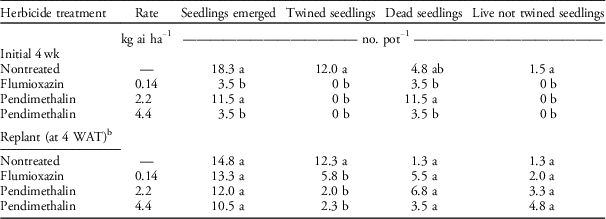
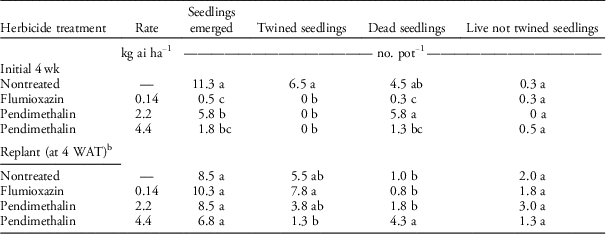
A total of 18.3 and 11.3 dodder seedlings emerged and 12.0 and 6.5 dodder successfully twined on the simulated host per pot in Trial 1 and Trial 2, respectively, over the initial 4-wk period in nontreated controls (Tables 1 and 2). Flumioxazin at 0.14 kg ai ha−1 reduced emergence of dodder 81% to 95% at 4 WAT compared with the nontreated controls and similar to pendimethalin at 4.4 kg ai ha−1 (Tables 1 and 2). Pendimethalin at the lower rate of 2.2 kg ai ha−1 reduced dodder emergence 37% to 52% at 4 WAT. All three herbicide treatments totally prevented dodder from twining on the simulated host for 4 WAT in both trials (Tables 1 and 2). Dodder that emerged in herbicide-treated pots failed to fully lengthen and eventually died. In research by Dawson (Reference Dawson1978), pronamide did not prevent emergence of dodder seedlings, but seedlings did not elongate normally and failed to twine on a host.
Total dodder seedlings emerged, number of seedlings twined on toothpicks, number of dead seedlings failing to twine, and number of live seedlings failing to twine in a 4-wk period following herbicide application in Trial 1.Footnote a

a Means within a column and 4-wk time period followed by the same letter do not differ significantly at P=0.05 according to a Tukey-Kramer means test.
b Dodder was replanted after the initial 4-wk period and similar data were collected for an additional 4 wk.
Total dodder seedlings emerged, number twined on toothpicks, number of dead seedlings failing to twine, and number of live seedlings failing to twine in a 4-wk period following herbicide application in Trial 2.Footnote a

a Means within a column and 4-wk time period followed by the same letter do not differ significantly at P=0.05 according to a Tukey-Kramer means test.
b Dodder was replanted after the initial 4-wk period and similar data were collected for an additional 4 wk.
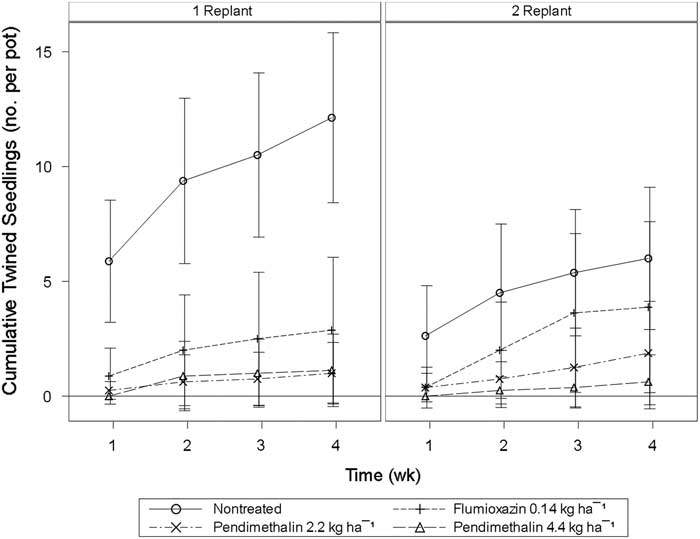
When additional dodder was seeded into soil at 4 WAT, none of the herbicide treatments significantly reduced dodder emergence (Tables 1 and 2). In nontreated controls, 83% and 65% of the emerged dodder successfully twined on the simulated host in Trial 1 and Trial 2, respectively, during the 4-wk period following replanting of dodder seed (Tables 1 and 2). In Trial 1, all herbicide treatments reduced dodder twining on the simulated host compared with nontreated controls, indicating herbicide activity was still present (Table 1; Figure 1). After replanting, 41% of the emerged dodder seedlings died in flumioxazin-treated pots and 44% were able to successfully twine on the simulated host (Table 1). However, in Trial 2, 76% of the emerged seedlings in flumioxazin-treated pots were able to twine on the simulated host, indicating the herbicide had dissipated to a level that no longer controlled dodder (Table 2; Figure 1). Even though flumioxazin has a relatively low water solubility (1.79 mg L−1 at 25 C) it is possible that some flumioxazin leached deeper in the soil during the first 4-wk period, as flumioxazin is mainly adsorbed to soil organic matter and the soil used in the study contained only 0.65% organic matter (Ferrell et al. Reference Ferrell, Vencill, Xia and Grey2005; Shaner Reference Shaner2014). In addition, the activity of flumioxazin on emerging dodder seedlings may have been reduced by disturbing the soil during the planting of additional dodder seed. The duration of weed control with flumioxazin can be decreased following tillage, cultivation, or other soil disturbance (Anonymous 2015). Pendimethalin tended to reduce the number of twined seedlings slightly more than flumioxazin in both trials during the second 4-wk period following the replanting of dodder seed, indicating it was more persistent and retained biological activity longer than flumioxazin at the rates tested (Tables 1 and 2; Figure 1).
Cumulative number of dodder seedlings successfully twining on the simulated host over a 4-wk period following replanting of 100 seeds pot−1 at 4 wk after herbicide application. Data presented are from Trial 1 and Trial 2, and bars represent mean confidence limits (95%).

Initially, flumioxazin control of dodder was equal to that of the standard treatment of pendimethalin at 2.2 or 4.4 kg ai ha−1. After soil disturbance and introduction of additional dodder seed at 4 WAT, flumioxazin still maintained some limited activity on dodder and prevented some twining on the simulated host in one of two trials, but it was slightly less effective than pendimethalin. It appears that pendimethalin may have slightly longer persistence and activity on dodder than flumioxazin under the conditions and herbicide rates tested in these experiments. Alfalfa seed fields are sometimes cultivated following PRE herbicides if there are weed escapes, and soil disturbance may decrease the activity of some herbicides like flumioxazin. Pendimethalin at lower rates of 0.6 and 1.1 kg ai ha−1 controlled dodder for only 3 wk in similar greenhouse studies, with follow-up field testing at higher rates of pendimethalin providing longer control of dodder while still exhibiting adequate safety for alfalfa (Dawson Reference Dawson1990).
Further field testing of flumioxazin for dodder control in alfalfa is warranted. Flumioxazin has potential to be useful for PRE early-season control of field dodder in alfalfa and offers alfalfa seed and forage growers a new mode of action for dodder control.
Acknowledgments
The authors are grateful to Bernardo Chaves-Cordoba for statistical analysis of the data and thank Tom Lanini for supplying the dodder seed used in the studies.