

Introduction
While historical institutionalism gives priority to structure over agency, institutions have never developed and operated without the intervention of interested groups.Footnote 1 However, despite numerous recent advances in historical institutionalism,Footnote 2 the literature has made little progress in developing a “more actor-centered approach.”Footnote 3 This should not come as a surprise. Injecting agency into historical-institutionalist accounts is challenging. The reason is what Peter Hall calls the problem of plasticity: If institutions are structuring agents’ actions, while they are simultaneously being structured by these very agents’ behaviors, the ontological status of institutions remains unclear.Footnote 4 At the most extreme, institutions may play no causal role at all.Footnote 5 Hence, a more actor-centered approach must ultimately explain both what changes and what stabilizes institutions.
In this paper, we aim to inject more agency into historical institutionalism. Based on recent historical institutionalist scholarship following the “coalitional turn,”Footnote 6 we develop a new account of institutional change and stability that awards a central role to agency. Our main argument is that constant coalition building by organized entrepreneurial actors is necessary for both stability and change in institutions. While social coalitions supporting institutions provide stability, challenger coalitions often seek to undermine institutions. The stability of institutions therefore presupposes constant coalitional work by the incumbent coalition in order to maintain the institution. At the same time, opponents engage in coalitional work in order to build up a powerful challenger coalition. However, for a variety of reasons we discuss below, collective action is complicated for challenger coalitions. In addition, institutional incumbents might be in a situation in which they can actively undermine the challengers’ coalitional work. Finally, we argue that relevant state agencies do not only institutionalize the outcomes of such coalitional dynamics but also actively shape whether incumbents or challengers prevail.
To illustrate the potential of our actor-centered approach to institutional change, we analyze the reform of commercial training in Switzerland, which is by far the most popular apprenticeship in Switzerland's vocational education and training (VET) system, tracing developments from the beginning of the 1980s until today. During this period, a reform process was set in motion that fundamentally changed the governance of commercial training. While commercial training was originally stabilized by a coalition between vocational schools and commercial employees, business interest associations from diverse economic sectors now dominate its governance. Methodologically, we conduct a systematic process analysis. In order to be able to trace back the decisive steps of the reform process as well as the actors involved in that process, we systematically examined primary resources and conducted twenty-one expert interviews with people who participated in the reform process. The interview data were triangulated with the primary resources and secondary literature as well as with newspaper articles on the reform.
This article is organized as follows. The next section discusses the role of agency in historical institutionalism and develops the implications of a more actor-centered approach to institutional stability and change. Subsequently, we provide a short summary of the reform process before we look at the coalitional dynamics of institutional change. Thereby, we discuss the coalition building by the institutional challengers, the parallel collapse of the incumbent coalition, the resulting institutional change, and, finally, how coalitional dynamics changed once challengers turned into incumbents. A final section concludes.
Towards a more actor-centered approach
Historical institutionalist research has long struggled to come to terms with agency, because, according to Vivien Schmidt, “the historical institutional framework is all focused on structures and processes, mostly with agent-less institutions following path-dependent logics if not incrementally changing ones.”Footnote 7 Clarifying the role of agency in historical-institutionalist accounts is, however, no easy task.Footnote 8 Hall refers to this as the paradox of plasticity: If institutions are structuring agents’ actions, while they are simultaneously being structured by these agents’ behavior, the ontological status of institutions remains unclear.Footnote 9 Hence, most historical-institutional accounts, at the conceptual level, tend to downplay the role of agency.Footnote 10 However, in this way, they remain incomplete.Footnote 11
Traditional accounts of historical institutionalism emphasize “sticky” institutional constraints and path dependency.Footnote 12 Neglecting agency in this way (albeit without denying its existence), these accounts were soon confronted with the challenge of how to explain institutional change.Footnote 13 In most of these accounts, exogenous critical junctures, defined as “relatively short periods of time during which there is a substantially heightened probability that agents’ choices will affect the outcome of interest,”Footnote 14 were identified as the moments during which agency mattered. Outside such critical junctures, little room was left to agency.
More recent historical institutionalist accounts understand institutions as being permanently contested.Footnote 15 This literature has convincingly demonstrated that institutional change is more common than the critical juncture framework suggests.Footnote 16 Yet if institutions regularly change, we must reconsider the question of whether institutions still have an independent causal role.Footnote 17 If we can no longer assume institutions to be stable per definition (as in the “sticky institutions” tradition), we must ask what explains the stability of institutions amid all these changes, because without some sort of stability (i.e., institutions delaying or shaping how social changes translate into some kind of policy), institutions cease to play a causal role in the explanations of social phenomena.Footnote 18
Institutionalist research must thus explain not only how institutions change but also how they remain stable despite constant change among actors and contexts. In response to this challenge, historical institutionalists have begun to emphasize the role of social coalitions in stabilizing and changing institutions.Footnote 19 According to Hall, “institutions are created by social coalitions composed of actors powerful in the relevant arena and persist only as long as they retain an ample supporting coalition, even if the composition of that coalition changes over time.”Footnote 20 The coalitional perspective stresses that institutions are both supported and challenged by social coalitions. While a coalition of (individual or collective) actors actively maintains and defends the institution, other social coalitions might oppose and attack it.Footnote 21 In this perspective, institutional stability and change is a function of these social coalitions’ activities.
Although social coalitions are an important concept in historical institutionalist research, the literature remains ambiguous with regard to who is part of these coalitions and how to recognize them.Footnote 22 Hall'sFootnote 23 rather thin description of social coalitions as “composed of actors powerful in the relevant arena” exemplifies this weakness. Researchers in the tradition of sociological institutionalism are more precise in describing actor constellations. According to them, actors are part of several institutional fields (equivalent to Hall's arenas), which are “constructed mesolevel social order[s].”Footnote 24 Coalitions are built between those that share a common understanding about the rules governing legitimate action in the field (incumbents), and between those that are marginalized and intend to challenge these rules. Importantly, sociologists assume that actors within the field implicitly know to which coalition they belong. The identification of these coalitions is thus primarily an empirical matter.
The coalitional perspective resolves the paradox of plasticity because it emphasizes the difficulty of building a coalition that is sufficiently strong to enforce institutional change. As Hall observes, “discontent with existing institutions has to reach certain levels” because “actors have to be convinced they should abandon procedures with which they are familiar to enter uncertain territory.”Footnote 25 Collective action is complicated for challenger coalitions, since actors might want to free-ride on other actors’ contributions, someone has to take the lead in order to organize, and actors need to be convinced that they can contribute to changing the institutional status quo.Footnote 26 In addition, institutional incumbents might actively try to undermine the challengers’ coalitional work, for example, through their agenda-setting power.Footnote 27 Thus, while the coalitional perspective adopts a considerably more dynamic and actor-centered approach, it still emphasizes institutional stability over change, because the creation of sufficiently strong challenger coalitions is difficult.
Yet there is a striking omission in this recent coalitional turn in historical institutionalist research. While both stability and change in institutions presuppose constant coalition building, the existence of social coalitions is typically not further problematized. But coalitions do not come out of nowhere. As the rich literature on collective action problems has repeatedly emphasized, coalition building is difficult.Footnote 28 The same can be said about the maintenance of coalitions.Footnote 29 Put differently, the coalitional perspective in historical institutionalism still lacks a micro-foundation.Footnote 30
We argue that one has to consider at least three important issues when analyzing the micro-foundations of institutional change. First, analyses of institutional change must problematize the questions of who engages in coalition building and how collective action problems are overcome. For this, “organized actors with sufficient resources” that see in institutions “an opportunity to realize interests that they value highly” (what DiMaggioFootnote 31 famously called institutional entrepreneurs) and their strategies must be identified, because they are the agents who do the coalitional work.Footnote 32 In any case, the existence of social coalitions cannot simply be assumed. Rather, coalition building must be part of the analysis.
In order to organize coalitions, entrepreneurial actors, who can be individual or collective, need to have access to material and social resources.Footnote 33 In this context, their position in actor networks is also an important resource.Footnote 34 Business often has an advantage compared to other actors, not only because it possesses more financial resources but also because it is often in a position of structural power.Footnote 35 In addition, these actors must be socially skilled, meaning that they must “possess a highly developed cognitive capacity for reading people and environments, framing lines of actions, and mobilizing people in the service of broader conceptions of the world and of themselves.”Footnote 36 Among others, social skills are needed when these actors aim at building strategic alliances with others that share only some interests but not all. In this process, entrepreneurial actors can rely on a large number of strategies for coalition building.Footnote 37 Thereby, collective entrepreneurial actors typically have advantages when forming a coalition compared to individual ones—both with regard to the access to resources and with regard to the successful framing of decisive events. Finally, institutional and political opportunities such as changes in the political environment, the field's degree of institutionalization, or exogenous shocks influence the likelihood of coalition building.Footnote 38 For instance, we should expect more agency in (temporarily) unsettled or non-settled institutional fields.
Second, analyses must consider to what extent the incumbent coalition is able to stabilize and maintain the relevant institution. Challenger coalitions will have difficulties influencing institutions if they face a strong incumbent coalition and vice versa. Recent contributions on institutional change have emphasized how negative (rather than positive) feedback effects may lead to situations in which the normal functioning of institutions undermines the institution's external preconditions.Footnote 39 Similarly, internal divisions might weaken the incumbent coalition. In these cases of institutional exhaustion, incumbents have shown little skill in maintaining an institution, which is therefore vulnerable to attacks by challenger coalitions. In any case, the stability of institutions (and the coalitions supporting it) cannot simply be assumed.
Finally, analyses of institutional change must examine how the emerging (challenger) coalitions try to win the relevant state agencies’ support, which is often necessary to be able to replace the incumbent coalition. At the same time, the relationship between the incumbent coalition and the relevant state agencies must be explored. As long as the incumbent coalition enjoys the relevant state agencies’ support, it is in an excellent position to contain the challenger coalition. However, coalitional work becomes much harder once the agencies withdraw their political support.
Kathleen Thelen finds that “the kinds of settlements that were possible in individual countries were heavily mediated by state action (or inaction), which frequently tipped the balance in ways that either facilitated coordination […], or aggravated the conflicts of interest.”Footnote 40 Thereby, the state does not only institutionalize the outcomes of coalitional dynamics,Footnote 41 but also actively shapes whether incumbents or challengers will prevail. Depending on the policy issues, different dynamics can explain why the state matters for the interaction between social coalitions. On the one hand, partisan politics might influence the support of certain social coalitions by state actors.Footnote 42 For instance, as the political composition of governments changes, so do state actors’ policy preferences.
On the other hand, state actors can also be primarily concerned about the effectiveness of policies. This is often the case when the issue is the responsibility of state agencies at the bureaucratic level and is not discussed in parliament. States agencies often have a strong interest in managing the domain for which they are responsible in an effective way because either the agencies care about these policies’ effectiveness (as professionals) or they need to legitimize their actions vis-à-vis higher levels of government.Footnote 43 These cases are often characterized by a status quo bias because the involved state actors are more likely to support the (successful) incumbent coalition. However, the likelihood of institutional change increases when the saliency of an issue rises, because public attention might push state actors into action.Footnote 44 Hence, even if the main political dynamic unfolds as a competition between social coalitions, the relevant state agencies’ unique position implies that they typically play an important role in the analyses of institutional change.
In sum, we argue that analyses of institutional change must consider the interaction between the coalition-building activities of institutional challengers, the coalitional work of the incumbents, and the role of the relevant state agencies in favoring stability or change. Focusing on the interaction of these three factors allows for a robust role for agency in historical institutionalist accounts.
The reform of commercial training in Switzerland
We demonstrate the usefulness of our actor-centered approach to institutional stability and change by examining the reform of commercial training in Switzerland, tracing developments from the mid-1980s until today. Collective skill formation systems are dual training systems in which firms and intermediary associations play a central role in governance and financing.Footnote 45 As in other policy fields in Switzerland,Footnote 46 the main intermediary associations involved in training are business associations, although commercial training used to be an important exception to this rule, as we show below.
Various aspects make the reform of commercial training in Switzerland an interesting case for analyzing the relationship between coalitional dynamics and institutional change. First, collective skill formation systems have figured prominently in recent work on institutional stability and change, in particular in the literatures on the coalitional foundations of institutions and on gradual institutional change.Footnote 47 Switzerland is a prototypical collective skill formation system, not least because it is the country with the highest share of youth entering dual apprenticeships. About two thirds of the students in upper secondary education are enrolled in Swiss VET programs.Footnote 48 Commercial training is by far the most popular apprenticeship in Switzerland.Footnote 49 The training prepares for clerk positions in diverse fields, such as customer services, human resources, and marketing, in a wide range of industries, for example, in banks, logistics companies, and the public sector. Consequently, there is a large number of very heterogeneous actors (with regard to both size as well as economic sectors) involved in the governance of commercial training. It therefore seems justified to explore our arguments about coalition building in explaining institutional stability and change in this context.
Second, the role of the state in the regulation of training occupations in Switzerland is not a political one that reflects power struggles. The Swiss VET system is relatively centralized since it is mostly governed by federal regulations.Footnote 50 Without the approval of the federal state, private actors cannot enforce any changes. In this process, a state agency is responsible for approving the respective changes. The “state” therefore needs to be understood as a bureaucratic institution whose main interest is a well-functioning, but also stable skill formation system. Hence, institutional change is less likely than in situations where the state's role is primarily political. Nevertheless, we can observe a process of institutional change, in which the state played a central part in determining the role of various social coalitions in Swiss commercial training.
Third, Swiss commercial training represents a settled institutional field with a long tradition. Historically, the Swiss Association of Commercial Employees (KV Schweiz)—a hybrid organization that owns many of the schools providing commercial training, while simultaneously representing the interests of commercial employees—was responsible for the governance of commercial training in schools.Footnote 51 No external conditions, being it economic, social, or political, would have required transformative institutional change. Nevertheless, we can observe transformative institutional change, which is—as we argue—the result of coalition-building activities by resourceful entrepreneurial actors and their interaction with the incumbent coalition, as well as the responsible state agencies.
Following pressure from several business actors, the coalition between vocational schools and KV Schweiz lost its power. Since a major reform in 2003, business interest associations from diverse economic sectors are the most important actors in commercial training, as three major changes reveal.Footnote 52 First, since the reform, firm-based training is regulated. Business intermediary associations (and not the state or the schools) define the training content in the firms. Second, the reform introduced inter-company courses besides firm-based and school-based learning, which are also (typically) organized by business intermediary associations. Third, during the reform process a new governance structure was established. A new association, the Swiss Conference for Commercial Training and Examination (SKKAB), replaced KV Schweiz as the responsible body for curriculum development and the overall governance of the occupation. SKKAB is carried mostly by business associations representing the various industries within commercial training, which are in turn responsible for the industry-specific part of training.Footnote 53
Yet this far-reaching reform did not stop the debate over the organization of commercial training. Shortly after the introduction of the 2003 reform, within-business conflicts over training content and skill specificity restarted. Mostly the banking industry and firms from the machinery, electronics, and metal (MEM) sector asked for industry-specific training also in the schools.Footnote 54 These large and well-organized sectors even threatened to exit from dual training and train their workforce by other means if their demands were not met.Footnote 55 Yet, the large firms faced strong opposition from the Swiss Trade Association (SGV), which represents the small and medium-size firms.Footnote 56 The differing views resulted in a big compromise with the 2012 reform. No firm-specific elements were introduced into school-based training. However, firm-based training is today completely organized along industry lines.Footnote 57
Why did Swiss commercial training experience transformative institutional change in 2003Footnote 58 but only incremental change in 2012? Which actors took the position of institutional entrepreneurs and pushed the reforms in their decisive directions? In order to answer these questions, we conduct a process-tracing analysis, which is the “systematic examination of diagnostic evidence selected and analyzed in light of research questions and hypotheses posed by the investigator.”Footnote 59 In a first step, we carefully analyzed government documents, position papers of the involved actors, and secondary literature. In a second step, we conducted twenty-one semi-structured interviews with people who were actively participating in the reform process. The interviewees are (former) representatives of business intermediary associations, the responsible federal state agencies, the project management group, KV Schweiz, and training firms. In addition, we also talked to an independent expert, a researcher, and a former member of parliament involved in the reforms. The interviews were conducted in 2016 and 2017 in various Swiss cities. We triangulated the interview data with the above-mentioned primary and secondary resources as well as with newspaper articles on the reform processes. We started our analysis in the 1980s because, already then, coalition-building activities took place that had a major impact on the reform agenda.
To preview the findings of our empirical analysis, we find that the reforms of commercial training were the result of four factors that interacted with each other in interesting ways. First, individual business actors, most importantly in the banking and insurance industries, engaged in active coalition building early on. They convinced the powerful SGV, representing small firms, to join their criticism. Hence, a strategic alliance of powerful business actors was formed and continuously lobbied the Federal Office for Industry, Gewerbe and Labor (BIGA, later renamed into BBT), the responsible federal state agency. Second, in contrast to business, the institutional incumbents were unable to engage in coalitional work because of internal problems (which we discuss, in detail, below). The weakness of the incumbent coalition further strengthened the influence of the business challengers.
Third, an economic crisis in the 1990s presented the challenger coalition with a political opportunity to frame the discourse on commercial training according to their interests. Seeing their hand forced by the crisis discourse, BIGA eventually experienced a belief shift and appointed business actors to draft a major reform of commercial training, which was enacted in 2003. Finally, after dormant within-business conflicts about training content had re-emerged in the aftermath of the 2003 reform, the responsible Federal Office for Professional Education and Technology (BBT, earlier BIGA) contributed once again to the institutions’ stabilization. In addition, the new governance structure, established in 2003, contributed to enforcing cooperation between the conflict parties.
Coalitional dynamics and institutional change
In the following, we analyze the coalitional dynamics driving the reform of commercial training since the 1980s until today. We first look at how business was able to create a challenger coalition. We then turn to the question of why the incumbent coalition was unable to defend the institutional status quo. The changing of the guards in commercial training is the topic of the third section, while the last section discusses how coalitional dynamics changed once challengers had turned into incumbents.
Business challengers: Coalition building
For a long time, the dominance of the schools and their association in commercial training was seen as self-evident and business did not question it. However, in the late 1970s–early 1980s, various business actors, mainly from the banking and the insurance industries, started to express concerns about the governance of commercial training.Footnote 60 Facing increasing international competition because of globalization and digitalization (especially capital market deregulation since the late 1970s), these industries were in need of a highly trained workforce and feared that commercial training would not meet this demand.Footnote 61 They therefore wanted to obtain more influence and strengthen the work-based part of training over which they could exercise considerably more control. In this process, other—more typical—training occupations, in which business intermediary associations were responsible for the governance of training (so-called “BIGA-Berufe”Footnote 62), served as role models.Footnote 63 Concretely, the criticism focused on the fact that the dual structure of commercial training—taking place in occupational schools and training firms—was not mirrored in the final examination since the firm-based part of training was not considered.Footnote 64
Banks and insurances are well-organized industries in which commercial employees constitute the main workforce.Footnote 65 Thus, both industries are highly interested in the organization and content of commercial training. At the same time, both industries have a credible exit option at hand, because they are sufficiently large and have the necessary resources to organize training by themselves. As a result, their criticism of commercial training has considerable weight.Footnote 66
However, at the beginning, only few firms in these industries were highly engaged in criticizing the institutional status quo. As a representative of a large Swiss bank explained in the interview, these firms faced collective action problems: “The employers made the biggest mistake: They did not participate enough in the discussion of these questions.”Footnote 67 For example, while the Schweizerische Bankgesellschaft (now UBS) was one of the major actors demanding a reform, its counterpart, the Schweizerische Kreditanstalt (now Crédit Suisse) had already started to train their future employees in their own training center, withdrawing from the collective system.Footnote 68 Thus, the firms that pushed for a reform of commercial training first had to create a coalition that would allow them to influence the discussion.
A first milestone for the coalition-building activities of business actors were minor changes in the governance structure introduced by a small (and seemingly insignificant) reform in 1987. In this reform, a new examination subject was introduced that relied on lessons learned in the firms.Footnote 69 Hence, firm-based training was finally recognized (although still not on equal footing with school-based training). Yet the reform was not primarily a success for the involved business actors because it included some firm-based training in the final examinations. More importantly, the reform also helped business to build up a challenger coalition against the school-dominated incumbent coalition.Footnote 70
Coalition building was facilitated because the various industry associations had to develop industry-specific examination content. This task was no problem for the well-organized industries.Footnote 71 However, a large number of training firms was not organized. For these typically small firms, the so-called PAK commission was established to develop the new curriculum.Footnote 72 Well-organized industries were asked to support other industries in this process. Therefore, besides the SGV, the peak-level association of small firms, also a representative from the Schweizerische Bankgesellschaft was part of this commission,Footnote 73 creating a natural forum for discussion and coalition building.
This emerging coalition between the SGV and some large firms is unusual. The SGV represents firms that have very different training preferences than the banking or insurance industries—not least because small firms have fewer resources for training investments. Nevertheless, the SGV participated in the PAK commission because it saw a possibility to increase its influence in commercial training and gain organizational prestige.Footnote 74 From other training occupations (the so-called “BIGA-Berufe”), the SGV was used to business playing a key role in the governance of training. It therefore saw an opportunity to gain in organizational prestige by taking over the political lead in organizing small firms on aspects of commercial training.Footnote 75 The coalition formed between large firms and the SGV is thus the result of pragmatic reasoning of these two actors that have different skill needs but share an interest in gaining control over commercial training.
The establishment of the PAK commission was the starting point for a close cooperation between the SGV and the large firms on issues of commercial training. Together, they could form a more powerful coalition against the status quo and formulated their criticism towards the responsible federal state agency BIGA and KV Schweiz, which was increasingly effective.Footnote 76 For example, several reform proposals of business actors were formulated that should have convinced BIGA to induce institutional change.Footnote 77 However, BIGA repeatedly rejected the business criticism until a major economic crisis forced its hand (more on this later).
To conclude, coalition-building activities of powerful business actors were crucial for setting up a coalition challenging the status quo as well as for designing a reform for Swiss commercial training that would considerably increase their influence. Thereby, the most important actors, i.e., the entrepreneurial actors, for forming a challenger coalition were firms in the banking and insurance industries, for example, the Schweizerische Bankgesellschaft, that were highly affected by international developments and digitalization. At the same time, these actors could rely on structural power because they could credibly threaten to exit from collective training. The example of the Schweizerische Kreditanstalt shows that this option was in fact realized. Knowing that the school dominance in commercial training was an exception in the otherwise business dominated Swiss VET system, they convinced the SGV to join their criticism of the schools’ dominance in commercial training. Together, they could enforce first changes in 1987 and increase business influence in commercial training.
KV Schweiz: Coalition collapse
While business actors successfully created a challenger coalition, the incumbents of commercial training, namely KV Schweiz and the commercial schools, lost their influence during the reform process. Even more remarkable, it seems that the incumbent coalition remained quite passive during the whole reform process. After BIGA support for school-dominated commercial training broke away, KV Schweiz vanished from the discussions on the future of the occupation—that is, an occupation it had dominated for more than one hundred years.
The central role of schools and KV Schweiz in commercial training has developed historically, when commercial employees started to coordinate themselves in order to improve their occupational qualifications in the nineteenth century.Footnote 78 With the establishment of a federal VET law in 1930, this incumbent coalition stayed in place and has been supported by the various responsible state agencies since then. Until the end of the 1980s, KV Schweiz and its vocational schools were the unchallenged incumbents of commercial training.Footnote 79 Even though the reform in 1987 gave business the opportunity to organize, KV Schweiz agreed to it because the involvement of firms should ensure the high quality of training.Footnote 80 Thus, KV Schweiz supported the idea of dual training and recognized the need for reform.
On the other hand, the support of BIGA for the incumbent KV Schweiz did not stop with the 1987 reform. Quite the contrary, although there were a large number of reform proposals—an interview partner talked of “a stack of about 50 proposals on the desk of the responsible BIGA staff”Footnote 81—BIGA blocked every reform proposal that came up during this period.Footnote 82 As one of our interview partners said: “There was a lot of understanding from the side of BIGA for the old regulations. This was never questioned. Implicitly, KV Schweiz always had the leader status. This had developed historically.”Footnote 83
Despite the continued support by BIGA, KV Schweiz responded to the increasing pressure by initiating a study on the future of commercial training in the early 1990s. It recommended several measures in order to bring the school-based and the firm-based part of commercial training closer together.Footnote 84 Yet BIGA clearly rejected the reform proposal.Footnote 85 Our interview partners offered two reasons for this rejection. Some argued that BIGA was not willing to implement any reform, as the rejection of other reform suggestionsFootnote 86 in the same period shows.Footnote 87 Others, in particular a former representative of BIGA, argued that BIGA rejected the reform proposal of KV Schweiz because the suggestions included more obligations for the training firms without changing the governance structure in which KV Schweiz still had the lead.Footnote 88 This view suggests that for BIGA, KV Schweiz did not respond enough to the increased pressure of the business coalition, which indicates that the challengers’ lobbying already had some success in shaping the relevant state agency's position.
Be that as it may, the harsh rejection of the study resulted in an irreversible gap between BIGA and KV Schweiz.Footnote 89 As a result, KV Schweiz decided not to engage in the reform discussions anymore, also because they expected that, eventually, BIGA would come back to KV Schweiz as its natural partner for commercial training.Footnote 90 As we show later, in contrast to the KV Schweiz's expectations, BIGA did not return to KV Schweiz but rather asked the business side to develop a reform after the “apprenticeship crisis” hit Switzerland. Hence, by entirely trusting on its seemingly indispensable role as the organizer of commercial training (i.e., as incumbent), the KV Schweiz ultimately planted the seeds of its own displacement.
However, with this decision of BIGA the future role of KV Schweiz was not determined yet. KV Schweiz still had the possibility to influence the reform discussion according to its interests. At one point, BIGA even asked KV Schweiz to organize and represent the small firms in the newly created SKKAB.Footnote 91 However, KV Schweiz declined this invitation because it was internally divided and not able to organize itself.
There were several reasons for its internal problems. First, there were internal disputes about the actual role of the association. The dispute centered around the question whether KV Schweiz should concentrate on its role as the representative of the commercial employees (and thus be a trade union) or should focus on organizing the schools.Footnote 92 Second, KV Schweiz was weakened: Since the 1990s, many of the vocational schools did not belong anymore to KV Schweiz but were taken over by the cantons.Footnote 93 Finally, in contrast to their association, the vocational schools that still belonged to KV Schweiz were quite sympathetic to giving business more influence.Footnote 94 After all, their success as vocational schools depended on firms training apprentices, which (some) firms threatened to stop if they did not gain more control over the governance of commercial training.
Summing up, the central role of KV Schweiz in commercial training was for a long time related to historical tradition and state recognition as the incumbent organization. When these sources of stability broke away, the association was no longer able to counter the powerful business criticism. Consequently, KV Schweiz played a negligible role in the reform process and lost its position as the incumbent of commercial training formally in 2003, when the reform was implemented. Today, KV Schweiz still organizes and represents commercial employees, owns several vocational schools, and is highly engaged in higher VET. In initial VET, however, KV Schweiz has been marginalized.
The changing of the guards
In the early 1990s, Switzerland was hit by a serious economic crisis. As a consequence, youth unemployment rose and in the mid-1990s an “apprenticeship crisis” broke out.Footnote 95 Between 1985 and 1995 more than 10,000 apprenticeship positions were lost, while the number of apprentices decreased by around 20 percent.Footnote 96 The lack of apprenticeships entered the public debate in 1996, when media reports announced that around 30 percent of school leavers could not find an apprenticeship position.Footnote 97 BIGA rejected these accusations, arguing that there was a lack of apprenticeship positions only in certain, very popular occupations (such as commercial training) and that school leavers should be more flexible when looking for apprenticeship positions.Footnote 98 However, the public pressure on BIGA continued.Footnote 99 Demands for more active intervention by BIGA were heard and it was accused of “oversleeping” the necessary reforms.Footnote 100 Under the impression of the apprenticeship crisis, VET policies regained in importance in the political and public debates in Switzerland.Footnote 101
The apprenticeship crisis presented the challenger coalition with a political opportunity to influence policymaking according to their goals because BIGA was under pressure to show that it actively responded to the crisis.Footnote 102 The earlier business demands for a reform of commercial training allowed BIGA to demonstrate activity. However, while the crisis triggered a large debate on VET in general, all the major political actors’ attention was focused on the parallel reform of the federal VET law.Footnote 103 In addition, KV Schweiz, as the institutional incumbent, was too weak to mobilize its allies amongst the political left. The business coalition thus managed to keep the debate on the reform of commercial training largely outside of the party politics arena.Footnote 104 Hence, in the case of commercial training, the apprenticeship crisis had the paradoxical effect of prodding the relevant state agency into action, but it did not attract much attention of political parties and the media, or involve any employee organizations other than KV Schweiz, which already indicates the incumbents’ weakness.Footnote 105
Organized business actors engaged in commercial training had prepared this reform process by skillfully lobbying BIGA, thereby setting up a framing of the situation in commercial training that would see more business control as beneficial for high quality training while similarly meeting the demands of the labor market. The constant lobbying activities of the challenger coalition but also their threat to exit from collective training ultimately convinced BIGA to finally reform commercial training and increase business influence. Hence, instead of reforming the training in close cooperation with KV Schweiz, it decided to give in to the demands of business and increase the influence of firms and their intermediary associations considerably. For BIGA, a reform of commercial training was relevant and necessary, because it feared the withdrawal of firms offering apprenticeships in this training occupation, which is by far the largest in Switzerland. This is why it reacted to the constant criticism and reform suggestions by the business coalition.
The goal of the reform, indicated in the state agency's contract with the project management team, showed the belief shift the BIGA had experienced. Commercial training was to become more business driven: “The main focus of the contract with the project management team was to include everyone. (…) We had to tell the business associations about the goal of the reform: Business should gain as much weight as the schools.”Footnote 106 As mentioned above, while the crisis prodded the state agency into action, the reform's salience in the party politics arena remained rather low. The reform therefore had only the attention of experts in the field. This lack of political attention further increased the already powerful position of firms and business intermediary associations.Footnote 107 As a result, control over commercial training eventually changed from KV Schweiz to organized business, yet few people outside the reform group took notice.
Thus, the apprenticeship crisis highlighted the problems in the Swiss VET system and forced BIGA's hand. Several business actors, which had already invested considerable resources into the creation of a strong and well-organized challenger coalition, immediately seized the opportunity and exercised pressure on BIGA as the responsible state agency. On the other side of the political spectrum, there was no actor who seriously challenged the business interpretation of the crisis, namely that youth unemployment was the result of a de-alignment of training content from labor market needs. The only employee organization involved was KV Schweiz but it was internally weakened and not able, or willing, to take part of the reform discussions. These two factors explain why BIGA adopted the business actors’ interpretation of the reasons for the apprenticeship crisis and agreed to the reform of commercial training. Instead of KV Schweiz, organized business now became the incumbent of commercial training. A coalition of small and large firms and their associations, aiming at increasing their influence over commercial training, thus promoted their ideas for the future of commercial training. These were taken up by the responsible federal state agency in a situation of high problem pressure and resulted in transformative institutional change.
Renewed conflict and reconciliation
The business coalition that initiated the transformative reform of commercial training was rather unusual because its members only partly shared similar preferences. While all business actors were interested in gaining control over training (i.e., wresting control away from KV Schweiz), there still exist different preferences with regard to training content. Large firms, competing on international markets, are in need of highly skilled workers and aim for more firm control over training in order to make sure that these needs are met.Footnote 108 In contrast, small firms have fewer resources available, tend to recruit from the external labor market, and therefore profit from a strong collective training system.Footnote 109 In the case of commercial training reform, the resource restrictions of these firms posed a problem when it came to integrate sector-specific elements into training since this content was to be developed by the sectors themselves. One member of the project management team indicated in the interview: “This [curriculum development] was the first obstacle. The sectors had never developed a curriculum. This had always been the task of the schools.”Footnote 110
Consequently, at the end of the reform process in December 2002, small firms started to criticize the new reform, arguing that they would stop to train apprentices if the regulations were not relaxed.Footnote 111 In this situation, the coalition-building capabilities of the SGV were crucial. While publicly defending the reform project, arguing that the reform would increase business influence in commercial training,Footnote 112 it internally pushed for a relaxation of the new regulations in order to support its member firms. Therefore, already before the reform was implemented, a project group formed that was to evaluate the reform's success.Footnote 113 The resulting relaxations were adopted in 2006.Footnote 114
The conflicts between the various business actors were not resolved with the 2006 adaptation. The discussions centered mainly on the training content in vocational schools. Because of their higher skill needs, the large firms in the banking and MEM industry asked for additional and industry-specific classes in school-based training. They even threatened to exit from commercial training and to establish their own training occupation if their demands were not met.Footnote 115 Being more cost-sensitive and having lower skill needs, the small firms rejected these claims.Footnote 116 For them, maintaining an encompassing training regime at low administrative costs was key.
Two factors dampened the conflict between the various business actors. On the one hand, the state in the form of the responsible BBT (previously BIGA) acted once again as a stabilizing force supporting the institutional status quo. BBT used its decision-making power to reject any industry-specific content in school-based training, thereby enforcing a compromise between small and large firms and their associations.Footnote 117 On the other hand, the new governance structure of commercial training itself compelled the two conflict parties to compromise. The newly established SKKAB represents the collective nature of commercial training because its members are the different industries that take part in commercial training. Most notably, regulations stipulate that any changes in training content must first be discussed in SKKAB, which forces advocates of change to face the defenders of the status quo, but also gives the latter the opportunity to suggest compromises.Footnote 118
The 2012 reform of commercial training reflects this compromise. Since 2012, the sectoral business intermediary associations have a lot of leeway to design training content in the firms and the inter-company courses according to their needs. There is thus no common ground for the non-school-based part of commercial training anymore.Footnote 119 However, the training content in the vocational schools is still similar across all sectors. Yet, although this new governance structure is supposed to induce stability (by keeping the coalition together), it is unclear whether it will be able to stop the fragmentation process. Several influential business actors, most importantly the banking industry, have already announced that more leeway is needed to design school-based training according to their industry- and firm-specific needs.Footnote 120 Only time will tell if the supporters of the institutional status quo can prevent such developments.
In sum, after the common adversary KV Schweiz had been discarded and the former challenger coalition turned into the incumbent of commercial training, conflicts about different preferences between small and large firms broke out. The business coalition, formed despite different skill preferences in order to gain control over training, was put into question. In this situation, the state, represented by BBT, took on, once again, a stabilizing role and enforced a compromise between the diverse business actors. However, this compromise was also enabled by the new organization of commercial training itself. SKKAB, established in 2003, forces the different actors to coordinate themselves and find a consensus.
Conclusion
The processes that resulted in institutional change in Swiss commercial training can be separated into three different phases. The first phase, until 1995, was characterized by institutional stability and, at the same time, the coalition-building activities of business. During this time, well-organized and large firms in the banking and insurance industries that relied on structural power started to convince other business actors, most importantly the peak-level association of small firms, to join their criticism. Together, they formed a powerful challenger coalition and lobbied the relevant state agency, BIGA, for a reform. At the same time, this phase is also characterized by the increasing struggles of KV Schweiz to maintain its incumbent coalition. The incumbents’ weakness paved the way for the challenger coalition to promote their ideas about a reform of commercial training. This shows that coalitional work is also needed in order to sustain the institutional status quo.
In the second phase, between 1996 and 2003, the major reform of commercial training was enacted and brought about transformative institutional change. The reform process was driven by the business coalition that used the apprenticeship crisis as a political opportunity to force BIGA's hand. They skillfully managed to frame the crisis on the apprenticeship market as the result of insufficient business influence and convinced BIGA that a change of the governance of commercial training was needed. Because of its final decision-making power, BIGA could act as a gatekeeper in this process. While it secured the institutional status quo for a long time by supporting the influential role of KV Schweiz, it also accelerated the decline of KV Schweiz by enabling transformative institutional change after the apprenticeship crisis had forced its hand.
Finally, in the third phase, from 2004 to 2012, commercial training experienced gradual institutional change due to new coalitional dynamics. After the common adversary, KV Schweiz, had finally been discarded and business had turned into the institutional incumbent, dormant conflicts within business over training content and occupational mobility broke out. Nevertheless, the new system turned out to be relatively stable because the relevant state agency maintained a preference for institutional stability and because its new governance structure creates incentives for compromising.
This case study therefore demonstrates that agency is not only relevant during critical junctures or moments of institutional change. Rather, it shows that agency characterizes all situations of institutional stability and change. Thereby, the agents’ main role is to be found in coalitional work. Agency is needed to create challenger coalitions, but agency is also necessary to maintain incumbent coalitions. Finally, agency plays a key role in maintaining or gaining the relevant state agency's support, which is often important because state agencies stabilize institutions by supporting the incumbent coalition or facilitate institutional change by withdrawing support from the incumbents. In the case of Swiss commercial training, we have shown how these dynamics of coalition building and coalition collapse are sources of both institutional stability and change. In addition, we have demonstrated how such coalitional dynamics can result in transformative change (the 2003 reform) or gradual change (the 2012 reform).
The actor-centered approach to institutional change presented in these pages contributes to injecting agency into historical institutionalism. Yet clearly, more work needs to be done. We would like to emphasize two areas for future research. Empirically, more evidence is needed to demonstrate the actors’ coalitional work. While we believe that our interpretation of coalition-building activities is plausible, future research might be able to analyze coalition-building activities “on the ground.” Theoretically, research should continue to develop further portable propositions that allow for the identification of broader patterns of political dynamics. In this paper, we have emphasized the structural power of organized entrepreneurial actors, the saliency of the respective policy issue in prodding state agencies into action, and the role of strategic alliances in coalition building. Yet we are convinced that future research will identify further portable propositions.
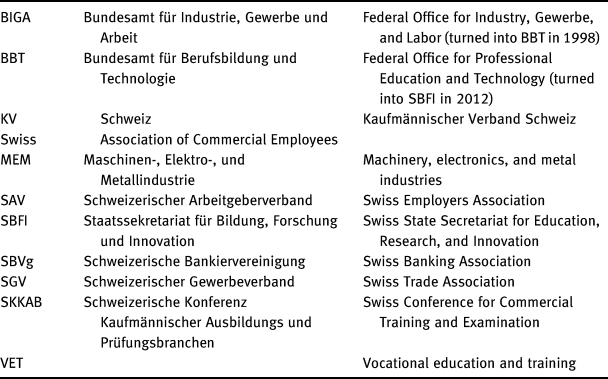
Appendix: Abbreviations