Introduction
This article deals with a particular moment in the history of North American city planning, situated between the founding of the National Conference on City Planning (NCCP) in 1909Footnote 1 and the beginning of World War I. During this period, and in a certain parallelism with the British context, that annual meeting was the theatre of a dialectic between two competing approaches to planning that played out there: urban reform, as a kind of civic activism, and city planning, as an emerging autonomous profession. The progressive dominance of the latter upon the former led to a process of institutionalization and professionalization of American planning. We could, following Jon A. Peterson,Footnote 2 isolate two successive stages of this process dealing with two different scales of networking. The first mobilized transnational resources in order to legitimize the positions of professional city planners like the allies of Frederick Law Olmsted Jr (1870–1957) who became the executive director of the NCCP in 1911. The second promoted city planning at a more local and municipal level in order to create a field of action for this new profession.
Several planning exhibitions that punctuated the period present a particularly interesting terrain for analysing these processes. Articulating, at the same time, a corpus of documents and a range of ‘exhibiting’ discourses,Footnote 3 an exhibition could be primarily defined as a field of intentionsFootnote 4 that reveals the strategies of multiple actors. At the turn of the 1910s, the genre of exhibitions on ‘planning’ was in the process of codification both in AmericaFootnote 5 and Europe.Footnote 6 At this very moment of the professionalization and institutionalization of planning, these exhibitions were key places of transnational exchange, networking and cultural transference as their designers, exhibitors and observers borrowed documents, corresponded, met, lectured and listened and shared experiences. These exhibits also sometimes revealed gaps, hiatus, divergences and differences between and within various national and municipal contexts.
Without pretending to be exhaustive, this contribution analyses a few key moments of these transnational exchanges, mainly between the USA and Great Britain. The link between these moments is the American story of a particular travelling exhibition: the Cities and Town Planning Exhibition (CTPExh),Footnote 7 created in London during the winter of 1910–11 and instigated by the Scottish thinker Patrick Geddes (1854–1932).Footnote 8 The many unsuccessful attempts by the Executive Committee of the CTPExh to send it to North America reveal interesting cross-sections of the field and period of interest here. The analysis of both printed and epistolary sources concerning these attempts reveals the many similarities and differences between national and transnational strategies of the different actors involved.
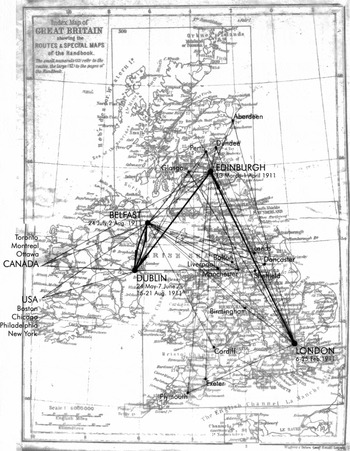
Effective tour (thick lines) and possible destinations (thin lines) of the CTPExh, 1911–12. Pierre Chabard; base map: Wagner and Debes, ‘Index map of Great Britain showing the routes and special maps of the handbook’, in K. Baedeker, Handbook for Travellers: Great Britain (Leipzig, 1910), 624.

Cities and town planning
Created after the great Town Planning Conference and Exhibition organized by the Royal Institute of British Architects (RIBA) in London in October 1910, the CTPExh Executive Committee was headed by Patrick Geddes, ‘a most unsettling person’Footnote 9 and generalist thinker, working at the frontiers of the world of science (natural sciences, evolutionism), the reforming ‘nebula’Footnote 10 and the town planning movement. Quite heterogeneous in its composition, the Executive Committee of the CTPExh brought together the main actors of this latter field, then in the process of institutionalization: John Burns (1858–1943), president of the Local Government Board (LGB), initiator of the first British legislation on town planning (adopted in 1909);Footnote 11 Thomas Adams (1871–1940) and Raymond Unwin (1863–1940), competing figures who represented the first practitioners of the garden city in the 1900s and future founders of the Town Planning Institute (in 1913); various RIBA architects involved in the debates about town planning: John W. Simpson (1858–1933), Henry V. Lanchester (1863–1953), Brook T. Kitchin (c. 1870–1940); representatives of major organizations active in these debates, like Ewart G. Culpin (1877–1946), of the Garden City Association, or Henry R. Aldridge, founder and secretary of the influential National Housing and Town Planning Council (NHTPC).Footnote 12
Combining nationalFootnote 13 and internationalFootnote 14 fragments of the RIBA's Exhibition of October 1910 together with items from Geddes’ own collectionsFootnote 15 accumulated since the turn of the twentieth century in his Edinburgh Outlook Tower,Footnote 16 the CTPExh was founded on the temporary convergence of the intentions of two types of actors: first, John Burns and the first professional planners who wished to use the exhibition as a mean to promote the principles of the new Town Planning Act, to diffuse locally an emerging planning opportunity (extension plans, garden cities and suburbs, etc.) and to arouse a municipal demand for it; secondly, Patrick Geddes, and his network of friends and disciples, who conceived the CTPExh as a vector of his more reformist conception of ‘city design’. Being neither an architect nor a planner, Geddes approached the problematic of the urbanization of the great industrial cities from his own scientific and evolutionist culture. According to him, the modern metropolis was the site of a profound rupture in the creative interaction between an individual and his geographical urban and social environment. To restore this evolutionary link which implied the individual as well as the civic community, in other words, to inflect the course of evolution, architectural and urban planning, was not enough. More eutopian than utopian, more evolutionary than revolutionary, his theory had two sides: first, an epistomological one, with the aim of founding a new science – civicsFootnote 17 – as a systematic and synoptic knowledge which included geographical, historical, social and economic dimensions of the city; secondly, a more positivist one founding on the idea that the making of local exhibitions of this knowledge would strongly stimulate the civic mood of the city. Like his Outlook Tower in Edinburgh in the 1890s, the CTPExh constituted a crucial instrument of Geddes’ evolutionary urban eutopia.
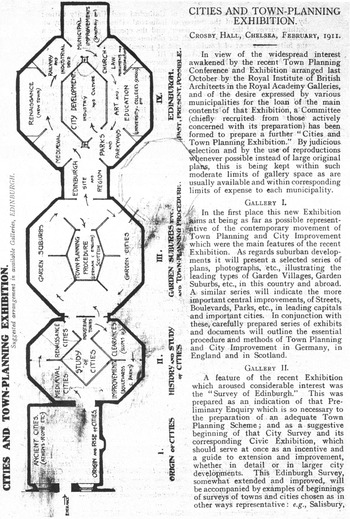
Plan of the CTPExh as displayed in the galleries of the Royal Scottish Academy, Edinburgh, 13 March to 1 April 1911. Cities and Town Planning Exhibition, Crosby Hall, Chelsea (London, 1911), 3 (University of Strathclyde, Glasgow (UStrath) TGED-6–10-1).

Reflecting these divergent but temporarily complementary intentions, the contents of the CTPExh combined both technical documentation for a specialized public (plans, maps, sections, graphic statistics, etc.) and copious and various visual exhibits accessible to a more general one (photographs, engravings, paintings, models, postcards, historic timelines, old maps, etc.).Footnote 18 This heterogeneous collection was shaped in a travelling exhibition, available from the winter of 1911, loaned, usually for a fortnight, to concerned municipalities for the sum of £300. To promote the CTPExh, the Executive Committee opted for local propaganda oriented towards the cities most likely to host the exhibition: cities where one of its members had connections or where the context was particularly favourable to town planning. Instead of taking on an all-encompassing publicity campaign, the Executive Committee prefered to set up a local committee to prepare the arrival of the CTPExh. This committee brought together chosen personalities of the targeted host city, with not only the power of influencing the decisions of the municipality, but also with the ability to contribute financially to the operation.
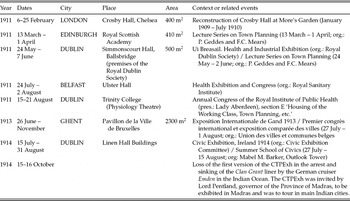
In practice, the actual travelling of the Exhibition followed a rather desultory pace, with ups and downs (see Table 1): a rapid series of showings in the UK, between February and August 1911 (passing through the provincial capitals of Edinburgh, Dublin and Belfast where the issue of territorial control by the imperial power was more crucial than elsewhere, and where town planning as rational action, as defined by John Burns’ Act, was an important political stake). Between August 1911 and June 1913, it was not exhibited at all. A prestigious invitation to the 1913 Ghent International Exposition led to a five-month display there. Seven months later, beginning in July 1914, it was exhibited again – part of the collection in the great Civic Exhibition in Dublin.
Showings of the CTPExh between 1910 and 1914

The analysis of the correspondence between the members of the Executive Committee of the CTPExh reveals a recurrent intention, first articulated in March 1911, to send the exhibit to the large industrial cities of eastern Canada (Toronto, Montreal, Ottawa) and the United States (Boston, Philadelphia, New York or Chicago). Capitalizing on the success of the 1910 RIBA's Exhibition, this possible North American horizon for the exhibition opened new and major professional opportunities to British planners and thus reveals important aspects of the network of actors that promoted it, particularly the voluntary involvement of Raymond Unwin. In spring 1911, he travelled for the first time to the North American continent. Along with Thomas H. Mawson (1861–1933) and Thomas Adams, he was invited by the US city planners to take part in the third NCCP, held from 15 to 17 May in Philadelphia. On the occasion of this North American voyage, Unwin, who saw a huge potential field of planning action there, also visited other major cities (Chicago, Boston, Toronto, etc.) and increased his professional contacts.Footnote 19
An impossible standardization
Seven months after the success of the American ‘City Beautiful’ exhibit at the RIBA's great exhibition in London, the organizers of the third NCCP were anxious to exploit this international capital on the American scene. The invitation of Unwin, Mawson and Adams to Philadelphia reflected the will of Frederick Law Olmsted Jr, new executive director of the NCCP, to legitimize his own vision of professional city planning by resorting to distant figures and major international examples. Like the RIBA in October 1910, the city planners wished to transcend local conflicts by an extensive use of transnational networks.
To achieve and sustain this international alliance, in May 1911, Olmsted discussed, with his English colleagues, a joint exhibition project that would unify the various collections then in circulation into a large homogeneous and easily reproducible documentary corpus on urbanism. The idea was to design a standardized exhibition with variable sizes, an exhibition that would have an international scope, but could also be adapted to local uses. The aim of this systematic standardization was both to constitute, by networking international actors sharing the same interest in professional planning, a unified, universal visual culture of this field, and to promote it locally by way of exhibition. Among the resolutions taken by the NCCP in its business session, a proposal for an International Standardized Exhibition (ISExh) was adopted:
[It is resolved] that this conference endorses the project of arranging for the systematic international exchange of exhibits illustrative of city planning, and of preparing uniform international standards of size and methods of presentation in order to facilitate such interchange, and that the executive committee be directed to take such steps as may be practicable to advance the project.Footnote 20
General secretary of the Allgemeine Städtebau-Ausstellung (Berlin and Düsseldorf 1910),Footnote 21 Werner Hegemann (1881–1936) was approached by the NCCP to head up the project in Germany.Footnote 22 Present in Philadelphia in May 1911, Unwin was also involved in it for the UK. While conscious of the difficulty of the undertaking, he saw here a great opportunity for the CTPExh. In his letter of June 1911, he encouraged Geddes to accept the terms of the American project, suggesting that the existing Executive Committee of the CTPExh could support the British part of the project.Footnote 23
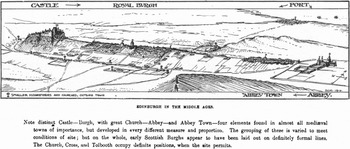
Frank C. Mears, bird's eye's view of ‘Edinburgh in the middle ages’, 1910. P. Geddes and F.C. Mears, Cities and Town Planning Exhibition. Explanatory Guide Book and Outline Catalogue (Edinburgh, 1911), 49 (UStrath, TGED-23–1-16).

Having received, after a long delay, the official letter from Olmsted dated 8 June, Geddes replied at length on 2 August, from Belfast.Footnote 24 Rather enthusiastic, his letter tried to reassure the American city planner about the technical and financial feasibility of the ISExh. However, in spite of these kind encouragements, most of his letter developed a major Geddesian claim: the argument that the ISExh should adopt a civic and reformist angle. In Geddes’ thinking, American city planning, like British town planning, should not be reduced to a narrow expertise but should include the involvement of other scientific disciplines (history, geography, sociology, etc.) and existing operational fields (social reform, hygienism, civil engineering, popular education, etc.). This openness was not only strategic, aiming to expand the scope of contributors or potential sponsors. It responded primarily to the theoretical and practical ambitions of Geddes, who wished to subsume urban planning under a larger science: civics, defined as an ‘applied sociology’. His own exhibition, he reminded Olmsted, was composed of two parts. The most important of the two ‘is the Cities Exhibition, which underlies and completes the Town Planning one’.Footnote 25 Having convinced Unwin in 1910 of the interest in an alliance between civics and town planning, he then tried the same strategy with American city planners.
Very far from the Geddes’ theoretical approach towards the ISExh, Unwin was mainly concerned by the practical aspects of the standardization of the exhibits. He saw here a way to improve the formal presentation of Geddes’ disjointed, disparate and unequal collectionsFootnote 26 while making them conform to these new international uses envisioned by the Americans. He brought together his recommendations in a letter sent to all the actors of the ISExh (Geddes, Hegemann, Olmsted, etc.). In this document, the technical and practical considerations prevailed: making drawings on tracing-paper for easy and cheap reproduction; stretching prints on simple frameworks of standard sizes; prefering varnish to on-glass, too fragile for transport; opting for sober black oak or teak frames, in the same formats as the storage boxes; captioning documents on independent cards for easy translations, etc.
Reacting to Unwin's proposals, Werner Hegemann proposed in a memorandum of 2 October a quite different modus operandi, based on his own experience of making exhibitions. Rejecting the solution of stretching documents on frames, he believed it better to mount them ‘on cloth with two round pieces of wood at the top and at the bottom which allow rolling.’Footnote 27 But most of his letter rather addressed the standardization of images itself: codification of colours and modes of representation; predilection for black and white graphic schemes, more easily reproducible in publications; search for clarity and readability of images to allow them to circulate outside the exhibition itself, i.e., for example, as illustrations in a book or in a newspaper:
It might be good then to state by what way of drawing for instance forest, parks, streets, one-family houses, apartment houses, trees, etc. etc. should be indicated. The advantage of that would be important, it seems to me, in so far as it enables laymen, after having understood once the meaning of a drawing or of a map in the exhibition, to understand all the rest easily and to make so the exhibition readable to everybody.Footnote 28
Like his involvement in major urban exhibitions since 1909 (Boston 1915, Allgemeine Städtebau-Ausstellung), Hegemann's approach to the standardization of the ISExh exhibits stemmed from his wish to put urban planning in the heart of public debate and civic life, to open it up to all citizens of a city. In this, he differed substantially from Unwin's or Olmsted's agendas, but was closer to Geddes’ ideals. However, no agreement was reached between the two men. The architect Frank C. Mears (1880–1953), Geddes’ assistant for the CTPExh, was resolutely opposed to Hegemann's proposals. His idea to roll documents seemed to Mears ‘fatal to appearance, and not good for drawings’; Footnote 29 his idea of graphic standardization seemed interesting but ‘deadly dull’Footnote 30 and inadequate to provide the theatricality necessary for a public exhibition.
By the discussions it generated, the ISExh was very revealing. Like any standardizing attempt, it highlighted relations of power, divergent and even contradictory interests and intentions. How to reconcile these three different visions for the same exhibition? Olmsted, like Unwin, saw it as a vast international documentary corpus, in order to exchange, to consolidate and to legitimize professional knowledges and know-hows of urbanism; Hegemann wanted to conceive it in a rational and systematic way, as a cognitive and teaching tool able to promote and to popularize urban issues; Geddes, with similar intentions, had a quite different approach to this exhibition. First, he privileged visual and iconic qualities of documents over textual and symbolic ones. Unlike Hegemann, he thought that a picture was less read than seen, less intelligible than sensible. Second, he favoured the scenographic qualities of the exhibition itself. According to Geddes, the success of an exhibition was not based on its documentary contents, but on its scenography or even its dramaturgy. He was not hostile to a standardization of formats and packagings (cards, frames, etc.). But, for him, the point was elsewhere: in the ability of the ISExh to adapt not only to the particular and always different space that a city allocated to it, but also to the intentions of whoever scenographied it.
In this regard, the final failure of this standardizing project did not result from intrinsic or immanent reasons but from the incompatibility between its actors themselves and from the divergence of their aims and intentions; or, in other words, from the fact that this standardizing project revealed the progressive supremacy of professional planners' ‘standards’ upon urban reformers’ ones.
Geddes v. Unwin: different purposes and networks
In 1911, Unwin and Geddes, even if they followed quite different interests and ambitions, shared the same goal of sending the CTPExh to the United States. To that same end, they mobilized different and sometimes rival networks. Unwin was closer to his American homologues: professional city planners, actors of the emerging operational planning field (municipalities, chambers of commerce, etc.). Having himself visited the United States, Geddes had a more academic and reforming network. He had constructed it with the help of the reformer Robert Erskine Ely (1861–1948), during the two American trips he made (February–April 1899 and December 1899 – March 1900)Footnote 31 in order to promote his undertakings for the Universal Exhibition in Paris, 1900.Footnote 32
This network included the reformer and sociologist Charles S. Zueblin (1866–1924), whose trajectory and role within the world of city planning was quite similar to those of Geddes. They met in Edinburgh in August 1897.Footnote 33 In winter 1900, Geddes stayed at Zueblin's home during his visit to Chicago and it is through him that the Scottish thinker met reforming elites of the city, including Jane Addams who opened her Hull house to him. After ten years of silence, Geddes wrote to Zueblin in June 1911, in order to seek his help to promote his CTPExh in the United States. The latter was at a crucial point in his career. He had relinquished his academic position (as professor of sociology at the University of Chicago) to embrace a new career as a civic journalist and social activist in Boston. From autumn 1911, he succeeded Benjamin Orange Flower at the head of the Twentieth Century Magazine, a literary and political publication, subtitled ‘the trade journal of democracy’.Footnote 34 The first issue published by Zueblin was in November of 1911. And, although he ensured Geddes his support for the exhibition,Footnote 35 his letters dealt mainly with his magazine and possible contributions of his old friend to it.
But beyond the relative ineffectiveness of Geddes’ step towards Zueblin, this exchange was interesting and revealing in and of itself. In writing to him, Geddes certainly addressed not only an actor of social reform in the United States but also a member of the complex networks that constituted the nascent field of American city planning. As pointed out by Peterson, Zueblin was a major figure of the American ‘Civic Improvement’ movement.Footnote 36 In 1900, together with Frank Chapin Bray (1866–1949) of the Chautauqua Institution and Mayor Samuel M. Jones (1846–1904) of Toledo, Ohio, Zueblin founded the American League of Improvement Associations. Its aim was to federate, at a national scale, numerous local civic associations that had flourished in the United States in the last third of the nineteenth century and that advocated rural and urban beautification, indexing social and community harmony on landscape beauty, i.e. on aesthetic, picturesque and domestic qualities of the physical environment. Head of the League between 1901 and 1903, Zueblin renamed it the American League for Civic Improvement (ALCI) and expanded its involvements from the village scale to a larger metropolitan one, linking them with methods of urban reform that he had practised in Chicago. In the 1900s, civic improvement was one of the two great traditions that converged in the City Beautiful Movement, the other coming from the field of landscape architecture, itself federated by the American Park and Outdoor Art Association (APOAA).Footnote 37
The dialectic between the ALCI, deriving from reforming and philanthropic models, and the APOAA, an organization with professional aims, was emblematic of the discussions that shaped the emergence of city planning in the United States. The progressive pre-eminence of planning ‘experts’ over civic reformers marked the successive sessions of the NCCP from 1909. In this regard, the third NCCP in Philadelphia in May 1911, that Unwin attended, was an important milestone. As noted by George B. Ford (1879–1930), the Congress was, for the first time, organized under the auspices of a municipality, which funded not only the event but also the organization of a planning exhibition and the development of an extension plan for the city. Envisioned to follow up and prolong the purposes of the London Town Planning Conference in 1910, the third NCCP wished to address all aspects of the new profession of the city planner: ‘The Economic, and the Legal, and to some extent the Social sides were given equal prominence with the Aesthetic, and justly so if we would attempt to arrive at an all-round development of the subject.’Footnote 38
From an institutional point of view, this Congress consecrated above all the supremacy of Frederick L. Olmsted Jr over Benjamin C. Marsh (1877–1952) after several years of rivalry. Secretary of the Committee on Congestion of Population in New York and author of the first book on city planning,Footnote 39 the latter was the main instigator of the first NCCP in Washington in May 1909. However, his strictly reforming approach towards planning and his persistence in promoting certain doctrinesFootnote 40 marginalized this atypical and uncompromising person in the American city planning movement. And, at the end of the second NCCP in May 1910, it was Olmsted, his direct challenger, who became the head of the Executive Committee and was in charge of the organization of the 1911 Congress with the ambition not only to professionalize the movement but also to internationalize it (hence the invitation of some representatives of British town planning).
In May 1911, Unwin joined the majority within city planning whose main aspirations he shared, men such as Frederick L. Olmsted, John Nolen (1869–1937), George B. Ford and Charles Mulford Robinson (1869–1917). As for Geddes, he continued to operate, in a somewhat anachronistic way, within the network of intellectuals and reformers that he had constructed more than 10 years before. In 1911, he began new correspondences with these old friends. Besides Charles Zueblin, he also wrote to Joseph Fels (1853–1914) of Philadelphia,Footnote 41 James Mavor (1854–1925) of Toronto, Stanley G. Hall (1844–1924) of Worcester (MA) and Percival A. Chubb (1860–1960), director of the Ethical Society of St Louis (MO). In Chicago, he contacted George Ellsworth Hooker (1861–1939), co-founder (in 1903) and secretary of the City Club, a typically philanthropic institution bringing together the elites of the city (including Jane Addams) towards civic reform and control over the worst problems associated with urbanization.Footnote 42 Familiar with city planning issues, this lawyer was also a member of the Executive Committee of NCCP.Footnote 43 Intermediary figure between city planning and urban reform, Hooker however showed, in his letters, less interest in the CTPExh than in the ‘Masques of Learning’, an ambitious historic and civic pageant that Geddes directed from the winter of 1912,Footnote 44 which seemed quite removed from professional city planning interests.
Victor V. Branford: a New York ambassador
The main support for Geddes in the United States came from the British businessman and social thinker Victor Verasis Branford (1863–1930), his old friend and patron, one of his early disciples in Edinburgh in the 1890s.Footnote 45 Between 1911 and 1913, he lived mainly in New York with his new wife, Sybella Gurney (1870–1926). From New York, Branford advised Geddes about people he might contact and, mainly during 1913, also worked towards bringing over the CTPExh. Branford's very profitable business left him more free time that year and the mounting of the CTPExh at the international exhibition of Ghent gave it an international visibility that provided Branford leverage in his discussions with his American interlocutors. Taking advantage also of the growing interest in planning in the United States, he became actively involved in promoting the exhibition in American city planning networks. More effective and enterprising than Unwin, because of his personal friendship with Geddes and his presence in New York, he focused his efforts in several simultaneous but converging directions. At his initiative, the idea of an American tour of the CTPExh, discussed since 1911, took hold in the spring of 1913, in New York, in networks close to George MacAneny (1869–1953).Footnote 46
Branford focused his efforts on a project, still diffuse for the moment, for a large itinerant city planning exhibition that would tour major cities in North America. This exhibition project was first initiated by George MacAneny, then president of the Borough of Manhattan in the Greater New York administration. Ex officio member of the Board of Estimate and ApportionmentFootnote 47 of the city, he formed a local committee to consider the height of buildings, particularly crucial issue in the case of the urbanization of Manhattan. In this committee, which foreshadowed the City Planning Committee that he founded in 1914, McAneny was surrounded by three recognized city planning experts: Frank Backus Williams (1864–1954) and George B. Ford, two members of the General Committee of the NCCP, and Edward Murray Bassett (1863–1948) who became its president in 1917.
It was mainly Ford and Backus Williams who took on the responsibility to collect the documents for the City Planning Exhibition. To this end, the latter travelled to Europe during the summer of 1913. Contacted by Geddes on the advice of Branford, he interrupted his tour in Germany (Frankfurt, Cologne, Berlin, etc.) and agreed to come to GhentFootnote 48 in order to attend the ‘Congrès International des Villes’ (27 July – 1 August 1913), and especially to visit Geddes’ and Paul Otlet's ‘Exposition Comparée des Villes’.Footnote 49 Staying two days, he inquired in great detail about the conditions under which Geddes would contribute to MacAneny's project.
Thanks to the support of the New York Merchant's AssociationFootnote 50 (whose Industrial Development Bureau seemed, as Branford wrote to Geddes, ‘very favorable to idea of [Geddes’] exhibition coming here’Footnote 51), MacAneny secured a budget of $3,000 for the CTPExh. In spite of these favourable conditions, the negotiations finally failed. Backus Williams seemed not to have been convinced by the qualities of Geddes’ collection presented in Ghent. A few months later, the Scottish thinker explained this failure to bring his exhibit to North America in a letter to his American friend Percival Chubb: ‘The NY Town Planning group. . .was also in treaty with us at Ghent, and practically arranged our coming over; but several of their members who visited us thought our show far too unpractical for their purposes.’Footnote 52
At the same period, Branford tried, in parallel ways, other strategies, for example, by changing the scale of action and by promoting the CTPExh directly in the cities themselves, in order to try and create interest in it. He tried in Philadelphia, where Geddes had old allies (Joseph Fels and William P. Wilson, director of the Commercial Museum since 1893). It was through this local Philadelphian network that the issue of the inclusion of the CTPExh in the City Planning Exhibition was discussed at the fifth NCCP in Chicago in May 1913. George S. Webster, chief engineer and surveyor at the Philadelphia Department of Public Works and member of the Executive Committee of the NCCP, transmitted to the Congress the will of certain Philadelphian institutions to welcome the CTPExh, but failed to involve the NCCP, dominated by technical, professional and legislative discussions about planning and financial problems, as he reported to the secretary of the mayor of Philadelphia:
The matter of bringing Mr Geddes’ exhibition to this country after the close of the Ghent Exhibition has been taken up by the City Parks Association, which held a meeting in the Mayor's Reception Room on April 5th at which time a committee was appointed to consider ways and means for bringing this exhibition to Philadelphia. This committee later referred the matter to the National Conference on City Planning which considered it thoroughly and decided that it did not seem possible at this time to undertake the expense contingent to providing for the exhibit. In view of lack of funds in the City and the indifference of the civic and city planning organisations, I think it is doubtful whether anything can be done in Philadelphia in reference to this matter.Footnote 53
Contrasting with the enthusiasm for international planning exhibitions that Unwin had met in 1911, the relative indifference of the NCCP described by Webster can be explained by the financial fragility of the organization, which, despite the Russel Sage Foundation's support, just managed to finance its own annual event.Footnote 54 But it also revealed a deeper evolution of this organization whose agenda was now increasingly dominated by very pragmatic questions about professional city planning. The point was to implement its ideals at the municipal level, through City Planning Commissions armed with the appropriate legislation and to secure public and private funds for financing the preparation of urban plans. The only exhibition mentioned in the proceedings of the conference was the 1915 Panama-Pacific Exhibition to which the American Civic Association and the National Municipal League encouraged city planners to contribute with ‘exhibits illustrating municipal advancements’Footnote 55 (a project the NCCP finally abandoned in 1914).Footnote 56
Pillar of the NCCP, the American Civic Association, founded in 1904 by the merging of the ALCI and the APOAA, also undertook a study tour in Europe during the summer of 1913 (from 11 July to 23 August). But, the intentions of Richard B. Watrous, secretary of the association, was not to collect documents for a possible exhibition but rather to study in situ town planning practices and achievements in Germany (Hamburg, Berlin – Potsdam, Dresden – Hellerau, Nuremberg, Rothenburg, Munich, Frankfurt, Dusseldorf), but also in Belgium (Brussels), France (Paris – Versailles) and Britain (London – Hampstead, Southampton). Around 10 August, the twenty delegates of the American Civic Association visited the headquarters of Otlet's Union of International Associations in Brussels. Neverthless, they declined Geddes’ invitation to visit the ‘Exposition Comparée des Villes’, in Ghent.Footnote 57
For his part, facing the relative lack of interest and the financial weakness of the NCCP, MacAneny resorted to an entirely different type of actor to promote his City Planning Exhibition: fund raising experts, key partners of American philanthropy during the Progressive Era, whose task was to link reforming networks and financial, industrial and political interests.Footnote 58 To carry out his exhibition project, MacAneny included in its committee the Buttenheim Brothers of the American City Bureau (ACB).Footnote 59 This organization was founded in New York in April 1913, in order to ‘promote the general welfare and prosperity of communities of any and all kinds, the health, safety, and comfort of the citizens thereof respectively and to raise money for civic and philanthropic purposes’.Footnote 60 The promotion and financing of MacAneny's City Planning Exhibition fell within the targeted fields of the ACB.
In late June 1913, after the fifth NCCP, Harold S. Buttenheim (1876–1961) wrote to Branford, informing him of the possibility that the ACB might directly take on the management of the City Planning Exhibition and make it possible for the CTPExh to come to the United States.Footnote 61 Incompatible with his commitments in Ghent (where the CTPExh remained until early November), Geddes was compelled to decline Buttenheim's proposals. Managed by the ACB under the auspices of the Board of Estimates and the Merchants’ Association of New York, the City Planning Exhibition was finally held without Geddes’ collections. It opened on Monday, 24 November 1913, for 15 days in the halls of the New York Public Library. Operating local networks (in particular Chambers of Commerce or Commercial Clubs), the ACB succeeded in circulating the exhibition in 21 cities until 1916: Oakland (CA), San Francisco (CA), Los Angeles (CA), Jersey City (NJ), Fort Wayne (IN), etc. Addressing not only local governments but also directly major private economic actors in these cities, the exhibition reflected city planners’ concerns to find concrete ways to implement their urbanistic ideals. And, as stated by George B. Ford, secretary of the City Planning Exhibition, city planning achievements necessarily implied involvement of private local interests: ‘If city planning in America is going to proceed along permanently satisfactory lines, it will be because the chambers of commerce have promoted it and backed it.’Footnote 62
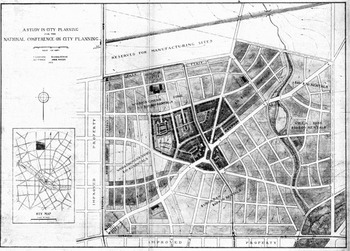
Competition for a complete study in city planning for a fictive American city of 500,000 inhabitants, organized by the NCCP in spring 1913. Entry no. 7 (F.A. Bourne, A.C. Comey, B.A. Haldeman and J. Nolen), in Proceedings of the Fifth National Conference on City Planning. Chicago, Illinois, May 5–7, 1913 (Boston, MA, 1913), 212.

This evolution in planners’ professional strategy implied a shift of scale of their involvment: at the turn of the 1910s, transnational networking has helped a national legitimation and structuration of their professional body; the municipal context was now the better scale to find concrete opportunities to plan cities.
Conclusion: international v. municipal scenes?
The failure of Branford's and Geddes’ attempts in 1913 reveals a paradox. The CTPExh, visible for several months at the Ghent International Exhibition, had never been so fully and so richly presented. Combined with other collections, it occupied a vast hall of 2,300 square metres, i.e. four to five times more than in Dublin or in Edinburgh in 1911. In addition, it accompanied and illustrated an important congress attended by planners from 22 countries and 150 cities and during which the ‘Union Internationale des Villes’ was founded.Footnote 63 Mainly European in its beginnings, this ‘international association for the development of cities’ was the first official transnational institution established in the planning field, after several previous failed attempts.
In 1911, as we have seen, these transnational ideals were embraced and defended by American city planners, as a resource to strengthen their position in municipal and national debates. But Olmsted, and his universalist project of a unified and standardized documentation on urban planning, met irreconcilable local singularities (Geddes’ or Hegemann's respective exhibiting problematics). For almost ‘babelian’ reasons, the ISExh remained incipient and never found its common ‘language’.
In 1913, on the contrary, the ‘Exposition Comparée des Villes’, managed by Paul Otlet (1868–1944), founder of the Union of International Associations and ardent supporter, among other things, of the universal standardization of language (such as Volapük or Esperanto),Footnote 64 offered to Geddes’ CTPExh a broad international visibility and legitimacy. But, in the meantime, American city planners’ concerns had significantly changed. Their aim was no longer to convince local authorities of the need for city planning but to consider the practical ways of its implementation at the municipal level. Therefore, at the fifth NCCP in Chicago in May 1913, the focus obviously shifted scale. It was no longer transnational, as in 1911, but transmunicipal. The point of the NCCP was to share city planning experiences already led in major North American cities (New York, Chicago, Pittsburgh, Kansas City, Montreal).Footnote 65 The ‘City Beautiful’ movement, whose spectacular graphical production was celebrated at the Town Planning Exhibition in London in October 1910, was by then quite out-of-date. In Chicago, the very technical approach of city planning contrasted with the pictorial images that dominated, five years earlier, Daniel H. Burnham's and Edward H. Bennett's work, for example. Focused mostly on practical and quantitative aspects, the contribution of the same Bennett to the fifth NCCPFootnote 66 deepened, complexified and refuted at the same time his Plan of Chicago of 1907–09.Footnote 67 In these circumstances, we understand why, in 1913, the American city planners in general, and Frank Backus Williams in particular, ignored the CTPExh that, despite its resolutely international ambition, continued to show American city planning through Jules Guerin's gorgeous painted perspectives.
Basically, it seems that the reasons why the CTPExh should have travelled to America in 1911 (mainly its comparative and transnational purposes) were the same as those why it could not in 1913. American avatars of this exhibition showed, in any case, the instability of urban planning networks at the turn of the 1910s and their rapid evolution towards more stable institutional and professional forms.