Introduction
Periodical cicadas in the genus Magicicada Davis (Hemiptera: Cicadidae) are fascinating insects because they have lengthy life cycles, synchronised mass emergences, and large aggregations of chorusing males. Emergences of 17-year periodical cicadas in the northeastern United States of America are composed of Magicicada cassinii (Fisher), Magicicada septendecim (Linnaeus), and Magicicada septendecula Alexander and Moore or of some combination of these species. Marlatt (Reference Marlatt1907), Williams and Simon (Reference Williams and Simon1995), and others have summarised the remarkable life history of Magicicada species. Magicicada septendecim is the most widespread and often the most abundant of the three, whereas M. septendecula usually is the rarest (Alexander and Moore Reference Alexander and Moore1962; Dybas and Lloyd Reference Dybas and Lloyd1974). Lloyd and White (Reference Lloyd and White1983) have proposed that the rarity of M. septendecula at sites with crowding may be related to its tendency to delay its emergence by one year, which greatly decreases its survival.
Alexander and Moore (Reference Alexander and Moore1962), Dybas and Lloyd (Reference Dybas and Lloyd1974), Lloyd and White (Reference Lloyd and White1976), and others have described the habitat or host preferences of Magicicada species. They have concluded that M. septendecula tends to use forest-edge or open areas, especially ones with hickories, Carya Nuttall species (Juglandaceae), black walnut, Juglans nigra Linnaeus (Juglandaceae), or both, for reproductive activities and development. In an analysis of ovipositional preferences, White (Reference White1980) has suggested that M. septendecula has a broader host range in disturbed forests than in mature ones. Typically, M. septendecula shows a greater tendency to oviposit in Carya species than do M. cassinii and M. septendecim (Lloyd and White Reference Lloyd and White1976).
Based upon museum specimens, 17-year periodical cicadas have been collected in Connecticut, United States of America, since at least 1843 (C.T.M., unpublished data). Connecticut specimens belong to brood II or XI, although the latter brood is now extinct (Manter Reference Manter1974). From 1843 to 2012, M. septendecim was the lone species known from the state (Leonard Reference Leonard1964; Manter Reference Manter1974; Maier Reference Maier1980, Reference Maier1982a, Reference Maier1982b, Reference Maier1985, unpublished data). However, during my survey of brood II in 2013, I found M. septendecula on Totoket Mountain in North Branford, Connecticut. The objectives of this paper are to document the discovery, to characterise the forest in the centre of two chorusing areas, and to estimate the nymphal density at one site.
Materials and methods
Discovery of Magicicada septendecula in Connecticut
The presence of M. septendecula was confirmed by collecting specimens, by hearing the calling song of males, or both. To rule out a possible earlier discovery of M. septendecula in Connecticut, I searched for specimens of brood II and XI in 12 insect collections, which are identified in the Acknowledgements. I also examined New York, United States of America, specimens of M. septendecula from all broods to find nearby locations with this species.
Both adults and exuviae of M. septendecula and M. septendecim from Connecticut in 2013 are deposited in the insect collection in the Department of Entomology, Connecticut Agricultural Experiment Station, New Haven, Connecticut.
Characteristics of chorusing centres
The basal area of trees in two emergence and chorusing areas of M. septendecula in North Branford (Fig. 1) was calculated after measuring the diameter of trees at breast height (dbh) or 1.4 m above ground during July 2013. All of the live trees ⩾10 cm in diameter were measured in one 50×50-m plot (0.25 ha) near the centre of each area (Fig. 1B). Hereafter, these forested plots will be called plot 1 (41.3513°N, 72.7858°W; elevation 86 m) and plot 2 (41.3560°N, 72.7861°W; elevation 112 m). These plots were located on the east-facing slope of the basalt ridge known as Totoket Mountain, which is located mainly in North Branford, New Haven County, Connecticut. Trunks that split into two or more boles were treated as separate trees if the split was <1.4m above ground. To estimate stand composition about five years earlier (~2008) and to reveal recent change in plots 1 and 2, dead standing or fallen trees with bark also were identified. Basal area was the principal measure used to assess dominance in the plots. Plots 1 and 2 were thinned between 1990 and 2001, but the identity and size of the removed trees are unknown. Species diversity of trees in plots was calculated with the Shannon and Weaver (Reference Shannon and Weaver1963) index (H′).
Areas sampled for Magicicada species in Connecticut, United States of America, in 2013. (A) Forested areas where exuviae were collected and measured. (B) Two chorusing centres of Magicicada septendecula with associated 0.25-ha plots on Totoket Mountain in North Branford. Square white plots 1 and 2 are located near the middle of the otherwise black chorusing centres.

The longitude, latitude, and elevation in the centre of plots 1 and 2 were recorded with a hand-held Garmin GPS 72H (Garmin International, Incorporated, Olathe, Kansas, United States of America). Boundaries of chorusing areas (Fig. 1B) were estimated by walking from the centre to points where only a single male was singing. The size of the chorusing areas around plots 1 and 2 was estimated on 8 June and 15 June, respectively, when it was sunny and>21 °C.
Soil samples were collected at a depth of 10–15 cm, and then analysed for texture, nutrient content, and pH at the Connecticut Agricultural Experiment Station, New Haven, Connecticut, by using mainly the Morgan soil testing method (Lunt et al. Reference Lunt, Swanson and Jacobson1950). Samples were collected at three locations within each plot, and then combined before analysis.
Estimating density
The density of cicadas was estimated by counting nymphal emergence holes of Magicicada species in 100 quadrats (0.5×0.5 m, or 0.25 m2) that were randomly selected in the 0.25-ha plot 1 (Fig. 1B). To find each quadrat, a grid of string lines spaced 5 m apart was installed in a northeast-southwest and a northwest-southeast direction. A tape measure and a metrestick were used to pinpoint individual quadrats as accurately as possible. The sampling procedure was not altered even if a tree trunk was in one of the quadrats; thus, the entire soil surface was considered to be potentially available for emergence. Sampling was conducted during the first 10 days of July after the emergence of Magicicada species had ended and before that of species of Tibicen Latreille (Hemiptera: Cicadidae) had peaked. In North Branford, the first Tibicen species sang on 8 July.
To estimate the proportion of nymphal emergence holes that belonged to each of the two Magicicada species in plot 1, exuviae were collected within 1 m of trunks of 69 trees that were ≥10 cm in diameter and within 25 m of the centre of the plot. The length of the right hind tibia (left one, if the right was missing) of exuviae was measured as indicated by Dybas and Lloyd (Reference Dybas and Lloyd1962). All tibiae in this study were measured to the nearest 0.067 mm (the length of one unit of the micrometer) with an ocular micrometer in the eyepiece of an Olympus SZ40 zoom stereomicroscope (Olympus Optical Company Limited, Hatagaya, Shibuya-ku, Tokyo, Japan).
Dybas and Lloyd (Reference Dybas and Lloyd1962, Reference Dybas and Lloyd1974) determined that in Virginia, United States of America, the hind tibial length could be used to identify most exuviae of Magicicada species. For example, with the method of Dybas and Lloyd (Reference Dybas and Lloyd1974), exuviae from Connecticut with a tibial length ⩾6.0 mm would be assigned to M. septendecim, and those with shorter ones would be M. septendecula. I took a slightly different approach to assign species because I found one adult female of M. septendecula next to her exuviae that had a hind tibial length of 6.16 mm. Dybas and Lloyd (Reference Dybas and Lloyd1974) either underestimated the upper range for the tibial length of M. septendecula, or this species can be larger in Connecticut.
To determine the size range of hind tibiae of Magicicada species, I measured the length of 100 tibiae of exuviae of each sex at Southington, Hartford County (41.6390°N, 72.8413°W) and at Hamden, New Haven County, Connecticut (41.4432°N, 72.9008°W) (Fig. 1A). These sites had exclusively M. septendecim in 2013. Southington was dominated by sugar maple, Acer saccharum Marshall (Sapindaceae), and Hamden was dominated by red oak, Quercus rubra Linnaeus (Fagaceae). In Southington, the tibial length of M. septendecim was 5.83–7.10 mm (mean 6.71 mm) for males and 6.30–7.57 mm (mean 7.03 mm) for females. Only one male had a tibia as short as 5.83 mm; the other 99 had lengths between 6.30 and 7.10 mm. In Hamden, the male length was 6.30–7.30 mm (mean 6.80 mm), and the female length was 6.43–7.71 mm (mean 7.06 mm). Therefore, at North Branford, exuviae with a tibial length<6.3 mm were considered to be M. septendecula, whereas those with a length ⩾6.3 were M. septendecim. If the North Branford population of M. septendecim were similar to the Southington one, then one out of 100 males might be assigned incorrectly. In plot 1 at North Branford (Fig. 1B), tibial lengths were analysed for only M. septendecula. The tibial length of<6.3 mm also was used to identify exuviae of M. septendecula in plot 2 and near a butternut, Juglans cinerea Linnaeus, in the chorusing area with plot 1 (Fig. 1B).
Sexual differences in tibial length of exuviae of Magicicada species were analysed with a t-test of means (Systat Software, Incorporated 2002). For M. septendecula, the sex ratio was tested with a χ2 analysis.
Results and discussion
Discovery of Magicicada septendecula in Connecticut
The first adults of M. septendecula (n=2♂♂) were collected on the foliage of understorey trees in plot 1 (Fig. 1B) at 1300 hours Eastern Standard Time (EST) on 6 June 2013. No males of M. septendecula were singing on this date even though it was sunny and 21–22°C. I collected additional adults on understorey foliage in plot 1 on 8 June (n=1♀, with exuviae) and 9 June (n=1♀). On these days, as well as during visits to plot 1 on 12, 15, and 18 June, males of M. septendecula were singing sporadically or chorusing mainly in tops of trees of pignut hickory, Carya glabra (Miller) Sweet, and white ash, Fraxinus americana Linnaeus (Oleaceae), in plot 1. Males sang between 1200 and 1500 hours EST when it was mostly sunny and between 21 °C and 28 °C. The chorusing area that included plot 1 was ~1.3 ha (Fig. 1B). Males of M. septendecula sang in the area that included plot 1 on at least five different days, which was more than the one to two days reported by Williams and Smith (Reference Williams and Smith1991) for Magicicada tredecula Alexander and Moore.
On 15 June, I found a second chorusing area with M. septendecula (plot 2 at centre) on the forested basalt ridge ~0.5 km to the north of plot 1 (Fig. 1B). In this 0.6-ha area where exuviae (n=1♂, 1♀) of M. septendecula were collected, males chorused in tops of trees of especially Carya species and F. americana. Additional areas with M. septendecula are likely to be found along this ridge system because it extends 11–12 km through terrain that largely is undeveloped and unsurveyed.
Along most of the ridge with plots 1 and 2 (Fig. 1B), M. septendecim chorused so loudly in mid-June that individual songs of males and discrete chorusing centres of this species could not be distinguished. However, in the two chorusing centres with M. septendecula, the intensity of chorusing by M. septendecim was less than in surrounding areas, and songs of individual males of M. septendecim could be heard.
Based upon examination of Magicicada specimens in museum collections, my discovery of M. septendecula is the first record from Connecticut and the northeastern-most one for this species. The nearest extant populations of M. septendecula of brood II are in the lower and mid-Hudson Valley of New York (White et al. Reference White, Lloyd and Karban1982; C.T.M., unpublished data)>100 km from the ones in Connecticut. Magicicada septendecula of brood II also is present on Staten Island, New York (>140 km from the North Branford chorusing centres), where its singing was heard in 1979 (Simon Reference Simon1979), 1996, and 2013 (C.T.M., unpublished data).
Historically, M. septendecula of brood XIV may have occurred at Wyandanch (Town of Babylon) and Dix Hills (Town of Huntington) (Alexander and Moore Reference Alexander and Moore1962), which are in Suffolk County, New York, on Long Island ~75–85 km to the west southwest of the new sites in Connecticut. The identification of museum specimens of M. septendecula from Wyandanch in 1923 and from Dix Hills in 1940, however, probably should be considered tentative because M. cassinii occasionally can have orange abdominal banding that resembles the pattern on M. septendecula. Davis’ (Reference Davis1924) casual description of singing certainly documented the presence of M. septendecim and another Magicicada species at Wyandanch. Alexander and Moore (Reference Alexander and Moore1962) considered the 1923 specimens collected by Davis and others to represent all three northern species of Magicicada. Since 1940, there have been no additional reports of M. septendecula on Long Island (Simon and Lloyd Reference Simon and Lloyd1982).
The presence of M. septendecula in Connecticut and the mid-Hudson Valley of New York (White et al. Reference White, Lloyd and Karban1982; C.T.M., unpublished data) appears to contradict the hypothesis that this species is absent from the northern edge of the range of Magicicada species (Alexander and Moore Reference Alexander and Moore1962; Dybas and Lloyd Reference Dybas and Lloyd1974; Lloyd and White Reference Lloyd and White1983). The hypothesis proposed by these researchers, however, was derived mainly from direct observations in the upper Midwest and before thorough searches of the Hudson Valley.
Characteristics of chorusing centres
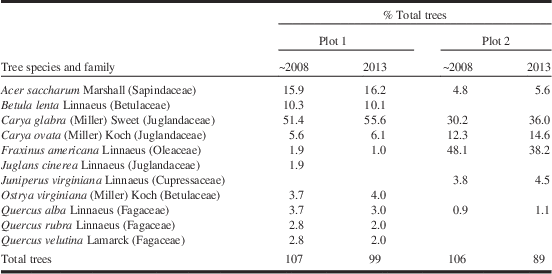
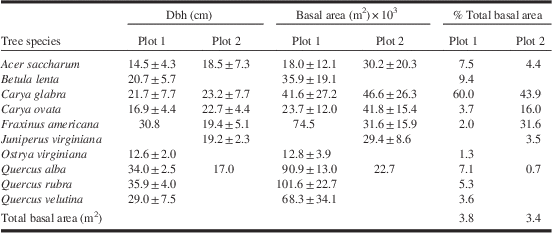
The characteristics of the forest in plots 1 and 2 where M. septendecula emerged and chorused are summarised in Tables 1 and 2. In 2013, the majority of the trees in plots 1 and 2 were Carya species (Table 1). In plot 1, the dominant species was C. glabra in both ~2008 and 2013. In the recent past, J. cinerea also occurred in plot 1. The last tree of J. cinerea in the plot was toppled during a snow storm in October 2011 (C.T.M., unpublished data). In plot 1, ~40% of the soil surface was covered with the remains of nuts of J. cinerea, providing further evidence that this species was more prevalent in the past and available as a host for M. septendecula. In plot 2, F. americana was the most numerous tree species even though it had decreased in relative abundance over approximately five years.
Species composition of trees in plots with Magicicada septendecula at North Branford, Connecticut, United States of America, in ~2008 and 2013.
The ~2008 sample included trees that were dead in 2013 but probably alive in ~2008.
Percentages were rounded to the nearest 0.1; thus, columns may not total exactly 100.
Diameter at breast height (dbh), basal area, and percentage of total basal area of trees in plots with Magicicada septendecula at North Branford, Connecticut, United States of America, in 2013.
Dbh and basal area are given as mean ± SD.
Percentages of total basal area are rounded to the nearest 0.1; thus, columns may not total exactly 100.
Species diversity (H′) decreased with time from 1.63 to 1.46 in plot 1, whereas it increased slightly in plot 2 from 1.28 to 1.31. These diversity values are the same or higher than the mean of 1.28 that Maier (Reference Maier1980) calculated for 17 Connecticut forests with populations of M. septendecim.
Mean diameter and basal area of trees varied between plots (Table 2). The relatively high standard deviations for diameter and basal area of several species provide evidence that plots had trees of mixed ages. When tree importance is based on the percentage of total basal area comprised by each species, Carya species collectively dominated in both plot 1 (63.7%) and plot 2 (59.9%), with C. glabra being the most important hickory in both plots. Fraxinus americana was the second most important species in plot 2, whereas it was relatively insignificant in plot 1.
Trees in the two plots grew on sandy loam, with the soil nutrients being higher in plot 1 than plot 2. The nitrate nitrogen was ∼5 parts per million (ppm) in plot 1 and 3 ppm in plot 2; the ammonium nitrogen was 24 and 12 ppm; phosphorus was 19 ppm and 12 ppm; potassium was 90 and 60 ppm; calcium was 700 and 500 ppm; and, magnesium was 25 and 18 ppm. The pHs of 5.6 and 5.0 in these respective plots were higher than was the mean pH recorded for 17 Connecticut forests with M. septendecim (Maier Reference Maier1980) and for Kentucky, United States of America, forests with M. septendecula and other Magicicada species (Kalisz Reference Kalisz1994). In a soil survey of New Haven County, Reynolds (Reference Reynolds1979) assigned the soil in plot 1 to the Holyoke–Cheshire complex, and that in plot 2 to the Holyoke–Rock outcrop complex. Holyoke soils tend to be shallow and well drained, occurring on ridges with bedrock-controlled glacial till.
Forested plots in Connecticut (Tables 1, 2; Fig. 1B) had some of the same features that Alexander and Moore (Reference Alexander and Moore1962) and Dybas and Lloyd (Reference Dybas and Lloyd1974) reported for forests or scattered trees with M. septendecula or its southern equivalent, M. tredecula. For example, trees in the Juglandaceae, notably Carya species, dominated in plots 1 and 2 (Tables 1, 2), and could have been more important in the past when J. cinerea was present (Table 1). Second, canopies of trees in the plots had good solar exposure, much like the preferred, isolated Carya species mentioned by Alexander and Moore (Reference Alexander and Moore1962) and Dybas and Lloyd (Reference Dybas and Lloyd1974). The sloping landscape (10–20% grade) in plots 1 and 2 contributed to increased solar exposure especially on the eastern and southern sides of trees. Furthermore, trees in plot 1 were near the edge of the forest, being bordered by a lake to the east (Fig. 1B). Finally, canopies of F. americana in plot 2 were increasingly exposed to the sun because of thinning caused by steady decline from larval infestations of the emerald ash borer, Agrilus planipennis Fairmaire (Coleoptera: Buprestidae).
The future of M. septendecula in the emergence and chorusing areas in Connecticut is uncertain. Two threats to its survival probably are the decline of F. americana from larval boring by A. planipennis and of J. cinerea from fungal diseases and succession (e.g., Graves Reference Graves1923; Anderson and LaMadeleine Reference Anderson and LaMadeleine1978; Ward et al. Reference Ward, Anagnostakis and Ferrandino1999). The first threat is most apparent in plot 2 where A. planipennis already is causing tree decline. Trees of F. americana in the two plots probably will die within six years (Knight et al. Reference Knight, Brown and Long2013). The second threat is evident in the chorusing area with plot 1, where only one live tree of J. cinerea (dbh 32 cm) remains and where dead ones are on the ground (Table 1). The one live tree apparently supported nymphal development because it had eight exuviae of M. septendecula at the base of its trunk, which was separated from other trunks by at least 5 m. If F. americana and J. cinerea are important species for M. septendecula in Connecticut, then this cicada truly is in peril. Certainly, Dybas and Lloyd (Reference Dybas and Lloyd1974), Lloyd and White (Reference Lloyd and White1976), White and Lloyd (Reference White and Lloyd1979), and Williams and Smith (Reference Williams and Smith1991) have shown that M. septendecula and M. tredecula use Fraxinus species for development, reproductive activities, or both.
Estimating density
The mean density of emergence holes in plot 1 was 1.88 ± 1.69 (SD)/0.25 m2. With extrapolation from this mean, density in the plot was 7.52 nymphs/m2 or 18 800 nymphs/0.25 ha. This estimated density per m2 was near the upper end of the range (2.2–8.0 nymphs/m2) that Maier (Reference Maier1982b) found in three Connecticut forests with M. septendecim and in the upper one-third of the range (3.7–9.3 adults/m2) that Kalisz (Reference Kalisz1994) reported for Kentucky forests with M. septendecula and at least one other Magicicada species. By contrast, density in plot 1 fell within the lower one-third of the range (1.1–26.3 adults/m2) for M. septendecim in the mid-Hudson Valley of New York (Karban Reference Karban1984).
Based upon the tibial length of 1315 exuviae collected near 69 trunks in plot 1, 7.91% of exuviae were M. septendecula and 92.09% were M. septendecim. Thus, of the estimated 18 800 cicadas within the plot, 1487 were M. septendecula and 17 313 were M. septendecim. On a ha-basis, the population size would be 5948 M. septendecula and 69 252 M. septendecim. Now, if a 1% error in assigning abnormally small males of M. septendecim to M. septendecula were considered, a correction is needed. First, the sex ratio of the exuviae presumed to be M. septendecula was 51♂♂:53♀♀, which did not depart significantly from a 1:1 (χ2=0.04, df=1, P>0.05). If 51/104 (49%) of exuviae were male, then by extrapolation 729 of the 1487 exuviae of M. septendecula can be considered males, with about seven potentially assigned incorrectly. With this subtraction, the number of M. septendecula in plot 1 would become 1480.
The mean tibial length of exuviae considered to be M. septendecula was 5.53±0.02 mm (SD) (range 5.16–5.90 mm) for males and 5.99±0.02 mm (range 5.70–6.16 mm) for females. The size was significantly smaller in males than females (t=16.9, df=102, P<0.0001). The mean tibial length of male exuviae of M. septendecim was 6.71±0.22 mm at Southington and 6.80±0.18 mm at Hamden, whereas for females it was 7.03±0.25 mm and 7.06±0.26 mm, respectively. As with M. septendecula, the length was significantly shorter in males than females at both Southington (t=9.4, df=198, P<0.0001) and Hamden (t=8.3, df=198, P<0.0001).
Acknowledgements
The author thanks Tracy Zarrillo and Morgan Lowry for their technical support during this study. Soil analyses were performed under the supervision of Gregory Bugbee at the Connecticut Agricultural Experiment Station. The South Central Connecticut Regional Water Authority (New Haven, Connecticut) kindly allowed the author to conduct research on property under its management. William VanDoren at the Water Authority was particularly helpful in compiling logging records from 1990 to 2013. The author appreciates the helpful suggestions that Francis Ferrandino, Chris Simon, and an anonymous reviewer made on earlier drafts of this paper.
The following persons kindly allowed access to cicada collections at their institutions: Jeffrey Barnes (New York State Museum, Cultural Education Center, Albany, New York), the late Richard Froeschner (United States Museum of Natural History, Smithsonian Institution, Washington, District of Columbia, United States of America), E. Richard Hoebeke (Cornell University, Ithaca, New York), Edward Johnson (Staten Island Institute of Arts and Sciences, Staten Island, New York), Frank E. Kurczewski (State University of New York, Syracuse, New York), Jane O’Donnell (University of Connecticut, Storrs, Connecticut), Philip Perkins (Museum of Comparative Zoology, Harvard University, Cambridge, Massachusetts, United States of America), Ray Pupedis (Peabody Museum, Yale University, New Haven, Connecticut), Toby Schuh (American Museum of Natural History, New York, New York), John Stoffolano (University of Massachusetts, Amherst, Massachusetts), James Traniello (Boston University, Boston, Massachusetts), and the late Kenneth Welch (Connecticut Agricultural Experiment Station, New Haven, Connecticut).