In recent years, China has intensified its efforts in environmental protection, a shift that has attracted increasing scholarly interest.Footnote 1 Much of the existing literature argues that Beijing has leveraged recentralization to enhance environmental governance,Footnote 2 by empowering specialized agencies and imposing stricter constraints on local governments and social actors.Footnote 3 This approach is widely referred to as authoritarian environmentalism.Footnote 4
Taking the national park policy launched in 2015 as its point of departure, this study argues that China in fact displays a hybrid policy style rather than pure authoritarian environmentalism. Top leaders have undeniably tightened oversight through broader regulatory frameworks, advanced monitoring systems and higher enforcement thresholds.Footnote 5 Yet, by issuing guidance and designing institutional incentives, they have also preserved space for locally tailored experimentation, seeking to balance environmental protection with economic growth and social stability.Footnote 6
This hybrid model nevertheless remains fluid rather than fixed. Among several national park pilots, the North-East China Tiger and Leopard National Park (Dongbei hu bao guojia gongyuan 东北虎豹国家公园, NCTLNP hereafter) has in particular shifted towards a more overtly authoritarian configuration. Central departments, most notably the State Forestry and Grassland Administration (SFGA), have driven this transition in policy style. Their behaviour demonstrates that the central authority is not monolithic with departments serving merely as passive conduits for directives from the top leaders. Instead, departments are bureaucratic actors with their own organizational interests and autonomous policy preferences that may redirect the policy visions of the top leaders.Footnote 7
This study adopts a bureaucratic politics perspective to move beyond the “central–local” lens that prevails in studies of authoritarian environmentalism.Footnote 8 Specifically, it aims to reveal the power and interests of central departments (tiao 条) in shaping the national park policy, and to examine their struggles with top leaders and local governments (kuai 块). Empirically, the discussion centres on the NCTLNP, the only national park managed directly by a central department. The analysis addresses two questions. First, what policy style does the national park policy embody? Second, how does the tiao–kuai model shape that style in the NCTLNP?
Overall, the analysis contributes to scholarship on Chinese environmental governance in two ways. First, it introduces the concept of a hybrid policy style and challenges the view that authoritarian environmentalism and policy experimentation are mutually exclusive by demonstrating that both approaches can coexist within China’s governance repertoire. Second, it shows that tiao actors, driven by organizational interests, can constrain experimentalism and thereby steer environmental governance towards a more centralized and technocratic model.
Theoretical Underpinnings
This study argues that China’s environmental governance features a hybrid institutional logic, blending authoritarian environmentalism with experimentalism. It draws on fragmented authoritarianism theory to identify key actors – tiao, kuai and top leaders – and examines their roles in influencing policy style.
Hybrid policy style in China’s environmental governance
A policy style is the characteristic pattern of behaviour shown by national and subnational actors as they formulate and implement policy.Footnote 9 This study uses the concept to explain the coexistence of two dominant styles in China’s national park policy, namely authoritarian environmentalism and experimentalism. In practice, these styles intermingle, creating a hybrid model that shapes China’s environmental governance.
Authoritarian environmentalism in China
The idea of authoritarian environmentalism arose from critiques of the limited capacity of Western democracies to address environmental problems.Footnote 10 It favours strong state intervention over lengthy deliberative procedures and aims to raise governance efficiency.Footnote 11 Under this model, environmental policy is directed by the central authority, whereas technocrats handle programme design and implementation. Meanwhile, the autonomy and participation of local governments and social actors are restricted.Footnote 12
China is often presented as an archetypal case.Footnote 13 Once environmental targets are set, the central departments can mobilize and coordinate large projects and impose strict regulatory measures, such as the “Three north shelter forest” programme and the “Natural forest protection” programme.Footnote 14 Even so, top-down authority frequently meets resistance during implementation. Socio-political factors, such as information asymmetry, local protectionism, the vested interests of state-owned enterprises and short official tenures, can blunt central directives.Footnote 15
Beyond administrative effectiveness, scholars note the unequal social impact of authoritarian approaches.Footnote 16 Limits on public participation and weak accountability may harm vulnerable populations,Footnote 17 especially in areas affected by conservation zoning and logging bans.Footnote 18 Some studies nonetheless show that local officials adjust central mandates in ways that reduce negative effects on vulnerable populations while still meeting policy objectives,Footnote 19 indicating a measure of flexibility within an otherwise authoritarian framework.Footnote 20
Policy experimentation
Policy experimentation in China refers to a centrally endorsed yet decentralized innovative practice.Footnote 21 It encourages local governments to pursue autonomous exploration, thereby generating diverse governance experiments.Footnote 22 This approach distinguishes China from a Soviet-style command system and aligns it with a more adaptive, trial-and-error model, which is often summarized as “crossing the river while feeling the stones” (mozhe shitou guohe 摸着石头过河).Footnote 23 Local governments, charged with multiple policy objectives, must tailor governance strategies to specific ecological and economic conditions to balance environmental protection with growth.Footnote 24 Successful local experimentations are frequently disseminated across provinces and may eventually become national initiatives.Footnote 25
The institutional basis of experimentation lies in China’s structural asymmetry, where high political centralization coexists with relative administrative decentralization.Footnote 26 The early guerrilla experience of the Chinese Communist Party (CCP) fostered a culture of flexible implementation,Footnote 27 while post-1978 reforms broadened policy discretion through an administrative subcontracting system.Footnote 28 Local governments therefore act both as executors of central directives and as crucial agents of institutional innovation.
In recent years, experimentation has faced mounting pressures. The growing centralization of authority under Xi Jinping 习近平 has prompted local governments to adopt risk-averse behaviour in response to intensified accountability mechanisms.Footnote 29 At the same time, the strengthening of central departments’ monitoring and control capabilities has narrowed the scope for local governments to innovate.Footnote 30 Even so, the top leaders’ strong commitment to ecological civilization has created new incentives and policy space for local initiatives.Footnote 31 Many local governments have increased fiscal investment in environmental protection and have continued to explore novel governance approaches despite the tighter oversight.Footnote 32
The tiao–kuai model under fragmented authoritarianism
Policy styles do not arise from the rational design of a single actor.Footnote 33 They evolve through the negotiations, contestation and adaptive coordination of multiple actors.Footnote 34 Clear actor identification and an appropriate analytical lens are therefore essential for understanding China’s environmental governance. To move beyond the dominant central–local dichotomy found in existing research on authoritarian environmentalism and policy experimentation, this study employs the tiao–kuai model, which captures the vertical and horizontal power dynamics that shape China’s fragmented authoritarianism.
Limitations of the central–local perspective
In research on China’s environmental governance, scholars typically adopt a central–local perspective to explain power struggles in the policy process.Footnote 35 In this view, the central authority is presented as a unified actor with coherent intentions, while its central departments appear as mere implementers of directives from top leaders.Footnote 36 Consequently, attention centres on whether local governments comply with or resist these directives.Footnote 37 A similar pattern appears in studies of policy experimentation, where scholars usually investigate how the centre delegates discretion, oversees implementation and confers legitimacy on local initiatives at different stages of experimentation.Footnote 38
This prevailing central–local perspective obscures two phenomena. First, the central authority itself is institutionally fragmented.Footnote 39 Particularly, tensions frequently arise between the broad reform goals of top leaders and the narrower technical approaches favoured by central departments.Footnote 40 Second, the behaviour of local departments is shaped not only by contractual relations between territorial governments and the central authorityFootnote 41 but also by the power of higher-level functional bodies within their own administrative hierarchies.Footnote 42 To understand China’s environmental governance, we must further unpack the central authority and recognize that diverse bureaucratic groups act in their own interests.Footnote 43 In so doing, they profoundly shape the connections between top leaders and local governments.Footnote 44
The tiao–kuai model and top leaders in fragmented authoritarianism
The theory of fragmented authoritarianism offers a useful perspective for analysing power interactions within the Chinese policy process.Footnote 45 Since its introduction in the 1980s, the framework remains explanatory despite decades of socio-political transformation.Footnote 46 It conceptualizes China as a matrix defined by tensions between vertical tiao and horizontal kuai entities, so that policymaking and implementation emerge from bargaining, compromise and competition rather than from a simple chain of command and control.Footnote 47
There are two main definitions in respect of the tiao–kuai model. From an organizational perspective, tiao refers to central departments and their subordinate branches, whereas kuai refers to local governments and the units under their control.Footnote 48 From a power-based perspective, tiao–kuai relations highlight the vertical and horizontal power dynamics that bureaucratic groups navigate. Under this model, tiao refers to professional relations within departmental hierarchies, while kuai denotes the leadership relationship within jurisdictional boundaries.Footnote 49 This study adopts the organizational perspective, because an actor-oriented lens better facilitates examination of how bureaucratic groups use their agency to influence policy style.Footnote 50
Since the reform era, kuai bodies have gained considerable control over fiscal, personnel appointment and administrative matters and bear full responsibility for local governance.Footnote 51 Supervision from higher levels continues, yet substantial residual authority still permits local discretion.Footnote 52 Research on cadre evaluations shows that performance indicators, especially those centred on economic growth, strongly influence the behaviour of local officials.Footnote 53 Local governments also tend to protect local networks, notably in the field of environmental governance.Footnote 54
Tiao units, understood as central departments, draft and implement national policies.Footnote 55 Besides defending their own preferences in the policy process, their behaviour is driven by organizational interests, such as budgets, staffing and jurisdiction over policy domains.Footnote 56 In the field of environmental governance, tiao bodies such as the Ministry of Ecology and Environment have expanded their influence through measures that recentralize authority, including the verticalization of environmental agencies, reallocation of regulatory powers and the mandatory direct uploading of monitoring data.Footnote 57
Recent scholarship on fragmented authoritarianism further highlights the role of the top leaders in integrating the fragmentated governance system.Footnote 58 Central leading groups, also known as deliberation and coordination agencies, serve as key mechanisms for convening senior officials in face-to-face meetings to convey the top leaders’ preferences on major issues.Footnote 59 Additionally, these groups can advance the design and approval of critical policy proposals.Footnote 60 Among these groups, the Central Leading Group for Comprehensively Deepening Reform (Zhonggong zhongyang quanmian shenhua gaige lingdao xiaozu 中共中央全面深化改革领导小组, CLGCDR hereafter), chaired by Xi Jinping, guides the top-level design of national reforms and coordinates multiple objectives.Footnote 61 Within the CLGCDR, the Special Group on Economic System and Ecological Civilization Reform plays a central role in steering environmental governance reforms.Footnote 62
Methodology
Case background
Overview of China’s national park policy
China ranks among the world’s most biologically diverse nations.Footnote 63 Since the first nature reserve was established in 1956, the country has developed a protected-area system covering some 185 million hectares. This network now includes about 85 per cent of key wildlife populations and 65 per cent of important plant species.Footnote 64
The national park policy marks the most significant reform of protected-area management in recent years. It aims to safeguard the most critical ecosystems and natural landscapes to the highest standards. In 2015, the National Development and Reform Commission initiated pilots for ten national parks. Following the 2018 super-ministry reform, responsibilities for national park management were consolidated under the State Forestry and Grassland Administration (SFGA), which also assumed the role for the administration of national parks. Since 2019, the central authority has proposed building a protected-area system with national parks at its core, thereby reaffirming their centrality in environmental governance.
By 2025, the CLGCDR had approved five national parks: the North-East China Tiger and Leopard National Park, the Sanjiangyuan National Park 三江源国家公园, the Giant Panda National Park 大熊猫国家公园, the Hainan Tropical Rainforest National Park 海南热带雨林国家公园 and the Wuyishan National Park 武夷山国家公园. Together, these cover over 230,000 square kilometres.Footnote 65 A further 49 candidate areas are now under development.
The North-East China Tiger and Leopard National Park
The NCTLNP, one of the first official national parks, was created to conserve flagship species, such as the Amur tiger and leopard, together with their habitats. By 2024, the park supported around 70 Amur tigers and 80 Amur leopards.Footnote 66
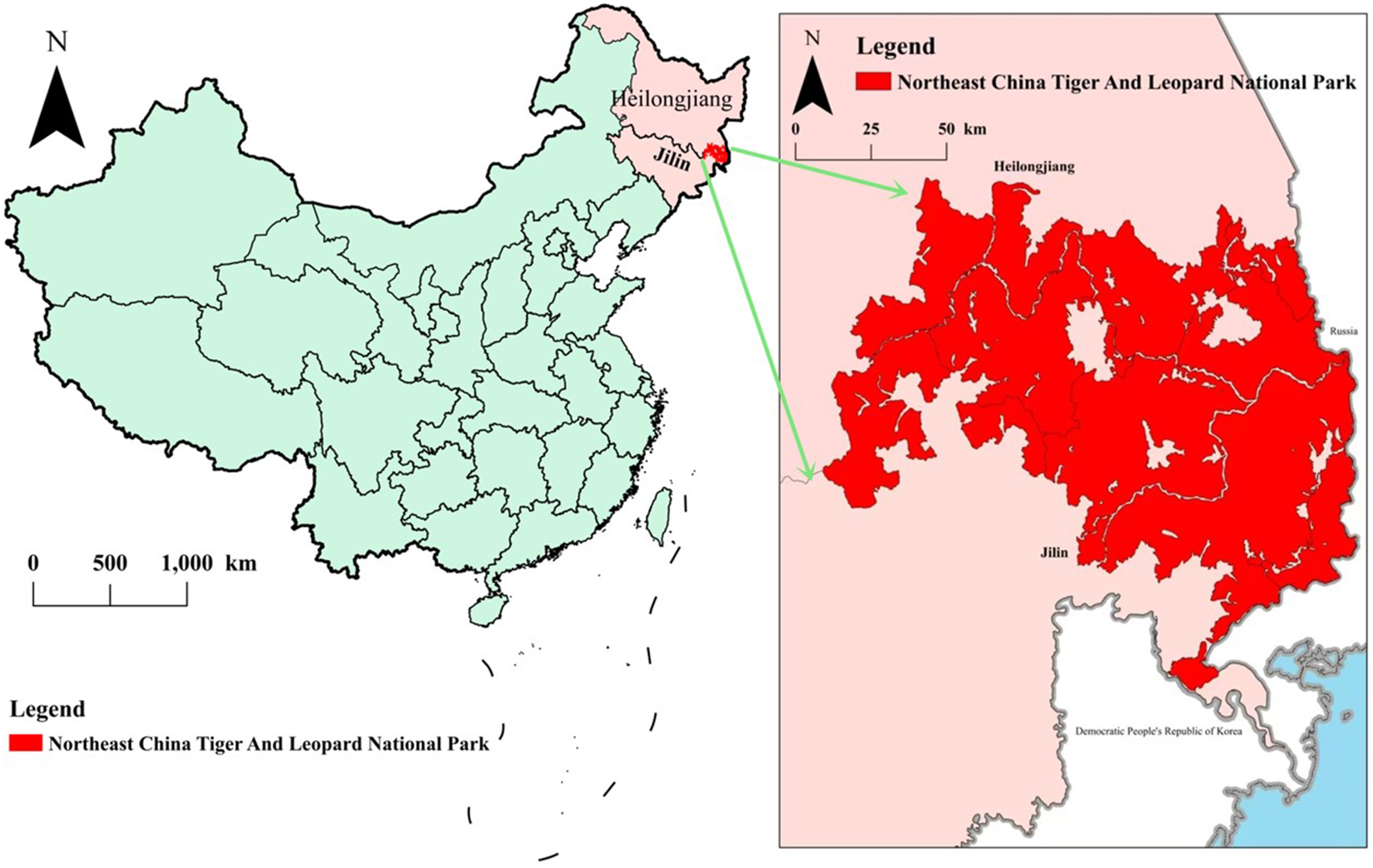
Situated at the tri-border area of China, Russia and North Korea, the park spans 14,100 square kilometres, 68 per cent in Jilin province and 32 per cent in Heilongjiang province. The park’s geographical location is illustrated in Figure 1. Approximately 19,100 residents of mainly Han and Korean ethnicity live within its boundaries. An estimated 70,000 people in and around the park depend on agriculture, forestry and animal husbandry for their livelihoods. Local economic activities include rice, soybean and corn cultivation, livestock grazing and the harvesting of medicinal herbs, pine nuts and wild mushrooms.
Location of the NCTLNP

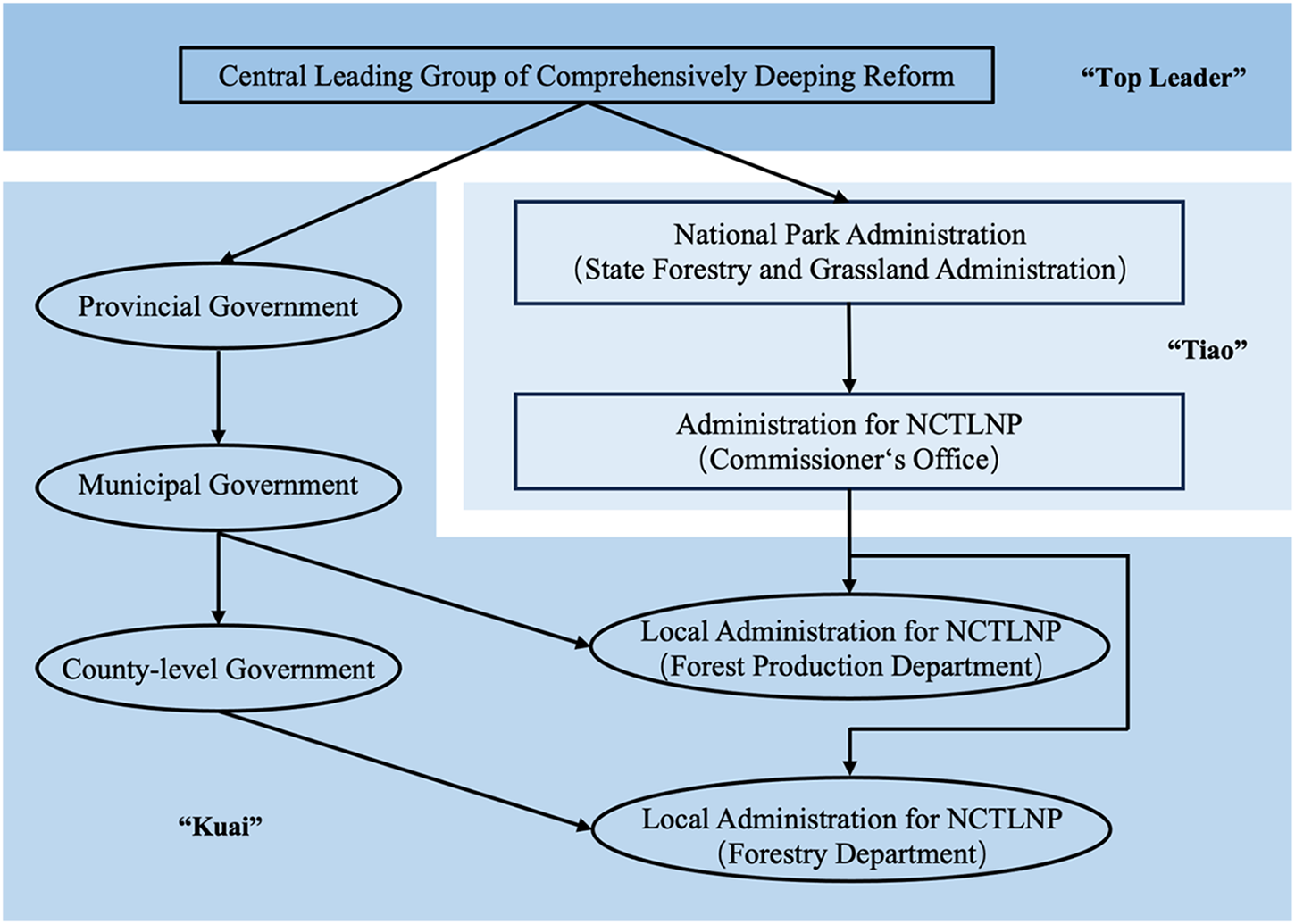
As the only national park managed directly by a central department, the NCTLNP serves as a representative case. Governance operates on three tiers: the national park administration, the NCTLNP administration and the local administration for the NCTLNP. The SFGA leads this structure, with the provincial governments of Jilin and Heilongjiang providing support and coordination. Within this policy process, three key actors emerge, as shown in Figure 2. First are the top leaders, who rely on the CLGCDR as the principal body for conveying their strategic priorities. Second are the central departments or tiao, represented here by the SFGA and the administration for the NCTLNP. Third are the local governments, or kuai, and their affiliated agencies, including the local administration for the NCTLNP.
Identification of Actors and Management Structure within the NCTLNP

Data collection
This study uses a process-tracing approach to examine how interactions between tiao and kuai units influence the evolution of policy styles and create tensions between environmental and social objectives.Footnote 67 It focuses on observable manifestations in three areas: (i) the characteristics of the policy style, including proposal specificity, breadth of objectives and mix of instruments; (ii) the power and interests of the tiao, kuai and top leaders; and (iii) policy outcomes such as ecosystem restoration and community development.
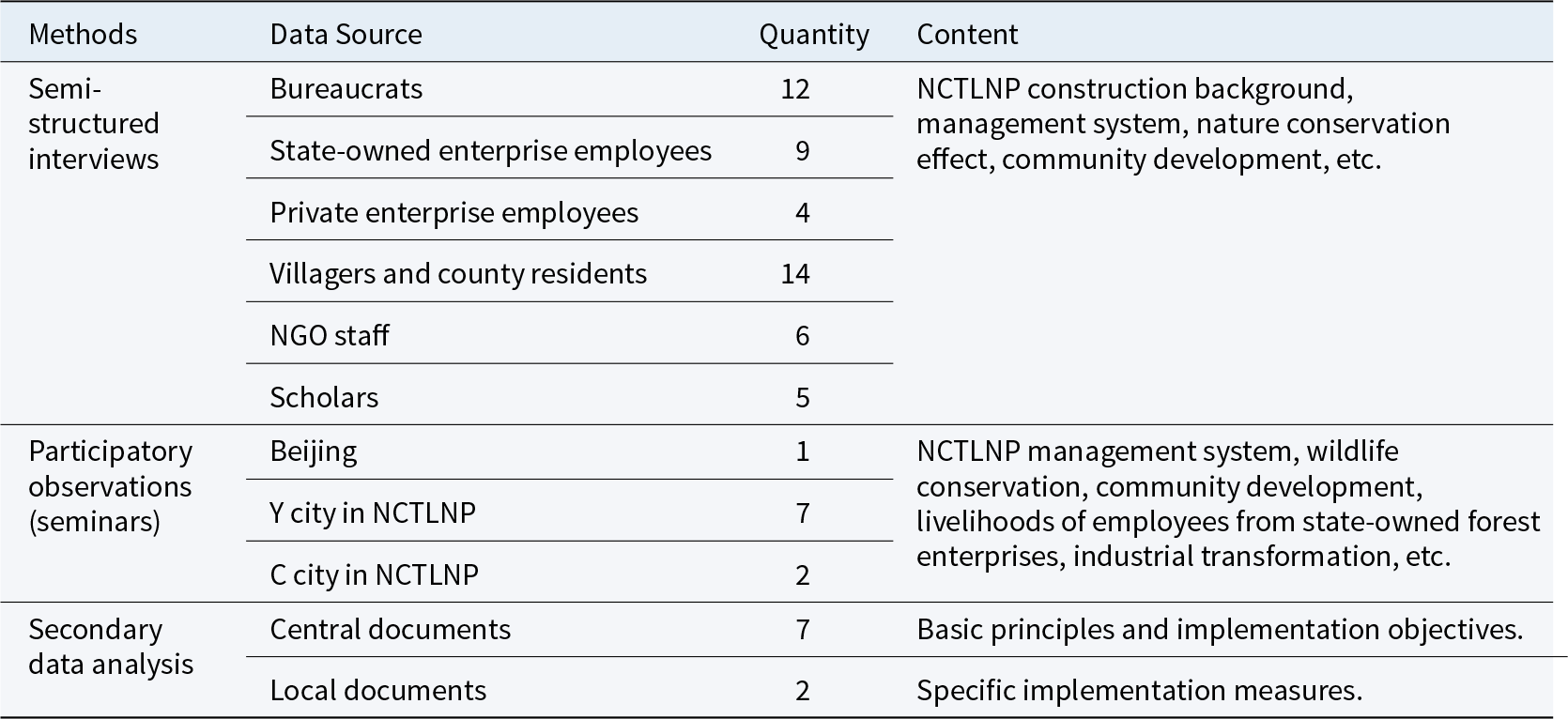
To ensure accuracy and reliability, the study employs methodological triangulation, combining semi-structured interviews, participatory observation and secondary data analysis.Footnote 68 The most important data derive from interviews and observations conducted during fieldwork. As shown in Table 1, between 2017 and 2023, the authors made five visits to Jilin province and conducted 50 interviews with a diverse group of participants, including municipal and forestry officials, state-owned and private enterprise employees, NGO staff, scholars and local residents. Owing to pandemic-related travel restrictions, five interviews were carried out over the telephone. The authors also participated in ten expert seminars. In addition, nine government documents on national park policy were collected and analysed. Finally, all sources were systematically coded and analysed in MAXQDA according to the key elements identified by the process-tracing framework.
Data Collection

Results
The analysis follows the logic of the policy process. It begins with the flow of power and the initial design of the national park policy, then proceeds to examine the tiao–kuai interactions during the implementation of the NCTLNP, before assessing the effects of the tiao-led NCTLNP developments on multiple objectives, as well as the responses of actors to the emerging policy outcomes.
Policy experimentation under the strictest conservation: hybrid policy style in national park policy design
China introduced its national park policy to address long-standing gaps in local implementation of protected-area management. The reform recentralized authority in central departments, notably the SFGA, while retaining room for local experimentation. This dual approach reflects a governance model that seeks to combine rigorous environmental protection with regional development and social stability.
Reflecting the authoritarian dimension of China’s hybrid national park policy, power was recentralized through direct control of the national park agenda and the restructuring of the protected-area network. This concept was first introduced in 2012 by the Yunnan provincial government with the aim of promoting tourism. Top leaders subsequently elevated it to national policy and assumed responsibility for defining core objectives and granting final approval for the establishment of parks. After the 2018 super-ministry reform, all management responsibilities for national parks were consolidated under the SFGA.
The national park policy’s primary aim is to overcome the administrative fragmentation within the protected-area system. Under the previous system, variable management standards allowed local governments to evade regulations, resulting in widespread ecological degradation.Footnote 69 Since reform, the SFGA has authority over all categories of protected areas. Within national parks, other overlapping reserves are integrated into a single system, which is governed by a unified and stringent conservation standard.
However, this recentralization of authority has not led to a purely authoritarian environmentalism; instead, the national park policy retains China’s experimentalist features, which are evident in two key aspects. First, while the national park policy upholds “strictest conservation,” it goes beyond ecological and landscape protection to create an integrative framework that balances multiple objectives. Both the 2017 “General plan for establishing a national park system” (General Plan hereafter) and the 2019 “Guiding opinions on establishing a natural protected area system centred on national parks” (Guiding Opinions hereafter) emphasize balancing environmental protection with community development and public recreation. Although these goals are outlined abstractly in top-level documents, their implementation relies on local interpretation and a degree of local autonomy.
Second, the principle of the national park policy remains an abstract governance concept that requires detailed elaboration from the implementing agencies. To guide this process, top leaders emphasize the importance of effective coordination between tiao and kuai units in developing concrete implementation strategies. This principle was reflected in the General Plan and was later enshrined in the 2024 National Park Law (Draft). In practice, China tested various pilot management models to rationally delineate the responsibilities between tiao and kuai units. The Guiding Opinions outlined three different pilot management cases: central department management, central–local co-management, and local government management. In 2025, most approved national parks fall under the first two categories.
Authoritarian environmentalism in the NCTLNP policy implementation under expanded tiao power
In implementing the NCTLNP policy, the SFGA steadily expanded its authority while sidelining local governments, which is a hallmark of authoritarian environmentalism. Although top leaders initially instructed the SFGA to oversee the park in consultation with local authorities, the agency adopted a command-and-control model that excluded local involvement. This expansion stemmed from the prioritization of environmental protection and a lack of confidence in local governments’ commitment to conservation. As one NCTLNP official observed in 2018, “I do not trust local governments; they always prioritize development and lack a higher-level perspective.”Footnote 70
Objectively, the expansion of the SFGA’s power served its bureaucratic interests, including the pursuit of its own policy priorities, the enlargement of its organizational scale and the extension of its domain. This growth in power and the suppression of local actors are evident in three respects. First, the SFGA transformed its provincial-level commissioner’s offices into dedicated administrative offices for the NCTLNP. Previously, these subordinate branches were nominally responsible for local forestry affairs and wildlife international trade. However, owing to insufficient staff and limited information channels, their capacity for oversight was weak, and they primarily conducted after-the-fact inspections in response to SGFA task assignments or public complaints.Footnote 71 In 2017, the Jilin and Heilongjiang commissioner’s offices were formally upgraded, accompanied by the reassignment of officials and the enhancement of their authoritative resources.Footnote 72 This institutional elevation enabled the SFGA to exercise direct control over the park’s natural resources. Although provincial Party committees were consulted on leadership appointments, final decision-making power rested with the SFGA’s own Party committee.Footnote 73
Second, the SFGA assumed direct management of forest production departments under state-owned forestry enterprises as well as county-level forestry departments, designating both as local administrative offices for the NCTLNP. Nevertheless, these institutions fall under different kuai tiers. For example, the Changbaishan Forest Production Enterprise, placed under the jurisdiction of Y City in 1984, established ten forest production departments to manage 2.114 million hectares of key forestland with a workforce of over 100,000. In contrast, county-level forestry departments are financed by and staffed through their respective county governments. When the NCTLNP was established, seven forest production departments and three county-level forestry departments were formally converted into local administrations.Footnote 74 This restructuring allowed the SFGA to bypass municipal and county authorities and to exercise more direct control over the park.
Third, the SFGA established an independent information channel by partnering with research institutions, reducing reliance on locally provided data. In the previous governance pattern, decisions made by upper-level governments hinged on information provided by subordinate governments, which could weaken central control due to limited local data collection capacity or intentional data manipulation.Footnote 75 In the NCTLNP, Beijing Normal University, sponsored by the SFGA, deploys an infrared camera network for real-time wildlife monitoring and produces annual reports on species reproduction, population dynamics and human–wildlife conflicts.Footnote 76 While this arrangement improves data integrity, it narrows the SFGA’s focus to ecological outcomes and may marginalize local community development.
Irreconcilable conservation and development objectives under authoritarian environmentalism
During the establishment of the NCTLNP, the SFGA steadily expanded its authority while focusing narrowly on the conservation of flagship species. This singular focus severely undermined key elements essential for effective policy experimentation, including inclusivity towards diverse goals, coordination across departments and adaptability in policy implementation. Regarding objective allocation, top leaders entrusted the SFGA with overall responsibility, yet the agency assumed sole control of functions such as resource monitoring, ecological restoration and environmental education. Meanwhile, it offloaded complex and politically sensitive responsibilities, such as community resettlement, onto local governments.
Regarding implementation style, the SFGA frequently bypassed several tiers of governance and instead worked directly with the national and local administrations for the NCTLNP, effectively sidelining the forestry, agriculture and civil affairs agencies. Furthermore, the SFGA relied on coercive and costly measures, including compulsory relocations and bans on resource use. This approach forced local governments to absorb the financial and social burdens and prevented the development of more flexible, locally tailored solutions. As a result, issues related to community livelihoods and compensation remained largely unresolved, leading to a policy stalemate.
The outcomes of this approach reveal its shortcomings. Despite claims of balancing conservation with development, the SFGA neglected the local community’s livelihoods, leading to widespread dissatisfaction and the erosion of trust. For example, rural communities within the NCTLNP have traditionally relied on cattle breeding as a primary source of income. However, following the launch of the NCTLNP pilot programme in 2017, the SFGA imposed a ban on forest grazing, citing concerns about grassland degradation, competition with wild ungulates and the potential impact on Amur tiger habitats.Footnote 77 This policy compelled villagers to shift from free-range to captive breeding, increasing costs from approximately 1,000 yuan to 3,000–4,000 yuan per head of cattle per year and significantly reducing their profit margins.Footnote 78 As a result, cattle populations within the NCTLNP declined dramatically: the herd in Village X of County H dropped from 3,000 in 2017 to fewer than 1,000 in 2023, while County W experienced a reduction of 15,000 head of cattle between 2020 and 2021.Footnote 79 Moreover, in an effort to restore under-forest grassland ecosystems, the NCTLNP administration demanded the removal of infrastructure deemed to be unrelated to conservation, as well as the dismantling of fencing around farmland and pastures.Footnote 80 These measures severely impacted the cattle industry and sparked widespread discontent among local villagers.Footnote 81
Similarly, the harvesting of non-timber forest products, also an important source of local income, has suffered substantial setbacks. In spring, villagers forage for bracken; May and June are peak months for gathering ferns and hazel mushrooms, followed by soy mushrooms in September. Employees of state-owned forestry enterprises also engage in pine nut cultivation and harvesting.Footnote 82 However, to protect Amur tiger and leopard habitats and reduce human–wildlife conflicts, the SFGA prohibited all harvesting activity in forests beginning in 2017. Enforcement proved difficult, as villagers continued to forage clandestinely, undermining the ban’s effectiveness.Footnote 83 In response, the SFGA partially relaxed the policy, allowing villagers to enter forests in registered groups of at least five during daytime hours, coordinated through the local NCTLNP administrative offices and village committees. Nevertheless, given the vast terrain, complex topography and limited staffing, supervision has been inadequate. Additionally, the requirement to harvest in groups has reduced efficiency, further fuelling local resistance to the government’s management of this foraging industry.Footnote 84
The SFGA’s conservation policies have also had a detrimental effect on the townships within the NCTLNP. Prior to the NCTLNP’s establishment, Town C boasted a thriving agricultural and service economy, which attracted an influx of migrant labour and supported a population nearing 12,000.Footnote 85 However, policies aimed at minimizing human activity restricted new residency,Footnote 86 terminated commercial contracts for pine nuts and forest frogs,Footnote 87 and consistently blocked public infrastructure projects such as road construction and housing development.Footnote 88 Cumulatively, these measures, which were compounded by the COVID-19 pandemic, triggered a sharp economic downturn and significant decline in the population. By 2023, the once-bustling Town C had become a ghost town: local businesses had shuttered and the streets were deserted, as the residents left in search of work. As one local resident observed, “Now there are over 500 vacant rooms on the streets. Many people have left to find jobs, and those who used to work here are gone. These rooms are neither inhabited nor rentable.”Footnote 89
Attempts at tiao–kuai coordination: central intervention and local informal networks
In the NCTLNP construction process, which was largely dominated by tiao mechanisms, the conflict between conservation and development remained unresolved, prompting direct intervention by top leaders. Although the SFGA sought to incorporate the participation of kuai units during the subsequent policy rectification phase to mitigate multi-objective tensions, the tiao bureaucracy continued to retain decisive authority. As a result, coordination between the tiao and kuai units lacked institutional safeguards. Meanwhile, relying on local governance networks for multi-objective integration and governance innovation appeared unpromising. Although county-level nature protection departments sought to address human–wildlife conflicts through mutual learning, their responses were largely reactive and fell short of proposing comprehensive structural reform solutions.
The SFGA-led direct management model not only failed to resolve core contradictions but also intensified dissatisfaction among local governments and residents, thereby attracting high-level political attention. In 2020, Xi Jinping reviewed NCTLNP-related documents on two occasions, and Wang Huning 王沪宁, a member of the Politburo Standing Committee, issued four directives that criticized the SFGA for its ineffective management, local governments for lacking political awareness, and the National Development and Reform Commission for poor coordination.Footnote 90 In response, the SFGA established a consultation mechanism with provincial governments and issued the “Opinions on the rectification and implementation of problems in the NCTLNP,” which identified 14 major concerns, including the park’s infrastructure, community livelihood transitions and the development of wildlife corridors. The SFGA also mobilized municipal forestry departments to form a 25-member rectification task force comprising personnel from natural resources, environmental protection and development departments. This group carried out a five-month rectification process, during which representatives from the SFGA, the NCTLNP administrative office and provincial forestry departments carried out joint field visits to address issues such as law enforcement and rural development.Footnote 91
However, the rectification initiative failed to transform the existing tiao–kuai power dynamics, and the SFGA continued to dominate the reform process by controlling meeting agendas and retaining final decision-making authority. Although municipal forestry departments were nominally assigned leadership roles, their responsibilities were largely limited to administrative tasks, such as logistical coordination and preparing materials for the drafting of documents and meetings.Footnote 92 After the rectification phase concluded, the municipal government established a temporary office, but its policymaking authority remained constrained by the SFGA. Consequently, municipal forestry departments were unable to transition from implementers to genuine architects of the reform plan. Instead, they continued to operate under the SFGA’s direction, which significantly limited the prospects for meaningful institutional transformation.
In parallel with top-down interventions, local governments and the local NCTLNP administrative offices began to develop informal governance mechanisms in response to recurring human–wildlife conflicts. In H County, for example, the local NCTLNP office pioneered an early warning system that uses infrared cameras to monitor the movements of large wildlife such as Amur tigers. When animals enter a five-kilometre radius of villages or towns, the system automatically issues alerts.Footnote 93 These alerts are transmitted across various levels of government and disseminated to village committees via WeChat groups, enabling a timely evacuation and emergency response.Footnote 94 This system has significantly enhanced local responsiveness and has been rapidly diffused through regional governance networks, leading to further innovations such as the installation of wildlife warning sirens.Footnote 95 While these risk-oriented initiatives reflect the local capacity for adaptive management, they remain fragmented and have not yet developed into an integrated strategy capable of balancing conservation and development objectives.
Discussion
Impact of tiao on policy style from a bureaucratic politics perspective
This study moves beyond the traditional central–local analytical lens to reinterpret the role of the tiao bureaucracy in China’s environmental governance, highlighting its significant influence on policy style. The tiao bureaucracy functions not merely as a central functional department but as an autonomous actor with distinct organizational interests and resources.Footnote 96 Driven by these interests, central departments often dominate the process of policy interpretation, resulting in governance outcomes that lean towards authoritarian environmentalism. Thus, policy processes in China must be analysed on two interrelated levels: first, the differences in policy orientation between top leaders and central departments; and second, the interaction and struggle between tiao and kuai units in policy implementation.
This study underscores the pivotal role of the tiao bureaucracy at the intersection of these two levels. From a bureaucratic politics perspective, tiao units contribute technical expertise to policy design and oversight, while simultaneously using their leverage to pursue informal organizational interests.Footnote 97 These interests include expanding their administrative turf in interdepartmental competition, securing additional fiscal and human resources, and promoting policy instruments that reflect departmental norms and thereby facilitate enforcement.Footnote 98 Consequently, environmental governance in China, when steered by tiao units, often exhibits features characteristic of authoritarianism – namely, goal singularity, reliance on coercive instruments and rigid implementation frameworks.Footnote 99
Using the case of China’s national park policy, this study identifies three primary mechanisms through which the tiao bureaucracy expands its authority, often simultaneously. First, it exploits policy windows to extend its reach. The rollout of the national park initiative offered the SFGA a key opportunity to consolidate its power vertically between central and local levels and horizontally across sectoral departments.Footnote 100 Similar patterns can be observed in the context of climate change policy.Footnote 101 Second, it reinforces its authority through institutional legacies. In the case of the NCTLNP, the SFGA upgraded the former commissioner’s office into the NCTLNP administrative office, thereby institutionalizing its control over policy implementation. Third, it cultivates external expert networks to enhance its access to information and technical capacity. Through partnerships with universities and research institutes, the SFGA has established stable channels for obtaining professional expertise. These relationships go beyond the typical client-service model, as both parties are ideologically aligned on environmental protection goals, forming a basis for mutual trust and sustained collaboration.
Hybrid policy style balancing multiple objectives and its tiao–kuai structure
While this study highlights the adverse effects of authoritarian environmentalism on environmental justice and policy effectiveness, it does not call for the wholesale abandonment of centralized control nor does it endorse unfettered local decentralization. Evidence shows that without corrective mechanisms, local governments frequently prioritize short-term economic gains over ecological integrity.Footnote 102 Conversely, the oversight provided by tiao units imposes necessary constraints on environmentally harmful practices.Footnote 103 We therefore argue that effective central supervision is a prerequisite for a hybrid policy style that combines authority with flexibility to foster ecologically sustainable experimentation.
Under this framework, authoritarian oversight ensures that environmental concerns remain at the forefront of local policy agendas while kuai units, with their capacity for adaptation and mobilization, implement pilot programmes that integrate ecological protection with social development and refine these initiatives through localized practice.Footnote 104 Realizing this hybrid model demands more than simple institutional design: it calls for a nuanced understanding of the power relations between top leaders and the tiao–kuai structure. Particularly when central attention and coordination capacity are limited, the balance of tiao–kuai power becomes critical to policy success. Lessons from China’s national parks suggest that measures such as the cross-departmental appointments of senior officials and interdepartmental joint meetings can establish checks and balances, cultivate shared visions and integrate multiple policy objectives. Another promising strategy is promotion-incentivized collaborative innovation, whereby tiao and kuai units co-develop demonstration projects that attract upper-level political backing and unlock additional promotion opportunities.Footnote 105
Nonetheless, tiao–kuai collaborative experimental pilots face persistent challenges. Authority remains unevenly distributed across different bureaucratic systems (xitong 系统). Particularly, those systems governing natural resources and environmental protection have become more centralized through vertical chains of command. This development raises the cost of cross-departmental coordination and may constrain horizontal collaboration at the local level.Footnote 106 In this context, creating vertical coordination mechanisms, such as strategic alliances between local and higher-level authorities, may prove essential to overcoming governance deadlocks and sustaining policy innovation.Footnote 107 Several national park pilots in Zhejiang and Fujian have already shown how provincial governments can serve as effective coordination platforms.Footnote 108
Conclusion
In response to research on authoritarian environmentalism, this study argues that China’s environmental policy exhibits a hybrid policy style that combines authoritarianism with experimentation. However, driven by tiao bureaucratic interests, this hybrid style may tilt towards authoritarian practices during implementation. Accordingly, the study has focused on how tiao units, motivated by organizational interests, have shaped China’s national park policy, especially through power struggles with top leaders and kuai units within the NCTLNP. The findings show that while top leaders reinforce central power, they also try to promote tiao–kuai collaboration to foster policy innovation that balances conservation and development. However, in the NCTLNP, the SFGA exercised direct control through its subordinate branches, excluding local governments and social actors from meaningful participation. This approach suppressed community development demands and reinforced an environmental protection-centred agenda. Although top leaders intervened in a rectification phase, their efforts did not alter the underlying tiao–kuai power structure and therefore had limited effect.
This study uses the concept of hybrid policy style to reveal the core tensions in China’s contemporary environmental governance. First, it shows that the central authority, even as it strengthens monitoring and control, actively encourages local governments to pursue policy innovation. Second, it demonstrates that although there is a determined effort to maximize environmental protection, the central authority must also balance a range of other objectives. Crucially, viewing the power struggle between central and local governments alone does not capture the full complexity and dynamics of the hybrid model. We must also recognize the ongoing expansion of a verticalized bureaucratic apparatus. As the power of specialized technocratic bodies devoted to environmental mandates expands, their strengthened professional capacity unquestionably enhances regulatory enforcement, yet it may also narrow the scope for multiple-objective trade-offs at the central level, as well as limit the autonomy of local experimental initiatives in practice.
As a single-case study, this study has certain limitations. Its main value lies in offering a new analytical lens for future research. It offers two new directions for future research: first, a top-down inquiry into how the expansion of the power of the tiao bureaucracy under Xi Jinping has reshaped local governance, and whether top leaders might reassert decentralization to check its power; second, a bottom-up investigation into the tiao–kuai power dynamics and the potential emergence of new vertical coordination models in environmental governance.
Funding
This research was supported by the National Social Science Foundation of China (NSSFC), grant No. 24CGL085.
Competing interests
None.
Pei ZHANG is a doctoral candidate in East Asian studies at the Institute for Asian and African Studies, Humboldt University of Berlin, Germany.
Jiacheng ZHAO is an assistant professor of public policy in the School of Public Administration, Central South University, Changsha, China.