Most planters are thoroughly alive to the fact that what is in the end best for the health of the coolie is leave rather than medicine. . .
(Report of the Assam Labour Enquiry Committee, 6 August 1906)Footnote 1
Introduction
On 29 December 1882, the steamer Scinde set sail with more than 500 souls for the tea plantations of Assam in eastern British India. Despite a violent storm on the river Brahmaputra upstream, she dropped anchor at Dibrugarh the following month with her consignment of indentured labour, among others. More than 40 immigrants lay dead, claimed by cholera alone.Footnote 2 In the next decade, more than 92,275 tea workers perished, with cholera, kala-azar (or black-fever), malaria, anaemia, dysentery, dropsy, diarrhoea, respiratory disease, and ‘other causes’ leading the list.Footnote 3 As the pattern continued well into the twentieth century and beyond, death and Assam became almost indistinguishable.
Numbers notwithstanding, this article argues that ideas of health and disease in the Assam estates transcended logics of bodily disorder, pathogens, or preventive medicine. It suggests that historical epistemologies and perceptions of mortality and morbidity—indeed, of the body—in nineteenth-century eastern India were seldom ‘scientific’ or medically objective. They could not have been. Producing one of empire's most coveted objects of desire, these plantations were highly prized economic assets. Fuelled by intra-imperial rivalry with China during the first Opium War, the ‘discovery’ of tea (Camellia sinensis var. Assamica) in Assam around the 1830s, and its eventual success in the metropolitan market, led to a veritable scramble of British speculators to the province. If the rest is history,Footnote 4 the geographical distance of this frontier territory, communication bottlenecks, and the abundance of agrarian land for local cultivators meant that labourers for this enterprise had to be brought in from other parts of India. Competition for working hands from colonial markets, and contiguous plantations, mines, and factories made the situation even more challenging for planters. Government-monitored labour recruitment and a slew of special legislations throughout this period attempted to balance this call of industry, laissez-faire, and trade. At least in theory, law permeated every aspect of these plantations and labour life—wages, hours of work, contract terms, and health. Within this context, this article shows that disease etiology and epidemiology, and norms of well-being were conditioned by three concurrent expedients: medical opinion, tea profits, and regulatory ‘standards’. It demonstrates that vector identification, prophylaxis, and policy recommendations were happy to—in fact, had to—play second fiddle to commerce and costs. Often, law dictated the parameters of fitness and diseased. In other words, I argue that social histories of medicine and health in the Assam plantations have to simultaneously deal with three bodies: the pathological, the productive, and the legal.
Despite the robust historiography of labour in the Assam tea enterprise, few, if any, have expressly looked at these intertwined factors of law, economy, and efficiency in perceptions of disease and health. Those who do, examine quantitative analyses of risk scenarios and death-rates among ‘new recruits’,Footnote 5 or the institutional history of therapeutics,Footnote 6 or look at mortality as the corollaries of the indenture recruitment system.Footnote 7 To be sure, none of these aspects is mutually exclusive or unimportant to my argument. I contend, however, that these explanations do not account for how health, disease, law, and profiteering were mutually implicated and, in turn, impacted on meanings of sickness and well-being in these estates.
Overall, public health and medical discourse in colonial India is now a well-defined and burgeoning field. Mark Harrison's early work looks at the imperial determinants of sanitary policy, competing medical opinions between metropole and colony, nationalist response to Western therapeutics and rhetoric of reform, and the relationship between disease theory and praxis.Footnote 8 In his pioneering work in the field of Western medicine's biosocial colonization of the ‘Indian’ body, David Arnold argues that scientific approaches to epidemic disease control—especially smallpox, cholera, and plague—were superimposed onto ideas of corporeality and the ‘political concerns, economic intents, and its cultural preoccupations’ of empire.Footnote 9 He thus suggests that caste practices, gender roles, and religious norms were imbricated in the discursive, ideological, and institutional role of medical therapeutics and control. Arnold contends that the indigenous response to this colonizing process was contingent and layered, and exceeded simplistic logics of resistance and co-option. Still others have looked at the ‘risk perceptions’ and scenarios of imperial infectious disease policy,Footnote 10 the emergence of ‘tropical medicine’ as an ideological and empirical system of etiology and epidemiology,Footnote 11 and the systematics of colonial public health implementation through institutions, individuals, mechanisms, ideas, and ‘native traditions’.Footnote 12 In a recent work, Nandini Bhattacharya shows that the tea plantations of northern Bengal and the hill-stations of Darjeeling and Duars provided unique eco-pathogenic sites for malarial research and idioms of (especially Western) corporeal well-being respectively.Footnote 13 However, she suggests that imperatives of capitalist profits and politics forestalled widespread implementation of disease prevention and health-care policies in these estates. In other words, Bhattacharya argues that locality—as discourse, concept, and ‘field’—conditioned and constrained tropical medical research and practices of public health in colonial India.
To be sure, this is not an exhaustive reading of the field, nor does it do justice to the range and depth of its analytics. However, even a summary glance shows that social histories of health and medicine in South Asia have closely followed the career of the colonial state, in areas and aspects where its hold was firmly, and unquestionably, in place. As this article demonstrates, this begins to change when we travel to the ‘peripheries’ of empire, where the zone between formal control and laissez-faire is loosely defined. Here, competitors to colonial power and authority, and exigencies of commerce, begin to modulate notions and priorities of medical opinion, health, and morbidity. ‘Who speaks for the body of the people?’Footnote 14 can no longer be answered simply in terms of indigenous response or hegemonic metropolitan discourse, since the subjects of medical intervention and disease prevention were not just regimented (as in the Army and jails) but also legislated. Here, the ‘enclavist argument’Footnote 15 of medical responsibility and successful disease control in cantonments and prisons is undercut by proprietorial battles of ‘coolie ownership’ between planters and the colonial state. Even Bhattacharya's ‘logic of locality’ remains inadequate because of structural dissimilarities between the plantation economies of Assam and north Bengal.
The second section of this article utilizes ‘political economy of health’ as a theoretical window to argue why well-being and disease exceeded—indeed, had to exceed—somatic and scientific logics of disorder in this story. In the process, it proposes that the labouring body in these estates were ‘read’ at three simultaneous registers: the economic, pathological, and legal. The next two sections expand on this idea by focusing on disease and law respectively. The third section looks at etiological debates on cholera, kala-azar, and malaria—the three main killers in the Assam gardens—through the eyes of sanitarians, medical investigators, and estate doctors. It shows that scientific and policy recommendations for prevention and cure were conditioned by—and very often ran counter to—the politics of profit in the tea industry. The fourth section takes an in-depth look at the legal subtexts of well-being, sickness, and morbidity in the Assam plantations. It suggests that law both furthered commercial interests and set regulatory parameters of labour health and ‘unhealth’. This section analyses this paradox as a peculiar feature of Assam's plantation history. The final section concludes.
Political economy of health in Assam: three ‘bodies’ of evidence
Health is too important to be entrusted only to doctors. . .Footnote 16
The social history of health in the Assam plantations cannot be understood within the hermeneutics of somatic disorder. Nor was it an exclusively public health issue, for neither ‘public’ nor ‘health’ were clearly defined. Here, normality and well-being depended on maintaining an operational equilibrium between medical prophylaxis, profits, and legal regulation. In other words, I argue that the peculiar structures of the tea industry, and its dominant relations of production, have to be taken into account in understanding histories of health and impairment in Assam.
As a theoretical paradigm, the political economy of health has been used in medical socio-anthropology since at least the 1970s.Footnote 17 At its most general level, this approach studied disease distribution, illness, and health-care as effected by the economic, especially capitalist, organization of society. The etiology of sickness and mortality was therefore examined as a multifactorial, multicausal socio-economic phenomenon rather than a bio-medical aberration. Of course, there were methodological variants to this way of thinking: the ‘orthodox Marxists’ looked at the ‘predictable logics’ of capitalist exploitation of wage-labour and its attendant impact on health and sickness;Footnote 18 the ‘cultural critics’ saw medical practices as replicating patterns of social inequality and exclusion; and ‘dependency theorists’ linked imperialism, colonialism, and capitalist expansion to (‘developing world’) under-development, poverty, and disease.Footnote 19 To be sure, Foucault's history of biosocial regulation and state control can also be included here, though his study is not explicitly about disease or health per se.Footnote 20 It is not my intention here to enter into the full theoretical range of these positions, nor do I uncritically subscribe to any one version as being more valid than the other. Instead, I argue that this theoretical perspective allows us a deeper understanding of three critical components of our story, namely the body, disease, and health.Footnote 21 In the process, it clarifies the logic of law in this plantation form and its connection to these three factors in Assam.
One of the most helpful aspects of this method was its nuanced deconstruction of the organismal integrity of the human body and models of health. It rejected the classical approach of health scientists that looked at the body as an automaton, a bio-machine of sorts. For them, sickness was a biologically induced malfunction of this well-tuned mechanism. The ‘social epidemiological school’, though cognizant of the societal basis of disease, was also critiqued for its implicit acceptance of illness as an index of ‘lifestyle’.Footnote 22 Early proponents of the political economy approach, especially Sander Kelman and Talcott Parsons, argued that neither ‘school’ tackled the substantive meaning of health—as condition and concept—that arose from a complex dialectic between somatic and social causes. For them, material relations in society were an important starting point as it engendered these meanings, and an individual's relationship to it, in the first place. Thus:
The definition of health cannot be normatively chosen on a priori grounds, but rather must be derived (in practice is derived) from the social and institutional dynamics of the society in question. In particular where expansive commodity production is combined with the control over production by a small, but powerful, social class, there is a tendency for health to become institutionally defined in functional, rather than experiential, terms.Footnote 23
These exegetical distinctions of health need further elaboration. Under capitalism, functional health refers to an externally imposed parameter of well-being, ‘a state of optimum capacity of an individual for the effective performance of the roles and tasks for which s/he has been socialized’.Footnote 24 Thus, instrumentally, it refers to providing for, and maintaining, a state of bodily condition that does not interfere with, or diminish, the accumulation of capital. On the other hand, experiential health is more phenomenologically defined as the intrinsic, self-perceptual understanding of wholesomeness, freedom from illness, ‘the capacity for human development’, and the ‘transcendence of alienating social circumstances’.Footnote 25 In other words, this is a state of wellness that is experienced rather than standardized. To be sure, these distinctions are theoretical rather than medical and are not mutually exclusive. Kelman clarifies: ‘in sum, experiential and functional health represent two qualitatively different notions or norms of organismic integrity which are either promoted or stunted in different forms of society’.Footnote 26 From the perspective of philosophical anthropology, these norms also relate to different corporeal states—functional well-being is about ‘having a body’, while experiential health draws from ‘being a body’.Footnote 27
Theoretical debates aside, these discussions of health and the body have important historical relevance to our story. As a means of production, the health of the Assam plantation labourer was a functional concern; performance of their roles was defined by the operation of these estates and the logic of capital.Footnote 28 As we shall see, malarial investigations, inoculation drives, etiological studies, prophylaxis, and prevention continually negotiated well-being with an eye to costs and profits. But beyond this, the Assam plantations had important structural peculiarities. As indentured workers, they (the Act-Labour in this case) were also the subjects of law.Footnote 29 The regulation of sanitary welfare, indeed health, was an inextricable and important part of labour legislations. I argue that in this respect at least, functional health in Assam was not just about maintaining productive efficiency, it was also dictated by juridical stipulations, lapses notwithstanding. With Act-Labour particularly, sanitarians, medical men, and planters were therefore simultaneously dealing with legal and economic ‘bodies’ in terms of scientific experimentation, therapeutics, work schedule, physical capacity, and standards of wellness. It is in this context that a statistical deviation of seven per cent made the difference between ‘healthy’ and ‘diseased’; where, theoretically, law could both cause and arrest mortality in the gardens; where the labour Protector could be expected to fulfil both legal and medical roles; and where the paradox of fitness and productivity operated. Reading into these correlations between commerce and regulation coloured attitudes to health and mortality in this history—in them we locate our first two bodies of evidence.
There was a third dimension of health and disease in the Assam plantations. This related to the natural, organic body of the labourer stripped of its legal and economic functions. They not only generated capital in the tea estates, and signed agreements, but also lived sickness and well-being. For the purposes of disease and health, I argue that this body was referred to in humoral, ecological terms. Here, morbidity was an attribute of the naturally insanitary, indolent, non-immune ‘coolie’ or the ‘weakly Behari’.Footnote 30 The ‘bad-batch’ theory of disease endemicity and epidemics, invoked by doctors, sanitary commissioners, and planters throughout this period used this third corporal register. Under this rubric, the body fell ill due to germs, habit, lifestyle, class and racial characteristics, location, or processes of imperfect modernization depending on points-of-view. Shorn off the logic of capital, and law, our third body of evidence was read in its visceral, natural, biological state. Not infrequently, these three understandings of the body and health clashed with each other, as we shall see.
Routes of infection and roots of disorder: cholera, kala-azar, and malaria
In November 1899, a severe cholera outbreak killed hundreds of labourers working in the Lumding section of the Assam Bengal Railways (hereafter ABR). Shortly thereafter, a war of words broke out between the agent of the Company and the chief commissioner of Assam, Mr H. J. S. Cotton. Charges and counter-charges centred around two issues: the party responsible for the infection and its dispersion, and financial liability for welfare arrangements undertaken.
In the immediate aftermath of the chief commissioner's opprobrious message to ABR for failing to effectively combat cholera, both the consulting engineer to the Government of India (hereafter GOI) for Railways, Assam, and the ABR agent and chief engineer were quick to focus on the question of infection. Here, they were keen to dispel notions that cholera was contracted on railway territorial boundaries. Arguing that labourers for the ABR were recruited from ‘districts free of cholera’,Footnote 31 the consulting engineer squarely blamed the disease on the fact that they had passed through previously infected areas in Assam. Echoing his colleague, the agent and chief engineer argued that cholera could not have originated and spread in areas under ABR jurisdiction, or through steamers used by its labourers, being duly under the charge of ‘fully qualified [European] Medical Officer, Assistant Surgeons, and Hospital Assistants’ in every division. He hastened to add: ‘there was no epidemic cholera at Lumding, but that it was all brought from Gauhati’.Footnote 32
Epidemiologically, the question of the routes and roots of cholera infection among ABR workers was connected to accepting financial responsibility for segregation camps, rest houses, and hospitals established for their cure. In fact, the chief commissioner of Assam passed orders to this effect on 6 November 1899. Unsurprisingly therefore, the debate here on ‘proving’ the origins of cholera and the general unhealthiness of ABR workers centred not on ‘bad batches’ nor on contagionist theories of bodily disorder. While waiting for unclaimed bills to be paid off, ABR's executive engineer wrote angrily to Assam's chief commissioner wondering why they should be made to pay for sanitary and medical arrangements used not by ‘railway coolies’ but presumably by their counterparts in the tea estates.Footnote 33
As it is, the etiological career of cholera in India was a long and vexed one. Designated variously as an ‘Asiatic disease’, a disease of filthy Hindu pilgrims, and one rooted in poverty, colonial medical readings of cholera vacillated between the contagionist, atmospheric, and racial theories of bodily disorder.Footnote 34 Dr James L. Bryden (1833–80), the first statistical officer of the then-newly established Sanitary Department of GOI, was strongly in favour of the airborne theory of cholera dispersion, occurrence, and etiology. Finding acceptance among powerful figures in the Indian Medical Service (hereafter IMS), especially J. M. Cuningham (1829–1905), India's longest-serving sanitary commissioner, the anti-contagionist lobby were long able to stem the tide against those who called more direct intervention in matters of public health. Chief among them was Annesley Charles C. DeRenzy (1828–1914), once sanitary commissioner of Punjab and a consistent and vociferous partisan of the water-borne theory of cholera. While the debate between DeRenzy and the GOI is well known,Footnote 35 it is important for our story to note that he was removed from a civil to a military position in ‘remote Assam’ for daring to challenge the ‘official’ line on the disease.Footnote 36 He was to subsequently take on the role of Assam's sanitary commissioner in 1877, a post he held until1880. I will return to this shortly.
Historians have remarked that the difference in medical opinion on cholera in late nineteenth century India was a battle of egos, a territorial fight to secure the originary, yet distinctive, character of the disease versus its European iterations. While the minutiae of this discussion need not detain us here, it is significant to note that, given the post-Mutiny anxiety of the government regarding meddling in ‘native’ affairs, the interventionist attitude to cholera prevention, prophylaxis, and cure took something of a backseat until the early twentieth century. David Arnold thus argues: ‘the tenacity with which so many medical researchers and senior medical advisers like Cuningham clung to their anticontagionism can be seen as an indication of how far out of touch they were with advances in medical science in Europe. But they were certainly encouraged by the “ostrich-like” mentality of the Government of India, which preferred for political and commercial reasons to pursue a noninterventionist, laissez-faire policy towards cholera.’Footnote 37 Of course, as Arnold and Harrison both show, this mindset slowly changed after Robert Koch's ‘discovery’ of the comma bacillus organism in water in Calcutta in 1884, though the effective ‘enthronement’ of the bacteriological origins of cholera in India was to take place only in the first decades of the twentieth century.Footnote 38 To be sure, Waldemar M. Haffkine, the Jewish-Russian bacteriologist who pioneered anti-cholera inoculation in India during his experiments in 1893–96, was much mistrusted by the anti-contagionist camp and was even suspected by some newspapers of being a spy.Footnote 39 Despite continuing differences of opinion regarding the source of cholera infection, Haffkine's vaccination experiments took him Sialkot, Hardwar, Calcutta, Gaya, and Darbhanga jails in Bihar and to 45 intensely choleraic tea plantations of Assam in 1894–95.Footnote 40 In his official report to the GOI, Haffkine writes:
I would think it most important that Government should recommend the inoculations to large bodies of men under their charge who, in the course of their duties, are subject to cholera epidemics, such as the troops, prisoners, coolies employed on railways, on public and military works, coolies passing through emigration depots, etc. . .A [circular] to large employers of labour, such as the directors of tea companies, coal mines, private railway lines, etc., drawing their attention to the inoculations would help in diffusing knowledge on the subject and aid in the progress of this work.Footnote 41
Haffkine's suggestion raises important questions regarding public health, colonial state intervention, and the discourse of efficiency. While Haffkine's ideas might have been considered suspect by the ilk of Cuningham and others, the issue here was not about medical opinion alone. Using the political alibi of non-interference, the colonial government largely resisted compulsory vaccination as a public health measure until almost the 1930s. For economically productive bodies such as prisoners, soldiers, and tea estate workers, the prophylactic benefits of inoculation surpassed political considerations. Instructions were duly issued by the Government of Bengal to accord Haffkine all support in his endeavours, and especially in the endemic ‘reservoirs’ of the disease in deltaic northeastern India.Footnote 42 Of course, as this article shows, planters repeatedly resented (and denied) the natural reservoir theory of cholera's origins by arguing that they were either ‘imported’, acquired en route, or were inherent in the racial make-up of workers. In Assam, Haffkine faced an additional problem. If vaccination was necessary, its attendant side effects (namely incapacitating fever) reduced labourers’ time in the estates.Footnote 43 Haffkine was thus forced to relocate the field of his demonstrations to a more stable, and controlled, target group in Bihar and Bengal.
To be sure, cholera left a trail of devastation and death in eastern India throughout the period under review. By one estimate, mortality rates due to cholera in tea labourers between 1871–78 averaged around 47.8 per cent of the total workforce.Footnote 44 Even after the turn of the century, between 1901–20, cholera alone was responsible for around 13.3 per cent of deaths of labourers in Assam.Footnote 45 Despite these numbers, there was no consensus among medical men, planters, and sanitary commissioners regarding cholera etiology and infection. In a narrative well known, the atmospheric route, water-borne route, and ‘bad batch’ theory all jostled for acceptance depending on scientific ideologies and prevailing opinion. For Assam, what is interesting and peculiar is that these positions varied depending on cost considerations, planter lobbying, and labour law stipulations. In other words, though a political disease, as Arnold puts it,Footnote 46 cholera in Assam carried additional semantic burdens—namely legal, economic, and structural.
DeRenzy helps us understand this point a little better. Almost immediately after assuming charge as Assam's sanitary commissioner in 1877, DeRenzy set out to prove that the lack of clean and adequate water supply on board steamers and in labour depots and encampment grounds was at the root of the province's cholera problem.Footnote 47 He urged the government to act on these grounds and remedy defects. Debunking theories of local endemicity, imported infection, and ‘widespread atmospheric influence that hangs over the great river Brahmaputra’,Footnote 48 as likely etiologies of the cholera pathogen, DeRenzy undertook a somewhat covert journey aboard a steamer transporting labourers to demonstrate his point. He wrote in his 1878 sanitary report (hereafter ASR) that there was but one tap providing clean water for a group of around 400–500 labourers, and tubs filled with the cholera virus and faecal matter were thus used in its place.Footnote 49 The water of the Brahmaputra could not be blamed as it was regularly hauled and used by the crew and European staff without any perceptible inducement of cholera. While some improvements regarding water supply on board vessels were introduced around 1879, heeding to all three of DeRenzy's recommendations was thought unnecessary and financially forbidding. Of course, Koch's ‘discovery’ was still many years away, and DeRenzy's previous spat with the GOI and Bryden ensured that its response was unfavourable and haphazard at best. DeRenzy later reminisced:
it is, I think, greatly to be regretted that Government did not comply with my earnest request to make the experiment complete, as I believe it would have thrown invaluable light on many obscure points relating to cholera. Emigration via Brahmaputra is assuming immense proportions. Last year 20,000 ‘coolies’ passed up the river. This great tide of human life affords unequalled opportunities for the exact study of cholera; but they are not turned to account because Government are taught to believe that the spread of cholera is governed by general influences which are altogether beyond human control.Footnote 50
In addition to the atmospheric theory of the miasmatic Brahmaputra, these general influences also included the German hygienist, Max von Pettenkofer's ‘sub-soil’ water theory of cholera that attributed local soil conditions and characteristics as likely agents of the disease.Footnote 51 But scientific correctness was the last thing on DeRenzy's mind when it came to his own business interests. In January 1894, a committee instituted to examine persistent unhealthiness among workers in the neighbouring collieries of the Assam Railways and Trading Company (hereafter ARTC) harshly criticized the insanitary conditions in and around the mines and recommended that further labour recruitment be immediately stopped. DeRenzy led a deputation on behalf of the ARTC to counter these charges and blamed the presiding sanitary commissioner of the committee for his ‘foolish and impracticable advise’.Footnote 52 In a letter dated 10 February 1894, DeRenzy was vocal in suggesting that the ARTC was instrumental in bringing numerous benefits to the province, and to the tea industry in particular. He further argued that labour unhealthiness at ARTC was due to extraneous factors, ‘bad coolie importations’, and ‘battles with nature’ that the company had to contend with since operations began in 1885.Footnote 53 He also cautioned the Government of Assam that it would be ruinous for the province if its ‘blighting policy’ of shutting down companies due to occasional labour unhealthiness continued. It is not widely known that DeRenzy was ARTC's director between 1885–1914.
While the debate on etiology continued, in 1883 Dr J. J. Clarke, sanitary commissioner of Assam, argued (using Pettenkofer's thesis) that the continuing incidence of cholera among Assam tea labourers had to do with the ‘unhygienic’ conditions of the lands through which they passed en route to the estates. It was on account of the insanitary habits, and conditions of these outlying local ‘publics’ that the tea labourers repeatedly fell victim to cholera. Clarke felt that the duration of around 12 to 14 days taken to cover the distance between the port of debarkation and the tea estates was too long and made workers susceptible to these choleraic influences. He argued creatively for faster steamboats that could cover the same journey in four to six days. In his opinion:
A quick transit for coolie emigrants from Dhubri to the several district coolie depots is what is required. And it is to a fast transport service that we must look as a probable solution to the difficulties which periodically recur in regard to the epidemics of cholera on board river steamers so destructive to human life and so ruinous to the tea industry.Footnote 54
Despite the eventual ascendancy and acceptance of the germ theory of disease in the twentieth century, the world of the Assam plantations continued to view it through multiple possibilities. Coloured by the politics of profit, scientific propriety was only one of these many concerns. Well into the 1920s, the debate on water supply, latrines, and conservancy had not been solved and medical men were reminded that recommendations should be made while keeping in mind that ‘tea gardens live in a world of competition’.Footnote 55
Kala-azar (or ‘blackwater fever’) had an even more complex and confusing career in the Assam plantations. Febrility was a vague and all-encompassing phenomenon and included kala-azar, malaria, and ‘jungle fever’ in enumerative nomenclature. Until the turn of the century, beri-beri, ancylostomiasis (or hookworm disease), anaemia, dropsy, malaria cachexia, and ‘all other fevers’ would appear interchangeably when precise etiology was in doubt or unavailable. While debates on kala-azar research, causation, and spread is not the concern of this article, suffice it to note here that along with cholera, blackwater fever remained a major killer in the tea estates of Assam.Footnote 56 With a plethora of vernacular names such as ‘saheb's disease’ (or the disease of the rulers), ‘Blacktown fever’, and ‘sarkari bemari’ (British government disease),Footnote 57 kala-azar confounded planters, government officials, and medical men alike.
Questions of endemicity, etiology, and location aside, kala-azar was an expensive disease, continually wiping out large numbers of tea labourers in Assam and eastern Bengal. Though first ‘identified’ in the sanitary report of 1883 as a ‘malarial cachexia’,Footnote 58 research on the disease was to take a long and arduous route to identification and preventive prophylaxis. It is pertinent to note here that Sir Leonard Rogers (1868–1962), IMS and professor of pathology at the Calcutta Medical School, actively sought endowments from the tea, jute, and mining establishments for his proposed Calcutta School of Tropical Medicine (hereafter CSTM) which opened its doors in 1921.Footnote 59 In fact, it has been argued that the ‘original impetus’ for research in tropical medicine (and an institute such as CSTM) came not from Rogers but from Dr Alfred McCabe-Dallas, a young medical practitioner based in the Assam plantations.Footnote 60 Long before the mid-twentieth century, of course, the IMS had already started dispatching its officers to the tea estates of Assam in search of information about and cures for this beguiling affliction. D. D. Cunningham, first sent to Assam, returned without being able to distinguish kala-azar from malaria. Surgeon George M. Giles was sent on special duty to Assam in 1889 to study the disease and made the confusing, and erroneous, claim that ancylostomiasis and kala-azar were both caused by the same agent.Footnote 61 In 1896, Rogers travelled to Assam and was followed by Sir Ronald Ross in 1898. Both their views still bordered on identifying blackwater fever as a malarial epidemic.Footnote 62 Much water had to flow under the bridge before William Leishman and Charles Donovan separately identified a protozoan parasite in 1903 as the causative agent of blackwater fever. In the meantime, from the turn of the century, official malariological work under the auspices of the GOI waded into kala-azar territory. Captain S. R. Christophers of the IMS, who had participated in the work of the Malaria Committee of the Royal Society to India in 1902, collaborated with C. A. Bentley six years later to investigate the ravages of malaria and blackwater fever in the Duars region of northern Bengal. Instituted after repeated petitions by Duars planters, their first report of 1908 also touched upon neighbouring Assam and its plantations. Retaining their opinion on the etiological similarities of malaria and kala-azar, they proffered the additional hypothesis that its endemicity in eastern India (and especially on its plantations and mines) had to do with the ‘industrial aggregation’ of large number of non-immune labour at these sites.Footnote 63 Of course, as is well known, Christophers was a vocal proponent of quinine prophylaxisFootnote 64 though race, locality, and ecology also appeared as contingent factors in his discussion of the disease. As with conservancy and water supply, costs associated with aggressive quinization meant that its implementation was erratic in the plantations of Assam.
As it is, Surgeon Giles made some interesting revelations about sanitary welfare in the Assam gardens, despite his confusing identification of kala-azar as ancylostomiasis. He suggests that one reason why estates failed to fall off the ‘unhealthy’Footnote 65 list, despite making improvements, especially in water supply, was because of their ‘imperfect’ approach to sanitation. Arguing that ancylostomiasis was a bigger killer than cholera in the Assam plantations, Giles contended that a more robust approach to conservancy would naturally lead to a decrease in mortality figures. He rejected ‘theoretical considerations of the innate dirtiness of the coolie character’, saying that by failing to provide for proper latrines, planters ‘neglected to give his labourers the chance of becoming cleanly’.Footnote 66 He went as far as to say that some degree of ‘legal coercion’ would have to be applied by planters if the scourge of ancylostomiasis was to be tackled among tea workers in Assam. Unwittingly, and from another perspective, Surgeon Giles was repeating the wisdom of the labour laws that laid down minute, and specific, instructions on sanitary welfare for plantation management to follow. In other words, Giles raised important points about the relationship between health, disease, and the politics of profit. We shall return to this in the next section. Closing his report to the government, Giles provided an alternative theory:
Tea-garden sanitation has, in fact, been commenced at the wrong end, for water-supply might, with comparative impunity, have been left to take care of itself, provided measures had been taken to put a stop to its pollution by means of adequate measures of conservancy.Footnote 67
Lieutenant-Colonel T. C. McCombie Young of the IMS, previously Assam's director of public health, made an even more forthright claim about sanitary investment and returns. In an address to the Royal Society in 1924, Young looked back at his work with kala-azar prevention in Assam and made some categorical observations.Footnote 68 He accepted Rogers’ earlier suggestion on segregation for kala-azar prevention in Assam,Footnote 69 but argued that checks on labour movement, compulsory removal of infected communities, and destruction of property had not stopped the disease from devastating tea labour in the Sibsagar district of upper Assam in 1917. More importantly, Young suggested that this policy, costing around £20 per family, rendered it financially impossible to implement on a large scale.Footnote 70 It is not clear from his account how Young arrived at this precise figure. Withholding full confidence in the ‘insect vector’ theory of kala-azar transmission, McCombie Young agreed that Rogers’ tartar emetic solution and U. N. Brahmachari's urea stibamine, thought to have proved to be universally effective in Assam, were still mitigating the spread of the disease to a great extent.Footnote 71 For him, however, the economy of health was not a matter of medical discourse alone. Its long-term financial implications were equally, if not more, important:
The total number of kala-azar cases treated since 1920 is now well over 80,000. Assuming a 90 per cent success-rate in treatment, at an estimated cost of 13s. 4d. per head, I calculate that the value to the State in land revenue alone of the lives saved by these operations will, in twenty years’ time, be £192,000, as against an expenditure of £53,333.Footnote 72
Not coincidentally perhaps, McCombie Young argued in 1922 that abolishing the breeding grounds of anopheles in the Assam estates would cost only a fraction of the money spent on quinine administration, ‘an expenditure [that] would yield a handsome return in an increased efficiency of labour forces’.Footnote 73 Taking serious note of Young's suggestion, the Indian Tea Association funded an official investigation on malaria in the Assam and Duars tea gardens through the CSTM in 1926.
Malaria carried a heavy etiological baggage in colonial India. Long after Sir Ronald Ross's 1897 discovery of the anopheline vector in malarial transmission, debates continued on its character as a disease of place, ecology, and modernization. Questions of detection, prevention, and cure oscillated between the laboratory, the ‘field’, and the human body.Footnote 74 Chief among these ‘fields’ were the plantations of eastern India. Nandini Bhattacharya argues that malarial research received constant patronage and entrepreneurial support from the tea agency houses throughout the late nineteenth and early twentieth centuries. Of course, as Bhattacharya shows, this was a paradoxical relationship as recommendations for effective malarial prevention (including site selection, non-immune labour regulation, and quinization) clashed with the logic of production and profit in these estates. The situation in Assam was strikingly similar, at least in this respect. Let us look into this a little closely.
Four years before Dr C. Strickland, medical entomologist at the CSTM, submitted the formal report of his malaria investigations referred to above, preliminary findings were read before the Jorhat branch of the British Medical Association on 2 March 1925. Strickland highlighted the need to fully understand the situation before adopting malaria control, as not all species of anopheline mosquitoes bred in similar conditions. He warned that ignorance, conjecture, and mismanagement of malarial control measures could in fact lead to a worsening, if not the proliferation, of carrier species of anophelines carrying the malarial parasite:
. . . take for instance, open-earth drainage: one drains a swamp and eradicates the species umbrosus; one drains another and introduces maculatus or funestus.Footnote 75
He isolated the funestus, aconitus, and culcifacies as the three most dangerous anopheline species, found near streams, irrigating channels of the rice-fields, and pools of pure water during or after the rains. In addition to quinine prophylaxis and prevention, Strickland recommended species-specific measures in controlling the disease in Assam. Here, he ran into another set of structural paradoxes specific to these plantations. Suggestions against open-earth drainage proved inconsistent with the agrarian technology needed for tea bush irrigation. Similarly, oiling, proposed as a check against pool breeders, proved futile because of high costs, fast-flowing rivers, and rice cultivation in and around these estates. Furthermore, Strickland's rather unconventional argument against jungle clearing, especially to arrest the growth of A. maculatus, flew in the face of basic tea planting methods. But the biggest paradox, and obstacle, in his estimation, was the practice of rice cultivation in the tea gardens that effectively cancelled out his previous findings: ‘if rice-growing need not be considered then the situation can easily be dealt with by draining and oiling combined, flooding, or by jungle-growing combined with draining’.Footnote 76 He struck at the proverbial hornet's nest by suggesting an inversely proportional relationship between paddy cultivation and species-specific malarial control:
. . . rice cultivation and only perhaps a mitigation of the malarial prevalence, or the rice given up and a non-malarious labour force.Footnote 77
Strickland's scorn for the ‘irresolute squad of managers’ and their ‘fetish’ of doling out cultivable land to labourers points to a larger, and intractable, relationship between disease prevention, health, and profiteering in the Assam estates. But how so? While we discuss the specifics of this debate in the next section, suffice it to note for now that geographical distance, middlemen involvement, and economic competition meant that labour recruitment to Assam was a costly affair.Footnote 78 Especially after 1882, therefore, planters resorted to penal provisions of existing labour laws to overwork workers while keeping wages to a bare minimum.Footnote 79 In addition, the desire for a readily available pool of recruits, even after the expiry of terms of contract, meant that a pattern of permanent settlement in and around the tea gardens was preferred to unfettered cyclical migration. Of course, the fact that labourers could come up to Assam under a concurrent scheme, without indenture and thereby were more ‘free’ and remuneratively demanding, led to intra-plantation rivalry and labour trafficking.Footnote 80 Under these circumstances, planters perceived cultivable plots of land for rice and other vegetables as an attractive sop, both for intending recruits and to induce them to stay on.Footnote 81 Furthermore, this was a measure that allegedly took care of attendant problems—subsistence earnings, malnourishment, and an emotional longing for village life back home. Ironically therefore, calls for proactive malarial control measures that cut into these logics fell on deaf ears even as mortality figures continued to rise, nearing 12.5 per cent during the first decades of the twentieth century.Footnote 82 Dr G. C. Ramsay, long-time medical officer in Cachar and later president of the Assam branch of the British Medical Association, was even more forthright in drawing parallels between human mismanagement and malaria in Assam. Addressing the Seventh Congress of the Far Eastern Association of Tropical Medicine and Hygiene in Calcutta in December 1927, Ramsay cautioned:
. . . the balance of nature has for many years been upset in many Assam tea estates when virgin jungle was felled and many artificial breeding areas created. Our obvious duty, therefore, is to assist nature to regain the balance by methods acceptable to civilized and unsalted mankind in the unnatural environment which he has created for himself. Truly, the cost of appropriate anti-malaria measures is trivial compared with the economic loss caused by this disease apart from the terrible wastage of life, ill-health and misery it creates.Footnote 83
In his official report of 1929, Strickland too took note of the economic loss at the ‘altar of ignorance’ and wrote with incredulity that estate medical officers had not been consulted regularly in matters of site selection.Footnote 84 In conclusion, he suggested emphatically that quinine prophylaxis alone would be insufficient in rooting out malaria from the Assam gardens, a wisdom shared by Sir Malcolm Watson earlier in 1924.Footnote 85
These debates about cholera, kala-azar, and malaria etiology foreground an important idea, namely that ill health in the Assam estates exceeded medical logics of bodily disorder. While scientific wisdom and sanitarians blamed multiple factors—germs, ‘bad batches’, miasmas, hostile disease environments, species endemicity, non-immunity, and imported epidemics—as routes of disease, the root of the problem was not as well defined. On the one hand, attitudes to health in the Assam plantations depended on the political economy of profits and returns, as discussed. On the other, the domain of law that regulated labour immigration and sanitary welfare, especially after Act I of 1882, created further discursive and enumerative understandings of fitness and well-being. To this we now turn.
Laws of health: paradox as problem
There can be no doubt that Act I of 1889 and the rules framed thereunder have most materially decreased the mortality among immigrants.Footnote 86
To put the above views of a provincial administrator in 1891 into historical perspective is to wade into the dense labour laws controlling immigration to the Assam estates. While the details of the successive legislations do not concern us here, it is to be noted that the social history of health in these plantations cannot be understood outside of, or dissociated from, its legal context. Beginning with Act III of 1863, Act VI of 1865, and Act VII of 1873, the entangled histories of law, life, and labour in the Assam plantations are hard to separate.Footnote 87 The 1865 Act effectively introduced the penal contract indenture system to Assam, the nine-hour work day, and overriding powers to managers to arrest absconding workers without warrant. The balance of payment game was, of course, a two-way process: difficulties in transport, dearth of labour, and the unchecked growth of fraudulent middlemen exponentially increased the per head cost of recruitment for planters; insanitary conditions, low wages, malnourishment, and estate servitude led to high mortality and persistent bouts of ill health among workers.Footnote 88 Pathogens, locality, or poor physique could only be blamed so far for causing sickness and death in these gardens.
Interestingly, from 1864, a concurrent scheme to recruit labour outside of these acts, namely Act XIII of 1859, was also extended to Assam. Though mostly used to recruit local and contract-expired workers, planters preferred the penal provisions of the other legislation in order to keep wages to a bare minimum while maximizing productivity. More importantly, after 1865, two classificatory schemes were introduced—‘Act-Labour’ for those immigrating under these legislations and ‘Non-Act’—for workers re-engaging in service after the expiry of their contracts and therefore theoretically ‘free’; for labourers recruiting under the 1859 Act and thereby outside indenture; and for non-productive and infirm dependants of Act-Labour. These enumerative logics are also important for our history of health, because much of the recorded assessment of disease in these estates (whether by sanitarians or estate medical men) took into account the ‘identifiable’, and therefore the ‘Act’ population, into its calculations. While the statistical veracity of mortality figures and indices of health in the Assam plantations remain contested to this day, the Non-Act enumerations are even more problematic. Despite their yearly ‘appearance’ in immigration report, Non-Act labour was theoretically outside the administrative control of planters and heavily under- or non-reported in mortality figures.Footnote 89 For Vibrio cholerae, Leishmania donovani, and the Anopheles, of course, legal status had little meaning.
The international tea market, especially in terms of prices, took a turn for the worse after 1878 and Assam planters, already saddled with vast swathes of plantation land, sought greater returns for their investment. Out of all the factors of production, labour was the most malleable and the industry argued that its ‘future hinged on the maintenance of an adequate supply of “coolie” labour at a cost calculated to leave a fair margin of profit’.Footnote 90 The government in council buckled under intense lobbying and introduced Act I of 1882, the legislative mainstay for the Assam plantations up until the first decades of the twentieth century. The 1882 Act increased the maximum terms of contract to five years, deregulated recruitment (although still under government supervision), fixed minimum wages, and retained the penal provisions of law. Major sanitary stipulations for the protection of labour health were instituted, though these were to remain paper tigers for the most part, as we shall see. Ironically, the idea of deregulation proved to be a major flaw and the number of unscrupulous and unlicensed recruiters, contractors, and middlemen shot up. Also, very few workers renewed their contracts for the full five years preferring the flexibility of the 1859 Act instead. Desertions and general exodus to ‘healthier’ gardens were not infrequent throughout this period. By the turn of the century, both the economic and political climate became unfavourable for planters, and amid reports of plantation violence and a ‘return to slavery in the British dominion’,Footnote 91 the government was forced to retract some of the penal provisions of earlier labour laws. Interspersed with official labour enquiry commission reports, the government rescinded the unregulated recruitment and penal provisions of earlier labour laws. Act VI of 1901 and XI of 1908 signalled the beginning of the end of this process. By 1926, the entire indentured apparatus, including Act XIII of 1859, was a dismantled ruin.
For our purposes, the tortuous history of these acts show that legislating health was an ongoing process in the Assam plantations. Of course, with burgeoning costs and demands for more working hands, hygiene, nutrition, sanitation, and welfare featured towards the bottom of the list of management priorities. But fitness and productivity were directly proportional. As planters trod a tenuous line between sanitary investment and profit margins, law became a cause célèbre in negotiating and setting parameters of sickness and well-being in Assam. But the problem was in the paradox, for if more laws meant better health, the situation in these plantations proved otherwise. For their part, planters blamed legal stringency and loopholes—along with germs, miasmas, and non-immunity—for causing death in the province. As a theoretical barometer—an etiology—as I argue in this article, law was intimately connected to health in these distant plantations of eastern India.
In their report of 1868, the commissioners appointed to examine the state and prospects of tea cultivation in Assam remarked candidly on this relationship.Footnote 92 They were especially critical of the 1863 Act for lacking regulatory teeth and clarity, and suggested that it had failed to provide for medical inspection at labour disembarkation depots, restrict overcrowding aboard steamers, and check unlicensed contractors from whisking away recruits and bypassing its provisions. Without getting into the medical discourse of cholera etiology, the commissioners argued that ‘there is little doubt that the germs of it have been imbibed in the depot’.Footnote 93 Drawing attention to the high mortality rates of Assam immigrants vis-à-vis other colonial émigrés, the report points out that the 1863 Act had been followed more in the breach than in practice. In their assessment:
The results of the working of Act III [of 1863] appear to us to have been far from satisfactory. The death-rates, both in the depots and on the voyage, have been extremely high. What these rates were before the Act came into operation, we have been unable to learn, but the mortality attendant on the emigration which has taken place since it came into force has been very great.Footnote 94
Medical inspection of labour was a thorny issue, for strict parameters of fitness and planter demands for working hands were often incommensurable. Moreover, the government was unclear if its authority extended to deciding questions of bodily ability and health on behalf of the employer, or planter in this case. As it is, the 1863 Act left this debate wide open. Thus, in a letter dated 17 October 1864, its stand was clarified:
the fitness of the labourer for work is a matter which it is not the duty of the Government Medical Inspector to decide. If a labourer decides to go and is not, in the opinion of the Medical Inspector, unfit for the voyage, that officer should offer no hindrance to his going.Footnote 95
With mortality figures mounting, these tautological arguments were both unconvincing and ineffectual. Act VI of 1865 amended some of this indecision by stipulating hospitals for every estate and a labour Protector. For the 1868 committee, the function of law went further:
The object of special legislation . . . has been to afford protection, so far as possible, both to the labourer and to the employer; but if men are allowed to proceed who are unfit to labour, and who, from natural weakness of constitution, are likely to succumb early to the effects of a new and malarious climate, the interests of both parties are sacrificed at the very outset. If the medical inspection be rendered more strict, the field of recruitment will certainly be limited; but the amount of real labour placed at the planter's disposal will be little effected, while he will be saved the fruitless expense, which so many have been put to, of bringing up labourers who are of no use.Footnote 96
In this version, law fulfilled several epidemiological functions. The medical term is apt as, for the committee at least, law could both cause (as with the 1863 Act) and control (as with 1865 Act) mortality in the Assam gardens. More importantly, law was the remedy—for labourers, by stopping unhealthy souls from proceeding onwards and for employers, by providing them with the best, albeit restricted, ‘crop’ of able-bodied men. It was an argument to resolve the paradox of health, morbidity, and productivity all at once. In the aftermath of the tea mania, these intertwined medico-legal logics did not seem out of place. But sanitary science was not an abstraction, and the 1868 committee realized that its argument could only be sustained if the Protector was also a medical man and therefore able to help labourers ‘in important matters affecting health, in which experience has shown that he requires protection most’.Footnote 97 Ground realities were of course quite different,Footnote 98 and the inquiry admitted that a labour inspector, rather than a Protector, was more practical under the circumstances. For the plantation management, labour legislations proved to be a necessary evil. Even if it facilitated immigration in a tough labour market, excessive interference in matters of health and sanitary welfare eroded authority and ate into profits. For once, even the lieutenant governor of Bengal sided with planters and argued that it was ‘a most intolerable arrangement to compel him to employ according to law any Medical Officer whom the Government may choose to select for him’.Footnote 99 The tug-of-war gained more traction over the next four decades.
Laissez-faire politics aside, legislating health in these plantations was ideologically necessary and materially expedient. With unabated deaths in the Assam plantations, Act I of 1882 envisioned a more proactive role in defining and regulating worker well-being. Despite its stringent penal contract clause, the 1882 Act provided a veritable prescription list of sanitary measures that contractors, recruiters, embarkation agents, and planters were expected to follow. Amid the scientific indecision on disease etiology, the logic of law returned with even greater urgency with its mandate to control sickness and mortality. Thus, the inspector was now empowered to legislate on labour housing, water supply, sanitary arrangements, estate hospitals, diet, ration, ability to work, and compensation due to illness.Footnote 100 Additionally, under sections 143 and 144 of the 1882 Act, the local government was empowered to institute more specific laws to do with labour transportation en route to Assam. Accordingly, contractors and employers were henceforth asked to see that medical officers be provided at depots, vaccinations of emigrants completed, and infected clothing destroyed. Also, steamers needed to have adequate ventilation, four water tanks, six taps for the ‘purest drinking water obtainable’, troughs for washing, arrangements for bathing, two sets of latrines for men and women, lanterns for safety, and fire-buckets in the event of an emergency.Footnote 101 These logics did not however rule out ‘a particular class of labourers’ unfit for plantation work from its legal vocabulary.
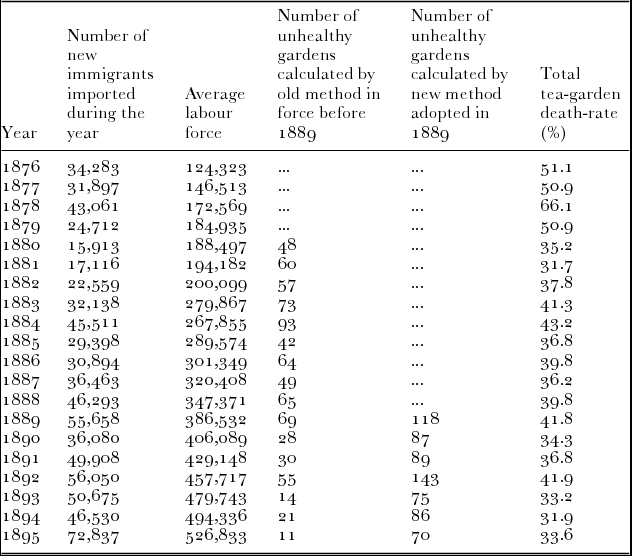
In addition to legal instructions on sanitation, numerical jousting also instituted parameters of health and ‘unhealth’ during this period. Thus, any estate exceeding an annual mortality rate of seven per cent of the total population was henceforth blacklisted and classed as ‘unhealthy’.Footnote 102 In 1889, in a bid to ‘strengthen control’ over persistent mortality, it was decided that seven per cent would now apply separately—for Act and Non-Act labour—whereas it had only been applied cumulatively in the past. The result of this statistical manoeuvre spoke for itself (see Table 1).
Statement showing mortality on tea estates and number of unhealthy estates.

Source: Appendix H, Assam Secretariat Proceedings, Emigration-A, File No. 229/4189R, September 1896, ASA.
The paradox was obvious: more laws had not only failed to curb unhealthiness, they had also created unreliable indicators of well-being in the first place. In any case, gathering data was in itself a tricky problem and often highlighted the administrative limits of the colonial government. Reminders and urgent requests for mortality figures from planters and district surgeons frequently fell on deaf ears.Footnote 103 In a candid disclosure, the government was forced to admit in 1890 that ‘deaths have been imperfectly classified . . . due to the non-receipt of returns from managers and the dilatoriness on the part of the Civil Surgeon to inspect’.Footnote 104 History repeated itself once again, and an official 1893 inquiry into the workings of the 1882 Act revealed widespread discrepancies between policy and practice. Legislating health had serious operational and economic limitations. It soon dawned on the government that race prejudice had forestalled bathing provisions in labour depots, as ‘emigrants of the type known as “jungly” [were] not accustomed to daily washing’.Footnote 105 In addition, vaccinations of adults and dependants were rarely carried out, ‘burial of excreta’ never enforced, and latrines inadequate. Surgeon-Major J. Mullane argued that law might even have been indirectly responsible for worker malnutrition in the Assam estates. He testified that with rice being more expensive in the open market, the stipulation to feed workers at contract rates proved unprofitable for employers who therefore kept its supply as low as possible.Footnote 106 Similarly, a large number of ancylostomiasis deaths in 1888 was attributed to making ‘coolies palpably suffering from it . . . to go on working, until it develops into an incurable stage’.Footnote 107 A memorial by the Indian Association to the GOI that year argued that planters had used the penal provisions of the 1882 Act with impunity to overwork labourers, especially women. High infant death rates (around 44 per thousand in 1884) and low birth rates (32.7 per thousand the same year) were linked to the impossibility of maternal care, neglect, lack of leave time, and preference for abortion to infantile servitude in the gardens. The memorial begged the government to inquire into aspects ‘of the law that makes such things possible’.Footnote 108
Planters, of course, had long argued that interference itself was at the root of the problem, and that Act I of 1882 was ‘too inquisitorial’.Footnote 109 Blaming labourers’ non-immunity (or ‘bad batches’) for rising mortality became a favourite trope for managers and provincial civil surgeons alike. Sometimes, law attempted to override this incommensurable logic. In a letter dated 30 September 1896, the officiating secretary to the chief commissioner of Assam clarified its position to GOI:
It should be explained that the importation of bad batches is, under no circumstances, accepted by the Chief Commissioner as sufficient excuse for excessive mortality on an estate; but in cases in which such importations have taken place, with the result of high mortality, and the employer is found to have neglected the precaution of having his labourers medically examined before placing them under contract, the Chief Commissioner has the less hesitation in putting in force against him the coercive provisions of the Act.Footnote 110
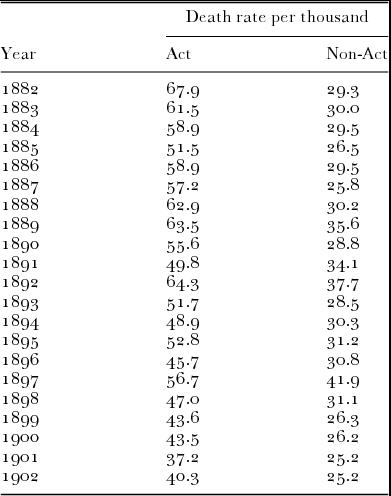
With the strict sanitary regulations of the 1882 Act, and persistent fears of a stricter amendment, planters targeted law as their whipping post. They even ridiculed statistics of unhealthy gardens and argued that similar parameters of well-being would ‘sweep away whole villages’ in mainland India.Footnote 111 However, most employers throughout this period recognized that the 1882 Act, especially with its penal provisions, gave them ‘exceptional powers’,Footnote 112 sanitary diktats notwithstanding. In the closing decades of the nineteenth century, renewed attempts were made to regulate the health and welfare of tea workers headed to Assam. The Inland Emigrants’ Health Act 1889 was extended to the province, and rehearsed earlier norms for recruiting agents and labour depots. Though this law attempted to standardize sanitary provisions, food quality, and water supply for labourers en route, the agents could now be fined for defaulting and his ‘money recovered together with a simple interest of six percent yearly’.Footnote 113 The numbers, as in Table 2, continued to tell a different story.
Statement of adult death rates in a 20-year period.

Source: Annual Reports on Labour Immigration into Assam for these years (Shillong: Assam Secretariat Press, 1882–1902).
As the new century dawned on these gardens of empire, the looming presence of mortality and ill health refused to go away. Despite scientific innovations, special legislations, medical breakthroughs, and vector identification, cholera, kala-azar, malaria, dysentery, and anaemia continued to ravage the Assam estates. Act VI of 1901 made another attempt to regulate health, and strengthened the jurisdictions and power of the medical inspectors while increasing the minimum wage for both men and women workers.Footnote 114 As it is, competition from other industries, and a volatile political and economic climate diluted the planters’ hold over labour during the first two decades of the twentieth century. As the penal clause came under fire, the colonial state argued more and more in favour of ‘freer’ immigration as the elixir for Assam's persistent, and peculiar, labour problem. It was felt that health, too, would be better off under laissez-faire than law. The 1906 Labour Enquiry Committee recommended: ‘the aim now is to keep the labourer on the garden by making life attractive to him and not by force of law . . . [we] are inclined to believe that a policy of less medicine and more leave off work would show better results as regards the health of labourers’.Footnote 115 The paradox had come full circle in the Assam plantations.
Conclusion
Away from the administrative gaze of the Presidency towns and municipal arenas, disease etiology, prophylactic policy, and parameters of health in the Assam tea plantations emerged from a strategic and uneasy relationship between the colonial state, medical opinion, and planter interests. I have shown that as far as the ‘economics of Eden’Footnote 116 was concerned, the body of the Indian ‘coolie’ was primarily for productive labour. Its accessibility to, and availability for, the ambitions of Western medicine—ideological differences notwithstanding—was conditioned by the imperatives of commodity capital and exigencies of plantation life. Our discussions of cholera, kala-azar, and malaria investigations in Assam amply highlight this tension between epidemiological theory and practice.
Disease etiology, identification, and prophylaxis also varied depending on whether the economic, legal, or natural body was being called on. Thus, Surgeon DeRenzy wore his staunch contagionist hat while dealing with Assam tea labour cholera and swiftly sacrificed it when it came to his own company's unhealthiness. Similarly, Haffkine's vaccination experiments were both facilitated by the aggregate pathological body of the Assam plantation workers and constrained by its economic rhythms. Strickland's prognosis of planter policy, site selection, and the anopheles as the unholy trinity of Assam's malaria problem also invoked these intertwined logics. Law, too, often spoke in a forked tongue: Act I of 1882 thus concurrently blamed hasty recruitment, insanitary work conditions, and a poor ‘class of labour’ for death and mortality in the tea gardens of eastern India. In other words, disease—as concept and condition—mediated institutional agendas (CSTM, ITA), individual opinion (Giles, Rogers, Strickland et al.), special legislations (1863, 1865, 1873, 1882, 1901), commodity markets, and bodily culpability (‘unsuitable class’, ‘non-immune race’, imported epidemicity) in questions of cause and cure. Of course, etymologically, the definition of disease in Assam was in itself slippery. Consider that malaria was subsumed under ‘jungle fever’ until 1892, and that ancylostomiasis and kala-azar were undifferentiated. As Charles Rosenberg argues: ‘it is fair to say that . . . a disease does not exist as a social phenomenon until we agree it does—until it is named’.Footnote 117
These legal, economic, and ecological interpretations of the body are not hermetically sealed. In fact, this article demonstrates that the scientific, functional, and regulatory transcripts of health and disease in Assam are inseparable from each other. All this is not to suggest, however, that Assam was pathologically unique, or that it formed an exceptional disease zone.Footnote 118 Rather, this article argues that ideas of mortality, death, and well-being exceeded—indeed, had to exceed—instrumental logics of scientific objectivity, imperial sanitary policy, vector identification, and preventive cure in these estates. It was shaped by the expedient exegesis of medical knowledge, law, commercial interests, and idioms of corporeality.
The politics of profit and unabated mortality rates in the Assam estates created an unprecedented challenge for the colonial government. Here in the tea gardens of eastern India, the colonizing force of Western medicine seemed to have adapted to, if not been upstaged by, the demands of capital. In addition, authority and power were zealously guarded privileges in the Assam estates, and planters shared it reluctantly with sanitarians, investigators, and medical men. Unlike jails, therefore, the colonial state had only mediated access to tea workers in matters of health and disease control. But the meanings of labour well-being went one step further in the Assam plantations. Along with the pathological and economic, this article argues that law infused an additional layer of discursive (and enumerative) understanding of the body, health, and morbidity in these plantations.
I suggest that the special legislations aiding immigration to the province were inherently contradictory and Janus-faced. While they pandered to planter requests for ‘freer’ recruitment and the penal contract, these laws simultaneously attempted to regulate labour health and sanitary welfare.Footnote 119 But this was a paradoxical vision. As shown, strict parameters of bodily fitness and the demands of plantation labour were incommensurable, or even unprofitable for the most part. In its turn, the terms of penal indenture and recruitment loopholes were themselves the cause célèbre for ill health, death, and disease en route to and on the plantations of Assam. Conversely, planters rued the excessive and unrealistic sanitary goals of these laws for ‘causing’ sickness, and argued for more freedom as the panacea for better health. Often, the colonial government sided with these warped medico-legal logics.
Managing health and disease in these estates rested on a functional balance between economic, legal, and medical viability; its history therefore has to be written alongside the structure of the plantation industry and its peculiar relations of production. Here, in the ‘garden of the Lord’,Footnote 120 ill health had multiple claimants: germs, miasmas, profiteering, and law.