Introduction
The common sunn pest, Eurygaster integriceps Puton, is the most economically detrimental of various Eurygaster spp. (Hemiptera: Scutelleridae) that occur at west Palearctic region and a key pest of wheat in the region. Among the various natural enemies attacking sunn pest, scelionid egg parasitoids have received the most attention (Safavi, Reference Safavi1973; Radjabi, Reference Radjabi2000; Kivan & Kiliç, Reference Kivan and Kiliç2005; Guz et al., Reference Guz, Kocak and Kilincer2013). Several species have demonstrated good potential for maintaining sunn pest populations below the economic threshold, although with significant temporal and spatial variation in efficacy (Radjabi & Amir Nazari, Reference Radjabi and Amir Nazari1989; Kivan & Kiliç, Reference Kivan and Kiliç2005; Nozad Bonab et al., Reference Nozad Bonab, Iranipour and Farshbaf Pourabad2014). The most common species attacking E. integriceps eggs in Iran are Trissolcus grandis (Thomson) and Trissolcus vassilievi (Mayr) (Radjabi, Reference Radjabi2000) and field parasitism rates can occasionally reach 100% of eggs collected (Al-Izzi et al., Reference Al-Izzi, Amin and Al-Assadi2004; El-Bouhsinni et al., Reference Dreyfus and Breuer2004), although it may be <10% in colder regions (Haghshenas, Reference Haghshenas2004; Nozad Bonab & Iranipour, Reference Nozad Bonab and Iranipour2009).
Many biological characteristics of parasitoids can be directly affected by thermal regime, including development time, searching behavior, fecundity, longevity and sex ratio (Torres et al., Reference Torres, Musolin and Zanuncio2002; Colinet & Boivin, Reference Colinet and Boivin2011; Anthony et al., Reference Anthony, Robert and Jonathan2013; Foray et al., Reference Foray, Desouhant, Voituron, Larvor, Renault, Colinet and Gibert2013). Radjabi (Reference Radjabi2000, Reference Radjabi2007) concluded that temperature is the best predictor of geographic range and local differences in Trissolcus species richness. Insect developmental rates depend upon the temperature to which insects are exposed and two species-specific properties are recognized: the lower developmental threshold t, or the temperature below which no measurable development occurs, and the thermal constant K, or the cumulative amount of heat required for an insect to complete development (Bursell, Reference Bursell and Rockstein1964; Grassberger & Reiter, Reference Grassberger and Reiter2002). Messenger (Reference Messenger1959a , Reference Messenger, Robb and Guthrie b ) argued that thermal requirements are useful metrics for predicting an insect's distribution and relative abundance over its geographic range. However, the application of this approach can be problematic. Because estimation of the lower threshold t requires extrapolation of the regression line to its intercept, the value so obtained may be inaccurate. At least 50 individuals must be reared at each of three or four constant temperatures to permit an accurate estimation of t. Furthermore, since K and t are negatively correlated, a small positive error in t will be automatically corrected by a corresponding negative error in K, resulting in a negligible effect on predicted rates of development, except at temperatures close to threshold (Campbell et al., Reference Campbell, Frazer, Gilbert, Gutierrez and Mackauer1974). However, Ikemoto & Takai (Reference Ikemoto and Takai2000) developed a new estimation method for these parameters with several advantages, including reduced bias.
Mathematical models based on thermal requirements, degree-days, and threshold temperatures have been used to predict the occurrence of insect pests and natural enemies, migration and colonization of new areas, and to support insect production in rearing facilities (Shelford, Reference Shelford1927; Wagner et al., Reference Wagner, Wu, Sharpe, Schoofield and Coulson1984; Higley et al., Reference Higley, Pedigo and Ostile1986; Peterson & Meyer, Reference Peterson and Meyer1994; Torres et al., Reference Torres, Pratissoli and Zanuncio1997, Reference Torres, Musolin and Zanuncio2002; Kumral et al., Reference Kumral, Kovanci and Akbudak2008; Wilstermann & Vidal, Reference Wilstermann and Vidal2013; Sjoberg et al., Reference Sjoberg, Swiergiel, Neupane, Lennartsson, Thierfelder, Tasin and Rämert2014). The thermal requirements of various Trissolcus species have been previously studied (Sheikhmoss, Reference Sheikhmoss2009; Trissi et al., Reference Trissi, El-Bouhssini and Kzaez2009; Iranipour et al., Reference Iranipour, Nozadbonab and Michaud2010; Kasraee et al., Reference Kasraee, Moeini-Naghadeh, Zamani, Asgari, Mahjoob and Manzari2010; Moeini-Naghadeh et al., Reference Moeini-Naghadeh, Kasraee, Asgari, Zamani, Mahjoob and Manzari2010; Islamoĝlu, Reference Islamoĝlu2012; Khattab, Reference Khattab2013), often yielding results that varied by region of origin. For example, Iranipour et al. (Reference Iranipour, Nozadbonab and Michaud2010) reported a 2.0°C difference in thermal threshold between two populations of T. grandis separated by only 50 km.
The present study compared the thermal requirements of a population of T. vassilievi from a warm region (Varamin), with another from a cooler region (Tabriz), to test the hypothesis that the thermal phenotype of the parasitoid would vary according to the geographic origin of its population. Because host quality is another critical factor affecting parasitoid development (Godray, Reference Godray1994; Harvey, Reference Harvey2000; Harvey & Strand, Reference Harvey and Strand2002; Colinet et al., Reference Colinet, Salin, Boivin and Hance2005), and previous work has shown that host egg protein content can affect the development and subsequent fecundity of Trissolcus spp. (Nozad Bonab & Iranipour, Reference Nozad Bonab and Iranipour2012), reciprocal experiments were conducted utilizing host populations from each of the two regions to test the hypothesis that host population would influence expression of thermal phenotype in the parasitoid. Furthermore, crosses were made between the two parasitoid populations to test the hypothesis that female progeny of crosses would express a thermal phenotype intermediate to that of their parental populations, given equal genetic contributions from each.
Materials and methods
Insect cultures
Source material of T. vassilievi was obtained from Tabriz in northwest Iran (38°N, 46°E, 1360 m ASL) and from Varamin in central Iran (35°N, 51°E, 918 m ASL) with a 600 km distance separating the two sites. Parasitoids were obtained by use of host egg traps constructed of yellow cards (5.0 × 15.0 cm) folded twice to form an inverted ‘U’ shape. A non-toxic, odorless glue (Ahoo, Ghaffari Chemical Industry Compony, Iran) was used to stick egg masses of E. integriceps to the internal surfaces and the traps were deposited in wheat fields and recovered weekly. Parasitized egg masses then were transferred to glass tubes (1.5 × 10.0 cm) and placed in a climate-controlled growth chamber (26.0±1.0°C, 50±5% RH and 16:8 L:D photoperiod). Emerging wasps were identified using a key of Palearctic species of Trissolcus (Kozlov & Kononova, Reference Kozlov and Kononova1983) and held as pairs in glass tubes (1.5 × 10.0 cm) with honey droplets provided on strips of paper, augmented with a few host eggs to enable host-feeding. Wasps of the third generation were used in experiments.
Adult E. integriceps were collected from wheat fields in the same respective regions (Tabriz and Varamin) using a sweep net and held in small groups (50 pairs) in rectangular plastic containers (30.0 × 20.0 × 9.0 cm) containing wheat kernels and water supplied on cotton balls (Zomorrodi, Reference Zomorrodi1961). The containers were held in a climate-controlled growth chamber under the same physical conditions as the parasitoids. Egg masses were deposited on folded strips of paper and were collected daily for use in experiments.
Experiments
The development of both T. vassilievi populations, and of reciprocal crosses between them (♀T × ♂V and ♀V × ♂T), was monitored twice daily (8 a.m. and 8 p.m.) under five constant temperatures: 15.0, 20.0, 25.0, 30.0 and 35.0±1.0°C. Previous work by Kasraee et al. (Reference Kasraee, Moeini-Naghadeh, Zamani, Asgari, Mahjoob and Manzari2010) demonstrated no survival of this species at 40°C. Newly emerged adult wasps were paired in glass tubes (1.5 × 10.0 cm) and provisioned with droplets of honey for 24 h to permit mating. Mated females (n = 20 per treatment) were presented individually with egg masses of both populations of E. integriceps (24 h old, 14 eggs per clutch) in similar glass tubes for 3.0 h at 26.0±1.0°C, whereupon females were removed and the egg masses incubated in growth chambers under the physical conditions as described above. The progeny of crosses were reared exclusively on Varamin hosts. Development time (days) was tallied for males and females and the sex ratio of the progeny (% female) was recorded.
Data analysis
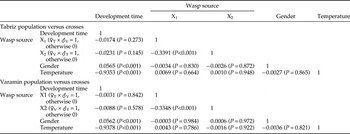
First, all data were pooled (except the inter-population crosses) and fit to a multiple linear regression model (Zar, Reference Zar1984) as Y=β0+β1 X 1+β2 X 2+β3 X 3+β4 X 4 with development time as the response variable Y, temperature as a continuous explanatory variable X 4, nominal variables of parasitoid and host populations and gender as dummy variables with X 1 = 1 for Tabriz wasp and X 1 = 0 for Varamin wasp, X 2 = 1 for Tabriz host, and X 2 = 0 for Varamin host, X 3 = 1 for female, and X 3 = 0 for male. Non-significant variables were then excluded stepwise from the analysis. Data from the reciprocal crosses were then included in two similar sets of analyses using two dummy variables, X 1 = 0, X 2 = 0, for population reference (one at a time), X 1 = 1, X 2 = 0 for ♀T × ♂V, and X 1 = 0, X 2 = 1 for the alternative, ♀V × ♂, X 3 and X 4 as before (host excluded because of non-significance). Partial correlations were used to assess possible interactions between pairs of variables using relevant SAS procedures (SAS Institute, 2011). The developmental rate of individuals was calculated as the reciprocal of the total development time according to the method of Campbell et al. (Reference Campbell, Frazer, Gilbert, Gutierrez and Mackauer1974). The relationship between developmental rate and temperature was analyzed by linear regression: y = a+bx, where the slope's reciprocal (1/b) and x-intercept (−a/b) represent the thermal constant K and temperature threshold t, respectively. The standard error of K and t were approximated according to Campbell et al. (Reference Campbell, Frazer, Gilbert, Gutierrez and Mackauer1974).
In a second procedure, a linear regression of DT on D was performed and the relation between developmental time D and temperature T rearranged as: DT = K + tD rather than the classic form of
 $\displaystyle{1 \over D} = - \displaystyle{t \over K} + \displaystyle{1 \over K}T$
in which t and K are parameters of the temperature threshold and thermal constant, respectively (Ikemoto & Takai, Reference Ikemoto and Takai2000).
Results
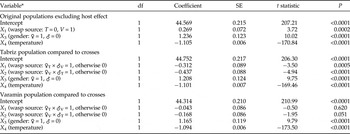
Multiple regression analyses revealed that host had a non-significant effect on T. vassilievi development (b 2 = 0.013±0.072, t = 0.18, df = 1, P = 0.857). Since the other factors had significant effects, host effect was excluded and the model simplified with all coefficients significant that did not permit further simplification (table 1). The progeny of both crosses expressed a thermal phenotype closer to the Varamin population than the Tabriz one.
Relationships between T. vassilievi development and wasp source (T = Tabriz, V = Varamin), gender and temperature, as described by multiple regression.

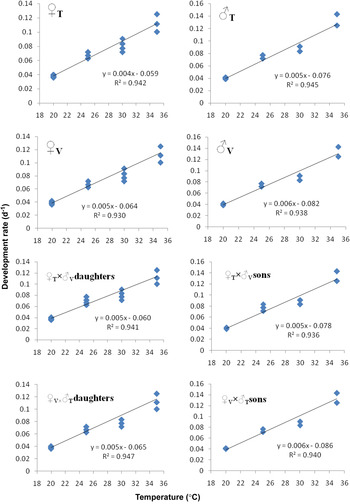
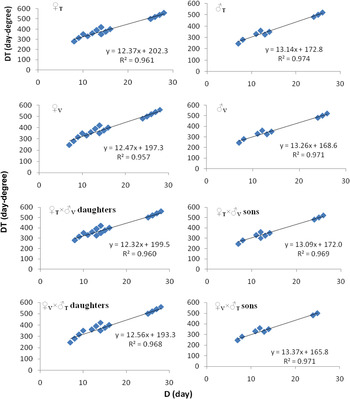
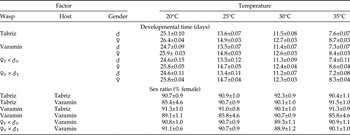
As expected, developmental times decreased at higher temperatures, although sex ratios were largely stable (85–92% in different treatments, table 2). For dependent variables, the only significant correlations were between development time and gender and developmental time and temperature (tables 3 and 4). No significant correlations were observed between independent variables in either analysis, with the exception of correlations between X 1 and X 2 in both comparisons of the second analysis. Figure 1 shows the relationship between development rate and temperature and fig. 2 depicts the relationship between DT and D as described by the model of Ikemoto & Takai (Reference Ikemoto and Takai2000). Despite apparently complete development at 15°C, no adult wasps emerged from parasitized eggs. Therefore, lower temperature thresholds and thermal constants of the two T. vassilievi populations were estimated for each sex separately on the eggs of each sunn pest population based on the four remaining temperature treatments (Figs. 1 and 2). The wasp was protandrous, with females requiring from 1.1 to 1.4 days longer than males to complete development. This resulted in a thermal constant for females that was about 20% higher than for males, and a thermal threshold about 1°C lower.
Relationship between development rate (1/D) as a function of Temperature (T) of two T. vassilievi populations and the reciprocal crosses between them.

Relationship between DT as a function of D in Ikemoto and Takai (Reference Ikemoto and Takai2000) method of estimating lower temperature threshold and thermal constant of two T. vassilievi populations and the reciprocal crosses between them.

Mean (±SE) developmental times and sex ratios of two populations of T. vassilievi and their reciprocal crosses when reared on eggs of two host (E. integriceps) populations at each of four constant temperatures.

Correlation matrices describing relationships between pairs of variables affecting the temperature-dependent development of two T. vassilievi populations (Tabriz and Varamin).

Correlation matrices describing relationships between pairs of variables affecting the temperature-dependent development of two T. vassilievi populations and reciprocal crosses between them.

The two reciprocal crosses had different effects on the thermal performance of wasps. Both male and female progeny of the ♀T × ♂V cross had temperature thresholds 0.3°C lower than those of the ♀V × ♂T cross and required more than six additional DD to develop.
Discussion
The results obtained supported our first hypothesis that the thermal phenotype of the parasitoid would vary with its geographical population source (Honek, Reference Honek1996; Ishihara, Reference Ishihara1998). Similar results were observed by Iranipour et al. (Reference Iranipour, Nozadbonab and Michaud2010) for two T. grandis populations. Similarly, Campbell et al. (Reference Campbell, Frazer, Gilbert, Gutierrez and Mackauer1974) showed that the thermal threshold of development of aphidiine parasitoids differed by 1.0–2.0°C over a 1300 km difference in latitude. The general pattern of change in phenotype across latitudes is for populations from colder regions (or higher latitudes) to have a lower temperature threshold, a more moderate rate of change in developmental time with increasing temperature, and a higher thermal constant. Honek (Reference Honek1996) confirmed this pattern with a study of thermal phenotypes for 335 insect species from different latitudes, including the scelionid egg parasitoids Trissolcus basalis, Trissolcus oenone, Telenomus podisi and Telenomus chloropus, concluding that insects from higher latitudes and colder regions had lower temperature thresholds and larger thermal constants. The adaptive value of a lower temperature threshold is likely the ability to begin development earlier in the spring in a shorter growing season. Since many enzymes critical for insect development have specific thermal optima (Ratt, Reference Ratt and Hoffman1985), their activation at lower temperatures may entail a trade-off in performance under higher temperatures, and thus a greater thermal constant.
Trissolcus vassilievi can develop successfully across a broad range of temperatures, with developmental times ranging from 43.1 days at 15°C to 7.7 days at 37°C for males and from 46.2 to 8.0 days for females at the same respective temperatures (Moeini-Naghadeh et al., Reference Moeini-Naghadeh, Kasraee, Asgari, Zamani, Mahjoob and Manzari2010), results which are comparable to our data at high temperatures. However, in contrast to the findings of Kasraee et al. (Reference Kasraee, Moeini-Naghadeh, Zamani, Asgari, Mahjoob and Manzari2010) and Moeini-Naghadeh et al. (Reference Moeini-Naghadeh, Kasraee, Asgari, Zamani, Mahjoob and Manzari2010), our study obtained no survival of wasps at 15°C. Similarly, Sheikhmoss (Reference Sheikhmoss2009), working with material in Syria, reported that T. vassilievi is semi-inactive and unable to parasitize host eggs at 15°C, so development at that temperature may be a moot point. Moreover, this appears to be a critical temperature for species in this group. For example, Trissolcus mitsukurii, Trissolcus plautiae and Trissolcus itoi all experience a sharp decline in emergence at 15°C (Arakawa & Namura, Reference Arakawa and Namura2002). Chabi-Olaye et al. (Reference Chabi-Olaye, Schulthess, Poehling and Borgemeister2001) inferred that the most frequent cause of death for Telenomus isis (Polaszek) at temperatures below 18°C is host desiccation due to prolonged immature development, with physiological disorders implicated at high temperatures. Another study of T. vassilievi parasitizing E. integriceps eggs reported relatively faster female development at 20 and 26°C compared with our findings (Trissi et al., Reference Trissi, El-Bouhssini and Kzaez2009), discrepancies that could be related to population source, rearing background, or different experimental methods.
According to Safavi (Reference Safavi1973) species of Trissolcus with parapsidal grooves (e.g., the flavipes and simoni species-groups in Kozlov & Kononova's (Reference Kozlov and Kononova1983) classification system) have longer development than species lacking them (e.g., semistriatus, gonopsidis and oobius groups of the same system). This trend appears consistently across various studies. For example, compare the results of Iranipour et al. (Reference Iranipour, Nozadbonab and Michaud2010) for T. grandis to those obtained for T. vassilievi in this study. The longest Trissolcus development reported is 214.7 DD for Trissolcus brochymenae from the flavipes group (Torres et al., Reference Torres, Pratissoli and Zanuncio1997; Cividanes et al., Reference Cividanes, Figueiredo and Carvalho1998) and the shortest is for Trissolcus rufiventris (Mayr) from the basalis group (Kivan & Kilic, Reference Kivan and Kiliç2006); 125.0 and 111.1 DD for females and males, respectively.
Although the thermal threshold of Tabriz females was lower than that of Varamin females, the difference was less than 0.5°C. In contrast, T. grandis populations separated by only 50 km differed in temperature threshold by 2°C (Iranipour et al., Reference Iranipour, Nozadbonab and Michaud2010). Even greater regional differences have been reported in other studies of T. grandis (e.g., Amir Maafi, Reference Amir Maafi2000; Nozad Bonab & Iranipour, Reference Nozad Bonab and Iranipour2009), suggesting this species expresses much more plasticity in thermal phenotype than T. vassilievi. Low thermal phenotype plasticity could well explain the low abundance of the latter species in the Tabriz region, where cold springs likely impede population growth. In contrast, T. grandis is better able to reduce its temperature threshold, begin development earlier, and develop faster under colder conditions.
The second hypothesis, that host population would affect the thermal phenotype of the parasitoid, was not supported by the results obtained, although such effects have been reported from other Trissolcus spp.-host combinations (e.g., Nozad Bonab & Iranipour, Reference Nozad Bonab and Iranipour2012). It is also true in other parasitoid–host systems (Logan & Thomson, Reference Logan and Thomson2002; Li & Mills, Reference Li and Mills2004).
The third hypothesis, that crosses between the populations would result in female progeny with intermediate thermal phenotypes, was partially supported. Results of the multiple regression analysis revealed that both crosses expressed phenotypes closer to the Varamin population than the Tabriz one (tables 1 and 2). Nevertheless, parameter estimations did not confirm such a pattern (fig. 2). Regardless of sex, progeny of the ♀V × ♂T cross expressed a phenotype closer to their maternal population, i.e., the Varamin population and those of the ♀T × ♂V cross expressed an intermediate phenotype. Crosses expressed a thermal constant 3–4 DD lower than the maternal population. Inspection of table 2 reveals that differences in parameter estimates obtained by regression analysis were due to differences in development time at the highest temperature. At all temperatures up to, and including, 30°C, development time was shorter in both crosses compared to parental populations, whereas at 35°C development of ♀T × ♂V cross more closely resembled that of the Tabriz population, decreasing the slope of the regression line in this treatment and suggesting a temperature-dependent maternal effect.
The Scelionidae are protandrous (Waage, Reference Waage, Waage and Greathed1986; Arakawa & Namura, Reference Arakawa and Namura2002) and adapted to inbreeding (Safavi, Reference Safavi1973; Loch & Walter, Reference Loch and Walter2002), which accounts for their paucity of male offspring (Hamilton, Reference Hamilton1967); females produce a few male eggs early in the oviposition cycle, but only enough to ensure the fertilization of their sisters. Haploid males carry a single copy of genes from the maternal genome, whereas all daughters are diploid and carry a complete copy of their father's genes as well (Dreyfus & Breuer, Reference Dreyfus and Breuer1944). Thus, if thermal phenotype were determined solely by genetic inheritance, that of male progeny would be expected to match that of their mothers, with females more intermediate to their parental populations due to paternal genetic factors. However, these results do not conform to this expectation. The thermal constants of both male and female progeny more closely matched that of their mothers than that of their paternal populations, pointing to a maternal effect on thermal phenotype development. Given that maternal effects can have substantial impact on the speed and direction of evolutionary change in response to directional selection (Kirkpatrick & Lande, Reference Kirkpatrick and Lande1989; Wade, Reference Wade, Mousseau and Fox1998), and that maternal phenotype itself may influence the strength of maternal effects (e.g., Rasanen & Kruuk, Reference Rasanen and Kruuk2007; Vargas et al., Reference Vargas, Michaud and Nechols2012, Reference Vargas, Michaud, Nechols and Moreno2014), maternal effects on thermal phenotype in T. vassilievi could accelerate population adaptation to changes in thermal regime such as may be encountered during range expansion or even scenarios of climate change. Furthermore, there was some indication of asymmetry between populations in the strength of the maternal effect; females of the Varamin population were able to shift the thermal constant of their daughters to one significantly different from females of the Tabriz population, whereas the reverse was not true. To our knowledge, this is the first demonstration of a maternal effect on the thermal phenotype of a parasitoid wasp. Knowledge that maternal effects can influence offspring thermal phenotype could be useful for augmentation programs seeking to rear T. vassilievi for utilization in regions with variable thermal conditions. Moreover, it may be possible to breed parasitoids with lower thermal thresholds and faster development via crosses between populations, which could improve their effectiveness in colder regions with a shorter growing season.
Acknowledgements
This study was supported by the University of Tabriz with financial assistance and use of facilities. We thank Mr Abbas Entezar Qaramaleki for helpful assistance.