1. INTRODUCTION
After Jesus was betrayed by Judas, his followers gathered to decide who would assume Judas’ apostolic ministry. They identified two possible candidates, Barsabbas and Matthias. ‘Then they cast lots, and the lot fell to Matthias; so he was added to the eleven apostles’ (Acts 1: 26).
There are at least two possible ways to interpret this act. On either interpretation, the Apostles had no reason for selecting either candidate over the other. They may, however, simply have cast lots as a means of being fair to both candidates. Perhaps they decided that both candidates were equally qualified for the position, and that random selection offered the fairest way of deciding between them. Alternatively, they may have cast lots as a means of asking God which candidate He preferred. God, after all, was omnipotent. He could clearly have controlled the manner in which the lots came up, and so the lots gave Him a chance to make His opinion known.Footnote 1
These rival interpretations of the selection of Matthias yield two conclusions relevant to the study of decision-making. First, there exist clear alternatives to the standard model of reasoned decision-making, ways of making decisions without any reference to reasons. Second, not all of these alternatives are on a par. Put another way, one might conceivably be justified in resorting to forms of non-reasoned decision-making (NRDM), and if so, it makes a difference which form one selects.
Scholars concerned with decision-making have clearly recognized the first point; they understand the existence, and even the value, of NRDM. Witness, for example, the large and growing literature on random selection, as clear an example of NRDM as one can find.Footnote 2 But they have not, as I shall show, adequately recognized the second point – that there are critically important differences between forms of NRDM. Recognition of this point requires sorting out the different forms as well as the circumstances under which each is appropriate. This paper performs this task.
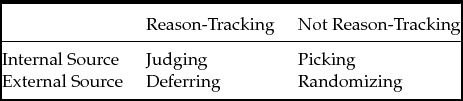
In this paper, I argue that there are four forms of NRDM – picking, randomizing, deferring and judging. Two of them – deferring and judging – aim to track heretofore unidentified reasons, while the other two – picking and randomizing – do not. Two of them – randomizing and deferring – bring to bear resources external to the decision-maker, while the other two – picking and judging – draw upon the mind of the decision-maker alone. The four forms of NRDM result from the distinct combinations of these attributes, and their respective advantages and disadvantages depend upon them.
Section 2 offers a schematic account of reasoned decision-making.Footnote 3 This account highlights the possibility of indeterminacy, the failure of reasons to recommend a unique course of action. Sections 3 and 4 introduce NRDM as a solution to indeterminacy. The former examines picking as a form of NRDM, building on the work of Edna Ullmann-Margalit and Sidney Morgenbesser (1977). The latter contrasts picking with three other forms of NRDM. Section 5 considers the advantages and disadvantages of these forms. Section 6 treats the choice of NRDM as a problem of second-order decision-making. Section 7 concludes by examining the philosophical assumptions that must be made in order for the forms of NRDM to be both possible and distinguishable from one another.
Before proceeding, I should note that I am interested in decision-making, both reasoned and non-reasoned, from a first-person perspective. That is, my concern is with an agent who is either trying to decide what to do on the basis of reasons, or trying to make a decision in the (perceived) absence of such reasons. I am thus interested in providing part of what Nomy Arpaly describes as a ‘rational agent's manual’, as opposed to an ‘account of rationality’ from a ‘God's eye view’ (Arpaly Reference Arpaly2000: 488). This is important, because my account deals with a number of problems an agent might face – such as ‘Might there be reasons for acting that I have not yet detected?’ or ‘Could there be a reason I feel that this option is the best one?’ – that are, from a God's eye perspective, strictly beside the point. In describing what the rational agent does, I am thus laying out what a rational agent does when, from that agent's own perspective, she is doing everything that she ought to do. This need not mean that the agent's decision-making is flawless or perfect, but it does mean that the agent is aware of the flaws and imperfections and takes them into account as best she can.
2. REASONED DECISION-MAKING AND INDETERMINACY
All decision-making processes consist of two steps. Jon Elster describes these two steps as filters.
A general theory of human action . . . can be sketched as follows. To explain why a person in a given situation behaves in one way rather than another, we can see his action as the result of two successive filtering processes. The first has the effect of limiting the set of abstractly possible actions to the feasible set, i.e. the set of actions that satisfy simultaneously a number of physical, technical, economic and politico-legal constraints. The second has the effect of singling out one member of the feasible set as the action which is to be carried out (emphasis in original; Elster Reference Elster1984: 76).
All decision-making, in other words, must identify a set of possible options and then use some process to reduce this set down to a singleton. Reasoned decision-making accomplishes this reduction via reasons.
In principle, reasons could accomplish this filtering in a variety of ways. On the standard account, a rational agent rank orders her options in accordance with the quality of the reasons behind them; she then filters out all options except the one ranked highest – the one with the ‘best’ reasons in its favour.Footnote 4 But alternative accounts could be given (for an example, see Gert Reference Gert2003, Reference Gert2007), and nothing in my story depends upon the specific account offered. All that matters is that reasons do somehow filter out actions, such that the rational agent rejects the filtered and embraces the unfiltered options.
Ideally, a decision-maker who correctly performs these two filtering operations will be left with a single option. But this may fail to happen. Multiple options might survive the filtering process.Footnote 5 This generates a problem of indeterminacy. On the standard account, this will take place whenever there is a non-singleton indifference class at the top of the rank ordering. This would mean a ‘tie’ between multiple ‘winning’ options, a case of indifference. This indifference could exist ‘in principle’, such that no further information could ever resolve it. Alternatively, the agent might be able to break the tie given further information, but obtaining that information would be too difficult or costly to justify making the effort. This would be a case of indeterminacy ‘within the limits of what it pays to find out’ (Elster Reference Elster1989: 107).Footnote 6
A non-standard account of reasoned decision-making yields other potential sources of indeterminacy. An agent unable to compare the reasons for one option with the reasons for another would be unable to rank them. Such an agent would face a problem of incommensurability (Chang Reference Chang1997). But again, nothing in my account hinges upon the way in which indeterminacy is generated. All that matters is that the agent must select from a set of options, but cannot do so based upon the relevant reasons.Footnote 7
An agent facing indeterminacy must resolve it before she can act. One way to do this is to make a second attempt at reasoned decision-making. This means revisiting the original process – brainstorming for more options, searching for more information about the existing options, trying to identify new reasons for action, etc. But alternatively, the agent could employ some sort of third filter. This filter cannot, by definition, involve identifying reasons, but must instead constitute what Otto Neurath called an ‘auxiliary motive’ (Neurath Reference Neurath1983).Footnote 8 To use such a filter is to engage in NRDM.Footnote 9
3. PICKING
NRDM, then, requires appeal to an auxiliary motive, which filters out options without employing identifiable reasons. In the next section, I shall distinguish between several filters of this kind. But to motivate this inquiry, I shall first describe in some detail the simplest and most common form of NRDM, what Edna Ullmann-Margalit and Sidney Morgenbesser call ‘picking’. This is what we do when we simply ‘pick’ one option out of a set without having a reason for doing so.
Ullmann-Margalit and Morgenbesser recognize the centrality of this form of NRDM, and so they distinguish between choosing, picking and selecting:
We speak of choosing among alternatives, when the act of taking (doing) one of them is determined by the differences in one's preferences over them. When preferences are completely symmetrical, where one is strictly indifferent with regard to the alternatives, we shall refer to the act of taking (doing) one of them as an act of picking. We adopt the term selection as the generic term, neutral with respect to choosing and picking. (emphasis in original; Ullmann-Margalit and Morgenbesser Reference Ullmann-Margalit and Morgenbesser1977: 757)Footnote 10
Ullmann-Margalit and Morgenbesser employ the idea of preference here, but they admit that they could just as easily speak of reasons for action (Ullmann-Margalit and Morgenbesser Reference Ullmann-Margalit and Morgenbesser1977: 767–768; cf. Rescher Reference Rescher1959–60: 142). ‘Choosing is choosing for a reason,’ they write, ‘and this presupposes preference’ (Ullmann-Margalit and Morgenbesser Reference Ullmann-Margalit and Morgenbesser1977: 758).
Ullmann-Margalit and Morgenbesser offer no detailed account of how picking works. Instead, they confine themselves to two major points regarding its nature. First, picking seems to involve the ability to focus attention upon one option instead of others (Ullmann-Margalit and Morgenbesser Reference Ullmann-Margalit and Morgenbesser1977: 774).Footnote 11 Second, this attention-focusing process is unrelated to reasons. It is a process that causes an agent to gravitate towards one option rather than others, but without providing reasons for doing so.
People pick all the time. They do it, for example, whenever they select the leftmost can of cream of mushroom soup on a store shelf rather than the rightmost. Picking in such situations is usually easy and effortless. Indeed, such cases are deliberately constructed so as to generate picking naturally. These are what Ullmann-Margalit and Morgenbesser call ‘social’ picking situations, in which one agent deliberately sets up circumstances under which it would be rational for another to pick (Ullmann-Margalit and Morgenbesser Reference Ullmann-Margalit and Morgenbesser1977: 761 n. 8). Ullmann-Margalit and Morgenbesser explain:
in this era of mass production and automated assembly lines there is an abundance of essentially identical products and consumer goods that repeatedly place every one of us in picking situations. We may choose the type but we often can do no better than pick the token, whether it be a toothpaste tube or a copy of a book, a king-size bed or a motorcar. (emphasis in original; Ullmann-Margalit and Morgenbesser Reference Ullmann-Margalit and Morgenbesser1977: 763)
Standardization on the part of manufacturers leads to social picking on the part of consumers. There is a reason for a manufacturer to want this. No manufacturer wants consumers to be able to judge one can of the same brand of soup better than another; if consumers could do this, the latter can would never get sold.Footnote 12
4. ALTERNATIVES TO PICKING
In a discussion of rational choice theory, Jon Elster wrote that indeterminacy ‘does not present any difficulties for normative rational-choice theory. If two options are equally and maximally good, we don't need a theory to tell us how to choose between them’ (Elster Reference Elster and Elster1986: 17).Footnote 13 If Elster were correct, then it would literally make no difference at all how an agent resolved indeterminacies she faced. She could pick, but she could do something else instead. (The one thing she could not do is decide using reasons.) And if picking were equivalent to all other forms of NRDM, then this conclusion would make sense. In this section, I shall distinguish picking from three other forms of NRDM (randomizing, judging and deferring); in the following section, I shall argue that the four are not normatively equivalent. Quite often it will be reasonable to use one, and only one, of the four to resolve an indeterminacy.
To understand the first alternative to picking, note that picking and random selection are often equated. James McAdam, for example, defines ‘non-rational choice’ as including ‘choosing at random, choosing arbitrarily, choosing by chance’, and the like (McAdam Reference McAdam1965: 132). Others have suggested that an agent who picks is effectively using the ‘human mind’ as a ‘randomizing instrument’ (Rescher Reference Rescher1959–60: 169; cf. Elster Reference Elster1984: 139–141). But such an agent could surely have tossed an actual coin instead. Reliance upon a coin toss, drawing straws, or using some other form of lottery is surely a form of NRDM, just as picking is. But they are not equivalent. At the very least, selection via lottery relies upon a device external to the agent, while picking does not. The former randomizes externally, the latter internally, at least to whatever extent picking resembles randomization.Footnote 14 I shall refer to selection via some form of external randomization as randomizing, and treat it as a form of NRDM distinct from picking.
One can distinguish a third form of NRDM by examining the relationship between decision-making and ‘feelings’. It is common to contrast deciding via reasons with deciding via feelings (as in ‘I feel like Thai food tonight’). But one can interpret such talk of ‘feelings’ in three different ways. First, the ‘feeling’ might simply refer to whatever biological sensation accompanies the act of picking. To select on the basis of such a sensation is simply to pick.Footnote 15
Second, talk of decision-making via ‘feelings’ might refer to a brute pleasure associated with selecting one of the options, or a brute desire that such selection would satisfy. To admit of such a desire or pleasure is simply to say, ‘I just want it’. If the agent makes her selection based upon such a feeling, she is clearly choosing. The pleasurable feeling provides a reason for favouring one option over the other, and so no indeterminacy exists. The satisfaction of a brute desire may not provide a strong reason for selection, but provide a reason it does, and so selection upon such a basis is equivalent to choosing.Footnote 16
The third possible interpretation resembles the second, but constitutes a distinct form of NRDM. The agent might believe that one of the options should be selected over the others, but be unable to articulate reasons for believing this. This is sometimes called a ‘hunch’ or an ‘educated guess’ or a ‘gut feeling;’ I shall refer to it as judging. Like picking, the force directing the agent to select one option over the others comes from within, from some internal cognitive process. Unlike picking, however, the agent does believe that reasons are involved. The agent believes that the process directing her towards one option is reason-tracking; she believes that it has identified reasons for selecting that option, even if those reasons remain opaque to her. The agent is not ‘admitting defeat’ when it comes to resolving the indeterminacy; rather, she selects one and hopes it is right, just as she would do if she had articulable reasons for thinking so.
Like picking, judging is hardly a marginal phenomenon. Take entrepreneurship, for example. Standard economic theory predicts that capital will flow towards investments that yield the best possible expected financial return. But calculating the financial return of an investment requires a probability assessment of how likely varying levels of reward will be. Such a probability assessment is not always possible. And so the entrepreneur (according to Frank Knight) assumes the risk in such situations, providing others with a guaranteed fixed return in order to keep the residual rewards for himself. The entrepreneur is willing to do this because he has made a judgement call that the situation may yield sizable profits (Knight Reference Knight2002). Similar examples have been provided by scholars in law (Hutcheson Reference Hutcheson1929) and psychology (Gigerenzer Reference Gigerenzer2008), as well as by more popular writers (Gladwell Reference Gladwell2005).Footnote 17
Judging is often conflated with picking. Ullmann-Margalit and Morgenbesser, for example, recognize a similarity between the way we make very small decisions (e.g. which can of soup to buy) and the way we make very large decisions (e.g. which medical school to attend). With regard to the latter, they follow the existentialists, and argue that many of our deepest values cannot receive rational grounding. To that extent, decisions involving such values resemble picking. And so ‘it just may be that, whether to our delight or to our dismay, it is picking rather than choosing that underlies the very core of our being what we are’ (Ullmann-Margalit and Morgenbesser Reference Ullmann-Margalit and Morgenbesser1977: 785). In other work, Ullmann-Margalit develops this analysis further by drawing a parallel between ‘small’ decisions involving picking and ‘big’ decisions involving what she calls ‘opting’ (Ullmann-Margalit Reference Ullmann-Margalit1985: Reference Ullmann-Margalit2006).Footnote 18 Whereas in small decisions, the agent has too little at stake to justify resolving indeterminacies, in big decisions indeterminacies involve enormous stakes but no rational solutions. (The dilemma posed by Sartre – should one join the Resistance or stay at home to care for one's invalid mother? – is a classic example.) Ullmann-Margalit and Morgenbesser correctly point to the similarity between opting and picking; nonetheless, the former is better regarded as judging. A person who opts is genuinely trying to make the best decision she can, even if she knows she cannot rationally defend the result; but a person who picks has no expectation or even hope of winding up with the superior option in the end. The judge believes that the internal process guiding her is being guided by reasons; the picker has no such belief.
Picking is distinguished from randomizing by the fact that the former relies upon a process internal to the agent, while the latter relies upon an external process. Picking is distinguished from judging by the fact that the latter, but not the former, aspires to be reason-following, even if those reasons cannot be identified. Taken together, these two dichotomies suggest a fourth possible form of NRDM. This is a form that relies upon an external process, but one that is reason-dependent. This is decision-making via deference to authority, what I will call deferring. Here the agent solicits the opinion of another agent regarding how to resolve the indeterminacy. The first agent may, of course, obtain reasons from the second agent for selecting one option over the others; if so, the first agent is no longer engaged in NRDM. But even if the second does not reveal any reasons for his conclusion (‘Well, I think you should go with A’), it might still make sense for the first to select A provided she believes that the second knows what he is talking about.
The authority to which the agent defers could be a collective decision-making body (vox populi, vox dei). It could be a supernatural agent; methods of divination, such as the casting of lots, solicit opinions from powers unable or unwilling to offer them any other way (as well as unwilling to defend those opinions with reasons).Footnote 19 The source of authority for an agent's decision might even be a later incarnation of the agent herself. When an agent postpones a decision, the resulting time delay allows the earlier self to let the later self do whatever the latter thinks right. Of course, the intrapersonal case is a case of pure delegation, in which the earlier self literally has no power to reverse her decision to rely upon her later self's decision-making powers. But reliance upon authority, as with reliance upon any form of decision-making, admits of varying degrees of fixity, with complete and irrevocable delegation simply constituting one extreme end of a spectrum.Footnote 20
The four forms of NRDM identified here can thus be arrayed as in Table 1.
Four forms of non-reasoned decision-making.
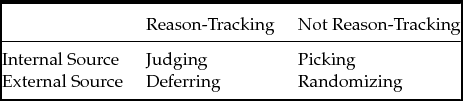
When using the options in the right column, it simply doesn't matter to the agent what she selects; all that matters is that she selects. But when using the options in the left column, the agent does believe that it matters what she selects. She does not treat all the options as indistinguishable; while she can identify no reasoned basis for distinguishing between them, she believes such a basis exists, and tries to identify a source that will allow her to access it. (She may, of course, be mistaken.) When using options in the bottom row, the agent draws upon a source outside herself to engage in NRDM, while she relies purely upon her own cognitive processes when using the top row.
5. CONDITIONS OF USE
As noted before, the four forms of NRDM are often conflated with one another. Sunstein and Ullmann-Margalit, for example, note that ‘Sometimes the difficulty of decision, or symmetry among the options, pushes people to decide on a random basis’ (Sunstein and Ullmann-Margalit Reference Sunstein and Ullmann-Margalit1999: 10). But they equate deciding on a random basis with picking; indeed, they use the latter term for both forms of NRDM. Similarly, Jon Elster claims that ‘When I know that the expected costs of gathering more information would exceed the benefits [in cases of indeterminacy], the choice is easy: I just flip a coin or consult my gut feelings’ (Elster Reference Elster1999: 289). But this only makes the choice easy if flipping a coin is equivalent to consulting gut feelings, and it is not.Footnote 21
All of this presupposes, however, that some purpose is served by distinguishing between the four forms of NRDM. And indeed, there is. Each form, I shall argue, is appropriate under different circumstances. This implies that if an agent faces indeterminacy, she does not have warrant to decide any which way she likes. Some ways will make more sense than others. But the agent will be unable to decide correctly which way makes sense without a proper understanding of her options and an assessment of their respective merits and demerits. This section will provide that assessment.
To start, recall that judging and deferring are both reason-tracking processes. An agent using one of them believes it is likely to select the option better supported by reasons, even if it does not reveal those reasons to the agent. And so the agent has reason to rely upon one of these processes if and only if the agent has reason to believe the process tracks reasons reliably. An agent might justifiably come to believe this in two ways. Both depend upon the process's ‘track record’. First, the agent might on previous occasions have discovered ex post the reasons tracked by the process ex ante. Dr Watson trusts Sherlock Holmes, even before Holmes explains his reasoning, because Holmes has eloquently explained his reasoning so many times in the past. This may also be true of judging; one might get a ‘bad feeling’ from an option only to discover later what was (justifiably) causing the feeling. In this case, one will presumably trust that same feeling in the future. But even if one never learns the reasons tracked by a process, one might still justifiably trust it if its success rate is high. If Old Man Winslow always and only gets a pain in his big toe just before it rains, one would be foolish not to carry an umbrella when the pain arises just because one cannot understand what is going on.Footnote 22
The contrast between Old Man Winslow and Sherlock Holmes demonstrates just how different authorities can be. In particular, different authorities can rely upon different strategies of decision-making, while being equally good at reason-tracking in the end. Some (Holmes) can reliably produce reasons for their decisions, which they may or may not share at some point with those they advise. Others (Winslow) may be relying upon NRDM themselves; one agent's judging thus becomes another agent's deferring. Instead of trusting my gut, I decide to trust another agent's gut (Sunstein and Ullmann-Margalit Reference Sunstein and Ullmann-Margalit1999: 19). The authority might even pick or randomize, although his credentials as an authority are liable to become suspect if word gets out.
Also, the decision to rely upon authority requires the selection of an authority upon which to rely. (Judging requires no such selection; each of us only has one gut to trust.) This selection can prove very involved and difficult. One must, after all, not only formulate a list of possible authorities, but also compare their respective abilities, both with each other and with judging. Further, one must not only consider the skill level of the authority, but its trustworthiness as well. Reliance upon authority creates a principal-agent problem, after all, and the authority may have an agenda that does not perfectly coincide with that of the agent (Sunstein and Ullmann-Margalit Reference Sunstein and Ullmann-Margalit1999: 19–20).
Once one has identified a competent and dependable reason-tracking source (whether external or internal), one can employ it to resolve indeterminacy even if the reasons being tracked never reveal themselves. But importantly, one could also use this reason-tracking source to make decisions even when indeterminacy is absent (see n. 16). Imagine, for example, a student who is contemplating cutting back on his social life so as to devote more time to his studies.Footnote 23 The student sees a number of clear, if marginal, reasons for doing so. And yet the student remains uneasy about the decision, sufficiently so that he declines to become a hermit for the purposes of studying. This is a judgment call despite the apparent lack of indeterminacy – the reasons clearly favour one option – and it might be the correct one. It is possible that the student had unconsciously identified reasons against monomaniacal studying – perhaps too much time studying would cause his attention span to lag and thus prove counterproductive – of which the student was not consciously aware. If a decision-making process, whether external or internal, does indeed track reasons, then those reasons should be able to do more than resolve indeterminacy; they should also be able to outweigh or overrule weaker reasons. It should be clear that this remains an example of NRDM, if a marginal one.
Of course, this becomes tricky when the reasons in question cannot be identified. In general, the stronger the identifiable reasons, the more confident one must in one's reason-tracking source before one could defensibly allow the latter to overrule the former. And one must always be open to the possibility that the source in question tracks, not reasons, but biases, weaknesses, or perhaps nothing at all. Perhaps the student's qualms about increased studying reflect, not a judgement about heretofore unidentified reasons, but simple laziness. But nobody ever said decision-making was easy.
In contrast with deferring and judging, both picking and randomizing abandon the possibility of resolving the indeterminacy via reasons. If either process is used, there is no pretence that one option might prove better than any other. This does not, however, render picking and randomizing indistinguishable. It would be odd if it did. For randomizing is parasitic upon picking. As Ullmann-Margalit and Morgenbesser explain, randomizing does not so much eliminate picking as ‘push the problem one step back’:
For suppose the picking situation comprises just two alternatives, A and B, and suppose that you have decided to toss a coin to settle the matter (and, indeed, that you have already somehow picked the coin that will be assigned the task). You will now have to match alternative A to heads (or tails) and B to tails (or heads). But this, of course, is inherently a matter of picking – so much so that it may deserve to be regarded as the picking situation par excellence.
‘In other words’, they conclude, ‘the very use of a random device is premised on the possibility of picking, that is on our capacity to extricate ourselves from a picking situation: the matching of each of the alternatives up for selection with some one of the possible outcomes of the device is, inherently, a matter of picking’ (Ullmann-Margalit and Morgenbesser Reference Ullmann-Margalit and Morgenbesser1977: 769–770). Randomizing does not eliminate picking entirely. Rather, it substitutes one act of picking (i.e. should option A or option B win if the coin toss comes up heads) for another (i.e. should I select option A or option B).
Thus, an agent who randomizes is always doing more than an agent who picks. She is picking plus doing something else, even if that ‘something else’ is just the procurement and use of a coin. An agent who randomizes will normally have picking available as an alternative.Footnote 24 And the final outcome of randomization will be no better than the final outcome of picking. So why would anyone ever randomize?
The answer is that randomizing can accomplish goals that picking cannot. This is true even though neither process identifies good reasons for selection. To see that this is the case, consider the following example. An agent must resolve an indeterminacy between options A and B. She picks A. If A and B were each restaurants at which the agent was considering having dinner, this would be perfectly unobjectionable. But if A and B were patients, and the agent a hospital administrator charged with deciding which of them is to receive a kidney transplant, her use of picking would seem unconscionable. A coin toss, however, might be perfectly acceptable (cf. Stone Reference Stone2012).
Why should randomizing make sense here but not picking? Both processes, after all, track no identifiable reasons. But randomizing, unlike picking, guarantees that no reasons will in fact be employed. The internal cognitive processes employed in the process of picking may not be tracking good reasons, but there is always the danger that, unbeknownst to the agent, they are actually tracking bad reasons.Footnote 25 A coin toss can thus sanitize the decision-making process – protecting against potentially unsavoury motives the agent might manifest – in ways that picking cannot. This ability to exclude bad reasons can prove useful in decision-making, especially when the allocation of scarce goods or the assignment of public responsibilities is at stake (Stone Reference Stone2007, Reference Stone2009, Reference Stone2011a).Footnote 26
Picking thus functions as the default option, the option to use when there are no good reasons for adopting some other form of NRDM. Unlike judging or deferring, it does not require the selection of a reason-tracking process, whether internal or external; it is thus available when no such process is available or cost-effective. Moreover, when there is no reason to fear bad reasons creeping into decision-making, there is no reason to prefer randomizing to picking. (And there are reasons to prefer picking to randomizing; the latter involves costs, however small, that the former does not.) Intuitively, it makes sense that picking should play this role. To use any of the other three options, one must make other decisions, some of which may prove very difficult to make. If one wishes to defer, one must identify a competent reliable authority. If one wishes to judge, one must have reason to trust one's gut not to lead one astray. If one wishes to randomize, one must select a lottery and associate each of its outcomes with one of the options available (cf. Elster Reference Elster1989: 37–38). But if one wishes to pick, one simply needs to pick.
6. SECOND-ORDER DECISION-MAKING
In distinguishing between different forms of NRDM, and describing what each can do, I am providing grounds for deciding which to use under different circumstances. In effect, I am discussing how people should decide how to decide. This makes the selection of a form of NRDM into a second-order decision – a decision ‘about the appropriate strategy for reducing the problems associated with making a first order decision’ (Sunstein and Ullmann-Margalit Reference Sunstein and Ullmann-Margalit1999: 7).Footnote 27 This fact is important, for it makes it possible to disarm one possible objection to the account of NRDM offered here. I have argued that there are different forms of NRDM, each of which makes sense in different contexts. Doesn't this imply that one could have reasons for using NRDM? And if so, isn't the reasoned use of NRDM a contradiction in terms?
The objection may be framed as follows. If an agent is justified in picking (for example) when faced with an indeterminate selection between A and B, then it would seem that the agent is justified in picking A and not B. And yet justification is all about offering reasons. Does this not imply that the agent does act upon a reason in selecting A over B? And doesn't that contradict the entire assumption motivating the idea of picking – the assumption that there is no reason to pick A over B?Footnote 28 Put another way, an agent must have motivational reasons whenever she selects A over B. She does not have normative reasons, however, if she selects A over B using NRDM. But if she is justified in using NRDM, then doesn't that mean that she does have normative reasons for selecting A over B after all?
The answer is that the reason an agent has for selecting A rather than B is of a fundamentally different type when she (say) picks A over B than when she chooses A over B.Footnote 29 To see this, consider the sort of answer the agent might give if asked to justify her behaviour. Why, one might ask her, did you select A rather than B? If the agent is choosing, her answer will look something like this: ‘A had set of reasons R in its favour, and B had set of reasons R’ in its favour, and R is a better set of reasons than R’.’ But if the agent is picking, then her answer must be of the following sort: ‘The reasons for selecting A (R) and the reasons for selecting B (R’) gave me no basis for choosing between them. But R and R’ were both clearly superior to the reasons behind any other option. I therefore had to select one of them, on pain of being irrational, but had no reasoned basis for doing so. So I used a process unrelated to reasons.’
The kind of justification that the agent can offer for herself thus differs when the behaviour being justified is NRDM or choosing. In the case of choosing, the justification is entirely in terms of the reasons supporting each option. In the case of NRDM, the justification must of necessity refer to the process of decision-making itself – specifically the breakdown in the ordinary process of acting upon reasons that takes place when indeterminacy occurs, as well as the need to overcome this indeterminacy if the fate of Buridan's Ass is to be avoided. The latter justification is thus of a higher order than the former. NRDM must be justified in terms of second-order reasons – reasons that only come into play at the level of second-order decision-making – whereas choosing can ordinarily be justified using first-order reasons (reasons relevant to first-order decision-making) only. It therefore makes sense to say that under the right circumstances, an agent can (and ought to) choose to pick (or whatever); it is important, however, to remember that in this case, the picking is a first-order decision while the choosing is a second-order decision. The reasons come into play only at the latter, not the former, level.Footnote 30
7. THE FOUNDATIONS OF NRDM
As I noted in the introduction, the account of NRDM presented here is intended to serve as part of a ‘rational agent's manual’. The ultimate purpose of any such manual is to help agents to make good decisions. It should be clear how the considerations given in this paper advance this purpose. An agent interested in making good decisions should understand what options she has when her reasoned decision-making process generates indeterminacy. Specifically, she should know what types of NRDM are available to her and how they differ from each other, so that she can select the one appropriate to her situation.
While this account of NRDM is thus intended to be practical, it also has important theoretical implications. Specifically, the account depends upon an important set of assumptions that are controversial in philosophical circles. I cannot defend those assumptions here, but before concluding, I would like to lay them out. If my account of NRDM is persuasive, then that should count as a reason in favour of these assumptions.
(1) People sometimes behave on the basis of reasons. Otherwise, the entire process of identifying the scope and limits of reasoned decision-making is a farce.
(2) People do not always behave on the basis of reasons. Reasons function as causes of human behaviour (Davidson Reference Davidson1980), but they are not the only causes. Many philosophers have rejected this claim. It is incompatible with Leibniz's principle of sufficient reason, for example, which posits that some difference must always exist in order for selection to be possible.Footnote 31 But if all causes of human behaviour were reasons, then both picking and randomizing would be impossible, and there would be little need for a theory of NRDM.Footnote 32
(3) People make mistakes. They sometimes incorrectly identify a non-reason as a reason, and vice versa. And even if they correctly perceive that something is (or is not) a reason, they might fail to treat it appropriately (due to weakness of will, for example). To use Scanlon's terminology, an agent's normative reasons (the reasons the agent ought to use) and her operative reasons (the reasons the agent does use) can diverge (Scanlon Reference Scanlon1998: 19). Were this not the case, there would be no need for a theory of NRDM (or reasoned decision-making, for that matter). Any such theory would be of merely academic interest, as it would merely catalogue what (faultlessly) reasoning agents do.
(4) People can act on the basis of reasons without recognizing what those reasons are. If this were not the case, then judging and deferring would be impossible.
(5) People can act on the basis of reasons without recognizing that they are acting on the basis of reasons. This is distinct from point 4, which holds that an agent can recognize that there are reasons for action (thanks to judging or deferring) but without understanding what those reasons are. An agent might believe that she is acting on the basis of no reasons at all while really acting on the basis of reasons. This claim is crucial to the distinction between picking and randomizing. I noted earlier that randomizing, but not picking, can ensure that an agent is not acting on the basis of unacknowledged bad reasons, and that this fact constitutes the only reason favouring randomizing over picking as a form of NRDM. If agents never acted on the basis of unacknowledged reasons, then this distinction would collapse, and randomizing would be indistinguishable from picking.
None of these claims, taken singly or collectively, should seem particularly unintuitive. And yet articulating a consistent and meaningful theory of reasoned decision-making that is compatible with all of them has proven extremely difficult. It is this difficulty that has led some to reject one or more of these claims (for example, the claim that reasons function as causes). But any workable theory of reasoned decision-making must make room for a theory of NRDM. Any such theory, I suggest, must either accept the assumptions made here or argue why a theory of NRDM can make do without them. Further work on a theory of reasoned decision-making would be helped if it took this – and the problem of NRDM more generally – into account.