In recent years, increased attention has focused on how doctoral programs prepare graduate students to become faculty members at colleges and universities. One reflection of this interest is the development of such training programs as Preparing Future Faculty (PFF), which the Association of American Colleges and Universities and the Council of Graduate Schools founded in 1993. With financial support from the Pew Charitable Trusts, the National Science Foundation, and the Atlantic Philanthropies, and with the participation of several professional associations, including the American Political Science Association, PFF has grown to include nearly 300 colleges and universities nationwide. In the recent past, 21 doctoral departments, including four from political science, have received funding for PFF. In addition to formal PFF programs, the literature on graduate education suggests that many doctoral departments have established their own training routines to assist graduate students as they prepare to teach and/or to assume faculty responsibilities.1
For articles relating to training in political science departments, see Euchner and Jewell (1989); Dolan et al. (1997); Knotts and Main (1999); Clarke et al. (2002); Mann (2002); and Simpson (2002). Additional articles about training activities in other disciplines include those by Darling and Earhart (1990); Tice et al. (1998); Poock (2001); Bartlett (2003); Lutz and Ransdell (2003); and Silverman (2003).
As the PFF web site and publications discuss, one of the central purposes of the program is to expose doctoral students to the many duties that faculty members have at institutions of higher education.2
PFF programs usually include an emphasis on learning and teaching strategies in addition to faculty training. While issues pertaining to learning and teaching are extremely important, this article focuses on faculty training. To access the PFF web site, go to www.preparing-faculty.org. For a more complete discussion of how PFF programs typically are organized, see Gaff et al. (2003).
As the reader might imagine, the intellectual challenges associated with creating programs for faculty training have led to a growing body of scholarly literature. One especially interesting effort was a 1999 survey by Golde and Dore (2001) that was based on the responses of 4,114 graduate students from 11 disciplines at 27 universities in the United States. The survey's purpose was to determine how doctoral students felt about their educational experiences and whether they believed they were properly prepared for careers in higher education. Based upon their findings, Golde and Dore concluded that doctoral programs were producing too many Ph.D. recipients for the relatively small academic job market; that graduate education places too much emphasis on research and too little on the other duties new faculty will face; and that those with a Ph.D. often struggle when they attempt to obtain non-academic jobs. These authors concluded that doctoral programs should be fundamentally restructured to provide more adequately for the needs of their students and the institutions that hire those students. A 2000 survey by the National Association of Graduate-Professional Students (NAGPS) reinforced these results, finding that both among current Ph.D. students and those who had recently received a doctoral degree over one-fourth felt they had not been adequately trained for teaching. The NAGPS survey also found that 70% of the doctoral recipients stated that their Ph.D. programs had not provided appropriate training in the skills needed for a successful academic career.
Another line of inquiry has considered how well doctoral programs prepare students for the jobs they face at the many two- and four-year colleges found throughout the United States. As Nelson and Morreale (2002) note, approximately 64% of those who find jobs in higher education do so at institutions that do not have doctoral programs and that place their primary emphasis on teaching. Nerad (2003) obtained similar results in a survey of political science Ph.D. students, finding that 72% want jobs in academia and that 10 years after graduation 66% have tenured and tenure-track faculty positions, 74% of which are in departments without a Ph.D. program. Therefore, Gaff (2002a; 2002b) argues that research regarding what non-Ph.D.-granting departments want when hiring new faculty should be an especially important consideration when designing doctoral programs.
Interestingly, those who write about faculty needs at smaller colleges reach varying conclusions. One school of thought suggests that teaching and student service activities are of paramount importance in a liberal arts setting. Meacham (2002) notes that the demand is for faculty with a strong commitment to teaching, who are prepared to spend long hours advising students and working with student organizations, and who are constantly seeking to find new ways to use technology and simulations to enliven their teaching. According to these writers, professors describe faculty research as a lower priority at small colleges, especially when compared to larger universities. Adams (2002) and Kolmerten (2005) agree with these observations. Fuerstman and Lavertu (2005) lend empirical support to these views, finding in their survey of political science department chairs that teaching experience is a higher priority and publications are of lesser importance in hiring decisions when comparing departments that do not offer the doctoral degree with those that do.
Some authors, however, disagree with these contentions regarding the limited interest in research at liberal arts colleges. For example, Deardorff et al. (2001, 856) state that “one misconception about liberal arts colleges … involve[s] expectations about research … quality research is valued,” and Durfee (1999) discusses the importance of retaining an active research agenda while a faculty member at a small college.
While these discussions on what various colleges and universities seek when hiring faculty are interesting, it is important to point out that, with the exception of Fuerstman and Lavertu, the research to date has been based on informal surveys from a very limited sample of institutions, as was the case with Meacham's analysis. The research can also reflect personal experiences at a small number of colleges, as was true for Kolmerten; Deardorff et al.; and Durfee. It is important to note that there is a dearth of information on the professional skills differing types of colleges and universities look for when hiring new faculty. If we are to build faculty training programs on a proper foundation, we need data from a more systematic survey of faculty needs at varying institutions of higher education. The research reported herein serves as a step down that road by reporting the results from a survey of political science department chairs from across the United States.
Survey and Results
The survey that provided the data for this essay was conducted by the authors by mail between October and December 2005. Questionnaires were sent to 1,256 political science department chairs. The APSA provided the names and addresses.3
The APSA list may not include some political science departments. Therefore, the reader should understand that the survey results herein may reflect bias due to the omission of some departments. Addresses and other information provided by the APSA, however, have been used in several previous surveys, including those by Euchner and Jewell (1989); Dolan et al. (1997); and Fuerstman and Lavertu (2005).
Since the responses were anonymous, it was not possible to compare the characteristics of respondents and non-respondents.
Each department chair received two questionnaires. The first asked whether several specific types of graduate training in four basic areas would increase the probability that their department would hire an applicant as a new faculty member. The four areas were: teacher preparation; student life; recruitment and retention; and administration. In addition, there was a category on research activities.5
As the discussion thus far has indicated, teacher preparation is a central component of faculty training programs, while anecdotal evidence suggests that student life, recruitment and retention, and administrative responsibilities are expected of faculty at many colleges. For example, Meacham (2002) describes these areas as key parts of the faculty experience at smaller colleges, and Deardorff et al. (2001, 857) report that “advising is an extraordinarily important activity at liberal arts colleges.” In addition, the author's personal experience as a faculty member at a small liberal arts college indicates that teaching, student life, recruitment and retention, and administrative duties often are expected of faculty at such institutions.
Table 1 summarizes the results regarding new faculty hiring preferences. The figures are the proportions of the responding chairs who indicated that a particular type of training would increase the chance someone would be hired in their departments. In reading the table, it should be noted that the responses from all departments offering some type of bachelor's degree are grouped under the B.A. label and that the format is the same for the varying master's and doctoral degree programs. Keep in mind the sample sizes mentioned above (197 for B.A., 44 for M.A., and 49 for Ph.D.).
Training Preferences for New Faculty

The most important thing to note from these results is the strong emphasis placed on actual teaching experience. The overwhelming majority of all department types indicated that teaching introductory and advanced classes would play an important role in hiring decisions. B.A. and M.A. departments also showed a strong preference for training relating to student writing, to the use of technology in the classroom, and to undergraduate advising. In addition, B.A. and M.A. programs regarded a teaching mentoring program and a course on how to teach political science as desirable. As one might expect from reading the faculty training literature, Ph.D. programs were far less interested in these other forms of preparation when hiring new faculty.
Additional results of interest pertain to the more modest levels of demand for Internet, legal, ethical, diversity, study abroad, and internship training. In no case did a majority of the responding departments display a preference for these forms of preparation, which is somewhat surprising when one considers the attention these issues attract in many of the media's discussions of higher education. The almost complete lack of interest in workshops on substance abuse also suggests that the widespread concern with this issue is not perceived as important when selecting new faculty.
As for service-related preparation, the findings reveal that only a handful of departments have much interest in any of these activities. Programs that have graduate students shadow faculty members appear to do little to enhance employment prospects. The same is true for attending faculty or committee meetings; engaging in enrichment activities; planning conferences or orientation programs; helping with recruitment; or becoming familiar with administrative duties.
One especially interesting result, given the divisions in the literature described above, is the emphasis on research when hiring. The preference for new faculty who have presented a paper or published an article is uniform across all departments. There also is an interest in those who have published a book, even among B.A.-granting departments. These results are directly contrary to what some writers say when discussing institutions that focus on undergraduate education. Two factors may explain this uniform desire for faculty who publish. The first is the strong graduate school socialization experience that stresses publishing. This may affect the faculty members' values throughout their professional careers, no matter what type of department they join. The second is the possibility that B.A. and M.A. departments believe faculty publications enhance their statures as they recruit students.
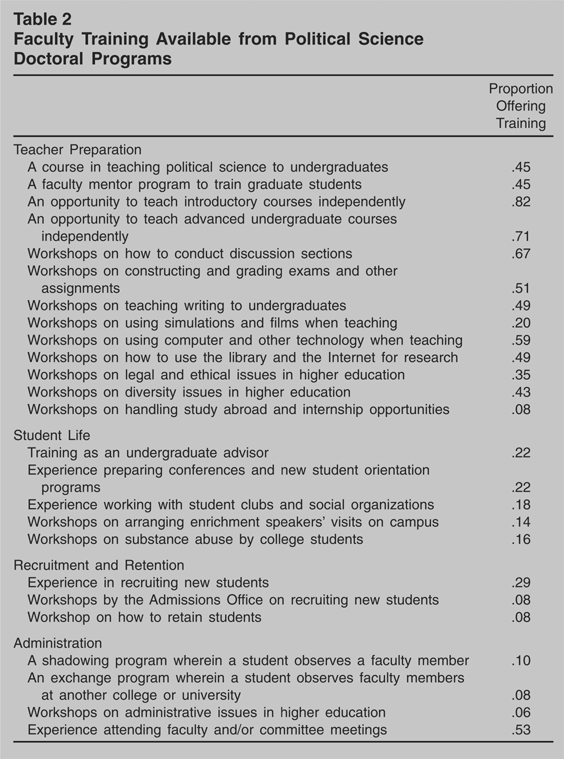
The second set of results pertains to the faculty training activities available from political science doctoral programs. The data in Table 2 reveal that in some areas doctoral programs' training matches what most departments say they look for in new faculty. For example, a large proportion of Ph.D. programs offer independent teaching opportunities. A sizable number also provide training in the use of technology in the classroom, another area that many of those who hire regard as important. In addition, a substantial number of departments offer workshops on handling discussion sections and grading. One reason these types of training are so prevalent may relate to Ph.D. departments' self interests because they uphold the graduate assistant model that provides help with teaching duties. It prepares graduate students to assist with those duties, thereby allowing graduate students to assume a portion of the department's teaching workload.
Faculty Training Available from Political Science Doctoral Programs

Table 2 indicates, however, that fewer doctoral institutions provide a course on teaching undergraduates, a teacher mentor program, an opportunity to learn how to teach writing, or training as an advisor. Bachelor's and master's departments described all of these as important, but they would make a more limited contribution to the Ph.D. department's teaching mission. Finally, although Ph.D. programs sometimes allow graduate students to attend faculty and committee meetings, other types of service experiences are not typically featured in most Ph.D. departments. Shadowing faculty members, either at the home university or at another institution, and workshops that address administration are relatively rare—appearing in no more than 10% of the responding departments. This pattern of results suggests that many doctoral departments continue to envision their primary goal as preparing graduate students as researchers and that other types of professional training have been embraced only when that training contributes to the Ph.D. department's own teaching needs.
Discussion
The above results point to several conclusions about the preparation of future faculty in political science. The first is that there is a considerable demand from bachelor's and master's program positions for candidates with extensive training in teaching. Since these departments make up the bulk of the employment opportunities in higher education, doctoral programs would be well-advised to put more emphasis on this area if they wish to find employment for their graduates. The typical activities associated with PFF programs provide a useful starting point, but additional training relating to writing instruction for undergraduates, the use of technology in the classroom, and student advising also should be included.
A second conclusion pertains to service training. While Golde and Dore's (2001) research indicated that graduate students appreciate these types of activities, the results from the current survey show that few departments, whether bachelor's, master's, or doctoral, place much emphasis on such instruction when looking for new faculty. Hence, if a department's resources are so thinly stretched that choices must be made, Ph.D. programs should consider putting an emphasis on enhancing teacher preparation instead of on service.
A third conclusion has to do with research. Contrary to what one sometimes hears and reads about bachelor's departments, the results herein show that there is a strong interest in research and publishing throughout the profession. The overwhelming majority of all types of departments indicated that presenting papers at conferences, publishing articles and book chapters, and writing books would enhance a candidate's chance of securing a job at their college or university. Therefore, recent doctoral degree recipients who seek a career in higher education should focus on acquiring these credentials no matter where they plan to seek employment.
Before closing, it should be noted that the results from this survey apply to two of the recommendations found in the “2004 Report to the APSA Council” by the APSA Task Force on Graduate Education. In this report, the Task Force calls for political science doctoral programs to emphasize diversity and instruction in professional ethics. Regarding diversity, the Task Force writes of the profound call to doctoral programs to display sensitivity toward minority students' needs, to provide them with proper support structures, and to ensure that they have appropriate faculty mentoring systems. It also recommended that such a “program could be extended to the undergraduate level” (APSA 2004, 7). If departments, both graduate and undergraduate, are to meet these goals, one might argue that it would be valuable for doctoral programs to provide graduate students with diversity training and for departments of all types to place an emphasis on such training when hiring. The results from the present survey show, however, that only a minority (43%) of doctoral programs provide diversity training at present and that the majority of each type of department does not currently rank diversity training as a key consideration when hiring. Thus, while the profession as a whole has made some progress in this area, a lot of work remains.
As for ethics, the Task Force observes that “for those entering the profession, it is often less clear just what their obligations and prerogatives are,” and maintains that “all departments must strive to convey concrete standards of professional ethics to their graduate students” (APSA 2004, 7). Despite these concerns, the results herein show that only a little more than a third of the responding doctoral departments offer ethical training to graduate students and that in no case does a majority of the responding departments look for such training when hiring new faculty. These findings clearly show that the profession needs to place a greater emphasis on this issue.
In conclusion, faculty training programs are one of many factors that need to be addressed to ensure that American colleges and universities will continue to provide the quality education students need in an increasingly globalized environment. If these programs are to be useful, it is important that they are built upon a firm foundation of empirical research so that they meet the needs of students and departments to the greatest extent possible. The current research was designed to serve as a step in that direction.
Author Bios
John M. Rothgeb, Jr. is professor of political science and distinguished scholar of the Graduate School at Miami University. He is the author of five books and numerous articles regarding international theory and international political economy. At present, he is preparing a survey of the tenure requirements in political science departments.
Annemarie Spadafore is a graduate student in the doctoral program in political science at Miami University. She currently holds a Fulbright Fellowship and is writing a dissertation on the Boeing-Airbus controversy.
Betsy Burger is an administrative assistant for the graduate program in political science at Miami University. She currently is assisting with a survey of the tenure requirements in political science departments.