I. INTRODUCTION
Magnesium and its alloys, the lightest metal structural materials, have been used in the fields of transportation for vehicle lightening, because of their unique characteristics such as low density, high specific strength, and damping capacity. Reference Harooni, Carlson, Strohmeier and Kovacevic1–Reference Subravel, Padmanaban and Balasubramanian5 The steels are still dominant metal materials in the transport industry today. The ultra-high strength steel can not only achieve auto lightweight but also increase its collision safety performance, and is increasingly applied in automobile industry. Therefore, the hybrid structure of Mg alloy to ultra-high strength steel has a widely applied prospect in the field of transportation, and it has received remarkable attention to join Mg alloy and steel dissimilar metals.
There are some difficulties encountered in dissimilar welding of Mg alloy and steel, which mainly result from the huge difference between their melting points (649 °C for Mg and 1535 °C for Fe) and the nearly zero solubility of Mg and Fe. Reference Cao and Jahazi6 In addition, Mg and Fe do not react with each other to form binary compounds at ambient pressure. Reference Watanabe, Kagiya, Yanagisawa and Tanabe7 The diffusion welding, Reference Elthalabawy and Khan8,Reference Schneider, Weinberger, Inoue, Koseki and Enzinger9 friction stir welding, Reference Cao and Jahazi6,Reference Liu, Xiao, Feng, Li, Esmaeili and Zhou10 and resistance spot welding Reference Liu, Xiao, Feng, Tian, Zhou and Zhou11 were used to join Mg alloy and steel. However, their application is limited by the geometry and size of workpiece. The hybrid laser-TIG welding Reference Qi and Song12–Reference Liu and Qi15 and laser penetration brazing (LPB) Reference Miao, Han, Yao and Li16,Reference Miao, Han, Yao and Li17 were also used for joining Mg alloy to steel. The results showed that the Ni interlayer favors improving the microstructure and tensile shear strength of Mg-steel joints produced by the hybrid laser-TIG welding. For the LPB, the transition layer at Mg/steel interface region consisted mainly of intermetallic compounds and metal oxides, and the joint strength reached a maximum of 185 MPa at 0.6 mm laser offset.
Metal inert-gas arc welding (MIG Welding) is widely applied in automotive industries due to its high efficiency, low cost, and good applicability. Wang investigated MIG welding of AZ31B Mg alloy and Q235 low carbon steel. The results indicated that Mg/steel interface zone was one of main factors affecting joint properties. Reference Wang, Sun and Sun18,Reference Wang, Sun, Sun and Ding19 The present work investigates MIG welding of AZ31B Mg alloy and SYG960E ultra-high strength steel using different welding heat inputs and filler metals. Its purpose is to better understand the weldability of Mg alloy and steel, and to provide some foundation for improving mechanical properties of the Mg-steel joints.
II. EXPERIMENTAL
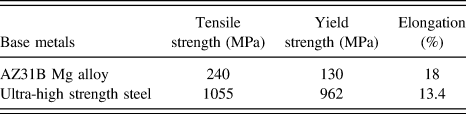
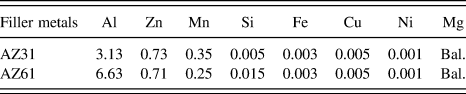
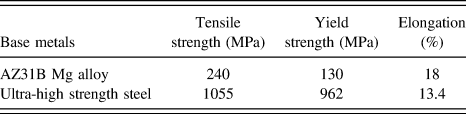
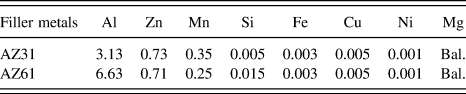
In this investigation, AZ31B Mg alloy (Mg–3.4Al–0.7Zn wt%) and SYG960E ultra-high strength steel (Fe–0.18C–0.27Si–1.36Mn–0.46Cr–0.38Mo wt%) were used as base metals, and the dimensions of test plates for both base metals were 150 × 50 × 4 mm. The Mg alloy welding wires (AZ31 and AZ61) with a diameter of 1.6 mm were chosen as filler metals. Mechanical properties of base metals and chemical compositions of filler metals are listed in Tables I and II, respectively.
Mechanical properties of base metals.
Chemical compositions of filler metals.
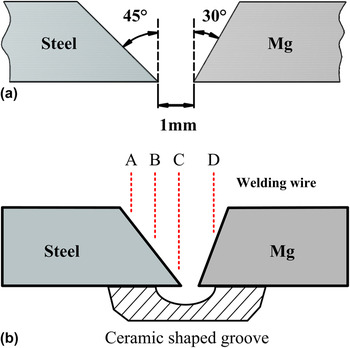
Prior to welding, the groove was machined on the Mg alloy and ultra-high strength steel test plates respectively, the groove angle being 30° for Mg alloy. The groove angle of 0°, 30°, and 45° was machined on the steel to evaluate its effect on weld appearance. Both Mg and steel test plates were assembled in butt configuration to form a single V-groove with a root opening of 1 mm, as shown in Fig. 1(a).
V-groove of MIG welding (a) and different positions of welding wire (b).

The welding of Mg alloy and ultra-high strength steel was carried out using automatic metal inert-gas arc welding (MIG welding). During the MIG welding, the filler metal was deposited in the V-groove with the welding current of 90–120 A, welding speed of 40–60 cm/min and Ar shielding gas flowing of 16–18 L/min. In the experiment, the welding wire position was changed for A, B, C, and D to evaluate its effect on the weld appearance, as shown in Fig. 1(b).
After welding, Mg-steel joint specimens were cut into dimensions of 15 × 10 × 4 mm vertical to the welds, and then were ground, polished, and etched with a solution of 4.2 g picric acid, 10 mL acetic acid, and 70 mL ethanol for metallographic examination. The microstructures and compositions of the Mg-steel joints were examined using optical microscope (OM; PMG3, Olympus Optical Co. Ltd., Tokyo, Japan), scanning electron microscope (SEM; EVO18, Carl Zeiss, Oberkochen, Germany) equipped with energy dispersive X-ray spectroscopy (EDS; Link-ISIS, Oxford Instruments, Oxfordshire, United Kingdom), transmission electron microscopy (TEM; JEM-2100F, JEOL Ltd., Tokyo, Japan) and X-ray diffraction (XRD; D/Max 2500 PC, Rigaku Corporation, Tokyo, Japan). The micro-hardness of the joints was measured at a load of 50 g and dwell time of 10 s. The tensile tests were carried out by means of MTS 810 material test system at room temperature. The joint strength was determined based on the average value of three measurements per condition. After the tensile tests, the fractured surface of Mg-steel joints was examined by SEM.
III. RESULTS AND DISCUSSION
A. Effects of welding condition
The appearance of weld is one of important factors to evaluate welding quality. The effect of welding condition on the weld appearance was studied firstly in this experiment. The results indicated that the angle of groove on steel base metal and position of welding wire (welding torch) had great effect on the weld appearance for MIG welding of AZ31B Mg alloy and SYG960E ultra-high strength steel.
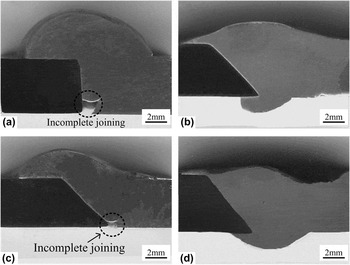
Prior to MIG welding, the steel and Mg test plates were assembled into a single-V groove. The weld appearance was studied by changing the groove angles (0°, 30,° and 45°) on steel base metal and welding wire positions shown in Fig. 1(b). At the groove angle of 0°, the weld had a bad appearance, the larger reinforcement in steel side and incomplete joining defect at bottom of weld [Fig. 2(a)]. When the groove angle was increased to 30°, the weld appearance was improved, but the root reinforcement was relatively small. The satisfactory weld appearance was obtained when the groove angle was 45°. The liquid Mg alloy spread uniformly on the steel groove surface, and the suitable reinforcement and root reinforcement were formed, as shown in Fig. 2(b). These results suggested that it is favorable to select the groove angle of 45° on steel base metal for improving the weld appearance.
Weld appearances produced in different groove angles and welding wire positions: (a) groove angle of 0°, (b) groove angle of 45°, (c) wire position A, (d) position D.

Under the condition of groove angle of 45°on steel base metal, the effects of welding wire position were studied. When the welding wire was in position A (aiming at the top of steel groove), the incomplete joining defect was observed at bottom of weld [Fig. 2(c)]. It can be explained by the bottom of steel groove having lower peak temperature of weld thermal cycle than the top of steel groove, affecting the spreading of molten Mg on steel groove bottom. The weld appearance was improved at position B of welding wire (aiming at the middle of steel groove). The groove surface was more evenly heated, eliminating the incomplete joining defect at bottom of weld. When the welding wires were in the position C (groove root) and position D (middle of Mg groove), the incompletely filled weld and undercut defects occurred at Mg alloy side [Fig. 2(d)], which deteriorates not only the weld appearance but also Mg-steel joint properties.
Based on results above, it is necessary to select suitable groove angle and welding wire position, and it is favorable to use the groove angle of 45° on steel base metal and put the welding wire aiming at the middle of steel groove for improving the weld appearance and mechanical properties of Mg-steel joints.
B. Microstructures of Mg-steel joints
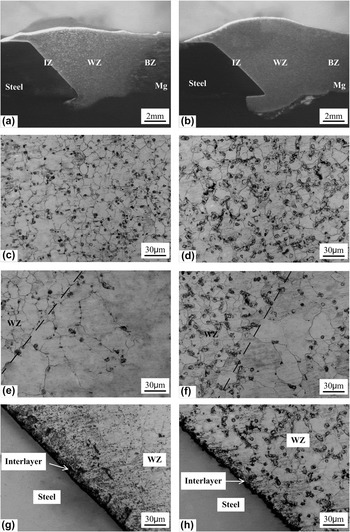
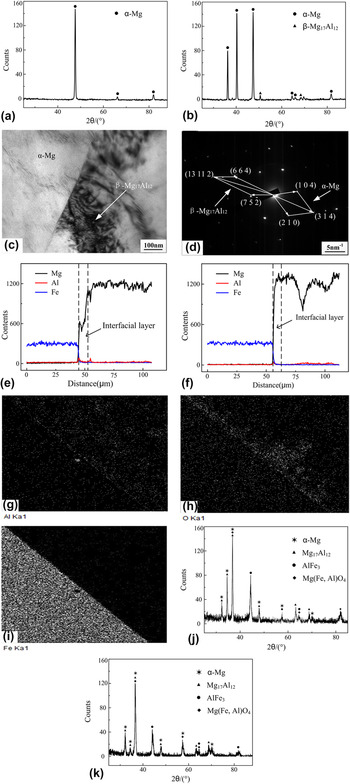
Figure 3 illustrate cross-sections and microstructures of MIG welded joints of AZ31B magnesium alloy and SYG960E ultra-high strength steel using AZ31 and AZ61 filler metals, respectively. Figure 4 shows XRD and EDS analysis results of the joints. From Figs. 3(a) and 3(b) it can be seen that during MIG welding, the filler metal and Mg base metal were molten to form the weld and bond zone at Mg base metal side while the ultra-high strength steel remained solid. The Mg alloy was joined to steel by wetting and spreading of molten Mg on steel surface to form brazing interface layer. Therefore, the Mg-steel joints have a fusion welding characteristic at the Mg alloy side and a brazing characteristic at the ultra-high strength steel side. According to the welding-brazing characteristics, the Mg-steel joints can be divided into the weld zone (WZ), bond zone (BZ), and interface zone (IZ).
The cross-section and microstructures of Mg-steel joints with AZ31 and AZ61 filler metals respectively: (a) joint cross-section (AZ31), (b) joint cross-section (AZ61), (c) weld zone (AZ31), (d) weld zone (AZ61), (e) bond zone (AZ31), (f) bond zone (AZ61), (g) interface zone (AZ31) and (h) interface zone (AZ61).

TEM, XRD and EDS results of Mg-steel joints with AZ31 and AZ61 filler metals respectively: (a) weld XRD (AZ31), (b) weld XRD (AZ61), (c) TEM image, (d) SEAD, (e) EDS linear scanning (AZ31), (f) EDS linear scanning (AZ61), (g) EDS area scanning (Al), (h) EDS area scanning (O), (i) EDS area scanning (Fe), (j) interface zone XRD (AZ31) and (k) interface zone XRD (AZ61).

Experimental results indicated that the chemical composition of welds depends on that of filler metals. With the AZ31 filler metal the weld Al content was 3.18%, and it increased to 6.24% when the AZ61 filler metal was used. Figures 3(c) and 3(d) show microstructures of weld zones with AZ31 and AZ61 filler metals, respectively. As can be seen, the welds have an equiaxed grain structure and their grain is finer than the Mg base metal due to the weld metal having very quick cooling rates. From XRD analysis results shown in Fig. 4, the weld produced with AZ31 filler metal mainly consists of α-Mg solid solution [Fig. 4(a)], and it contains α-Mg and β-Mg17Al12 intermetallic compound when AZ61 filler metal is used, as shown in Fig. 4(b). In this investigation, it was found that the weld with AZ31 filler metal contained the eutectic structure. Figures 4(c) and 4(d) illustrate TEM bright field image and selected area diffraction (SEAD) patterns of the weld with AZ31 filler metal. From Figs. 4(c) and 4(d) the eutectic structure consisting of alternating laminas of α-Mg and β-Mg17Al12 was identified in α-Mg grain boundaries, which is related to characteristics of weld solidification. With the growth of α-Mg grains, the solute Al was rejected into the liquid between α-Mg grains. Since higher cool rates of weld allowed less time for diffusion of the rejected solute, the Al concentration raised in the liquid, resulting in that the eutectic reaction occurred to form α-Mg and β-Mg17Al12 in α-Mg grain boundaries when the temperature was lowered just below eutectic temperature. Figures 3(e) and 3(f) show microstructures of bond zones with AZ31 and AZ61 filler metals. As can be seen, the welds have good metallurgical bond with Mg base metal without welding defects such as lack of fusion and cracks in the bond zones.
From Figs. 3(g) and 3(h) it can be seen that there exists an evident interface transition zone between Mg weld and steel base metal. Figures 4(e) and 4(f) show EDS linear scanning analysis results across the interface zones with AZ31 and AZ61 filler metals, respectively. From steel side to Mg weld side, the Mg concentration increased, the Fe concentration decreased and the Al concentration had an increased tendency in the interface zones, demonstrating that the diffusion of Mg, Fe, and Al occurred in the interface zone during MIG welding. EDS area scanning results indicated that the interface zone is rich in Al in steel side and O in Mg weld side, as shown in Figs. 4(g) and 4(h). The Micro-X-ray diffraction was used to identify phase compositions of interface zones. Figures 4(j) and 4(k) show XRD results of interface zones with AZ31 and AZ61 filler metals. The AlFe3, Mg(Fe, Al)O4, and Mg3.1Al0.9 phases were detected in the interface zones, indicating that the interface reaction happened to form intermetallic compounds (IMCs) and metal oxide during MIG welding.
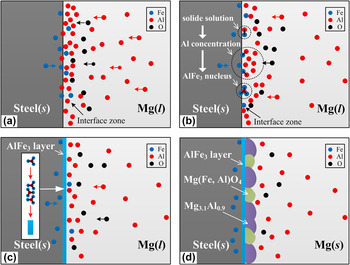
Based on results above, it is concluded that the Mg/steel interface reaction is necessary for joining Mg alloy to ultra-high strength steel, the Al plays an important role in the joining because Mg and Fe do not react with each other to form binary compounds, and the Mg/steel interface zone has a double-layer structures: the AlFe3 IMC layer at steel base metal side and the Mg(Fe, Al)O4 + Mg3.1Al0.9 layer at Mg weld side. The microstructure evolution process of the interface zone can be summarized as follows:
-
(i) The initial stage: the molten magnesium alloy wetted and spread on the surface of solid steel and the diffusion of Al, Fe, Mg, and O atoms occurred at Mg/steel interface zone under the action of concentration gradient. As the diffusion activation energy of Al atom in solid steel was larger than that of Fe atom in liquid magnesium, the accumulation of Al atom in the interface zone was relatively easier, as shown in Fig. 5(a).
-
(ii) The nucleation stage of AlFe3: with the accumulation of Al atom, the supersaturated solid solution formed firstly at Mg/steel interface. When the Al concentration in the solid solution reached a certain degree, it transformed into AlFe3 nucleus at the interface, as shown in Fig. 5(b).
-
(iii) The formation stage of AlFe3 layer: with further diffusion of Al and Fe, the AlFe3 nucleus grew up and the neighboring nucleus were connected together to form continuous AlFe3 intermetallic compound layer, as shown in Fig. 5(c).
-
(iv) The formation stage of interface zone: the Mg(Fe, Al)O4 and Mg3.1Al0.9 phases initiated on the formed AlFe3 layer surface near weld pool, because not only this region was rich in Mg, Al, O, and Fe but also the energy for nucleation in this case was relatively low. With their growth, the interface zone consisting of AlFe3 layer and Mg(Fe, Al)O4 + Mg3.1Al0.9 layer formed between Mg weld and steel base metal, as shown in Fig. 5(d).
Microstructure evolution process of the interface zone: (a) the initial stage, (b) the nucleation stage of AlFe3, (c) the formation stage of AlFe3 layer, (d) the formation stage of interface zone.

C. Mechanical properties of Mg-steel joints
1. Joint micro-hardness
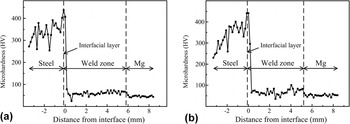
Figure 6 shows the micro-hardness profiles of Mg-steel joints produced with AZ31 and AZ61 filler metals respectively. As can be seen, the micro-hardness distribution was uneven across the joints. The average hardness values of Mg and steel base metals are 52.6 and 325.8 HV, respectively. The hardness of weld zones is higher than Mg base metal due to their grain refining. The weld with AZ61 filler metal has higher hardness (72 HV) compared with that (65 HV) with AZ31 filler metal, which is attributed to the Mg17Al12 intermetallic compound distributing in α-Mg grain boundaries. The maximum hardness value (440 HV) of Mg-steel joints appeared at the Mg/steel interface zone because it consists mainly of intermetallic compounds (AlFe3 and Mg3.1Al0.9) and metal oxide (Mg(Fe, Al)O4).
Micro-hardness distributions of joints with AZ31 and AZ61 filler metals: (a) AZ31 and (b) AZ61.

2. Joint strength
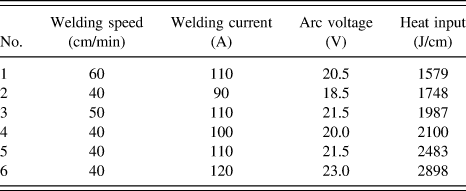
The joint strength of Mg alloy and ultra-high strength steel was studied with different welding parameters listed in Table III. The experimental results indicated that the welding heat input has a significant effect on the tensile strength of Mg-steel joints. The welding heat input (E) represents the amount of heat input per unit length of weld, and is determined according
 $$E = {{\eta IU} \mathord{\left/ {\vphantom {{\eta IU} v}} \right. \kern-\nulldelimiterspace} v}{\rm{\quad ,}}$$
where I is the welding current, U is the arc voltage, v is the welding speed, and η is the heat source efficiency, a constant of 0.7 for the MIG welding process.
MIG welding parameters used in this investigation.
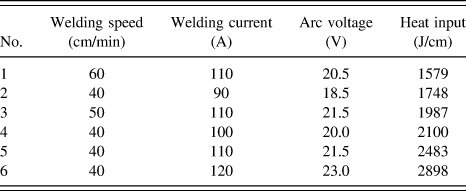
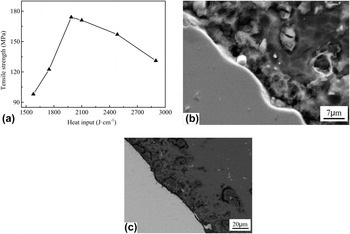
Figure 7(a) shows the tensile strength of Mg-steel joints as a function of welding heat input with AZ31 filler metal. At low heat input of 1579 J/cm, the joint strength was poor (98 MPa). It was mainly attributed to forming incomplete joining defect in the Mg/steel interface zone [Fig. 7(b)] due to the low heat input resulting in insufficient interface reaction. With an increase of heat input, the tensile strength of the joints increased, and it reached 171–174 MPa when the heat inputs were 1987–2100 J/cm. Further increasing the heat input, the joint strength decreased. When the heat input was increased to 2898 J/cm, the joint strength was decreased to 131 MPa and cracks were observed in the interface zone, as shown in Fig. 7(c), which is related to the excessive heat input accelerating growth of brittle Al-Fe IMC and metal oxides in the interface zone, and enhancing the tensile stress in the joints. They not only provided preferential sites for the initiation and propagation of cracks but also decreased the effective cross-sectional area of the joints, and hence the joint strength deteriorated seriously. The joint fracture mainly occurred at the Mg/steel interface zone, indicating that it is the weakest link in the Mg-steel joints. Therefore, it is necessary to select suitable welding heat input of 1987–2100 J/cm for improving the tensile strength of Mg-steel joints.
The effect of welding heat input on tensile strength of joints with AZ31 filler metal (a), and welding defects in Mg/steel interface zone: (b) incomplete joining and (c) cracks.

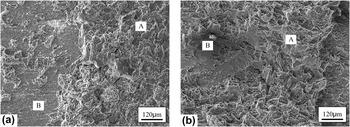
In this investigation, it was found that weld Al content also has a significant effect on the tensile strength of Mg-steel joints. When the AZ61 filler metal was used, the weld Al content was increased to 6.24% and the joint strength reached 201 MPa, 83.8% of Mg alloy base metal. To further clarify reason for joint strength change, the fracture surfaces of Mg-steel joints were investigated. Figure 8 shows the fracture surface morphology of Mg-steel joints produced with AZ31 and AZ61 filler metals, respectively. As can be seen, the fracture surfaces can be divided into two regions, region A and region B. In region A, a large amount of retained Mg alloys on the steel surface and features of plastic deformation are observed, indicating that the joining of Mg alloy and steel is realized in this region. The fracture surface of region B is relatively smooth with less retained Mg alloy, which means that Mg alloy and steel is joined partially due to forming incomplete joining defects in this region. From the fracture surface characteristics, the Mg-steel joint with AZ31 filler metal has much more incomplete joining defects in the interface zone [Fig. 8(a)] than that with AZ61 filler metal [Fig. 8(b)]. Therefore, the increased joint strength with AZ61 filler metal is mainly related to the increased weld Al content promoting Mg/steel interface reaction and decreasing incomplete joining defects in the interface zone. Based on the results above, suitable welding heat input of 1987–2100 J/cm and increase weld Al content of 6.24% for improving the dissimilar joint strength.
Fracture surface morphologies of Mg-steel joints with AZ31 and AZ61 filler metals: (a) AZ31 and (b) AZ61.

IV. CONCLUSIONS
-
(1) The welding groove angle and welding wire position have a significant effect on weld appearance for dissimilar MIG welding of AZ31B magnesium alloy and SYG960E ultra-high strength steel. It is favorable to use the groove angle of 45° on steel base metal and put the welding wire toward the middle of steel groove for improving the weld appearance.
-
(2) The Mg-steel joints have dual characteristics of welding-brazing and include the weld zone, bond zone and Mg/steel interface zone. The weld zone has a fine equiaxed grain structure and its composition and microstructure depend on the filler metals. With AZ31 filler metal, weld Al content is 3.18% and its microstructure mainly consists of α-Mg. With AZ61 filler metal, weld Al content is increased to 6.24% and its microstructure contains α-Mg and β-Mg17Al12. The Mg/steel interface reaction is necessary for the joining of Mg and steel. The Mg/steel interface zone has a double-layer structures: the AlFe3 IMC layer at steel base metal side and the Mg(Fe, Al)O4 + Mg3.1Al0.9 layer at Mg weld side. It is favorable to increase weld Al content (6.24%) for promoting the interface reaction to eliminate incomplete joining defects in the interface zone.
-
(3) The micro-hardness distribution of Mg-steel joints is uneven and the maximum hardness value of 440 HV appears at the interface zone. The joint strength increases with increasing heat input due to promoting the interface reaction, but the excessive heat input conversely results in decreasing the joint strength due to the increase of brittle phases, tensile stress and cracking sensitivity in the interface zone. With AZ31 filler metal, the joint strength reaches 171–174 MPa with the heat input of 1987–2100 J/cm, and AZ61 filler metal increases the joint strength to 201 MPa, 83.8% of Mg alloy base metal. Suitable welding heat input of 1987–2100 J/cm and suitable weld Al content of 6.24% are favorable for improving the tensile strength of the dissimilar joints.
ACKNOWLEDGMENTS
The authors would like to thank National Natural Science Foundation of China (No. 51275204) for the financial support.