Children born with congenital heart disease (CHD) now have an increased chance of long-term survival thanks to advances in surgical techniques.Reference Mahle 1 Despite these improvements, children undergoing cardiac surgery procedures with cardiopulmonary bypass remain at risk for neurological injury.Reference Hovels-Gurich, Seghaye and Dabritz 2 , Reference Miller, Eggli, Constant, Baylen and Myers 3 Studies have shown that a small percentage (2.3–5.9%) of the patients have acute perioperative events, ranging from transient seizure with no long-term sequelae to permanent and severe neurological disabilities.Reference Fallon, Aparicio, Elliott and Kirkham 4 – Reference Menach, du Plessis, Wessel, Jonas and Newburger 7 However, a significantly larger proportion is at risk of longer-term educational and behavioural difficulties, with a pattern of neurodevelopmental problems similar to that seen with preterm infants.Reference Samango-Sprouse and Suddaby 8 – Reference Bellinger, Wypij and Rivkin 10 Although it is well established that children with CHD are at risk of longer-term educational and behavioural difficulties, these are often not identified until the child reaches school age, and predictors of these outcomes have not been well established.
A previous study conducted by our groupReference Robertson, Justo, Burke, Pohlner, Graham and Colditz 11 prospectively examined a cohort of infants who underwent cardiac surgery with cardiopulmonary bypass between 1999 and 2001. A total of 47 infants were enrolled before cardiac surgery and underwent detailed preoperative neurodevelopmental assessment and postoperative monitoring, with 35 of them undergoing follow-up neurodevelopmental assessment at 1 year. The primary aim was to assess the power of perioperative markers associated with neurological injury – electroencephalographic abnormalities, reduced cerebral arterial blood flow velocity, and elevated serum S-100B levels – to predict neurological outcomes at 1 year of age. At 1-year follow-up, there were lower neurodevelopmental scores compared with the preoperative assessments (mean mental scores changing from 103±5 to 04±13 (p=0.001), and mean motor scores changing from 99±8 to 89±20 (p=0.004)). However, no association was found between electroencephalographic abnormalities, reduced cerebral arterial blood flow velocity or elevated serum S-100B levels, and impaired neurodevelopmental outcome.
This aim of the current study was to assess the neurodevelopmental status of this cohort of children 6 years following their surgery as infants. Specifically, outcomes of interest included current level of cognitive functioning or intelligence, memory and learning skills, level of academic achievement, and executive function, as well as behavioural and psychological functioning. A secondary aim was to determine whether there was any correlation between perioperative risk factors, previous developmental factors, and current level of functioning.
Materials and methods
Participants
The study is a prospective cohort study and involved the long-term follow-up of a previously assessed cohort 6 years following cardiac surgery. Parents of participants who had been enrolled in the previous study were contacted and their children invited to participate in the follow-up study.
The initial study involved 47 infants with structural heart disease aged 16 days–4 months, admitted for cardiac surgery requiring cardiopulmonary bypass at the Prince Charles Hospital, Brisbane, Australia. Exclusion criteria were: known chromosomal abnormalities, associated extracardiac malformations, or an abnormal neurological examination. Of the 47 infants, 35 children had been followed up to 12 months of age.
Procedure
At study commencement, data were obtained on demographic – age, weight, gestational age – anatomical, and surgical details – cardiac diagnosis, surgical details, requirement for further surgery. In addition, neurodevelopmental data were collated from the first study.
All participating children underwent a detailed psychometric assessment performed by two trained neuropsychologists. Parents were asked to complete the questionnaires while their child was being assessed. Family socio-economic status was also assessed with parental questionnaires.
Measures
Cognitive function
The Wechsler Primary and Preschool Scale of Intelligence – third editionReference Wechsler 12 was used to assess intellectual abilities, which in addition to Full-Scale Intelligence Quotient assesses verbal and non-verbal cognitive functioning and speed of information processing. Outcome measures included Full-Scale Intelligence Quotient, Verbal Intelligence Quotient, Performance Intelligence Quotient, and the Processing Speed Quotient (Mean=100, standard deviation=15).
Memory and learning
Wide Range Assessment of Memory and Learning – second editionReference Sheslow and Adams 13 was used to assess verbal and visual memory and learning, and the recognition of the same information. Outcome measures included a General Memory composite, and a General Recognition Composite (Mean=100, standard deviation=15).
Academic achievement
The Abbreviated Wechsler Individual Achievement Test – second editionReference Weschler 14 was used as a screen of literacy and numeracy functioning. Scores from the spelling, word reading, and numerical operations subtests were used as outcome measures (Mean=100, standard deviation=15).
Executive function
The Behaviour Rating Inventory of Executive Function–Parent VersionReference Gioia, Isquith, Guy and Kenworthy 15 was used to obtain parent ratings of current functional and behavioural aspects of executive function. The General Executive Composite Score (Mean=50, standard deviation=10) was used as an outcome measure or executive function. A higher score indicates a higher level of executive dysfunction, with a score of 65 or above, indicating abnormal elevation.
Behavioural functioning
The Child Behaviour ChecklistReference Achenbach and Rescorla 16 assessed parental perceptions of the child’s emotional, social, and behavioural functioning. The Internalising Problems Score, Externalising Problems Score, and the Total Problems Score (Mean=50, standard deviation=10) were used as outcome measures. Higher scores indicate greater behavioural problems, with scores between 65 and 69 in the borderline clinical range, and scores of 70 and above in the clinical range.
Psychopathology
The Conner’s Parent Rating Scale–RevisedReference Connors 17 was also used to assess child psychopathology, with respect to clinical diagnoses of attention disorders. The Diagnostic and Statistical Manual of Mental Disorders-IV Total Score, the Diagnostic and Statistical Manual of Mental Disorders-IV Attention-Deficit Hyperactivity Disorder Inattentive Score, and the Diagnostic and Statistical Manual of Mental Disorders-IV Attention-Deficit Hyperactivity Disorder hyperactive/impulsive Score (Mean=50, standard deviation=10) were outcome measures. A higher score indicates greater concern regarding these areas of functioning, with scores of 60–69 considered elevated, and scores above 70 considered highly elevated.
The study was approved by the Prince Charles Hospital Human Research Ethics Committee and informed consent was obtained in all cases.
Statistical analysis
All statistical tests were conducted using GraphPad Prism version 3.02 for Windows (GraphPad Software, San Diego, United States of America. http://www.graphpad.com). Values are expressed as mean (standard deviation) or number (%) as appropriate. For comparative data, two-tailed paired t-tests were used. Spearman’s correlation coefficients, with two-tailed hypothesis testing were used to estimate the associations between the 12-month neurodevelopment scores and the test scores obtained at the age of 6. Statistical significance was set at a p-value<0.05.
Results
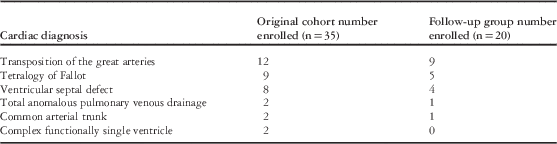
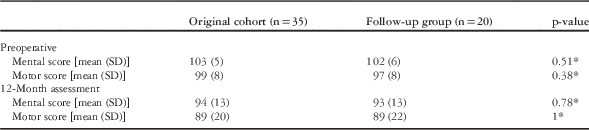
Of the 35 patients who completed the initial study, 20 patients were recruited into the current study (58%). Of them, five patients were lost to medical follow-up, five were unable to attend the assessment because of geographical location, and five originally agreed to participate but failed to attend the assessment sessions. There were 10 male and 10 female participants assessed. Mean age at assessment was 6.6 years (standard deviation 0.4; range, 5.8–7.2). The degree of surgical complexity was similar to the original cohort (Table 1), although no patients with a functionally single ventricle were in the follow-up group. There was no statistically significant difference in age or weight at surgery, cardiopulmonary bypass time, or requirement for circulatory arrest between the original cohort and the follow-up group. The length of circulatory arrest time did reach statistical significance, with the follow-up group having a greater arrest time (Table 2). One patient with truncus arteriosus underwent further surgery at 2 years of age with an upgrade of right ventricle–pulmonary artery conduit. This patient was not excluded from the study as the surgical procedure was uncomplicated. There was no significant difference between the preoperative or postoperative Bailey Scale of Infant Development Mental or Motor scores between the original cohort and follow-up group (Table 3).
Comparison of cardiac diagnosis between original cohort and follow-up group.

Comparison of intraoperative details between original cohort and follow-up group

* Paired t-test
Comparison of baseline Bailey Scale of Infant Development: second edition scores between the original cohort and follow-up group.

* Paired t-test
Socioeconomic status
Combined annual income was greater than $80,000 in 11 of 20 families, and 7 of 20 (35%) children had at least 1 parent with tertiary qualifications.
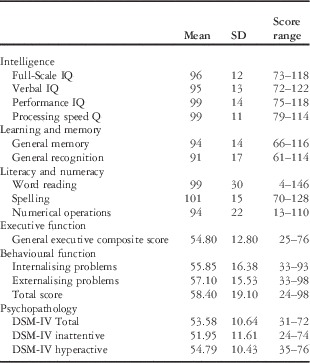
All results outlining cognitive, neuropsychological, and psychosocial outcomes can be seen in Table 4.
Means, standard deviations, and ranges of scores across all outcome measures.

General intelligence
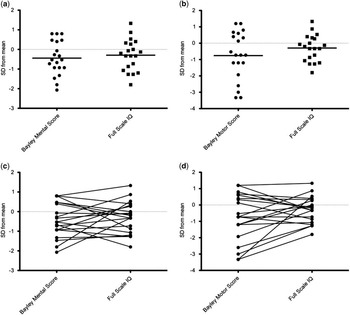
All mean scores of intelligence, across each of the measures of cognitive functioning, were found to fall within the average range. No subject had a Full-Scale Intelligence Quotient<70 (Intellectual Impairment;>2 standard deviations below the mean). However, 7/20 (35%) patients had a Full-Scale Intelligence Quotient in the low-average (six subjects) or borderline range (one subject). The remainder were in the normal range (12 subjects), with only one in the above average range (Fig 1).
Bayley Mental and Motor Scores (12-month assessment) compared with FSIQ. Data plotted as SD from normative population mean. ( a ) Bayley mental score and FSIQ (solid line depicts cohort mean). ( b ) Bayley motor score and FSIQ (solid line depicts cohort mean). ( c ) Line graph of Bayley mental score and FSIQ. ( d ) Line graph of Bayley motor score and FSIQ.

Memory and learning
The majority of the sample had age-appropriate memory and learning skills, as assessed by the Wide Range Assessment of Memory and Learning – second edition, with all mean scores falling within the average range. However, 20% had some elements in the severely impaired range (>2 standard deviations below the population mean). Of them, one patient had severe impairment of general memory and three patients of general recognition.
Literacy and numeracy
Mean literacy scores as assessed by the Abbreviated Wechsler Individual Achievement Test – second edition were within the normal range in all the areas assessed, specifically with word reading, spelling, and numerical operations. It was found that 20% of the patients had moderately impaired numeracy and spelling skills (>1 standard deviation below the population mean).
Executive function
Executive function within the sample was found to be within the normal range, as measured by the General Executive Composite Score on The Behaviour Rating Inventory of Executive Function. Despite this, 25% of the sample was found to fall within the clinically elevated range in terms of executive function.
Behavioural functioning
Parental perceptions of the emotional, social, and behavioural functioning of the sample were also found to fall within normal limits, as measured by the Child Behaviour Checklist. A total of 35% were in the borderline or clinical ranges with regard to internalising behaviour problems, externalising behaviour problems, and the Total Score of social, emotional, and behavioural functioning.
Psychopathology
The Conner’s Parent Rating Scale measured psychopathology in the cohort, specifically with respect to clinical diagnoses of attention disorders. All scores within the Diagnostic and Statistical Manual of Mental Disorders-IV Total Score, the Attention-Deficit Hyperactivity Disorder Inattentive Score, and the Attention-Deficit Hyperactivity Disorder hyperactive/impulsive Score fell within the normal range. However, a group of 26% fell within the elevated or highly elevated range in the overall Diagnostic and Statistical Manual of Mental Disorders-IV Total Score, 16% fell within the elevated or highly elevated range in the Diagnostic and Statistical Manual of Mental Disorders-IV Attention-Deficit Hyperactivity Disorder Inattentive index, and 26% fell within the elevated or highly elevated range in the Diagnostic and Statistical Manual of Mental Disorders-IV Attention-Deficit Hyperactivity Disorder hyperactive/impulsive index.
Correlation with perioperative factors
No statistically significant correlation was found between perioperative factors and the level of intelligence 6 years later (S100-B versus Full Scale Intelligence Quotient r=−0.11 p=0.62; cardiopulmonary bypass time versus Full-Scale Intelligence Quotient r=−0.18, p=0.44; Aortic cross clamp time versus Full Scale Intelligence Quotient r=−0.16, p=0.48.)
Correlation with 12-month assessment
There was a weak association with the Baileys infant scores at 12 months of age and Full-Scale Intelligence Quotient at the age of 6 years that did not reach statistical significance (Baileys mental versus Full-Scale Intelligence Quotient r=0.37 p=0.11; Baileys motor versus Full Scale Intelligence Quotient r=0.39 p=0.08). The positive predictive value of an abnormal mental score (<84) at 12 months and an abnormal Full-Scale Intelligence Quotient at 6 years was 0.5 (0.06–0.9), with a negative predictive value of 0.84 (0.6–0.96). The positive predictive value of an abnormal motor score at 12 months with an abnormal Full-Scale Intelligence Quotient was 0.5 (0.15–0.84), with a negative predictive value of 0.91 (0.61–0.91) (Fig 1).
Discussion
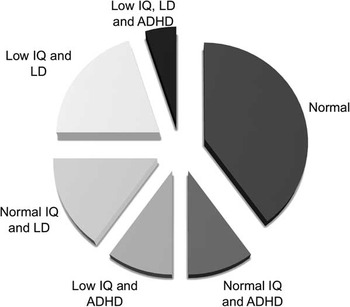
Our study examined the neurodevelopmental status of a cohort of children with CHD 6 years after surgery during infancy, using detailed psychometric assessment and parental questionnaires. On analysing our data, and taking the neurodevelopmental profile of the cohort as a whole (Fig 2), the group was generally found to be performing within the normal range with regard to their intellectual, neuropsychological, academic, behavioural, and psychological functioning. Despite this, a significant proportion was found to have specific cognitive, neuropsychological and academic difficulties, and behavioural and psychological issues, that is clinically significant attention and hyperactivity difficulties. These findings support previous findings in the literature that have found that children with CHD are at risk of longer-term educational and behavioural difficulties.Reference Samango-Sprouse and Suddaby 8 , Reference Wernovsky, Shillingford and Gaynor 9 , Reference Bellinger, Wypij and Kuban 18 , Reference Mahle 19 Similar outcomes have now been described in patients undergoing single ventricle palliation and biventricular repair.Reference Gaynor, Ittenbach and Gerdes 20 These data are important from both research and clinical perspectives.
Neurodevelopmental profile of cohort (n=20) (low IQ=IQ in low-average range; LD=learning difficulty; ADHD=clinically significant score on Conner’s Rating Scale).

Longer-term educational and behavioural difficulties in these children are often not identified until the child reaches school age, and predictors of these outcomes have not been well established. Predicting long-term developmental outcomes of children with CHD based only on evaluations conducted at 1 year have been shown to be inaccurate, with low-positive predictive value, despite demonstrating good specificity and negative predictive value.Reference McGrath, Wypij, Rappaport, Newburger and Bellinger 21 The findings of the current study support this previous finding with similar positive and negative predictive values. This suggests that early neurobehavioural functioning is not an accurate predictor of long-term intellectual functioning.
This follow-up study was not powered to correlate perioperative risk factors with outcomes at 6 years of age, but clearly this is an area that needs further exploration. Risk factors for more significant brain injuries have been well described,Reference McQuillen, Barkovich and Hamrick 22 , Reference Petit, Rome and Wernovsky 23 but the relationship with long-term neurodevelopmental outcomes remain unclear.Reference Bellinger, Wypij and Kuban 18 , Reference Fuller, Rajagopalan and Jarvik 24 With the development of more advanced brain imaging techniques such as MRI, cerebral abnormalities, in particular white matter injuries are being detected in a significant proportion of infants both before and after cardiac surgery.Reference Beca, Gunn and Coleman 25 These white matter changes have not been shown, however, to relate to neurodevelopmental outcome at 2 years. Conversely, more generalised brain immaturity was found to be associated with early adverse neurodevelopmental outcome; however, the contribution to later developmental outcome remains unknown at this stage.Reference Beca, Gunn and Coleman 25
Clinical implications
The current findings suggest that a significant proportion of children with cardiac disease suffer significant cognitive, academic, neuropsychological, and behavioural difficulties, as well as clinically significant psychopathology, specifically associated with attention and hyperactivity. Children who have abnormal testing at 1 year of age can of course be targeted for intervention; however, many with scores within age expectations at 1 year will go on to have abnormal scores at school age. As children reach school age they are required to perform more complex tasks, and hence testing at this age is more likely to uncover specific learning problems. This highlights the need for serial neurodevelopmental follow-up to further define the at risk sub-group, and to identify children developing difficulties in these areas in a timely manner.
While total scores are important in terms of placing the participant within the normal population, the formulation performed by neuropsychologists during test administration can provide a vast amount of information regarding a participant’s neurodevelopmental ability, and their risk of academic difficulties, and future psychopathology. These formulations are not only useful in early identification, but also inform the design and implementation of intervention strategies to manage these difficulties, and prevent the exacerbation of these problems over time.
Early intervention programmes that target children who have sustained a neurological insult early in life may have a role in maximising their developmental potential over the short- to medium-term as evidenced by the beneficial role in the preterm infant population.Reference Spittle, Orton, Doyle and Boyd 26 In children with CHD, identifying and targeting a subgroup that are at risk of neurodevelopmental difficulties is important for appropriate targeted intervention and the best allocation of finite resources.
Limitations
There are several limitations to this study and potential sources of bias. The high lost-to-follow-up rate (25% in the first study and 40% in the current study) not only resulted in small numbers, limiting regression analysis of risk factors associated with adverse neurodevelopmental outcomes, but also may have selected out a biased subgroup of the population. In addition, family socio-economic status correlates with measures of child intelligenceReference Bouchard and McGue 27 and developmental delay,Reference Najman, Bor, Morrison, Andersen and Williams 28 and the fact that our population had a significant proportion of university educated parents may have improved the mean test scores. In addition, we studied a heterogeneous group of participants with respect to anatomical diagnoses.
Conclusions
Although dealing with overall small numbers we have demonstrated that whereas these children have intellectual function in the average range as a group, a significant proportion have specific learning difficulties and deficits in attention and concentration, as well as psychosocial and behavioural problems. These children should have long-term neurodevelopmental surveillance as part of their routine follow-up care, which will allow early identification of potential difficulties and initiation of timely targeted interventions.
Acknowledgement
The authors wish to acknowledge Sascha Hardwick who assisted with the neuropsychological assessments.
Financial Support
This work was supported by the Prince Charles Hospital Foundation (Grant number FRC0300–04).
Conflicts of Interest
None.
Ethical Standards
The authors assert that all procedures contributing to this work comply with the ethical standards of the Australian National Health and Medical Research Council on human experimentation and with the Helsinki Declaration of 1975, as revised in 2008, and has been approved by the Prince Charles Hospital Human Research Ethics Committee.