

Introduction
On a global scale, citrus is the second most important fresh fruit crop after grapes (Qureshi et al., Reference Qureshi, Bilal, Ali and Ayyub2014). Pakistan is among the top 10 countries in citrus production, producing 2.3 million tonnes annually, with a market share of approximately 3–4% of world production (Mustafa et al., Reference Mustafa, Arshad, Ghani, Ahmad, Raza, Saddique, Asif, Khan and Ahmed2014). Pakistan is the sixth largest producer of the ‘Kinnow’ cultivar (Citrus reticulata Blanco) (Tahir, Reference Tahir2014). This cultivar contributes more than 70% of the citrus fruit produced in the country (Khan et al., Reference Khan, Nawaz, Ahmad, Afzal, Malik and Saleem2010; GOP, 2012).
The citrus leafminer (CLM), Phyllocnistis citrella Stainton (Lepidoptera: Gracillariidae: Phyllocnistinae) is known to attack all species of citrus, as well as some related species of the family Rutaceae (Wagner et al., Reference Wagner, DeFoliart, Doak and Schneiderheinze2008). Heavy attack of P. citrella can severely damage young citrus fruit trees in the field and in the nursery (Elekcioğlu and Uygun, Reference Elekcioğlu and Uygun2013), while the injury is less significant in mature plants (Kalaitzaki et al., Reference Kalaitzaki, Tsagkarakis and Lykouressis2011). By mining throughout the leaf surface, larvae of CLM destroy the epidermis of fresh leaves, and the damaged leaves curl and become sclerotic and necrotic (Uygun et al., Reference Uygun, Senal, Karaca and Elekcioğlu2000).
There are few detailed studies on the effect of CLM damage on growth and productivity of citrus; thus, the percentage of the annual foliage flushes that needs to be protected through management of the CLM, so as to protect citrus plants against reduction in growth, development and yield, has not been established (Schaffer et al., Reference Schaffer, Pena, Coils and Hunsberger1997).
Many leafminer species have been shown to reduce net photosynthesis of the host crops, due to leaf tissue damage (Parrella et al., Reference Parrella, Jones, Youngman and Lebeck1985). In most studies, leaf damage by CLM has been determined visually in the form of percentage of leaf area damaged (Peña and Duncan, Reference Peña and Duncan1993). However, visual estimate of damage requires specific expertise, yet the accuracy of using such visual estimates is unstandardized for wider use. Image evaluation for damage assessment (Gilbert and Grégoire, Reference Gilbert and Grégoire2003) may be a suitable alternative method but without the accuracy and variability issues associated with visual assessments. We hypothesized that increasing infestation levels—as well as larval weight of CLM—affects the physiological parameters of citrus plants. Similarly, we also investigated whether larval weight was related to cultivar and if it has significant effect on amount of leaf damage and on net photosynthetic rates in citrus cultivars.
Materials and methods
Two citrus cultivars, ‘Kinnow’ (C. reticulata Blanco) and ‘Fairchild’ (C. reticulata Clementine × Orlando Tangelo) were selected from nurseries of the Department of Horticulture, University College of Agriculture, University of Sargodha, Pakistan. Ten one-year-old citrus nursery plants of each cultivar were selected for sampling. One plant from each cultivar was selected to serve as control. Three newly emerged leaves without any infestation by CLM were also selected and covered with mesh cages to avoid any insect infestation (Delaney et al., Reference Delaney, Haile, Peterson and Higley2008). For each selected plant, three infested leaves containing a single third instar CLM larva were selected and tagged. Net photosynthetic rate of healthy and infested leaves was measured using a CI-340 handheld photosynthesis meter (CID Bio-Science Inc., Camas, WA USA). The experiment was replicated three times. An image of each leaf was captured using a Sony Cyber-Shot DSC-W650 digital camera. Before recording the data for physiological parameters, images of selected leaves were taken once the third instar CLM larvae had inflicted maximum damage. The images were analysed with SigmaScan Pro-5.0 software (SPSS Inc., San Jose, California) (Gilbert and Grégoire, Reference Gilbert and Grégoire2003). Images were opened in SigmaScan software on trace mode to select the desired portion of leaves. According to hue, ranges of 0–47 were selected, while saturation was adjusted at 0–100 according to O'Neal et al. (Reference O'Neal, Landis and Isaacs2002). For accuracy, each leaf was analysed three times and the average of leaf or mine area used for further analysis. The percent infestation was calculated using the formula:
 $$\begin{equation*}
\% \;{\rm{Infestation}} = \frac{{{\rm{Damaged}}\;{\rm{area}}}}{{{\rm{Damaged}}\;{\rm{area}} + {\rm{undamaged}}\;{\rm{area}}}}\times 100
\end{equation*}$$
as described by Gilbert and Grégoire (Reference Gilbert and Grégoire2003).
To quantify the relationship between larval mass and CLM preference for infestation, 30 third instar larvae were randomly collected from each cultivar. These larvae were placed in a freezer for 1–2 h, then placed in a drying oven at 45 °C for 48 h, and weighed (Low et al., Reference Low, Wood and Nisbet2009). One-way analysis of variance (ANOVA) was performed to check the significance of citrus cultivars for different physiological parameters [photosynthetic rate, CO2 fixation, water use efficiency (WUE), stomatal conductance and transpiration rate] (Table 1). Means were compared with LSD pairwise comparison test. Regression analysis was performed to check the relation between percent infestation and larval weight for each citrus cultivar. All analyses were performed using statistical software R.3.0.3 and SPSS.
Analysis of variance (ANOVA) to check the significance of citrus cultivars for different physiological parameters for treatments

Notes: Pn, Photosynthetic rate; WUE, water use efficiency; C, stomatal conductance; and E, transpiration rate.
Results
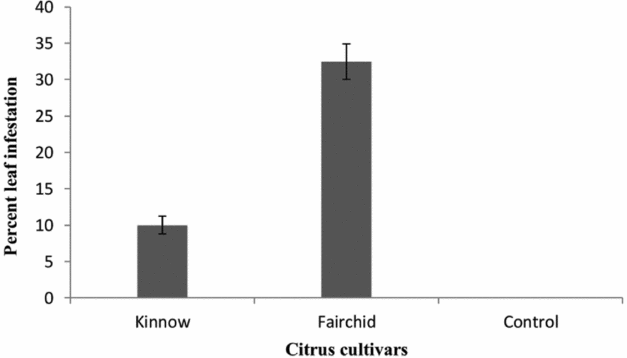
The CLM larvae per leaf significantly affected the percentage of leaf area damaged in both cultivars. However, the percentage of damage was higher in the ‘Fairchild’ cultivar compared to ‘Kinnow’. The percentage of the leaf area mined was (32.5%) in the ‘Fairchild’ cultivar and 10.6% in ‘Kinnow’ (Fig. 1).
Percent leaf infestation caused by CLM larvae on ‘Kinnow’ and ‘Fairchild’ mandarin cultivars.

Effect of CLM larvae on net photosynthetic rates (Pn) and stomatal conductance (C)
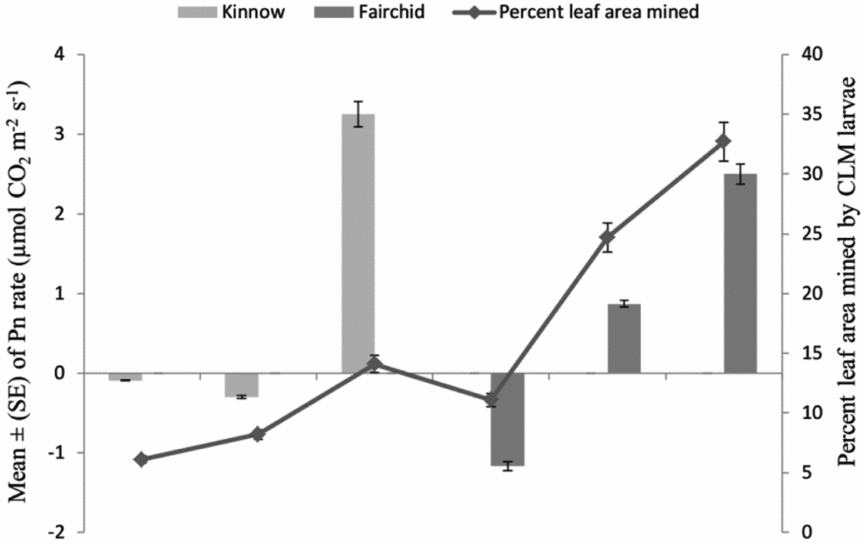
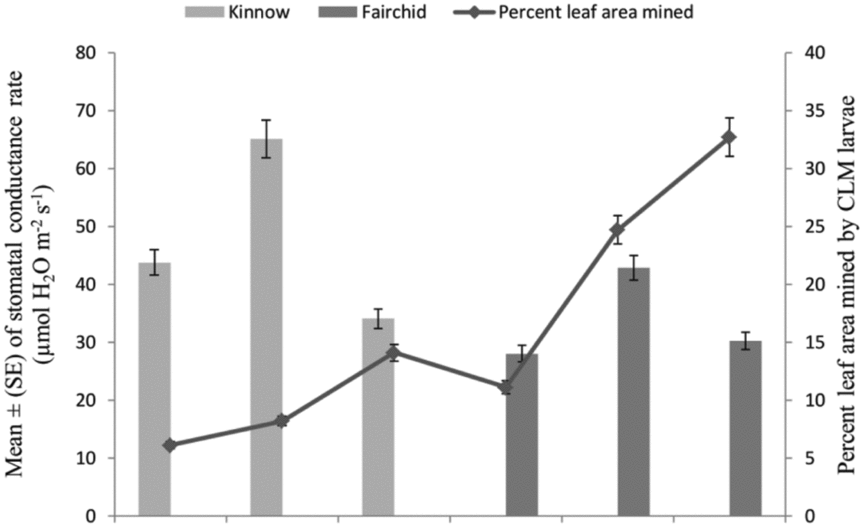
Infestation by CLM larvae had a negative but insignificant effect on net photosynthetic rates (F 1, 59 = 0.74, P = 0.48) in both cultivars. However, a relatively higher decrease in net photosynthetic rates was observed in ‘Fairchild’ (2.27 μmol CO2 m−2s−1) than in ‘Kinnow’ (3.4 μmol CO2 m−2s−1) (Fig. 2). CLM damage significantly affected stomatal conductance (F 1, 59 = 3.70, P = 0.0307) with more decline in ‘Fairchild’ (32.08 μmol H2O m−2s−1) than ‘Kinnow’ (45.99 μmol H2O m−2s−1) (Fig. 3).
Effect of CLM mining activity on photosynthetic rate (µmol CO2 m−2 s−1) of citrus (‘Kinnow’ and ‘Fairchild’ cultivars).

Effect of CLM mining activity on stomatal conductance (µmol H2O m−2 s−1) of citrus (‘Kinnow’ and ‘Fairchild’ cultivars).

Effect of CLM mining activity on the water use efficiency (WUE), CO2 fixation and transpiration rates (E)
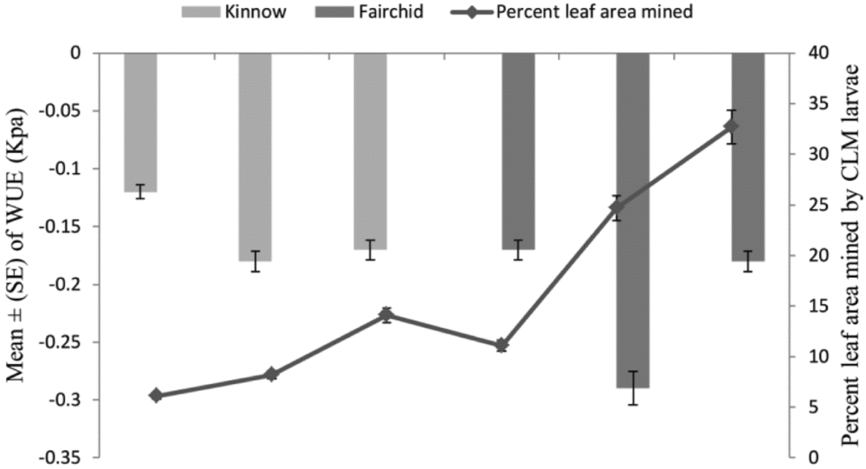
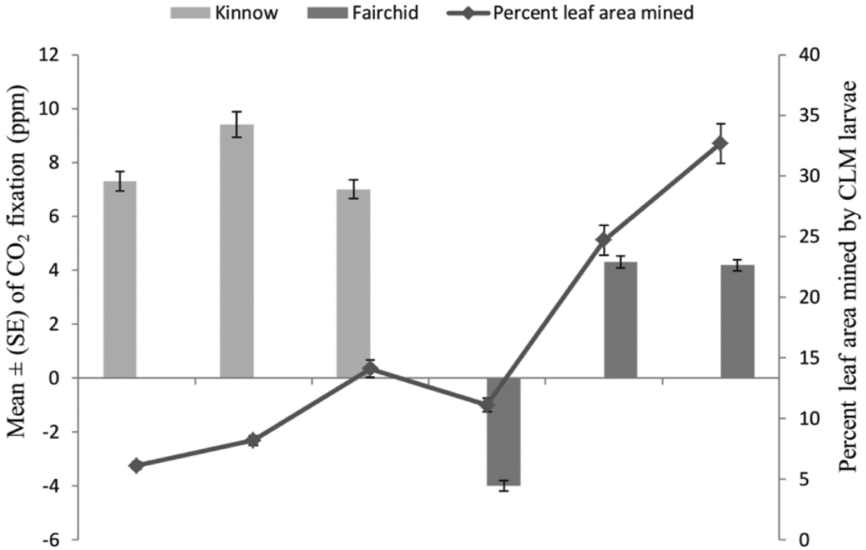
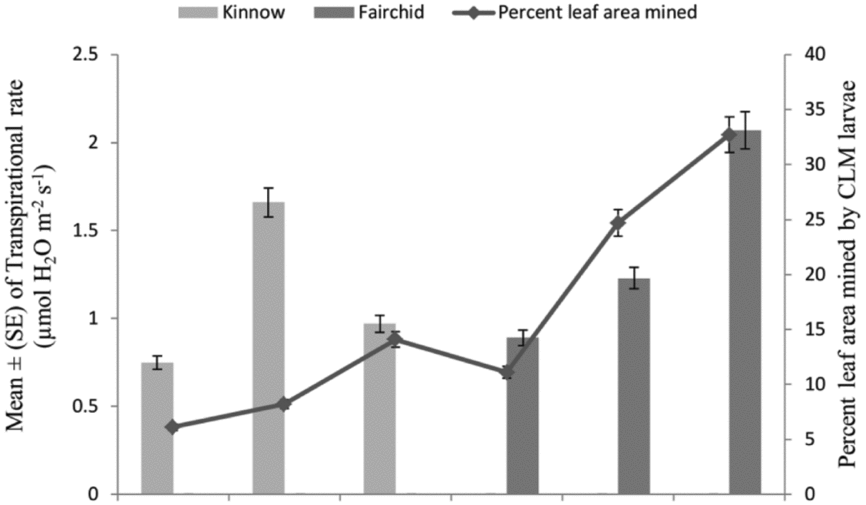
There was a significant effect (F 1, 59 = 28.2, P < 0.001) on the WUE of plants by the action of CLM larvae mining the leaves. The WUE was at 8.08 kpa for control plants. A decreasing trend of WUE was noted for ‘Fairchild’ and ‘Kinnow’ cultivars: −0.29 kpa and −0.16 kpa, respectively (Fig. 4). The CO2 fixation rate (F 1, 59 = 1.19, P = 0.3117) and transpiration rate (F 1, 59 = 2.30, P = 0.1090) were not significantly affected by CLM damage (Figs. 5 and 6).
Effect of CLM mining activity on water use efficiency (Kpa) of citrus (‘Kinnow’ and ‘Fairchild’ cultivars).

Effect of CLM mining activity on CO2 fixation (ppm) of citrus (‘Kinnow’ and ‘Fairchild’ cultivars).

Effect of CLM mining activity on transpiration rate (µmol H2O m−2 s−1) of citrus (‘Kinnow’ and ‘Fairchild’ cultivars).

Relation between CLM larval weight and percent of leaf area mined
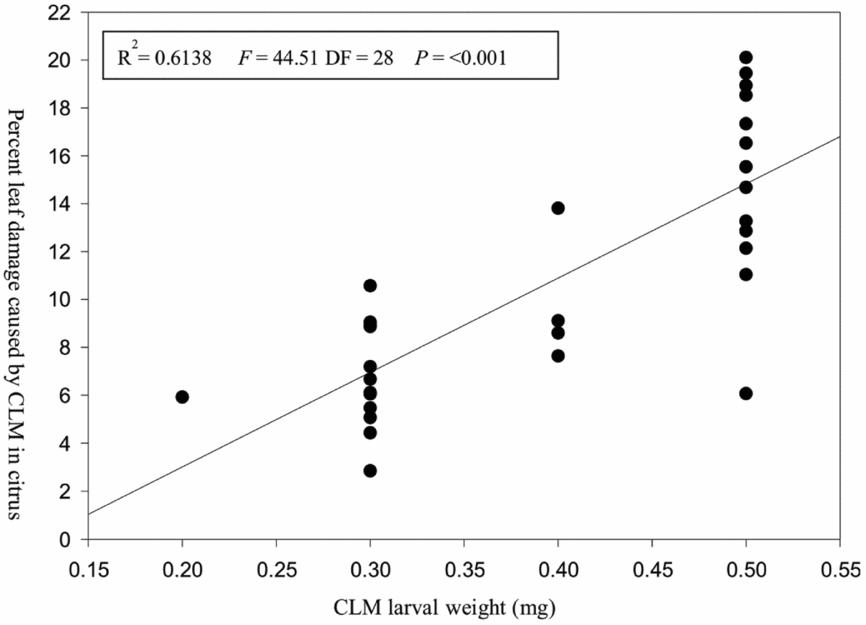
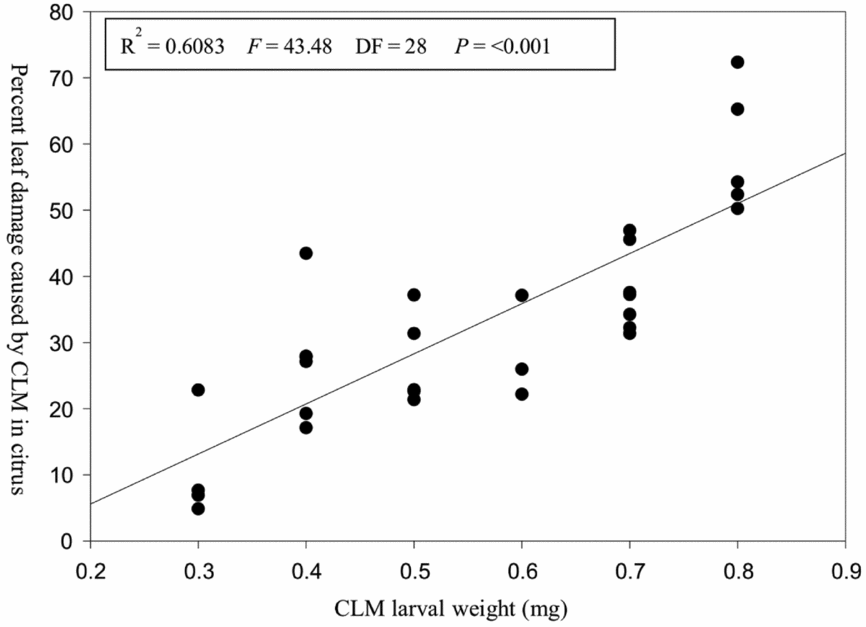
There was a high correlation between percent leaf damage and larval weight for both citrus cultivars tested (R 2 = 0.6138, F 1, 28 = 44.51, P<0.001) (Figs. 7 and 8).
Relation between CLM larval weight (mg) and associated percent leaf infestation in ‘Kinnow’ cultivar.

Relation between CLM larval weight (mg) and associated percent leaf infestation in ‘Fairchild’ cultivar.

Discussion
The leaf damage by CLM was higher in the cultivar ‘Fairchild’ compared to ‘Kinnow’ (32.5% damage was estimated by leaf-mining activity of P. citrella in the ‘Fairchild’ cultivar compared to 10.6% in ‘Kinnow’). A close examination between larval weight and percent damage showed that CLM larvae damage the leaves more as its body size increases with age. As larvae weight increases, the mine area also increases, which leads to greater leaf damage. This is in accordance with the results of Yoshida and Takei (Reference Yoshida and Takei1964) who found that an increase in mine length of Citrus unshu leaves was associated with an increase in larval weight of P. citrella.
Quantification of leaf damage can be carried out either through image processing or visual observation. Image processing provides an accurate estimate and considers the variability in leaf size. For good image capture and processing, approximately 4–5 min are required, thus it is a time-consuming process. However, one can improve processing time by using specific equipment similar to that manufactured by Delta-T Devices Ltd. (Cambridge, UK) for scanning and analysing leaf samples, because of its ability to process 800 leaves per hour (Schaffer et al., Reference Schaffer, Pena, Coils and Hunsberger1997; Gilbert and Grégoire, Reference Gilbert and Grégoire2003).
As the CLM damage increased in both cultivars, photosynthetic rate and WUE were significantly affected. Our results are in accordance with Li et al. (Reference Li, Nyrop and Lakso2003), who assessed the correlation of physiological parameters of apple leaves with damage by leafminer Phyllonorycter blancardella (Fabricius). In leafminer (Cameraria ohridella), Raimondo et al. (Reference Raimondo, Ghirardelli, Nardini and Salleo2003) concluded that the reduction in assimilation rate was associated with the total mined surface area (infestation level), which often failed to develop green patches. Therefore, the loss of photosynthetic activity was negatively correlated with infested area. Proctor et al. (Reference Proctor, Bodnar, Blackburn and Watson1982) recorded a loss of only 23% in leaf net absorption rate in apple leaves, yet infestation of P. blancardella was high (20 mines per leaf). The chemical compounds in insect saliva affect unmined, healthy tissues with regard to photosynthetic efficiency. Physiological variations in the pigment responsible for light capture when destroyed or inactivated hinder the biochemical phase of photosynthesis; but without the intensification of the captured light there are no free electrons to effect photosynthesis (Taiz and Zeiger, Reference Taiz, Zeiger, Taizl and Zeiger2004).
Our results indicate that CLM damage insignificantly affected stomatal conductance and transpiration rate. Stomata function in the release of water vapour from plants in a process called transpiration—and the rate of transpiration—is dependent on the stomatal conductance of leaves. It has been demonstrated that stomata in the mined leaf are partially functional compared to undamaged leaf tissues, which are fully functional (Jones, Reference Jones1992; Huxman and Monson, Reference Huxman and Monson2003). CLM larval damage, therefore, positively affects the WUE.
Conclusion
For both cultivars, the percent CLM damage was directly proportional to amount of mines generated. Our study also reported effects of leafminer damage on the various plant physiological parameters. Among all variables studied, photosynthesis and WUE were the most important variables to determine the physiological damage of citrus plants caused by CLM larvae. These can be used as new parameters in integrated pest management (IPM) programmes to assess CLM larvae damage.
Acknowledgements
We thank the staff of the Department of Horticulture, University College of Agriculture, University of Sargodha for providing us necessary support for the completion of this study.