Introduction
Aedes aegypti Linnaeus, 1762 (Diptera: Culicidae) is a cosmopolitan and highly anthropophilic mosquito (Christophers, Reference Christophers1960; Soares et al., Reference Soares, Silva, Oliveira and Abreu2015). This insect is the main vector of dengue virus, which is considered as the most important arboviral disease of our time and a major global public health problem (Soares et al., Reference Soares, Silva, Oliveira and Abreu2015). Recently, this vector has gained new importance, since it may be responsible, along with Aedes albopictus, for the autochthonous transmission of Chikungunya and Zika in the world (Nadeeka et al., Reference Nadeeka, Gunathilaka and Amarasinghe2014; CDC, 2016).
Larval stages of both mosquitoes inhabit containers in residential landscapes. Selection of an oviposition site by the female mosquitoes is one of the most important behavioural components of their survival (Bentley & Day, Reference Bentley and Day1989). Female mosquitoes choose oviposition sites by a combination of visual and chemical cues. Ovipositing mosquitoes taste the water in a potential oviposition site to detect chemical cues (Bentley & Day, Reference Bentley and Day1989). Further, mosquitoes may also select oviposition sites based on the availability of larval food (Blaustein & Kotler, Reference Blaustein and Kotler1993). Normally a female does not lay her entire batch of eggs in one location, but rather distributes them in multiple water-filled containers, a behaviour called skip oviposition (Colton et al., Reference Colton, Chadee and Severson2003). This behaviour increases the distribution of eggs over a larger area and may be increased by the tendency of gravid females to avoid ovipositing in sites, where eggs of conspecific females have been laid (Chadee et al., Reference Chadee, Corbet and Greenwood1990; Apostol et al., Reference Apostol, Black, Reiter and Miller1994).
Gravid Aedes females lay their eggs in water-filled containers. However, very few cases have been examined to explain the role of container shape and size in oviposition site selection. Aedes mosquitoes are usually day active mosquitoes and might be relying more on optical cues such as the contrast between dark container openings for selection of resting and oviposition sites, than night active mosquito species (Reiskind & Zarrabi, Reference Reiskind and Zarrabi2012). Further, Aedes mosquitoes breed in different types of household containers including different coloured flower pots. Therefore, many aspects of the oviposition behaviour of these insects are less known and remain to be controversial.
However, understanding the oviposition behaviour of mosquitoes may not only give a new insight about their life history, but also lead to more refined dengue surveillance and control practices (Panigrahi et al., Reference Panigrahi, Barik, Mohanty and Tripathy2014). Hence, the objective of the present study was to determine the oviposition behaviour and preferences of Aedes mosquitoes at laboratory settings in order to facilitate in formulating strategies for dengue vector control in Sri Lanka.
Method
Collection of Aedes mosquitoes
Both immature and adult stages of Ae. aegypti and Ae. albopictus were collected from Narangodapaluwa Public Health Inspector (PHI) division, which remains to be the highest dengue cases reported area in the Ragama Medical Officer of Health (MOH) area. Collected mosquito samples were transported to the laboratory for mass rearing at the Molecular Medicine Unit, Faculty of Medicine, University of Kelaniya, Sri Lanka.
Identification of field caught mosquitoes
Mosquito larvae were placed individually in a depression microscopic slide with a minimum amount of water and were identified under a light microscope (Olympus Optical Co. Ltd., Tokyo) with an objective (×10). Stages III and IV instar larvae collected from the field and I and II stages reared to IIIrd stage were identified using morphological keys. Adult mosquitoes were identified by an achromatic magnification lens (×10) using standard morphological keys prepared for Aedes mosquitoes (Rueda, Reference Rueda2004).
Maintenance of mosquito colonies
Ae. aegypti and Ae. albopictus colonies were established by using a single blood-fed adult female mosquito of each species. The mosquito colonies were maintained separately at 26 ± 1°C and at a relative humidity of 75–80% under a photoperiod of 12:12 h L:D.
Larvae were fed with a mixture containing 36% of bovine liver powder, 50% of tuna meal and 14% of brewer's yeast (Puggioli et al., Reference Puggioli, Balestrino, Damiens, Lees, Soliban, Madakacherry and Gilles2013). Adults were kept in 30 × 30 × 30 cm cages fitted with cotton surgical stocking tops and were maintained on a 10% sucrose solution provided ad libitum. For all the experiments pertaining to the selection of oviposition medium and preference for oviposition, the laboratory-bred colonies of Ae. aegypti and Ae. albopictus collected from local population were used.
Study design
For each experiment, 4–5 days old females were given a blood meal (vide supra) of cattle origin and transferred into cages (30 cm × 30 cm × 30 cm) in batches of 1000 mosquitoes with 1 : 1 sex ratio per cage. After 48 h of the blood meal, ovitraps were introduced to each experiment. The ovitraps were internally coated with filter paper up to half the water level to act as the moistened surface for egg laying by the female Aedes mosquitoes. Oviposition preference of both Ae. aegypti and Ae. albopictus was determined for following parameters at the laboratory setting. Egg collections were made after a 24 h exposure period. The number of eggs laid in each ovitrap was counted using a binocular dissecting microscope.
The percentage oviposition was calculated as the percentage of number of eggs per container, against the total number of eggs laid in all the containers. Each of the following experiment set up was repeated three times with a sample size of 1000 mosquitoes for both Ae. aegypti and Ae. albopictus, separately. Overall a total of 3000 each of Ae. aegypti and Ae. albopictus was tested for every experimental trial.
Preference of container size for oviposition
Black colour ovitraps representing different surface areas of 12.57, 50.28, 176.78, 314.28 and 419.07 cm2 were kept inside the cages randomly, without any definite arrangement or sequence.
Effect of salt (NaCl) concentration on oviposition
A concentration series of NaCl (analytical grade) as 0.2, 0.5, 1, 2 and 3% in distilled water by volumetric dilution were evaluated for oviposition preference of Aedes mosquitoes using black colour ovitraps, which are 176.78 cm2 in size. Pure distilled water was used as the control medium.
Oviposition preference for different water sources
Black colour ovitraps of 176.78 cm2 in size were used for the experiment. Ovitraps that were half-filled with water from different sources, such as drain, de-chlorinated water, chlorinated water, pond and well, were introduced into the mosquito cages. Water quality status of eight abiotic variables (temperature, pH, dissolved oxygen (DO), conductivity, salinity, total dissolved solid, turbidity and total hardness) of each water source were measured by calibrated digital meters (EUTECH Dowp 300/02K and Hach SenSION TM) and EDTA titrimetric method, respectively.
Oviposition preference to larval holding water
Black colour ovitraps of 176.78 cm2 were filled with water holding larvae (n = 20) and oviposition behaviour was evaluated. The ovitraps filled without any larvae were taken as the control.
Oviposition in response to colour of ovitrap
The ovitraps having a size of 176.78 cm2 were covered with green, blue, black, white, yellow and red coloured papers. The ovitraps were randomly distributed inside the cages without any specific sequence of arrangement.
Statistical analysis
One-way analysis of variance (ANOVA) followed by Tukey's pairwise comparison was used to investigate the presence of any significant differences among the oviposition behaviour of Ae. albopictus and Ae. aegypti, with respect to each parameter followed by two-way ANOVA and cluster analysis (with Bray Curtis resemblance). Correlation and multi-variate regression analysis were used to investigate the nature of the oviposition preferences in terms of container size, NaCl concentration and different water quality parameters for both Ae. albopictus and Ae. aegypti.
Results
Preference of container size for oviposition
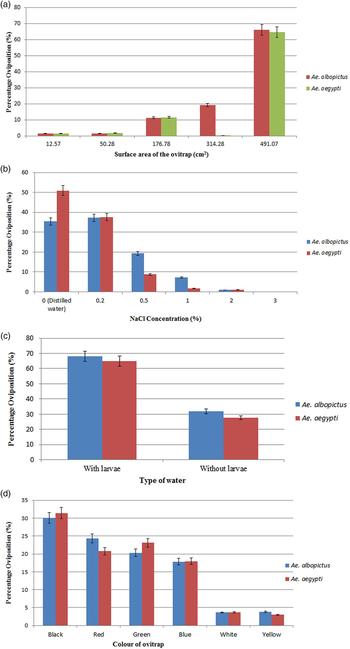
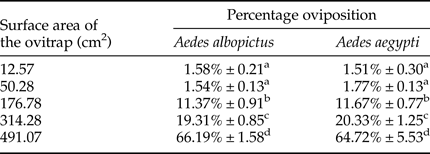
Percentage oviposition rates of Aedes mosquitoes on ovitraps with different sizes are mentioned in table 1, along with the test results of one-way ANOVA. There was a significant variation in the number of eggs deposited in ovitraps with different sizes, in accordance with the one-way ANOVA (P < 0.05 at 95% level of confidence). As indicated in fig. 1, the highest percentage oviposition of both species were detected in ovitraps having the largest surface area (491.07 cm2). According to the statistics of two-way ANOVA, percentage oviposition of both species were not significantly different (P > 0.05 at 95% level of confidence) in relation to size difference in ovitraps. Both Ae. albopictus (Pearson's coefficient = 0.941) and Ae. aegypti (Pearson's coefficient = 0.934) indicated strong positive significant correlations among number of eggs deposited and container size (P < 0.05 at 95% level of confidence).
Oviposition preference of Aedes albopictus and Aedes aegypti in terms of (a) size of the ovitrap, (b) sodium chloride (NaCl) concentration, (c) water source, (d) colours of the ovitrap.

Mean percentage oviposition ± SE deposited in egg laying cups by Aedes mosquitoes in response to difference size.

Values are mean ± SE. Different superscript letters in a column show significant differences (P < 0.05) indicated by Tukey's pairwise tests after one-way ANOVA.
Effect of salt (NaCl) concentration on oviposition
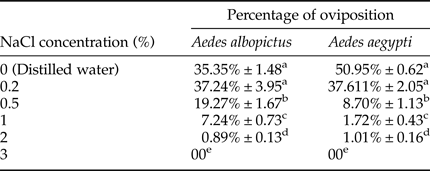
The highest oviposition by Ae. aegypti and Ae. albopictus were detected at 0.2% concentration, while there was no oviposition observed at the concentration of 3%, which was taken as the highest concentration for both species (table 2, fig. 1). There was a significant variation in the percentage oviposition with the concentration of NaCl, in accordance with the one-way ANOVA (P < 0.05 at 95% level of confidence). It was observed that no significant difference was present in the mean percentage oviposition in both Ae. albopictus and Ae. aegypti species at any NaCl concentration, as suggested by the two-way ANOVA, (P > 0.05 at 95% level of confidence). Both Ae. albopictus (Pearson's coefficient = −0.748) and Ae. aegypti (Pearson's coefficient = −0.878) indicated strong negative correlations among number of eggs deposited and the NaCl concentration of the aqueous medium. However, only the relationship of Ae. aegypti was significant (P < 0.05 at 95% level of confidence).
Mean percentage oviposition ± SE deposited in ovitraps with different concentrations of sodium chloride (NaCl) by Aedes mosquitoes.

Values are mean ± SE. Different superscript letters in a column show significant differences (P < 0.05) indicated by Tukey's pairwise tests after one-way ANOVA.
Oviposition preference for different water sources
The oviposition behaviour at different water sources are given in table 3. The highest rate was identified from the water collected from drain, which had the lowest DO level for both species. A significant variation in the number of eggs deposited in egg cups with water from different sources was observed in accordance with the one-way ANOVA (P < 0.05 at 95% level of confidence). However, two-way ANOVA represented that there is no significant difference among both species with respect to source of water (P > 0.05 at 95% level of confidence). The highest mean number of eggs of both species were laid in waste water, while the minimum number of eggs were laid in well water characterized by the highest salinity and hardness levels of all the samples (table 3, fig. 1).
Mean physico-chemical parameters ± SE and mean percentage oviposition ± SE deposited in ovitraps with different sources of water by Aedes mosquitoes.

Values are mean ± SE. Different superscript letters in a column show significant differences (P < 0.05) indicated by Tukey's pairwise tests after one-way ANOVA.
Based on the results of the correlation analysis, it was noted that temperature and turbidity indicated positive corelationship with the percentage oviposition in both Ae. albopictus and Ae. aegypti, while the other water quality parameters indicated negative corelationships. Among them, only temperature, DO level and turbidity of water denoted significant strong corelationship with the percentage oviposition of both Ae. albopictus and Ae. aegypti (P < 0.05 at 95% level of confidence; Pearson's coefficient > 0.95). The results of step-wise multi-variate regression indicated that the oviposition behaviour of Ae. albopictus is mainly characterized by turbidity, while both turbidity and hardness governed the oviposition preference of Ae. aegypti.
Oviposition preference to larval holding water
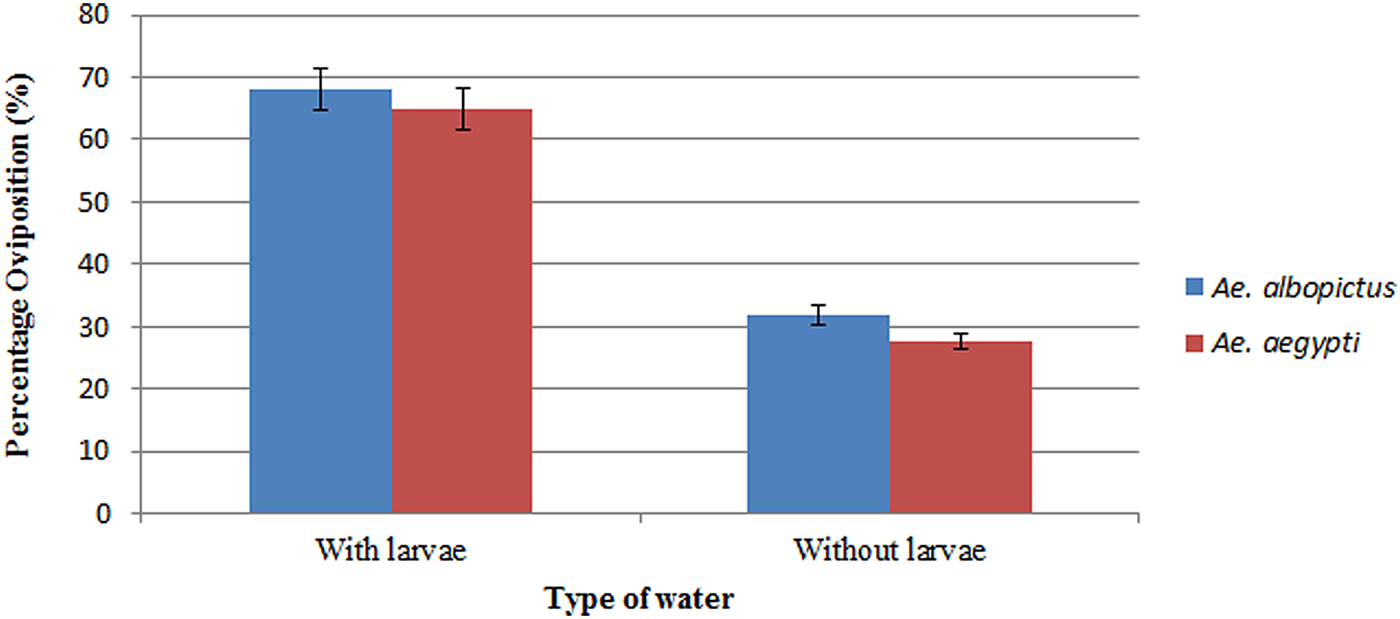
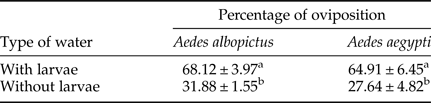
The percentage oviposition of Ae. albopictus and Ae. aegypti was relatively higher, when mosquito larvae were present in the ovitraps (table 4, fig. 2). This was recognized to be significantly different by the one-way ANOVA test for both species tested. The results suggested that the presence of larvae in the ovitrap act as a stimulating factor in egg laying of both Ae. albopictus and Ae. aegypti.
Oviposition preference of Aedes albopictus and Aedes aegypti with respect to the presence and absence of larvae.

Mean percentage oviposition ± SE eggs deposited in ovitraps with larvae and without larvae by the two species of Aedes mosquitoes.

Values are mean ± SE. Different superscript letters in a column show significant differences (P < 0·05) indicated by Tukey's pairwise tests after one-way ANOVA.
Oviposition in response to colour of ovitrap
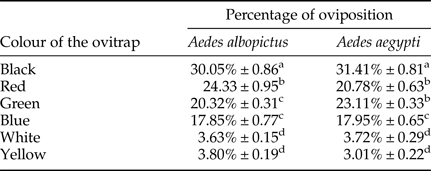
The mean number of eggs deposited by the two species in ovitraps having different colours are presented with one-way ANOVA test (table 5). According to Ae. albopictus, the highest oviposition was observed in the ovitraps coloured with black followed by red, green, blue, yellow and white, while the highest preference by Ae. aegypti was detected as black followed by green, red, blue, yellow and white, respectively. It was noted that both species had the highest and lowest preference to black and white colour ovitraps, respectively (fig. 1).
Mean percentage oviposition ± SE deposited indifferent coloured ovitraps by Aedes gravid females.

Note: Values are mean ± SD. Different superscript letters in a column show significant differences (P < 0.05) indicated by Tukey's pairwise tests after one-way ANOVA.
Oviposition behaviour of Ae. albopictus and Ae. aegypti
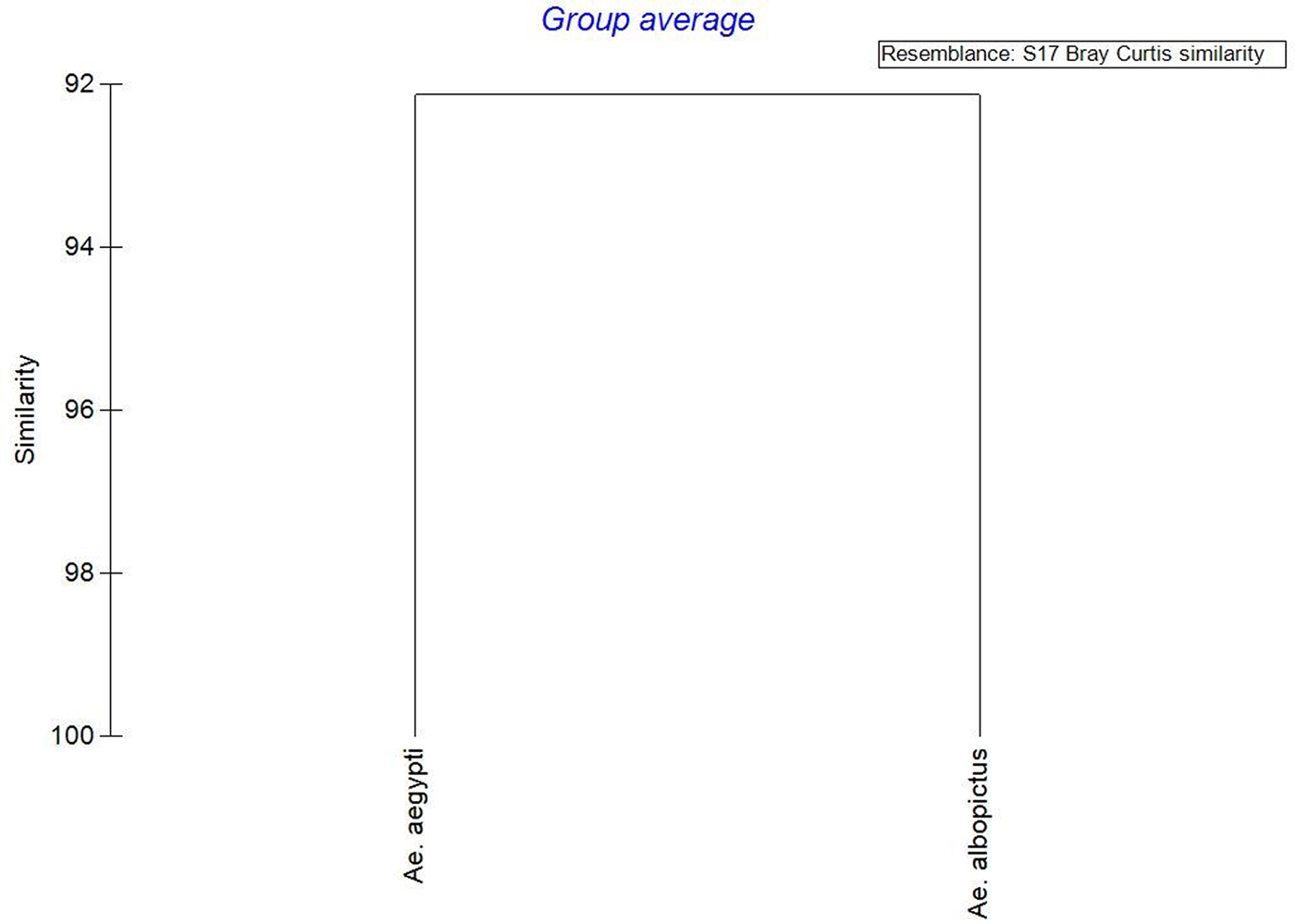
As suggested by the Bray Curtis similarity, Ae. albopictus and Ae. aegypti indicated a 92.13% similarity in oviposition behaviour with respect to size and colour of ovitraps, sources of water, NaCl concentration, presence and absence of larvae (fig. 3). This in turn confirms the results of two-way ANOVA, which also suggested the absence of a significant difference among the oviposition behaviour of Ae. albopictus and Ae. aegypti.
Dendrogram indicating the similarity between the fecundity of Aedes albopictus and Aedes aegypti.

Discussion
Mosquito ecology is an important aspect to determine the factors that limit species-specific behaviour to different oviposition. This is one of the most important behavioural components of mosquito survival (Bentley & Day, Reference Bentley and Day1989). Until now, control of Aedes mosquito is the only option to stop dengue viral transmission. Therefore, understanding various factors that favour abundance of mosquito population is a paramount importance in implementing successful mosquito control programmes. Hence, proper understanding of oviposition behaviour may provide insights about mosquito life history and help in dengue surveillance and control of the vectors. Effective control of these mosquitoes, particularly during an outbreak of disease, can be achieved through different strategies targeting specific life-history stages.
In the present study, it was observed that the ovipositing females prefer ovitraps with larger surface area than the smaller ones. The number of eggs laid has a distinct bearing on the area of the ovitrap exhibiting a direct linear relationship between the surface area and the number of eggs laid, which was similar to the observations made by previous studies of Derraik & Slaney (Reference Derraik and Slaney2005).
However, in a natural environment, the effect of habitat size cannot be evaluated from such a comparison, because containers and pools are different from each other, not only in habitat size but also in other factors such as surrounding environments and complexity. It is expected that the significance of predation in mosquito populations depends on the habitat size. Some studies have indicated that the larger containers can still hold more mosquito larvae and increase offspring competition. In addition they can hold more predators. The small size of container habitats may be an important characteristic that determines community structure of mosquitoes and other aquatic insects including predators (Sunahara et al., Reference Sunahara, Ishizaka and Mogi2002). Washburn (Reference Washburn1995) has referred to MacArthur & Wilson's (Reference MacArthur and Wilson1967) island biogeography theory as an explanation of poorer species richness in containers than in pools.
Aedes mosquitoes are day active mosquitoes. Therefore, they may be relying more on optical cues like the contrast between dark container openings and water surface reflections for selection of resting and oviposition sites, than night active mosquito species (Reiskind & Zarrabi, Reference Reiskind and Zarrabi2012; Panigrahi et al., Reference Panigrahi, Barik, Mohanty and Tripathy2014). Aedes mosquitoes breed in different types of household containers including flower pots. Within the study area, people use different coloured pots, especially yellow, green, black and grey for ornamental plants. Therefore, it is interesting to find out the preference of such coloured ovitraps for oviposition by the Aedes females. Some similar studies have indicated that there were significant variations in the number of eggs laid in dark or light conditions on different colour ovitraps except for white ovistrips. It may be concluded that the Aedes mosquitoes have a notable visual perception (Panigrahi et al., Reference Panigrahi, Barik, Mohanty and Tripathy2014).
The present study recorded that the maximum number of eggs was laid by the females of both species on black ovistraps followed by red and green ovistraps for Ae. albopictus and Ae. aegypti, respectively. According to literature, most of the insects are unable to see red. Therefore, the red ovitraps probably appear dark grey to the mosquitoes (Colton et al., Reference Colton, Chadee and Severson2003). However, there was a statistical difference between the number of eggs laid by them on black and red ovistrisps, which might be a new adaptation for survival. There were no significant relationships detected from the ovitraps coloured with green (575–491 nm) and blue (491–424 nm). This may be due to the closer wavelengths of these two colours, which may not be significantly differentiated by their vision. White ovitraps were least preferred for oviposition by the Aedes mosquitoes. Evidence from previous studies indicates that Aedes mosquitos most likely use visual stimuli in initially seeking breeding sites (Chua et al., Reference Chua, Chua, Chua and Chua2004). Containers with a dark surface are more preferred. As they move closer to breeding containers, olfactory stimuli may come into play in their selection of oviposition (Arbaoui & Chua, Reference Arbaoui and Chua2014).
According to the results of the present study, number of eggs laid in dark or light condition on different coloured ovitraps varied significantly. Therefore, it cannot be concluded that the Aedes mosquitoes have either no or very little visual perception as suggested by some studies (Panigrahi et al., Reference Panigrahi, Barik, Mohanty and Tripathy2014). Hence, more studies should be conducted to evaluate the visual perception of mosquitoes.
In an oviposition experiment performed in the field with ovitraps having salt gradients ranging from 2 to 20%, Ae. aegypti eggs were found in traps with salt concentrations of up to 18% (Ramasamy et al., Reference Ramasamy, Surendran, Jude, Dharshini and Vinobaba2011). In another study conducted in the laboratory, oviposition was observed at concentrations of up to 20% (Navarro et al., Reference Navarro, Oliveira, Potting, Brito, Fital and Goulart Sant'Ana2003). Several studies performed in the filed have reported finding larvae and pupae in various container types with salinities between 0.1 and 13.5% in São Sebastião (Brito-Arduino et al., Reference Brito-Arduino, Marques and Serpa2010) and between 2 and 15% in Sri Lanka (Ramasamy et al., Reference Ramasamy, Surendran, Jude, Dharshini and Vinobaba2011; Surendran et al., Reference Surendran, Jude, Thabothiny, Raveendran and Ramasamy2012). Some recent studies in Brazil have indicated that Ae. aegypti populations are able to oviposit in brackish water at salt concentrations of up to 17% and to develop in salt concentrations of up to 14% (Brito-Arduino et al., Reference Brito Arduino, Mucci, Serpa and Rodrigues2015).
However, Ae. albopictus indicated the maximum oviposition at 0.2%, which is the lowest concentrated solution. Interestingly, the mean number of eggs laid by Ae. albopictus was higher in the 0.2% concentration than that of the control, which contained pure distilled water. Therefore, it can be concluded that 0.2% NaCl solution would be useful to get the maximum oviposition rate for Ae. albopictus at insectary settings, which are maintained for research purposes. This preference of a low concentration of salt in the medium by the ovipositing females could be probably due to the fact that such medium may provide nutrients for larval sustenance and growth (Panigrahi et al., Reference Panigrahi, Barik, Mohanty and Tripathy2014).
A study conducted by Panigrahi et al. (Reference Panigrahi, Barik, Mohanty and Tripathy2014) has shown that although Ae. aegypti females laid the maximum number of eggs in 0.25% concentration, Ae. albopictus females laid the maximum number of eggs in distilled water (Panigrahi et al., Reference Panigrahi, Barik, Mohanty and Tripathy2014), which is the opposite behaviour observed from the present study. In both mosquito species, the number of eggs laid gradually decreased with an increase in NaCl concentration in the oviposition medium, which is almost similar to the findings of Wallis (Reference Wallis1954), Macfie (Reference Macfie1921) and (Panigrahi et al., Reference Panigrahi, Barik, Mohanty and Tripathy2014).
It has been observed that Ae. aegypti survival in deionized water, used as a control, was lower than the survival at a 3.5% salt concentration (Brito-Arduino et al., Reference Brito Arduino, Mucci, Serpa and Rodrigues2015). This could be probably because ovipositing females lack the choice for laying eggs or, alternately, a low concentration of salt could be providing nutrients for larval sustenance and growth. From the present findings, it may be concluded that Aedes mosquitoes have a wider range of preference for salinity of the oviposition medium for egg laying.
It has been reported that ovipositing females generally select water with the occurrence of life (Bentley & Day, Reference Bentley and Day1989). Mosquitoes normally avoid oviposition where interspecific competitors are present, but are attracted to sites where other mosquito larvae are present (Beehler & Mulla, Reference Beehler and Mulla1995), because the presence of conspecific larvae may provide a reliable clue that the site offers apposite conditions for larval development (Stav et al., Reference Stav, Blaustein and Margalith1999). The present experiment also indicated that the gravid females of both species preferred larval holding water over distilled water, which was used as the control. However, some studies have indicated that Culiseta and Culex females oviposited preferentially in habitats with low-density, avoiding pools that contained high larval densities (Kiflawi et al., Reference Kiflawi, Blaustein and Mangel2003). Therefore, the oviposition behaviour of mosquitoes cannot be generalized for all genera and this should be further investigated at generic and species level of disease vectors.
The prime of a suitable oviposition site has a great impact on maternal reproductive success in species with both larval and pupal stages (Millar et al., Reference Millar, Chaney, Beehler and Mulla1994). This is because several attributes of the water, both physical and chemical, influence the hatching success and larval survival (Resetarits & Wilbur, Reference Resetarits and Wilbur1989). Therefore, the mosquitoes have a strong selection for discrimination of potential oviposition sites based on offspring viability (Petranka & Fakhoury, Reference Petranka and Fakhoury1991). Some findings evidence that the gravid females follow visual or olfactory cues to identify appropriate water collections. Further, they are guided by chemical cues and physical factors in the water and the quality of water before deciding to lay their eggs (Bonnet & Chapman, Reference Bonnet and Chapman1956; Panigrahi et al., Reference Panigrahi, Barik, Mohanty and Tripathy2014). Although previous studies conducted by McDaniel et al. (Reference McDaniel, Bentley, Lee and Yatagai1976) and Panigrahi et al. (Reference Panigrahi, Barik, Mohanty and Tripathy2014) have demonstrated that both Ae. aegypti and Ae. albopictus preferred clear and clean water, the present study indicated that the highest oviposition rates were recorded from the ovitraps filled with drain water having low DO levels (0.43 ± 0.12 mg l−1). According to the DO level, this water can be categorized as waste water with respect to the standards available for surface water (Gunathilaka et al., Reference Gunathilaka, Abeyewickreme, Hapugoda and Wickremasinghe2015). Therefore, this adaptation may lead them to attain a wide dissemination in the natural environment.
However, vector control approaches mainly aim on artificial containers since Aedes mosquitoes are regarded as container breeders. Therefore, this adaptation may mislead the current vector control interventions, which have been implemented in Sri Lanka. Since oviposition habitat selection can have significant demographic consequences (Spencer et al., Reference Spencer, Blaustein and Cohen2002), which may carry over to the community level (Blaustein, Reference Blaustein and Wasser1999), it can be suggested that vector control approaches should be adopted based on vector biology and bionomic information relevant to disease vectors. Therefore, understanding the mechanism of oviposition habitat selection would not only enhance understanding of the structure of transient communities in the breeding habitats, but may also emphasize to formulate appropriate vector-control strategies.
Conclusion
There were no significant variations among oviposition behaviours of Ae. albopictus and Ae. aegypti in relation to ovitrap size, colour and salt concentration in ovitraps. However, high visual perception was identified from both vectors. The ability of these vectors to breed in waste water with low DO levels may lead them to attain wide dissemination in the natural environment. Further studies on oviposition behaviour of Ae. albopictus and Ae. aegypti could be recommended to improve dengue vector controlling interventions in Sri Lanka.
Ethics approval and consent to participate
Ethical clearance for the study was obtained from the Ethical Review Committee (ERC) of the Faculty of Medicine, University of Kelaniya, Sri Lanka. Written consents were obtained from the study participants to conduct entomological surveys in and around the house premises. All data collected were kept confidential.
Consent for publication
Written consent to publish the data on the present study was obtained from each participant.
Availability of data and materials
Data will not be shared in any of the source.
Competing interests
The authors have declared that they have no competing interests.
Funding
Research activities were supported by the National Research Council Funded Dengue Mega Grant (NRC TO 14-04), Sri Lanka and International Atomic Energy Agency (CRP 17959).
Authors’ contributions
NG – designing the research, supervision of the research and writing the manuscript; TR – conducting field surveys and laboratory experiments. LU – conducting field surveys, assisting laboratory experiments and statistical analysis. AW – supervision of laboratory experiments and reviewing the manuscript; all authors read and approved the final manuscript.
Acknowledgements
Financial support by the International Atomic Energy Agency (CRP 17959) and National Research Council Funded Dengue Mega Grant (NRC TO 14-04), Sri Lanka. Head and all staff of the Molecular Medicine Unit, Faculty of Medicine, University of Kelaniya, Sri Lanka for facilitating the research work.