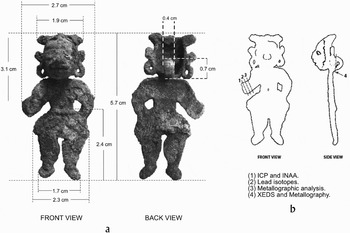
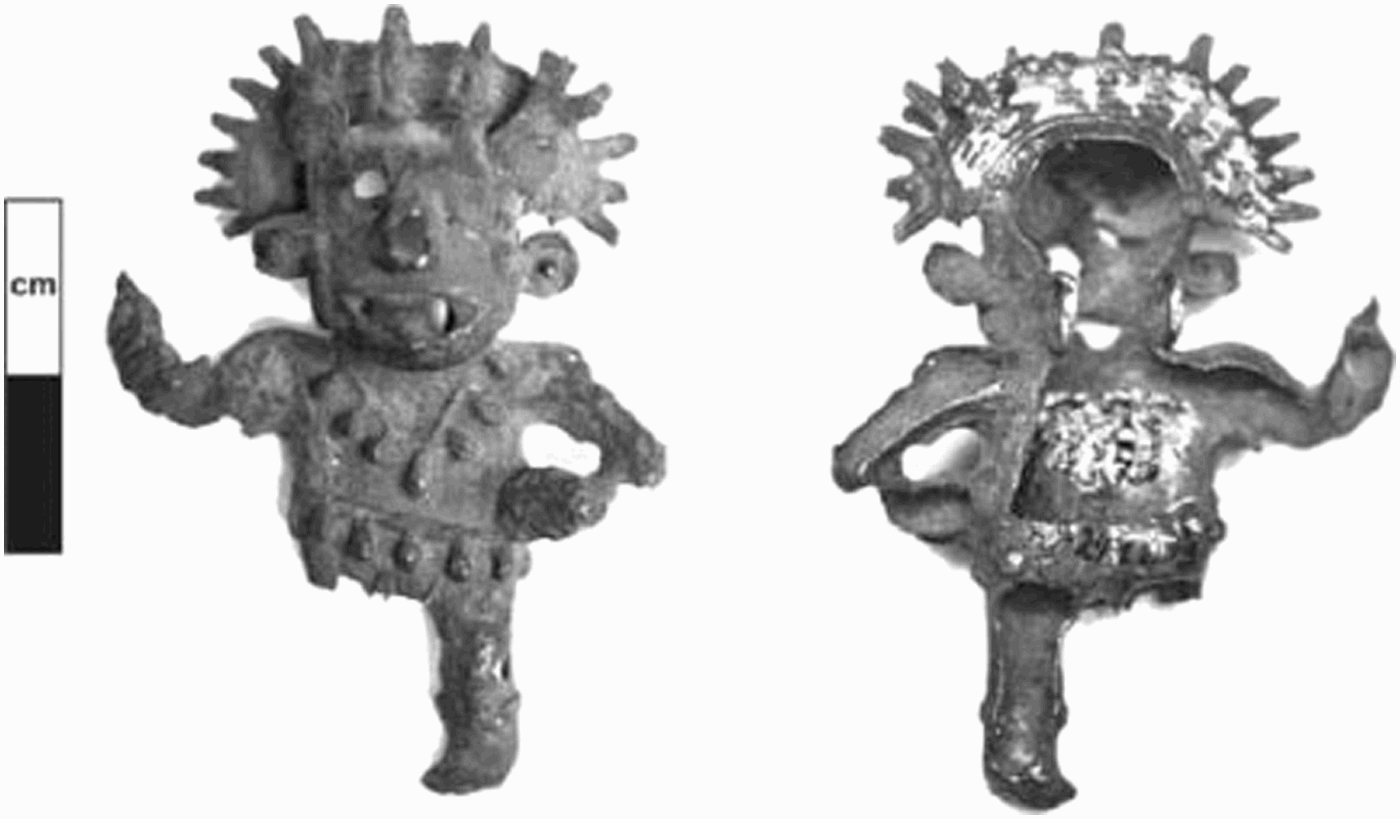
Dr. Ruben Cabrera and colleagues recently excavated a lost-wax cast small copper figurine (Figure 1a) at Atetelco, Teotihuacan, in Mazapan burial # 23. This constitutes a major and remarkable find since no other metal artifacts have been excavated at this city either during its florescence or abandonment or during the subsequent Postclassic period. Dates for the production of the figurine are imprecise. Various works (Manzanilla and Arrellin Reference Manzanilla, Arrellin, Manzanilla and Serrano1999; Manzanilla, Lopez, and Nicolas Reference Manzanilla, Lopez, Nicolas, Carrion and Cook2007; Sanders Reference Sanders1986, Reference Sanders, Diehl and Berlo1987; Sanders and Murdy Reference Sanders, Murdy and Sanders1987) date Mazapan to between a.d. 800–900 from pottery associations. P. Claudia M. Lopez and Claudia Nicolas Careta (Reference Lopez, Careta and Manzanilla2005) have recently argued for an a.d. 770 date for Mazapan in the Teotihuacan Valley. George Cowgill has placed the Mazapan occupation between a.d. 800–850 and a.d. 1000–1050.Footnote 1 Regardless, this specimen is the earliest metal object found in highland central Mexico.
(a) Front and back views of Atetelco figurine. (b) Location of samples for chemical and metallographic analysis.

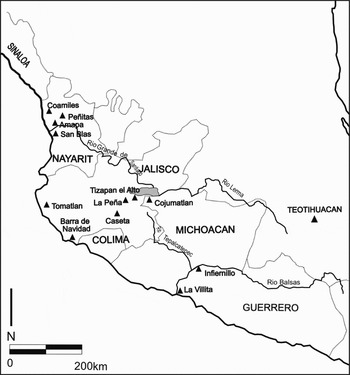
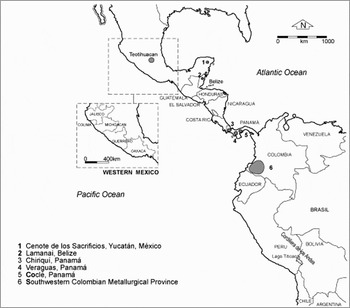
Metal objects first appeared in Mesoamerica in west Mexico about a.d. 700 or slightly earlier. Figure 2 locates sites in west Mexico where metal artifacts have been recovered. The technology was introduced from lower Central America and Andean South America (Dewan and Hosler Reference Dewan and Hosler2008; Hosler Reference Hosler1986, Reference Hosler1988b, Reference Hosler1994, Reference Hosler2005). Most metal artifacts recovered before a.d. 1000 appear at sites (Mountjoy Reference Mountjoy1969) along the west coast or at sites with riverine access to more inland settlements (Garcia Reference Garcia2007; Hosler Reference Hosler1988a, Reference Hosler1988b, Reference Hosler1994). Peoples in the west Mexican metalworking zone (Guerrero, Michoacan, Colima, Jalisco, Nayarit) developed a technically complex copper-based metalworking technology, which by a.d. 1150 was characterized by the extensive use of bronze (copper-arsenic and copper-tin), copper-silver, and other alloys. In Oaxaca and southeastern Mesoamerica local but related metalworking technologies date to after about a.d. 1150. Oaxacan metallurgy is distinguished predominantly by complex castings made from copper-gold and copper-silver-gold alloys (Bray Reference Bray and Hammond1977; Caso Reference Caso and Willey1965; Hosler Reference Hosler1994). In southeastern Mesoamerica, copper castings (particularly bells, buttons, rings, and other small ornaments) distinguish that technological tradition. Copper ores exist in the state of Oaxaca that could have served as sources for Oaxacan objects (Hosler and Macfarlane Reference Hosler and Macfarlane1996). The highland areas of Chiapas, Guatemala, and Honduras contain copper deposits that could have served as sources for the southeastern Maya area metal artifacts, although we have no lead isotope data from those deposits that could illuminate provenience.
Map of West Mexico and location of Teotihuacan. Map locates some sites where metal objects have been recovered (from Hosler Reference Hosler1994, Reference Hosler2005).

Apart from the unusual context, the Atetelco figurine is atypical in the Mesoamerican metallurgical repertoire and raises a set of highly intriguing questions concerning where the figurine was manufactured. Only a handful of standing metal figurines are known to have come from Mesoamerica, and very few examples exist that are stylized (Pendergast Reference Pendergast1962). This particular figurine is an open-backed casting, a technique that is rare in Mesoamerica but common in lower Central America and Colombia. The artifact chemistry complicates the picture because, as our analytic data demonstrate, this figurine is made from an alloy of copper and arsenic containing 1.75% As by weight. Open-backed figures from lower Central America and Colombia are invariably cast from copper-gold, an alloy typical of those regions. Copper-arsenic alloy objects are virtually nonexistent in the repertoires of those metallurgies. If we assume an a.d. 800–1050 date for the Mazapan figurine, this date also slightly predates copper-arsenic alloy castings in Mesoamerica (Garcia Reference Garcia2007; Hosler Reference Hosler1994).
Here we describe the object and its depositional context at Atetelco and the results of laboratory studies to determine fabrication technique, composition, and provenience. We then present what we believe to be the most plausible explanation for the presence of an open-backed cast figurine in a Mazapan context made from a copper-arsenic alloy.
THE ARCHAEOLOGICAL CONTEXT
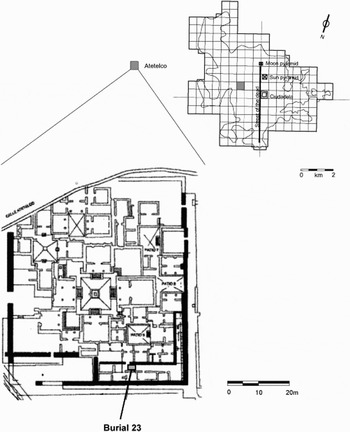
The figurine was recovered in excavations carried out on the southeast side of the Atetelco complex at Teotihuacan by Ruben Cabrera and his students during 1997 and 1998 (Cabrera and Gomez Reference Cabrera and Gomez1998). Atetelco is located on the west side of the ceremonial precinct of Teotihuacan, approximately 1500 m to the southwest of the Pyramid of the Sun (Figure 3). The complex lies in sector N2W3 of Millon's (Reference Millon1973) archaeological map. The objective of the excavations in 1997 and 1998 was to explore the southeast sector of the complex and to locate the southeast corner in a longer-term project to define the construction sequence and the dimensions of the complex. Prior archaeological work at Atetelco (Armillas Reference Armillas1950; Ortega and Andrade Reference Ortega and Andrade1999; Séjourné Reference Séjourné1956–1957; Sèjourné and Romero Reference Séjourné, Romero, Cabrera, Rodríguez and Morelos1982) provided key information but did not determine dimensions, construction sequence, or the role that Atetelco may have played at Teotihaucan before or after the decline of the city.
Location of Atetelco within the Teotihuacan complex and location of burial 23 within the complex of Atetelco.

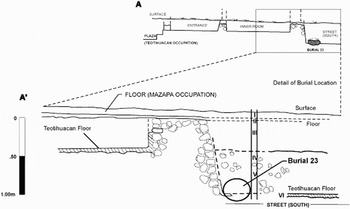
The excavations (Figure 3) defined the entire southeast corner and the southeastern limits of the complex. They also identified where the streets intersected that demarcate the complex's eastern and southern edge. Archaeological explorations (Figure 4) which consisted of a series of deep stratigraphic pits, initially revealed a rough hard-packed floor between 0.5–15 cm below the surface. Subsequent work demonstrated that this floor corresponded to a post-Teotihuacan Mazapan occupation. The floor of the last Teotihuacan occupation lies below it at levels varying between 40–80 cm. In fill deposited between these levels, researchers discovered a number of burials containing Mazapan pottery, which strongly suggests that the floor immediately above these burials was constructed by a Mazapan group living above the ruins of this Teotihuacan architectural complex. The Teotihuacan floor occurs at 1.20 m near the street that delimits the south edge of the complex. The thickness of the fill above the Teotihuacan floor suggested that it had been abandoned for a substantial period before the Mazapan occupation.
Burial 23
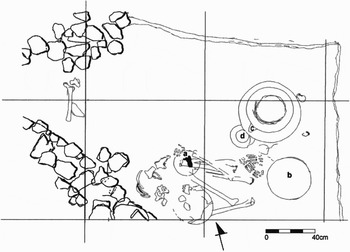
Burial 23, where the figurine was recovered, lies in level 5, directly below the Mazapan floor and below the street that marks the southeast edge of the complex. Depth varied between 98–121 cm with respect to the datum (Figure 4A and A’). Osteological remains comprise an area measuring 55 cm in length by 38 cm in width. The remains, which suffered significant post-depositional damage, were crushed by fill and displaced by tree roots. Archaeologists were nonetheless able to determine that the burial was primary, flexed, in a seated position, and oriented east to west. The presence or absence of cranial deformation could not be determined. The individual is a young male adult (Kanjou Reference Kanjou2002). The copper figurine, which was detected just after the burial was removed, was found directly below the skeleton proximate to a femur (Figure 5a).
Stratigraphic location of Mazapa burial 23 in the Atetelco complex at Teotihuacan.

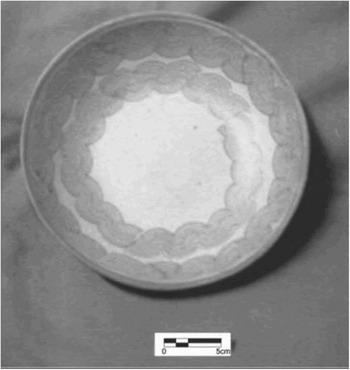
Apart from the copper figurine, this burial also contained five Mazapan pottery vessels: a miniature plate placed face down directly on the area of the feet, two tripod bowls (Figure 5b and c), and a miniature bowl (Figure 5d) placed inside of a spherical bowl. The tripod bowls, based on the form and paste, are Mazapan red-on-white wares (Figure 6). Two worked ceramic fragments and a cranium fragment were also recovered.
Burial 23 and location of the offerings.

Mazapa bowl from burial 23.

Figurine Description
The figurine weighs 9.95 g and measures 5.7 cm in length (see Figure 1a and b). The body is flat, the metal measuring only 0.2 cm in thickness. The back of the head is slightly concave; the height of the concavity raises the head 0.9 cm above the plane of the body. The length of the head, 1.8 cm, is one-third the total length of the artifact. The eyes and other facial features are partially obscured by corrosion products, but it is clear that the facial features are finely detailed. The figurine has its proper left hand on its hip. The other arm, which was broken prior to deposition, is extended outward. The missing hand may have held a staff or other object that broke away. At the center of the figurine's midsection there is a small protrusion representing an umbilicus. The ratio of the waist-to-hip width (0.39) produces a tapered waist and broad hips. Corrosion products suggest a skirt-like garment. The feet are rounded, toeless, splayed, and pointed slightly downward. At the top of the head is a headpiece with a protrusion at the center and one at each side. Round earrings or ear spools hang from the ears. A vertical suspension ring is located at the back of the neck. Figure 1a illustrates the front and back of the figurine. The illustration shows that the figurine is open at the back and indicates the position and orientation of the suspension ring. Figure 1b specifies the sites where we removed samples for our analytical work, and the caption identifies the analytical procedure followed in the case of each sample. Those portions of the object where samples were removed were subsequently restored.
ANALYTICAL STUDIES
Chemical Compositional Analyses on the Intact Artifact
We initially carried out scanning electron microscope (SEM) analysis on the artifact despite the fact that the figurine is heavily corroded and that we were analyzing surface corrosion products rather than the underlying artifact metal. Nonetheless the elemental data obtained are worth reporting. We performed X-ray energy dispersive spectrometric (XEDS) analyses at an electron energy of 20 kV and collected data that identified the major and minor elements present at various locations on the corroded surfaces of the figurine. The accuracy of XEDS in variable pressure mode is not sufficient to determine elemental concentrations precisely. Nevertheless, at a reference point on the proper right shoulder of the figurine, we detected copper, oxygen, and carbon as major elements and aluminum, potassium, magnesium, and iron as minor elements. Copper and oxygen comprised more than half of the material by weight, which is to be expected when the corrosion products are primarily oxides and carbonates of copper. These elemental determinations characterized nearly all areas of the artifact that we examined, apart from the head and neck areas where we also detected iron and arsenic in trace concentrations. The back surfaces of the artifact displayed similar spectra: oxygen, copper, and carbon were present in major concentrations. Arsenic was present among the minor elements together with silicon and aluminum.
Chemical Compositional Analyses of Artifact Samples
SEM-XEDS analyses
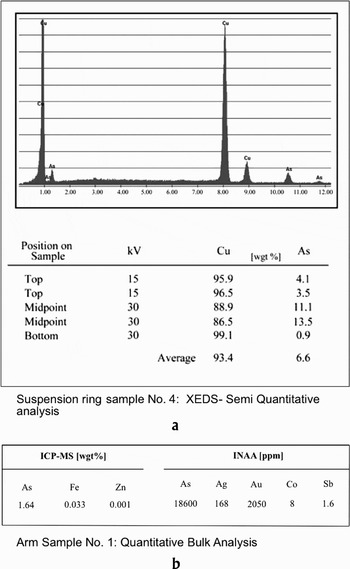
We removed the suspension ring at the junction of the ring and the figure's neck to provide a cut, uncorroded metal surface that could be analyzed for a more accurate determination of artifact metal composition. We also carried out metallographic studies of the suspension ring to identify fabrication techniques. Metallographic results are discussed subsequently. We collected data from three areas on the cut surface at the back of the neck using XEDS. In each area the metal contained only two elements: copper and arsenic (Figure 7a). The arsenic spectra are unambiguous, as the spectrum reproduced in Figure 7a makes clear. At the top and base of the oval-shaped cut we measured the copper concentration at about 96–99% by weight; the arsenic concentration varies between 1% and 4% by weight. At the center of the cut, the arsenic concentration was much higher, reaching between 11% and 13% by weight. We discuss the significance of these broad compositional differences in the section on fabrication techniques.
Analytical results. (a) XEDS semi-quantitative analysis; (b) ICP–MS and INAA quantitative analysis.

ICP-MS and INAA analyses
Both Inductively Coupled Plasma-Mass Spectrometry (ICP-MS) and Instrumental Neutron Activation (INAA) analyses (INAA) were carried out on sample No. 1, removed from the proper right arm of the figurine (Figure 1b). The sample was cleaned of external corrosion products prior to the analysis. The analytical results are given in Figure 7b. The metal is an alloy of copper and arsenic, with the arsenic concentration at 1.75 weight percent (the average of the ICP-MS [1.64] and INAA [1.86] values). This value of arsenic concentration corresponds to the SEM-XEDS analyses (Figure 7a) determined at the two extreme ends of the sections from the exposed metal oval cut where the suspension ring was removed.
Lead isotope analyses
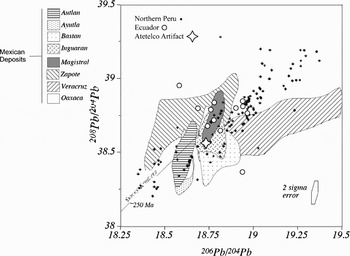
We carried out lead isotope analyses on sample No. 2 (Figure 1b). The results are presented in Figure 8, which compares the results of the lead isotope determinations from the figurine with an extensive body of lead isotope data from Mesoamerican copper mines (Hosler and Macfarlane Reference Hosler and Macfarlane1996), with data collected from Ecuadorian copper deposits in coastal and highland Ecuador by Dorothy Hosler and Andrew Macfarlane (see Macfarlane Reference Macfarlane, Young, Pollard, Budd and Ixer1999) and by Macfarlane in earlier, unpublished work in Ecuador and northern Peru. As Figure 8 indicates, two ore source areas constitute likely candidates. The most likely is western Mexico where the figurine lead isotope values fall precisely on two values for Michoacan mines: Inguaran and Bastan. Central Ecuador provides another, but somewhat less likely, alternative source because the figurine's lead isotope values fall between known values (Andrew MacFarlane, personal communication 2005).Footnote 2
Results of lead isotope studies from northern Peruvian, Ecuadorian, and West Mexican ores. The star locates the lead isotope ratios for the Atetelco object, the black dots indicate northern Peruvian ore deposits, and the open circles locate deposits from Ecuador.

Fabrication Techniques
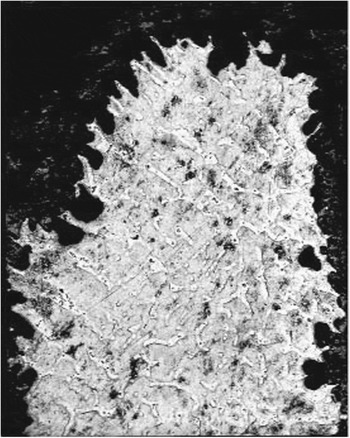
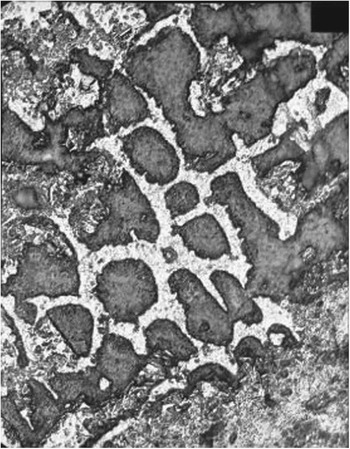
Two samples were removed to determine fabrication technique (Figure 1b): one from the proper right arm (Figure 1b front view sample No. 3), and the other from the suspension ring (Figure 1b side view sample No. 4). Although the sample from the arm (1b3) is extremely thin (0.15 cm) and heavily corroded, the dendritic microstructure typical of cast metal is evident in the photomicrograph in Figure 9. The microstructure provides evidence that the figurine was cast to shape. The dendrite arms appear gray in the photomicrograph, whereas the interdendritic spaces appear white. The white zones correspond to an arsenic-rich alloy; the gray areas contain less arsenic than the white zones. This inhomogeneous distribution of arsenic in the alloy is known as coring or segregation and is a function of the rate of solidification of the molten alloy. A longitudinal cross section was cut through the entire suspension ring, and this section provided the second sample for metallographic investigation (See Figure 1b sample 4). Although the ring is heavily corroded, the dendritic structure is visible even in the corrosion product as well as in tiny areas of residual metal (Figure 10). The photomicrograph in Figure 10 furnishes unambiguous evidence for a cast alloy that cooled extremely slowly in the mold. Further, pools of the eutectic microconstituent are visible in the metal at a magnification of 500, although they are not visible in this photomicrograph (200x). The metallographic evidence furnished by samples from both the arm and the suspension ring provide further evidence that this object was cast. Furthermore, the SEM-XEDS analysis of the exposed metal on the figure where the suspension ring was removed (Figure 7a) shows an extremely high concentration of arsenic (13.5 wgt %) at the center of the cut. This finding strongly suggests that the last liquid in the mold, highly enriched in arsenic, solidified at the location of the ring. This may also suggest that the ring was located proximate to a casting sprue. Since the figurine was undoubtedly cast by the lost-wax method, and as the back of the figurine is open (or hollow), the wax was laid onto and shaped on the front of a ceramic core; the back of the core was free of wax. This configuration achieved an open-backed casting once the liquid metal had solidified and the core was removed.
Photomicrograph of arm sample No. 3 showing the cast, heavily cored, dendritic structure of the alloy. Magnification: 50. Etchant: potassium dichromate.

Photomicrograph of a longitudinal section from the suspension ring. The dendrites are preserved in the corrosion product of the alloy. Magnification: 200. Etchant: potassium dichromate.

ORIGINS: THE CENOTE MATERIALS AND A PANAMANIAN/COLOMBIAN SOURCE
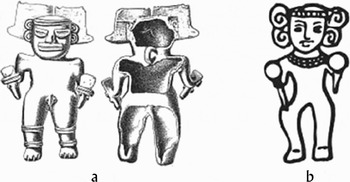
Where was this figurine cast? Several figurines made using the same or a similar technique have been dredged from the Cenote of Sacrifice in Yucatan. The Cenote figurines are lost-wax cast from gold, copper-gold, or copper-silver-gold alloys. Scholarly opinion holds that the Cenote figurines are imports from Panama in Chiriqui, Cocle, and Veraguas styles (Lothrop Reference Lothrop1952), where lost-wax castings of anthropomorphic and zoomorphic items constitute the basis of that metallurgy. Although dating the Cenote materials is difficult, researchers argue that Central American imports to the Yucatan and the Cenote date to a.d. 800–1150 and then to a.d. 1250–1539 (Coggins Reference Coggins, Coggins and Shane1984:31). The imported artifacts were subsequently thrown into the Cenote as offerings, then recovered in various 20th century dredging projects (Coggins Reference Coggins, Coggins and Shane1984; Lothrop Reference Lothrop1952). Some of the stylistic characteristics of the Atetelco figurine suggest a Veraguas, Cocle, or other Panamanian source. An artifact recovered from the Cenote of Sacrifice and ascribed to Veraguas (Lothrop Reference Lothrop1952: Figure 96), reproduced here in Figure 11a, exhibits close similarities to the Atetelco figurine, including the partially open back and the orientation and location of the suspension ring. Root's analyses of this artifact (Root, Reference Lothrop1952:Table XXXIV) indicate that it is cast from a copper-silver-gold alloy. Lothrop notes that the Veraguas (Panama) figurines are invariably male. In his study of the metal artifacts from the Sitio Conte in the province of Cocle, Panama, Warick Bray (Reference Bray, Haeme and Sharer1992) identified those items that fall stylistically within what he terms the International Group. Bray describes the qualities of this style that pertain to the treatment of the human figure as “… generally simple, often realistic, and showing none of the extravagance of classic Conte or Veraguas jewelry (Bray Reference Bray, Haeme and Sharer1992:35–36). Within the category of metal human figurines, Bray defines a Type A (Bray Reference Bray, Haeme and Sharer1992:36) whose prototype we illustrate in Figure 11b (Bray Reference Bray, Haeme and Sharer1992:Figure 3.4a). On stylistic grounds this prototype closely resembles the Atetelco figurine; it has no male attributes. Bray relates this type of human figurine to Quimbaya figures from the Cauca Valley of Colombia but maintains that “… within the Isthmus they are no more numerous in Panama than anywhere else” (Bray Reference Bray, Haeme and Sharer1992:36). In general, he remarks that both the Colombian and Isthmian examples share certain features that appear regularly, such as headbands, multiple ear ornaments, and spiral adornments at the sides of the head (Bray Reference Bray, Haeme and Sharer1992:36). Though some details of the Atetelco figurine are destroyed by corrosion, the attributes that Bray considers familiar on Type A figurines appear to be present on the Atetelco figure. The human figurines belonging to the International Group date to Bray's Period 5 (a.d. 500–700/800) and Period 6 (a.d. 700–800/900) (Bray Reference Bray, Haeme and Sharer1992:34, 36). The Panamanian dates coincide reasonably well with those of the Atetelco figurine.
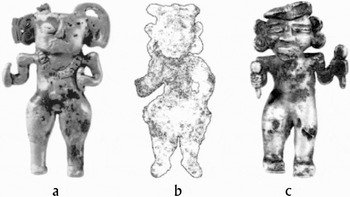
Figure 12 illustrates two metal figurines from the Cenote de Sacrificios (Figures 12a and 12c) flanking a drawing of the Atetelco figurine (Figure 12b). All three figurines are reproduced at the same size to facilitate comparisons among them. Coggins (Reference Coggins, Coggins and Shane1984) describes the figurine in Figure 12a as having been made in the Cocle style, “… with ear spirals, half-collar, objects in either hand, and characteristic small arms and large thighs” (Coggins Reference Coggins, Coggins and Shane1984:65). It is cast in a tumbaga alloy containing 50% copper, 47.3% gold, and 3.0% silver, by weight (Coggins Reference Coggins, Coggins and Shane1984: Figure 49). We illustrate it here because of its unusual posture, with the proper left arm bent and the hand at or near the waist, similar to the stance of the Atetelco figurine. Coggins dates this artifact to a.d. 800–900 (Coggins Reference Coggins, Coggins and Shane1984:65). Figure 12c illustrates that the figurine was cast with an open back in the Veraguas style. It has ear spirals and grasps an object in each hand, in the manner of the Cocle International Group prototype shown in Figure 11b. We reproduce it here to show the similarity between this figurine's head piece and the one worn by the Atetelco figurine. The Figure 12c figurine was cast from an alloy containing 96.4% gold and 3.6% silver, by weight. Coggins dates the artifact to a.d. 900–1150 (Coggins Reference Coggins, Coggins and Shane1984:80). The analyses of both Cenote figurines (Figures 12a and 12c) are reported in Lothrop (Reference Lothrop1952: tables 31, 32). Comparison of the production technology of the Atetelco figurine and that of the Panama figurines provides yet other clues. The Atetelco figurine was cast with an open back, an attribute that Lothrop (Reference Lothrop1950) identifies as characteristic of Veraguas figurines. Lothrop observes that the chief difference between the fabrication of Cocle and Veraguas pendants is that the Cocle pieces were generally cast in the round over a clay core, whereas the Veraguas items “… always were cast with an open back” (Lothrop Reference Lothrop1952:100). In terms of the casting process, then, the Atetelco figurine falls in the camp of the Veraguas pendants. This evidence, which draws on fabrication techniques and style, makes clear that the Atetelco figurine closely resembles Panamanian and Colombian items cited by Bray. Its date also fits with Warwick Bray's dates for the International Group Style. Yet the fact that the chemical composition of the Atetelco artifact—a Cu-As alloy—is totally anomalous for Colombian and lower Central American castings greatly complicates the problem and raises other possibilities for the origin of this object.
(a) Representation of a Veraguas-type figurine from the Cenote de Sacrificios, Chichen ltza (after Lothrop Reference Lothrop1952: Figure 96); (b) Illustration of a prototype of Cocle-type metal figurines of the International Group (after Bray Reference Bray, Haeme and Sharer1992: Figure 3.4a).

(a) Image of a Cocle-style figurine from the Cenote de Sacrificios (CogginsReference Coggins, Coggins and Shane1984: Figure 49, height 5.7 cm); note the position of the proper left arm, which is similar to the Atetelco figurine illustrated in (b) (Coggins Reference Coggins, Coggins and Shane1984: Figure 74, height 4.9 cm). (c) illustrates a Veraguas-type figurine from the Cenote de Sacrificios; note the similarity between this figure's headdress and that of the Atetelco figurine. All three figurines have been reproduced here at the same size to facilitate comparisons among them.

Compositional Considerations: A Colombian/Ecuadorian Source ?
Copper deposits are common in Panama and present in Colombia. Data concerning deposits of tennantite (a copper sulfarsenide ore) or arsenopyrite (an iron sulfarsenide ore) are less readily available but these ores are known from Colombia and probably occasionally found in Panama. The difficulty is that, to date, no metal artifacts analyzed from these regions—save several Colombian cold-worked tools that are imports from Ecuador—have been found to contain arsenic as an alloying element. Most artifacts from Colombia, Panama, and Costa Rica, including figurines, consist of copper-gold and copper-silver-gold lost-wax and open-mold castings (Hosler Reference Hosler1994; Root Reference Root1937, 1952). At the same time, copper-arsenic alloy objects are extremely common in the Central Andes, especially in Ecuador and Peru, from about a.d. 300 through the Spanish invasion (Hosler Reference Hosler1994: Chapter 4). Arsenic-bearing copper ores are abundant in this area, as documented elsewhere. Yet nearly all of the artifacts made from copper-arsenic alloys are cold-worked to shape. Lost-wax cast items are highly unusual in this Central Andean (Ecuador and northern Peru) zone. Nonetheless, the southwestern metallurgical province of Colombia is adjacent to the border with Ecuador (Figure 13), and iconographic features and artifacts are shared by both areas (Plazas Reference Plazas2007). This raises the possibility that the artifact was cast from Ecuadorian metal using a Colombian fabrication technique and subsequently imported to Mesoamerica.
Map showing location of areas and sites mentioned in text.

A Mesoamerican Source ?
Apart from the location of this find in a Mazapan burial, the two other most notable features are the fact that the object is a figurine, and that it was cast from a copper-arsenic alloy. The lead isotope data (Figure 8) assign a slightly higher probability to manufacture in West Mexico/Michoacan than in Ecuador. We need to emphasize that realistic metal figurines are uncommon in the ancient Mesoamerican artifact corpus apart from those dredged from the Cenote de Sacrificios in Yucatan, discussed earlier, and imported from lower Central America. Two other examples are mentioned by Saville (Reference Saville1920): one from Tehuantepec and the other from El Tajin. Teobert Maler (Reference Maler1942) cites a third figurine from a looted Zapotec burial (no illustration) described as a seated Zapotec king. None resembles the Atetelco figurine. However, four open-backed cast human figurines—several partial, one complete—appear in the collections of the Regional Museum of Guadalajara in Jalisco, Mexico. Macroscopic examinations indicate that these objects are cast from copper or a copper alloy. One (Figure 14) measures 5 cm in length, has the proper left had on the hip, and the right hand holds a staff or other object. The figurine has no distinguishing secondary sexual characteristics. The figurine wears a necklace of bells, which constitute typical west Mexican designs (Hosler Reference Hosler1994), and bells around the waist. Fragments of two other open-backed figurines, cast from copper or copper alloys, also appear in the MRG collections. The significance of these figurines cannot be overstated because they provide the only known west Mexican examples of the open-backed production technique used to make copper or copper alloy figurines. Further, the design characteristics of the figurine illustrated in Figure 14—a necklace and waistband of West Mexican style bells—clearly reflect this figurine's West Mexican origins.
Open-back cast figurine from the Museo Regional de Guadalajara (MRG), Jalisco, Mexico.
Turning to the alloy type, copper-arsenic alloy objects were extremely common in western Mexico after about a.d. 1150 (especially lost-wax cast bells, cold-worked ornaments, cold-worked needles, axes, awls, and other items) (Hosler Reference Hosler1986, Reference Hosler1988a, Reference Hosler1994). The northern Andes and West Mexico are the two zones in the Americas where metalworkers frequently employed this alloy type. In the northern Andes, copper-arsenic alloys were cold-worked; in west Mexico some were lost-wax cast, others cold-worked. In Mesoamerica arsenopyrite is the most common ore of arsenic and was the primary ore used for the manufacture of Cu-As objects (Hosler Reference Hosler1994; Chapter 2). The most significant examples of lost-wax castings from copper-arsenic alloys anywhere in the Americas come from the west Mexican metalworking zone and consist of intricate, extremely thin-walled (0.02 cm–0.05 cm) bells whose design parameters required the solidification characteristics of a copper alloy. Alloys are used in thin-walled castings because they solidify over a range of temperatures (not at a single temperature, as is the case with pure metals), so that the liquid metal has time to flow into and fill all the intricate details of the mold before the casting solidifies completely. We do not know if an alloy was necessary to produce the Atetelco figurine since even the thinnest areas (ear spools) are relatively thick (0.8 cm). Nonetheless west Mexico makes a plausible source for the Atetelco figurine both in terms of alloy type and casting technology.
DISCUSSION
Two regions thus constitute possible production zones for this figurine: Colombia/Ecuador (the southwestern metallurgical province) or the West Mexican metalworking zone. As mentioned, the use of copper-arsenic alloys, including lost-wax castings (apart from figurines), is common in the West Mexican metalworking zone, but only after a.d. 1150. We should note that in southeastern Mesoamerica a local metalworking technology was established around 1150 where copper lost-wax cast bells and other small cast items were common (Hosler Reference Hosler1994). This area is an unlikely source for the Atetelco figurine. None of the chemical analyses of these southeastern Mesoamerican lost-wax cast objects contains arsenic as the sole alloying element. What is more, the lead isotope signatures for Oaxacan ore deposits (which may have served as source material for these southeastern items) do not conform to the lead isotope results for the Atetelco figurine which fall squarely in the fields of the Inguaran and Bastan mines in Michoacan and, more generally, within the Ecuadorian lead isotopic fields. An extensive body of research has documented that some aspects of West Mexican metallurgy (cold-working techniques) were introduced from the central Andean region (Ecuador and Northern Peru) and that the west Mexican casting technology derived from lower Central America and Colombia (Figure 13) (see, for example, Dewan and Hosler Reference Dewan and Hosler2008; Garcia Reference Garcia2007; Hosler Reference Hosler1986, Reference Hosler1988a, Reference Hosler1988b, Reference Hosler1994, Reference Hosler2005). One plausible explanation is that the Atetelco figurine was cast in Ecuador/Colombia then transported north through the same exchange systems responsible for the figurines discussed earlier that were dredged from the Cenote of Sacrifice. The Atetelco object was then moved to the central highlands. Documentation of such an exchange system is beyond the scope of the present paper, but this transport route must be considered. Another explanation is that the figurine arrived from Ecuador via the better-studied maritime route responsible for the introduction of metallurgy from South America to West Mexico. Yet the four MRG examples of open-backed castings of human figurines found in West Mexico made from copper or copper alloys, coupled with the fact that one of them displays unambiguous West Mexican iconography, suggests that these open-backed castings were cast from West Mexican metal and in west Mexico. Taken as a whole, the evidence (stylistic characteristics, metal and alloys, lead isotope data, and now fabrication methods) points to west Mexico as the place of manufacture for the Atetelco figurine. Although the explanation for the presence of this figurine in a Mazapan phase burial is still an enigma, we should certainly be looking for similar figurines in other Michoacan/west Mexican contexts. But quite apart from the place of manufacture, how do we explain that this tradition of lost-wax cast open-backed figurines did not take off and become a mainstay of West Mexican metal production? We have no answers except that west Mexican metalsmiths were interested in metal for its properties of sound and color (Hosler Reference Hosler1994, Reference Hosler2005)—in bells and in sheet metal—rather than in the production of cast metal human figurines and other cast ornaments. It may be the case that a number of South and Central American techniques and artifact classes were initially part of the west Mexican experimental repertoire and were eventually discarded for technical or social reasons, (or both) but that at least a single example of one of these artifact classes—this particular lost-wax cast open-backed figurine produced in the west—somehow made its way from the west to the Valley of Teotitihuacan and to the Atetelco burial. This case of pre-industrial technology transfer patently demonstrates that not all elements of an introduced technology become incorporated into the technological mainstream, for a variety of reasons, but that they sometimes can and do leave material remains.
RESUMEN
En excavaciones de la fase Mazapa en el complejo Atetelco de Teotihuacán conducidas por el Ruben Cabrera y sus colegas fue encontrada una pequeña figurilla humana de cobre. Este hallazgo no tiene precedentes y es sumamente significante cuanto a cuestiones del desarrollo de la metalurgia en Mesoamérica y para las transferencias de las tecnologías en general. Los estudios previos sobre la metalurgia Mesoamericana han indicado que la metalurgia fue introducida alrededor de 700 d.C. desde Colombia, Ecuador y los Andes Centrales. Esta figurilla en particular representa un hallazgo muy fuera del patrón: las fechas (800–900 d.C.) preceden a los artefactos de cobre encontrados en el centro de México. La técnica utilizada (vaciado de espalda abierta) es rara en Mesoamérica, pero común en Colombia y Panamá. Algunas figurillas de vaciado de espalda abierta han sido encontradas en el Cenote de Sacrificios en Yucatán, México, pero estas están hechas de aleaciones de cobre-oro y fueron importadas desde Centroamérica o Colombia. La figurilla de Atetelco esta hecha de una aleación de cobre-arsénico. Los objetos de aleación de cobre-arsénico son comunes en el Occidente de México (después de 1150 d.C.), al igual que en Ecuador y el Norte de Peru (después de 300 d.C.). La cuestión fundamental en relación con este objeto es si éste fue fabricado en Ecuador o Colombia y luego importado, o si por el contrario fue fabricado en el Occidente de México. Nuestros estudios de la composición química del artefacto, las técnicas de manufactura y la procedencia, indican que la figurilla pudo haberse fabricado en el Occidente de México. Sugerimos que mientras esta técnica de manufactura (figurillas humanas vaciadas a la cera perdida con espalda abierta) fue introducida desde Colombia nunca llegó a ser un componente significante de la tradición metalúrgica Mesoamericana, Sin embargo deja huella del proceso de las transferencias de las tecnologías —en las cuales se incorporan los elementos por su forma, metal, manufactureo o otros factores llevan un significado social. o crean o representan .una realidad que coincide o extiende las perceptiones y creencias delas sociedades que las incorporan.
ACKNOWLEDGEMENTS
We would like to thank the Consejo de Arqueología, National Institute of Anthropology and History, Mexico City, for permission to study at MIT, to sample, to restore, and to conserve the Atetelco artifact; Prof. Otto Schöndube of the Regional Museum of Guadalajara, Guadalajara, Jalisco, Mexico, for facilitating aspects of this work; Dr. Elizabeth Hendrix for artifact restoration and conservation; Dr. Andrew Macfarlane for the lead isotope analyses; Johan Garcia for extensive work on illustrations and graphics; and Hannah Reitzel for help with the texr.