Introduction
The bombing of London (UK) during World War I resulted in a number of collapsed structures, the survivors of which presented a number of symptoms posterior to the event itself, as first described by Bywaters.Reference Mardones, Arellano, Rojas, Gutierrez, Oliver and Borgna 1 One of the most important observations was of early signs for hypovolemia associated with brown urine, renal insufficiency, and the death of all patients by the seventh day, secondary to uremia. Crush syndrome is defined by systemic manifestations following muscular damage produced by direct injury, generally through traumatic compression. These systemic manifestations include: acute kidney injury (AKI), sepsis, adult respiratory distress syndrome, disseminated intravascular coagulation, hypovolemic shock, cardiac failure, arrhythmias, hydroelectrolytic variations, and psychological trauma.Reference Bywaters 2
Publications resulting from research on the largest earthquakes of the past 20 years have shown that the incidence of crush syndrome has risen from two percent to 20% in rescued patients, representing a critical clinical picture within the field of confined space medicine.Reference Sever and Vanholder 3 The principal actor in crush syndrome is rhabdomyolysis,Reference Sever and Vanholder 4 or the liberation of intracellular components from damaged skeletal muscle into the circulatory system. This liberation exposes the patient to an overload of harmful toxins, principally myoglobin, organic acids, phosphate, and potassium. Currently, the best alternative for treatment is volume replenishment from the start of rescue operations, but up to 40% of patients still present AKI, the mortality of which can reach up to 30%.Reference Knochel 5
Following is a description of the in situ management and clinical evolution of a patient rescued from a trench through a collaborative effort between the Santiago and Colina Fire Departments in Chile.
Report
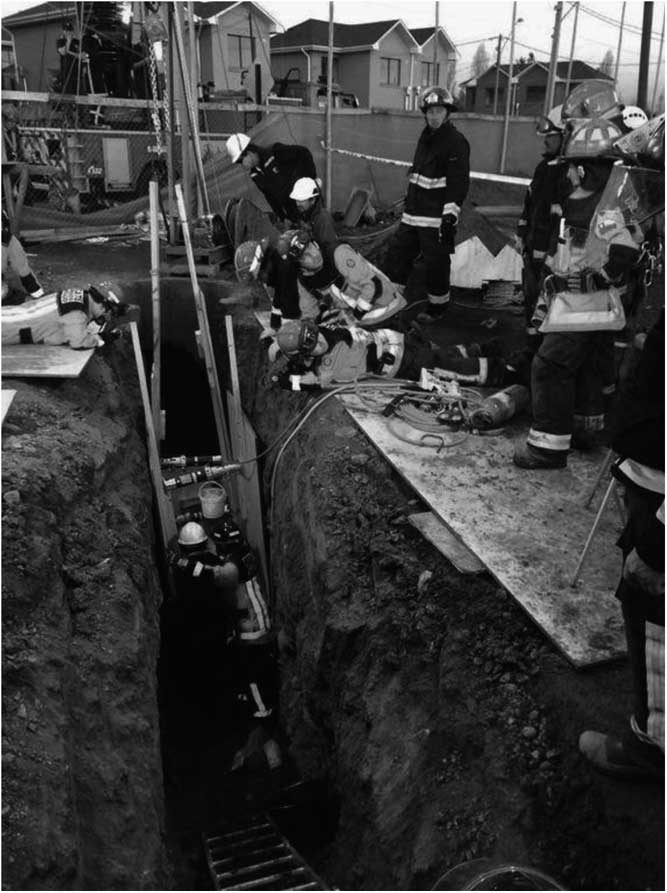
A 40-year-old, male worker, free of a clinical history of disease, was working in a four-meter-deep trench when a landslide occurred, completely covering the worker with rocks and soil. Due to the urgency of the situation, other workers and first responders carefully uncovered the buried worker’s head using a backhoe, which posteriorly allowed access to the victim (Figure 1).
Stabilized Trench and the Buried Worker Trapped Inside.
Prehospital care was given two hours after the collapse by firefighter paramedics on site via a 14 gauge peripheral venous cannulation in the left arm. Through this, the patient was administered an infusion of 0.9% saline at a rate of 1.0 L/h for the first three hours and at 0.5 L/h thereafter. Vital signs and diuresis were monitored indirectly during the entire rescue operation, and hypothermia was prevented by providing the patient with heated blankets as well as by administering warm saline. The patient was extricated 19 hours after the start of rescue initiatives.
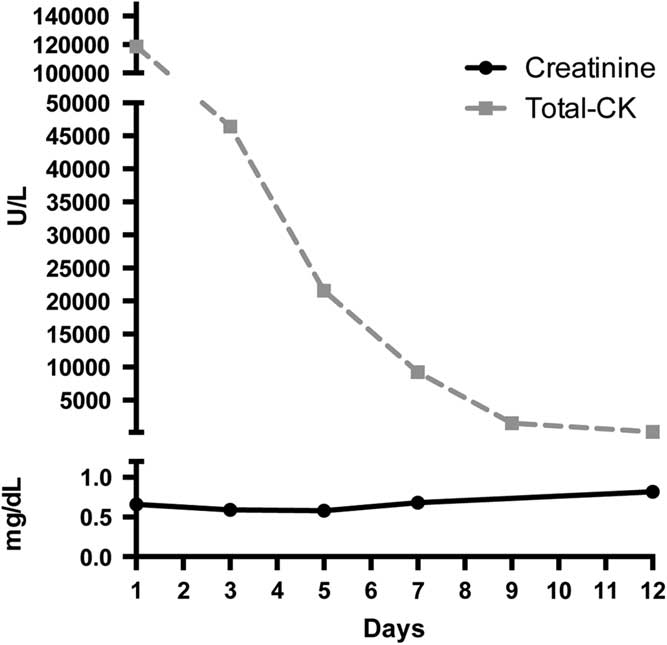
The patient was admitted to emergency care with a Glasgow Coma Score of 15, a stable haemodynamic state (heart rate: 80 per minute; blood pressure: 130/80 mmHg; O2 saturation: 98% [FiO2: 0.21]), and pain in both extremities and the thorax. While pain in the left inferior extremity decreased, blisters appeared on the medial surface of the left leg and right knee in association with decreased sensitivity and distal pulses in the left leg. Hospital admission examination revealed that the patient had plasmatic creatinine levels of 0.66 mg/dL and total creatine kinase (CK) levels of 118,700 U/L (Figure 2). Four hours after hospital admission, the patient was diagnosed with compartmental syndrome in the left leg, and a fasciotomy was performed, including medial and lateral compartments. After 12 days, the patient showed decreased total CK levels of 198 U/L and creatinine levels of 0.82 mg/dL. There were no observed increases in plasmatic electrolytes or of a requirement for hemodialysis during hospitalization.
Evolution of Total Creatine Kinase and Plasmatic Ceatinine during Hospitalization. Abbreviation: CK, creatine kinase.

Discussion
Little is known about crush syndrome due to its low incidence and few scientific reports. Over the last 20 years, 2,000 cases of crush syndrome have occurred in areas affected by earthquakes, resulting in more than one-half of patients requiring hemodialysis treatment. This is therefore an urgent public health concern during massive disasters.Reference Bywaters 2
Rhabdomyolysis plays a key role in the pathogenesis of crush syndrome, which is also known as traumatic rhabdomyolysis. Other described etiologies that can result in rhabdomyolysis include the use of pneumatic anti-shock trousers, injuries with vascular compromise, multiple lithotomies, and electrocution. Within the pathophysiology of rhabdomyolysis, muscle tissue is able to resist up to 1.5 hours of ischemia after extrinsic compression without presenting histological injuries, which occur after two hours and become irreversible after seven hours.Reference Huerta-Alardin, Varon and Marik 6 Therefore, rescue efforts lasting more than three hours, together with the area of compromised muscular mass, increase the probability of presenting this pathology.Reference Slater and Mullins 7
Acute kidney injury is unquestionably the most serious complication of rhabdomyolysis and occurs in up to 85% of patients with traumatic injuries. Subsequent mortality in clinical cases ranges from seven percent to 80% of patients.Reference Sever and Vanholder 4
Prehospital care of crush syndrome currently recommends the airway, breathing, circulation (ABC) algorithm designed by Advanced Trauma Life Support (ATLS)Reference Aoki, Demsar and Zupan 8 for trauma management. The first responders to the scene should evaluate the victim's airway, letter A. In the case of obstruction, an endotracheal tube or, in adverse environmental conditions, a laryngeal mask airway should be used. The letter B, for breathing, indicates that one should assume the patient has a compromised airway as thoracic injury occurs in up to 13% of trapped victims.Reference Ferlay, Soerjomataram and Dikshit 9 Due to this, the use of a high-flow (10-12 L/min) oxygen mask is recommended.Reference Yoshimura, Nakayama, Nakagiri, Azami, Ataka and Ishii 10
The letter C, for circulation, of ATLS trauma support recommends peripheral venous cannulation or, if this cannot be achieved, intraosseous cannulation. Moreover, with at least two access points, hypodermoclysis is also a valid alternative that should be kept in mind for exceptional cases when all of the prior options are inviable.
Despite that treatment is recommended based on expert opinions and a lack of randomized clinical trials, aggressive early resuscitation through volume replenishment holds the consensus. Regarding the type of liquid that should be used, solutions containing potassium, such as Lactated Ringer’s solution, are contraindicated. Moreover, the clinical use of mannitol is debated since, despite having nephroprotective properties, its application in patients with heart failure or anuria is contraindicated.Reference Ashkenazi, Isakovich, Kluger, Alfici, Kessel and Better 11 Solutions with bicarbonate have been the gold standard for rescue crews in recent yearsReference Brown, Rhee, Chan, Evans, Demetriades and Velmahos 12 since the “theoretical” alkalization of the urine would prevent the precipitation of myoglobin in the renal tubules. However, there is not sufficient evidence to demonstrate that active alkalization is the best method for nephroprotection.
Both EuropeanReference Bywaters 2 and AmericanReference Gonzalez 13 guidelines recommend the use of 0.9% saline to resuscitate a trapped patient, beginning at a rate of 1.0 L/h for the first two hours, followed by a rate of 0.5 L/h thereafter. If the patient presents no comorbidities, a rate of 1.0 L/h can be maintained throughout the entire rescue operation if signs of pulmonary congestion are not present. The clinical case presented in this study indicates that aggressive early resuscitation with isotonic solutions during the entire rescue effort is able to prevent AKI and provide nephroprotection to the patient. These positive effects were observed despite the patient presenting high total CK values, which can be related to the injured area and serve as a good indicator of trauma severity. This prehospital care determined a positive prognosis for the patient, who did not require dialytic support.
Considering that optimal trauma care prior to hospital admission positively influences patient prognosis, it is indispensable that all members of a medical team, including rescue crew and paramedics, be able to diagnose and treat crush syndrome in any patient exposed to compression trauma.
Conclusion
Aggressive early management with isotonic solutions before hospital arrival is an effective option for nephron-protection and prevention of crush syndrome.