Antibiotic prescribing at discharge is an important and underrecognized opportunity to improve antibiotic use.Reference Chavada, Davey, O’Connor and Tong1-Reference Yogo, Shihadeh and Young3 Most antibiotic courses initiated in hospitals are completed after discharge.Reference Chavada, Davey, O’Connor and Tong1-Reference Yogo, Shihadeh and Young3 More than half of discharge antibiotic prescriptions are of excessive duration,Reference Chavada, Davey, O’Connor and Tong1,Reference Hoover2,Reference Scarpato, Timko and Cluzet4 overly broad,Reference Yogo, Shihadeh and Young3 or unnecessary,Reference Scarpato, Timko and Cluzet4 and knowledge about the drivers of discharge antibiotic decision making is limited. Furthermore, unlike in hospitals, patients are responsible for acquiring, taking, and completing the antibiotic at home. We performed a qualitative evaluation of healthcare workers (HCWs) and patients discharged on antibiotics to understand the intertwined work systems of discharge antibiotic decision making and antibiotic medication managementReference Werner, Malkana, Gurses, Leff and Arbaje5 to identify barriers to and strategies for discharge antimicrobial stewardship.
Methods
We used 2 approaches to evaluate antimicrobial stewardship at the hospital-to-home transition: (1) in-person semistructured interviews with HCWs and (2) contextual inquiry followed by semistructured interviews of discharged patients. HCWs and patients were recruited from a tertiary-care hospital in Baltimore, Maryland, and a community hospital in Bethesda, Maryland.
We performed purposive sampling in semistructured interviews to capture experiences from different HCW roles.Reference Crabtree and Miller6 Eligible HCWs were aged ≥18 years, were able to speak and read English, and were either inpatient HCWs or providers from an ambulatory clinic. The interview guide was based on the “Four Moments in Antibiotic Decision-Making” framework adapted to hospital dischargeReference Tamma, Miller and Cosgrove7 and the “Transition Model of Medication Management” (Appendix A online).Reference Werner, Malkana, Gurses, Leff and Arbaje5 Interviews were conducted by 2 investigators (S.C.K. and S.L.S.) between January 2019 and August 2019.
Contextual inquiry involves observing individuals (ie, patients) in their work system (ie, antibiotic medication management) and asking clarification questions.Reference Gurses, Seidl and Vaidya8 Eligible patients were aged ≥18 years, English-speaking, and not on hospice care. Contextual inquiry guides were based on the Transition Model of Medication Management and the Systems Engineering Initiative for Patient Safety (SEIPS) 2.0 model.Reference Holden, Carayon and Gurses9 For contextual inquiries between July 2019 and February 2020, 1 or 2 investigators (S.C.K. and S.L.S.) visited patients’ homes.
Interviews were audiorecorded and transcribed. After independently reviewing and comparing 3 transcripts, 2 investigators (S.C.K. and S.L.S.) created a preliminary code structure.Reference Crabtree and Miller6 A third investigator (A.I.A.) independently reviewed 8 transcripts, and 2 investigators (S.C.K. and S.L.S.) reviewed each transcript. The code structure was revised as subsequent transcripts were reviewed, and changes were applied retroactively.
Directed content analysis of the transcripts was performed, focusing on barriers to and strategies for discharge antibiotic decision making. Although the overall analysis was deductive and was based on the models,Reference Werner, Malkana, Gurses, Leff and Arbaje5,Reference Tamma, Miller and Cosgrove7,Reference Holden, Carayon and Gurses9 we used inductive reasoning as additional themes emerged. These themes included recurrent unifying concepts or statements, particularly those that were frequent, novel, or relevant.Reference Crabtree and Miller6 Interviews were conducted until thematic saturation was reached (ie, no new themes or understandings were obtained).Reference Crabtree and Miller6 Analysis was facilitated by NVivo version 12 Pro software (QSR International, Australia). The Johns Hopkins University Institutional Review Board approved this study.
Results
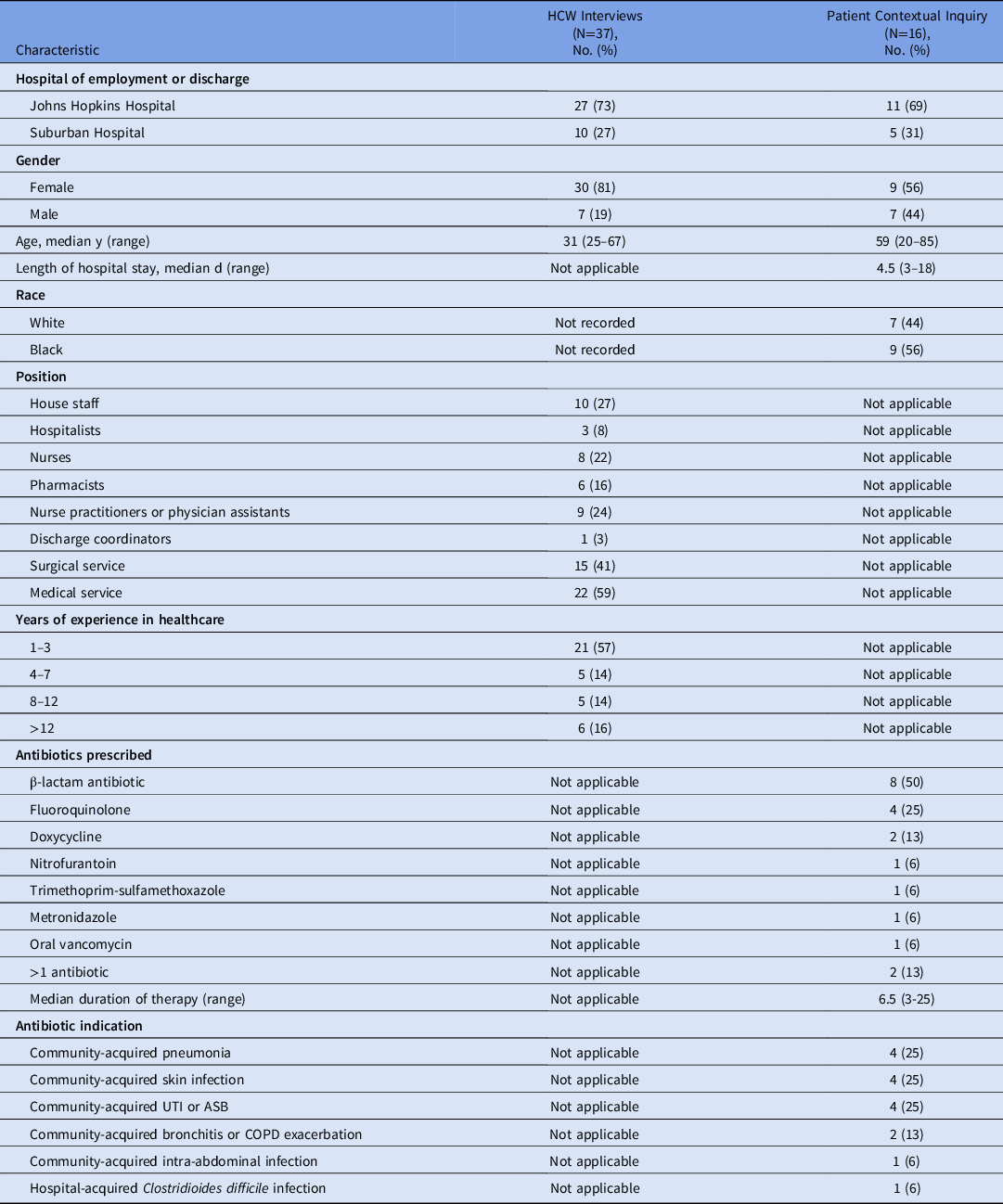
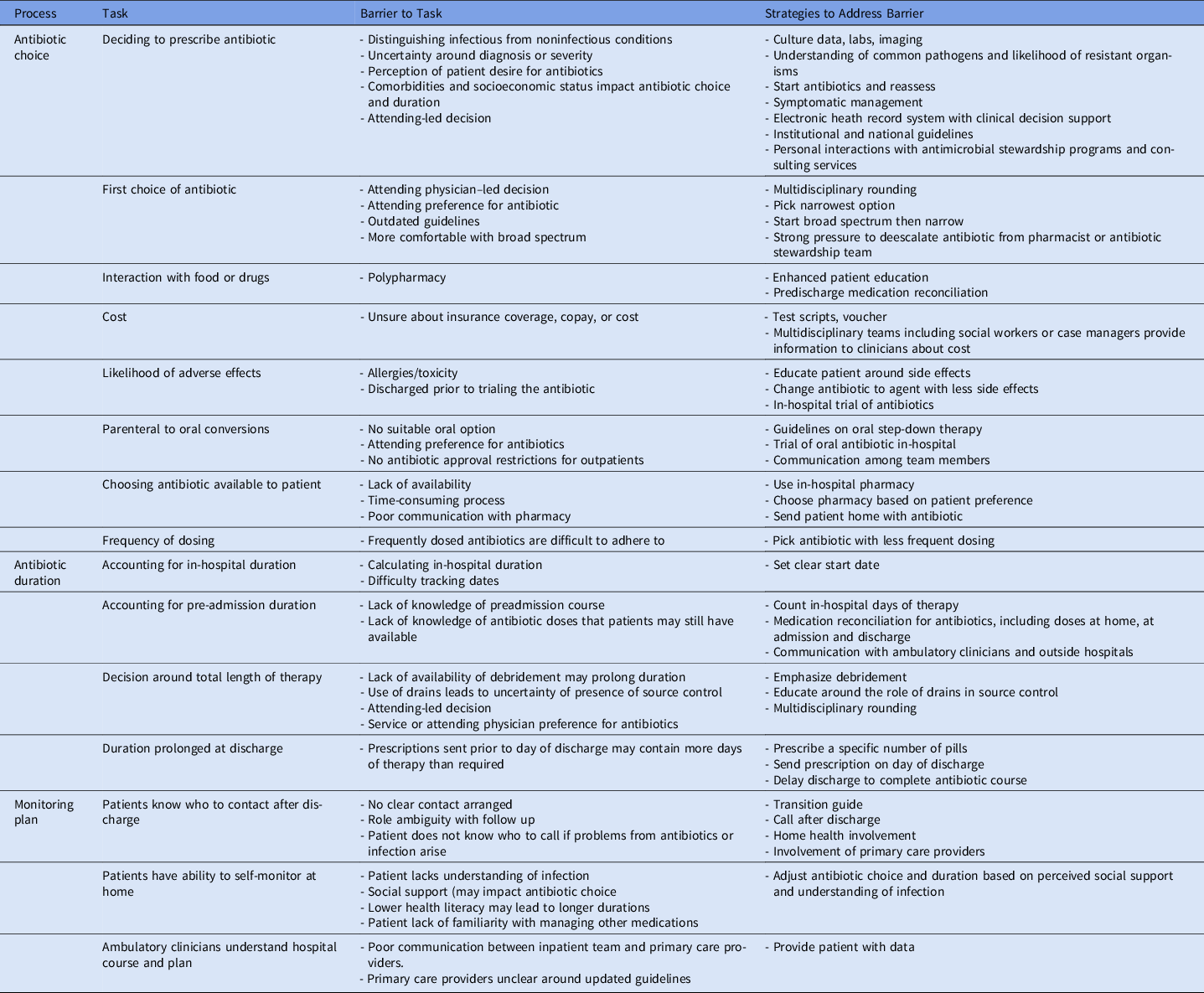
In total, 37 HCW interviews and 16 patient contextual inquiries were performed (Table 1). Barriers to and strategies for discharge antibiotic decision making (as discussed by participants, or observed during contextual inquiry) are described (Table 2). We focused on 5 themes that highlight barriers to and strategies for discharge antibiotic decision making.
Characteristics of HCWs and Patients Discharged on Oral Antibiotics

Note. HCW, healthcare worker; UTI, urinary tract infection; ASB, asymptomatic bacteriuria; COPD, chronic obstructive pulmonary disease.
Processes and Tasks in the Antibiotic Decision Making Work System Including Barriers and Strategies to Address Barriers

HCW perceptions of patient expectations for antibiotics sometimes influenced antibiotic prescribing, as one community-hospital hospitalist explained: “Patients love getting antibiotics… Sometimes families and patients demand antibiotics; they think they need them.” However, other HCWs noted decreasing patient requests for antibiotics, and patients did not describe wanting antibiotics.
Diagnostic uncertainty influenced inappropriate prescribing. Due to an elevated procalcitonin, a 68-year-old male patient with rhabdomyolysis was discharged with a diagnosis of “bronchitis” and 6 days of amoxicillin-clavulanate: “I [saw] on the discharge papers that they diagnosed [me with] bronchitis … it seems that the significant manifestation of whatever I had was the pains in my legs…”
Team culture and communication influenced discharge antibiotic decision making. On some medical teams, clinicians, pharmacists, discharge coordinators, and social workers together reevaluated antibiotic prescribing and identified affordable medications. On some surgical teams, antibiotic choices were described as being led by the attending physician. Multidisciplinary versus hierarchical attending physician–led team cultures impacted discharge antibiotic prescribing.
Poor communication across clinicians and care settings impacted decisions about duration. Accounting for total duration was highlighted as a major barrier, as described by an academic pharmacist: “It’s easier to write a script for 10 days versus looking back to count up everything.”
Determination of total antibiotic duration usually excluded preadmission duration due to limited information on preadmission events, resulting in prolonged antibiotic courses. In one contextual inquiry, a patient presenting for a lumbar fusion was given 7 days of nitrofurantoin for asymptomatic bacteriuria. After 3 preadmission days, 6 inpatient days, and 7 postdischarge days of therapy, and with instructions to complete all her antibiotics which she interpreted to include those at home, she took 20 days of nitrofurantoin for asymptomatic bacteriuria. Participants described mitigation strategies including setting a fixed end date and calculating in-hospital days of therapy. Not accounting for treatment across the course of illness may result in excessive antibiotic duration.
Organizational emphasis on early discharge prior to return of clinical and microbiologic data influenced antibiotic decision making. Proactive discussions about antibiotic choice and duration mitigated this barrier.
Discussion
We identified 5 main barriers to antimicrobial stewardship at hospital discharge: (1) clinician perception of patient expectations, (2) diagnostic uncertainty, (3) multidisciplinary versus hierarchical attending physician–led cultures, (4) not accounting for the total antibiotic duration, and (5) organizational pressure for discharge.
Clinician perceptions of patient demand for antibiotics has been described as promoting inappropriate antibiotic use in ambulatory settings.Reference Rezal, Hassali, Alrasheedy, Saleem, Yusof and Godman10 Interview participants differed in whether these perceptions drove antibiotic prescribing. Proposed mitigation strategies include patient education and clinician communication training.
Diagnostic uncertainty was identified as a driver of inappropriate antibiotic prescribing. Treatment guidelines may mitigate diagnostic uncertainty.
Team culture contributed to discharge antibiotic decision making. Antimicrobial stewardship efforts for discharge antibiotic decision making should consider team culture by targeting interventions to the decision makers.
Another common challenge was not accounting for in-hospital and preadmission antibiotics. In this study, we identified a need to implement structured strategies to account for the total antibiotic duration across the course of illness through improved medication reconciliation at admission and discharge. Patients who are told to finish “all of their antibiotics” may interpret this as finishing antibiotics from a preadmission prescription; clinicians should clarify these instructions. Antibiotic time-outs at the time of discharge can readdress antibiotic choice and duration.
Discharge on empiric antibiotic therapy with incomplete data was identified as a barrier to antibiotic decision making, contributing to prolonged treatment and lack of antibiotic de-escalation.
The strengths of this study include the integration of inpatient and outpatient HCW and patient perspectives in understanding barriers to antibiotic decision making at hospital discharge.
This study also has several limitations. Although thematic saturation was observed, perspectives may have been missed, particularly male HCWs and attending physicians. Only participants who spoke English were included, limiting generalizability to non–English-speaking populations. In this study, we focused on oral antibiotics, we did not focus on the distinct process of discharge on Occupational Physical Assessment Test (OPAT). Because this is a qualitative study; it is hypothesis generating, with a focus on transferability rather than generalizability. Further work is required to test the impact of proposed interventions.
Improving antibiotic prescribing practices at hospital discharge is a complex task with multiple barriers. Antimicrobial stewardship programs should target hierarchical structures, differences in service cultures, and diagnostic uncertainty. The antibiotic decision-making system needs to account for the total duration of antibiotics to avoid prolonged courses of therapy. Discharge on empiric therapy before clinical and microbiological data can be mitigated by proactive antibiotic planning. Implementation of targeted interventions can result in more effective outcomes for antibiotic use at the hospital-to-home transition.
Supplementary material
To view supplementary material for this article, please visit https://doi.org/10.1017/ice.2020.1383
Acknowledgements
We appreciate the support of the HCWs who kindly shared their insights with us, and the patients who invited us into their homes to discuss their perceptions.
Financial support
This work is funded by the Agency for Healthcare Research and Quality (AHRQ grant no. R03 HS026995-01; PI, S.C.K.).
Conflicts of interest
All authors report no conflicts of interest relevant to this article.