For US actor, playwright, and theatre manager Harry Watkins (1825–94), the 1852–3 season was a whirlwind of ups and downs, elation and despair, triumph and tragedy. His engagement as an actor in C. R. Thorne's stock company at the New York Theatre ended abruptly in mid-September, leaving him without work at a point when few theatres were hiring. He mourned the loss of a beloved cousin, Jane Mott, who passed away one rainy day in October after a drawn-out illness. He endured many a headache while spearheading a fund-raising effort among his fellow actors to contribute a memorial stone to the Washington Monument. He was elected to the board of the American Dramatic Fund Association, but infighting among the directors left him feeling insulted and underappreciated, ultimately leading him to cease his involvement. By far, his biggest frustration was his inability to obtain reliable employment. He wrote many letters to many managers, to no avail. More than once, he considered giving up the theatre altogether.Footnote 1
A few joyful moments motivated Watkins to persist, however. Most of them involved an audience. During a brief engagement across the Hudson River in New Jersey, he appeared in J. T. Haines's 1823 comedy The Idiot Witness (a repertory staple at the time), and the spectators called for him after the curtain fell, applauding Watkins for his portrayal of Gilbert. “The approbation of that Newark gathering was as the triumphs of a Cushman or a Forrest,” observe Maud and Otis Skinner in their 1938 biography of Watkins. “These little victories solaced his soul, wounded by the injustice of a prejudiced world; they vindicated his right to a place in the sun.”Footnote 2 And the season ended on a very high note. On 2 July 1853—closing night at the Odeon in Williamsburg, New York (a theatre he had been managing since late February)—the audience surprised him with a gift: a beautiful presentation sword, inscribed with compliments from his “dramatic admirers.” He was so moved by the audience's gesture that he was only able to muster an “effective, if not eloquent” speech of gratitude.Footnote 3
Watkins managed to eke out a living in the theatre for nearly fifty years, but he never achieved the renown he craved, let alone the renown usually required to be the subject of a scholarly article (Fig. 1). His career was barely above average. This is probably why his appearance in theatre historiography has been fleeting and occasional.Footnote 4 Histories of the performing arts tend to be dominated by the brightest stars and greatest hits, not only because relatively few manuscripts written by entertainers have been preserved, cataloged, and rendered discoverable, but also because theatre historians tend to be attracted to people and plays whose significance is obvious: artists who were widely known or markedly innovative, or dramas with political or cultural resonance. Yet when scholars focus exclusively on exceptional lives and events, a lot gets left out of the story. The sensational, scandalous, or tragic episodes in a celebrity's life jump into the foreground, overshadowing the everyday preoccupations that make up the majority of human experience. Since roughly the 1960s, social historians have offered compelling studies of “ordinary” people as a way to augment and complicate our understanding of the past. E. P. Thompson, Carlo Ginzburg, Robert Darnton, Laurel Thatcher Ulrich, Thomas Augst, and many others have revealed that rich insights can be gleaned from studying the commonplace.Footnote 5 More recently, some theatre scholars have recognized the value of what Derek Miller has called the “forgotten middle,” mining it for rich insights about US entertainment culture. For example, in Highbrow/Lowdown: Theater, Jazz, and the Making of the New Middle Class, David Savran proposes the “middlebrow” as way to complicate the lowbrow–highbrow binary that tends to dominate conversations about performance and culture; and Debra Caplan, Brian Eugenio Herrera, and Miller are investigating what lesser-known laborers and less-than-successful ventures can reveal about twentieth-century entertainment culture.Footnote 6 Similarly, Watkins's extensive diary, which he kept during the fifteen years leading up to the Civil War (1845–60), allows us to explore the potential of the quotidian. Of course, his chronicle of the antebellum theatre is indelibly shaped by his perspective as a white, male, straight, nativist, working-class New Yorker. As such, it is considerably limited. But his diary rewards careful study, particularly when contextualized by other sources, or when read against the grain.
Carte de visite of Harry Watkins, circa 1850. Courtesy of Houghton Library, Harvard University.

In this essay, I offer Watkins's sword as an object lesson exemplifying what an artifact can reveal about nineteenth-century theatre culture.Footnote 7 Like Robin Bernstein, Leo Cabranes-Grant, Aoife Monks, Marlis Schweitzer and Joanne Zerdy, Andrew Sofer, and many others, I believe that “things” archive important revelations about the theatre, because they invite and shape behavior, communicate ideas and ideologies, and circulate within professional networks.Footnote 8 However, the utility, materiality, and thingness of Watkins's sword are not my focus. Instead, I use the sword as a springboard to launch a broader narrative about how actors and spectators engage and rely upon each other. When examined alongside gifts that were presented to better-known actors (including Edwin Booth, Charlotte Cushman, Edwin Forrest, Clara Morris, Anna Cora Mowatt, and James E. Murdoch), Watkins's sword exposes the complex dynamics of give-and-take that sustained nineteenth-century US theatres—something akin to what Avner Offer has called “the economy of regard.”Footnote 9 Collectively, gift presentations in theatres render visible this affective and affirmative system, which strongly contradicts images of angry, rowdy, disruptive spectators that predominate in historiography about the nineteenth century as well as in popular culture. For instance, a performance of Uncle Tom's Cabin depicted in Martin Scorsese's 2002 film Gangs of New York (an adaptation of Herbert Asbury's 1927 book) terminates tumultuously with Daniel Day-Lewis and Leonardo DiCaprio pitching rotten vegetables at the actors. Like most clichés, this one is at least partially true, as Richard Butsch demonstrates in The Making of American Audiences.Footnote 10 Undoubtedly, class tensions played out within the diverse communities that congregated at urban theatres, and occasionally erupted in fights and violence. But much more often, audiences performed gestures of affirmation and support. These ranged from the relatively simple “call-out” to the elaborately staged gift presentation or “testimonial.” Ritualistic offerings of “praise, plaudits, and presents” (to quote US actress Clara Morris) cemented the social bonds between actors and spectators at a given theatre, and the sense of camaraderie they generated had material effects in the world.Footnote 11 In the moment of their enactment, they solidified an actor's position within a stock company; cumulatively, they could make a career. Thanks to the unrelenting dailiness of Watkins's diary, we can see that rowdiness was the exception rather than the rule. Spectators threw flowers more often than they threw tomatoes.
To understand fully the significance of Watkins's sword, we have to rewind to February of 1853, when the out-of-work actor took a ferry to the city of Williamsburg to see a makeshift theatrical company performing at the Odeon, a venue owned by the brothers Albert and Henry Kemp. Williamsburg is now a fashionable neighborhood in Brooklyn, but in his day, Watkins called it “a country town.”Footnote 12 A few weeks before Watkins's excursion, the editor of the Williamsburgh Daily Times had observed, “People complain of the want of amusement in this city,” and perhaps that is what inspired the troupe of actors to stage a few plays at the Odeon.Footnote 13 Up until that point, a smattering of concerts, lectures, and minstrel shows had been presented at the Kemps’ theatre, but no dramas.Footnote 14 Two days after his trip to the Odeon, the memory pestered Watkins, burrowing into his brain like a worm. He was getting the glimmer of an idea: What if he leased the theatre and assembled a permanent stock company there?Footnote 15 Despite the challenges he was likely to face managing a theatre in a town that had never had one, he decided to pursue the potentially lucrative speculation. The people of Williamsburg, to his eye, seemed interested in amusements; maybe he could develop a following there. After all, he had nothing better to do—why not this?
Ten days after his initial visit, Watkins wrote in his diary, “[I] entered into an arrangement with the owner of the Odeon to become partner with him in the management of the Theatre—he to bear all the losses, if any, I to share the profits with the same proviso.”Footnote 16 He promised the Kemps that he would reopen the theatre the following Monday—just three days later. He hustled to find actors, and by 5 p.m. on Saturday, he had secured a dozen who were ready and willing to perform on the promised date.Footnote 17 Alas, as the season unfolded, several performers turned out to be disorganized and disloyal, missing rehearsals in the morning, acting unevenly in the evening, and accepting better work when an opportunity presented itself. Watkins kept the theatre going until April, then closed it temporarily so that he could put together a new company for the summer season. “When I reopen I shall not retain a single member of the present company for their conduct to me has been shameful,” he vowed.Footnote 18 Newly christened the Odeon Garden, to make it more attractive to customers seeking relief from the summer heat, the theatre reopened on 16 May. That night, the audience was fine, but ticket sales quickly waned.Footnote 19 The Kemps, newly anxious about the pecuniary state of their venue, discharged the prompter, resulting in more work for the already strapped manager.Footnote 20 Watkins became frustrated. He had had such confidence in the residents of Williamsburg, believing them to be ready to support a theatre. But clearly, he had misjudged them. His ongoing struggles, as well as a disappointing turnout at his benefit on 11 June, caused Watkins to contemplate pursuing some other career.
Performances at the Odeon limped along until July. The Kemps, apparently on good terms with Watkins despite their financial losses, agreed to give him a complimentary benefit on 2 July, the closing night of the season. After the curtain fell, he was presented with the sword. Watkins reports in his diary,
It was bought by subscriptions given by many personal and dramatic friends, and bore the inscription: “Presented by his many dramatic admirers to Mr. H. Watkins, as a tribute of respect to his character as a man, his talent as an actor, and, as the First Theatrical manager in our city. Williamsburg, L.I.” The sword was delivered by Mr. Sparks, Sheriff of the county, and one of the editors of the Williamsburg Times. He made a very neat and appropriate speech to which I responded in effective, if not eloquent, terms. This sword was a facsi[mile of a sword] presented by the State of New York to General Worth, for his services during the Mexican War. After the presentation a bouquet was thrown to me with a very handsome gold watch-seal attached to it. The proceedings of this evening were certainly quite flattering, as the idea of a presentation was only mooted about forty-eight hours previous to the night of the Benefit.Footnote 21
When read closely, this passage offers fascinating clues about how and why the audience presented a sword to Watkins. For one, the inscription suggests that the “dramatic admirers” who chipped in included not only spectators at the Odeon, but also friends and colleagues who had observed Watkins's valiant endeavor from afar and wanted him to know that his efforts had not gone unnoted. Furthermore, Watkins states that the sword was a replica of a weapon given to US–Mexican War hero General William J. Worth.Footnote 22 As far back as the Revolutionary War, decorative “presentation swords”—more akin to trophies than weapons—were frequently given to distinguished US military personnel.Footnote 23 In choosing to give Watkins a sword, the Odeon spectators may have been referencing his service as a fifer in the US Army from 1838 to 1845. As a military musician, he rarely would have needed to use a sword; but as an actor, he regularly wielded swords onstage. In essence, the audience expressed its gratitude by bestowing a gift that could serve variously as memento, trophy, or stage prop.
It seems the presentation pleasantly surprised Watkins. But public expressions of gratitude were, in a word, ordinary. Actors’ diaries and memoirs, newspapers, and ephemera underscore the frequency of gift giving, the wide variety of mementos bestowed upon performers, and the symbolic value of such gifts. Sterling silver, gold watches, decorated canes, ornamental weapons: all of these, and more, were given to performers by admiring spectators.Footnote 24 For example, Edwin Forrest received a large number of gifts over the course of his legendary career, including several swords and a silver pitcher with matching goblets.Footnote 25 When Edwin Booth toured the South in the late 1850s, he collected gifts in several cities, including a bag containing $500 in gold.Footnote 26 And when Charlotte Cushman gave her farewell performance in Boston in 1874, a group of admiring spectators presented her with a laurel crown.Footnote 27 Many gifts were given, but few survive in libraries and museums. One of the few is a gold pocket watch at the Harvard Theatre Collection, which was presented to actor James E. Murdoch at the Sacramento Theatre in 1853.Footnote 28 Like Watkins's sword, the watch was inscribed: etched into the case is Murdoch's name as well as the date and location of the presentation. According to a document in the archive describing the watch, “In accepting the gift, the actor said that he had never carried a valuable watch, because he so often forgot to wind it, but now that he had this beautiful one, he would consider it a moral duty he owed the donors to keep it running.”Footnote 29 It seems Murdoch fulfilled this “moral duty,” because the decorative etching on the timepiece has been worn down in places, suggesting it was well used.
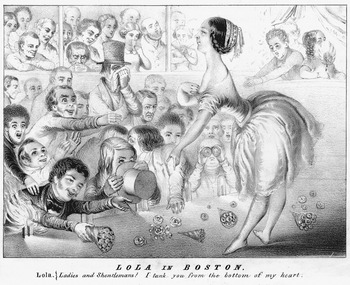
As happens occasionally today, spectators expressed adoration by throwing flowers. In an 1852 illustration in The Old Soldier, a pictorial publication based in New York City, buds and bouquets litter the stage at the tiny feet of Irish dancer and actress Lola Montez (Fig. 2).Footnote 30 Artist John L. Magee ridicules not only Montez, who expresses her gratitude to the audience in accented English, but also the male spectators, who surge toward the stage with floral offerings. A man in the lower left corner, wielding a bouquet in one hand and imploring for attention with the other, focuses on Montez with such abandon that the footlight has set his sleeve on fire. Actress-playwright Anna Cora Mowatt states in her autobiography, “Every actress who gains celebrity is tolerably sure of being courted and fêted, inundated with poems, complimentary letters, flowers, rich gifts. These things seem to be the inevitable consequences—I might say the conventional accessories—of her public position.”Footnote 31 Such “conventional accessories” served as the outward signs of a performer's status within the profession.
John L. Magee, “Lola in Boston.” The caption reads, “Lola: Ladies and Shentlemans! I tank you from the bottom of my heart.” Illustration in The Old Soldier (NY), 1 April 1852. Courtesy of American Antiquarian Society.

Two gifts stand out in Mowatt's autobiography. In December 1852, during an engagement at the Holliday Street Theatre in Baltimore, she received a large star-shaped bouquet made principally of white camellias. Anyone onstage or in the house who was acquainted with the nineteenth-century language of flowers would have understood the camellias to mean either “My destiny is in your hands” or “perfected loveliness.”Footnote 32 More bizarrely, a group of devotees also presented the actress with a fawn. (Yes: a baby deer.) Spectators who had read Baltimore's The Sun or American & Commercial Daily Advertiser that day would not have been surprised, because those newspapers announced that a fawn would be presented to Mowatt that night. The Sun, treating the fawn like a celebrity visitor, termed it a noteworthy “Arrival” in Baltimore: “A most beautiful fawn arrived here yesterday from the West, which will be presented to the distinguished American actress, Mrs. Mowatt, this evening, at the Holliday St. Theatre, by an association styled the Alamana. It is a rare specimen and very beautiful.” The Advertiser, in a brief item titled “A Compliment to Mrs. Mowatt,” specified that the fawn was brought from Cumberland—a major transportation hub located in the mountainous region of Allegany County (Maryland). Mowatt's benefit bill included The Honeymoon by John Tobin, a popular comedy reminiscent of Shakespeare's Taming of the Shrew. The fawn appeared in the fourth act of the play, when one of Mowatt's fellow actors brought it onstage with him. “My new pet followed me about and played his part to perfection,” the actress remembered. “When the Duke and Lopez were conversing, I seated myself upon a footstool beside the table, and the gentle fawn ate out of my hand, varying the feast by munching my curls, greatly to the amusement of the audience.” What happened to the creature after the performance is anyone's guess. Mowatt does not mention its fate in her autobiography.Footnote 33
Clara Morris, writing in her diary about a performance she gave at Cleveland's Academy of Music in 1873, recorded the gifts she received: two floral arrangements and a casket containing a gold necklace and earrings. The Cleveland Daily Herald notes that an arrangement assembled by Dr. W. H. Beaumont (a local florist) was displayed that day at the shop of druggists Vaupel & Moore. J. N. Gotthold, the leading man who played with Morris that evening, presented the gifts and made a speech. When Gotthold gave Morris the casket of jewelry on behalf of “some of the eleven hundred young men who, in this city, went to school with you in your younger days,” the Herald observed that the actress was “wholly taken by surprise.” Morris said to those assembled,
You are showering praises, plaudits, and presents upon me, that I hardly feel worthy of. It is said that it is more pleasant to give than to receive. If so, many must be in a delightful frame of mind tonight. I am more than ever convinced that there is nothing like study, hard work and patience in the profession, and if you will only give me time, I hope to return to you with a reputation that you may feel proud of.
To commemorate this moment of affection and esteem, the gold cross given to Morris was inscribed, just like Watkins's sword and Murdoch's watch. The monogram “C. M.” named Morris as the object of the audience's admiration, and the date and place (“Cleveland, January 23, 1874”) served as a kind of signature.Footnote 34
Gift presentations were so ubiquitous that they became the subject of jokes. In 1858, the New York Clipper, a sporting newspaper that reported on theatricals, boxing matches, dogfights, and other amusements, published this short squib:
When [Edmund] Kean first played Sir Giles Overreach, (June, 1816,) he made as great an impression on his fellow-actors as on his audience—insomuch that they agreed to present him with a silver cup. When [Joseph Shepherd] Munden was applied to [contribute], he replied in his peculiar manner, “I've no objection to your cupping Mr Kean, but I'll be hanged if you shall bleed me!”Footnote 35
In this anecdote about two celebrated English actors, Munden scoffs at the invitation to chip in for a silver cup for Kean—equating the request with the unpleasant medical procedure of “bleeding” a patient of impurities. Shortly after publishing this jest, the Clipper reported on a gift presentation staged as a practical joke on US actor-manager William Wheatley:
Manager Wheatley … is said to have been presented with a “testimonial of the esteem of his friends,” in the shape of a gold watch, a few days since, at Atlantic City, where he has been spending the summer. Judge of his surprise, however, when, on opening the case, he discovered that he had been presented with his own watch, which he had left at home, and which a few wags took advantage of to have a joke at the manager's expense. Both parties enjoyed the joke amazingly, but it “kinder disappointed” the recipient.Footnote 36
These satirical treatments of the gift presentation indicate that the typical Clipper reader would be fully familiar with the practice: the editor expected his readers would get the joke. The squib about Munden suggests that people who were approached to contribute to a gift confronted a dilemma about whether and what to give. It seems that Kean's colleague did not want to be “bled” even though he didn't object to Kean's being “cupped” (referring to another painful nineteenth-century medical procedure). The humor hinges on the punch line's play on words as well as the knowledge that fellow actors’ involvement in gift presentations was sometimes forced. Similarly, in the anecdote about Wheatley, the “wags” who presented the actor-manager with his own watch imitated the conventions of the public testimonial to provide a good laugh for Wheatley's fans.
But the most compelling evidence of the significance of gift giving in nineteenth-century theatres is reports of presentations that never happened. In January 1822, after the police raided the African Grove in New York City (a theatrical venue established and managed by African American impresario William A. Brown), the editor of the Republican Sentinel observed, “It is thought that this incident will deprive Mr. Brown (a dramatist who wrote for this establishment) of the supper, speech and silver Pitchers, which he had a right to expect for his literary services”—alluding to the silver pitchers that Stephen Price, manager of the Park Theatre, had recently presented to Mordecai Noah (dramatist, local sheriff, and editor of the National Advocate). Both Noah and Price played pivotal roles in the effort to shut down Brown's pleasure garden, which had attracted audiences away from the Park.Footnote 37 This passing allusion to a presentation that would never take place underscores that testimonials were frequent, and frequently discussed, within theatrical communities. Allegations about disingenuously staged presentations underscore this as well. For example, while Watkins was a member of the stock company at the American Theatre in New Orleans, he expressed concerns in his diary that a silver cup presented to Joshua Silsbee—a traveling star best known for Yankee characters—was acquired and coordinated by Silsbee himself. “It was given him as coming from his friends and patrons of New Orleans,” Watkins writes, “but who they was [sic] nobody could find out, though there was a letter read on the stage as coming from them—but there was no signatures. I guess he bought it himself, [and] that is the opinion of the company.”Footnote 38 Local newspapers neither affirm nor deny Watkins's suspicions. The Daily Picayune did not alert the public that a gift presentation would take place that evening, but eventually reported that Silsbee received a silver cup presented “by a committee of gentlemen, through Mr. Stanley, the acting stage-manager,” and that it was inscribed, “Presented to Mr. J. S. Silsbee by his friends, as a mark of their esteem for him as a gentleman of irreproachable character, and as an actor unrivaled in his profession as a true delineator of the Yankee character.”Footnote 39 The inclusion of the inscription in this article suggests that someone associated with the theatre (stage manager Stanley, perhaps, or Silsbee himself) provided it to the editor, either to promote the theatre or to puff the departing star.
Diana Taylor's notion of the repertoire—the everyday “gestures, orality, movement, dance, singing” and other practices “usually thought of as ephemeral, nonreproducible knowledge”—helps illuminate why an actor like Silsbee might fabricate a gift presentation. Practices in the repertoire, despite their ephemerality, have a unique staying power because they accrue and concretize over time. They are defined by the sense of “againness” they generate, and perennially “reconstitute themselves, transmitting communal memories, histories, and values from one group/generation to the next.”Footnote 40 The conventions associated with gift presentations were so specific that a book of “ready-made speeches” published by Joseph Barber in 1871 includes an entire section devoted to them. “America is emphatically the Land of Testimonials,” Barber asserts. “Nowhere else is the fashion of complimenting the individual and associated merit with valuable presents and public expressions of approbation, as general as in this country.”Footnote 41 The present, presenter, and recipient in each of Barber's speeches are surprisingly specific—suggesting that the choice of gift tended to be governed by tradition, too. Among other scripts, it contains sample texts for “Presenting a Service of Plate to a Public Officer,” “Presenting a Gold Watch to a Party Leader,” and even “Presentation of a Token of Remembrance by the Young Lady Pupils of a School or Seminary to a Favorite Female Teacher.” In most of Barber's speeches, the presenter emphasizes that he has been appointed to speak by a sizable group or committee; in other words, he is but one of many admirers. Each speech attempts to amuse the audience through a double entendre or a fitting quotation. Barber also includes exemplary replies for honorees—humble, self-deprecating responses of (roughly) one-third to one-half the length of the presenter's remarks.Footnote 42
Spectators constituted the principal audience at gift presentations, and the presenter and honoree served as the key performers. But their roles overlapped in complex ways, ghosted by past presentations and widely known facts about the participants. For example, a presenter's reputation or public profile conveyed something about the actor's status. When spectators honored Watkins at the Odeon, Caspian A. Sparks, the Kings County undersheriff and an editor at the Williamsburgh Daily Times, served as the presenter. In his 1885 history of volunteer firefighters in New York City, J. Frank Kernan claims that Sparks “had a great influence among the ‘boys’” in Williamsburg.Footnote 43 As a county official viewed favorably by the working-class men who patronized the Odeon, Sparks gave the proceedings an air of respectability as well as revelry. In addition, because it was customary for managers to hire people to keep the peace at their theatres, the undersheriff's presence might have underscored the mutual support enjoyed by theatre makers and peacekeepers.Footnote 44 It is also likely that Sparks and Watkins had a business relationship. As a newspaper editor, Sparks probably received payments from Watkins for advertisements and puffed and promoted the theatre's offerings in the “Local Items” section. Sparks even published an essay written by Watkins, in which the actor-manager refuted a Methodist minister's criticism of the theatre industry.Footnote 45 Sparks took the stage, and therefore took a stand, for Watkins. In contrast, when Silsbee received the silver cup in New Orleans, the stage manager—not one of the “friends” who allegedly funded the gift—presented it to the actor. The stage manager's lackluster might be one reason why Watkins and his fellow actors questioned the legitimacy of the whole affair.
In addition to the spectators in the house, actors and managers comprised another important audience at gift presentations, their reactions ranging from curiosity to appreciation to annoyance. In 1850, while he was in A. H. Purdy's employ at the National Theatre in New York City, Watkins expressed chagrin about a speech given by H. Perry, a fellow actor, when he received a silver trumpet from Fire Company No. 42. “Mr. Perry's speech in reply to the remarks of the presenter was in very bad taste if not a gross slander upon his profession,” Watkins complained in his diary. “After asserting that the public styled the Actor a drunkard, instead of giving it the lie, as he could and should have done, he indirectly admitted it to be so. … Many actors were standing around who appeared as much displeased at Mr. H. Perry's speech, as myself.”Footnote 46 On the other hand, when the performer being honored behaved admirably during a gift presentation, his status could increase in his colleagues’ eyes, and his labor became more valuable.
The many conventions associated with gift presentations suggest that they mattered to everyone—on, behind, and in front of the stage. Why? We can easily imagine how Watkins might have benefited practically and economically from the sword he received at the Odeon. To make a good impression on audiences, actors had to assemble a stylish and functional wardrobe, because theatres did not provide costumes except when something unusual was required.Footnote 47 But the way in which Watkins treasured his sword suggests that gifts from an audience carried intangible value, too. A gift presentation celebrated an actor's talent and status, forcing people around him (peers and managers especially) to take notice. In other words, an actor would enjoy an increase in his social capital: his standing as perceived by others.Footnote 48 Audiences understood this, which is probably why they performed their love publicly. Over time, the prestige derived from such expressions of support could translate into financial gain. Fellow actors and theatre managers who witnessed the event would be obliged, later, to deal with the ramifications of the public's recognition. Watkins knew quite well he could transform the social capital generated by the audience's love into economic capital. Actors would feel compelled to respond more readily to his requests for volunteers at future benefits, and managers might offer larger salaries.Footnote 49
The opportunity to enhance one's reputation (and concomitantly, one's leverage) also explains why actors might decide to fabricate a gift presentation. Watkins's doubts about the provenance of Silsbee's silver cup likely sprung from the knowledge that such humbug was common. Describing the successful opening of her play Fashion, Mowatt cautions readers of her autobiography that “the floral showers” that happen on such occasions “are always more or less a conventional farce. The friends of the performer usually arm themselves with bouquets, and the management as frequently prepare a second supply.” She warns, “It is a mistake to suppose that the bouquet rain is ever a sign of the estimation in which an actor is held by the public in general, though it is often the evidence of private esteem. Sometimes the same bouquet is made to do service more than once during an evening.” But “flower showers” and other displays of generosity existed and persisted precisely because they played such an important role in theatrical enterprises.Footnote 50
If we stretch our definition of “gift” to include other performances of appreciation, such as spectators’ “calling out” an actor to appear before the curtain at the end of a performance, the frequency and conventionality of testimonials are even more apparent.Footnote 51 By calling out a performer, the audience sent a strong signal that the actor deserved whatever salary, benefits, and roles the manager could offer. It thrilled Watkins whenever his fans acknowledged him with shouts and cries, because it proved his popularity to everyone present—managers, actors, and spectators alike.Footnote 52 When called out, the actor usually made an extemporaneous speech of gratitude, echoing the conventional reply given at gift presentations. “Whatever the present may be, a speech and reply are the indispensable accompaniments of its presentation and reception,” Barber writes in his anthology of ready-made speeches. “Etiquette demands this interchange of courtesies, and no token or respect and esteem, from a flag to a farm, from a cluster pin to a furnished palace or a pile of greenbacks, can be tendered and accepted without it.”Footnote 53 When an actress was called out, a male colleague usually led her from the wings to the stage, at which point the actress addressed the audience directly or asked her escort to do so on her behalf.
Because spectators’ approbation boosted an actor's status within a stock company, testimonials and call-outs occasionally led to power struggles between managers and employees. For instance, in the contractual “Rules and Regulations” in force at Boston's National Theatre during the early and mid-1800s, the management warned the actors, “No person is permitted, on any account, to address the audience, but with the consent of the Manager. Any violation of this article will subject the party to a forfeiture of a week's salary, or a discharge, or both, at the option of the manager.”Footnote 54 Managers at many theatres expected actors to follow this rule. When the audience at John W. Bates's National Theatre in Cincinnati called out Watkins in 1854, the actor went before the curtain without permission—deeply displeasing D. A. Sarzedas, the stage manager. Watkins wrote in his diary, “Sarzedas … told me that I had no right to do so without first asking his permission, that it was Mr. Bates's wish that no stock actor should appear before the curtain.” As Watkins's popularity grew, tensions between him and Sarzedas grew, too. When he was called out after performing Middleton in W. H. Smith's The Drunkard on a night when Sarzedas was absent, Watkins boasted, “I was loudly called for and went out, there being no stage manager to prevent me.”Footnote 55 Playbills confirm that spectators’ determination to praise stock actors greatly annoyed the management. Take, for example, this message to the audience:
The practice of calling Actors in front of the curtain originated in a desire on the part of an audience to compliment rare and superior merit; when it is exercised indiscriminately by Boys and injudicious personal friends, it ceases to be a compliment, and becomes a Satire. It is presumed that the practice of calling out, which has been recently so much abused, will meet with no approval from the judicious portion of the audience. The Manager, from this time forth, is determined to enforce the standing rule of all well regulated Theatres, not to allow any members of the Stock Company to address the audience.Footnote 56
Such attempts to regulate behavior often amused critics and aficionados. The New York Clipper, for example, noted Bates's and Sarzedas's efforts to impose order at their theatre, and made fun of them.Footnote 57
Testimonials, gifts, and practices like the call-out reveal the complicated web of competition and cooperation that existed within the nineteenth-century theatre industry. In many ways, the theatre was a cutthroat business, with actors constantly vying for better footholds in the profession. But theatre makers and theatregoers understood they had both rights and responsibilities within what Cabranes-Grant (drawing on Bruno Latour) has described as the “knots or nodes of entangled agencies” in actor-networks.Footnote 58 In 1857, the New York Clipper criticized theatre managers’ risky speculations and asserted, “the proper remuneration of performers [is] a matter of public concern” because “a friendly regard for the welfare of those who amuse or instruct us is a natural result of the intimate relations between the public and their favorite performers.”Footnote 59 Conventions of generosity in nineteenth-century theatres make these “intimate relations” visible as an economy of regard.Footnote 60 Benefits, during which theatre professionals received a portion of the evening's profits, illuminate this most clearly. Most gift presentations were made during benefits, and if we view the benefit as a kind of performance genre in itself, it becomes clear why spectators might coordinate a public show of friendship at such an event. For an actor, a benefit was an important opportunity for financial and professional gain. Because the benefit system enabled managers to give actors relatively low salaries, the bulk of the responsibility for failure or success rested on the beneficiary's shoulders: the performer had to design an evening of entertainment that would draw a large crowd and, when possible, recruit prominent colleagues to play gratis. A triumphant benefit relied on the benevolence of others in myriad ways. The manager had to offer a promising date and good sharing terms, newspaper editors had to write about it, and the theatre's community of spectators had to show up.Footnote 61 Furthermore, actors had to forge and maintain friendly relations with fellow performers in order to ensure they would have the talent required for a successful benefit. Actors regularly volunteered their labor for colleagues’ benefits with the understanding that, one day, their effort would be reciprocated. But they could easily ruin the event by mugging, acting lazily, being imperfect in their parts, or refusing to participate. Such slights often resulted in long-term grudges. Watkins did not inventory every instance of generosity or disregard in his diary, but when he felt particularly insulted, he noted it. In the winter of 1849, while working as a stock actor at the Beach Street Museum in Boston, Watkins asked the leading man in the company to play at his benefit. “J. Proctor refused to play for my benefit, giving as a reason that he expected to leave town before Friday. This was said on Tuesday—now I find out that he does not leave town until Monday next. I'll not forget this,” Watkins fumed.Footnote 62
Watkins's comments about yet another benefit underscore how friendship and magnanimity played instrumental roles in an actor's career. Apparently, to his surprise and that of many others, the turnout at a benefit he received in March 1854 was excellent, second only to the houses drawn by starring actress Julia Dean, who had recently appeared at the same theatre. “This success is one of the most gratifying things I ever experienced,” he wrote. “It proves that my conduct off the stage has gained me many friends and that my talent as an actor has made me popular with the public, thus silencing the slanders of my foes, and placing me on a better footing with Mr. Bates who judges a man by the money he makes.”Footnote 63 Watkins's assertion that his “conduct off the stage” contributed to the positive outcome suggests that actors’ and spectators’ interactions spilled beyond the playhouse and into everyday life. The friendships Watkins forged offstage helped ensure his supporters would show up at the theatre when it mattered most.
Spectators who patronized a particular playhouse shared common ground, their experiences and impressions accumulating over time. At the theatre, they exchanged news, swapped gossip, and hatched plans. They also freely expressed their admiration or displeasure about the actors and management. “Familiarity with the place, the performers, the plays, and the fellow audience members produced a community that was inclined to claim collective rights of audience sovereignty,” Butsch asserts. “Members of such a community were more prone to be familiar with each other, to speak their minds, to be invested in this community.”Footnote 64 In a sense, actors “belonged” to the patrons who helped ensure their livelihoods. Social intimacy between actors and spectators coalesced and grew, thanks to the regularity of their encounters with one another. They interacted in boardinghouses, shops, libraries, lyceums, Masonic lodges, and city streets. Today, theatregoers tend to choose shows rather than venues, so this dynamic is difficult for us to grasp. But during the nineteenth century, spectators usually remained loyal to one or two theatres, affiliating with them due to their location, repertory, actors, or typical audience.Footnote 65
Butsch suggests that during the nineteenth century, only working-class spectators attended theatres regularly, “demonstrating more interest and commitment than the fashionable crowd who came more to be seen than to see.”Footnote 66 But the prominent participants and complicated logistics involved in gift presentations tell a different story. Little documentation of spectators’ participation in testimonials survives in the archive. But an extraillustrated volume assembled by Curtis Guild Sr. (1827–1911), founder and editor of the Boston Commercial Bulletin, provides a rare glimpse of the gift presentation as viewed through the eyes of a fan. An avid theatre aficionado, Guild acquired numerous biographies and encyclopedias about actors and enhanced them with correspondence, newspaper clippings, illustrations, and other unpublished material. Several of these extraillustrated volumes are now housed at the Massachusetts Historical Society. His copy of Clara Erskine Clement's Charlotte Cushman (1882) includes many items related to the actress's farewell performance in Boston in 1874, during which several prominent residents (including Guild) collaborated on the presentation of a laurel crown to the actress. Guild wrote and gave a speech on behalf of the committee of subscribers. Among his mementos from the event is a printed invitation sent by Arthur Cheney, a key organizer of the affair, with instructions for when and how to gather on the stage after Cushman's performance. Sharing the stage with a legendary performer was a thrill for these admirers, even though many of them were prominent people themselves. A letter addressed to Guild by one of the subscribers, Alexander H. Rice (who served his fellow Bostonians as mayor, congressman, and eventually, governor), enables us to imagine how dazzling it must have been to participate in such an event: “We … felt like very small corks in very large bottles; at least one of us did. I think it will be several seasons distant before I make a second ‘appearance on any stage’ except a stage coach.”Footnote 67 Guild's mementos underscore how meaningful an event like this could be for members of a theatrical community—actors, presenters, and patrons alike.
Watkins enjoyed the benefits of this community, both as a performer and a spectator. Nevertheless, he regularly suffered from doubts about whether to continue working in the theatre at all. He thrived on the praise, plaudits, and presents he received from the people who championed him, and he felt betrayed whenever he was ignored. During his unsuccessful venture at the Odeon in Williamsburg, he complained to his diary:
Should [the actor] but lose his voice or any of those powers which give effect to his representations, … those very persons who once applauded him … would turn their backs upon their “favorite” … and thus this individual, who was once so tenacious of his reputation, finds the “dear public” turning him out to die, like an old horse that can no longer do its master's work.Footnote 68
Elsewhere, and often, Watkins characterizes the audience as whimsical and difficult to satisfy. His bitterness underscores the double bind of the nineteenth-century actor: he depends utterly upon his audiences’ regard, because this regard (or the lack thereof) impacts not only his ability to be employed, but also his faith in himself, his precious self-esteem.
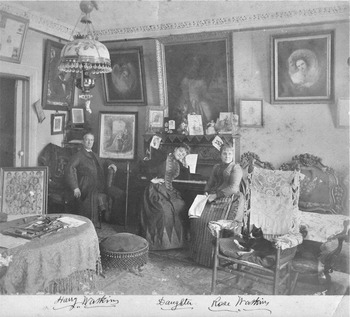
Perhaps this is why Watkins cherished the sword throughout his life. You can see it prominently displayed in a family photograph taken in the parlor of his New York City home in the 1880s (Fig. 3). A number of theatrical treasures are exhibited alongside Watkins, his wife Rose, and his daughter Amy Lee. The sword leans against the wall next to him, as if it has been moved from its proper place for the purpose of this photograph. Similarly, a print depicting dozens of heads (perhaps an illustration of actors in character) has been taken down from a wall and propped up against the pocket door. Also, a rocking chair has been dragged into the frame, to ensure the family cat is visible. The care with which the sword is memorialized in this portrait confirms what is crystal clear in the diary: it was more than just a sword, and more than just a gift. It was an endorsement by a community that understood how the theatre worked. Staged at the conclusion of the first season of plays ever offered in Williamsburg, the presentation signaled that the community was coming into its own, a respectable town in its own right. The event required organization, disposable income, and a metropolitan understanding of how stock companies worked; and through it, the Odeon's patrons acknowledged that they, too, were important participants in the theatrical enterprise. That summer evening in 1853, at the end of a challenging season, Watkins finally received the approbation he craved. The audience's gesture vindicated his decision to forge ahead in his chosen profession despite lukewarm, unreliable colleagues and the managers who refused to give him the positions he felt he deserved. In a career that spanned nearly five decades, it was just one moment. But for Watkins, it was momentous.
(L to R) Harry Watkins, daughter Amy Lee, and wife Rose Watkins in their parlor, ca. 1880s. The sword leans against the wall, between Harry and the piano. Courtesy of Laurie Thomassen and Meredith Wells.

Echoes of affection, applause, and regard remained embedded in the steel. When Watkins could no longer hold the sword, his daughter picked it up, and she continued to cherish it, hanging it on the wall under a photograph of her father in her modest quarters in the Edwin Forrest Home, a retirement community for actors.Footnote 69 When she died in 1925, it was still there. I don't know what happened to it after that. A handwritten note in the register of residents at the Forrest Home indicates that her belongings were collected by a man named John Moran, a steam fitter from Long Island. It is unclear what their relationship was.Footnote 70 To Moran, the sword was probably nothing special. And so, as tends to happen to the precious bits and pieces of a life, it was given away, or sold, or forgotten. What made it special for Watkins were the memories interred in it—an exhilarating evening marking the culmination of his grand experiment in Williamsburg. Both prop and property, the sword was always much greater than itself.
As an actor, manager, and playwright, Watkins knew that his success, and that of the companies he managed, hinged on the audience's whims. Of course, this is something we have always known about the nineteenth-century theatre. But we've neglected to acknowledge that the audience's generosity was as crucial as its whims. Watkins's chronicle belies the stereotypical rowdyism described in histories of the United States and depicted in films. And the complex conventions around gift giving, in particular, render visible the alliances that shape and sustain theatrical communities, both in the past and the present. They allow us to see that the relationships between spectators and performers are intensely collaborative and absolutely conditional. The statuette presented to an actor at the Tonys or the Oscars has some material value, but the social capital it confers on the recipient is priceless. Other gifts we give are virtual, but no less valuable. When we “follow” an actor on Twitter, Instagram, or Facebook—or withdraw our “friendship” by doing the reverse—we publicly perform our regard or disdain. We do this because we know that, cumulatively, these gestures matter. Theatre makers often say that for a performance to happen, the only thing that is indispensable is an audience. But Watkins's sword, Murdoch's watch, Mowatt's fawn, and Silsbee's dubious silver cup demonstrate that audiences facilitate not only performances, but also entire careers.