

Introduction
Everyday discussion at home, at work, and during our leisure time with friends or acquaintances defines our fundamental human experience, from our sense of self to our political preferences (Sinclair, Reference Sinclair2012). Building on seminal studies from the Columbia School (Lazarsfeld et al., Reference Lazarsfeld, Berelson and Gaudet1944; Berelson et al., Reference Berelson, Lazarsfeld and McPhee1954), the existing research has shown that interpersonal discussion has a fundamental impact on opinion formation and electoral choice (e.g. Huckfeldt and Sprague, Reference Huckfeldt and Sprague1995; Beck et al., Reference Beck, Dalton, Greene and Huckfeldt2002; Huckfeldt et al., Reference Huckfeldt, Mendez and Osborn2004; Zuckerman, Reference Zuckerman2005; Campus et al., Reference Campus, Pasquino and Vaccari2008). Indeed, it is through heterogeneous interpersonal discussion that ‘public dialogue’ and deliberative democracy come alive (McKuen, Reference McKuen1990).
Yet, despite being normatively desirable, discussing politics with not like-minded people might not necessarily be beneficial for democratic participation. In her influential research, Mutz (Reference Mutz2006) has documented that while encountering disagreement tends to promote deliberative democracy, the same experience can dampen a citizen’s motivation to participate. In other words, even if discussing politics with people holding different views can be generally deemed positive, it can jeopardize democracy by discouraging citizens to participate in politics (Delli Carpini et al., Reference Delli Carpini, Cook and Jacobs2004; Schmitt‐Beck and Lup, Reference Schmitt‐Beck and Lup2013). Hence, a democratic dilemma exists since deliberative and participatory democracy might be at odd.
Recent evidence on the influence of interpersonal discussion on political participation adds to this puzzle. On the one hand, some studies find that discussion within heterogeneous social networks reduces political participation (Mutz, Reference Mutz2002a, Reference Mutz2006; Eveland and Hively, Reference Eveland and Shah2009; Valenzuela et al., Reference Valenzuela, Kim and de Zúñiga2012). On the opposite, others find evidence that discussing politics with not like-minded people actually increases political engagement (Lake and Huckfeldt, Reference Lake and Huckfeldt1998; McClurg, Reference McClurg2003; Scheufele et al., Reference Scheufele, Hardy, Brossard, Waismel‐Manor and Nisbet2004; Klofstad, Reference Klofstad2007, Reference Klofstad, Sokhey and McClurg2015; Foos and de Rooij, Reference Foos and de Rooij2017). In addition, it is not clear which mechanisms drive these effects, since politically heterogeneous networks can either decrease participation by making voters more ambivalent (e.g. Mutz, Reference Mutz2006) or increase participation through political learning (e.g. Scheufele et al., Reference Scheufele, Hardy, Brossard, Waismel‐Manor and Nisbet2004). The current literature, therefore, presents us with an unresolved question: does discussion with not like-minded peers encourage or discourage political participation?
In this study, we address this question by focusing for the first time on the influence of network diversity – defined as exposure to a social network characterized by a mix of viewpoints (Schmitt‐Beck and Lup, Reference Schmitt‐Beck and Lup2013) – on turnout in a referendum campaign. The effect of interpersonal communication on political participation has usually been investigated in the context of national election campaigns (e.g. McLeod et al.Reference McLeod, Scheufele and Moy, 1999; Mutz, Reference Mutz2002a; Campus et al., Reference Campus, Pasquino and Vaccari2008; Vezzoni and Mancosu, Reference Vezzoni and Mancosu2016). However, we do not know whether these effects apply also in a context of direct democracy. As recent studies have shown, information plays a crucial role in influencing voting behaviour in referendum campaigns (Christin et al., Reference Christin, Hug and Sciarini2002; De Vreese and Semetko, Reference Delli Carpini and Keeter2004; Hobolt, Reference Hobolt2005; Kriesi, Reference Kriesi2005), due to the uncertainties related to referendum proposals (LeDuc, Reference LeDuc2002; Morisi, Reference Morisi2016), and to the weaker role of traditional party politics (Denver, Reference De Vreese and Semetko2002; LeDuc, Reference LeDuc2002). Thus, we can expect interpersonal communication to matter even more in shaping participation in direct democratic campaigns compared to national elections.
The analysis relies on panel data collected by the Italian National Election Study (ITANES) in occasion of the Italian constitutional referendum that was held on 4 December 2016 (henceforth simply, the Italian referendum). The referendum concerned the most extensive attempt to reform the Italian Constitution since the birth of the Italian Republic. Among the proposed set of modifications, the key aim of the reform was to abolish the so-called ‘perfect bicameralism’ by greatly reducing the prerogatives of the Upper House of the Italian parliament, that is the Senate, and leaving the main legislative powers to the Lower House, that is the Chamber of Deputies. After an intense referendum campaign, a majority (59%) of Italian voters rejected the prospect of changing the Constitution with a high turnout of 65.5%.
By exploiting the unique structure of the ITANES Panel, we can assess whether network diversity, as measured before the referendum, influenced actual turnout at the polls, as measured after the referendum. Our results show that having a heterogeneous network of families, friends, and acquaintances increases political participation in a referendum campaign. Crucially, this positive effect of network diversity occurs only when frequency of discussion with personal contacts is considered in the analysis, thus suggesting that potential discussion with not like-minded peers, and not mere exposure to a mix of viewpoints, fosters turnout in direct democracy. The analysis reveals that the positive effect of network diversity on political participation is mostly channelled through political knowledge, while ambivalence does not have a significant effect on turnout.
The rest of the paper is structured as follows. The next section presents the theoretical framework and the hypotheses based on the literature on interpersonal discussion. Subsequently, the paper presents the context of the Italian referendum, the design of the study, and the results. Lastly, we conclude by discussing the implications of our findings.
Network diversity and political participation: an unresolved dispute
Democracy is unworkable and unthinkable without people turning out to vote. Voting is the base upon which democracy rests. But, what encourages citizens to take an active part in the political process? Traditionally, scholars have shown that turnout is associated with socio-economic determinants (e.g. Smith, Reference Smith1986; Verba et al., Reference Verba, Schlozman and Brady1995), support for parties (e.g. Tarrow, Reference Tarrow1998; Campus et al., Reference Campus, Pasquino and Vaccari2008), civic duty, and the perceived benefits of voting (e.g. Riker and Ordeshook, Reference Riker and Ordeshook1968). In this regard, interpersonal discussion has been considered one of the most influential sources of political participation since early studies on personal influence in election campaigns (Lazarsfeld et al., Reference Lazarsfeld, Berelson and Gaudet1944; Katz and Lazarsfeld, Reference Katz and Lazarsfeld1955). According to deliberative theory (for a review, see Chambers, Reference Chambers2003), genuine political debate happens when individuals exchange different views and opinions in an ‘ideal speech situation’ (Habermas, Reference Habermas1989). However, although evidence indicates that exchanging diverse viewpoints can be beneficial for different outcomes, such as political tolerance (Mutz, Reference Mutz2006; Pattie and Johnston, Reference Pattie and Johnston2008; Ikeda and Richey, Reference Ikeda and Boase2009), there is an unresolved debate on whether political discussion within heterogeneous groups of people – that is groups with dissimilar viewpoints – either fosters or depresses political participation.
Seminal studies on election campaigns have suggested that social ‘cross-pressures’ (Lazarsfeld et al., Reference Lazarsfeld, Berelson and Gaudet1944) and conflicting considerations (Campbell et al., Reference Campbell, Converse, Miller and Stokes1960: 83) can delay the time of voting decisions, and ultimately reduce the likelihood that citizens will turn out to vote. Building on this tradition, in a series of influential studies, Mutz (Reference Mutz2002a Reference Mutzb, Reference Mutz2006) has provided evidence that exposure to heterogeneous viewpoints, despite having positive consequences for political tolerance, can reduce citizens’ motivation to participate in politics. Similarly, Valenzuela et al. (Reference Valenzuela, Kim and de Zúñiga2012) find that discussion with people with diverse viewpoints acts as a deterrent to political participation online, while Eveland and Hively (Reference Eveland and Shah2009) document that diversity in political discussion is negatively related to participation.
On the other hand, scholars have questioned the claim that network diversity dampens political engagement (see e.g. Nir, Reference Nir2005) and have emphasized, on the contrary, the positive role of network diversity in encouraging participatory democracy (Scheufele et al., Reference Scheufele, Hardy, Brossard, Waismel‐Manor and Nisbet2004, Reference Scheufele, Nisbet and Brossard2006; Ikeda and Boase, Reference Ikeda and Richey2010). Research has shown a direct link between heterogeneous social networks and non-traditional forms of political participation, such as deliberative forums or town hall meetings (McLeod et al., Reference McLeod, Scheufele, Moy, Horowitz, Holbert, Zhang, Zubric and Zubric1999); in addition, several studies have provided evidence that political discussion leads to increased engagement and participation in politics (Huckfeldt and Sprague, Reference Huckfeldt and Sprague1995; Lake and Huckfeldt, Reference Lake and Huckfeldt1998; McClurg, Reference McClurg2003; Klofstad, Reference Klofstad2007, Reference Klofstad, Sokhey and McClurg2015). In a recent field experiment, Foos and de Rooij (Reference Foos and de Rooij2017: 290) have shown that even partisan disagreement within the household can be ‘beneficial for encouraging political debate and ultimately participation’. Clearly, the existing literature leaves us with opposite predictions about the impact of network diversity on political participation.
A theoretical explanation for these diverging findings is the existence of two conflicting mechanisms that usually the literature fails to consider simultaneously. The first mechanism concerns ambivalence. The seminal studies conducted by the Columbia School (Berelson et al., Reference Berelson, Lazarsfeld and McPhee1954) stressed that individuals regularly interacting with people with different views are more likely to take into consideration contrasting messages and exhibit dissonant views. As Huckfeldt et al. argued, ‘citizens who encounter politically diverse messages are more likely to hold intense but balanced (or ambivalent) views regarding politics and political candidates, and they are less likely to hold intense and polarized (or partisan) views’ (Reference Huckfeldt, Mendez and Osborn2004: 212). In particular, studies indicate that encountering disagreement can make citizens ambivalent about complex issue stances (Mutz, Reference Mutz2002a; Huckfeldt et al., Reference Huckfeldt, Mendez and Osborn2004), thus reducing their motivation to be politically active. Mutz (Reference Mutz2006) argues that people with heterogeneous social networks tend to make up their minds later in the campaign, which gives them less time to participate in campaign-related activities before election day. Hence, we hypothesize that network diversity should increase ambivalence, thus leading to lower participation:
Hypothesis 1 Network diversity increases ambivalence, that is the more diverse an individual’s network at time 0, the higher the ambivalence at time 1.
Hypothesis 2 Network diversity reduces turnout due to increased cognitive ambivalence.
The second mechanism concerns political knowledge. According to one strand of research – the so-called ‘communication confusion’ theory (Lenart, Reference Lenart1994) – interpersonal discussion can interfere with the information received from the media, thus reducing the positive effect of news exposure on political knowledge (see also Feldman and Price, Reference Feldman and Price2008). In contrast with this view, however, a large body of literature shows that exposure to heterogeneous viewpoints can actually have a positive effect on political knowledge, since it facilitates learning processes about politics (McLeod et al., Reference McLeod, Scheufele, Moy, Horowitz, Holbert, Zhang, Zubric and Zubric1999; Scheufele et al., Reference Scheufele, Nisbet, Brossard and Nisbet2003). This political learning function of network heterogeneity (Scheufele et al., Reference Scheufele, Hardy, Brossard, Waismel‐Manor and Nisbet2004) partly derives from the fact that discussion with not like-minded people often requires compromise between different viewpoints and motivates individuals to re-evaluate the issues on which conflict occurs (Knight and Johnson, Reference Knight and Johnson1994). In particular, research has highlighted that exposure to disagreement in discussion is likely to produce greater cognitive activity (Levine and Russo, Reference Levine and Russo1995) since it forces individuals to learn about alternative perspectives and reflect more carefully on what they already know, thereby enhancing political knowledge and understanding (McPhee et al., Reference McPhee, Smith and Ferguson1963). In addition, Calvert (Reference Calvert1985) argued that individuals might profitably obtain information from individuals holding divergent preferences (see also Lupton and Thornton, Reference Lupton and Thornton2017).
In turn, several studies have shown that increased political knowledge is positively related to active participation in various political activities (Inglehart, Reference Inglehart1979; Bennett, Reference Bennett1986; Neuman, Reference Neuman1986; McLeod et al., Reference McLeod, Scheufele, Moy, Horowitz, Holbert, Zhang, Zubric and Zubric1999), including the probability that individual turn out to vote at elections (Delli Carpini and Keeter, Reference Denver1996; Popkin and Dimock, Reference Popkin and Dimock1999; Larcinese, Reference Larcinese2007). Thus, we can expect network diversity to have a positive effect on political participation through political learning. This leads us to the following hypotheses:
Hypothesis 3 Network diversity increases political knowledge through learning, that is the more diverse an individual’s network at time 0, the higher the level of knowledge at time 1.
Hypothesis 4 Network diversity increases turnout due to a learning process.
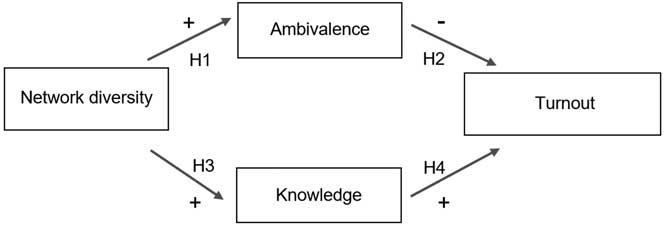
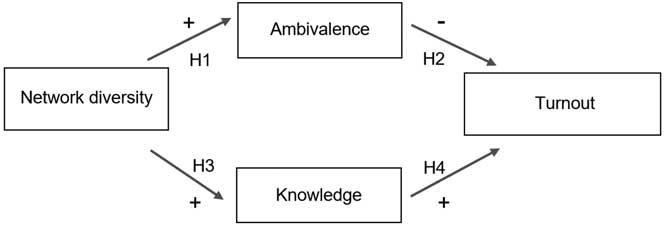
Figure 1 summarizes our theoretical expectations. As stated in the first and the third hypothesis, network diversity should increase both ambivalence and political knowledge. However, we are left with two competing Hypotheses 2 and 4 regarding the effect of network diversity on turnout, since ambivalence should reduce the probability that individuals turn out to vote, while political knowledge should actually increase turnout.
The effect of network diversity on turnout – a theoretical model.
The moderating role of frequency of discussion and strong-tie homogeneity
Beside theoretical conflicting mechanisms, the literature has often underestimated the impact of two important moderating variables in the relationship between network diversity and political participation: frequency of discussion and the distinction between strong-tie and weak-tie networks (Klofstad et al., Reference Klofstad2013).
With regard to the former element, research has documented that only those who engage frequently enough in political discussion are expected to show the negative or positive signs of exposure to different viewpoints (Scheufele et al., Reference Scheufele, Hardy, Brossard, Waismel‐Manor and Nisbet2004; Campus et al., Reference Campus, Pasquino and Vaccari2008). As argued by Mutz, ‘even if one’s network includes people who have oppositional political viewpoints, it is difficult to argue that cross-pressures are at work if political views are never communicated’ (Reference Mutz2006: 110). Hence, frequency of discussion can be a crucial weighting factor that should reinforce the effect of network diversity on political participation. This leads us to the following hypotheses:
Hypothesis 5 The higher the frequency of discussion, the larger the effect of network diversity on political participation.
Another key moderating variable is the level of homogeneity of an individual’s core social network – that is family and relatives – since this network functions as a basis for repeated exposure to agreeable beliefs and values (Granovetter, Reference Granovetter1973; Putnam, Reference Putnam2000; McPherson et al., Reference McPherson, Smith-Lovin and Cook2001). Given that those belonging to homogenous core social networks usually exhibit stronger political conviction (e.g. Berelson et al., Reference Berelson, Lazarsfeld and McPhee1954; Haythornthwaite, Reference Haythornthwaite2002), we can expect network diversity to exert a stronger influence on political participation if individuals experience diversity within their core social network. This expectation finds support in recent studies showing that exchanging different viewpoints in the household – that is within strong-tie networks – can enhance political engagement and voter participation (Zuckerman and Kotler-Berkowitz, Reference Zuckerman and Kotler-Berkowitz1998; Cutts and Fieldhouse, Reference Cutts and Fieldhouse2009; Foos and de Rooij, Reference Foos and de Rooij2017). Thus, we expect also strong-tie diversity to be an important weighting factor in the relationship between network diversity and political participation.
Hypothesis 6 The higher the diversity within strong-tie networks, the larger the effect of network diversity on political participation.Footnote 1
The Italian referendum
The constitutional referendum held in December 2016 is considered by many commentators one of the most important referendums in the history of modern Italy. Italian voters have been asked to vote on a wide set of constitutional changes that were proposed directly by the government and by the then Prime Minister, Matteo Renzi.
The reform had three main aims. First, it aimed to radically reform the Senate, the Upper House of the Italian parliament. Italy is among the very few countries in the world characterized by perfect bicameralism in which the Chamber of Deputies and the Senate have the same powers and functions. The reform intended to transform the Senate in a representative institution of local governments composed of 100 members, of which 95 elected by the Regional Councils and five appointed by the President of the Republic (instead of the current 315 directly elected members). Thus, the Chamber would have remained the only body directly elected by the citizens with main legislative powers. The second aim of the reform was to abolish the National Council for Economy and Labor (CNEL), a constitutional authority formed mainly by economic experts that advise the Italian government, the Parliament, and the regions and promotes legislative initiatives on economic and social matters. The third aim of the reform concerned a series of changes related to popular referenda, legislative procedures, and the use of urgent decrees.Footnote 2
The Yes side in favour of the reform was supported primarily by the Prime Minister and part of his party – the Democratic Party (PD) – while all the other major parties in the Parliament, including part of the PD, were on the No side and campaigned against the reform. On 4 December, after a divisive campaign with a high turnout (65.5%), a majority of voters (59.1%) rejected the proposed reform. The result triggered the immediate resignation of the Prime Minister and led to a reshuffle of ministerial positions. Recent evidence confirms that support for the Prime Minister and governmental performance played a decisive role in influencing voting behaviour (Bellucci et al., Reference Bellucci, De Angelis and Garzia2017; Colombo et al., Reference Colombo, De Angelis and Morisi2017). In addition, experimental studies indicate that the Prime Minister’s endorsement of the reform might have even damaged the reform, due to his decreasing approval rate over the referendum campaign (Vezzoni and Segatti, Reference Vezzoni and Segatti2016; Colombo et al., Reference Colombo, De Angelis and Morisi2017).
Design and measures
This study relies on data from a national panel survey that was carried out online by ITANES.Footnote 3 The panel includes two waves: a pre-referendum wave that was conducted in June 2016, and a post-referendum wave that was carried out right after the referendum, in December 2016. The pre-referendum wave includes 3012 respondents of which 90.5% participated in the post-referendum wave.Footnote 4
Design
Identifying the effects of political discussion on attitudes and behaviours such as turnout proves challenging due to issues of reversed causality (Ikeda and Boase, Reference Ikeda and Richey2010). Although endogeneity concerns can only be fully addressed by resorting to controlled experiments (Karpowitz and Mendelberg, Reference Karpowitz and Mendelberg2011), the panel structure of our data alleviates such issues since it allows us to measure network diversity, our main independent variable, well in advance of the referendum day (as recorded in the pre-referendum wave), while all our dependent variables are measured in the post-referendum wave. It seems highly unlikely that those who engaged in heterogeneous political discussions in June did so because they intended not to go to vote. In addition, there are good reasons to believe that the effect goes from interpersonal discussion to behaviour (and not the other way), due to the fact that choices of conversation partners are often constrained and many citizens find themselves confronted with views they do not share, even if they would prefer to avoid such views (Lazer et al., Reference Lazer, Rubineau, Chetkovich, Katz and Neblo2010). In the Italian context, there is evidence that political diversity is not rare and that Italian people often discuss politics with those who hold different views especially within weak ties (Campus et al., Reference Campus, Pasquino and Vaccari2008; Baldassarri, Reference Baldassarri2009; Mancosu, Reference Mancosu2016; Vezzoni and Mancosu, Reference Vezzoni and Mancosu2016).
To test the effect of network diversity on political participation we will rely on both straightforward regression models and more complex models based on structural equation modelling (SEM). This additional analysis allows us to address the complex nature of the relationship between network diversity and turnout, as illustrated in Figure 1.
Measures
Political participation (post-referendum wave): Our key measure of political participation is turnout at the polls, as recalled by the respondents after the referendum.Footnote 5 The variable is a dummy with value ‘1’ for those who declared that they went to vote and value ‘0’ otherwise.Footnote 6
Network diversity (pre-referendum wave): Our key independent variable of interest, that is network diversity, relies on three items about respondents’ estimate of how many people within their networks of family and relatives (strong ties), friends (medium ties), and acquaintances (weak ties) would have voted Yes in the referendum. The responses were recorded on a seven-point scale, consisting of none (0%), almost none (10%), only some (25%), about half (50%), many (75%), most of them (90%), and all (100%) with an additional ‘Don’t know’ and a ‘No reply’ category. To create an index of network diversity, first, we excluded all those who answered ‘Don’t know’ or ‘No reply’ to at least one of the three items.Footnote 7 Second, we folded the values of each item at the mid-point, giving maximum value to those who replied ‘about half’, and minimum value to those who replied either ‘none’ or ‘all’. Third, we combined the recoded items in an additive index of network diversity, with final values rescaled from 0 (minimum diversity) to 1 (maximum diversity). The index is treated as a continuous variable, in line with theoretical predictions.
Ambivalence (post-referendum): The post-referendum wave includes four questions about respondents’ opinions on different aspects of the reform: (A) abolition of the provinces; (B) abolition of perfect bicameralism through the reduction of the power of the Senate; (C) attribution of increased powers to the central state with regard to infrastructure and energy; (D) lowering the quorum required for referendums. Respondents reported their opinions using an 11-point scale for each aspect of the reform, ranging from 0 (‘Very negative’) to 10 (‘Very positive’). To create a measure of ambivalence, first, we rescaled the values of each item from −5 to 5; and, second, we combined all the items in a single index by relying on the ambivalence formula developed by Thompson and colleagues (Thompson and Zanna, Reference Thompson and Zanna1995; Thompson et al., Reference Thompson, Zanna and Griffin1995) but adapted to the case of multiple items by Schmitt-Beck and Partheymüller (Reference Schmitt-Beck and Partheymüller2012):
 $${\rm Ambivalence}\,{\equals}\,{\rm Mean}\,\left( {{\rm A},{\rm B},{\rm C},{\rm D}} \right){\minus}{\rm 2}{\asterisk}{\rm SD}\left( {{\rm A},{\rm B},{\rm C},{\rm D}} \right),$$
where A, B, C, D correspond to each opinion item about the reform. The values of the final index have been rescaled from 0 (minimum ambivalence) to 1 (maximum ambivalence) to facilitate comparability with the other variables.Footnote 8
Political knowledge (post-referendum): The measure of political knowledge draws on two questions about factual elements of the constitutional reform included in the post-referendum wave. One item concerned respondents’ knowledge about the proposed changes of the Senate, while the other item measured respondents’ knowledge about the abolishment of CNEL. The responses to these two questions have been combined in a simple additive index of political knowledge where each correct answer counts as a ‘1’ and each incorrect answer as a ‘0’. Since only 5% of the respondents replied incorrectly to both questions, we recoded the index as a dummy variable, with value 0 (low knowledge) for those who replied incorrectly to either one or two items, and value 1 (high knowledge) for those who replied correctly to both items.Footnote 9
Frequency of discussion (post-referendum wave): To measure frequency of discussion we relied on a question about how often the respondents engaged in political discussion with personal contacts (family, friends, and colleagues). The respondents could choose among four options, ranging from never to everyday. To test whether frequency of discussion increases the effect of network diversity (Hypothesis 5), we created a weighted index by multiplying the original index of network diversity with frequency of discussion, after rescaling the values of the item from 0 (no exposure to interpersonal communication) to 1 (maximum exposure). In the obtained weighted index, therefore, high values correspond to those who have a highly diverse network and frequently discuss about politics, in line with similar measures used in existing studies (e.g. Mutz, Reference Mutz2002a; Eveland and Shah, Reference Eveland and Hively2003; Eveland and Hively, Reference Eveland and Shah2009; Lee et al., Reference Lee, Kwak and Campbell2015).
Strong-tie diversity (pre-referendum wave): The measure of strong-tie diversity corresponds to the item used in the network diversity index concerning family and relatives. The values have been folded along the mid-point and rescaled from 0 to 1. To test whether diversity within strong ties increases the general effect of network diversity (Hypothesis 6), we created an additional weighted index by multiplying the original index of network diversity with the rescaled values of the strong-tie diversity item. This operation increases the relative weight of those who have a highly heterogeneous network of family and relatives, but low diversity of viewpoints in their networks of friends and acquaintances.
Additional variables: In the following analysis, we include also different demographic factors that are traditionally correlated with political participation (Matsusaka and Palda, Reference Matsusaka and Palda1999), such as age, gender, education, and employment status, in addition to respondent’s geographical area of residence. In addition, we control for evaluation of the government, as measured on a standard 0–10 scale in the pre-referendum wave, since recent studies show that respondents’ assessment of the Renzi government played a crucial role in explaining voting in the Italian referendum (Bellucci et al., Reference Bellucci, De Angelis and Garzia2017; Colombo et al., Reference Colombo, De Angelis and Morisi2017). Lastly, in the preliminary analysis we consider also respondents’ intention to turnout, as measured in the pre-referendum wave, while in the supplementary analysis we include also party identification in the regression models.Footnote 10
Results
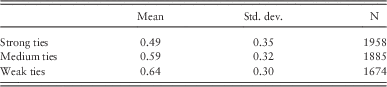
Table 1 displays summary statistics for the three items that compose the index of network diversity. Each measure ranges from 0 to 1, with value 1 corresponding to those whose network is equally divided between Yes and No voters (maximum diversity). As the mean values indicate, network diversity increases as social bonds become weaker, meaning that voters are more likely to experience less homogeneous networks among friends and acquaintances than among their families.Footnote 11 As discussed above, this finding is in line with previous studies conducted in the Italian context. In addition, Pearson’s correlations show that the three measures are all significantly correlated (P<0.001) and that the correlation, according to common convention (Cohen, Reference Cohen1988), is moderately strong.Footnote 12
Diversity within strong, medium, and weak ties (summary statistics)

Values from 0 (minimum diversity) to 1 (maximum diversity).
Additional analysis on data from the pre-referendum wave shows that network diversity is significantly and negatively correlated with intentions to turnout. Analysis with logistic regressions controlling for demographic factors and evaluation of the government reveals that those with a highly diverse network are around 10 percentage points less likely to turn out to vote at the referendum, as measured in June (see Table A1 in the Online Appendix). Preliminary analysis, therefore, provides support to the expectation that network diversity should reduce political participation, as advanced in the second hypothesis.
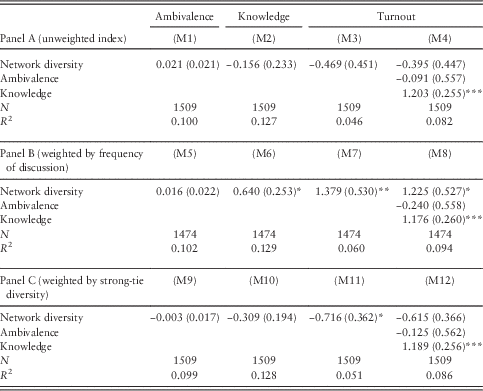
The unique structure of the panel, however, allows us to test whether network diversity, as measured in the pre-referendum wave, either increases or decreases actual turnout, as measured in the post-referendum wave.Footnote 13 To test our theoretical expectations, we started by running different regression models, in which the key independent variable is the index of network diversity, while the dependent variables are ambivalence, knowledge, and turnout. Table 2 presents the results of the regression analysis, controlling for key demographic factors like age, gender, education, employment status, in addition to the respondent’s geographical area of residence and the evaluation of government performance. The regression coefficients in Panel A show that the unweighted index of network diversity does not have significant effects on turnout. Although the sign of the coefficients in the case of ambivalence and turnout are in line with the hypotheses, they do not reach common levels of statistical significance.
The effect of network diversity on ambivalence, knowledge, and turnout
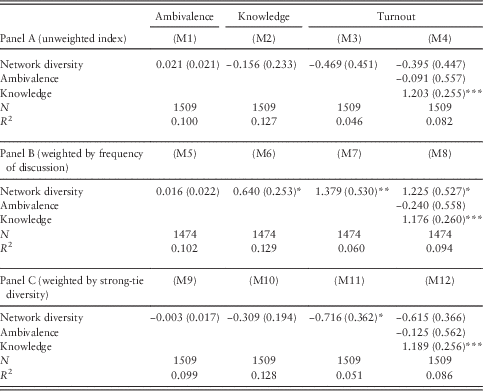
M1, M5, M9: ordinary least square regressions; all other models: logistic regressions. Dependent variables from post-referendum wave. All models control for age, gender, education, employment status, geographical area of residence, and evaluation of the government. Complete regression models including control variables are available in Tables A2–A4 in the Online Appendix.
Standard errors in parentheses. *P<0.05, **P<0.01, ***P<0.001.
However, when we include frequency of discussion in the measure of network diversity, we obtain a substantially different picture. As the findings in Panel B reveal, the voters with an active, heterogeneous social network – that is those who actually discuss with not like-minded peers as measured through frequency of discussion – knew more about the constitutional reform (M6) and turned out to vote more frequently on the referendum day (M7) than those with a less diverse social network. When we include both ambivalence and political knowledge in the model (M8), results show that higher political knowledge is associated with higher turnout (in line with Hypothesis 4) while network diversity still has a positive effect on turnout. With regard to ambivalence, although the direction of regression coefficients in Panel B is in line with the theoretical expectation that network diversity should increase ambivalence (M5) and that higher ambivalence should be associated with lower turnout (M8), the effects are not statistically significant.
Lastly, Panel C shows the results of our models when the index of network diversity is weighted by heterogeneity within strong ties (family and relatives). The results indicate that network diversity has a significant effect on turnout. The negative regression coefficient in M11 indicates that experiencing diversity of views especially within close networks actually reduces turnout on referendum day in line with the second hypothesis. However, when we introduce ambivalence and knowledge in the model (M12), the effect of network diversity does not reach common levels of statistical significance.
The results presented so far show, first, that frequency of discussion proves a key moderator of network diversity, in line with theoretical expectations (Hypothesis 5) and with the idea that exposure to diversity of viewpoints influences political participation only when voters actually engage in political conversations. The findings also indicate that experiencing diversity of viewpoints within close networks of family and relatives proves an important moderator that can reduce political participation (Hypothesis 6), although the effects are not statistically significant when we control for all factors (M12).
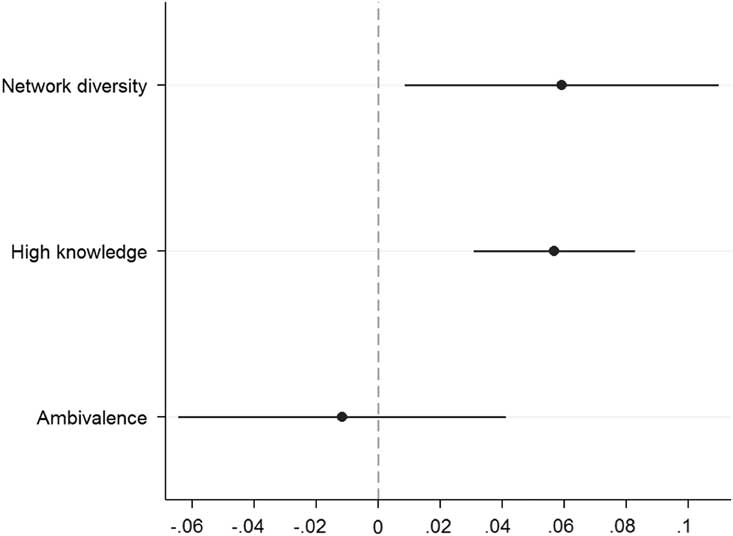
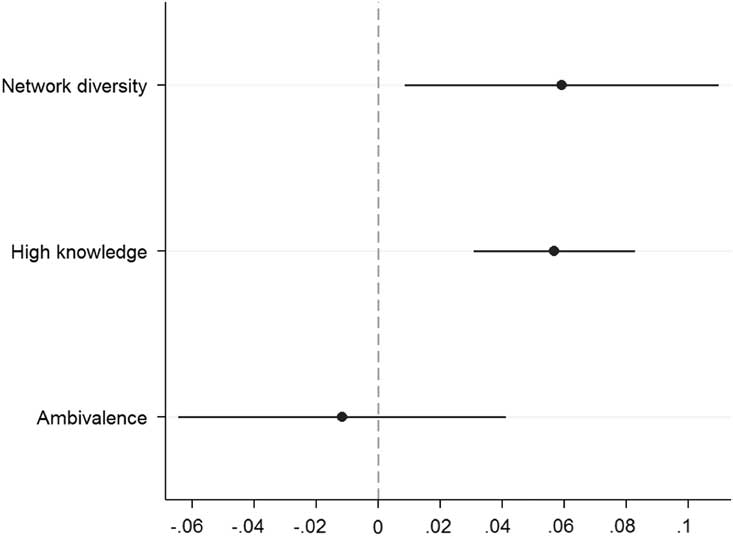
When frequency of discussion is taken into account, the findings confirm the hypothesis that network diversity increases political knowledge (Hypothesis 3), and suggest that political learning might be the major channel through which network diversity exerts a positive influence on electoral participation, since those who know more about the constitutional reform turn out at the polls more frequently than those who know less. In addition, the analysis (M8) indicates that having an active and heterogeneous social network also has an effect on turnout. As illustrated in Figure 2, a heterogeneous social network increases actual turnout by about 6 percentage points, compared to a non-heterogeneous network. Similarly, correlations among political knowledge, ambivalence, and turnout as measured in the post-referendum wave indicate that those with high knowledge are about 6 percentage points more likely to vote than those with low knowledge, while being ambivalent is not significantly associated with a decrease in turnout.
The effect of network diversity, knowledge, and ambivalence on turnout. Average marginal effects on actual turnout as reported in post-referendum wave. Calculations based on M8 in Table 2. The model controls for age, gender, education, employment status, geographical area of residence, and evaluation of the government. Horizontal bars correspond to 95% confidence intervals.
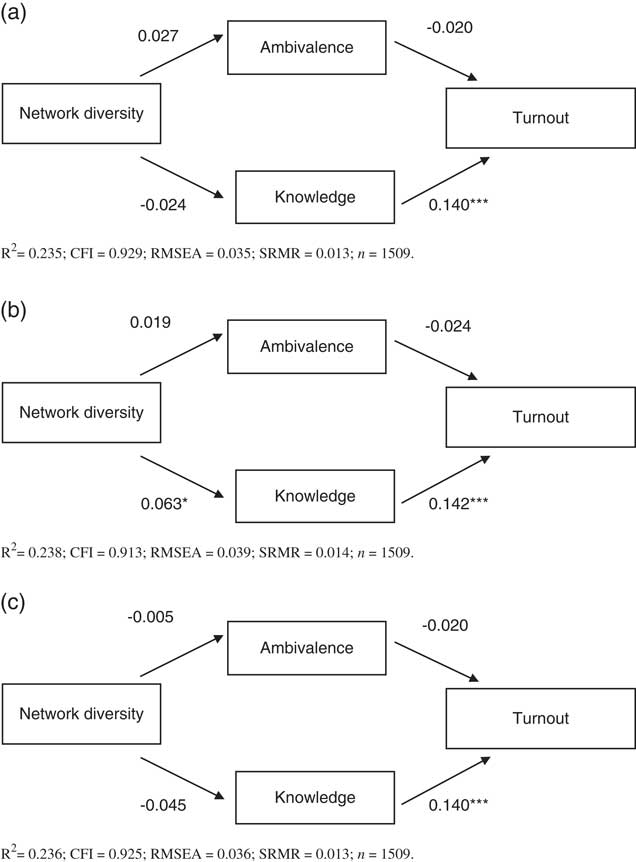
To complete our investigation, we employ SEM to examine the extent to which the effect of network diversity on turnout is entirely or only partially channelled through ambivalence and political knowledge. The results confirm that network diversity has no direct effects on both ambivalence and knowledge when we use either the unweighted index or the index weighted by strong-tie diversity (see Figure 3). However, when we consider frequency of discussion, the findings support the results from the previous regression analysis. In line with expectations, results from Panel B suggest that network diversity increases ambivalence (Hypothesis 1), while higher ambivalence, in turn, is associated with lower turnout (Hypothesis 2), although these effects do not reach conventional levels of statistical significance.
The effect of network diversity on ambivalence, knowledge and turnout (structural equation modelling). All models control for age, gender, education, employment status, geographical area of residence, and evaluation of the government. (a) Unweighted index; (b) weighted by frequency of discussion; (c) weighted by strong-tie diversity. Complete regression models including control variables are available in Table A5 in the Online Appendix. Standard errors in parentheses. *P<0.05, **P<0.01, ***P<0.001. CFI=comparative fit index; RMSEA=root mean square error of approximation; SRMR=standardised root mean square residual.
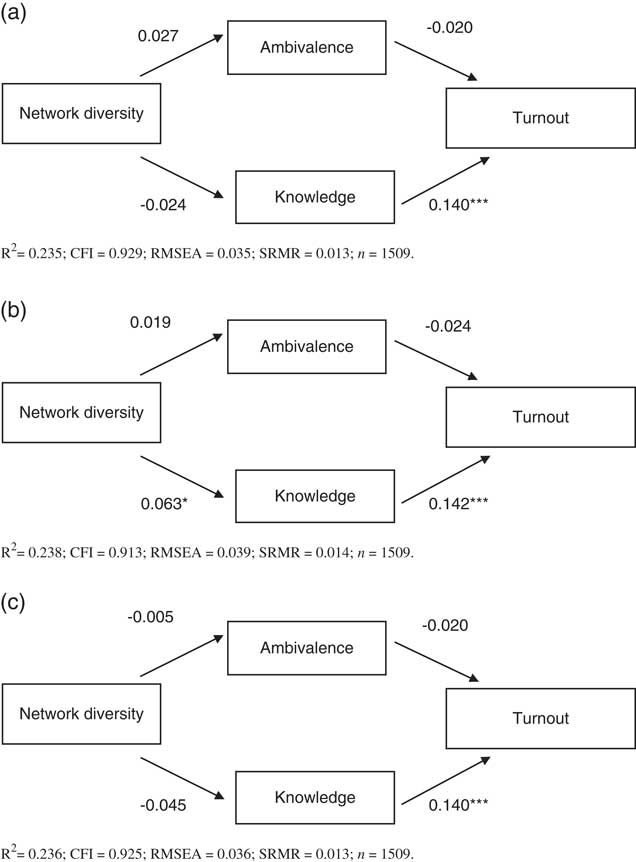
With regard to political knowledge, on the contrary, the findings show that having an active, heterogeneous social network increases knowledge about the constitutional reform (Hypothesis 3). In addition, Figure 3 highlights that political knowledge has a substantial, positive correlation with turnout, since those who know more about the reform go to vote more frequently than those who know less, in line with expectations (Hypothesis 4). The positive association between knowledge and turnout is consistent across all models, regardless of the index of network diversity used in the analysis. Lastly, the analysis reveals that adding a direct effect between network diversity and turnout does not improve the explanatory power of our models, given that a direct effect of network diversity on turnout is consistently negative but not statistically significant. This suggests that political learning is the main channel through which network diversity increases political participation.
As an alternative analysis of how network diversity influences turnout when frequency of discussion is taken into account, we run additional regression models in which we interacted the unweighted index of network diversity with our measure of frequency of discussion. This analysis indicates, first, that those who never discuss about politics are less likely to turnout at the referendum than those who rarely discuss about politics, in line with evidence in the literature (for a review, see Eveland and Hively, Reference Eveland and Shah2009: 209). Second, we find that although the interaction between frequency of discussion and network diversity is not statistically significant, discussing about politics everyday (compared to rarely discussing about politics) correlates with higher turnout only among those with a diverse network (see Table A8 and Figure A1 in Online Appendix). This suggests that frequent discussion about politics leads to increased political participation as long as people are exposed to different viewpoints.
Conclusions
Political discussion with not like-minded peers is a fundamental element of genuine public debate and deliberative democracy. Yet, within the existing literature an unresolved puzzle exists: while evidence indicates that discussion with not like-minded citizens depresses political participation by making citizens more ambivalent (e.g. Mutz, Reference Mutz2006), other studies show that the same type of interpersonal discussion can foster participation through political learning (e.g. Scheufele et al., Reference Scheufele, Hardy, Brossard, Waismel‐Manor and Nisbet2004). In this study, we have addressed this democratic dilemma by investigating the effect of discussion with not like-minded peers on political participation for the first time in a context of direct democracy. In particular, we have focussed on the interplay between network diversity, political knowledge, and ambivalence, and their conjoint effect on turnout.
Our findings show that discussing politics within a heterogeneous network of families, friends and acquaintances increases political participation. More specifically, we provide evidence that within the context of the Italian referendum those who were actively exposed to heterogeneous social networks – that is those who frequently discussed about politics with not like-minded citizens – turned out more frequently at the polls than those with less heterogeneous social networks. Analysis based on regression models and SEM shows that this positive effect is channelled mainly through political learning, since network diversity increases factual knowledge about the constitutional reform, which in turn is associated with an increase in turnout. We do not find, however, a significant effect of network diversity on ambivalence, as predicted by previous studies.
It is important to mention the limitations of our analysis due to data availability. Since panel data do not include a single item in which respondents report how frequently they discuss with not like-minded peers, we partially addressed this problem by combining two variables. However, this operation provides only a proxy of active discussion within a heterogeneous network, since we cannot be fully certain that our respondents actually talk about politics with the members of their networks who hold different viewpoints. Second, data availability limits our measure of political knowledge to a dichotomous item, while a more extended battery of knowledge questions would have allowed us to create a more fine-grained measure.
With regard to the explanation of our findings, a possible reason why political learning (and not ambivalence) plays a crucial role might depend on the specific context of direct democracy in which we conducted our study. Contrary to elections for candidates or political parties, in referendum campaigns voters face ‘demanding choices’ (Bowler and Donovan, Reference Bowler and Donovan1998), since they are often required to cast a vote on complex issues, such as in the case of constitutional referendums. Within these campaigns, learning about the issue at stake acquires crucial relevance both for the decision-making process and for motivating voters to turnout. In this sense, our findings add to the existing literature on information effects in direct democracy (e.g. Christin et al., Reference Christin, Hug and Sciarini2002; De Vreese and Semetko, Reference Delli Carpini and Keeter2004; Hobolt, Reference Hobolt2005; Kriesi, Reference Kriesi2005, Morisi, Reference Morisi2016), by showing that also information as acquired through interpersonal discussion plays a crucial role in explaining political behaviour in referendum campaigns.
On the other hand, when citizens face less demanding choices, such as in elections for candidates, the relative weight of political knowledge and ambivalence might change, with ambivalent attitudes playing a more important role in influencing the voting decision compared to direct democratic contexts. Thus, the specific context of our study might partially explain why our findings differ from previous research on general elections that has found negative effects of network diversity on political participation. In this sense, further investigations should be dedicated to explore the extent to which our findings can be generalizable to other contexts of direct democracy. Future studies should also closely consider the role that moderating variables play in either reducing or enhancing the effects of interpersonal discussion on political behaviour, since our results indicate that it is only through frequent discussion that network diversity significantly affects political participation. Furthermore, another promising avenue for future research concerns the relationship between exposure to diversity of viewpoints in both offline and online networks. Although the ‘online dimension’ of network diversity falls outside the scope of our analysis, recent studies indicate not only that experiencing disagreement online can affect political participation (Gil de Zúñiga and Valenzuela, Reference Gil de Zúñiga and Valenzuela2011; Valenzuela et al., Reference Valenzuela, Kim and de Zúñiga2012), but also that the extent to which individuals are exposed to disagreement in offline and online networks might differ (Vaccari et al., Reference Vaccari, Valeriani, Barberá, Jost, Nagler and Tucker2016), thus leading to potentially composite effects on political participation.
Our results have also important implications for conceptions of both deliberative and participatory democracy. With regard to our initial dilemma of whether it is possible to have an ideal citizen who is open to hearing the other side and at the same time enthusiastically active in politics (see Mutz, Reference Mutz2006: 125–126), the evidence presented in this study suggests that this can be possible, as long as exposure to not like-minded views within social networks help citizens to learn about politics. It seems therefore that when citizens are required to vote directly on referendum proposals, a healthy ideal of deliberative democracy can actually coexist with an active participatory democracy.
Acknowledgements
The authors thank the participants at the 2017 SISP General Conference for feedback on earlier versions of this manuscript and the anonymous reviewers for their useful comments and suggestions. This study participates to the “2016 Italian Constitutional Referendum Research Preacceptance Competition” launched by the Italian National Election Studies Association (ITANES), the Società Italiana di Scienza Politica (SISP) and the Italian Political Science Review (IPSR) within the Open Science Framework of the Center for Open Science (COS). The project has been originally preregistered at: https://osf.io/xhhxm/.
Financial Support
The research received no grants from public, commercial, or non-profit funding agency.
Replication Material
The replication data set is available at doi:https://dataverse.harvard.edu/dataverse/ipsr-risp.
Supplementary material
To view supplementary material for this article, please visit https://doi.org/10.1017/ipo.2017.30