

INTRODUCTION
Interviews have been used for decades in empirical inquiry across the social sciences as one or the primary means of generating data. In applied linguistics, interview studies have increased dramatically in recent years, particularly research that adopts case study, ethnographic, narrative, (auto)biographical, and related qualitative frameworks. This developing literature continues to address a rich array of topics and to yield notable insights concerning research participants’ identities, experiences, beliefs, attitudes, and orientations toward a range of phenomena. However, despite the proliferation of interview research in qualitative applied linguistics, it has become equally apparent in recent years that there is a profound inconsistency in how the interview has been and continues to be theorized. As Block (Reference Block2000, p. 757) described it, there is a “tendency” in qualitative applied linguistics research that uses interview methods “to take research participants ‘at their word,’” that is, to offer “presentation of data plus content analysis, but no problematization of the data themselves or the respective roles of interviewers and interviewees” (also see Johnston, Reference Johnston1997; Pavlenko, Reference Pavlenko2007). Writing nearly 10 years later, in a major review of qualitative research in language teaching, Richards (Reference Richards2009) was more resolute:
There is still work to be done to encourage yet deeper engagement with methodological issues, especially where interviews are concerned. We need to have more details of methodological and especially analytical matters in published papers, and it would be satisfying to see the demise of summaries [of interview data] amounting to no more than a couple of sentences or a short paragraph. (p. 168)
As such comments suggest, it seems that qualitative applied linguistics researchers have engaged only partially and variably with debates concerning their ideologies of interviewing (Briggs, Reference Briggs2007b), debates that have taken place for some time in neighboring disciplines, particularly sociology, anthropology, and (discursive) psychology (e.g., Briggs, Reference Briggs1986; Cicourel, Reference Cicourel1964; Drew & Heritage, Reference Drew and Heritage1992; Gubrium & Holstein, Reference Gubrium, Holstein, Gubrium and Holstein2002a; Holstein & Gubrium, Reference Holstein and Gubrium1995, Reference Holstein, Gubrium, Gubrium and Holstein2003, Reference Holstein, Gubrium and Silverman2004; Mishler, Reference Mishler1986; van den Berg, Wetherell, & Houtkoop-Steenstra, Reference van den Berg, Wetherell and Houtkoop-Steenstra2003). As a result, a usually implicit and intuitive, or commonsensical, perspective on the interview remains evident in many qualitative studies in applied linguistics that employ interview methods (Block, Reference Block2000; Pavlenko, Reference Pavlenko2007; Richards, Reference Richards2003, Reference Richards2009).
In this article, I refer to this commonsensical conceptualization of the interview as an interview as research instrument perspective. It is contrasted with an orientation that I call research interviews as social practice, in which the research interview is explicitly conceptualized and analyzed as social action. I employ this basic classificatory scheme as a heuristic to organize my discussion of a selection of qualitative applied linguistics interview research published in refereed journals over the past 5 years or so. I restrict the range of studies I consider to qualitative studies that primarily use face-to-face semistructured and unstructured interviews as one or the sole means of data generation in the qualitative frameworks mentioned earlier.Footnote 1 I note at the outset that my discussion does not concern the practicalities of conducting interviews: for example, how to develop interview guides or protocols, what types of questions to ask and when, effective techniques for developing rapport, interview ethics, computer-mediated communication interviewing, and so forth. There are many excellent resources concerning these matters both in applied linguistics (e.g., Richards, Reference Richards2003) and qualitative research more generally (e.g., Fontana & Prokos, Reference Fontana and Prokos2007; Gubrium & Holstein, Reference Gubrium and Holstein2002b; Kvale, Reference Kvale2007; Kvale & Brinkman, Reference Kvale and Brinkman2009; Spradley, Reference Spradley1979; Warren, Reference Warren, Gubrium and Holstein2002; Warren & Karner, Reference Warren and Karner2010). Instead, my focus in this review is on the ideologies of interviewing evident in these studies, as they are realized by the relative status that is ascribed to interview data (i.e., as direct reports or accounts of phenomena), as well as how those data are described, analyzed, and represented.
CARTOGRAPHIES OF COMMUNICABILITY IN “THE INTERVIEW SOCIETY”
Although interviews have become a method of choice in a great deal of qualitative applied linguistics research, the scarcity of material that addresses how they might be theorized is “quite curious” (Wooffitt & Widdicombe, Reference Wooffitt, Widdicombe, Drew, Raymond and Weinberg2006, p. 32), especially since there is no shortage of methodologically oriented texts concerning how interviews should be conducted. The comparative lack of consideration of the ontological, epistemological, and ideological assumptions underpinning interviews in applied linguistics and elsewhere has been traced to their “ubiquity” in contemporary social life: as Briggs (Reference Briggs1986) argued, “because the interview is an accepted speech event in our own . . . speech communities, we take for granted that we know what it is and what it produces” (p. 2; also see Mishler, Reference Mishler1986, p. 23). Atkinson and Silverman (Reference Atkinson and Silverman1997, pp. 304–305) similarly located “the stubbornly persistent . . . special faith” that many researchers place in the interview to what they call the contemporary “interview society,” where interviews are a pervasive feature of the discursive landscape: indeed are “everywhere” (Sarangi, Reference Sarangi, van den Berg, Wetherell and Houtkoop-Steenstra2003, p. 69). The “contemporary uses of the interview” have, Atkinson and Silverman (Reference Atkinson and Silverman1997, pp. 309–310) maintained, “give[n] researchers, amid a diversity of methodological and epistemological positions, a spurious sense of stability, authenticity, and security.” This has led to
the widespread, sometimes uncritical, adoption of the interview, and an unreflective endorsement of the core assumptions of the interview society. . . .[whereby] unexamined models of the social actor and of the research process [are implicitly introduced] into the particular styles of interviewing that [researchers] recommend” (Atkinson & Silverman, Reference Atkinson and Silverman1997, p. 310).
The core assumptions of the interview society can be explicated in terms of what Briggs (Reference Briggs2007a, Reference Briggs2007b) called the cartographies of communicability that constitute particular conceptualizations of interviewing. A communicable cartography of interviewing is essentially a conceptual map consisting of certain ideologies of language, communication, and the institution of the interview, which are temporally and spatially located, and which produce certain (contestable) social roles, subject positions, agency, and social relations that allow individuals in the interview society to make sense of interviews and interview data, to understand what they are, and to interpret them as particular kinds of social phenomena. Communicable cartographies of interviewing can also work to naturalize and project themselves, to ensure their continued circulation.
Briggs (Reference Briggs2007a) argued that three particular ideologies of language and communication have converged in a communicable cartography of interviewing that has been naturalized in contemporary times: language as a transparent medium, separation of the private from the public spheres, and a “nostalgia for the supposedly primordial face-to-face basis of communication and social life.” Interviews from this perspective “magically appear to embody all three ideologies, producing discourse that seems to transform inner voices into public discourse by constructing particular types of subjectivity and inducing subjects to reveal their inner voices (attitudes, beliefs, experiences, etc.)” (pp. 553–554).
I use the label interviews as research instrument to refer to a similar communicable cartography of interviewing, as it is manifested in qualitative applied linguistics. As a research instrument, interviews are theorized (often tacitly) as a resource for investigating truths, facts, experience, beliefs, attitudes, and/or feelings of respondents. Language tends to be conceptualized in referential terms, as a neutral medium that reflects or corresponds to objective or subjective reality (Alvesson, Reference Alvesson2003; Baker, Reference Baker, Gubrium and Holstein2002; Briggs, Reference Briggs1986; Holstein & Gubrium, Reference Holstein and Gubrium1995; Richards, Reference Richards2003; Roulston, Reference Roulston2010; Sarangi, Reference Sarangi, van den Berg, Wetherell and Houtkoop-Steenstra2003; Silverman, Reference Silverman2001). Interview data are ontologically ascribed the status of “reports” of respondents’ biographical, experiential, and psychological worlds, with the interview thus conceptualized as the epistemological conduit to those worlds: the interviewer reveals what “really” happened, or what participants “actually” felt through the technology of the interview, with closer approximations of reality depending on the interviewer's skill at developing rapport, for example, or not asking leading questions. (Neo)positivist approaches such as survey or structured interviewing take the interview as research instrument perspective (see Alvesson, Reference Alvesson2003; Roulston, Reference Roulston2010), as do “naturalistic” (Lincoln & Guba, Reference Lincoln and Guba1985), “romantic” (Alvesson, 2001), or “emotionalist” (Silverman, Reference Silverman2001) approaches, such as those utilizing so-called open-ended or in-depth interview methods, which “suggest that it is possible. . .to unravel a deeper or more essential reality” (van den Berg et al., Reference van den Berg, Wetherell and Houtkoop-Steenstra2003, p. 3) than allowed by structured interviewing.
Clearly, interviews as social practice share with the interview as research instrument perspective an interest in generating research data for the purpose of analysis, answering research questions, a concern with interview techniques, and so forth. However, the former position departs from the latter by problematizing the assumptions that constitute the research instrument perspective, and treating interviews themselves as topics for investigation (also see Sarangi, Reference Sarangi, van den Berg, Wetherell and Houtkoop-Steenstra2003; see Table 1). In this respect, the research interview as social practice orientation aligns with Holstein and Gubrium's (Reference Holstein and Gubrium1995, inter alia) well-known active interview. In terms similar to Silverman (Reference Silverman2001), Holstein and Gubrium (Reference Holstein, Gubrium, Gubrium and Holstein2003) contrasted the active interview with conventional approaches by arguing that the latter privilege the whats of the interview, that is, the interview content, whereas active interviews are interested in both the whats and hows, that is, the content and the “interactional [and] narrative procedures of knowledge production” (p. 68). Holstein and Gubrium argued that conceiving of the interview as a fundamentally social encounter rather than a conduit for accessing information means that the interview becomes “a site of, and occasion for, producing reportable knowledge” (p. 68). Further, by “activating” the subject “behind” the respondent, the interviewee is transformed from a “passive vessel of answers” to someone who “not only holds facts and details of experience, but, in the very process of offering them up for response, constructively adds to, takes away from, and transforms the facts and details” (p. 70). In this respect, bias and distortion, validity and reliability, topics of great concern in (neo)positivist and naturalistic theories of interview are transformed since the “respondent can hardly ‘spoil’ what he or she is, in effect subjectively creating” (p. 70; also see Briggs, Reference Briggs1986, pp. 21–23).Footnote 2
Contrasting conceptualizations of the research interview
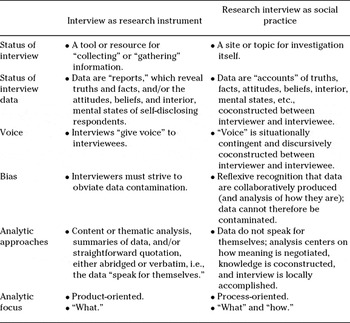
Analyzing not only the whats, or the product of the interview, but also the hows, or the process involved in the coconstruction of meaning, has significant implications for data analysis. In conventional approaches, analysis of interview data often takes form in content or thematic analysis, “systematically grouping and summarizing the descriptions” of experience produced by respondents by common themes or content categories, such that their “interpretive activity is subordinated to the substance of what they report.” In an active interview analysis, by contrast, “[t]he focus is as much on the assembly process as on what is assembled” (Holstein & Gubrium, Reference Holstein, Gubrium, Gubrium and Holstein2003, p. 78; cf. Braun & Clarke, Reference Braun and Clarke2006). A range of analytic approaches can be adopted for this undertaking but all in some way account for the fundamental sociality of the interview.
INTERVIEWS AS RESEARCH INSTRUMENT IN APPLIED LINGUISTICS
There is an impressive diversity of topics addressed by qualitative applied linguistics studies that conceptualize interviews as a research instrument. For this reason, the discussion in this section is organized by the qualitative approach that authors indicated they adopted, using the following subheadings: ethnographic and case study research; narrative/life-history research; and a more generic class of interview studies that were identified as qualitative, or were not identified at all.
Ethnographic and Case Study Research
Interviews are frequently used in ethnography and case studies, employed in tandem with methods such as participant observation and document analysis as a means of developing in-depth understandings of phenomena through triangulation (by method and source) (Denzin & Lincoln, Reference Denzin, Lincoln, Denzin and Lincoln2000; Lincoln & Guba, Reference Lincoln and Guba1985). In this respect, it might come as a surprise that only a minority of the studies that were reviewed here presented findings based on an evident synthesis of the research methods employed. Among them was Vickers's (Reference Vickers2007) ethnography of the second language (L2) language socialization of an Indonesian electrical engineering student into the practices of a community of student engineers. Featuring a sophisticated design that included participant observation, interviews, document analysis, playback sessions of videorecorded team meetings, and micro-analysis of face-to-face interaction, the study traced the development of the focal student's participation in project team meetings, using interview data to provide important contextual information about the participants’ perspectives on the project and each other. In Rankin and Becker's (Reference Rankin and Becker2006) action research case study, observational data were similarly integrated with written student and teacher reflections, stimulated recall sessions of videorecorded classes, and interviews in a small-scale investigation of a German as a foreign language teacher's oral corrective feedback practices. Interviews in this study were used “to trace the long-term development of [the teacher's] thinking” about his provision of the practice in question. In Creese's (Reference Creese2006) ethnographic study of an English as a second language (ESL) teacher and a subject teacher who were partnered in a secondary geography class, interviews were used to document these teachers’ contrasting views of their pedagogical roles and responsibilities. Having thus “set the scene” (p. 444), the two teachers’ views were then compared in an analysis of their actions in the actual classroom.
More typical of the ethnographic and case study research that was reviewed was the relative foregrounding of interviews from a larger ethnographic project, with these data composing the majority of the data presented (in some cases, the only data). As in the studies reviewed earlier, interviews were used most often as a means of accessing and presenting participants’ beliefs, attitudes, perceptions, and experiences. For example, in Motha's (Reference Motha2006) critical feminist ethnography about the links between ESL and (neo)colonialism, data from interviews, conversations, and afternoon teas served as the primary record, used “to listen to voices that have traditionally been delegitimized within educational research” (p. 80), as four practicing teachers and the researcher discussed monolingualism, assimilationism, and linguicism in public schools. Canagarajah's (Reference Canagarajah2008) ethnography concerning the role of the family in processes of language shift in three Sri Lankan disaporic communities, used interviews to gain an emic or “insider perspective on how the community explains its language choice and attitudes” (p. 148). Interviews also predominated in Golombek and Jordan's (Reference Golombek and Jordan2005) case study (data from reaction papers were provided, too, although it is not always clear which data came from which source). These data were used to present the thoughts and beliefs of two Taiwanese preservice L2 English teachers during and following a poststructuralist pronunciation pedagogy course, as they confronted such (language) ideologies as the native speaker myth and worked to “assert their right” (p. 514) to teach English pronunciation. Similarly, interview data were supplemented by language autobiographies in Haddix's (Reference Haddix2008) insightful study of two White, monolingual-English teacher candidates in a sociolinguistics course. L. Taylor's (Reference Taylor2006) short-term study of the experiences of a group of racially and ethnically diverse high school ESL students in a “Freirean-styled, antidiscrimination leadership camp” (p. 520) also relied heavily on interview data, as did K. King and Ganuza's (Reference King and Ganuza2005) ethnographic investigation into the national, ethnic, and linguistic identifications of Chilean-Swedish transmigrant youth, as manifested in interview talk.
Narrative/Life-History Research
It is no surprise that interviews were the central method of data generation in the studies that were reviewed, which focused on participant life histories and narratives (see, e.g., Andrews, Squire, & Tamboukou, Reference Andrews, Squire and Tamboukou2008; Benwell & Stokoe, Reference Benwell and Stokoe2006; Clandinin & Connelly, Reference Clandinin and Connelly2000; Gubrium & Holstein, Reference Gubrium and Holstein2008). Nor is it a surprise that these studies investigated “subject realities” and “life realities” (Pavlenko, Reference Pavlenko2007), nor, for that matter, that the kinds of analyses undertaken were as varied (and variable) as they were. Nevertheless, there was considerable methodological and analytic overlap between studies in this section and the previous one, particularly those ethnographic and case studies that foregrounded interviews. On the one hand, these overlaps are an artifact of the categories I have used to organize this section, and the leakage (Trinh, Reference Trinh1989) between them. On the other, they may serve as evidence of some slippage in terms of how ethnography, case study, and narrative research have been conceptualized in applied linguistics: in fact, at times, the only way to discover whether a given study was an ethnography, a case study, a narrative inquiry, life-history research, or a phenomenological study, was by the terminology used to identify it. Even then, these terms were at times used as if they were interchangeable (cf. Creswell, Reference Creswell1998; Hatch, Reference Hatch2002; Polkinghorne, Reference Polkinghorne, Hatch and Wisniewski1995; Silverman, Reference Silverman2001).
An exception is Menard-Warwick's (Reference Menard-Warwick2005) life-history study of two Central American women and their contrasting educational experiences following their immigration to the United States. Menard-Warwick used data from interviews and classroom observations to represent the sociohistorically situated “life trajectories” (p. 171) of Brenda and Serafina as they attempted to balance English-language learning with family, work, scheduling difficulties, and U.S. immigration policy. Tsui's (Reference Tsui2007) narrative inquiry concerning a Chinese EFL (English as foreign language) learner and teacher's negotiation of multiple conflicting identities utilized a design more common to other narrative/life-history studies reviewed, drawing on face-to-face interviews and diaries for Min-Fang's stories about struggling to identify with the professional identity of “communicative language teacher.” Gao (Reference Gao2008) included some welcome methodological detail concerning her (thematic) data analysis, although her decision to employ life-history interviews to investigate 14 Chinese students’ language-learning strategies is curious, given the topical focus, and the number (two) and length (45 minutes) of the interviews. Nonetheless, the study generally succeeded in its goal of “capturing learners’ voices” (p. 173), at least as those voices were represented in the study. Participant voices were also well-represented in Carroll, Motha, and Price (Reference Carroll, Motha and Price2008), which analyzed narratives (written and spoken) from two separate studies to examine how “social structures and contexts can behave simultaneously as powerfully tyrannizing regimes of truth and powerfully liberating imagined communities” (p. 189). However, there is less detail than might be expected about the procedures of the content and thematic analyses that were undertaken, and little consideration of implications that the modalities of the narrative data might have had for the analysis. A point of contrast here can be found in Cheung's (Reference Cheung2005) study of teachers’ narratives about their career development, which provided a remarkable amount of information about the interviews and data analytic procedures that were undertaken.
“Qualitative” Interview Research
The studies considered in this section were identified by their authors simply as qualitative or were not identified at all; despite substantive differences between them, all used interviews as the primary method for generating empirical data. Palfreyman (Reference Palfreyman2005), for example, relied almost exclusively on interviews in his important study about processes of Othering (cf. Said, Reference Said1978) among Turkish teachers and expatriate administrators at a Turkish university's English-language center. B. King (Reference King2008) provided a comparatively robust analytic framework based on Sacks (Reference Sacks, Gumperz and Hymes1972) to consider the pervasive but little-investigated problem of heteronormativity in L2 English education, using what appeared to be a single group interview with three gay male Korean L2 learners for his data-set. In Baek and Damarin (Reference Baek and Damarin2008), interviews were used to describe “the complex inner stories” (p. 195) of seven female L2-English-speaking university students from Korea and their experiences with computer-mediated communication in the L2. Atay and Ece (Reference Atay and Ece2009) “explore[d] the ideas” (p. 21) and “identity clash” (p. 31) of Turkish preservice teachers of English through a rich display of quotes from their 34 participants, although it was unclear whose voices belonged to whom since quotes were not attributed to particular participants. In Sarkar and Allen's (Reference Sarkar and Allen2007) qualitative study of identity and language use in a community of multilingual, multiethnic hip-hop artists in Montreal, interviews “focused on rappers’ use of mixed language and the links they perceive to their identities as Quebec hip-hoppers” (p. 122). In a related study, Pennycook (Reference Pennycook2007) used interview data in his analysis of hip-hop in such countries as Malaysia, Korea, and Tanzania, and studied the challenges these localized varieties posed to the African American hip-hop ideology of “keepin’ it real.” Varghese and Johnston (Reference Varghese and Johnston2007) indicated that the participants in their qualitative study of evangelical Christian L2 English teachers were “very articulate” and “very pleased” to be interviewed, and as a result, that the researchers “had the impression that . . . the interviewees’ words could at one level . . . be taken as a reasonably accurate record of what they actually thought” (p. 13). Interviews were also used in K. King and Fogle's (Reference King and Fogle2006) study of ways that parents discursively positioned themselves to justify their bilingual parenting practices and policies, with parents’ quotes about these matters organized around common themes that “emerged” from the data.
SUMMARY
As the review here suggests, qualitative research in applied linguistics that conceives of interviews as research instrument is remarkably diverse, in terms of the topics addressed, the theoretical frameworks adopted, the research methods employed, and the ways that data and analyses are represented. Certainly, these studies illustrate how common the interview as a methodological option in qualitative applied linguistics has become. As well, they underscore the utility, flexibility, and convenience of qualitative interviews for investigating an impressive array of matters of relevance to applied linguistics. At the same time, each of these studies illustrates in different ways one or more of the features of the communicable cartography of interview as research instrument described earlier. I alluded earlier to several of these features; here I elaborate briefly on four of them: the status of interview data as “reports,” the obfuscation of power, the interview as giving “voice” to participants, and matters concerning data analysis.
Status of Data as “Reports”
There is an evident propensity in the research discussed earlier to conceptualize interview data as participant “reports” of objective or subjective reality, with a generally exclusive focus on “content,” or the “what” of the interview. Perhaps the clearest indication of the status ascribed to these data is in how they are displayed: frequently as decontextualized, stand-alone quotes of respondents’ answers, as if they were “discrete speech events isolated from the stream of social interaction in which—and for which—they were produced” (Wooffitt & Widdicombe, Reference Wooffitt, Widdicombe, Drew, Raymond and Weinberg2006, p. 39). Even when interviewers are included in representations of data, there tends to be little analysis concerning their role in the production of data. Both points are significant analytically, for, as a long line of research in conversation analysis has demonstrated, “answers” are normatively oriented to and designed for the questions that occasion them (Sacks, Reference Sacks1992; Sacks, Schegloff, & Jefferson, Reference Sacks, Schegloff and Jefferson1974; Schegloff, Reference Schegloff2007). In other words, interviewees’ answers are “shaped by, and oriented to, the interactional context. This [insight] . . . invites [researchers] to give serious consideration to the ways in which the interviewer's participation is significantly implicated in what the respondents end up saying, and how they say it” (Wooffitt & Widdicombe, Reference Wooffitt, Widdicombe, Drew, Raymond and Weinberg2006, p. 56, my emphasis). This valuable analytic resource disappears, however, when data are represented as direct reports—as if the interviewer were invisible—and consequently, a wide range of potentially important insights concerning the data, analysis, and interpretations of a given study can be lost. For example, although Canagarajah (Reference Canagarajah2008) provided important contextual information by mentioning differences in religion, caste, and class between his participants and him, there was no analysis of the impact this may have had on his interviews. L. Taylor (Reference Taylor2006), too, mentioned her own race (White), but did not consider implications of this for her interviews or her findings, a curious omission given the study's focus on race, and that many interviewees were youth of Color. Although Menard-Warwick (Reference Menard-Warwick2005) indicated that she made “every effort to take into account [her] own presence as an Anglo, Spanish-speaking, former teacher” (p. 170), she, too, was largely absent in her analysis of interview data. Similarly, in my (Talmy, Reference Talmy, Park, Endo and Goodwin2006) ethnographic study concerning the struggles of a group of Micronesian students at a Hawai'i high school, I failed to consider my raced and “placed” (Blommaert, Reference Blommaert2005) status as an adult White male researcher whose first language is English, interviewing ESL youth of Color. The same can be said of Palfreyman (Reference Palfreyman2005), who inexplicably did not consider his own identity as a British expatriate in a study of Othering between expatriates and Turks at a Turkish university; and Varghese and Johnston (Reference Varghese and Johnston2007), who, although clear that as “atheists” their “interpretations, findings, and conclusions will be colored by and filtered through our subject positions” (p. 13), were less informative concerning the actual implications of this for their interviews with evangelical Christians. In Golombek and Jordan (Reference Golombek and Jordan2005), one of the researchers was the teacher of the two focal students, and apparently, was one of the interviewers, too; yet nothing was discussed about this relationship or its potential effect on the interviews. The same is true of Motha (Reference Motha2006), who was her focal participants’ course advisor, university teacher, and practicum coordinator; and Chavez (Reference Chavez2007), who was her participants’ course supervisor, though she did briefly acknowledge (p. 185) that this relationship may have had some relevance for her findings. This is not to single out these studies as being unusual in any way; indeed, the neglect of the role of the researcher/interviewer in coconstructing interview data—whatever their relationship to the interviewee—is common across studies that conceive of interviews as a research instrument.
Power
Relatedly, the interview is constituted by complex relations of power, which can be differentially realized in many ways: who chooses what—and what not—to discuss; who asks what questions, when, and how; who is ratified to answer them (and who is not); who determines when to terminate a line of questioning; and so on. There are also other potentially important asymmetries that may be less directly observable but equally relevant, if not more so, ranging from differences in institutional status, age, language expertise, social class, and more. Analyses that conceive of interviews as providing access to what participants think or believe, ascribe interview data the status of reports, or do not account for the “complex pragmatics of interview practices” (Briggs, Reference Briggs2007a, p. 555) obscure such power imbalances by simply not attending to them. Additionally, important power asymmetries can be enacted beyond the immediate interactional context of the interview, in terms of data representation, specifically in what Bauman and Briggs (Reference Bauman and Briggs1990) have called entextualization, “the process of rendering discourse extractable, of making a stretch of linguistic production [e.g., talk from an interview] into a unit—a text—that can be lifted out of its interactional setting” (p. 73) so that it can be recontextualized, that is, placed into another context. Thus, as Briggs (Reference Briggs2007a) noted: “power lies not just in controlling how discourse unfolds in the context of its production but [in] gaining control over its recontextualization—shaping how it draws on other discourses and contexts and when, where, how, and by whom it will be subsequently used” (p. 562). Just as interviews as research instrument do not address power within the interview itself, neither do they attend to power in terms of how those data are entextualized, decontextualized, and subsequently recontextualized, for example, as stand-alone quotes of “what participants think.”
Voice
A frequently cited rationale for adopting qualitative interview methods is that they allow participants’ own “voices” to be “heard” rather than obscured, for example, in summaries, tables, or statistics; indeed, participant voices were communicated in resounding fashion in the studies reviewed earlier. However, such a conception of voice carries with it a range of assumptions that may go unexamined: for example, that a person speaks with a single voice; that voice does, or at least can, given the right circumstance, express one's true self; and that the researcher or interviewer plays a central role in creating the liberatory conditions for this voice to be heard, by establishing trust, asking the right questions, and not interrupting. All caveats concerning “multiple,” “conflicting,” and “contradictory” identities notwithstanding, such an unproblematized notion of voice suggests the existence of a unitary, coherent, and essential self that the participant “gives voice to.” As Mazzei and Jackson (Reference Mazzei, Jackson, Jackson and Mazzei2009) sum up:
Qualitative researchers have recognized the dangerous assumptions in trying to represent a single truth (seemingly articulated by a single voice) and have therefore pluralized voice, intending to highlight the polyvocal and multiple nature of voice. . .. This practice of “more is better” has indeed highlighted the ways in which voices are not singular, yet the obsession for more full voices side-steps . . . the problem: these practices remain attached to notions of voice inherited from metaphysics—voice as present, stable, authentic, and self-reflective. Voice is still “there” to search for, retrieve, and liberate. (pp. 1–2)
Data Analysis
All of the studies reviewed earlier analyzed their interview data using some combination of content and thematic analysis, an approach to analysis that is well-aligned with a conceptualization of the interview as a research instrument (cf. Braun & Clarke, Reference Braun and Clarke2006).Footnote 3 As one might expect for a collection of studies so diverse, the type and quality of analyses were variable, ranging from sophisticated thematic analyses, to general summaries of the content of what participants said, to little or no provision of analytic comment at all. In her important review of autobiographic narrative research in applied linguistics, and with clear relevance to the present discussion, Pavlenko (Reference Pavlenko2007) noted that the key advantage of content and thematic analyses is their “sensitivity to recurrent motifs salient in participants’ stories and thus to themes that are important to L2 learners but [that] may not have been reflected in previous scholarship” (p. 166). This is indeed the case with each of the studies discussed here, from B. King's (Reference King2008) welcome discussion of heteronormativity in applied linguistics, to Canagarajah's (Reference Edwards and Potter2008) problematization of the pivotal role of family in language maintenance, to the insights yielded by Menard-Warwick's (Reference Menard-Warwick2005) memorable life histories of Brenda and Serafina, to Sarkar and Allen's (Reference Sarkar and Allen2007) significant contribution to the growing literature on hybridity, globalization, and hip-hop. However, in addition to the benefits that attend content and thematic analyses, Pavlenko (Reference Pavlenko2007) enumerates five of what she calls their major weaknesses:
The first is the lack of a theoretical premise, which makes it unclear where conceptual categories come from and how they relate to each other. The second is the lack of established procedure for matching of instances to categories. The third is the overreliance on repeated instances, which may lead analysts to overlook important events or themes that do not occur repeatedly or do not fit into pre-established schemes. The fourth is an exclusive focus on what is in the text, whereas what is excluded may potentially be as or even more informative. The fifth and perhaps the most problematic for applied linguistics is the lack of attention to ways in which storytellers use language to interpret experiences and position themselves as particular kinds of people. . .. In other words, content analysis may result in a laundry list of observations, factors, or categories, illustrated by quotes from participants, that misses the links between the categories, essentializes particular descriptions, and fails to describe the larger picture where they may fit. (pp. 166–7)
Perhaps a sixth potential weakness concerns issues of theoretical (in)compatibility, that is, when studies that are explicitly formulated with poststructuralist, social constructionist, and/or social practice theoretical frameworks adopt for their theory of interview a research instrument perspective. There is, of course, always the possibility that a deliberate decision has been made to do this; if that is the case, however, some meta-methodological discussion about that choice would be anticipated (see Roulston, Reference Roulston2010; Silverman, Reference Silverman2001).
RESEARCH INTERVIEWS AS SOCIAL PRACTICE IN APPLIED LINGUISTICS
As mentioned earlier, studies that conceive of research interviews as social practice treat the interview not as a resource for extracting data held within a univocal respondent, but as a site for investigation itself. Rather than direct reports, data are conceptualized as accounts of phenomena, jointly produced by interviewer and interviewee. Rather than a concern with researcher bias, there is a fundamentally reflexive orientation to the collaborative character of knowledge production and data generation. Rather than an exclusive focus on interview content, or the “what” of the data, attention is directed both to the “what” and “how,” that is, the content and the linguistic and/or interactional resources used in coconstructing content and locally achieving the interview as speech event. Taken together, these features constitute a communicable cartography of the interview as participation in social practice(s)—the “(partially) routine activities through which people carry out (partially) shared goals based on (partially) shared (conscious or unconscious) knowledge of the various roles or positions people can fill [or do] in these activities” (Gee, Reference Gee and Rogers2004, p. 33; also see Giddens, Reference Giddens1984). A wide range of analytic approaches can be adopted for the analysis of research interviews as social practice; among the most common are various types of (critical) discourse analysis (see, e.g., Blommaert, Reference Blommaert2005; Eggins, Reference Eggins2005; Fairclough, Reference Fairclough2003; Gee, Reference Gee2005; Johnstone, Reference Johnstone2008; Schiffrin, Tannen, & Hamilton, Reference Schiffrin, Tannen and Hamilton2001; cf. Wooffitt, Reference Wooffitt2005), narrative analysis (e.g., Andrews et al., Reference Andrews, Squire and Tamboukou2008; Gubrium & Holstein, Reference Gubrium and Holstein2008), conversation analysis (Sacks, Reference Sacks1992) especially work in “institutional” (Heritage, Reference Heritage, Fitch and Sanders2005) or “applied” (ten Have, Reference ten Have2007) conversation analysis (see especially Drew & Heritage, Reference Drew and Heritage1992), membership categorization analysis (Sacks, Reference Sacks, Gumperz and Hymes1972, Reference Sacks1992; for work on interviews, see Baker, Reference Baker, Gubrium and Holstein2002, Reference Baker and Silverman2004), positioning analysis (e.g., Bamberg, Reference Bamberg2000; Harré & van Langenhove, Reference Harré and van Langenhove1992), and interactional sociolinguistics (e.g., Gumperz, Reference Gumperz1982), to name but a few. Depending on the design of a study and its scope, research questions, and theoretical framework, analytic focus can range from the comparatively “micro” (e.g., sequential organization, recipient design, discourse markers, contextualization cues, evidentiality, category-bound activities), to the “macro” (e.g., narrative structure, membership categorization devices, negotiation of identities, power relations, intertextuality, interdiscursivity), to more general orientations that engage less with the “how” than the “what,” but still challenge the conception of interviews as a conduit into what people really think, know, or believe. In other words, to presume that analysis of interviews as social practice necessarily involves some form of micro-analysis, for example, would be as much a mistake as presuming that it does not. Instead, the primary issue for a social practice analysis entails an ontological and epistemological shift, by problematizing the ideologies that constitute the cartography of communicability that is referred to earlier as interviews as research instrument.Footnote 4
To demonstrate implications of this discussion, I consider in the remainder of this section several qualitative applied linguistics studies that conceive of the research interview as social practice. Each study uses interviews for a different purpose, and each analyzes the data generated from them using a different approach, ranging from micro-analysis to more general orientations that problematize the status of the interview, the data, and the role of the interviewer. My aim in discussing these studies is not to hold them up as exemplars of any kind, but to provide some illustrative examples of this particular conception of the research interview.
Liebscher and Dailey-O'Cain's (Reference Liebscher and Dailey-O'Cain2009) qualitative study of language attitudes provides a useful entry point for this discussion. In terms that parallel the different conceptualizations of the interview referred to above, Liebscher and Dailey-O'Cain identified three different approaches taken in the analysis of qualitative data on language attitudes, which are typically drawn from interviews: a “content-based approach” (pp. 197–198), which aligns with the interview as research instrument perspective; and two alternatives, “turn-internal semantic and pragmatic approaches” (pp. 198–199) and “interactional approaches” (pp. 199–201), which can be situated under the rubric of research interview as social practice. The authors make a strong case for integrating these three “levels” of analysis, drawing on interviews they conducted with western Germans who had moved to Saxony and German émigrés in Canada, concerning attitudes about the Saxon dialect. Using an analytic framework that combined interactional sociolinguistics, positioning analysis, and critical discourse analysis, they showed not only that there was, for western Germans, a “stigma” associated with the Saxon dialect, but also how it was interactionally worked up among focus group participants. The authors also demonstrated the comparative nonsalience of the stigma among German émigrés in Canada, suggesting that it was more important for these participants to index a “common ground in the German language” than to mark differences based on regional variation. As a result, the interviews themselves became central analytic sites, where participants not only talked about language attitudes but also produced them with one another and the researcher(s) in the interactions that constituted the interviews.
Johnson's (Reference Johnson, de Fina, Schiffrin and Bamberg2006) study of the construction and negotiation of teacher identity in a research interview uniquely foregrounds the interview as site for knowledge production. The study posed the following research question: “Can a poststructural approach to critical reflection encourage teachers to become more critical?” (p. 215). Rather than providing a thematic analysis based on the teacher's reports about her reflections on teaching, whether they were critical or not, and if, as a result, she became more or less critical, Johnson investigated how the identities of a “good teacher” and a “good research participant” became salient in her interviews. Drawing on conversation analysis and membership categorization analysis, she described in substantive detail the ways that the teacher “portrayed herself as doing reflective practice from a ‘critical perspective’” (p. 217, my emphasis), as well as how she oriented to being an “excellent interviewee, in the terms laid out by the researcher/interviewer” (p. 219). Consequently, the answer to her research question is based on a notably reflexive analysis: that “the interviewer primarily position[ed] the interviewee through the assignation of a teacher as excellent reflective practitioner category [with that] option . . . taken up by the teacher . . . in the ensuing [interview] (p. 232).
Prior (in press) utilizes discursive psychology (e.g., Edwards & Potter, Reference Edwards and Potter1992, Reference Edwards, Potter, te Molder and Potter2005) and narrative analysis to examine two versions of the “same” emotionally charged narrative told on two separate occasions by Trang, a multilingual, multiethnic adult immigrant for whom English was an L2. From an interview as research instrument perspective, such a study might be concerned with issues related to reliability, for example, the degree of consonance between Trang's two tellings of a frustrating experience at a bank in Canada, whether they diverged and if so, in what ways, and so forth, with the similarities and differences pointing to how truthful Trang was, how dependable his memory was, and whether his story was to be believed as a report of what really happened. However, Prior located important differences between the two narrative versions, characterizing them not as an indication of inconsistency but as evidence that the tellings served substantially different rhetorical purposes in the different contextual circumstances of the two interviews (also see Pavlenko, Reference Pavlenko2007). The analysis is, once again, fundamentally reflexive, as it accounts not only for the “content” of the two versions of the bank narrative but also the interactional and interpersonal circumstances of their local production.
Campbell and Roberts (Reference Campbell and Roberts2007) continue a long line of work by Gumperz and associates (e.g., Roberts, Davies, & Jupp, Reference Roberts, Davies and Jupp1992) concerning interethnic communication in workplace encounters. The article examined the variable performance of White and of Color “British born” applicants versus “born abroad” applicants in job interviews, accounting for the comparatively unsuccessful performance of the latter group in terms of their failure to “synthesize” what the authors called personal and institutional discourses in the job interview. The interview data were subjected to a methodologically eclectic discourse analysis, as the authors displayed differences in how both groups of applicants negotiated the interview, although it is not always clear what role the interviewer played in coconstructing successful and unsuccessful interview performances. However, one concern that stood out in the study, given the analysis of the job interview data, is what emerges as a central analytic inconsistency: the conceptualization of the status of a secondary stream of data used from stimulated recall interviews. In contrast to the job interview data, the stimulated recall data were taken at face value, as accurate representations of what participants were really thinking in the job interviews; that is, the stimulated recall interviews were treated as research instruments, in contrast to the job interviews. Unfortunately, the authors did not comment upon this apparent tension, leaving one to wonder whether it was a deliberate analytic move or not.
Finally, Hawkins (Reference Hawkins2005) provides a good example of a study that engages less with the “how” than the “what” of her interviews, but still problematizes the ideologies that constitute the communicable cartography of interview as research instrument (also see Block, Reference Block2000). This is likely due, at least in part, to the fact that her interview participants were young children. Stating at one point that what was missing in her previous research on young children's school-based language and literacy development was “their voices and opinions” (p. 67), Hawkins and her research collaborator devised several ways of including them, one of which involved interviewing. The analysis of these data connects the contrasting patterns of communication and school engagement of two kindergarten boys: interactional patterns that were observed in classrooms are shown to be recontextualized and repeated in the interviews themselves. The analytic focus on how these boys participated in the interviews thus served as an important secondary source of data for Hawkins’ larger argument about their differing ways of participating in school.
CONCLUSION
It may appear from the preceding discussion that I am advancing the position that qualitative applied linguists using interview methods should theorize them as social practice. That is not the case. Studies that adopt (neo)positivist or naturalistic/romantic theoretical frameworks, for example, need not conceptualize research interviews as social practice, though I believe there are clear advantages if they do. Rather, my goal is to call for greater attention to the theories of interview that all qualitative applied linguistics studies adopt, to highlight the communicable cartography of interviewing that has been naturalized in “the interview society,” and to raise questions about it so that the ideologies of language, communication, and the interview that constitute it are not imported into qualitative applied linguistics studies, at least without due consideration. As Briggs (Reference Briggs2007a) argued, when interviews are not adequately theorized, and ideologies of interviewing go unexamined, interviews “largely remain black boxes . . . technologies so widely accepted that [researchers] can just feed in questions and get quotations for [their] publications without worrying about the complex pragmatics that make them work. Our own assimilation of these ideologies [can] thus limit . . . the ways we interview and reflect on our own and other people's interviews” (p. 555). In this respect, I would suggest that there is considerable need for heightened reflexivity about the interview methods that applied linguistics researchers use in their studies, on the role of the interviewer in occasioning interview answers, on the subject “behind” the interviewee, on the status ascribed to interview data, and on how those data are analyzed and represented, regardless of whether one opts to conceive of interviews as research instrument, or research interviews as participation in social practices.
AUTHOR NOTE
My thanks to Keith Richards, Charlene Polio, and the anonymous reviewers for comments on earlier drafts of this article, and to Gabi Kasper, who several years ago introduced me to many of these ideas. All errors in the article are my responsibility.



