Introduction
As anyone who has tried to swat a fly knows, insects are highly sensitive to moving objects in their environments (Chapman et al. Reference Chapman, Simpson and Douglas1998). Visible motion is detected through signals from the compound eyes being processed in the visual centres of the brain, and in honeybees (Apis mellifera Linnaeus (Hymenoptera: Apidae)), is probably mediated by the green receptors within each facet (ommatidium) (Srinivasan Reference Srinivasan2011), but colour vision may be involved as well, depending on the speed of motion (rotating sectorally coloured discs) (Stojcev et al. Reference Stojcev, Radtke, D’Amaro, Dyer and Neumeyer2011). Paulk et al. (Reference Paulk, Phillips-Portillo, Dacks, Fellous and Gronenberg2008) have indicated that colour vision and motion detection are processed in anatomically segregated parts of the brain of Bombus impatiens Cresson (Hymenoptera: Apidae). Certainly, honeybees have been shown to detect moving objects (Srinivasan and Lehrer Reference Srinivasan and Lehrer1984; Lehrer and Srinivasan Reference Lehrer and Srinivasan1992), track them (Zhang et al. Reference Zhang, Xiang, Zili and Srinivasan1990), and measure the speed at which they move (Srinivasan et al. Reference Srinivasan, Lehrer, Kirchner and Zhang1991). Dyer (Reference Dyer2007) has suggested that Bombus terrestris (Linnaeus) orientation to coloured targets may be impeded by the bees being buffeted by wind. Honeybees use the speed of optical flow of objects they pass by or fly over in measuring distances that are important in orientation and dance communication (Esch and Burns Reference Esch and Burns1996). It is well known that workers of various social bees follow each other while foraging (e.g., Apis Linnaeus, Bombus Latreille, Melipona Illiger, Trigona Jurine) and move away from aerial threats, such as predatory wasps (Roubik Reference Roubik1992).
Almost all bees use floral resources for their own nutrition and for their brood (Roubik Reference Roubik1992; Michener Reference Michener2000), but floral motion, such as under naturally windy conditions, has not been often invoked as a visual attractant to flowers (Kevan Reference Kevan1970; Kevan and Menzel Reference Kevan and Menzel2012). Recently, Alcorn et al. (Reference Alcorn, Whitney and Glover2012) have suggested that the epidermal microsculpturing on flowers acts as a gripping surface and aids anthophiles in landing on them when in motion. Some flowers have mobile appendages (flimmerkörper) that have been suggested to attract pollinators (Faegri and van der Pijl Reference Faegri and van der Pijl1966). Wolf and Zerrahn-Wolf (Reference Wolf and Zerrahn-Wolf1936) investigated the relative attractiveness of stationary versus moving model flowers to honeybees in arrays on horizontal platforms. The artificial flowers on the moving platform attracted about twice as many honeybees than did those on the adjacent stationary platform. Faegri and van der Pijl (Reference Faegri and van der Pijl1966) suggested that flower motion may be significant as an attractant in smaller flowers, but discarded its importance because they considered the eyes of insects to be extremely sensitive to colour (true) but unresponsive to flicker (false).
More extensive studies have been made on sphinx moths (Macroglossum stellatarum (Linnaeus) and Manduca sexta (Linnaeus) (Lepidoptera: Sphingidae)) in respect to their abilities to forage on moving flowers (Zhou Reference Zhou1991; Farina et al. Reference Farina, Varju and Zhou1994; Willmott and Ellington Reference Willmott and Ellington1997; Sprayberry and Daniel Reference Sprayberry and Daniel2007). They noted that sphinx moths could track and forage while hovering in front of flowers moving at rates up to about 2 Hz (waving or looming). However, ruby-throated hummingbirds (Archilochus colubris (Linnaeus); Aves: Trochilidae) do not seem to be able to manoeuvre fast enough to accommodate rapid floral motion into foraging flight (Hurlbert et al. Reference Hurlbert, Hosoi, Temeles and Ewald1996). More recently, Warren and James (Reference Warren and James2008) recorded the seeding success of Silene maritima Withering (Caryophyllaceae) in regard of the movement of the flowers in the wind. They noted bumblebees (Bombus), as the primary pollinators, increased seeding success with increasing floral motion. They used a direct index of mobility (DIM) (observed number of oscillations of the flower head/minute×length of the longest oscillation recorded (cm)) and an indirect index (IIM) (length of the flowering stem/diameter of the flowering stem). Seeding success increased as DIM increased to ~50 and IIM increased to 20, but declined thereafter, especially when IIM was used.
In summary, there are three components to the importance of floral motion in pollination ecology: (a) attraction by waving to anthophiles and pollinators versus (b) additional difficulty in foraging by tracking or landing on a moving target and (c) the motion of the anthophile relative to that of the floral display as the former approaches the latter.
Our study is based on the general hypothesis that floral motion can influence the foraging abilities of bees and examines preferences of worker bumblebees (B. impatiens) when feeding from an immobile or mobile artificial flower (with variable rates of motion) and the abilities for landing and feeding from mobile flowers at varied frequencies and in different directions; horizontal H (left to right wave) and vertical V (from en-face presentation at the lowest point to horizontal presentation at the zenith). We also investigate if experience with flowers in motion affects performances and if the bees learn to recognise floral motion by direction and speed.
Materials and methods
General methods
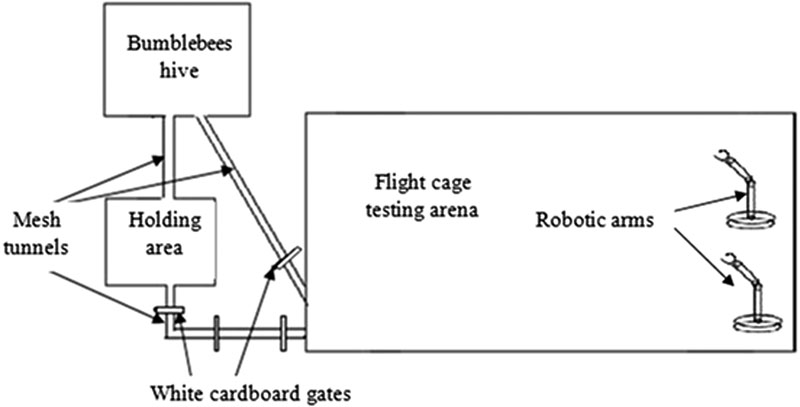
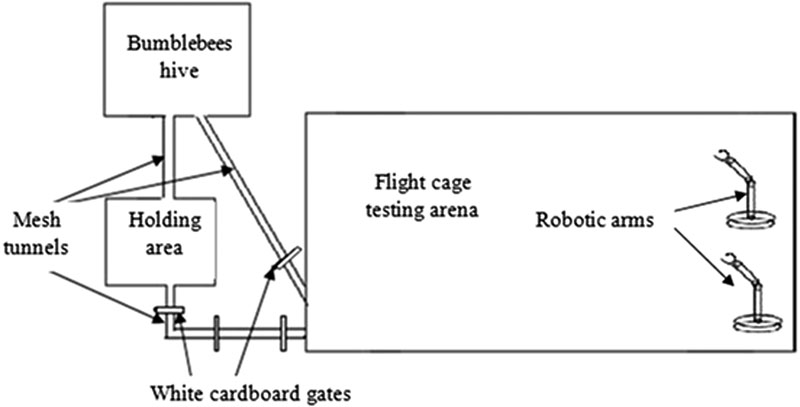
We trained bumblebees (B. impatiens) to collect a food reward on a stationary artificial flower (see below) and then tested their ability to discriminate it from an identical moving artificial flower. Then, we tested their abilities to land on mobile artificial flowers with respect to direction of floral motion (horizontal or vertical) and frequency (Hz) of motion. We also tested the bees to determine if they could differentiate between horizontally and vertically waving flowers as well as between frequencies (Hz) of motion. We used standard methods (see e.g., Laverty and Plowright Reference Laverty and Plowright1988; Chittka Reference Chittka1998) to train our experimental subjects to forage on artificial flowers in a screened flight cage (Figs. 1, 2). The specific details of our training regimes for each series of tasks are described below.
Experiment setup with hive, holding area, flight cage testing arena in which one or two arms on which the artificial flowers were mounted and presented to the bees. The mesh tube routes with equipped with gates by which the bees were allowed to enter and exit the flight cage.
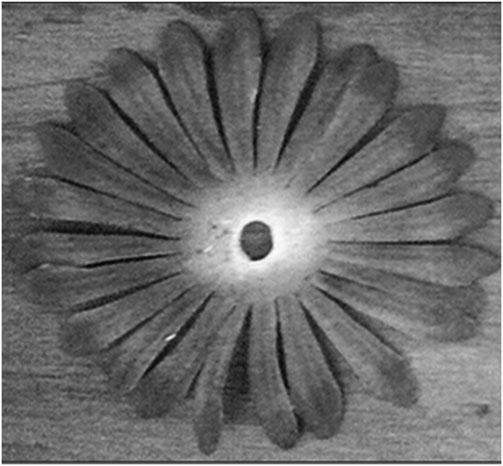
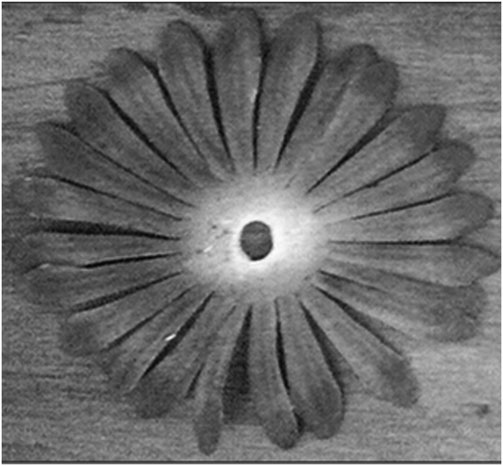
Dissected cloth flower 10 cm in diameter, blue with 24 lobes, which was attached to 1.5 mL centrifuge tube.
Experiments were made in indoor, screened flight cages (2.15 m long ×1.20 m wide×1.80 m tall) with grey floors. Directly overhead, diffused light from the fluorescent illumination entered the testing arena through the screen roof and remained the same in all experiments. The bees used were adult workers from queen-right colonies of 30–40 workers/colony (supplied by BioBest Biological Systems Canada (Leamington, Ontario, Canada)). Moveable screens on one side of the cages allowed experimenter access. Seven colonies were used in these experiments. Each colony was connected to a small, outer cage (30×23×20 cm) (holding area) attached to the main flight cage (testing arena) by gated, wire-mesh tunnels that allowed experimental control of the entry of bees to and egress from the flight cage. Colonies, when not being tested, had constant pollen supplies and their diets supplemented with sugar syrup. Individually, foragers were marked on the thoracic dorsal surface with uniquely numbered and coloured Opalith tags (Plättchen, Christian Graze KG, Weinstadt-Endersbach, Germany).
The experimental arena of the feeder (Fig. 1) was placed in the flight cage 165 cm from where the bees entered and exited. It comprised a green styrofoam base 45×35×5 cm with eight artificial flowers, each constructed from 10 cm dissected blue cloth flower attached to microcentrifuge tubes (1.5 mL). The flowers, mounted on the styrofoam base, were supplied with 50% sucrose solution (syrup) as the reinforcer reward. The amount of syrup was not controlled, but was replenished as soon as it was exhausted.
Description and operation of the robotic arm
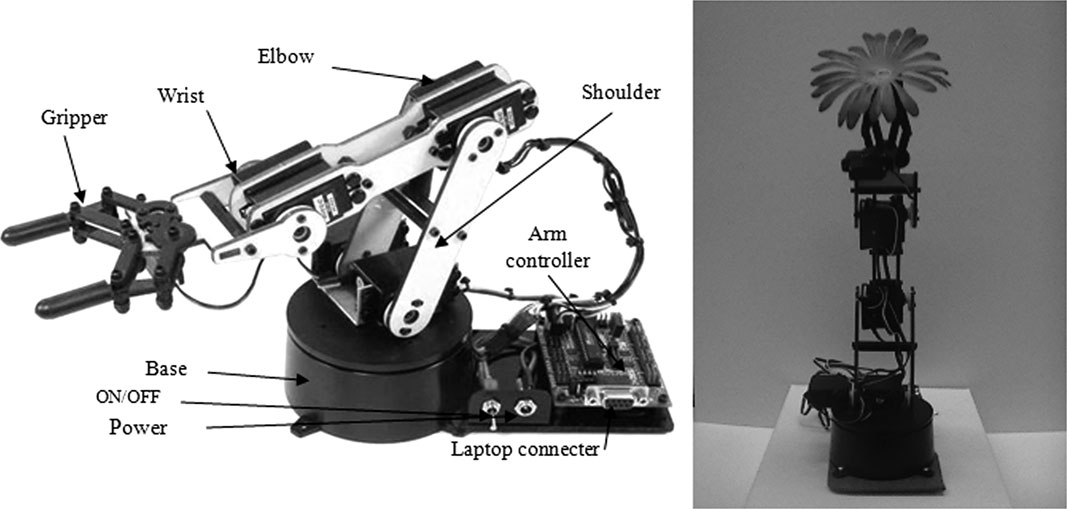
A. Lynx 5 robotic arm (Lynxmotion Inc. Pekin). The lynx-motion 5-axis robotic arm can be programmed (RIOS) to move unidimensionally: horizontally (H), vertically (V), and looming (L) and with different speeds (frequencies, Hz). B. Gripper with artificial flower in place for experimentation, here for vertical motion.
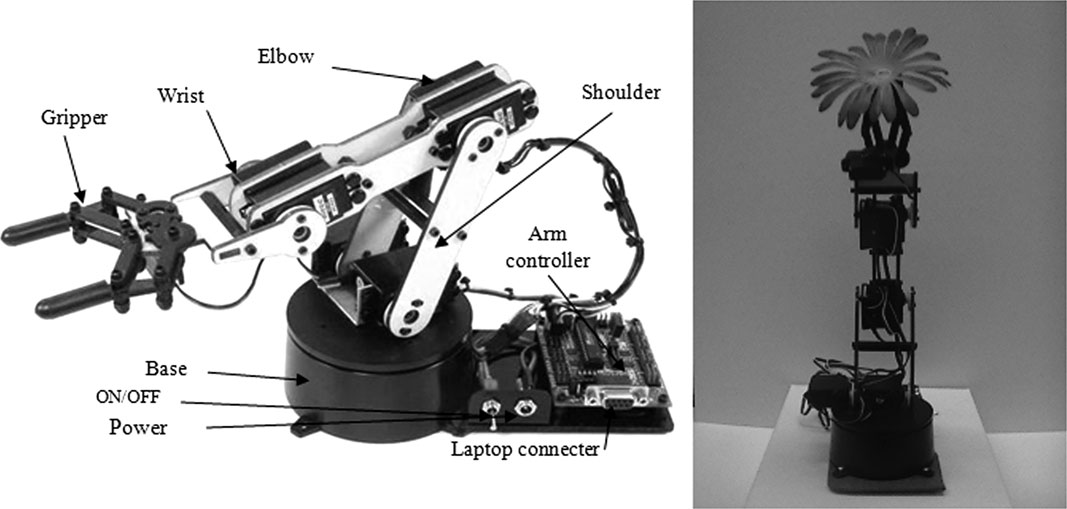
The L5AC-KT Lynx 5 (L5) robotic arm combo kit for personal computer (PC) (serial port) from Lynx Motion (Pekin, Illinois, United States of America) is composed of rotational base, shoulder, motional elbow and wrist, and a functional gripper. The L5 robotic arm delivers fast, accurate, and repeatable movements in five modalities (horizontal, vertical, looming, circular, frequency (Hz)) and was used by Sprayberry and Daniel (Reference Sprayberry and Daniel2007) for experiments similar to ours but with Manduca sexta. The PC-based software RIOS (Robotic arm Interactive Operating System) is a Windows program for controlling L5 robotic arms with SSC-32 servo controller. The L5 robotic arm was programmed to move unidimensionally: arcing horizontally (H) by 18.8, 14, or 5 cm, or vertically (V) in an arc of 8 cm length (radius=5.1 cm) (Fig. 3B) and with different oscillation frequencies (0.1, 0.25, 1, 2, 3 Hz). We did not use the looming (which Sprayberry and Daniel (Reference Sprayberry and Daniel2007) noted as problematic for their hawkmoths) and circular options for movement. The artificial flower was attached to the robotic arm by the gripper (see Fig. 3B).
The speeds of oscillation and lengths of the arcs we chose are similar to those observed for floral motion in wind (Hurlbert et al. Reference Hurlbert, Hosoi, Temeles and Ewald1996; Kevan Reference Kevan1970; Etnier and Vogel Reference Etnier and Vogel2000; Read and Stokes Reference Read and Stokes2006; Sprayberry and Daniel Reference Sprayberry and Daniel2007; Alcorn et al. Reference Alcorn, Whitney and Glover2012).
Experimental procedure
The first step was to allow naïve bees to forage for syrup (50% percentage weight for weight (w:w) solution of sucrose in water) at feeder consisting of eight artificial flowers, described above, mounted in a styrofoam base (45×35×5 cm) and placed at the far end of the testing arena from the colony’s access to the arena. Once the bees were accustomed to foraging at those feeders for a week to 10 days, they were marked individually and up to 20 of those that made regular foraging trips back and forth to the artificial flowers were then challenged with learning tasks as described for each experiment (below). During the experiment, the only food source in the cage was at a blue cloth 12 cm diameter lobed artificial flower mounted on one or two L5 robotic arms, placed at the end of testing arena, programmed to move in two dimensions: horizontal (H), and vertical (V) according to the experiment.
Experiment 1: preference of moving (horizontally waving) or stationary flowers
To test bees’ preferences of stationary flower or flower in motion one bumblebee colony (A) was used. The experiment started by presenting two robotic arms, one stationary while the other one in motion with one cycle/10 seconds (0.1 Hz), each arm held an artificial flower and both contained equal amounts of 50% sucrose solution. One arm was programmed to be immobile while the other was programmed to move more or less horizontally (side to side) (in 1/4 of full circle of 24 cm diameter, with 18.8 cm vertically symmetrical arc). During the experiment the arms were switched to right and left to avoid positional effects. Twenty individually marked worker bees were used. Each individual bee was observed for 10 trials, and the number of times it landed on each flower recorded and if they switched between stationary and mobile flowers.
Experiment 2: velocity discrimination
Two experiments on differential conditioning (e.g., Giurfa Reference Giurfa2004 for honeybees) each involved one bumblebee colony, colony B in Experiment 2a and C in Experiment 2b, and two robotic arms to examine bumblebees’ initial choices of slowly or rapidly moving artificial flowers then to assess their abilities to discriminate between two different motion speeds (fast versus slow) of the artificial flowers, regardless of direction (H and V).
Experiment 2a: horizontal motion, fast versus slow with fast rewarded
Twenty individually marked worker bees from colony B were trained to forage from horizontally mobile artificial flowers oscillating with 18.8 cm amplitude. The artificial flower that contained the 50% sucrose solution reward was programmed to oscillate at 1 Hz, while the non-rewarding artificial flower oscillated at 0.25 Hz. The arms were switched to right and left to avoid the bees’ learning by orientation. On the first day of the experiment, 20 inexperienced bees were allowed into the training arena and their first (immediate preference for slow or fast moving flowers) and subsequent nine choices (learning which flower was rewarding) were recorded. They were tested again on the second day for their choices.
Experiment 2b: vertical motion, fast versus slow with fast rewarded
Twenty individually marked worker bees from colony C were trained to forage from vertically arcing (by 90o so that the artificial corolla being horizontal at the top of the arc and vertical at the lowest point of the arc) being mobile artificial flowers oscillating with an 8 cm amplitude. The artificial flower that contained the 50% sucrose solution reward was programmed to oscillate at 1 Hz, while the non-rewarding artificial flower oscillated at 0.25 Hz. The arms were switched to right and left to avoid the bees’ learning by orientation. On the first day of the experiment, 20 inexperienced bees were allowed into the training arena and their first (immediate preference for slow or fast moving flowers) and subsequent nine choices (learning which flower was rewarding) were recorded. They were tested again on the second day for their choices.
Experiment 3: motion inexperienced bees versus experienced bees
After we had the results of experiment 2a that suggested the bees did not remember which of slowly or rapidly horizontally moving flowers to visit, we made further tests to examine if worker bumblebees with experience in foraging at mobile flowers are more adept than bees inexperienced with mobile flowers. We used two colonies (D and E) and only one rewarding artificial flower on its arm in the testing arena. Colony E contained individually marked worker bees that had been trained to forage at artificial flowers moving horizontally at 0.1 Hz and an 18.8 cm arc. The same workers were then tested the next day on flowers that had the same pattern of motion, but at 1 Hz. The inexperienced bees originated from another colony (F) and tested with the exact same pattern of floral motion as those workers from colony E on second day (i.e., 1 Hz).
Experiment 4: changing the speed of movement of horizontally moving artificial flowers
To try to determine the relative importance of the frequency of motion (Hz) versus the rate of motion (cm/second), we initially (on day 1) trained individual worker bees from one colony, F, to obtain reward from mobile artificial flowers on one robotic arm making a horizontal long wave with 14.13 cm arc, (1 Hz with the flower moving at 28.3 cm/second). Then, knowing from experiment 3 that, once trained, the worker bees retained their capacities to forage at mobile flowers even when the frequency (Hz) was increased, we varied both frequency and distance the artificial flower moved on the arm. Thus, on the second day the same bees were tested with shorter wave of 5 cm arc but the frequency remained 1 Hz for a speed of motion of 10 cm/second. On the third day the frequency was doubled (2 Hz) with the shorter (5 cm) arc (i.e., 20 cm/second). Then, on the fifth day the same bees were tested at 3 Hz and the same short arc (5 cm) for a speed of 30 cm/second. The time each individual bee took to enter the testing arena and to land and feed on the artificial flower was recorded for each of 22–18 bees for 10 trials each.
Data analysis
We used two tests in our experiment, one-way repeated measurement ANOVA analysis to determine if the significant difference between trials and subjects. To compare between the choices of the subject for the right wave speed with same direction, a χ2 test of equal probability of choice (H0) was used. A t-test was used to compare the times for attaining accuracy between two different directions. Then to compare between pairs we used multiple comparison procedures (Holm-Sidak method) or multiple comparison procedures (Tukey’s test). The statistical program was used Sigma Plot version 12.2.43f (Systat Software Inc., San Jose, California, United States of America).
Results
Stationary versus slowly mobile and rewarding artificial flowers
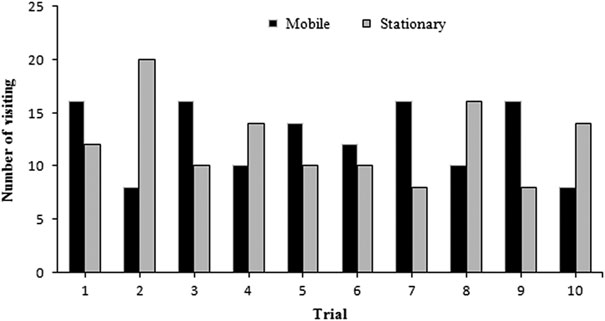
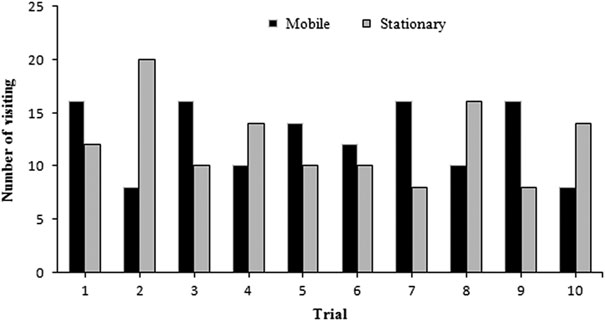
Worker bees did not discriminate between landing on moving (waving horizontally at 0.1 Hz (1 cycle/10 seconds) over an arc of 14.13 cm) or stationary rewarding flowers (Fig. 4) (H0: the bees would choose mobile or stationary flowers equally: t 18=0.99, P=0.34). The bees did not show any consistent choice of visiting flowers on the left (10 of 20) or right (10 of 20) side of the testing arena (χ2 1=0.0; P=1) regardless of the flower’s motional status. Throughout the experiment, individual bees would forage more than once by leaving a flower, returning to it, or going to a different flower (see Fig. 4). Individual bees differed in their behaviour: 10 used only a single artificial flower regardless of its motional status, six using two artificial flowers in only one trial but otherwise were consistent in choosing only one flower, and four bees visited both flowers on most of the trials.
Individually marked worker bumblebees’ (n=20) choices of stationary or mobile (0.1 Hz) flowers by visitation and by trial (e.g., for trial 1, the 20 bees made a total of 28 visits to the artificial flowers).
Discrimination by speed of motion
Horizontal motion fast versus slow, fast with reward
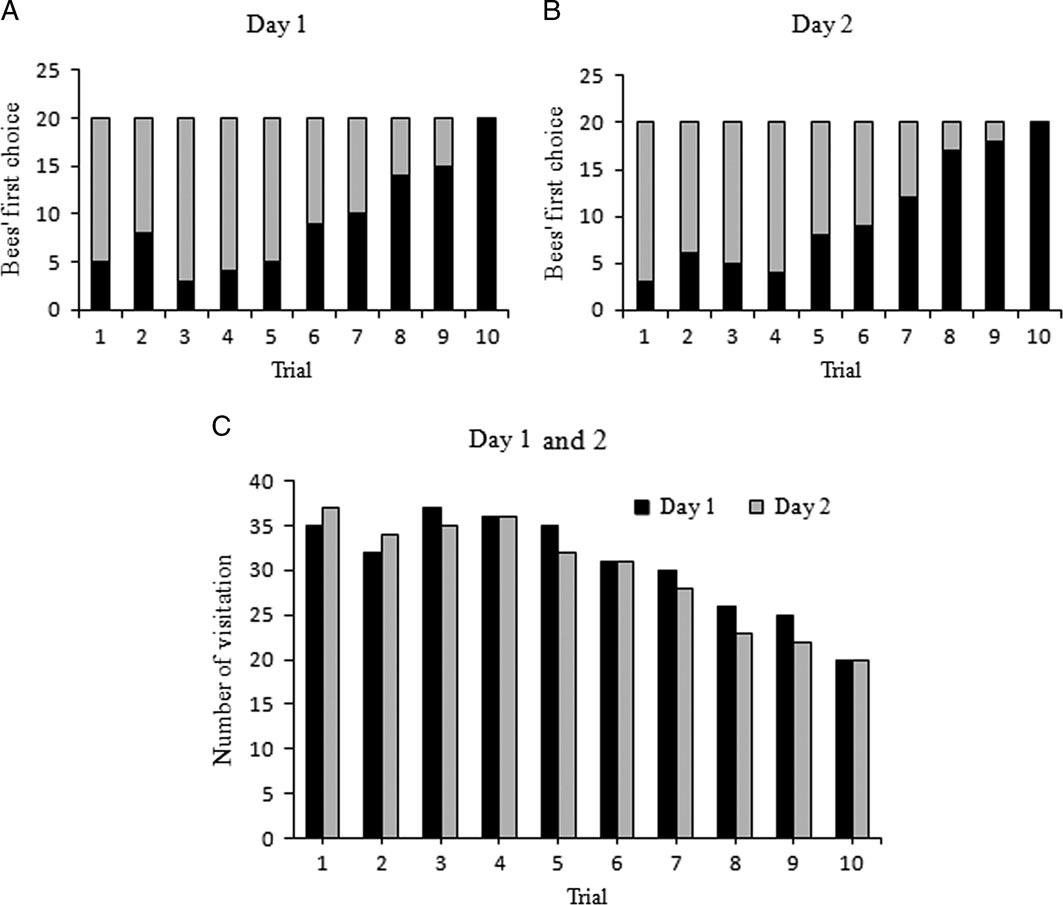
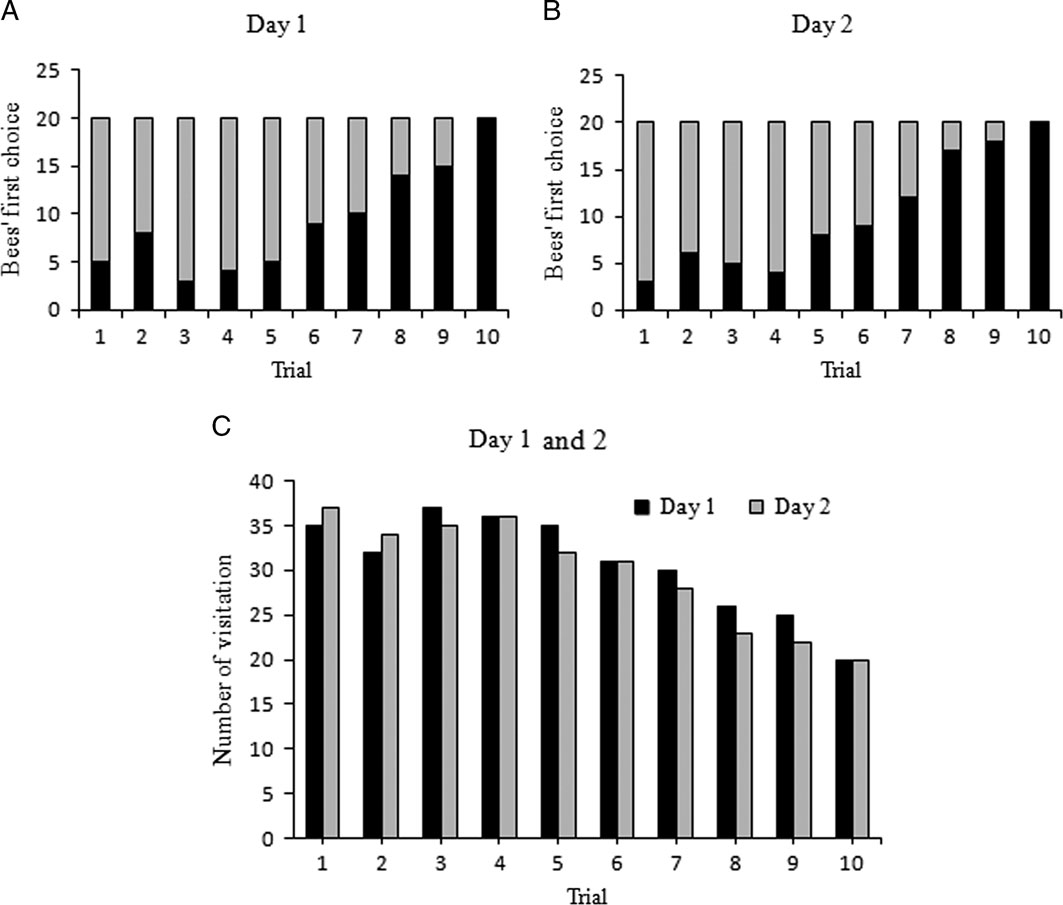
On day 1 of training, our results indicate that the bees first preferred to visit the slowly moving flowers) (H0: the bees would choose slowly or rapidly moving flowers equally: χ2 1=5.000; P=0.0253) and required about eight experiences before they became adept at visiting rapidly (H0: as above for trials 8, 9, and 10 combined; χ2 1=12.800; P=0.0003) moving flowers (Fig. 5A). On day 2, they seemed not to have retained memory of their previous experience (Fig. 5B) and had the same pattern of learning (χ2 9=1.9; P=0.99 for goodness of fit comparing day 1 and day 2 by trials). When those data are analysed by visitation, we note that 202 of 312 on day 1 and 200 of 308 on day 2 visits to flowers were to the more rapidly and rewarded moving ones (H0: the bees would choose to visit slowly or rapidly moving flowers equally χ2=9.8; P=0.0017) (Fig. 5C).
Discrimination of frequency of motion (1 Hz versus 0.1 Hz). Discrimination between two different frequencies and one direction; bees trained, for one day horizontally waving, rapidly (1 Hz) waving (with 50% sucrose syrup reward) (black bars) versus slowly waving (without 50% sucrose syrup reward) (grey bars) artificial flowers over horizontal arcs of 18.8 cm, then tested in the second day (n=20). (A) Bees’ first choice on day 1 of initial training. (B) Bees’ first choice on day 2, testing day. (C) Number of visitations to both arms regardless of the rate of waving and presence of reward, unrewarded slowly and rewarded rapidly waving artificial flowers, on day 1 of initial training and on day 2 of testing day.
Vertical motion, fast versus slow with fast rewarded
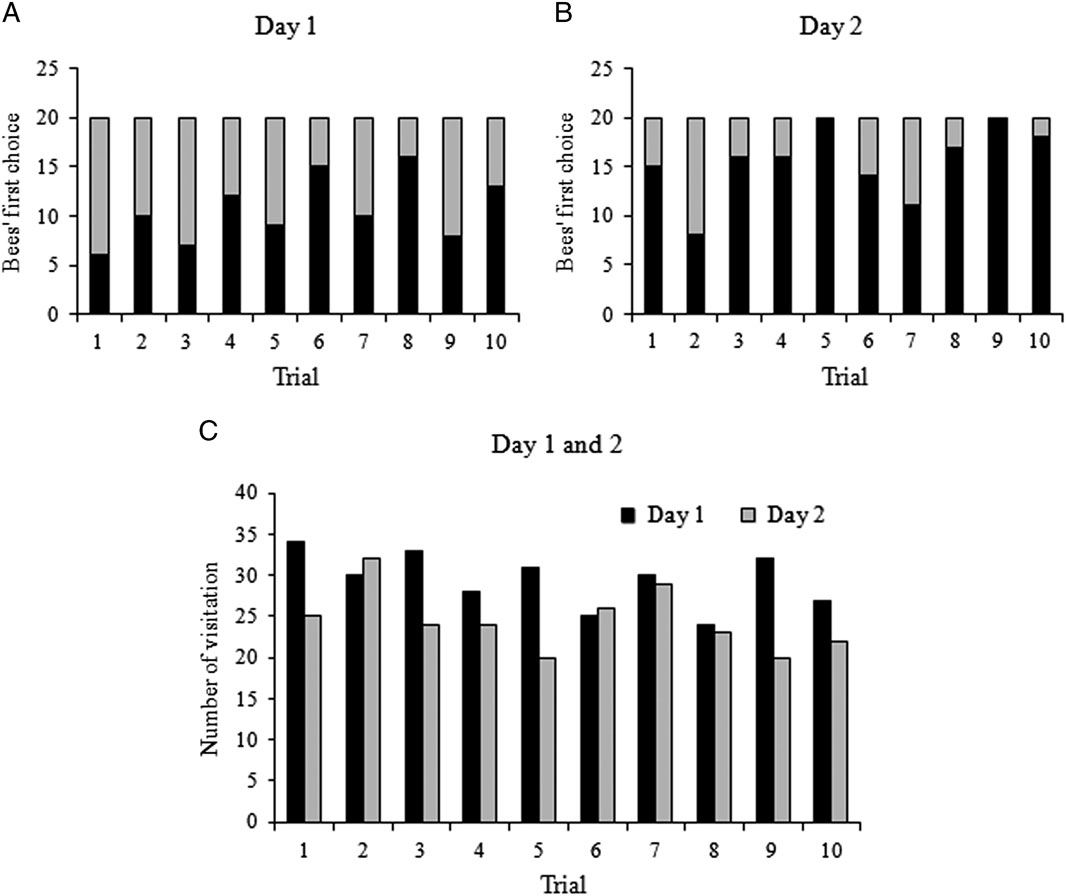
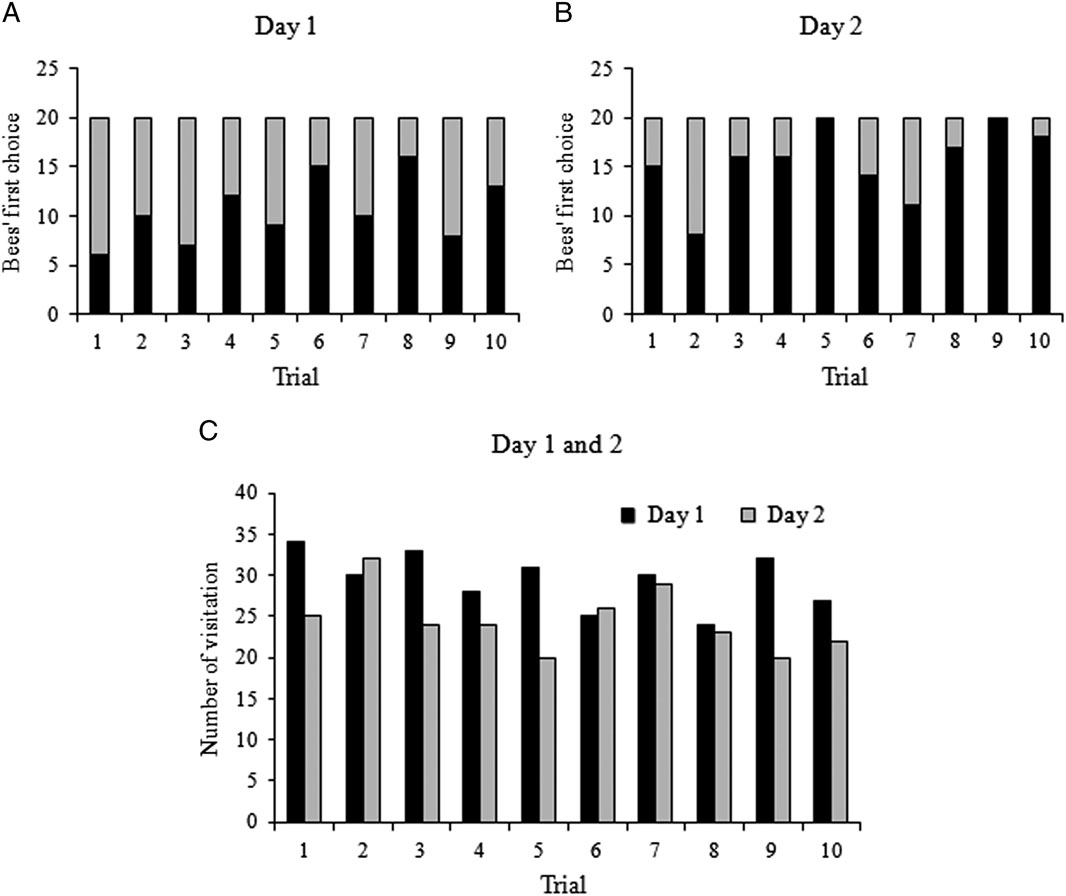
On day 1 of training, our results indicate that the bees first preferred to visit the slowly moving flowers) (H0: the bees would choose slowly or rapidly moving flowers equally: χ2 1=3.200 P=0.0736) and required about eight experiences before they became adept at visiting rapidly (H0: as above for trials 8, 9, and 10; χ2 1=12.800; P=0.0003) moving flowers (Fig. 6A). After the individually marked bees had been trained on day 1 to associate reward (50% sucrose syrup) in the fast moving artificial flower, they proved able to discriminate between the speeds of the flower on day 2 (unlike the bees experienced with horizontally waving flowers). On day 2, they had retained memory of their experience and landed significantly more on the flowers that moved faster (rewarded) than on the slow motion, unrewarded, flower (H0: the individual bees over all of their trials would choose slowly or rapidly moving flowers equally: χ2 18=36.83; P⩽0.0001) (Fig. 6B). When those data are analysed by visitation, we note that 200 of 240 visits to flowers were to the more rapidly moving, rewarded, ones (H0: the bees would choose to visit slowly or rapidly moving flowers equally χ2 1=5.000; P=0.0253) (Fig. 6C).
Discrimination of frequency of motion (1 Hz versus 0.1 Hz). Discrimination between two different frequencies and one direction; bees trained, for one day vertically waving, rapidly (1 Hz) waving (with 50% sucrose syrup reward) (black bars) versus slowly waving (without 50% sucrose syrup reward) (grey bars) artificial flowers over vertical arc of 8 cm, then tested in the second day (n=20). (A) Bees’ first choice on day 1 of initial training. (B) Bees’ first choice on day 2, testing day. (C) Number of visitations to both arms regardless of the rate of waving and presence of reward, unrewarded slowly and rewarded rapidly waving artificial flowers, on day 1 of initial training and on day 2 of testing day.
Reactions of bees to horizontally waving flower with previous experience, and without experience
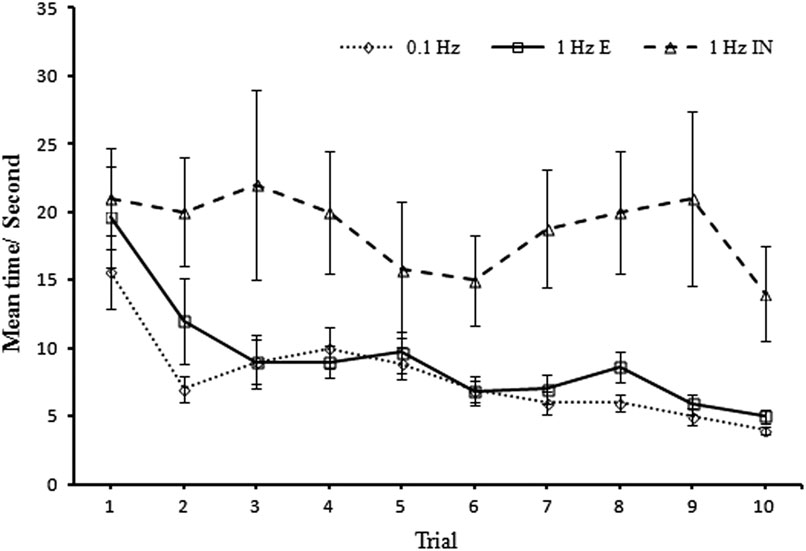
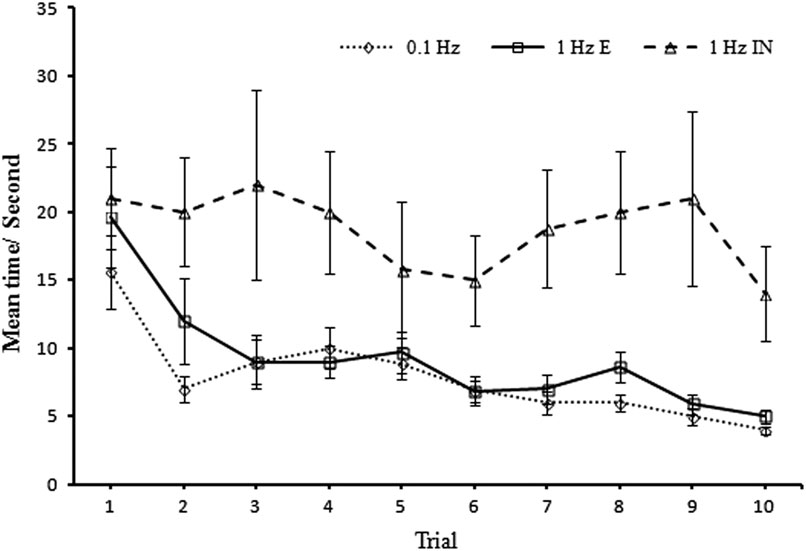
Subject bees were able to land on the artificial flowers waving horizontally at 1 Hz and forage after they had learned to land on flowers waving at 0.1 Hz (Fig. 7, dotted line). They also spent the same amount of time, landing on the waving flower, in all the trials (from the first to the 10th encounter) (Fig. 7, solid line), while the bees which had no experience on landing on mobile flower spent longer through the test and their learning curve did not decrease much (Fig. 7, dashed line). The difference of the means between bees inexperienced with artificial flowers moving at 0.1 Hz (Fig. 7, dotted line) and the experienced bees with artificial flowers moving at 1 Hz (Fig. 7, solid line) are not statistically significantly different (t 18=0.79; P=0.44), but when the experienced bee with artificial flowers moving at1 Hz (solid line) and inexperienced bees with artificial flowers moving at 1 Hz (dashed line) are included in the analysis the differences are statistically significantly different (F(2,9)=72.58; P<0.0001). Multiple comparison procedures (Tukey’s test) showed that the differences between the groups (experienced versus inexperienced bees) are statistically significantly different (F(2,9)=5.41; P⩽0.001).
The mean (±SE) of the durations (seconds) taken by experienced and inexperienced bees to land on waving flowers. One group, colony D, of tested bees had previous experience of handling flowers moving slowly (0.1 Hz) and horizontally by a long wave (18.8 cm arc) (dotted line) and were then tested by presenting flowers moving more rapidly (1 Hz) in the same manner (solid line) (n=10 bees each). The second group of bees (dashed line) from colony E were inexperienced and tested on flowers moving rapidly horizontally (1 Hz) by a long wave, 18.8 cm arc (n=10 bees).
Changing the speed of movement of horizontally moving artificial flowers
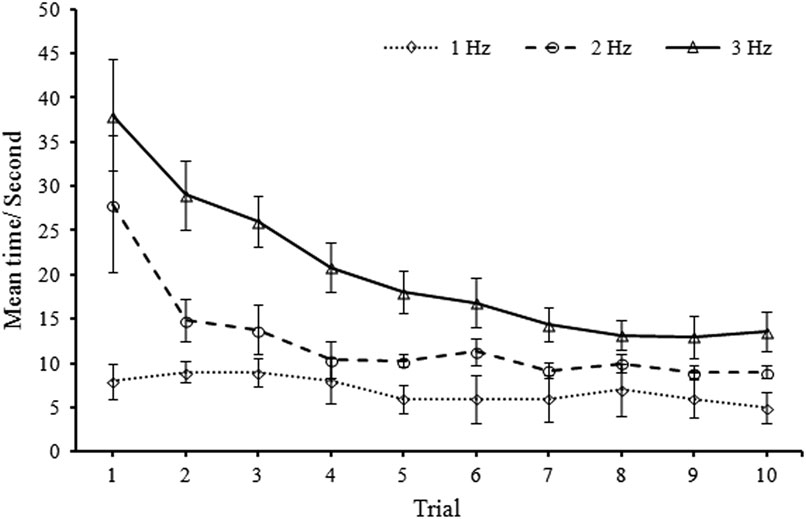
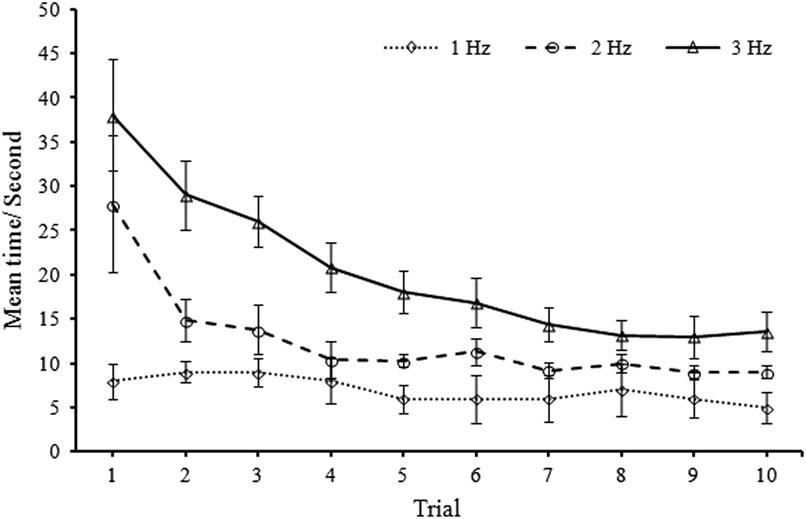
The increase of the frequency (Hz) of floral motion affected the performance of the bees (Fig. 8). As the frequency increased 1, 2, and 3 Hz, the bees’ performances decreased by their spending longer to handle the flowers. The differences in the mean values among the treatment groups (frequencies of motion) are statistically different from each other (F(2,9)=28; P<0.0001).
The mean (±SE) of the durations (seconds) taken by the bees to land on flowers waving at three different frequencies (1, 2, and 3 Hz). All tested bees had previous experience of handling flowers waving horizontally at 1 Hz by a long arc of 14.13 cm arc. They were then tested on flowers waving at three different rates over a short arc (5 cm) and the three different frequencies (n=10 bees at each frequency).
Discussion
Foraging bees are active under windy conditions. Honeybees generally stop foraging when wind speeds reach about 24 km/hour but bumblebees can tolerate much higher wind speeds (Roubik Reference Roubik1992; Heinrich Reference Heinrich2004). In windy weather, flowers are blown about and foraging anthophiles must accommodate to land on them, feed, and pollinate. It has been supposed that floral motion in the wind may constitute an additional component of visual attractiveness of flowers (or perhaps not (Dyer Reference Dyer2007)) for anthophiles while adding to the difficulty of landing and foraging (Kevan Reference Kevan1970; Hurlbert et al. Reference Hurlbert, Hosoi, Temeles and Ewald1996; Etnier and Vogel Reference Etnier and Vogel2000; Sprayberry and Daniel Reference Sprayberry and Daniel2007; Alcorn et al. Reference Alcorn, Whitney and Glover2012).
From the published literature (Wolf and Zerrahn-Wolf Reference Wolf and Zerrahn-Wolf1936; Lehrer and Srinivasan Reference Lehrer and Srinivasan1992), one might expect that the frequency of visits to moving flowers would be higher than to stationary flowers. Wolf and Zerrahn-Wolf’s (Reference Wolf and Zerrahn-Wolf1936) experiment on horizontally moving arrays of flowers versus stationary arrays of the same size showed two-fold greater attention by honeybees to visiting the former. However, they were unable to show any effect of rotating pots of flowers (0.5–1 circle/second) on the attentions of honeybees: although they seemed to follow the rotating flowers, they would not land and forage! Lehrer and Srinivasan (Reference Lehrer and Srinivasan1992) used a more complex experiment and concluded that honeybees are innately attracted to moving targets (moving on a circular trajectory of about 39 cm diameter with and without a surrounding striped drum). They showed that honeybees followed a moving, rewarding target and landed on it to feed, but did not land to feed if the target was moving at 25 cm/second or more. At faster speeds, the bees failed to forage. The results of our experiments, with individual flowers, indicate no preference by inexperienced bees for flowers in slow motion (0.1 Hz over about 38 cm, i.e., 3.8 cm/second) or stationary (Fig. 4). Moreover, we found that half of the individually marked bees visited one flower in each trial, about one-third visited two flowers (one moving and the other not) in any one trial, but about one-fifth visited both flowers on each and every occasion that they were tested. Thus, we conclude that the bees did not discriminate between the slowly waving and the stationary artificial flowers under our experimental conditions. Nevertheless, we can conclude that worker bumblebees of B. impatiens can land and forage on artificial flowers moving at 30 cm/second after some experience (Fig. 8), but cannot say if the bees would choose stationary flowers over such rapidly moving ones. Future research by others could address that issue and determine the maximum speed that our bees would accept.
Our experiments were not designed to assess the interesting issue of spontaneous choices of the bees with respect to stationary, slowly moving or rapidly moving flowers. However, looking at the results from Figs. 7–8 one can see that the bees took longer to be able to first land and forage on flowers in accordance with the rate of waving (untrained bees took about 22 seconds to land and work flowers waving at 1 Hz and about eight seconds less at 0.1 Hz). Thus we can infer that the rate of motion affects the foraging abilities of naïve and experienced bees. The same trend can be seen with trained bees taking about nine seconds to land on flowers moving at 1 Hz, 28 seconds for 2 Hz, and 35 seconds for 3 Hz.
The speed of floral motion affects the foraging abilities of other flower-visiting animals. The hawkmoths, Macroglossum stellatarum and Manduca sexta, were shown to successfully track the looming motion of artificial flowers as their velocities ranged from frequencies from 0.15 to 5.00 Hz (Zhou Reference Zhou1991; Farina et al. Reference Farina, Varju and Zhou1994; Moreno et al. Reference Moreno, Tu and Daniel2000). In testing the abilities of another hawkmoth, Manduca sexta, to feed from moving artificial, trumpet-form flowers while hovering, Sprayberry and Daniel (Reference Sprayberry and Daniel2007) found that the moths exhibited highest feeding rates from stationary flowers than from moving ones (1–3 Hz) and that they were better able to forage at horizontally moving ones than from vertically moving ones and had most difficulty with flowers in looming motion. Hurlbert et al. (Reference Hurlbert, Hosoi, Temeles and Ewald1996) showed that humming birds had higher nectar extraction rates at artificially immobilised flowers of Impatiens capensis Meerburgh (Balsaminaceae) than at naturally mobile flowers. Hence, they expected that the birds would prefer patches of stationary flowers over patches of waving flowers, but found that 11 of the 14 birds they studied visited naturally mobile flowers when presented with a choice even though mobility increased handling times and reduced nectar extraction rates by about 25%. They did not measure the mobility of the naturally mobile flowers they used.
Our results, like those of the others discussed above, indicate that anthophilous animals can and do respond to floral motion. They also indicate that those responses have consequences for energetic (rate of energy intake) (Hurlbert et al. Reference Hurlbert, Hosoi, Temeles and Ewald1996; Sprayberry and Daniel Reference Sprayberry and Daniel2007), understanding the ecophysiology of visual perception of motion (Wolf Reference Wolf1933; Wolf and Zerrahn-Wolf Reference Wolf and Zerrahn-Wolf1936; Lehrer et al. Reference Lehrer, Srinivasan, Zhang and Horridge1988; Zhou Reference Zhou1991; Lehrer and Srinivasan Reference Lehrer and Srinivasan1992; Farina et al. Reference Farina, Varju and Zhou1994; Moreno et al. Reference Moreno, Tu and Daniel2000; Paulk et al. Reference Paulk, Phillips-Portillo, Dacks, Fellous and Gronenberg2008; Stojcev et al. Reference Stojcev, Radtke, D’Amaro, Dyer and Neumeyer2011), and plant pollination biology (Kevan Reference Kevan1970; Hurlbert et al. Reference Hurlbert, Hosoi, Temeles and Ewald1996; Warren and James Reference Warren and James2008; Kevan and Menzel Reference Kevan and Menzel2012).
Our experiments not only addressed the responsiveness of anthophiles (e.g., for our work, in this case, workers of B. impatiens) but also their capacities to distinguish and learn motion cues. Figs. 5–6 present the learning curves for the differential conditioning of the bees as they became more and more adept at associating reward with motion. We noted that our experimental bees were more adept at learning to distinguish different speeds of horizontally moving flowers (see Fig. 5 for both day 1 and day 2) than learning to forage at vertically moving ones (see Fig. 6 day 1 versus day 2). It seems that the bees do not retain information gained about horizontally waving flowers from one day to the next (the two days are not significantly different from each other), but for vertically waving flowers there seems to be improvement from day to day (the results from day 1 and day 2 are statistically significantly different). The differences in the learning curves indicate that the bees are more able to associate horizontal motion with reward in the short term (one day, 10 trials) and then forget that association easily, but that the vertical motion seems more difficult to learn but the cue is then retained better in memory. We note that the bees in our trials were able to land on the horizontally moving flowers, presented en-face, at any point on the trajectory, but for landing on the vertically moving flowers they mostly landed when the flower was at the top of the arc and momentarily presented a horizontal platform. We were unable to quantify those behaviours for lack of suitable recording equipment. We also noted, but did not quantify, the relationship between the relative speed of motion of the artificial flowers and of the subject bees, but it seemed that the bees, on entering the testing arena first approached the slower moving flower, but then switched to the faster, rewarding flower.
Our results suggest a variety of future experiments that could involve colours and motion, testing horizontal and vertical movement against almost stationary flowers and choices between horizontal and vertical movements of the same speed. Certainly, the bees learn how to become adept at landing on more rapidly moving flowers (Figs. 7–8).
Although the test bees seemed not to remember their experience on horizontally moving flowers from day to day, other test bees given other challenges did (i.e., vertically moving flowers). We tested the effect of experience in a more complex manner by presenting inexperienced bees (i.e., no experience with moving flowers) versus experienced bees (i.e., they had already encountered moving flowers at 0.1 Hz and 14.4 cm trajectory the day before) with moving flowers at 10-fold frequency (1 Hz) and the same trajectory. The experienced bees landed more quickly than the inexperienced bees. We conclude that floral motion is a cue in foraging. The difference in the result in experiment 2a in which the bees seemed to forget what they had learned the previous day versus experiment 3 are explained by the fact that the bees had choice in experiment 2a (and 2b) of fast versus slow moving flowers but in experiment 3 had no choice.
When a flower is shaken by the wind, it does not move in a single plane but in a complex pattern dictated by the length, cross-sectional shape and size, and elasticity of the stem, the size and shape of the flower or inflorescence, as well as of the nature and turbulence of the wind itself (Etnier and Vogel Reference Etnier and Vogel2000; Read and Stokes Reference Read and Stokes2006). The wind would also influence the flight trajectories of the foraging bees and affect perceptual processes (Dyer Reference Dyer2007). Thus, as discussed, flower-visiting animals must compensate by position, speed of motion, and manoeuvrability in all three body axes. Our experiments show that bumblebee workers are naturally attuned to the vagaries of floral motion, can learn that flowers move, how fast, and respond accordingly, then use their experiences with moving flowers to improve their foraging rates from day to day.
Acknowledgements
The authors thank the Natural Sciences and Engineering Research Council Canadian Pollination Initiative (NSERC-CANPOLIN) for funding some of this research reported. This contribution is number 126 from NSERC-CANPOLIN. H.M. thanks the Libyan Ministry of Education for scholarship received. BioBest Biological Systems, Leamington, Ontario kindly provided colonies of the test subjects.