The risk of mastitis has been studied using different mastitis classification methods: (1) generic, which makes no distinction in causal pathogens (Rajala & Gröhn, Reference Rajala and Gröhn1998; Steeneveld et al. Reference Steeneveld, Hogeveen, Barkema, van den Broek and Huirne2008) and (2) pathogen-specific mastitis (Barkema et al. Reference Barkema, Schukken, Lam, Beiboer, Wilmink, Benedictus and Brand1998; Sargeant et al. Reference Sargeant, Scott, Leslie, Ireland and Bashiri1998; Olde Riekerink et al. Reference Olde Riekerink, Barkema, Kelton and Scholl2008). To analyse the effect of clinical mastitis (CM) on herd profitability, it is important to distinguish the different pathogens causing CM. This is essential as the losses associated with CM (milk yield (Hertl et al. Reference Hertl, Schukken, Welcome, Tauer and Gröhn2014a), decreased conception risks (Hertl et al. Reference Hertl, Schukken, Welcome, Tauer and Gröhn2014b)), prognosis (Guterbock et al. Reference Guterbock, Van Eenennaam, Anderson, Gardner, Cullor and Holmberg1993; Sol et al. Reference Sol, Sampimon, Barkema and Schukken2000; Schukken et al. Reference Schukken, Gunther, Fitzpatrick, Fontaine, Goetze, Holst, Leigh, Petzl, Schuberth, Sipka, Smith, Quesnell, Watts, Yancey, Zerbe, Gurjar, Zadoks and Seyfert2011), cost of diagnostic testing and treatment depend on the specific agent causing CM.
Furthermore, considering information relating to previous case(s) could help explain whether a previous infection from one pathogen provides protection against a subsequent CM case of the same pathogen, or if cows with a subsequent CM infection are actually more likely to contract the same bacteria as experienced in the previous case. Previous studies have demonstrated that exposure to pathogens causing CM may be protective against a subsequent CM case depending on the pathogen involved (Hill, Reference Hill1988; González et al. Reference González, Cullor, Jasper, Farver, Bushnell and Oliver1989; Green et al. Reference Green, Green, Medley, Schukken and Bradley2002). The question of a protective effect would help inform the course of action adopted for effective treatment and management of pathogen specific CM cases. An increased risk of a repeated case of CM would suggest an increased susceptibility of cows that already had a first case, lack of cure, or a potential persistent infection that shows multiple clinical flare-ups, or a combination of these mechanisms. Increased susceptibility may be due to an inherent greater susceptibility of a sub-population of cows due to their genetic disposition, or a specific increased susceptibility due to a previous case. In Staphylococcus aureus related intramammary infection, the production of super antigens can affect the immune system, resulting in a chronic infection. The probability of a quarter succumbing to CM in the next lactation increased when Streptococcus dysgalactiae, Streptococcus faecalis, Escherichia coli or Enterobacter spp. were cultured at drying off (Green et al. Reference Green, Green, Medley, Schukken and Bradley2002). In the same study, the risk of mastitis for specific pathogens increased if the same species of bacteria that had caused mastitis was isolated in late dry period and post-calving samples.
Our objective was to describe the relationship between the risk of a previous and subsequent case of CM and how this impacts our understanding of protection against a future CM case. We examined whether a previous case of pathogen-specific CM was a risk factor for a second and third case of pathogen-specific CM in the same lactation and whether the previous case was the same pathogen as the second or third case and the time that had passed since the previous CM case within the same lactation. Parity, calving diseases, milk yield before the occurrence of CM, current season and number of CM cases in the previous lactation (for second and third cases only) were included to estimate the effect of the previous CM case on a recurrent case.
Materials and methods
Herd descriptions
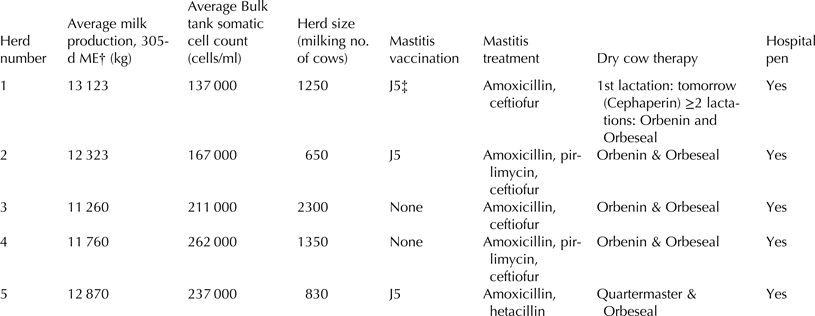
We collected and analysed data from 40 864 lactations (17 265 parity 1 and 23 599 parity ≥2 in a total of 19 835 cows). We included first lactation cows as we were interested in cases of CM within lactation. Data were collected from 2003/2004 until 2011 from 5 large dairy herds in New York State. Table 1 shows general herd characteristics.
Herd description

† Mature Equivalent i.e., predicted performance adjusted for age and stage of lactation
‡ J5 Escherichia coli vaccine
Case definition and unit of observation
Cows were identified as having CM based on milkers observing clinical signs of CM, i.e. a warm, swollen udder or changes in milk consistency. Cases missed by milkers were identified by herdspersons who examined cows after being alerted by elevated milk electrical conductivity and/or a sudden milk loss as indicated by the farm computer system.
Treatment protocol
The treatment protocol for diseased cows was specific for each of the 5 dairy herds and remained similar on each farm throughout the study (Table 1). Treatment protocols were determined by herd veterinarians and applied to CM cows based on the identified pathogen and severity of signs. All intramammary treatments involved the use of FDA approved commercially available medications.
Variables of interest
The bacteria causing CM studied were Streptococcus spp., Staphylococcus aureus, Staphylococcus spp. (CNS), Escherichia coli, Klebsiella spp. and Trueperella pyogenes.
Five other diseases (milk fever, retained placenta, metritis, ketosis and displaced abomasum (DA)) were included as risk factors. The effect of CM in the previous lactation (‘carryover’) represented the number of CM cases a multiparous cow had in her previous lactation (range: 0 to ≥3).
The outcome variable was pathogen-specific CM of case 1, case 2 or case 3. The risk for cases 2 and 3 were conditional on the previous case of CM. For the first 2 weeks in milk (WIM) only the risk of a first case of pathogen-specific CM was estimated. Every effort was made to study effects of interest for each pathogen-specific CM and case; however, if solution convergence could not be attained, generic CM was the outcome variable.
For cases 2 and 3, the previous case (pathogen) in the same lactation was included in the model. This variable had 3 levels: (1) the previous case was the same as the outcome of interest, (2) the previous case was different than the outcome of interest or the cow had both (1) and (2).
Statistical methods
Primiparae and multiparae were analysed separately. Previous milk yield in the current lactation (milk yield (kg) from 2 weeks before the current WIM) was stratified into quintiles. The kilogram values are different for each level for each pathogen specific CM model. The first 2 WIM of lactation recorded for the cow were also analysed separately, as this analysis focused on calving diseases as risk factors; previous milk yield was not included.
The GLIMMIX procedure of SAS (SAS Institute, 2008) was used to build generalised linear mixed models aimed at estimating the risk of the pathogen-specific (or generic) CM of interest occurring due to various factors. Variables for inclusion were selected based on univariate analysis where a P-value ≤ 0·20 was considered significant; biologically important variables were always kept. These variables were then all included in the model and stepwise backward elimination performed until all remaining variables were significant at P ≤ 0·05, or were considered biologically significant (i.e., calving diseases for first 2 WIM analyses, previous CM history for recurrent CM analyses). The form of the generalised linear mixed model used was
 $${\rm Ln}\;{\rm (\mu )} = {\rm \bf X}{\rm \beta} + {\rm \bf Z}{\rm \gamma}, $$
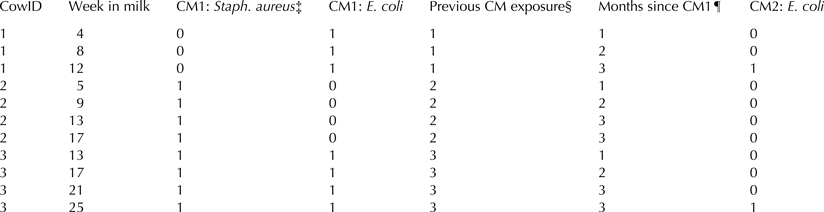
where Ln is a link function (natural log); μ is the mean probability of a cow contracting the pathogen-specific CM in a week for first case analyses and in a month for second and third case analyses; β is the vector of regression coefficients corresponding to a fixed effects matrix X; γ is an unknown vector of random-effect parameters with matrix of herd indicators Z. Distributional assumptions were that Y|μ ~ Poisson and γ ~ N(0, σ2). In case of large overdispersion (fit statistics > 1·26), Negative Binomial models were also fitted (Staphylococcus spp. 3rd case analysis). Fixed effects were parity (second, third and fourth and greater in lactation), stage of lactation (for first case analysis, ranging from WIM 1 to WIM 43, and for second and third case analyses, months 1, 2 and 3 and greater since the previous case of CM); current season (summer (June to Aug), fall (Sep to Nov), winter (Dec to Feb) and spring (Mar to May)), carryover effect (number of CM cases in the previous lactation; for multiparous cows only: 0, 1, 2, 3 and greater), other diseases (only for first case analysis; if she did/did not contract the disease in the first 2 weeks), milk weight with five levels (only for WIM ≥ 3 and first case analyses), and what pathogen associated CM she experienced (in the current lactation, termed ‘CM exposure’) with 3 levels (only for second and third case analyses, i.e., she had the same bacteria, a different bacteria, or both in her most recent previous CM case). Herd was a random effect unless model fit improved with herd as a fixed effect. Model fit was evaluated by comparing the Generalised chi-square (where herd was a random effect) or Pearson chi-square (when herd was fixed) with the remaining degrees of freedom. We also assessed the -2 log pseudo-likelihood value to determine residual variability in the marginal distribution of the data (SAS Institute, 2006). We assumed that all CM cases occurred at the end of the risk period; therefore an equal weight of 1 was assigned to every observation. The sample coding scheme for three cows with a first case of CM is illustrated in Table 2. Cows were right censored at 44 WIM (to approximate a 305 d lactation), or when they contracted a fourth case of CM, or when the cow died or was culled.
Covariate coding scheme for 3 example cows to study the risk of a second clinical mastitis (CM) case, here, E. coli, all with a first case of CM of any type†
† Dataset contained only cows (all experienced a 1st CM case of any type) that were at risk of having E. coli as their second CM case
‡ CM1: first CM case. Because this is an example dataset for a second CM case (CM2), the first record kept for this analysis is the week the cow had her first CM case
§ Previous CM exposure: 1 = CM1 due to same pathogen as CM2; 2 = CM1 due to a different pathogen than CM2; 3 = CM1 due to both same and different pathogens as CM2
¶ Months since CM1: 1 = 1 month since first case, 2 = 2 months since first case, 3 = 3 and/or greater than 3 months since first case
The unit of analysis was relatively short; therefore the distinction between risk and rate diminishes. Hence, risk per cow-week (first case analysis) or cow-month (second and third case analyses) was used as a measure of CM occurrence. The relationship between risk (cumulative incidence) and rate is given by:
 $${\rm CI} = {\rm 1}-{\rm exp(} - I \times {\rm \Delta} t{\rm )}$$
where CI is cumulative incidence and I is incidence rate. The term Δt is the time measured in cow-months. For small CI, a good approximation is I × Δt, and as Δt in our models equals 1, essentially CI and I can be used interchangeably (Rothman, Reference Rothman1986).
For the dataset with only WIM 1 and 2, week of lactation was not included as WIM 1 and 2 were combined into 1 time step. For first case models, WIM was included in the model (results not shown). For the dataset with WIM ≥ 3, for primiparae, generic CM models were fitted. Tables of statistical results for primiparae are not included due to space restrictions, though the key results are described in our Results section.
As our primary focus was whether the previous case was the same or different to the second or third case and the time that had passed since the previous CM case within the same lactation, those results have been described and discussed. While parity, calving diseases, milk yield before occurrence of CM, current season and number of CM cases in the previous lactation (for second and third cases only) were included, we have discussed these to a minimum as they are already well described in the literature and were included here to generate an accurate estimate of the effect of the previous CM case on a recurrent case.
Results
Descriptive findings
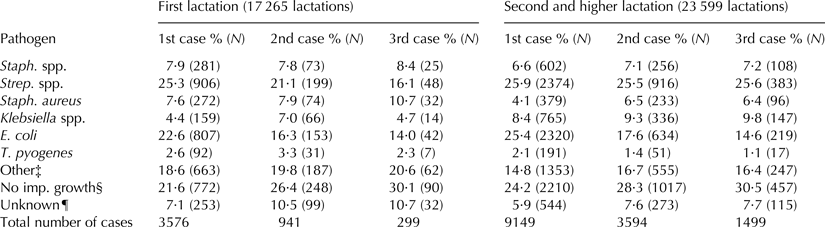
A total of 40 864 lactations (19 835 cows) was analysed. The summation of the pathogen specific lactational incidence risks (49·6%) is slightly greater than the generic lactational incidence risk (45·1%); cases with two pathogens are included as one case in the generic lactational incidence risk, but individually in the pathogen specific lactational incidence risks (Table 3).
Number of clinical mastitis (CM) pathogen cases in 5 New York State dairy herds†
† Each cow may have more than one lactation. In each case one or more organisms may be involved
‡ Included Enterobacter, Citrobacter, Corynebacterium bovis, Prototheca, Mycoplasma, Pseudomonas, Pasteurella, Yeast, Gram-positive bacillus spp., contamination (≥3 species identified in a sample), and others
§ No bacterial growth (above the level detectable from our microbiological procedures) observed in culture sample
¶ Etiologic agent unidentified in cultured sample
The fit of the models was evaluated to be sufficient; most models had a Generalised Chi-square or Pearson Chi-square divided by df goodness of fit statistic ranging from 0·84 to 1·20.
Risk of a first case of pathogen-specific CM by week in milk
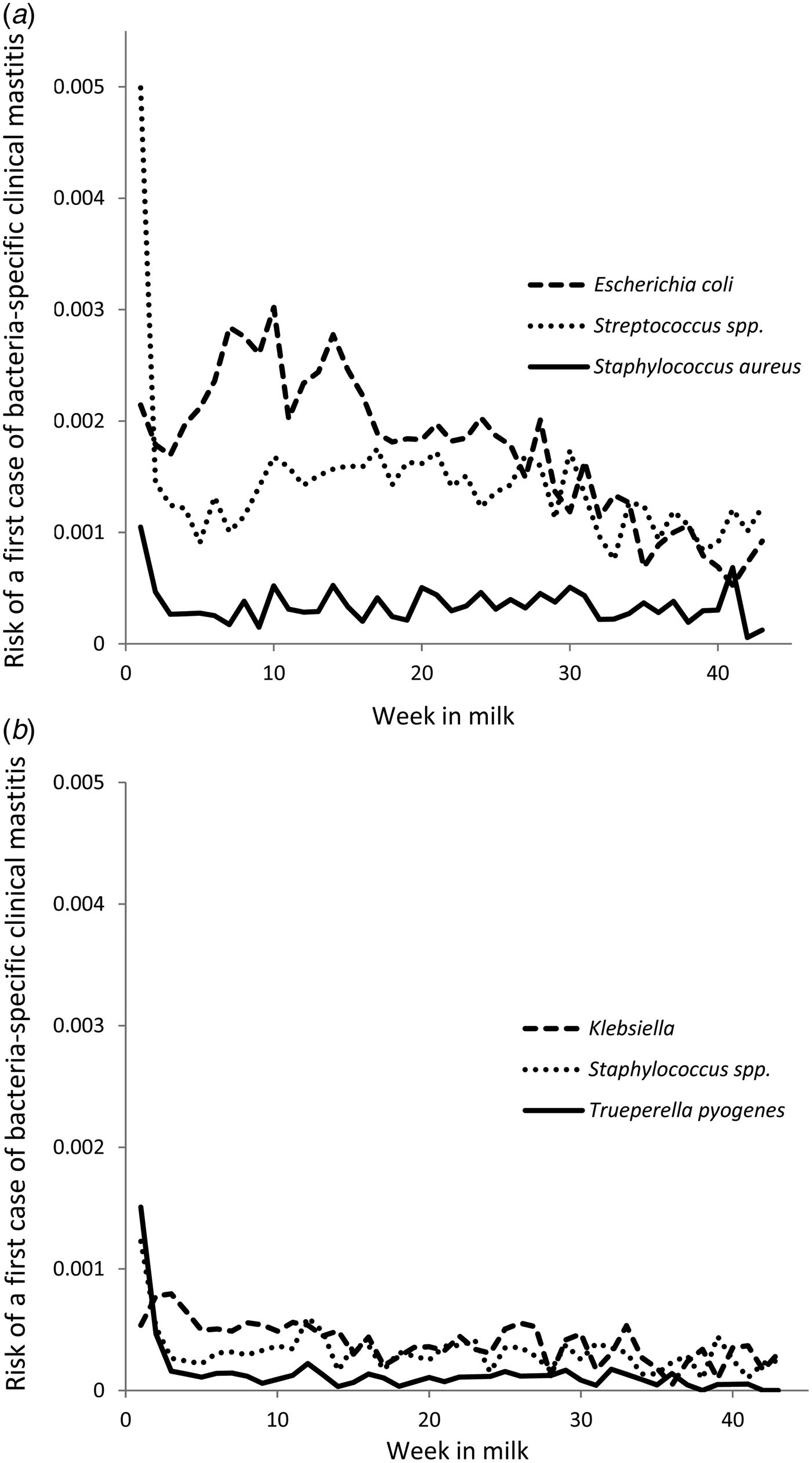
Risk of a first case of the coliforms differed markedly compared with Streptococcus spp.; the risk of a first case of E. coli was much lower at the beginning of lactation with a dip around WIM 3, and a peak at approximately WIM 10 then declines (Fig. 1a). Klebsiella spp., however, had an increase in risk around the same WIM that a first case of E. coli had a dip, then maintained a lower risk across WIM (Fig. 1b). The curve for the risk of a first case of environmental Streptococcus spp. began markedly differently from that of E. coli, but then the curves became similar beginning around WIM 27. Both Staphylococcus spp. and Staphylococcus aureus had similar risk curves.
(a) Weekly risk (cases/cow-lactation-week) of a first case of pathogen-specific clinical mastitis (Escherichia coli, Streptococcus spp. and Staphylococcus aureus) by week in milk, in the first 43 weeks of lactation, in 5 New York State Holstein herds. (b) Weekly risk (cases/cow-lactation-week) of a first case of pathogen-specific clinical mastitis (Klebsiella spp., Staphylococcus spp. and Trueperella pyogenes) by week in milk, in the first 43 weeks of lactation, in 5 New York State Holstein herds.
Risk of a first case of pathogen-specific CM across lactation
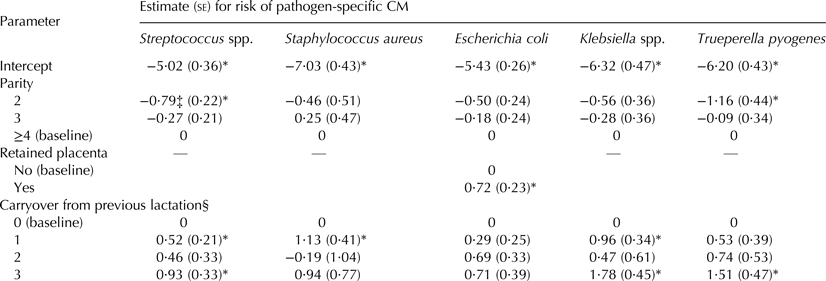
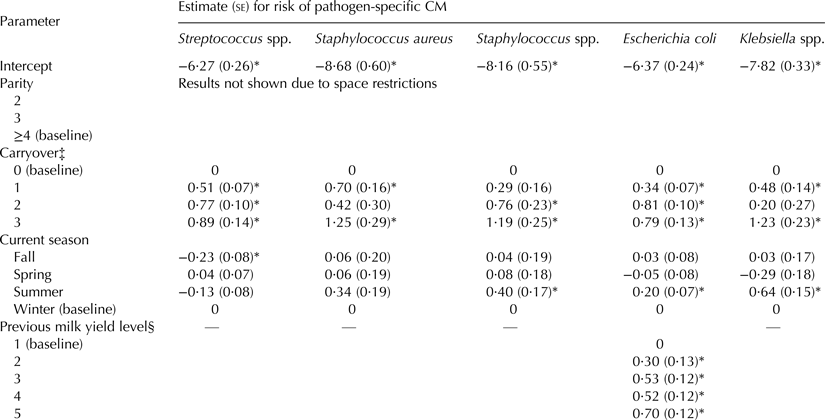
During the first 2 weeks of lactation for two of the five pathogens studied, the risk of a first case of CM was significantly greater for cows with parity ≥4 compared with parity 2 cows (Table 4). For wim ≥3, older cows were at greater risk of a first case of CM for most pathogens (Table 5). Cows with retained placenta were at greater risk of a first case of E. coli in the first 2 weeks of lactation, and in WIM ≥ 3 cows that were producing in the highest quintile 2 weeks before the current WIM were at greater risk of a first case of E. coli. Cows were at greater risk of a first case of pathogen specific CM in WIM ≥ 3 during the summer season.
Parameter estimates and standard errors for the generalised linear mixed models to estimate effects of parity, retained placenta and carryover on risk of first occurrence of pathogen specific clinical mastitis (CM) in the first two weeks of lactation in multiparous cows (23 563 lactations) in 5 New York State dairy herds†
* P ≤ 0·05
† Herd was a random effect
‡ Risk ratio: exp(−0·79) = 0·45
§ Number of CM cases in previous lactation: 0 = none, 1 = 1 case, 2 = 2 cases, 3 = ≥3 cases of CM
Parameter estimates and standard errors for generalised linear mixed models of the risk of first occurrence of pathogen specific clinical mastitis (CM) in multiparous cows (23 017 lactations) in week in milk (WIM) ≥ 3 in 5 New York State dairy herds†
* P < 0·05
† Herd was random except for Klebsiella spp. (fixed)
‡ Number of CM cases in previous lactation: 0 = none, 1 = 1 case, 2 = 2 cases, 3 = ≥3 cases of CM
§ Milk yield from 2 weeks before current WIM; levels are quintiles of milk yield (1 = lowest, 5 = highest). Values differ for each level for each pathogen –specific CM model
Risk of a second case of pathogen-specific CM in WIM ≥ 3 of lactation
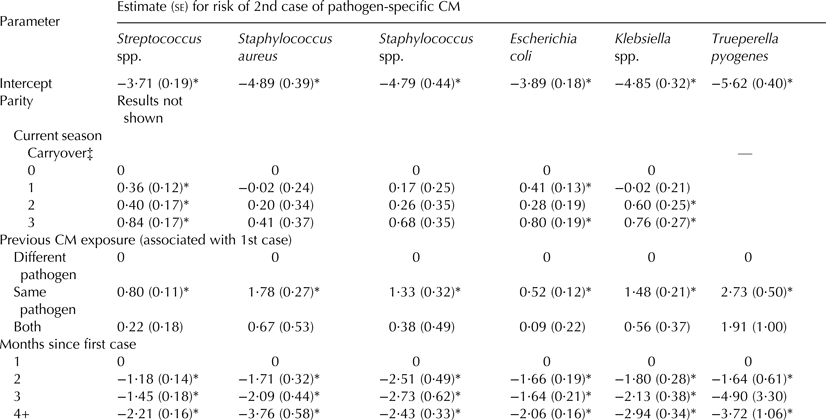
The statistical models reported in Table 6 were stratified by lactation (i.e., primiparae and multiparae). For generic CM in primiparae, cows were at greater risk of a second case of CM between 1–2 months after a first case of CM and had a greater risk in the summer compared with winter (results not shown). In multiparae, however, cows were at greatest risk within 1 month following the first case of CM. Cows were at greater risk of a second case of pathogen specific CM if they had the same pathogen in their second case as in the first case, compared with a different pathogen in their first case. Cows were more likely to contract a second case of Klebsiella spp. in the summer than in other seasons.
Parameter estimates and standard errors for generalised linear mixed models of the risk of a second occurrence of pathogen specific clinical mastitis (CM) in multiparous cows (8417 lactations) in week in milk (WIM) ≥ 3 in 5 New York State dairy herds†
* P < 0·05
† Herd was random, except for T. pyogenes
‡ Number of CM cases in previous lactation: 0 = none, 1 = 1 case, 2 = 2 cases, 3 = ≥3 cases of CM
Risk of a third case of pathogen-specific CM in WIM ≥ 3 of lactation
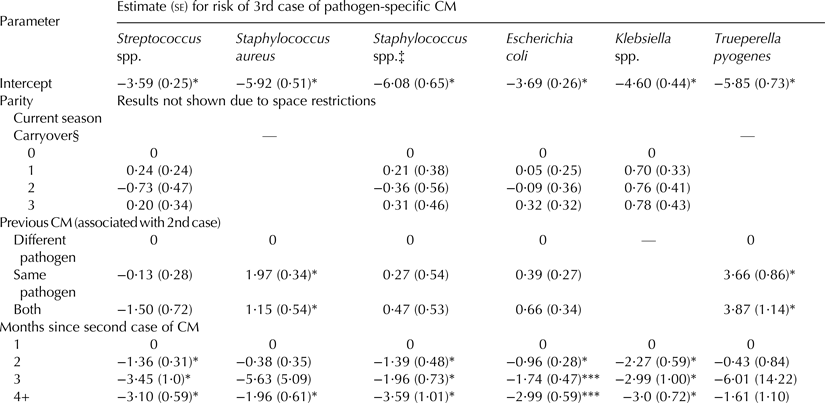
In primiparae, a cow's risk of a third case was greater within 2 months following her second case. In multiparae, however, the risk was greater within only the first month since her second case (Table 7). The effect of history of second case on risk of a third case differed depending on the pathogen of interest.
Results of generalised linear mixed models of the risk of a third occurrence of pathogen specific clinical mastitis (CM) in multiparous cows (3031 lactations) in week in milk (WIM) ≥ 3 in 5 New York State dairy herds†
* P < 0·05
† Herd was random, except for S. aureus and T. pyogenes
‡ Herd as fixed effect
§ Number of CM cases in previous lactation: 0 = none, 1 = 1 case, 2 = 2 cases, 3 = ≥3 cases of CM
Discussion
Major findings from this study include the high risk of re-occurrence of CM and a greater risk of a second case caused by the same pathogen as the first case. This has implications for understanding bacterial interactions and persistence of infections. Compared with recent publications on Gram positive, Gram negative and other CM conducted by the current group (Schukken et al. Reference Schukken, Hertl, Bar, Bennett, González, Rauch, Santisteban, Schulte, Tauer, Welcome and Gröhn2009; Hertl et al. Reference Hertl, Gröhn, Leach, Bar, Bennett, González, Rauch, Welcome, Tauer and Schukken2010, Reference Hertl, Schukken, Bar, Bennett, González, Rauch, Welcome, Tauer and Gröhn2011), there were approximately 30% more data in this study, allowing for examination of relationships at the pathogen-specific level.
Cows were at greater risk of contracting a subsequent mastitis case within 1 month rather than months later after the previous case, possibly due to the cow's immune system still compromised and more easily susceptible to a subsequent case of CM. Recurrent cases may also indicate unsuccessful treatments of a chronic infection.
There is a high risk of recurrence of pathogen specific CM, and a reason may be that cows are not being completely cured of a previous case of CM. The results suggest that natural occurrence of the disease does not result in protection, although there may be a reduction of severity (Cha et al. Reference Cha, Hertl, Schukken, Tauer, Welcome and Gröhn2013; Hertl et al. Reference Hertl, Schukken, Welcome, Tauer and Gröhn2014a) or duration of pathogen specific CM, which was not evaluated in this study.
Cows with more cases of CM in the previous lactation were at greater risk of CM in the current lactation. Similarly, Houben et al. (Reference Houben, Dijkhuizen, van Arendonk and Huirne1993) reported finding an increased risk of mastitis in the current lactation, due to mastitis in the previous lactation, ranging from a factor of 2·0 (one mastitis case) to 2·9 (3 or more cases). In that study, however, CM cases were defined at the quarter level. Cases in a previous lactation may increase risk of CM in the current lactation because of either a persistent intramammary infection that flares up again, or because CM in the previous lactation is a general indicator of the cow's increased susceptibility to CM.
Our results suggest that a previous CM case does not provide protection against a subsequent CM case; instead a previous CM case appears to increase the risk of a subsequent CM case. This is supported by the findings of Schukken et al. (Reference Schukken, Hertl, Bar, Bennett, González, Rauch, Santisteban, Schulte, Tauer, Welcome and Gröhn2009) where a previous case of Gram-negative or Gram-positive mastitis did not protect against a subsequent CM case with the same Gram classification. For both types of CM, the incidence approximately doubled when a previous case was experienced. Zadoks et al. (Reference Zadoks, Allore, Barkema, Sampimon, Wellenberg, Gröhn and Schukken2001a, Reference Zadoks, Allore, Barkema, Sampimon, Gröhn and Schukkenb) found that quarters that had recovered from Strep. uberis or Staph. aureus mastitis had a higher rate of a repeated infection with the same bacterial species compared with quarters that had not experienced infection. The lack of protective effects was also demonstrated in a study by van Dorp et al. (Reference van Dorp, Martin, Shoukri, Noordhuizen and Dekkers1999), where mastitis from 0–30 d in lactation increased the risk of both mastitis from 31–150 d in lactation and cystic ovaries, and both of these increased the risk of mastitis in late lactation. In a study looking at the effect of puerperal mastitis in heifers, intramammary infections at calving increased the risk of CM within the first week p.p., while mastitis prior to parturition and within the first week p.p. increased the risk of further cases of mastitis during the first 45 d of lactation (Edinger et al. Reference Edinger, Tenhagen, Heuwieser, Kalbe, Klünder and Baumgärtner1999). This is in contrast to other studies illustrating a protective effect of previous intramammary infection with Strep. uberis against subsequent CM (Hill, Reference Hill1988), where a subsequent challenge found 32·2% (11/34) led to CM, a significant reduction over the primary challenges. The presence of Corynebacterium spp. in the late dry period and post-calving samples was associated with reduction in risk of CM (Green et al. Reference Green, Green, Medley, Schukken and Bradley2002). Trial results showed a strong relationship between vaccination and lack of clinical Gram-negative mastitis, with an estimated risk ratio of the measure of risk of having clinical Gram-negative mastitis for vaccinated cows to unvaccinated cows being 0·20 (P < 0·005) (González et al. Reference González, Cullor, Jasper, Farver, Bushnell and Oliver1989).
Our results quantify that a previous case of CM puts cows at greater risk of a recurrent case, encouraging examination of management factors, such as CM identification, isolation of sick animals, treatment and post-treatment strategies, which not only reduce the risk of a first case of pathogen specific CM but also subsequent cases of CM. There may be other cow-level factors such as morphology and behavioural characteristics which predispose cows to recurrent case of pathogen specific CM which were not explored in this study.
This project was supported by the Agriculture and Food Research Initiative Competitive Grant no. 2010-65119-20478 from the USDA National Institute of Food and Agriculture. We thank the owners and personnel from the 5 dairies, and the personnel of the Ithaca, Canton, and Geneseo Regional Laboratories of Quality Milk Production Services for their valuable cooperation.