Introduction
For organic producers, weed control is a continuous issue in crop productionReference Sooby, Landeck and Lipson 1 . Producers rely extensively on tillage to control weeds; however, tillage degrades soil health and reduces crop yieldReference Triplett and Dick 2 , Reference Hobbs 3 . Adopting conservation tillage will accrue an array of benefits, such as improved soil porosity, greater microbial activity and carbon storage, and reduced fuel use, but may also cause potential weed problems, such as increased perennial weedsReference Peigne, Ball, Roger-Estrade and David 4 . To gain the benefits of conservation tillage, scientists are exploring reduced- and no-till systems for organic farmingReference Maeder and Berner 5 – Reference Carr, Maeder, Creamer and Beeby 8 .
Organic producers are seeking cultural strategies for weed management that lessen the need for tillageReference Sooby, Landeck and Lipson 1 . One possible solution may be controlling weeds with management designed to disrupt weed population dynamicsReference Anderson 9 . Two crucial aspects of this approach are rotation design and no-till. Weeds are managed more easily when rotations include crops with different life cycles, such as cool-season crops such as winter wheat (Triticum aestivum L.) and warm-season crops, such as soybean [Glycine max (L.) Merr.]. No-till benefits weed management by maintaining weed seeds on the soil surface to favor seed death. This approach reduces weed community density in conventional agriculture such that herbicide use can be reduced by 50%. In some rotations, producers eliminated use of herbicides in three crops out of four when using this approach.
Stimulated by success with population-based weed management, we proposed a complex rotation that may help organic producers in the northern US Corn Belt manage weeds in their croplandsReference Anderson 10 . The rotation comprises a diversity of crops with different life cycles and includes an interval of a perennial legume. This proposed rotation includes a 2-year sequence of cool-season cereals to reduce density of warm-season weeds infesting soybean and corn. A recent study quantified the impact of an oat–winter wheat sequence on weed dynamics in soybean when grown in either a no-till or a tilled systemReference Anderson 11 . Weed density in soybean was five times higher in the tilled system than in no-till. Furthermore, weed emergence was delayed in no-till; the initial flush of weed seedlings was 2–3 weeks later. Consequently, soybean yield was not affected by weed interference in no-till, but weeds reduced yield 43% in tilled soybean.
Reduced weed interference in no-till soybean in this study occurred because of two reasons. First, weed seeds lose viability more rapidly when left on the soil surface with no-tillReference Froud-Williams, Altieri and Liebman 12 , Reference Mohler, Liebman, Mohler and Staver 13 . Loss of seed viability in no-till, however, is related to time. A study in the US Central Great Plains showed that seedling emergence was eightfold higher in a tilled system compared with no-till in the third year after initiation of the studyReference Anderson 9 . In contrast, seedling emergence did not vary in the first year between till and no-till. Because addition of new weed seeds was prevented during the 3-year interval, the contrast in emergence in the third year resulted from differences in seed survival over time. The second reason for weed suppression in soybean is that plant residue on the soil surface in no-till delays weed emergence and reduces establishment of seedlingsReference Wicks, Crutchfield and Burnside 14 , Reference Teasdale, Brandsaeter, Calegari, Skora Neto, Upadhyaya and Blackshaw 15 .
This 2-year sequence of cool-season crops eliminated need for herbicides to control weeds in no-till soybeanReference Anderson 11 ; however, herbicides controlled weeds during the interval between harvesting the cool-season crop and planting soybean. We wondered if cultural tactics could replace the need for herbicides or tillage during that interval. For example, organic producers may be able to control after-harvest weeds with cover crops planted in the fall and that winterkillReference Peachey, Williams and Mallory-Smith 16 , Reference Lawley, Weil and Teasdale 17 . Also, efficacy of cover crops may be enhanced if combined with other practices in a multi-tactic approachReference Anderson 9 , Reference Westerman, Liebman, Menalled, Heggenstaller, Hartzler and Dixon 18 . Thus, we hypothesized that the combination of no-till, cover crops and plant residue lying on the soil surface may suppress weed seedling establishment and density such that tillage would not be needed before planting soybean.
We are testing this 9-year rotation to validate its possible benefit for producers. Our ultimate goal is to develop a continuous no-till system for organic producers, which will lead to more sustainable production systemsReference Hobbs 3 , Reference Peigne, Ball, Roger-Estrade and David 4 . The objective of this study was to evaluate cultural systems following harvest of a cool-season crop for impact on weed dynamics in soybean grown the next year. These cultural systems will be compared to intensive tillage practices commonly used by organic producers in this region.
Materials and Methods
Study procedures
The study was established on a Barnes clay loam (Calcic Hapludoll) near Brookings, SD. The soil contained approximately 4% organic matter and had a soil pH of 6.9. Average yearly precipitation (30-year record) is 584 mm. The cropping history of the site prior to the study was a corn–soybean–winter wheat rotation.
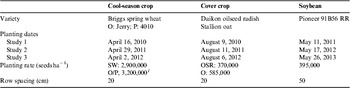
The study was a two-way factorial experiment, with tillage treatment and choice of preceding cool-season crop as the two factors. Cool-season crops were either spring wheat harvested for grain or an oat (Avena sativa L.)–dry pea (Pisum sativum L.) mixture harvested for forage. After harvest of the cool-season crops, five tillage treatments were established. One tillage treatment, referred to as the tillage control, consisted of chisel plowing and disking in the fall after harvest of the cool-season crops, and tillage once with a field cultivator in the spring before planting soybean. The second and third treatments were tilled once with a chisel plow after harvest of the cool-season crop (referred to as 1-till). A cover crop was then seeded into the third tillage treatment. The fourth and the fifth treatment was not tilled (referred to as no-till), with cover crops established in the fifth treatment. The cover crops were oat plus oilseed radish (Raphanus sativus L.). The study involved a 2-year interval, with cool-season crop and tillage treatments established in the first year, and soybean planted uniformly across all treatments in the second year (Table 1). The plots were not tilled between the rows during the growing season of soybean.
Cultural practices for establishing cool-season crops, cover crops and soybean.

1 Oat/pea mixture (O/P) was planted at a ratio of two pea to one oat by weight.
SW, spring wheat; O/P, oat/pea mixture; O, oat; P, pea, OSR, oilseed radish; RR, roundup-ready cultivar.
The ten treatments were arranged in a randomized complete block design with four replications; plot size was 7 m × 20 m. The study was conducted three times, during 2010–2011, 2011–2012 and 2012–2013 (Table 1). Each site had been in no-till winter wheat the year prior to initiating the study.
All crops were planted with a no-till drill equipped with single disk openers. No fertilizers were used in the study. Plots in soybean were randomly split into subplots, 7 m × 10 m. One subplot was maintained weed-free with two applications of glyphosate at 840 g ha−1 (2 and 6 weeks after soybean emergence) and hand weeding. Weeds were allowed to grow in the second subplot.
Biomass of cover crops (including crop volunteers) was determined from three 0.33 m2 quadrats randomly located in each plot in late October of each year. Samples were oven-dried to constant weight at 65 °C.
Seedling emergence of the weed community in soybean was recorded weekly in two 0.33 m2 quadrats randomly located in each weed-free subplot. Counting started on day of soybean planting and continued for 8 weeks after soybean planting (WAP); after the weekly counting, seedlings were removed by hand. Weed infestation in soybean was also assessed in four 0.33 m2 quadrats randomly placed in the weed-infested subplot 8 WAP. All weeds in the quadrat were harvested to determine species, density and dry weight.
In each weed-free subplot, the number of soybean plants in 1 m of row was recorded at four random sites 4 weeks after emergence (WAE). Soybean grain yield in each subplot was determined by harvesting an area, 3 m × 10 m, with a plot combine.
Statistical Analysis
Data were initially examined for homogeneity of variance among years, and then subjected to analysis of variance to determine treatments effects and possible interactions among treatments and years. Main and interaction effects were considered significant at P≤0.05; treatment means were separated with Fisher's Protected LSD. Weed biomass in cultural treatments were compared with the conventional treatment within each cool-season crop using the Dunnett's test. Weed data were averaged across quadrats within a plot before analysis.
Emergence pattern of the weed community was characterized for selected treatments by converting seedling density per week to a percentage of total emergences during the first 8 weeks after soybean planting. Weekly means were compared with the t-test to determine if emergence varied. Emergence curves were developed by cubic spline interpolation (Sigma Plot, Jandel Scientific, Point Richmond, CA); data were averaged across quadrats, replications and studies.
Yield loss due to weed interference was determined by dividing the difference in sample weights between weed-infested and weed-free subplots by yield of the weed-free sample and expressing data as a percent. The percentage values were used for statistical analysis. Reported soybean yields were adjusted to 13% moisture level.
Results and Discussion
An interaction among studies occurred with the data. Study 2 differed from studies 1 and 3; therefore, data were averaged across studies 1 and 3 and will be discussed first. An interaction also occurred between tillage treatments and preceding crop for all measured parameters with one exception, weed-free soybean grain yield. When an interaction occurred, data were shown for both factors.
Fall biomass of cover crops
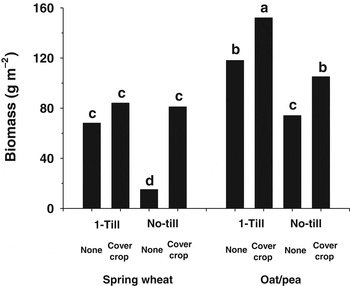
Cover crops produced the highest quantity of biomass when following oat/pea (Fig. 1). Biomass was 130 g m−2 following oat/pea but only 82 g m−2 following spring wheat (averaged across 1-till and no-till treatments). Biomass was also high in treatments without cover crops because crop volunteers established in both tilled and no-till treatments. Tillage increased the number of crop volunteers, resulting in a 40–80% increase in biomass when comparing no-till and tilled treatments without cover crops. For example, following spring wheat, 68 g m−2 of biomass occurred with the 1-till, no cover crop treatment compared with 15 g m−2 with the no-till, no cover crop treatment (Fig. 1). A similar difference occurred when comparing the same treatments following oat/pea. These trends occurred in both studies 1 and 3.
Biomass of cover crops and crop volunteers harvested in late October. Data averaged across studies 1 and 3. Bars with identical letters are not significantly different as determined by Fisher's LSD (0.05).

Averaged across all treatments, plant biomass was lower in treatments following spring wheat than oat/pea (62 g m−2 following spring wheat and 112 g m−2 after oat/pea). This difference may be related to higher N supply in the soil because of N fixation by dry peaReference Stevenson and van Kessel 19 , Reference Przednowek, Entz, Irvine, Flaten and Thiessen-Martens 20 . Biomass was also greater in the 1-till treatments following oat/pea compared with no-till, likely because tillage enhanced N mineralization and availability in the soilReference Mohr, Entz, Janzen and Bullied 21 .
Weed biomass in soybean
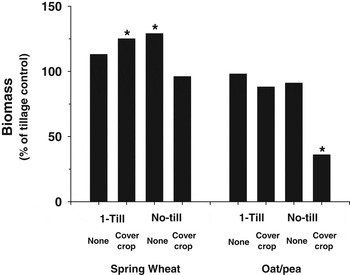
Compared with the tillage control, the only treatment that reduced weed biomass in soybean (8 WAP) was no-till plus cover crops following oat/pea. Weed biomass in this treatment was 49 g m−2, whereas 135 g m−2 of weed biomass was recorded in the tillage control, a difference of 63% (Fig. 2). Weed suppression by this treatment was 70% in study 1 and 58% in study 3. Weed biomass in the other three treatments following oat/pea did not differ from the tillage control. Following spring wheat, no treatments reduced weed biomass, but two treatments, tillage with cover crops and no-till without cover crops, had 25% or more weed biomass than the tillage control. Choice of cool-season crop affected weed growth, as weed biomass in soybean was significantly lower in treatments following oat/pea compared with spring wheat (105 versus 145 g m−2, averaged across treatments in studies 1 and 3).
Weed biomass in soybean among the tillage treatments. Data expressed as percent of weed biomass in the tillage control for each cool-season crop, which was 125 g m−2 following spring wheat, and 135 g m−2 following oat/pea. Data collected 8 WAP and averaged across studies 1 and 3. Bars with an asterisk are significantly different from the tillage control for that cool-season crop as determined by Dunnett's test (0.05).

We included the 1-till treatments in our study because we were concerned that established weeds in no-till would continue growth after harvest of the cool-season crops, produce weed seeds, and increase weed density the following year. Our results, however, indicate that after-harvest tillage was not beneficial compared with no-till (Fig. 2). An intriguing trend was that weed biomass did not differ between multiple tillage operations and one operation in the fall, as shown by comparing 1-till treatments without cover crops to the tillage control following either spring wheat or oat/pea.
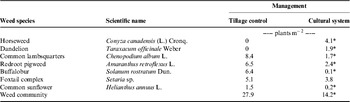
To further understand why the no-till plus cover crop treatment following oat/pea (referred to as the cultural system) was so effective, we compared the weed community composition infesting soybean of this system with the tillage control following oat/pea, 8 weeks after planting. Fall-emerging weeds, such as horseweed and field dandelion were present in the cultural system but not the tillage control due to tillage eliminating these species (Table 2). However, density of common lambsquarters, redroot pigweed, buffalobur and common sunflower in the tillage control was 22.8 plants m−2, or five times higher than in the cultural system. Consequently, the total weed density was twofold higher with tillage.
Weed community composition in soybean, comparing the tillage control to the cultural system comprising no-till plus cover crops, when both treatments followed oat/pea.

Weed community assessed 8 WAP; data averaged across studies 1 and 3. Means in the cultural system column followed by an asterisk differ from the mean in the tillage control for a weed species, as determined by the t-test at the 0.5 level of probability.
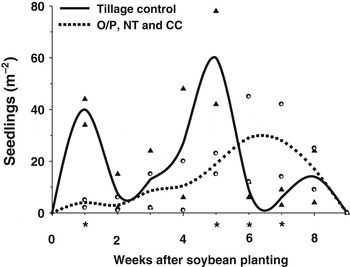
We also compared the emergence pattern of the weed community in these two treatments during the 8 weeks following soybean planting. Weed seedlings emerged earlier in the tillage control (Fig. 3). In the first week following soybean planting, approximately 40 seedlings emerged with tillage, whereas only two seedlings were observed in the cultural system. A second flush of weeds occurred at the fifth week after planting, with threefold more seedlings emerging in the tillage control. Seedling emergence was not only delayed in the cultural system, but also the total number of seedlings emerging in the first 5 weeks after planting was three times higher with tillage. Tillage led to more weed seedlings as well as earlier emergence.
Seedling emergence pattern of the weed community comparing the tillage control with the no-till plus cover crop treatment following oat/pea (abbreviated as NT, CC and O/P). Data represent weekly means averaged across replications of studies 1 and 3. Asterisks beneath the X-axis indicate that emergence in that week differed between treatments at the 0.05 level of probability.

The reasons for these trends are that weed seeds remaining on the soil surface lose viability faster than when buried in soilReference Mohler, Liebman, Mohler and Staver 13 , lethal germination is higher when seeds are on the soil surfaceReference Mohler 22 , and crop residues suppress weed establishmentReference Teasdale, Brandsaeter, Calegari, Skora Neto, Upadhyaya and Blackshaw 15 , Reference Mohler and Teasdale 23 , Reference Kruidhoff, Bastiaans and Kropff 24 . Even though the cover crops winterkilled, the crop residue was still present in no-till when soybean was planted. Weed emergence was delayed in no-till because of cooler soil temperatures with crop residues on the soil surface compared with bare soil after tillageReference Teasdale and Mohler 25 . Our results are similar to a previous study at this location that found weed emergence being reduced and delayed by no-till and crop residue cover on the soil surfaceReference Anderson 11 .
Soybean grain yield
Grain yield of weed-free soybean did not differ among treatments. Yield averaged across all treatments for studies 1 and 3 was approximately 2600 kg ha−1, averaging 2710 kg ha−1 in study 1 and 2480 kg ha−1 in study 3. The lack of tillage impact on soybean yield has also been noted in other studies. For example, DeFelice et al.Reference DeFelice, Carter and Michell 26 examined results from 43 studies in Central USA, and found that soybean yields similarly in tilled and no-till systems in this region.
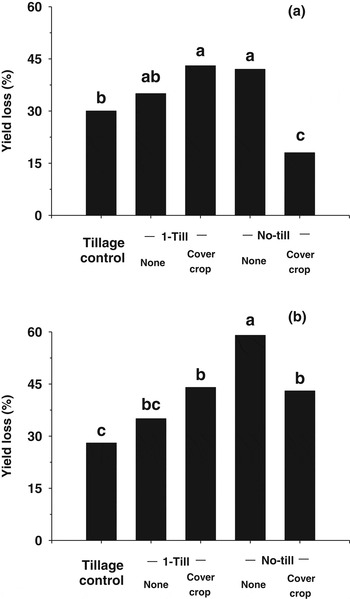
However, soybean grain yield did vary among tillage treatments when weed interference was present. Yield in the no-till plus cover crop treatment following oat/pea was reduced only 17% by weed interference, whereas yield loss in the tillage control was 31% (Fig. 4a). The reduction in yield loss was due to lower weed biomass in these two treatments (Fig. 2). Yield losses due to weeds were greater in two treatments (no-till without cover crops and 1-till with cover crops) compared with the tillage control (Fig. 4a), even though weed biomass did not differ between these treatments (Fig. 2). The higher yield loss with these treatments may be due to soil water use by cover crops or crop volunteers the previous fall, which can reduce yields of crops in following yearsReference Carr, Anderson, Lawley and Miller 27 .
Yield loss in soybean due to weed interference, comparing the five treatments following (a) oat/pea and (b) spring wheat. Data expressed as a percent of the corresponding weed-free subplot for each treatment, averaged across studies 1 and 3. Bars with identical letters are not significantly different as determined by Fisher's LSD (0.05).

No tillage treatments following spring wheat were more favorable than the tillage control in minimizing yield loss due to weed interference (Fig. 4b). Weed interference reduced yield 29% in the tillage control, but more than 36% with the two no-till treatments and the 1-till plus cover crops treatment. Yields did not differ between the 1-till without cover crops treatment and the tillage control following either spring wheat and oat/pea (Figs. 4a and 4b), which indicates that several tillage operations may not be needed to control weeds before growing soybean.
Anomalous results in study 2
Results in study 2 were anomalous compared with the other two studies because of drought conditions. Precipitation during the fall interval following harvest of spring wheat and oat/pea was only 25% of normal. Cover crops germinated, but died 4–5 weeks after emergence.
The growing season for soybean in the next year was also dry; precipitation was only 65% of normal, with no rain occurring between June 8 and August 1. Soybean died in the weed-infested plots, whereas the density of soybean in weed-free plots was only 50% of studies 1 and 3. Grain yield in weed-free soybean was only 910 kg ha−1, or 35% of yield levels in studies 1 and 3.
Even though cover crops did not survive in study 2, weed biomass was still lower in the no-till treatments following oat–pea compared with tilled treatments or any treatment following spring wheat (data not shown). A second trend noted in this study was high density of horseweed in no-till. More than 20 horseweed plants m−2 established in no-till plots following either cool-season crop, but less than 3 plants m−2 were present in treatments with tillage. Horseweed is a winter annual that emerges during late fall and early spring and readily establishes in no-till systemsReference Weaver 28 . Cover crops suppress horseweed establishmentReference Nandula, Eubank, Poston, Koger and Reddy 29 , and lack of cover crop survival in study 2 allowed this species to establish in no-till.
Summary
The cultural system comprising oat/pea followed by no-till and cover crops performed favorably when compared with the tillage control. Weed biomass was reduced 63% and yield loss due to weed interference was 14% lower. Thus, producers may be able to reduce intensity of tillage when growing soybean after cool-season crops. In a tilled system, organic producers can control weeds in soybean with between-row cultivation and rotary hoeing. However, recent advances in equipment will enable producers to control weeds in soybean with a no-till system also. For example, DonaldReference Donald, Singh, Batish and Kohli 30 designed a mower to control weeds between soybean rows, whereas other implements can remove weeds in the crop rowReference Forcella 31 , Reference Melander, Rasmussen and Barberi 32 , thus eliminating the need for tillage in soybean. Another approach would be to grow soybean in narrower rows, which will reduce weed growth and interferenceReference Harder, Sprague and Renner 33 . Also, using rye as the cover crop after harvesting the cool-season crops and controlling rye with a crimper roller would provide another option for producers to control weeds in soybeanReference Kornecki, Price, Raper and Arriaga 34 , Reference Mischler, Curran, Duiker and Hyde 35 .
Organic producers are concerned that extensive tillage may be harming their soil health, therefore they are interested in using less tillageReference Sooby, Landeck and Lipson 1 , Reference Peigne, Ball, Roger-Estrade and David 4 , Reference Maeder and Berner 5 , Reference Carr, Maeder, Creamer and Beeby 8 . Our study demonstrates that a 2-year sequence of cool-season crops followed by cover crops can help manage weeds in soybean with no-till practices. This approach will integrate well with complex rotations comprised of crops with a diversity of life cyclesReference Anderson 10 , Reference Teasdale, Mangum, Radhakrishnan and Cavigelli 36 .