Introduction
The concept of anosognosia is used to describe a person's lack of awareness of an objective deficit, whether cognitive, perceptual or motor Reference McGlynn and Schacter(1). Anosognosia is now widely recognised as a common symptom of Alzheimer's disease (AD), with prevalence rates ranging from 20 Reference Migliorelli, Teson and Sabe(2) to 81% Reference Sevush and Leve(3) depending on the severity grading of the patients examined. The clinical presentation of anosognosia is heterogeneous and a person may exhibit awareness for impairment in one domain but not in another (Reference Bisiach, Vallar and Perani4–Reference Jehkonen, Ahonen and Dastidar6). In AD, the most common presentation of anosognosia relates to memory impairments, and patients tend to overestimate their memory abilities Reference Barrett, Eslinger, Ballentine and Heilman(7,Reference Moulin, Perfect and Jones8). Current theoretical models suggest a number of different ways by which brain damage could result in anosognosia. To account for the domain heterogeneity of anosognosia, one theoretical model proposes that the different modalities of awareness are each supported by a modular system. Domain specific anosognosic symptoms would then appear when such modules were disconnected from a higher order ‘Conscious Awareness System’ (CAS) associated with structures within the parietal lobes Reference Schacter(9). Another theoretical proposal has attempted to account more specifically for anosognosia in respect of memory impairments in AD Reference Agnew and Morris(10). This account suggests that accurate awareness of one's level of performance is achieved through the balanced interplay of several mechanisms. These would include executive functions, episodic and semantic memory, and self monitoring. Individuals might then constantly monitor their performance to update stored information with new information about their current level of ability in the different domains. When the incoming information regarding a memory failure is consciously experienced, it then enters a comparator mechanism, most likely associated with structures within the frontal lobes. This process compares incoming new information with existing information within a ‘Personal Knowledge Base’ (PKB), where semantic memories relating to the person's past performance have accumulated. In the normal situation, any disparity between the incoming information regarding performance and the information stored in the semantic PKB concerning the person's past ability results in episodic memory updating the relevant semantic memories. Damage to this system could cause anosognosia for the impaired domain. Using such theoretical models, anosognosia in AD might, therefore, appear because of damage at different levels, either to the CAS itself (primary anosognosia), a comparator mechanism (executive anosognosia) or to the pathway which updates the PKB with recent information (mnemonic anosognosia) Reference Agnew and Morris(10).
AD patients often overestimate their current abilities Reference Barrett, Eslinger, Ballentine and Heilman(7,Reference Moulin, Perfect and Jones8), perhaps by relying on their general semantic knowledge and extracting relevant universals that they then use to estimate their own performance. There is some evidence, however, that they are also able to monitor their performance during a task, and use the knowledge gained from task exposure to improve the accuracy of their estimations (Reference Moulin, Perfect and Jones8,Reference Duke, Seltzer, Seltzer and Vasterling11–Reference Moulin, James, Perfect and Jones13). AD patients with anosognosia for memory impairment may, therefore, successfully monitor their performance during tasks but be unable to maintain awareness of their memory failure over a sustained period of time. Anosognosia in AD would be of the mnemonic type if AD patients were unable to achieve an enduring record of their deficits in a PKB semantic store. A recent study, however, showed that AD patients were able to use task information to accurately revise their predictions after a delay of 20 min Reference Ansell and Bucks(14). This evidence suggests a retained ability to update PKB using new information at least over this time period. Decay of information would be expected, however, within a 20-min window (and even less) when AD patients exercise free recall, and the maintenance of feedback ability in these patients might be because of testing procedures which allowed contextually cued recall. In this latter experimental design the time delay might have not been sufficient to observe complete decay of the memory trace. There is other evidence that patients with amnestic syndromes and with degenerative dementia may have normal performance for delays of 20 min or less and show accelerated forgetting and faster decay over longer delay intervals (Reference Carlesimo, Sabbadini, Fadda and Caltagirone15–Reference Isaac and Mayes18). It is possible, therefore, that the relatively short delay used in the Ansell and Bucks study Reference Ansell and Bucks(14) might explain the inconsistency with earlier observations.
The present study was designed to test this time delay hypothesis by recording the estimation patterns of mild AD patients on a memory test before the task, immediately after the task, and after an hour-long delay. This design should allow the detection of sufficient memory decay even allowing for the influence of contextually driven recall. Patients should, as predicted by the evidence for mnemonic decay in AD, return to their pretesting levels of prediction accuracy after a delay of 1 h.
Material and methods
Participants
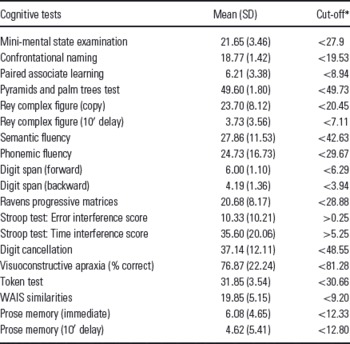
Twenty-three patients (8 male, 15 female) with probable AD were recruited from the Clinical Neuroscience Centre at the University of Hull. All met the National Institute of Neurological and Communicative Disorders and Stroke and the Alzheimer's Disease and Related Disorders Association (NINCDS-ADRDA) clinical criteria Reference McKhann, Drachman and Folstein(19) for probable AD. The age of patients ranged between 53 and 88 years old (mean age = 72.3 years, SD = 10.7), they had a mean of 12.2 years (SD = 3.07) in formal education, and a mean Mini-Mental State Examination (MMSE) score of 21.65 (SD = 3.46). Only those patients who attended the clinic with a reliable informant took part in the study. Patients were also excluded if there were vascular risk factors even where there was no history to suggest overt brain ischemia, if they had history of head injury, of other neurological or psychiatric disorders, or of other significant pathologies. Other exclusion criteria included Hachinski Ischemia scale score greater than four Reference Hachinski, Iliff and Zilhka(20) and other types of degenerative or secondary dementia as assessed with current clinical diagnostic criteria (Reference Brun, Englund and Gustafson21–Reference Roman, Tatemichi and Erkinjuntti23). All patients had psychiatric assessment, neurological examination, extensive neuropsychological screening (Table 1) and structural scanning (computed tomography or magnetic resonance imaging).
Mean and standard deviation (SD) scores obtained by the AD patients on the neuropsychological test battery

* Cut-off values are derived from a local normative sample.
Thirty healthy older adults (15 males and 15 females) and their spouses constituted the control group. The participants were aged between 60 and 84 years old (mean age = 70.1 years, SD = 7.22), had a mean length of education of 12.3 years (SD = 2.28) and had no history of neurological or psychiatric illness. The same exclusion criteria used for patient selection were applied when selecting controls. All controls had a score of 27/30 or higher on the MMSE. Consent was obtained from each participant prior to the experiment and ethical approval was granted by the regional Ethics Committee.
Methods
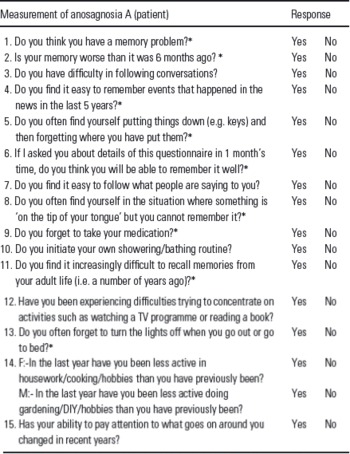
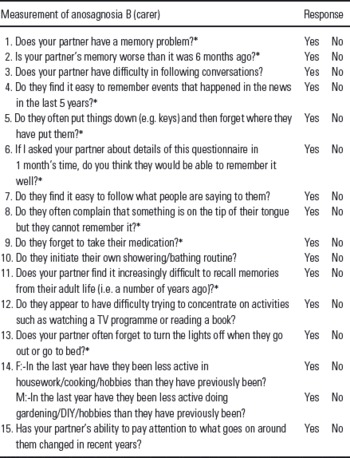
Anosognosia was assessed using a purpose devised Measurement of Anosognosia instrument. This instrument was an extensively modified version of the original anosognosia assessment proposed by Migliorelli et al. Reference Migliorelli, Teson and Sabe(2). The new instrument contained 15 dichotomous items (Appendices 1 and 2) questioning the participants' beliefs about their abilities in different areas such as their performance on cognitive tasks and activities of daily living (ADL) tasks and was administered in two different forms: a self-rating and an informant-rating version. It was scored by awarding one point for each response which signified awareness for that deficit, and a score of zero for lack of awareness. Anosognosia was assessed by calculating discrepancies between the self- and informant-rating scores of each individual. In addition to a total discrepancy score, the design of the questionnaire allowed two subcomponent scores to be calculated; one for discrepancy in memory items (nine items) and the other for discrepancy in non-memory items about functioning in other cognitive and ADL skills (six items).
Memory was tested using the verbal paired associates learning task Reference Wechsler(24). The participant listened to a list of eight pairs of spoken words. Participants were asked to recall the second word which was matched with the cued item. The task was administered through a computer recorded presentation on a portable computer to maintain a standardised presentation procedure.
Procedures
The anosognosia instrument was completed by both the participants and their paired informant rater. The participants were then asked to predict their performance on the impending memory task, in terms of how many word pairs they believed they would be able to recall out of the eight to be presented.
The memory task was then administered to get a true reflection of each participant's memory ability and the original test administration procedure was followed. Immediately after taking the memory task, participants were asked to judge how well they had done by estimating the number of word pairs correctly recalled. After a delay of 1 h, the AD participants were again asked to judge their performance on the memory task.
Results
Measurement of anosognosia
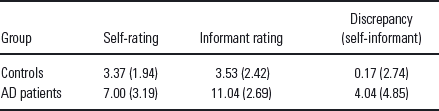
Table 2 shows the means and standard deviations for both self- and informant-rating scores of the AD patients and controls on the anosognosia questionnaire, as well as the discrepancies between the two types of rater (self minus informant ratings).
Means and standard deviations (SD) for self and informant ratings on the questionnaire and discrepancy score (self minus informant), for both AD patients and controls
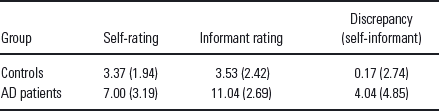
A 2 × 2 analysis of variance (ANOVA) was carried out to compare participant groups and self versus informant ratings. There was a significant effect of group, with AD patients scoring higher than controls on the awareness (of a deficit) questionnaire [F (1,51) = 140.30, p < .001] and a significant effect of rater [F (1,51) = 16.01, p < .001], with the overall mean for informant ratings being higher than the total mean for self rating (Table 2). There was also a significant interaction between group and rater [F (1,51) = 13.57, p < .001], with there being more discrepancy between the self- and informant raters' scores for the AD patients than for the controls.
Awareness of memory abilities
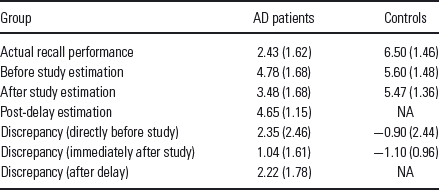
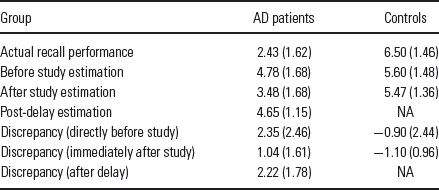
Awareness of memory performance was assessed by examining the accuracy of the participants' estimations on the paired associate learning task, and by calculating the discrepancies between the estimations and the actual recall performance, both pre- and immediate postadministration of the task (Table 3).
Means and standard deviations (SD) for the actual performance on the memory test, performance estimations and the discrepancies between actual and estimated scores (pretest, immediately after the test and after the 1-h delay)
NA, not available.
ANOVA on discrepancy scores showed a main effect of estimation time [F (1,51) = 5.49, p < .05], with the participants significantly altering their estimations immediately after having taken the test. No interaction between group and estimation time was found [F (1,51) = 2.96, ns], but the general trend showed that AD patients lowered their estimation immediately after having taken the test to a greater degree than controls (Table 3). There was, however, a significant main effect of group [F(1,51) = 38.18, p < .001], with AD patients being less accurate in their predictions overall than the controls. Paired samples t-tests were used to further investigate the estimations of the patients and controls (actual memory performance vs. pretest estimations vs. post-test estimations). These analyses showed that the AD group significantly overestimated their memory ability at pretest (t 22 = 4.58, p < .001). Immediately after performing the memory test these estimations dropped significantly (t 22 = 2.63, p < .05) reflecting a level of awareness more in line with reality; although even after this adjustment the patients were still significantly overestimating their ability (t 22 = 3.11, p < .01). The controls on the other hand tended to underestimate their memory ability pretest (t 29 = −2.02, p = .053). Immediately after testing the predictions of the controls did not change significantly from the predictions before testing (t 29 = .34, p = ns). However, since the controls tended to further underestimate their memory performance after undertaking the test, the comparison with actual performance reached significance (t 29 = −5.48, p < .001).
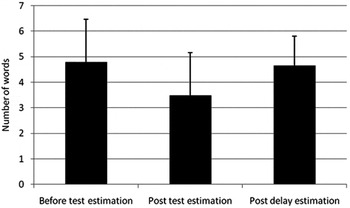
Paired samples t-tests compared AD patients' estimations pre- and post-test, and after a 1-h delay. There was a significant difference between the AD patients' estimation accuracy before and immediately after test (t 22 = 2.63, p < .05), showing that patients significantly lowered their estimations after having been administered the test. There was also a significant difference between their predictions immediately after the test and after the delay period [t 22 = −3.43, p < .01], showing that after an hour, patients' estimations had increased significantly. No significant difference was found between their estimates pretest and after the delay period (t 22 = .31, ns), showing that patients' returned to their pretest prediction levels after the 1-h delay (Fig. 1).
Alzheimer's disease patients' estimations of their abilities pretest, immediately post-test, and after the delay.

Awareness and severity of dementia
A Pearson's correlation analysis found a significant negative relationship between the degree of awareness (measured by self-informant discrepancies) and patients' MMSE scores, r = −.54, p < .01. The higher the discrepancy score, the lower the score on the MMSE.
Correlations of neuropsychological tests with anosognosia measures
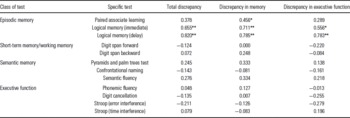
Correlation analyses were carried out between memory and executive function tests with the discrepancy scores (self-informant) on the total questionnaire and with discrepancy scores on the memory and non-memory subcomponents of the instrument. Separate discrepancy scores for the two components of the questionnaire were used to clarify the link between impairment in either executive functions or memory tasks and poor awareness for memory deficits specifically or more generally for poor executive competence in everyday activities or other cognitive skills.
Pearson's correlations showed that the total discrepancy scores (self-informant) were significantly correlated with the measures of verbal episodic memory (Table 4). Logical memory (immediate and delayed) correlated significantly with the total discrepancy score, and with both the memory and the non-memory subcomponents of the questionnaire. Verbal paired associate scores correlated only with the memory subcomponent of the questionnaire. Short-term memory/working memory scores, semantic memory scores, and executive processing scores did not correlate significantly with either the total discrepancy scores or with any of the questionnaire subcomponents (Table 4).
Correlations between anosognosia (discrepancy) scores and neuropsychological tests

The discrepancy scores are for the total discrepancy between patient/carer on the questionnaire and the sub-categories of discrepancies in memory and in executive function.
* p < .05.
** p < .01.
Discussion
This study investigated awareness of cognitive symptoms in patients with mild to moderate AD. In addition, it explored whether patients at this level of severity were able to modify and maintain over time their level of awareness of memory deficits after direct exposure to a memory test. The results showed that AD patients were generally less accurate in evaluating the level of their cognitive abilities than healthy older adults, as showed by a larger discrepancy between self- and informant ratings on the awareness questionnaire for patients than controls. This finding is supportive of and extends a long line of research which suggests that anosognosia for cognitive deficits is a common and early feature of AD Reference Sevush and Leve(3). A positive relationship was also found between the degree of anosognosia and the severity of dementia. The finding is in line with evidence from earlier studies (Reference Migliorelli, Teson and Sabe2,Reference Kashiwa, Kitabayashi and Narumoto25–Reference Vogel, Hasselbalch and Gade27) and implies that the mechanisms involved in anosognosia in AD are increasingly damaged with disease progression Reference Schneck, Reisberg and Ferris(28).
The results examining prediction accuracy showed that AD patients significantly overestimated their performance pretest, whereas controls were more likely to underestimate it. Immediately after taking the test, AD patients revised their predictions downwards to more closely correspond with their actual performance. This improved accuracy of self-appraisal immediately after having taken the test suggests that they were able to monitor their own memory performance, and then use this information to reduce their subsequent estimation (Reference Moulin, Perfect and Jones8,Reference Duke, Seltzer, Seltzer and Vasterling11–Reference Ansell and Bucks14) presumably relying on the integrity of the postulated CAS. Even so, the patients were still significantly overestimating their ability, and their capacity to update performance awareness did not extend to reflecting their actual performance accurately. Controls in contrast underestimated their performance post-test although the change in estimation score was not significant. Gross overestimation in patients might be explained by their use of general rather than specific knowledge of possible levels of performance on a given task, as distinct from their actual contemporary capabilities. On the other hand, underestimation in controls might reflect a more specific and realistic appraisal of feasible performance, based on their personal experience, and independent of any general theoretical capacity.
The revised appraisal of their ability post-test was not maintained over time by the AD patients. No significant difference was found between before test prediction and estimations after the 1-h delay, and patients returned to pretesting accuracy levels. This finding argues strongly against notions of a psychological cause of anosognosia. There have been claims that the defence mechanism of denial could cause anosognosia by suppression or repression of awareness of any memory deficit (see Reference Ecklund-Johnson and Torres(29) for review). The results of the present experiment, however, can hardly be explained by a process of denial. If this were the case, then the exaggerated estimation of performance would be expected to persist throughout the testing period. The fact that patients altered their estimates and then returned to pretesting levels of awareness suggests, at least in these patients, an alteration over time and an evolving deficit in the neural processes which are involved in maintaining more accurate appraisal.
Taking the more persuasive view, therefore, that cognitive, rather than motivational impediments account for anosognosia in AD, one possible mechanism is that awareness cannot be maintained in AD because of an inability to update semantic knowledge about memory performance Reference Agnew and Morris(10). This theory has been challenged by other work which has shown sustained awareness for at least 20 min after exposure to the task Reference Ansell and Bucks(14). Supporters of the failing semantic update hypothesis pointed to the evidence that autobiographical episodic information about memory ability is normally ‘semanticised’. A store of general knowledge about one's performance in a variety of respects is generated in a process known as ‘abstraction’Reference Conway, Pleydell-Pearce, Whitecross and Sharpe(30). In order for semantic memory to be updated, this process of abstraction must be working effectively. In AD the process of abstraction is compromised, however, and this may be because episodic memories are not properly retained for abstraction to be effective. The process of abstraction has been associated with medial temporal lobe (MTL) structures, especially the hippocampus Reference Westmacott, Black, Freedman and Moscovitch(31), a primary area of pathological neuronal loss in AD Reference Gosche, Mortimer and Smith(32,Reference Jack, Petersen and Xu33), and damage to these structures could contribute to difficulty in updating semantic memory using the process of abstraction. In this way these patients may not be able to convert their episodic experiences (such as failing on a memory test) into accurate generalised self-knowledge for their everyday functioning. This is plausible, but seems only a partial explanation. If reduced awareness of memory difficulties were secondary to hippocampal atrophy and related functional deficits (e.g. inability to form new episodic memories and retain them for sufficient time to consolidate), then anosognosia for memory deficits should be present in all patients with amnesia caused by hippocampal damage. There is evidence, however, that patients with profound amnesia caused by damage restricted to the hippocampus, although unable to form, retain and consolidate new episodic memories, still have good awareness of their deficits (see Reference Kasniak and Zak(34) for a review). Patients with amnesia and hippocampal damage who also have frontal lobe damage, on the other hand do show loss of awareness of their memory deficits. A recent study Reference Vogel, Hasselbalch and Gade(27) has suggested that frontal lobe damage is an important contributor to the development of anosognosia, and Westmacott et al. Reference Westmacott, Black, Freedman and Moscovitch(31) have advocated that damage to both the MTL and the frontal lobes contributes to the genesis of anosognosia in AD. They suggested that the prefrontal cortex facilitates connections between the brain areas which hold episodic memories (i.e. MTL) and those which represent semantic information. This proposal suggests a possible neural circuit for the maintenance of accurate self-knowledge through the updating of semantic memory by episodic memories.
An alternative approach to the reconciliation of data from amnesia and from early dementia without speculating on a potential role of the frontal lobe is possible, however. There is evidence that patients with damage restricted to the hippocampus are able to form new semantic memories when their perirhinal cortex is still intact Reference Vargha-Khadem, Gadian and Watkins(35). In early AD there is severe hippocampal cell loss, but there is also substantial neuronal loss in perirhinal cortex Reference Venneri, McGeown and Hietanen(36). Combined damage to these crucial regions at such an early stage might disrupt the process of abstraction and lead to degraded awareness of cognitive decline.
The finding of a significant correlation between abnormal awareness and poor scores in the memory tests, but not in executive tests or any other neuropsychological tasks in this study of early AD, provides strong support for a primary role of disruption of medial temporal structures and related functions rather than frontal lobe degeneration at this stage of the disease. It follows that within the framework proposed by Agnew and Morris Reference Agnew and Morris(10) poor awareness of memory and other cognitive and ADL deficits in this early stage of the disease reflects damage to the pathway which normally would update the PKB with recent information. As neuropathology spreads to the neocortex during disease progression, frontal lobe structures will then be affected and this will modulate the clinical presentation. More substantial deficits of awareness, including in some patients confabulatory or psychotic beliefs about cognitive and physical abilities, may emerge. Anosognosia in these cases can be compared to that observed in patients following right sided stroke in frontal and parietal regions, who also show unawareness of impairment, especially of paralysis or paresis, and may express a range of confabulatory or delusional beliefs about their residual abilities Reference Venneri and Shanks(37).
Assessing anosognosia by calculating discrepancies between self- and informant ratings on a questionnaire has been criticised for assuming that the informant is able to give an accurate and reliable assessment of the participant's residual competence Reference Clare, Markova, Verhey and Kenny(38). Although the present study used informants who were close to the participant to maximise the likelihood of them providing valid ratings of the participants' abilities, this method is less than ideal to obtain an accurate measure of a person's true level of awareness, and more refined techniques should be developed.
The implications of poor awareness are substantial in terms of patient management and treatment, and any means of improving awareness in this clinical population would greatly benefit the patient and their carers. Some studies have suggested that exposing patients to their memory failures explicitly is one way of facilitating improved awareness Reference Clare, Wilson and Carter(39). If as argued above, however, anosognosia in AD develops after neural damage in areas critical for retaining and updating information about self performance, it seems unlikely that attempts to improve awareness through explicit memory based interventions would succeed. In seems more likely that sustaining awareness of ability in AD might not be achievable without either constant feedback which takes advantage of residual implicit memory abilities, or by guided environmental/carer interventions. For example, family members and professional carers might be encouraged to frame residential environments so that organisational and sensory cues are in place to compensate for explicit memory failures Reference Hirschman and Blackwell(40). In this way a more accurate ongoing representation of the patient's own abilities might be dynamically maintained or prosthetically supported, at least in the earlier stages of the disease.
Appendices
Appendix 1

* The subset of items which investigate anosognosia for memory are marked with an asterisk. F = female, M = male.
Appendix 2

* The subset of items which investigate anosognosia for memory are marked with an asterisk. F = female, M = male.