Introduction
The taxonomy of Micarea Fr., a crustose lichen genus in the family Pilocarpaceae, is insufficiently known owing to the small number of morphological characters available and difficulties in their interpretation. The genus comprises c. 100 species and occurs on all continents (Kirk et al. Reference Kirk, Cannon, Minter and Stalpers2008; Coppins Reference Coppins2009). It is best known and most widely collected from Europe where it is widespread and common. However, even after two monographic treatments of the European species of the genus (Coppins Reference Coppins1983; Czarnota Reference Czarnota2007), new species and distribution data are frequently published from Europe and Macaronesia (Czarnota & Guzow-Krzemińska Reference Czarnota and Guzow-Krzemińska2010; Svensson & Thor Reference Svensson and Thor2011; van den Boom & Ertz Reference van den Boom and Ertz2014; Guzow-Krzemińska et al. Reference Guzow-Krzemińska, Czarnota, Łubek and Kukwa2016; van den Boom et al. Reference van den Boom, Brand, Coppins and Sérusiaux2017) as well as from other lesser known areas (Cáceres et al. Reference Cáceres, Mota, de Jesus and Aptroot2013; Aptroot & Cáceres Reference Aptroot and Cáceres2014; Barton & Lendemer Reference Barton and Lendemer2014; Brand et al. Reference Brand, van den Boom and Sérusiaux2014; Córdova-Chávez et al. Reference Córdova-Chávez, Aptroot, Castillo-Camposa, Cáceres and Pérez-Pérez2014; Launis & Myllys Reference Launis and Myllys2014; McCarthy & Elix Reference McCarthy and Elix2016). In many cases, DNA based phylogenies have been necessary for understanding the species diversity.
Recent molecular phylogenies have shown that Micarea is paraphyletic (Andersen & Ekman Reference Andersen and Ekman2005; Sérusiaux et al. Reference Sérusiaux, Brand, Motiejūnaitè, Orange and Coppins2010), even after the introduction of a new genus Brianaria S. Ekman & Svensson for the M. sylvicola group (Ekman & Svensson Reference Ekman and Svensson2014). Species delimitation has perhaps been especially problematic in the M. prasina group which includes the type species of the genus, M. prasina Fr. (Andersen & Ekman Reference Andersen and Ekman2005; Sérusiaux et al. Reference Sérusiaux, Brand, Motiejūnaitè, Orange and Coppins2010; Schmull et al. Reference Schmull, Miadlikowska, Pelzer, Stocker-Wörgötter, Hofstetter, Fraker, Hodkinson, Reeb, Kukwa and Lumbsch2011). In his European monograph, Coppins (Reference Coppins1983) delimited the group based on morphological, anatomical and chemical features: all species have a “micareoid” photobiont (coccoid green alga with cells 4·0–7·5 μm diam.), immarginate apothecia, branched paraphyses and an ascus of the Micarea-type (Hafellner Reference Hafellner1984). The majority of the species produce the Sedifolia-grey pigment (K+ violet, C+ violet) which is typically present in the apothecia and pycnidia (Coppins Reference Coppins1983; Czarnota & Guzow-Krzemińska Reference Czarnota and Guzow-Krzemińska2010). According to Coppins (Reference Coppins1983), the group comprised M. prasina, M. hedlundii Coppins, M. levicula (Nyl.) Coppins and with some uncertainty also M. misella (Nyl.) Hedl., M. melanobola (Nyl.) Coppins and M. synotheoides (Nyl.) Coppins. Micarea prasina was treated in a wide sense having a variable morphology and including three chemical races. However, M. prasina was eventually shown to be non-monophyletic and two distinct lineages were described as new species: M. subviridescens (Nyl.) Hedl. and M. micrococca (Körb.) Gams ex Coppins (Coppins Reference Coppins2002). Furthermore, M. xanthonica Coppins & Tønsberg (Coppins & Tønsberg Reference Coppins and Tønsberg2001) and M. viridileprosa Coppins & van den Boom (van den Boom & Coppins Reference van den Boom and Coppins2001) were recognized as members of the M. prasina group.
Recently, Czarnota & Guzow-Krzemińska (Reference Czarnota and Guzow-Krzemińska2010) conducted a phylogenetic study, based on mtSSU sequences, to investigate species delimitation in the M. prasina group. They concluded that M. micrococca includes three distinct lineages and recognized two of them at species level, M. byssacea (Th. Fr.) Czarnota et al. and M. micrococca (Körb.) Gams ex Coppins s.s. A third lineage did not have sufficiently clear morphological, distributional and ecological characters to be recognized as a separate species. The results of Czarnota & Guzow-Krzemińska (Reference Czarnota and Guzow-Krzemińska2010) show that the variation within the M. prasina group, and more specifically in M. micrococca and M. byssacea, needs to be studied in more detail using information from several gene regions.
According to previous single-gene phylogenetic studies (Czarnota & Guzow-Krzemińska Reference Czarnota and Guzow-Krzemińska2010; Guzow-Krzemińska et al. Reference Guzow-Krzemińska, Czarnota, Łubek and Kukwa2016), M. byssacea and M. micrococca form a monophyletic species group together with M. viridileprosa and the undescribed lineage discovered by Czarnota & Guzow-Krzemińska (Reference Czarnota and Guzow-Krzemińska2010). In general, M. byssacea and M. micrococca are characterized by immarginate, convex to hemispherical apothecia and a thallus composed of goniocysts. These species are mostly epiphytes or rarely grow on decaying wood in various woodland habitats. More specifically, the species in the M. byssacea and M. micrococca complexes differ from each other in the size of apothecia: species in the M. byssacea complex form larger apothecia (0·3–0·6 mm diam.) than the species in the M. micrococca complex (0·2–0·4 mm diam.).
In the present study, the species diversity within the M. byssacea and M. micrococca species complexes is further investigated. We use phenotypic characters and multiloci sequence data (ITS, mtSSU and Mcm7) to examine the phylogenetic relationships and species delimitation in the two species complexes. Due to the relatively few distinct phenotypic traits, we decided to search for new characters for species delimitation. Crystalline granules in sections of apothecia and thalli, examined in polarized light, have been used in the identification of crustose lichen species in genera such as Lecanora and Mycobilimbia (Brodo Reference Brodo1984; Spribille et al. Reference Spribille, Klug and Mayrhofer2011). In these genera, the presence, distribution, size and solubility of the granules are considered important features. However, their significance in many lichen groups, including Micarea, is still poorly known (Orange et al. Reference Orange, James and White2010).
Material and Methods
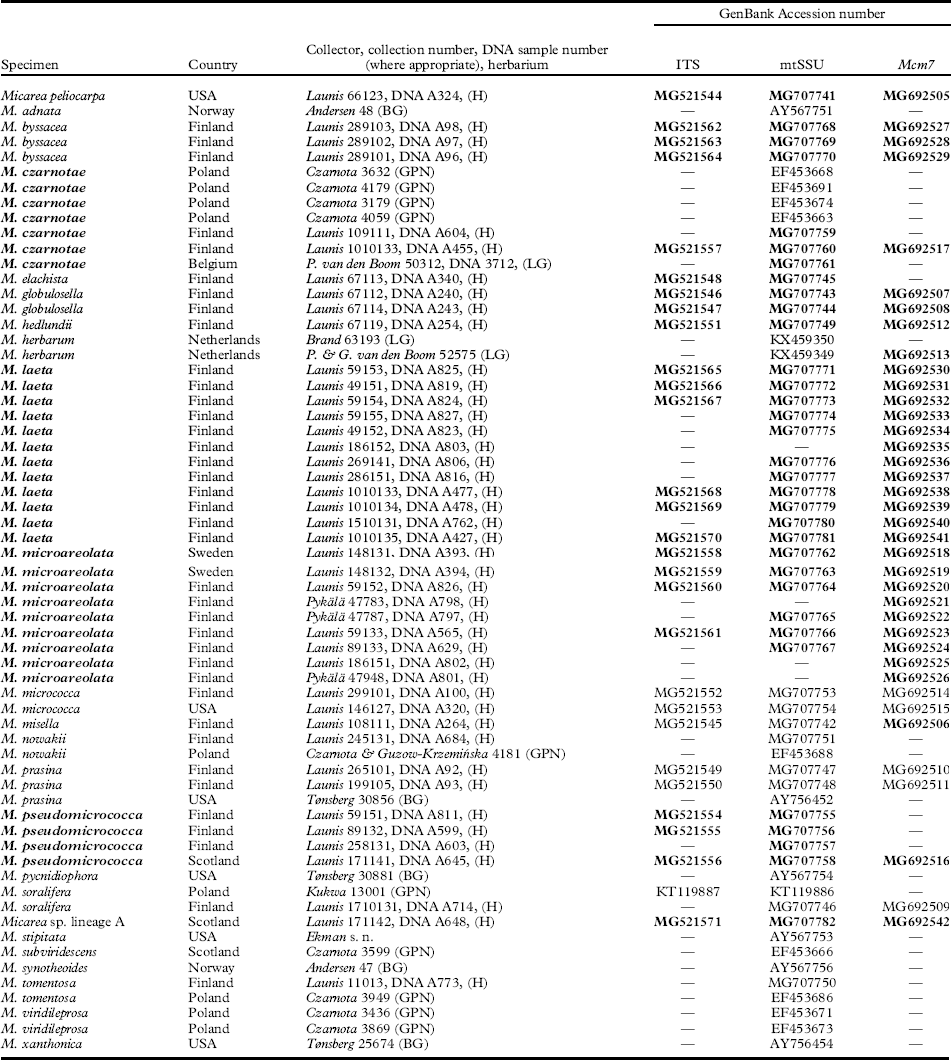
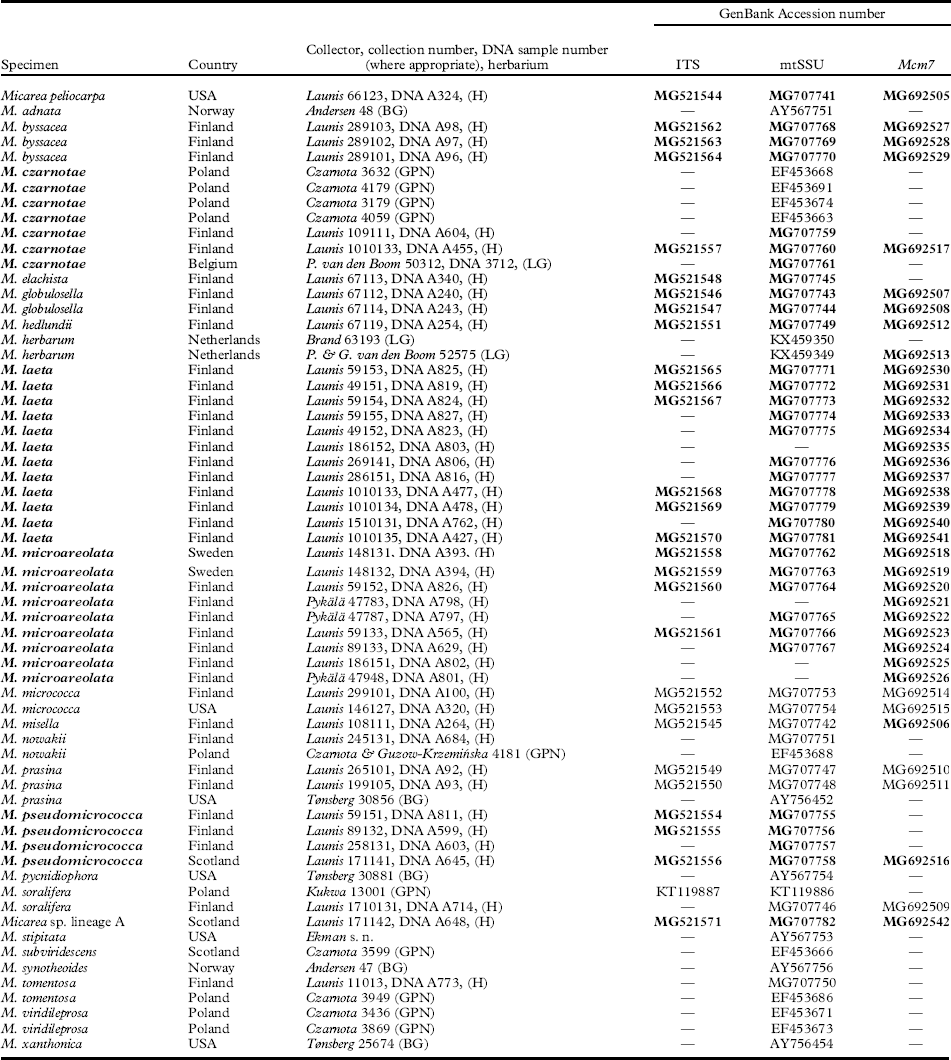
Twenty-five taxa corresponding to the Micarea prasina group (sensu Andersen Reference Andersen2004; Czarnota & Guzow-Krzemińska Reference Czarnota and Guzow-Krzemińska2010; Sérusiaux et al. Reference Sérusiaux, Brand, Motiejūnaitè, Orange and Coppins2010) were used in this study. It is based on material collected from Finland, the Netherlands, Poland, Sweden, Scotland and the USA during 2002–2015. Type material of related Micarea species from the herbaria G, H, and UPS was studied for comparison, and the type specimens placed under synonymy of M. micrococca by Czarnota (Reference Czarnota2007) were also examined. Detailed information of the material used in the phylogenetic analyses is presented in Table 1.
Specimens of Micarea used in the phylogenetic analyses. New species and new sequences generated for the current study are in bold
DNA extraction and sequencing
DNA was extracted from apothecia of specimens which were a maximum of three years old (n=1–3). For most specimens, DNA was extracted using DNeasy® Blood & Tissue kit by Qiagen following the protocol described in Myllys et al. (Reference Myllys, Velmala, Holien, Halonen, Wang and Goward2011). PCR reactions were prepared using PuReTaq Ready-To-Go PCR beads (GE Healthcare). The 25 µl reaction volume contained 19 µl of dH2O, 1µl of each primer (10µM) and 4µl of extracted DNA.
For the ITS region, PCR was run under the following conditions: initial denaturation for 5 min at 95 °C followed by five cycles of 30 s at 95 °C (denaturation), 30 s at 58 °C (annealing) and 1 min at 72 °C (extension); in the remaining 40 cycles the annealing temperature was decreased to 56 °C, the PCR program ended with a final extension for 7 min at 72 °C. The primers ITS1-LM (Myllys et al. Reference Myllys, Lohtander, Källersjö and Tehler1999) and ITS4 (White et al. Reference White, Bruns, Lee and Taylor1990) were used both for PCR amplification and for sequencing of the nuclear ribosomal ITS region.
For the mtSSU region, PCR was run under the following conditions: initial denaturation for 10 min at 95 °C followed by six cycles of 1 min at 95 °C (denaturation), 1 min at 62 °C (annealing) and 105 s at 72 °C (extension); in the remaining 35 cycles the annealing temperature was decreased to 56 °C and the extension time to 1min, the PCR program ended with a final extension for 10 min at 72 °C. The primers mrSSU1 and mrSSU3R (Zoller et al. Reference Zoller, Scheidegger and Sperisen1999) were used for both PCR amplification and sequencing.
For the Mcm7 region, PCR was run under two different conditions depending on the primers selected: initial denaturation for 10 min at 94 °C followed by 38 cycles of 45 s at 94 °C (denaturation), 50 s at 55/56 °C (annealing) and 1 min at 72 °C (extension); the PCR program ended with a final extension for 5 min at 72 °C. The primers x.Mcm7.f (Leavitt et al. Reference Leavitt, Johnson, Goward and St. Clair2011) and Mcm7.1348R (Schmitt et al. Reference Schmitt, Crespo, Divakar, Fankhauser, Herman-Sackett, Kalb, Nelsen, Nelson, Rivas-Plata and Shimp2009) or newly generated primers Mcm7_AL1r (5' CKGTCACARCSAAGCARTAYACACCTATG 3') and Mcm7_AL2f (5' CTTTYGTCACWCCSCCRATKAGRAGC 3') were used for both PCR amplification and sequencing. The annealing temperature was 56 °C for the first primer pair and 55 °C for the second newly generated primer pair. PCR products were cleaned and sequenced by Macrogen Inc., South Korea (www.macrogen.com).
Phylogenetic analyses
For the analysis 107 sequences were generated and 19 were obtained from GenBank. Micarea peliocarpa (Anzi) Coppins & R. Sant. was used as an outgroup for the M. prasina group.
A total of 29 ITS sequences, 59 mtSSU sequences and 38 Mcm7 sequences were aligned separately with MUSCLE v.3.8.31 (Edgar Reference Edgar2004) using EMBL-EBI’s freely available web service (http://www.ebi.ac.uk/Tools/msa/muscle/). The single-gene trees did not show any strongly supported conflicts according to the method of Kauff & Lutzoni (Reference Kauff and Lutzoni2002) (≥75% bootstrap values) and the three matrices were combined into a concatenated matrix in MacClade 4.08 (Maddison & Maddison Reference Maddison and Maddison2005). Portions of the alignment with ambiguous positions that might not have been homologous were excluded. The concatenated data set, including 63 terminals, was subjected to maximum parsimony analysis as implemented in TNT v.1.1 (Goloboff et al. Reference Goloboff, Farris and Nixon2008) and to maximum likelihood analysis using RAxML v.8.1.15 (Stamatakis Reference Stamatakis2014). The parsimony analysis was performed using the “Traditional Search” with random addition of sequences with 100 replicates and the tree bisection and reconnection (TBR) branch-swapping algorithm. Ten trees were saved for each replicate and gaps were treated as missing data. Node support was estimated using bootstrapping with 1000 replicates. Bootstrap values >75% are considered significant. For the maximum likelihood analysis, the combined data set was assigned to seven partitions: ITS1, 5.8S, ITS2, mtSSU and three codon positions of Mcm7. The hypervariable region near the end of the mtSSU was removed from the analyses (characters 649–804 in the alignment). We used an independent GTR+G model for each subset and branch lengths were assumed proportional across subsets. The tree with the highest likelihood from 36 individual runs was selected. Node support was estimated with 1000 bootstrap replicates using the rapid bootstrap algorithm.
Morphology and chemistry
Hand-cut apothecial sections and squashed thallus preparations were examined with a dissecting or compound microscope. Ascospore dimensions and other anatomical measurements were made on material mounted in water. Chemical spot tests were performed under a compound microscope using sodium hypochlorite (C) and 10% potassium hydroxide (K) (Orange et al. Reference Orange, James and White2010). Pigments were characterized following Coppins (Reference Coppins1983), Meyer & Printzen (Reference Meyer and Printzen2000) and Czarnota (Reference Czarnota2007). Specimens were further studied using thin-layer chromatography (solvent C) following Culberson & Kristinsson (Reference Culberson and Kristinsson1970) and Orange et al. (Reference Orange, James and White2010), and crystalline granules were examined using a compound microscope with polarized light. The crystalline granules were studied from sequenced specimens within the M. micrococca and M. byssacea complexes, and from specimens of M. prasina. Specimens are deposited in BG, GPN, H, LG and E.
Results
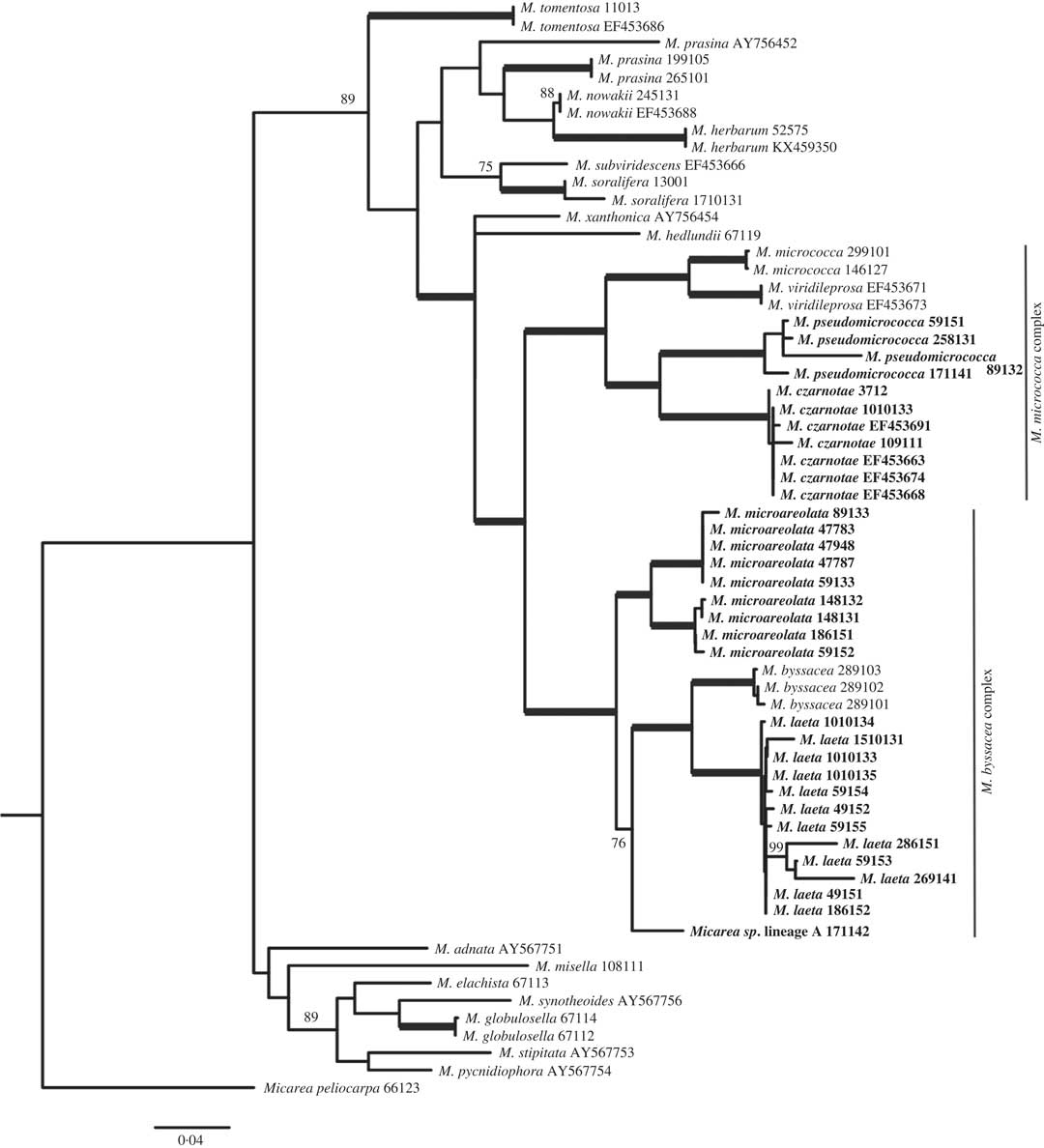
In this study a total of 107 new sequences were generated and 19 sequences were downloaded from GenBank. The final 3-loci data set consisted of 126 sequences and 1825 characters, of which 720 were parsimony-informative. Since the topologies of the maximum likelihood and TNT analyses did not show any strongly supported conflicts, only the tree obtained from the maximum likelihood analysis is shown (Fig. 1).
Phylogenetic relationships of Micarea czarnotae sp. nov., M. laeta sp. nov., M. microareolata sp. nov., M. pseudomicrococca sp. nov. and Micarea sp. lineage A (all shown in bold) as revealed by a maximum likelihood phylogram generated from RAxML analysis based on the combined ITS, mtSSU and Mcm7 data set. Bootstrap values ≥75% in both analyses (RAxML and TNT) are indicated by thickened branches. Branches which are supported solely by maximum likelihood analysis bootstrap values ≥75% are shown above nodes.
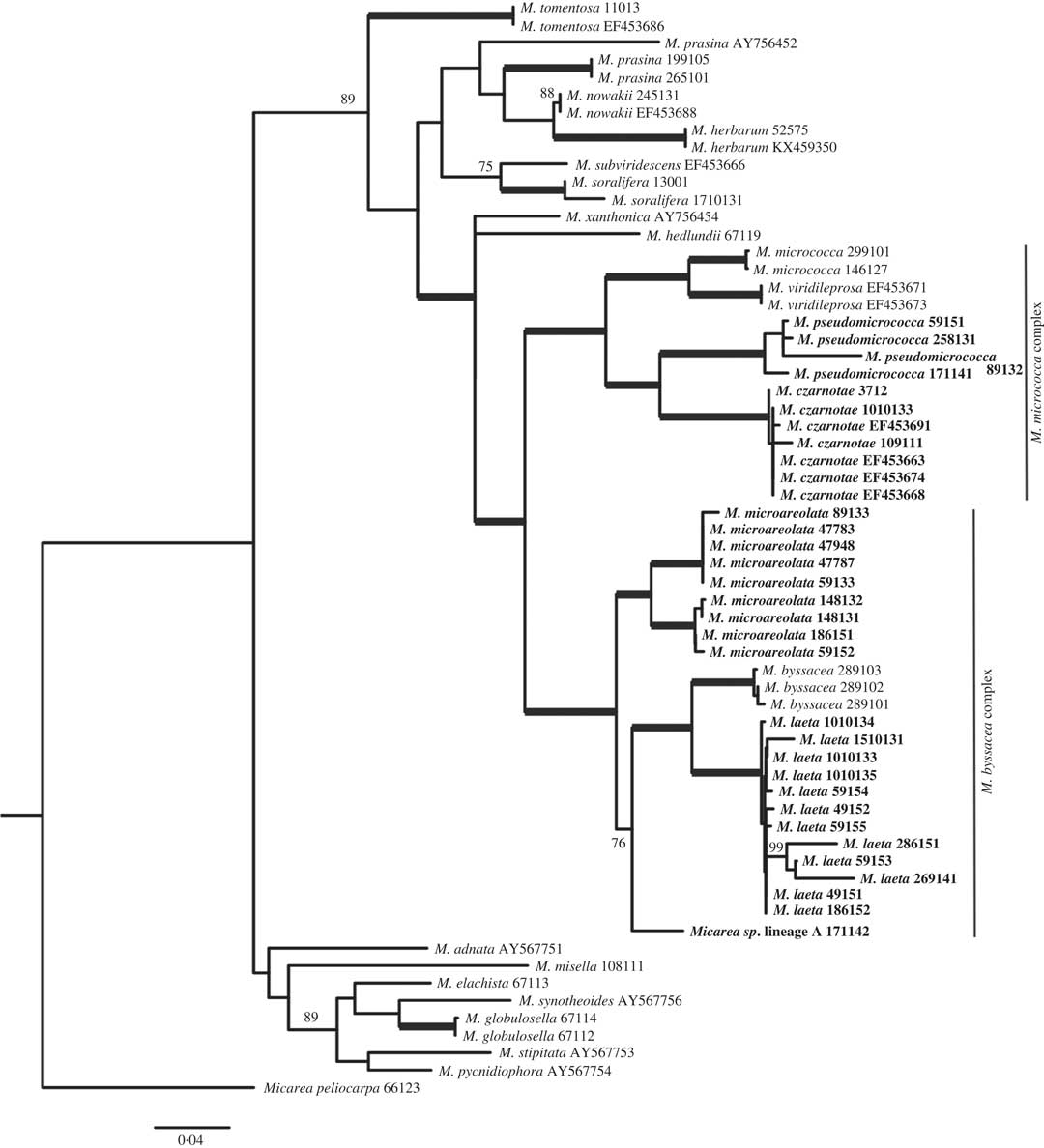
Our multiloci phylogeny agrees with the previous single-locus phylogenies for this group (Czarnota & Guzow-Krzemińska Reference Czarnota and Guzow-Krzemińska2010; Guzow-Krzemińska et al. Reference Guzow-Krzemińska, Czarnota, Łubek and Kukwa2016) and shows that the Micarea prasina group is strongly supported and monophyletic. Furthermore, M. byssacea and M. micrococca are sister groups and form strongly-supported monophyletic species complexes with five previously undescribed new lineages.
The M. byssacea complex is divided into four lineages: 1) M. microareolata, represented by nine specimens in our study; 2) a single unidentified individual (lineage A in Figs 1 & 4D) collected from Scotland; 3) M. byssacea s.s., with three specimens and 4) M. laeta, represented by 12 specimens. Micarea byssacea s.s. and M. laeta form a strongly supported sister group. Additionally, a cryptic lineage is quite likely present within M. microareolata.
The M. micrococca complex consists of four distinct well-supported groups. The two clades, M. viridileprosa and M. micrococca s.s. (Czarnota & Guzow-Krzemińska Reference Czarnota and Guzow-Krzemińska2010), form a strongly supported sister group. The remaining two clades represent new species: M. czarnotae with seven specimens (corresponding to M. micrococca “B” in Czarnota & Guzow-Krzemińska (Reference Czarnota and Guzow-Krzemińska2010)) and M. pseudomicrococca, represented by four specimens in our phylogeny.
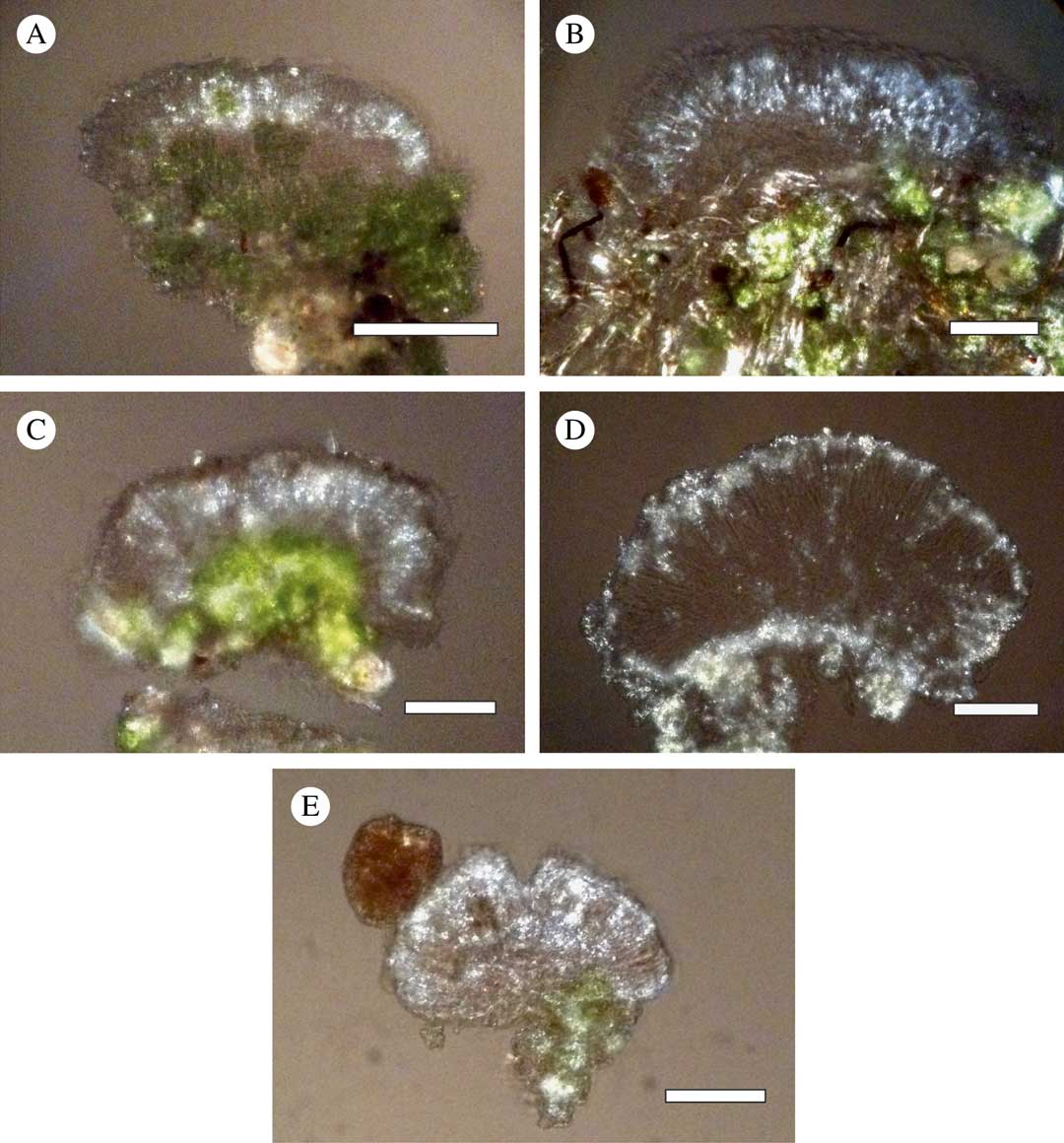
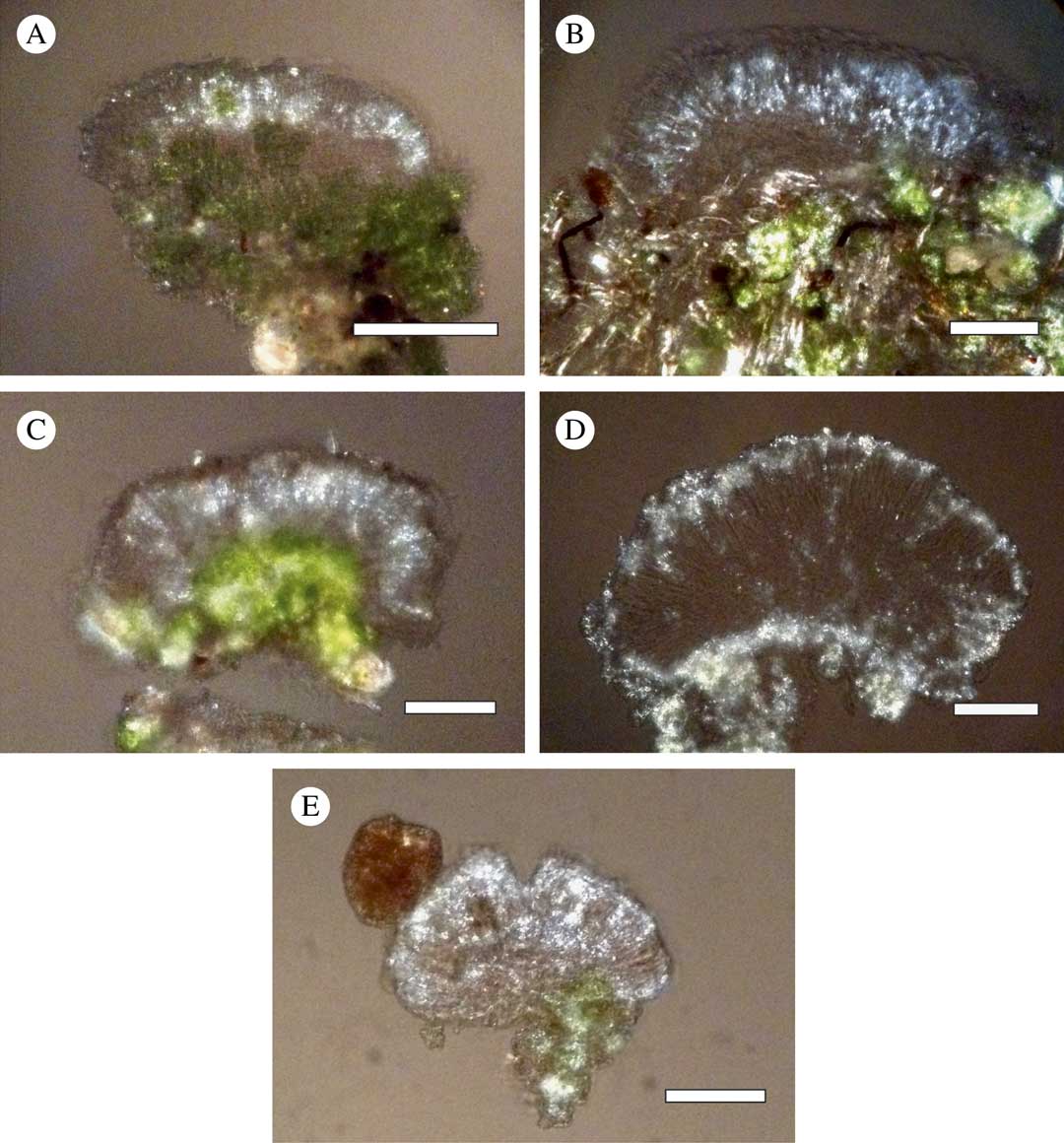
Small crystalline granules, soluble in K, were detected in polarized light in all species studied (Fig. 2). Such granules were present in both the hymenium and thallus of M. byssacea, M. laeta, M. microareolata, M. pseudomicrococca and M. micrococca. In contrast to other species, M. czarnotae formed granules only in the hymenium and never in the thallus. Crystalline granules were also investigated in M. prasina s.s. (Fig. 4C) because of its morphological resemblance to species in the M. byssacea and M. micrococca complexes. Micarea prasina formed crystals in the epihymenium and the thallus (Fig. 2D) but, unlike the other species, never in the hymenium (M. prasina sample AY756452, resolved as a different branch in the analyses, but was not studied). Without exception, identical crystalline features were present in all individuals within each of the species studied. It should be noted that crystalline granules were examined only in sequenced specimens, as this is the most reliable way of species identification. Consequently, the number of specimens studied was limited.
Crystalline granules in apothecial sections, detected in polarized light. A, Micarea czarnotae (holotype); B, M. laeta (holotype); C, M. microareolata (holotype); D, M. prasina (Launis 229106, H); E, M. pseudomicrococca (holotype). Scale bars=100 µm. In colour online.
Discussion
Our multiloci phylogeny corresponds well with the previous single-locus phylogenies of the M. prasina group (Czarnota & Guzow-Krzemińska Reference Czarnota and Guzow-Krzemińska2010; Guzow-Krzemińska et al. Reference Guzow-Krzemińska, Czarnota, Łubek and Kukwa2016; van den Boom et al. Reference van den Boom, Brand, Coppins and Sérusiaux2017). Generally, the clades were strongly supported despite the rather large quantity of missing data, especially in the ITS regions (see Table 1). Based on predominantly new collections, the present study revealed five previously undescribed, well-supported lineages. These lineages are also supported by morphological traits. Four of the lineages represent new species, for which the following names are proposed: Micarea pseudomicrococca Launis & Myllys, Micarea czarnotae Launis, van den Boom, Sérusiaux & Myllys, Micarea microareolata Launis, Pykälä & Myllys and Micarea laeta Launis & Myllys.
The fifth previously undescribed lineage is represented by only a single sample collected from decaying wood in eastern Scotland. This putative new taxon forms pallid, 0·2–0·7 mm diam. apothecia, resembling in size and shape those of M. byssacea, except that they always lack the Sedifolia-grey pigment (K− and C−). Furthermore, this new taxon forms a bright green thallus composed of goniocysts strongly resembling the thallus of M. micrococca. Owing to insufficient material, no taxonomic innovation is proposed at this time. However, this result indicates that there is insufficient knowledge of the diversity within the M. prasina group, and more precisely within the M. byssacea complex, even in well-studied areas of Europe.
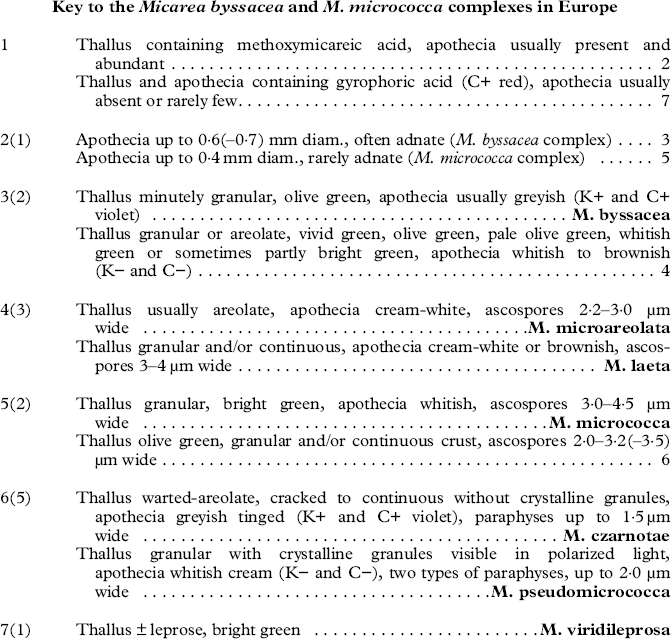
Two of the new species, M. czarnotae and M. pseudomicrococca, belong to the M. micrococca complex while M. microareolata is part of the M. byssacea complex. Our results show that species in the two groups differ mainly in the size and shape of the apothecia. Species in the M. micrococca complex, including the new species described in this study, have small apothecia that are plane, convex, hemispherical or sometimes tuberculate and 0·2–0·4 mm diam. Species in the M. byssacea complex are characterized by wider apothecia that are 0·3–0·6(–0·7) mm diam., adnate, convex to hemispherical or sometimes tuberculate. Results based on molecular data show that these subtle phenotypic differences are significant in defining species boundaries in the M. byssacea and M. micrococca complexes.
Micarea czarnotae produces the Sedifolia-grey pigment (K+ violet and C+ violet), whereas M. micrococca and M. pseudomicrococca do not. Furthermore, thallus morphology and colour differ between the species: M. micrococca has a bright green or olive green thallus composed of coalescing granules, whereas M. pseudomicrococca has an olive green, minutely granular thallus and M. czarnotae an olive green, densely granular, warted-areolate or, when well developed, an almost continuous and cracked thallus.
Micarea byssacea produces the Sedifolia-grey pigment (K+ violet and C+ violet), whereas M. laeta and M. microareolata do not. Furthermore, thallus colour and morphology differ between the species in the M. byssacea complex: M. byssacea is usually characterized by an olive green, minutely granular thallus, M. microareolata by a whitish or pale olive green thallus composed of small areolae, and M. laeta by a vivid green or olivaceous thallus composed of coalescing granules.
Finding appropriate morphological and chemical characters is one of the major challenges in species delimitation of lichen-forming fungi, especially in groups where characters are few or highly homoplastic (see Lumbsch & Leavitt Reference Lumbsch and Leavitt2011; Mark et al. Reference Mark, Saag, Leavitt, Will-Wolf, Nelsen, Tõrra, Saag, Randlane and Lumbsch2016). Crystalline granules have not previously been examined in the genus Micarea and thus their value in the identification of Micarea spp. was unknown. Our study shows that crystalline features are, at least in some cases, useful as a species-level character. The presence and distribution of such granules were found to be unique in M. prasina (granules only in the epihymenium, Fig. 2D) and in M. czarnotae (no crystalline granules in the thallus, Fig. 2A). Within the M. byssacea complex, crystalline features were not found to be useful because the size and distribution of these granules were shown to be identical amongst the species. Many of the crystalline deposits found in lichens are composed of calcium oxalate (Orange et al. Reference Orange, James and White2010) but the detailed composition of the crystalline granules detected in the M. prasina group is unknown. The presence, distribution and quantity of crystals were shown to be unaffected by light conditions, apothecial pigments and other anatomical or environmental features. The crystalline granules were studied in sequenced specimens as this was the most reliable way to delimit species in this phenotypically challenging group. However, this restriction limited the number of specimens used to investigate for the presence of crystalline granules. Therefore, to truly understand the reliability of the new feature as a species-level character within Micarea, a larger data set is needed. Several taxonomic problems in the M. prasina group still remain to be addressed. In light of this study, and those of Czarnota (Reference Czarnota2007), Czarnota & Guzow-Krzemińska (Reference Czarnota and Guzow-Krzemińska2010), Brand et al. (Reference Brand, van den Boom and Sérusiaux2014), Guzow-Kremínska et al. (Reference Guzow-Krzemińska, Czarnota, Łubek and Kukwa2016) and van den Boom et al. (Reference van den Boom, Brand, Coppins and Sérusiaux2017), some of the type specimens synonymized with M. prasina Fr. (e.g. M. melanobola (Nyl.) Coppins) should be investigated in more detail. Additionally, the infraspecific genetic variation between European and American specimens of M. prasina s.s. should be examined. These questions are currently under consideration and are expected to be addressed in the near future.
The Species
For descriptions of M. byssacea and M. micrococca, see Czarnota & Guzow-Krzemińska (Reference Czarnota and Guzow-Krzemińska2010). Even with the recognition of M. laeta, the description of M. byssacea is still valid but specimens of M. byssacea with completely pallid apothecia should be examined carefully. We studied all synonyms placed under M. byssacea and M. micrococca (Czarnota Reference Czarnota2007) with relevant conclusions presented below species descriptions.
The mtSSU sequences of M. byssacea and M. micrococca s.s. used in the phylogenetic analysis (Fig. 1) are identical to those used and identified by Czarnota & Guzow-Krzemińska (Reference Czarnota and Guzow-Krzemińska2010).
Micarea czarnotae Launis, van den Boom, Sérusiaux & Myllys sp. nov.
MycoBank No.: MB 824291
Thallus olive green to darkish olive green, goniocysts often coalescing to form dense ± continuous thallus, sometimes cracked, if less developed warted-areolate; apothecia numerous, crowded, up to 0·3 mm diam., cream-white or pale brownish, often greyish tinge (K± violet, C± violet); ascospores oblong-ellipsoid or obovoid, 0–1 septate, 7·0–10·0×2·25–3·5 µm; production of methoxymicareic acid. Resembles M. micrococca and M. pseudomicrococca but differs by having variously coloured apothecia and by producing the Sedifolia-grey pigment. In addition, M. czarnotae lacks crystalline granules in the thallus.
Type: Finland, Varsinais-Suomi, Nummi-Pusula, Myllypuro, mixed forest between Vahermanjärvi and Tarkeelanjärvi, near River Myllypuro, on bark of Pinus sylvestris, in N-facing shaded and moist microhabitat, YKJ N6719586, E3335308, 2011, Launis 109111 (H—holotype). GenBank Accession numbers: ITS, MG521557; MtSSU, MG707759, MG707760, MG707761; Mcm7, MG692517.
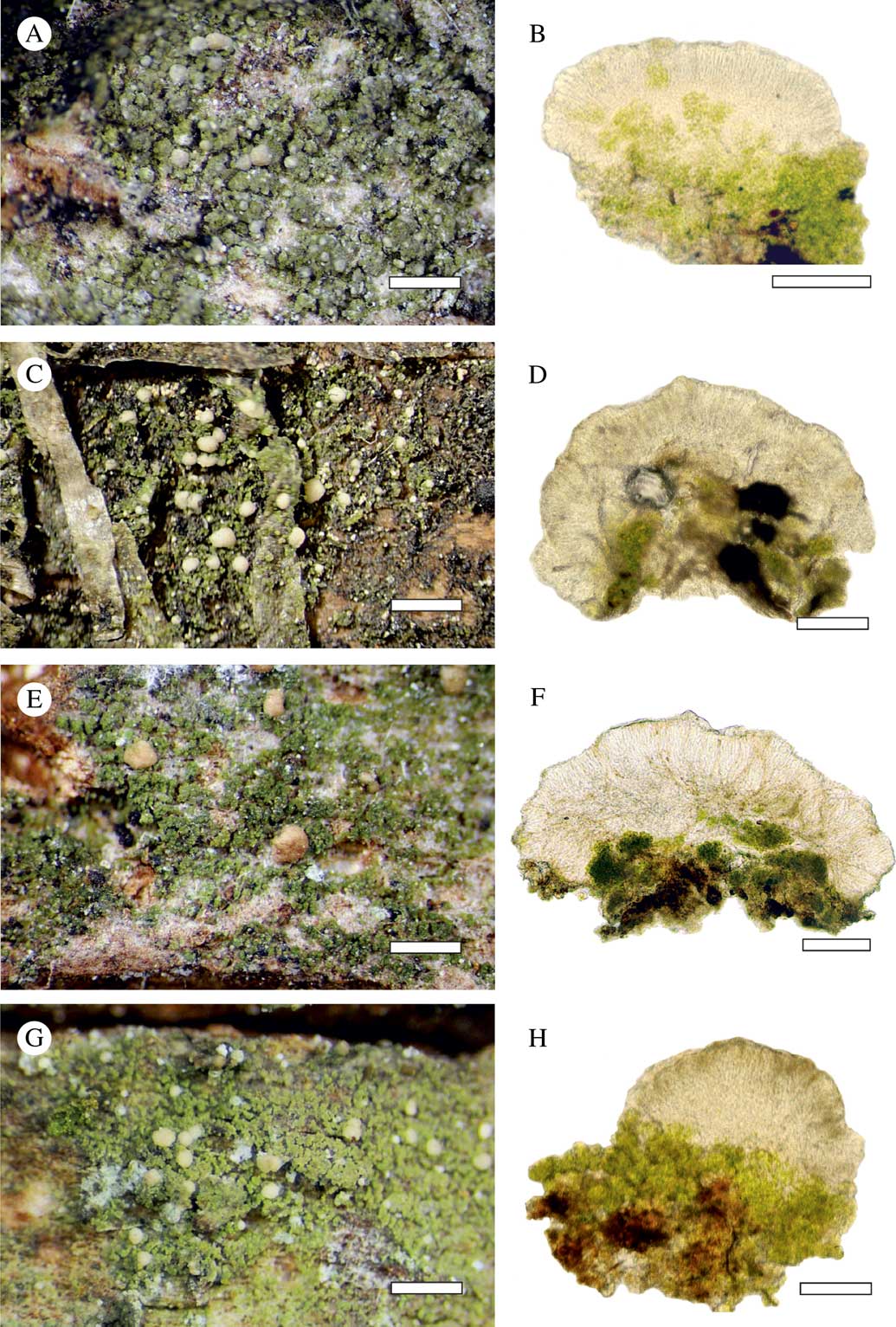
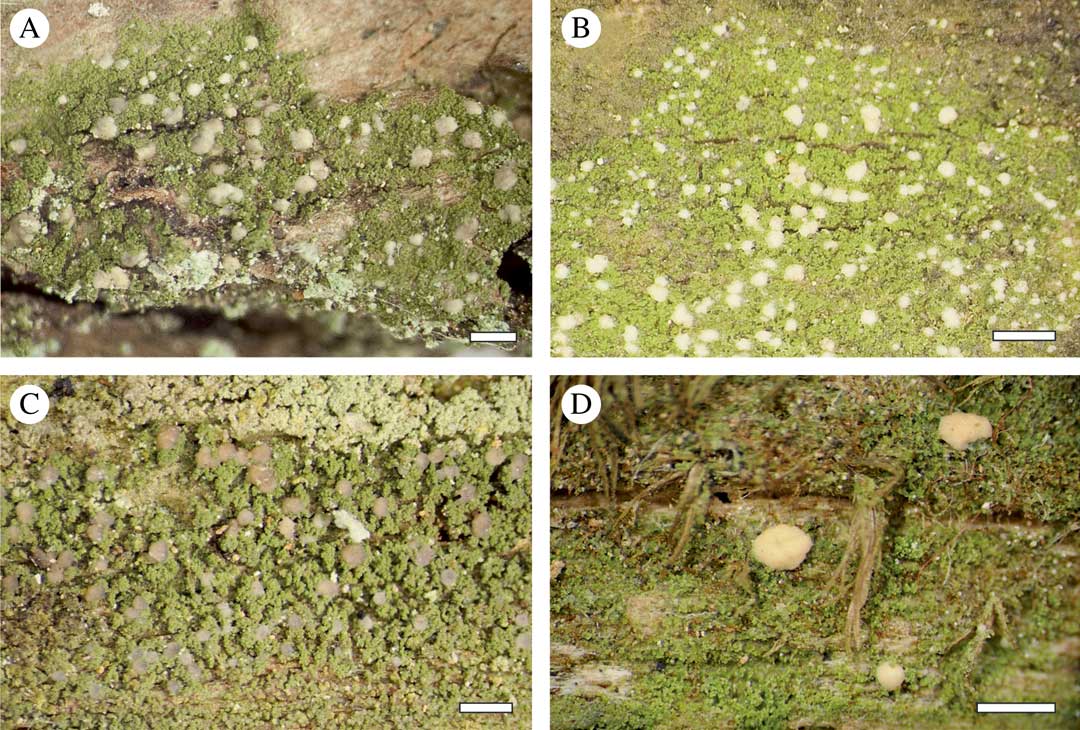
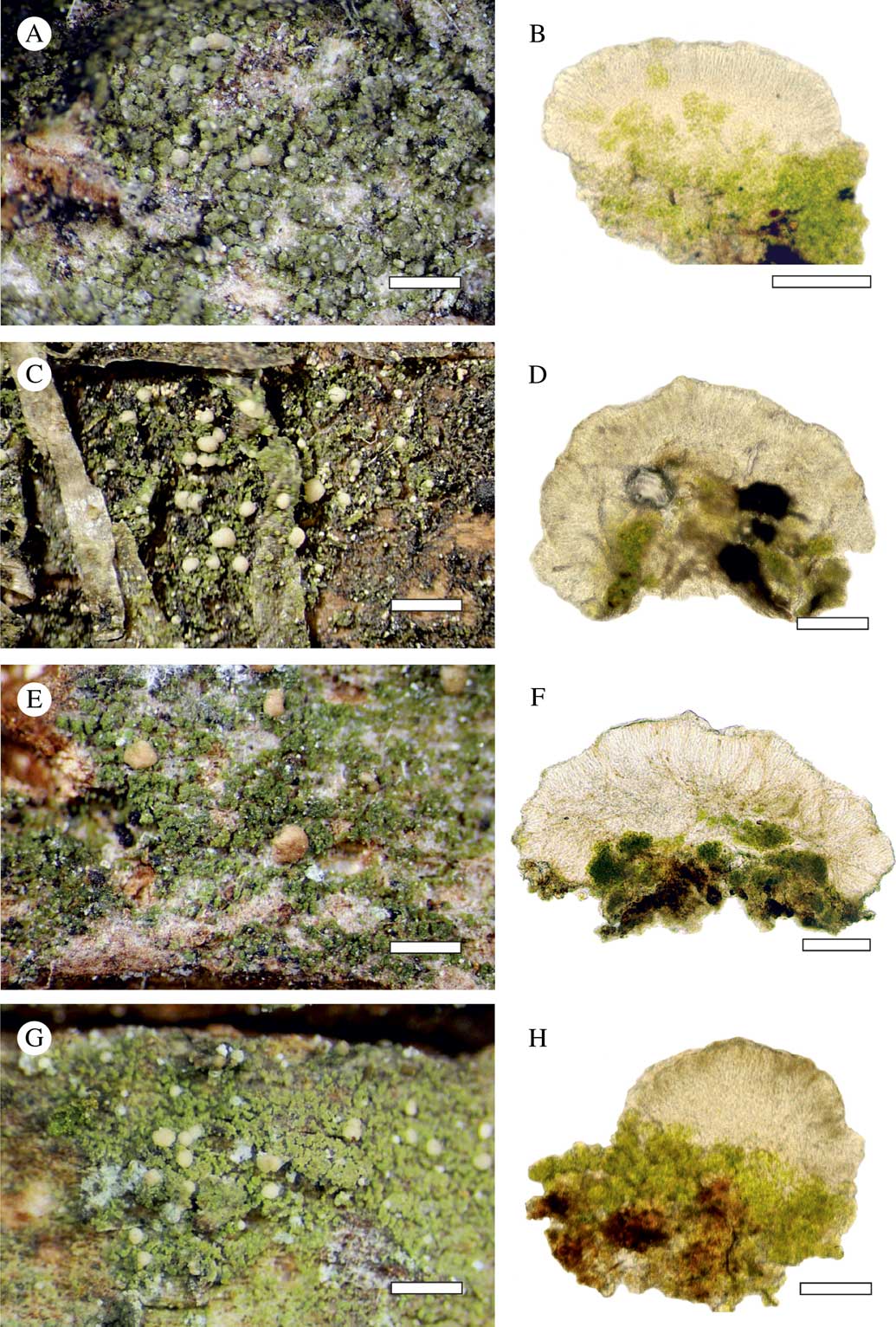
A & B, Micarea czarnotae (holotype); A, habitus; B, apothecial section. C & D, M. laeta (holotype); C, habitus; D, apothecial section. E & F, M. microareolata (Pykälä 47787, H); E, habitus; F, apothecial section. G & H, M. pseudomicrococca (holotype); G, habitus; H, apothecial section. Scale bars: A, C, E & G=1 mm; B, D, F & H=100 µm. In colour online.
Thallus effuse, olive green to darkish olive green, usually ± thick, granular, composed of goniocysts 20–35(–40) µm diam.; goniocysts usually coalescing to form a dense almost continuous thallus, sometimes cracked, if less developed warted-areolate. Photobiont micareoid, algal cells 4·5–7·5 µm diam.
Apothecia numerous, often crowded, small, 0·1–0·3 mm, usually plane or hemispherical, sometimes becoming tuberculate (and then up to 0·4 mm diam.), cream-white or brownish, often with a greyish tinge due to the Sedifolia-grey pigment (K± violet and C± violet). Hypothecium hyaline. Hymenium hyaline, c. 30–45µm high. Epihymenium hyaline or pale grey, K± violet and C± violet. Paraphyses numerous, branched, 1·0–1·5 µm wide, apices not wider. Asci clavate, Micarea-type, 35–40×8–10 µm. Ascospores oblong-ellipsoid or obovoid, 0–1 septate, 7·0–10·0 × 2·25–3·5 µm.
Pycnidia of two types, whitish, usually K− and C−, sometimes K± violet and C± violet (Sedifolia-grey pigment). Mesopycnidia often numerous and sessile, sometimes immersed in surrounding goniocysts, c. 70–100µm wide, globose or doliform, sometimes with gaping ostiole extruding white conidial mass. Mesoconidia cylindrical or cylindrical-fusiform, 4·0–5·0(–5·5)×1·0–1·5µm. Micropycnidia immersed in surrounding goniocysts or sessile, 80–130 µm wide, globose, if sessile often with gaping ostiole. Microconidia filiform to narrowly fusiform, 5·5–7·0 × 0·8–1·0(–1·2) µm.
Crystals (studied in polarized light). Visible in hymenium, none detected in the thallus. Soluble in K (Fig. 2A).
Chemistry. Methoxymicareic acid.
Etymology. The species is named after our colleague Dr Pawel Czarnota for his significant contribution to the study of the genus Micarea, and for collecting the first known specimens of M. czarnotae.
Habitat and distribution. Known from bark of Pinus sylvestris, wood and bark of Picea abies, bark of Quercus sp. and twigs of Alnus glutinosa. Several specimens were collected from humid environments near a bog or river, or from standing tree trunks on the northern side or from near the ground. Micarea czarnotae is so far known from Southern Finland, Poland and the Netherlands.
Notes. Micarea czarnotae was first introduced by Czarnota & Guzow-Krzemińska (Reference Czarnota and Guzow-Krzemińska2010) as “M. micrococca B”, a transitional morphotype between M. micrococca and M. byssacea. Because of the lack of clear morphological, distributional, ecological and, above all, molecular multiloci data, no taxonomic innovations were proposed at that time. Our study, however, shows that M. czarnotae is both molecularly and morphologically a distinct species-level taxon.
Micarea czarnotae forms small, convex to hemispherical apothecia resembling those of M. micrococca and M. pseudomicrococca. However, its apothecia are often variously coloured and K± violet, C± violet when the Sedifolia-grey pigment is present. It also differs from M. micrococca and M. pseudomicrococca in characters detectable in polarized light: M. czarnotae does not produce crystalline granules in its thallus whereas M. micrococca and M. pseudomicrococca always do.
Micarea byssacea differs in larger, often adnate apothecia and a minutely granular thallus that is never densely continuous or cracked (Fig. 4A). In addition, M. byssacea produces crystalline granules in the thallus and a hymenium detectable in polarized light.
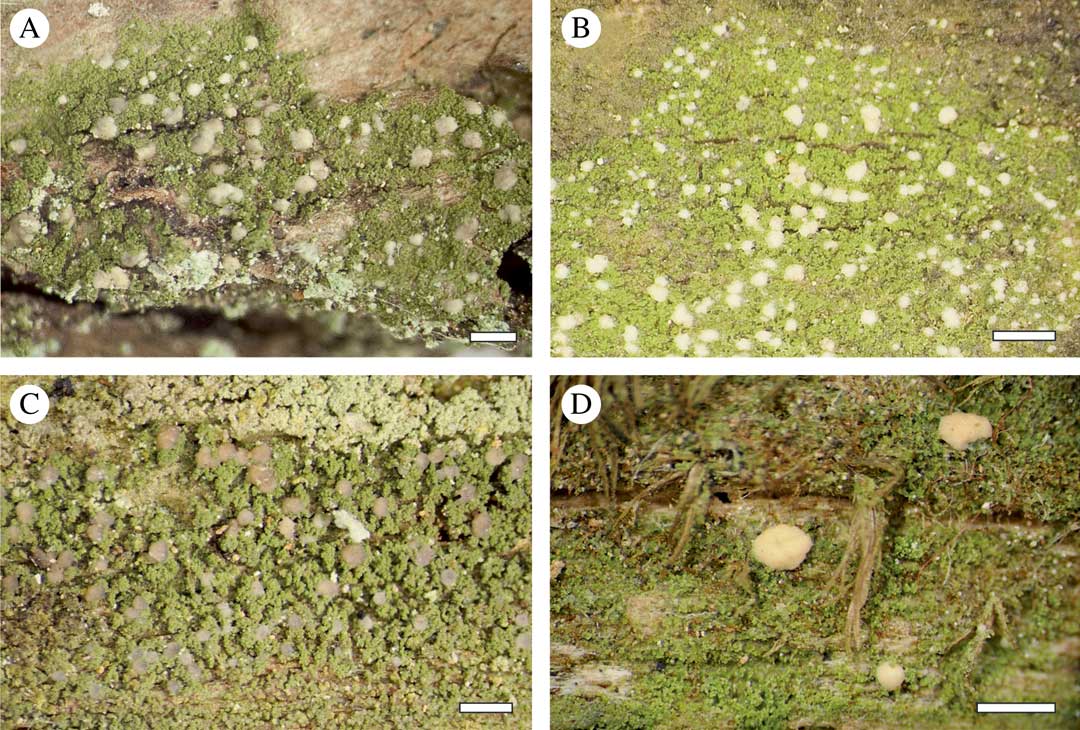
A, Micarea byssacea (Launis 66128, H) habitus; B, M. micrococca s.s. (Launis 1010131, H) habitus; C, M. prasina (Launis 229106, H) habitus; D, Micarea sp. lineage A (Launis 171142, H, see Fig. 1) habitus. Scale bars=1 mm. In colour online.
Additional specimens examined. Finland: Uusimaa: Tuusula, near Korso, Picea abies-dominated managed forest, shaded and dense, on wood of fallen, decaying (late-stage) Picea abies, ETRS-TM35FIN N 6692506, E 391428, 2013, Launis 1010133 (H).—The Netherlands: Noord-Brabant: W of Son, S of Bestseweg, 51°30'39''N, 5°27'41''E, 30 m alt., small Pinus forest, on fallen rotting trunk, 2014, P. & B. van den Boom 50312 (LG, hb v.d. Boom).—Poland: Kotlina Sandomierska: Płaskowyż Kolbuszowski, c. 2 km SE of Wilcza Wola Village, 50°19'69''N, 21°58'23''E, c. 120 m. alt., on bark of Pinus sylvestris within wet pine forest, 2003, Czarnota 3632 (GPN). Wzniesienia Łódzkie: Wzniesienia Łódzkie Landscape Park, Tadzin forest district, forest section no. 110, c. 1 km W of Tadzin Village, 51°49'39''N, 19°44'33''E, c. 190 m alt., on bark of Quercus sp. within mixed pine-oak forest, 2004, Czarnota 4179 (GPN). Pojezierze Chełmińsko-Dobrzyńskie, Garb Lubawski: Park Krajobrazowy Wzgórz Dylewskich, oddz. 97c., on twigs of Alnus glutinosa within alder bog forest (no coordinates available), 2002, Czarnota 3179 (GPN) & Kukwa. Beskid Niski Mts: SW slope of Piotruś Mt., above Stasianie settlement in valley of Jasiolka River, 49°28'02''N, 21°44'20''E, c. 500 m alt., on bark at the base of Picea abies trunk within Carpathian beech forest, 2004, Czarnota 4059 (GPN).
Micarea laeta Launis & Myllys sp. nov.
MycoBank No.: MB 824294
Thallus effuse, vivid green to olive green, composed of goniocysts, granular or almost continuous crust, if less developed small warted or warted-areolate; apothecia numerous, usually cream-white, sometimes brownish, up to 0·5(–0·6)mm, adnate, convex to hemispherical, rarely subglobose, simple or tuberculate; ascospores oblong-ellipsoid or obovoid, 0–1-septate, (8·0–)8·5–12·0×3·0–4·0µm; production of methoxymicareic acid. Resembles M. byssacea and M. microareolata but differs from M. byssacea by lacking the Sedifolia-grey pigment and often forming a more aggregated or continuous thallus. Micarea microareolata, in contrast, has narrower ascospores and usually an areolate thallus.
Type: Finland, Etelä-Häme, Jyväskylä, Korpilahti, Picea abies-dominated mixed managed forest, on bark of standing decaying Betula sp., on shaded N-side of the tree, YKJ E3418597, N6885262, 5 September 2015, Launis 59153a (H—holotype), 59153b (E—isotype). GenBank Accession numbers: ITS: MG521565, MG521566, MG521567, MG521568, MG521569, MG521570. MtSSU: MG707771, MG707772, MG707773, MG707774, MG707775, MG707776, MG707777, MG707778, MG707779, MG707780, MG707781. Mcm7: MG692530, MG692531, MG692532, MG692533, MG692534, MG692535, MG692536, MG692537, MG692538, MG692539, MG692540, MG692541.
Thallus effuse, vivid green to olive green, usually rather thin, composed of goniocysts 17–40 µm diam.; goniocysts usually coalescing to form larger granules or an almost continuous crust, if less developed small warted or warted-areolate. Photobiont micareoid, algal cells 4·5–7·5 µm diam.
Apothecia numerous, whitish or usually creamy-white, sometimes brownish, 0·3–0·5(–0·6) mm, adnate, convex to hemispherical, rarely subglobose, simple or becoming tuberculate (and then up to 0·6 mm diam.), always K− and C−. Hypothecium hyaline. Hymenium hyaline c. 35–50 µm high. Epihymenium hyaline. Paraphyses numerous, branched, 1·0–1·5(–1·8) µm wide, apices barely wider. Asci clavate, Micarea-type, 35–40×8–10 µm. Ascospores oblong-ellipsoid or obovoid, 0–1-septate, (8·0–)8·5–12·0×3·0–4·0 µm.
Pycnidia of two types, whitish, K− and C−. Mesopycnidia usually numerous, globose or doliform, 40–90 µm wide, usually immersed in surrounding goniocysts, sometimes sessile with gaping ostiole and extruding white conidial mass. Mesoconidia cylindrical or cylindrical-fusiform, 4·0–5·5 × 1·2–1·5 µm. Micropycnidia immersed in surrounding goniocysts, inconspicuous, globose, up to 60 µm wide. Microconidia filiform to narrowly fusiform, straight or slightly curved, 5·0–7·5(–8·0) × 0·8–1·0 µm.
Crystals (studied in polarized light). Visible in hymenium and in thallus. Soluble in K (Fig. 2B).
Chemistry. Methoxymicareic acid.
Etymology. The name is derived from Malme’s exsiccate specimen Micarea prasina Fr. f. laeta Th. Fr. The original etymology chosen by Th. Fries refers to the pale apothecia.
Habitat and distribution. Known from bark of Betula sp. and bark and wood of Picea abies. So far known from several localities in Southern and Central Finland and Sweden. Specimens were collected from managed and old-growth forests.
Notes. Specimens designated as the newly described species M. laeta have been collected many times since 1890 and determined as a form level of M. prasina (i.e. M. prasina f. laeta (Th. Fr.) Hedl (=Catillaria prasina f. laeta Th. Fr.) (Hedlund Reference Hedlund1892)) or treated as a synonym of M. prasina Fr. (Coppins Reference Coppins1983) and of M. byssacea (Czarnota & Guzow-Krzemińska Reference Czarnota and Guzow-Krzemińska2010). In light of this, specimens resembling M. byssacea with completely pallid apothecia should be investigated carefully.
As M. laeta was first known as a form of M. prasina, we considered describing a new combination instead of a new species. However, this was not possible because the original name has been shown to be invalid (see Coppins Reference Coppins1983) since the type specimen of M. prasina f. laeta is the same as that of M. prasina. The taxon is found, for example, in Malme’s exsiccate specimens and based on phenotypic characters this specimen is identical to the fresh specimens found in our study. Therefore, we propose the name M. laeta for the new species.
To the best of our knowledge, the name ‘laeta’ has previously been used invalidly only in the level of form of M. prasina, and never at species level. Our molecular results clearly show that the taxon we have found and linked to Malme’s exsiccate specimens is a species-level unit. As the word ‘laeta’ refers to pale, it is considered very suitable for the new species with pale apothecia.
Micarea laeta is characterized by a granular thallus, pale apothecia and wide spores. The main morphological features separating it from M. byssacea and M. microareolata include the structure of the thallus, pigmentation in the apothecia and spore width. Micarea byssacea usually produces the Sedifolia-grey pigment in the apothecia, except when growing in deep shade. In addition, it forms a minutely granular thallus that rarely coalesces to form larger granules, or a continuous crust. Micarea microareolata, in contrast, has narrower spores and an areolate thallus.
Exsiccati. Malme, Lichenes Suecici Exsiccati, No 23 (H) [as Micarea prasina Fr. f. laeta Th. Fr; Sweden, Södermanland, 1890, O. Malme]. Magnusson, Lichenes Selecti Scandinavici Exsiccati, No 134 (H) [as Catillaria prasina (Fr.) Th. Fr. f. laeta Th. Fr; Sweden, Västergötland, 1927, A. H. Magnusson].
Additional specimens examined. Finland: Etelä-Häme: Hämeenlinna, Evo, managed mixed forest, on bark of fallen, decaying Picea abies, ETRS-TM35FIN N6787475.7690, E399873.8954, 2013, Launis 1510131 (H). Etelä-Häme: Jyväskylä, Korpilahti, Picea abies-dominated mixed managed forest, on bark of standing decaying Betula sp., on shaded N-side of the tree, YKJ E3418597, N6885262, 2015, Launis 59153 (H); Jyväskylä, Kuusimäki, mixed managed forest, on bark of standing decaying (early stage) Picea abies, YKJ E3425022, N6902706, 2015, Launis 49151 (H); ibid., Picea abies-dominated mixed managed forest, on bark of standing decaying Picea abies, YKJ N6867631, E3459820, 2015, Launis 59154, 59155 (H); ibid., mixed managed forest, on bark of standing decaying Betula sp., in shade near ground, YKJ E3425062, N6902944, 2015, Launis 49152 (H); Joutsa, Höystösensuo, Pinus sylvestris-dominated mixed managed forest, on bark of standing decaying Picea abies, YKJ E3458859, N6968267, 2015, Launis 186152 (H); Joutsa, Leivonmäki, mixed managed forest, on bark of standing decaying Betula sp., in shade, YKJ E3443740, N6868132, 2014, Launis 269141 (H); Äänekoski, mixed managed forest, on bark of standing decaying Picea abies, N-side of the tree in shade, YKJ E3427400, N6959860, 2015, Launis 286151 (H). Uusimaa: Tuusula, near Korso, Picea abies-dominated managed forest, shaded and dense, on wood of fallen, decaying (mid-stage) Picea abies, ETRS-TM35FIN N6692506, E391428, 2013, Launis 1010133, 1010134, 1010135 (H).
Micarea microareolata Launis, Pykälä & Myllys sp. nov.
MycoBank No.: MB 824292
Thallus pale olive green, whitish green or bright green, goniocysts usually coalescing to form convex to subglobose small areolae; apothecia numerous, whitish or cream-white, up to 0·6(–0·7)mm diam., adnate, convex to hemispherical, K− and C−; ascospores oblong-ellipsoid or obovoid, 0–1 septate, 7·5–12·0×(2·00–)2·2–3·00µm; production of methoxymicareic acid. Resembles M. byssacea and M. laeta but differs from M. byssacea by lacking the Sedifolia-grey pigment, forming a more aggregated thallus and by the narrower ascospores. Micarea laeta also has pale apothecia but its ascospores are wider than those of M. microareolata.
Type: Finland, Etelä-Savo, Jyväskylä, Korpilahti, Picea abies-dominated mixed managed forest, on bark of standing decaying Picea abies, YKJ E3418403, N6885234, 2015, Launis 59152 (H—holotype). GenBank Accession numbers: ITS: MG521558, MG521559, MG521560, MG521561. MtSSU: MG707762, MG707763, MG707764, MG707765, MG707766, MG707767. Mcm7: MG692518, MG692519, MG692520, MG692521, MG692522, MG692523, MG692524, MG692525, MG692526.
Thallus effuse, pale olive green, whitish green or sometimes partly bright green, usually rather thin, composed of goniocysts 18–40 µm diam.; goniocysts usually coalescing to form convex to subglobose small areolae (in cross-section goniocysts distinctly visible), areolae effuse or concentrated, sometimes thallus granular or, if less developed, small warted. Photobiont micareoid, algal cells 4·5–7·5 µm diam.
Apothecia usually numerous, whitish cream, 0·3–0·6(–0·7)mm diam., adnate, convex to hemispherical, sometimes becoming tuberculate, always K− and C−. Hypothecium hyaline. Hymenium hyaline, c. 30–45µm high. Epihymenium hyaline. Paraphyses numerous, richly branched, 1·0–1·8(–2·0)µm wide, apices not wider or only slightly. Asci clavate, Micarea-type, 25–35×9–10µm. Ascospores oblong-ellipsoid or obovoid, 0–1-septate, 7·5–12·0×(2·0–)2·2–3·0µm.
Pycnidia of two types, small and inconspicuous, whitish, K− and C−. Mesopycnidia usually present, immersed in surrounding goniocysts, up to 70µm wide, sometimes sessile with gaping ostiole extruding white conidial mass. Mesoconidia cylindrical or cylindrical-fusiform, 4·0–5·5(–6·0)×1·0–1·2(–1·5)µm. Micropycnidia immersed in surrounding goniocysts, globose, up to 60µm wide. Microconidia filiform to narrowly fusiform, straight or slightly curved, 5·0–7·5×0·8–1·0µm.
Crystals (studied in polarized light). Visible in hymenium and in thallus. Soluble in K (Fig. 2C).
Chemistry. Methoxymicareic acid.
Etymology. The name M. microareolata refers to the areolate morphology of the thallus.
Habitat and distribution. Micarea microareolata is known from bark of Alnus glutinosa, Betula sp., Picea abies, Salix pentandra and Quercus robur from Southern and Central Finland and southern Sweden. This species seems to have rather broad habitat requirements. Specimens have been collected from well-lit to shaded and from mesic to wet, managed and old-growth forests.
Notes. Micarea microareolata is characterized by a ± pale green areolate thallus, composed of goniocysts, and cream-white apothecia that lack the Sedifolia-grey pigment. In many respects it resembles M. byssacea and M. laeta, with which it forms a closely related species group. These three species are characterized by similar ecological preferences, and shape and size of the apothecia. In addition, all three species produce methoxymicareic acid and crystalline granules in the apothecia and thallus.
The main morphological features separating M. microareolata from M. byssacea and M. laeta involve the structure of the thallus, pigmentation in the apothecia and spore size. Micarea byssacea usually produces the Sedifolia-grey pigment in apothecia, except when growing in deep shade. In addition, it forms a minutely granular thallus that is never areolate and has wider ascospores. Micarea laeta, instead develops pale apothecia that are similar to M. microareolata. However, M. microareolata has narrower spores and an areolate thallus.
In the phylogenetic analysis, M. microareolata forms two subgroups differing by a small number of base pairs. The two subgroups show no morphological, chemical or ecological differences. In addition, a large quantity of data is missing, especially in the ITS regions of one subgroup. Therefore, at least for now, we treat these groups as one species instead of, for example, two closely related cryptic species.
Additional specimens examined. Finland: Varsinais-Suomi: Lohja, Ojamo, Ojamo lime quarry 200 m west, Alnus glutinosa/Salix-dominated swamp on shore of Lake Lohjanjärvi, on Salix pentandra, 33 m a.s.l., YKJ N6684589, E3335560 ±8m, 2014, Pykälä 47783 (H); ibid., on Alnus glutinosa, 32 m a.s.l., YKJ N6684555, E3335588 ±8m, 2014, Pykälä 47787 (H). Pohjois-Karjala: Lieksa, Koli National Park, E slope of Koli, old natural forest, on bark of fallen, decaying (late-stage) Picea abies, ETRS-TM35FIN N 7000213.0560, E 641998.5098, 2013, Launis 59133 (H); ibid., on bark of decaying (late-stage) Betula sp., ETRS-TM35FIN N7000159.5977, E642051.3884, 2013, Launis 89133 (H). Etelä-Savo: Joutsa, Höystösensuo, Pinus sylvestris-dominated mixed managed forest, on bark of standing decaying Picea abies, ETRS-TM35FIN E3459820, N6867631, 2015, Launis 186151 (H). Varsinais-Suomi: Lohja, Pappila, Tytyri lime quarry 150 m E, shore forest of Lake Lohjanjärvi, Alnus-dominated, on dead Alnus glutinosa, 32 m a.s.l., YKJ N6687374 E3338195 ± 8 m, 2015, Pykälä 47948 (H).—Sweden: Östergötland: Vadstena Region, Omberg, near top of Hjässan, well-lit forest, on bark of Quercus robur, 58°18'24·1''N, 14°38'55·2''E, 262·8 m a.s.l., 2013, Launis 148131, 148132 (H).
Micarea pseudomicrococca Launis & Myllys sp. nov.
MycoBank No.: MB 824290
Thallus olive green, sometimes partly bright green, minutely granular, composed of goniocysts; apothecia abundant or few, 0·2–0·4 mm diam., plane, convex or ± hemispherical, sometimes becoming tuberculate, creamy-white or often pale brownish, always K− and C−; ascospores oblong-ellipsoid or obovoid, 0–1(–2)-septate, 8–14(–15) × 2·0–3·2 µm; methoxymicareic acid present. Resembles M. micrococca and M. czarnotae. Differs from M. micrococca by having an olive green instead of bright green thallus and thinner ascospores. Differs from M. czarnotae by forming less numerous and crowded apothecia, lacking the Sedifolia-grey pigment and forming a more granular thallus. In addition, M. pseudomicrococca has two types of paraphyses (up to 2 µm wide).
Type: Finland, Etelä-Häme, Jämsä, Hallinmäki Nature Reserve, Betula sp./Picea abies-dominated old-growth forest, on bark of decaying Betula stump, YKJ E3401759, N6894425, 2015, Launis 59151 (H—holotype). GenBank Accession numbers: ITS: MG521554, MG521555, MG521556. MtSSU: MG707755, MG707756, MG707757, MG707758. Mcm7: MG692516.
Thallus effuse, olive green, sometimes partly bright green, minutely granular, composed of goniocysts, 25–40(–55) µm diam., usually coalescing to form larger granules. Photobiont micareoid, algal cells 4·5–7·5 µm diam.
Apothecia abundant or few, 0·2–0·4 mm diam., plane, convex or ± hemispherical, sometimes becoming tuberculate, creamy-white or often pale brownish, always K− and C−. Hypothecium hyaline. Hymenium hyaline, sometimes with vertical brownish streaks, c. 35–50 µm high. Epihymenium hyaline or brownish. Paraphyses numerous, of two types: 1) scanty, scarcely branched, 0·8–1·0(–1·2) µm wide, apices usually not wider; 2) thicker, 1·2–2·0 µm wide with apices usually increasing up to 3 µm, simple or branched, sometimes branched 1–3 times from the apices resulting in a fork- or brush-like appearance. Asci clavate, Micarea-type, 8–10×30–35µm. Ascospores oblong-ellipsoid or obovoid, 0–1(–2)-septate, 8–14(–15) × 2·0–3·2 µm.
Pycnidia of two types, cream-white or often brownish, always K− and C−. Mesopycnidia usually present and immersed in surrounding goniocysts, globose, up to 100 µm diam. Mesoconidia cylindrical or cylindrical-fusiform, 4·0–5·0 × 1·2–1·5 µm. Micropycnidia usually present, sometimes few or absent, sessile or immersed, if sessile usually with gaping ostiole, 80–100 µm diam. Microconidia filiform to narrowly fusiform, 5·5–9·0(–9·5) × 0·8–1·0(–1·2) µm.
Crystals (studied in polarized light). Visible in hymenium and in thallus. Soluble in K (Fig. 2E).
Chemistry. Methoxymicareic acid.
Etymology. The new species morphologically resembles a close relative, M. micrococca. The two species differ, however, in several anatomical features as well as phylogenetically.
Habitat and distribution. Collected on bark of Betula sp., Prunus padus and Alnus incana, and on decaying wood of fallen Picea abies. Known currently from Southern and Central Finland and from eastern Scotland.
Notes. Micarea pseudomicrococca is characterized by an olive green granular thallus and small creamy-white or pale brownish apothecia that lack the Sedifolia-grey pigment. In many respects it resembles the closely related species M. micrococca and M. czarnotae. These species are characterized by similar ecological preferences and the shape and size of the apothecia. In addition, all three species produce methoxymicareic acid.
The main morphological characters separating M. pseudomicrococca from M. micrococca and M. czarnotae involve the two types of paraphyses, structure and/or colour of thallus, pigmentation of apothecia and crystalline granules detectable in polarized light. Micarea micrococca forms a granular thallus, very similar in structure to M. pseudomicrococca, but the thallus of the latter is olive green instead of bright green. In addition, M. micrococca never develops brownish or greyish apothecia (Fig. 4B), its paraphyses are thinner and of one type instead of two, and it has wider ascospores. Micarea czarnotae, in contrast, forms numerous and often crowded apothecia and a less granular thallus compared to M. pseudomicrococca. It also produces the Sedifolia-grey pigment in the apothecia and no crystalline granules were detected in the thallus.
Additional specimens examined. Finland: Pohjois-Karjala: Lieksa, Koli National Park, E slope of Koli, old natural forest, on wood of decaying Picea abies, ETRS-TM35FIN N 7000159.5977, E 642051.3884, 2013, Launis 89132 (H). Uusimaa: Mäntsälä, Ohkolanjoki, Picea abies-dominated old-growth forest, by River Ohkolanjoki near railway, on bark of standing decaying (early-stage) Alnus incana, ETRS-TM35FIN N 6713368, E 399932, 2013, Launis 258131 (H).—Great Britain: Scotland: V.C. 82, East Lothian, Humbie, Church wood, on bark of Prunus padus, NT 46105, 64588, 2014, Launis 171141 & Coppins (H).
We wish to thank two anonymous reviewers for their useful and insightful comments which improved the text. We also warmly thank Dr Teuvo Ahti for valuable help with the nomenclature. Financial support for this study was provided by the research project “Conservation of wood-inhabiting Ascomycetes in changing forest landscapes” (grant number 7000T-YTB079), part of the research programme on insufficiently known and threatened forest species (PUTTE) financed by the Ministry of the Environment.