


1 Introduction
A main goal in the field of dynamical systems is unveiling stable properties that cannot be destroyed by small perturbations. Another fundamental goal is to identify typical properties among all systems or within specific classes. In this paper, we address both of these objectives for linear cocycles.
Given a homeomorphism
$f:X\to X$
 of a compact metric space X, and a vector bundle
$\pi :\boldsymbol {E} \to X$
 , a linear cocycle over f is a homeomorphism
$F:\boldsymbol {E} \to \boldsymbol {E}$
 such that
$\pi \circ F=f\circ \pi $
 , and the restriction of F to the fibers of
$\boldsymbol {E}$
 is linear. A canonical example is the derivative
$Df:TM \to TM$
 of a diffeomorphism f on a manifold M. Another illuminating example that naturally leads to a cocycle defined on a trivial vector bundle is the cocycle associated with the random products of a finite family of matrices.
The principal subject of study in linear cocycles is the behavior of fiberwise dynamics, where concepts such as hyperbolicity, dominated splitting and Lyapunov exponents are developed. This study is at the core of many branches in dynamical systems and related fields, including smooth ergodic theory, homogeneous dynamics and mathematical physics.
Uniform hyperbolicity and its extensions, such as dominated splitting, are stable phenomena that give rise to rich and chaotic dynamics (see §2.2 for the definitions in the case of linear cocycles). As a matter of fact, there are open sets of systems that do not admit dominated splitting. Therefore, it is fundamental to identify stable and prevalent behaviors appearing in the lack of domination.
Question 1.1. What stable phenomena prevent a linear cocycle from admitting (global) dominated splitting?
A consequence of dominated splitting for a cocycle is a uniform gap in the Lyapunov spectrum with respect to every measure invariant under the base dynamics. Hence, an obstruction for global dominated splitting is the degeneracy of the Lyapunov spectrum for some invariant measure on the base. Several works have employed this approach to describe the cocycles without domination. In this direction, we can mention the statements announced by Mañé in ICM 1983 [Reference MañéMañ84, Reference MañéMañ96], later proved by Bochi [Reference BochiBoc02, Reference BochiBoc10] and Bochi-Viana [Reference Bochi and VianaBV02, Reference Bochi and VianaBV05], and improved by Avila-Crovisier-Wilkinson [Reference Avila, Crovisier and WilkinsonACW16]. All these results provide a dichotomy between a degenerate spectrum and dominated splitting for generic linear cocycles. More precisely, they show that for systems in a residual subset (in certain classes) of volume-preserving
$\mathcal {C}^1$
 diffeomorphisms of closed smooth manifolds, either the derivative cocycle admits a variant of hyperbolicity or all the Lyapunov exponents for almost every point vanish. The statements also apply in the setting of continuous linear cocycles over certain bases. There are also other works aimed to characterize linear cocycles without domination in terms of the Lyapunov spectrum under various conditions on the cocycles, namely on the base dynamics or on the dimension of the fibers. Among them we can mention [Reference Bochi and FayadBF06, Reference Bochi and NavasBN14, Reference Avila and BochiAB07, Reference Avila and BochiAB12, Reference BochiBoc10, Reference BochiBoc13, Reference Kassel and PotrieKP22]. See also the survey paper [Reference Bochi and VianaBV04] and the book [Reference VianaVia14] and references therein.
The aforementioned works describe the generic behavior of fiberwise dynamics of linear cocycles. Nevertheless, they do not provide stable phenomena in the absence of dominated splitting. Indeed, concerning Question 1.1, one needs a mechanism ensuring the persistence of ergodic invariant measures with degenerate fiberwise spectrum under small perturbations. This is the strategy followed in [Reference Bochi, Bonatti and DíazBBD14] to identify open sets of iterated function systems with vanishing spectrum (see also [Reference Bochi, Bonatti and DíazBBD16, Reference Bochi, Bonatti and DíazBBD18, Reference DíazDía18, Reference Bonatti, Díaz and KwietniakBDK21]). Another strategy to achieve stable behaviors obstructing dominated splitting is based on focusing on the periodic measures (orbits) and highlights the notion of ellipticity. If a periodic fiber exists such that the eigenvalues of the composition of associated linear maps up to the period have the same modulus, then the cocycle cannot admit global dominated splitting. For volume-preserving cocycles (those that preserve the volume form on the fibers), this condition is equivalent to the existence of a periodic fiber that is conjugated to an isometry.
In volume-preserving cocycles over two-dimensional vector bundles, it follows from the work of Mañé [Reference MañéMañ82] that if the base dynamics is sufficiently chaotic, a generic dichotomy of elliptic/hyperbolic behavior holds; a cocycle in an open and dense subset either admits uniform hyperbolicity or admits a periodic point with non-real eigenvalues of modulus 1. An analogous result for linear iterated function systems generated by a finite family of elements of
$\operatorname {\mathrm {SL}}(2,\mathbb {R})$
 has been proved in [Reference YoccozYoc04, Reference Avila, Bochi and YoccozABY10], where the authors give a delicate understanding of the set of generators, leading to ellipticity or hyperbolicity.
In attempting to extend such dichotomy to higher dimensions, the initial observation is that unlike dimension 2, the existence of periodic fibers with eigenvalues of equal modulus is not stable in higher dimensions. Nevertheless, the work of Bonatti-Diaz-Pujals [Reference Bonatti, Díaz and PujalsBDP03] shows that every (volume-preserving) linear cocycle over certain chaotic systems (such as the shift map) either admits dominated splitting or has several periodic points with a pair of complex conjugate non-real eigenvalues (cf. [Reference GourmelonGou22]). They use such periodic points to show that every volume-preserving cocycle without dominated splitting can be
$\mathcal {C}^0$
 -approximated by cocycles with identity action on some periodic fiber (cocycles with homothetic action on some periodic fiber if the cocycle is not volume-preserving). See Section 6 for more details. So, when the base dynamics f and the fiber bundle
$\boldsymbol {E}$
 are fixed, if we denote the set of continuous cocycles F admitting dominated splitting by
$\mathcal {D}$
 , and the cocycles which are conjugated to an isometry on some periodic fiber by
$\mathcal {B}_{\mathrm {Per}}$
 , the equality
$\mathcal {D}^c = \operatorname {\mathrm {cl}}(\mathcal {B}_{\mathrm {Per}})$
 holds in the space of volume-preserving cocycles endowed with the
$C^0$
 topology. As a matter of fact,
$\mathcal {B}_{\mathrm {Per}}$
 has no interior, and its complement is residual for
$d>2$
 .
In this paper, we study the existence of points (not necessarily periodic) whose associated linear maps under the iterations of cocycles remain (uniformly) close to homothety.
More precisely, we say that the linear cocycle F over
$f:X\to X$
 admits fiberwise bounded orbits if there exists
$x\in X$
 and
$\kappa>0$
 such that

where
$F_n(x)$
 denotes the linear map induced from
$F^n$
 , the n-th iteration of F to fiber
$\boldsymbol {E}(x):=\pi ^{-1}\{x\}$
 . Similarly, we say that F admits quasi-conformal orbits, if there exists
$x\in X$
 and
$\kappa>1$
 such that

Whenever the fiber bundle
$\boldsymbol {E}$
 is a trivial vector bundle, the linear maps
$F_n(x)$
 correspond to some matrices. The above notions are equivalent to saying that the associated product of matrices remains in a specific set.
If
$\boldsymbol {E}$
 is a trivial vector bundle of dimension
$d\in \mathbb {N}$
 , every linear cocycle F is represented by a continuous function
$A:X\to \mathrm {GL}(d,\mathbb {R})$
 ; that is for every
$x\in X$
 and
$v\in \mathbb {R}^d$
 ,
$F(x,v)=(f(x),A(x)v)$
 . In such a case, we write
$(f,A)$
 instead of F and say that
$(f,A)$
 is a
$\mathrm {GL}(d,\mathbb {R})$
 cocycle. The concept of
$\mathrm {SL}(d,\mathbb {R})$
 cocycles is defined similarly. Clearly, for every
$n\in \mathbb {Z}$
 ,
$F^n$
 is a cocycle over
$f^n$
 . We denote the matrix-valued function associated with
$F^n$
 by
$A_n$
 . The cocycle
$(f,A)$
 admits fiberwise bounded (resp. quasi-conformal) orbits if there exists an open neighborhood
$\mathcal {U}$
 of
$\mathrm {Id}$
 (resp. of orthogonal matrices) in
$\mathrm {GL}(d,\mathbb {R})$
 with compact closure such that
$A_n(x)\in \mathcal {U}$
 , for every
$n\in \mathbb {Z}$
 .
We denote the set of cocycles admitting quasi-conformal orbits by
$\mathcal {Q}\mathcal {C}$
 , and the set of cocycles admitting fiberwise bounded orbits by
$\mathcal {B}$
 . These two notions are closely related. They coincide in volume-preserving cocycles. For general linear cocycles, by factoring out the determinant, cocycles in
$\mathcal {B}$
 will correspond to cocycles in
$\mathcal {Q}\mathcal {C}$
 . Note that,
$\mathcal {B}\subset \mathcal {Q}\mathcal {C}$
 , but
$\mathcal {B}\neq \mathcal {Q}\mathcal {C}$
 . Indeed, one can start with a cocycle in
$\mathcal {Q}\mathcal {C}$
 , for instance, by taking all fiberwise linear maps to be isometry (which is contained evidently in both
$\mathcal {B},\mathcal {Q}\mathcal {C}$
 ) and multiply all the fiberwise linear maps with a constant number greater than 1. The resulting cocycle is again in
$\mathcal {Q}\mathcal {C}$
 but not in
$\mathcal {B}$
 .
On the other hand, the set
$\mathcal {Q}\mathcal {C}$
 (and hence
$\mathcal {B}$
 ) does not intersect
$\mathcal {D}$
 . The aim of this paper is to understand the properties of sets
$\mathcal {Q}\mathcal {C}$
 and
$\mathcal {B}$
 . A question in this direction is the following.
Question 1.2. When the base dynamics f is hyperbolic, does
$\mathcal {B}$
 have a non-empty interior?
Our first result answers this question affirmatively for cocycles over the shift map in the
$\mathcal {C}^\alpha $
 topology.
Theorem A. For every
$\alpha>0$
 and every integer
$d\geq 2$
 , in the space of
$\mathrm {GL}(d,\mathbb {R})$
 cocycles over the full shift on finitely many symbols, the
$\mathcal {C}^\alpha $
 -interior of
$\mathcal {B}$
 is non-empty.
The definition of Hölder topology on the space of linear cocycles is provided in §2.5. We would like to remark that the Hölder topology is essential in our proof. Indeed, very recently Bochi [Reference BochiBoc25] has shown that the
$\mathcal {C}^0$
 -interior of
$\mathcal {B}$
 is empty. Further discussion can be found in Subsection 8.2.
The next question concerns prevalence of cocycles in
$\mathcal {D}^c$
 with fiberwise bounded orbits. Clearly, the mentioned example made by perturbation of a cocycle with orthogonal elements demonstrates that
$\mathcal {B}$
 is not dense even in the complement of
$\mathcal {D}$
 . However, one may expect the density of cocycles (stably) admitting quasi-conformal orbits in
$\mathcal {D}^c$
 .
Question 1.3. When the base dynamics f is hyperbolic, is the
$\mathcal {C}^\alpha $
 -interior of
$\mathcal {Q}\mathcal {C}$
 dense in
$\mathcal {D}^c$
 ?
The answer to this question may depend on the topology on the space of cocycles. Here, in this paper, we address the density in Question 1.3 with respect to the
$\mathcal {C}^0$
 topology. Note that for volume-preserving cocycles since
$\mathcal {B}_{\mathrm {Per}}\subset \mathcal {B}$
 , it follows from the work of Bonatti-Diaz-Pujals [Reference Bonatti, Díaz and PujalsBDP03] that the set
$\mathcal {B}$
 is dense in
$\mathcal {D}^c$
 . Nevertheless, this does not imply the density of the interior of
$\mathcal {B}$
 in
$\mathcal {D}^c$
 when the dimension of fibers is greater than 2 as
$\mathcal {B}_{\mathrm {Per}}$
 has no interior. Indeed, in this case, for a generic cocycle (in the
$\mathcal {C}^\alpha $
 topology), the linear maps on all periodic fibers on their period are hyperbolic (see Proposition A.3).
Here, we use the method introduced in [Reference Fakhari, Nassiri and RajabzadehFNR25] based on a covering condition to establish orbits whose fiberwise linear maps remain in a bounded region along iterations of the cocycle, and we can guarantee this covering condition, sufficiently
$\mathcal {C}^0$
 -close to every cocycle. As a result, we give a positive answer to Question 1.3 in Hölder regularity.
Theorem B. For every
$\alpha>0$
 and every integer
$d\geq 2$
 , in the space of
$\mathrm {GL}(d,\mathbb {R})$
 cocycles over the full shift on finitely many symbols, the
$\mathcal {C}^\alpha $
 -interior of
$\mathcal {Q}\mathcal {C}$
 is
$\mathcal {C}^0$
 -dense in
$\mathcal {D}^c$
 .
Consider the shift map
$\sigma $
 acting on the space of bi-infinite sequences from a finite alphabet, and let
$(\sigma ,A)$
 be a
$\mathrm {GL}(d,\mathbb {R})$
 cocycle over
$\sigma $
 . The continuous
$\mathrm {GL}(d,\mathbb {R})$
 cocycle
$(\sigma ,A)$
 admits quasi-conformal orbits if and only if the cocycle
$(\sigma ,\hat {A})$
 defined by
$\hat {A}(x)=|\det A(x)|^{-1/d}A(x)$
 admits fiberwise bounded orbit. This is because
$|\det \hat {A}(x)|=1$
 . So Theorem B follows from a similar theorem for volume-preserving cocycles. The following is the analog of Theorem B for
$\mathrm {SL}(d,\mathbb {R})$
 cocycles.
Theorem C. For every
$\alpha>0$
 and every integer
$d\geq 2$
 , in the space of
$\mathrm {SL}(d,\mathbb {R})$
 cocycles over the full shift on finitely many symbols, the
$\mathcal {C}^\alpha $
 -interior of
$\mathcal {B}$
 is
$\mathcal {C}^0$
 -dense in
$\mathcal {D}^c$
 .
Our mechanism provides a
$\mathcal {C}^\alpha $
 open set of cocycles with bounded fiberwise orbits on non-periodic fibers. This is a new result even for two-dimensional cocycles. Our approach relies on the fact that locally constant cocycles are
$\mathcal {C}^0$
 -dense in the space of all continuous cocycles over the shift. Indeed, the proofs of our main theorems imply the following statement for locally constant cocycles.
Theorem D. Every locally constant
$\mathrm {SL}(d,\mathbb {R})$
 cocycle over the full shift on finitely many symbols either admits a dominated splitting or can be
$\mathcal {C}^0$
 -approximated by locally constant cocycles that
$\mathcal {C}^\alpha $
 -stably admit fiberwise bounded orbits.
Although Theorem D has some apparent similarity to some results in [Reference Avila, Bochi and YoccozABY10, Reference YoccozYoc04] on the generic behavior of iterated function systems generated by a finite family of matrices in
$\mathrm {SL}(2,\mathbb {R})$
 , there are substantial differences. In those works, all the cocycles are restricted to the space of cocycles that depend only on the zeroth position. In contrast, in our setting, the locally constant cocycles do not necessarily depend only on the zeroth position, and the perturbations involve cocycles depending on a larger number of positions. Therefore, the proofs in the present paper do not address analogues of Theorem C within the space of locally constant cocycles depending only on the zeroth position; see Subsection 8.1 for further discussion.
We remark that, thanks to the symplectic variants of [Reference Bonatti, Díaz and PujalsBDP03] established in [Reference Horita and TahzibiHT06], the proofs of Theorems C and D can be modified to apply also to cocycles with values in
$\mathrm {Sp}(2d, \mathbb {R})$
 , the group of symplectic
$2d \times 2d$
 matrices. See [Reference ReshadatRes25] for a detailed proof.
1.1 How big is the set of fiberwise bounded orbits?
In order to analyze the quasi-conformal orbits for a general linear cocycle
$(\sigma ,A)$
 over the shift map, we may assume that the map A takes values in
$\mathrm {SL}(d, \mathbb {R})$
 . A key question regarding quasi-conformal behavior on the fibers is the prevalence of these orbits. To better understand the set of fiberwise bounded orbits, it is natural to identify the invariant measures it supports. From the viewpoint of Bernoulli measures on the shift space, this set has measure zero for most cocycles. Indeed, for a majority of
$\alpha $
 -Hölder maps A, the cocycle
$(\sigma ,A)$
 has a positive top Lyapunov exponent (see [Reference FurstenbergFur63, Reference LedrappierLed86, Reference VianaVia08, Reference Avila and VianaAV10]). In the forthcoming paper [Reference Nassiri, Rajabzadeh and ReshadatNRR], we will provide a positive answer to the problem of the existence of ergodic measures with positive entropy supported on the set of bounded orbits, shedding light on the topology of the set of bounded orbits. This is relevant to a series of works concerning the robust existence of non-hyperbolic ergodic invariant measures with positive entropy (see [Reference Bonatti, Díaz and KwietniakBDK21, Reference Díaz, Gelfert and RamsDGR22, Reference LackaŁąc23]).
1.2 Critical behaviors of dynamical systems
Critical behaviors of dynamical systems usually refer to phenomena originated to (stable) non-hyperbolicity, mainly because the nearby systems may exhibit different dynamical behaviors.
For one-dimensional smooth maps, critical points may also refer to points with vanishing derivative. A remarkable theorem of Mañé [Reference MañéMañ85] shows that a generic one-dimensional smooth map without any point with vanishing derivative is either hyperbolic or conjugate to irrational rotation.
For diffeomorphisms in dimension two, homoclinic tangencies play a role similar to the critical points of one-dimensional maps (see [Reference Benedicks and CarlesonBC91, Reference Mora and VianaMV93] in the study of Hénon maps). The works of [Reference Pujals and Rodriguez HertzPRH07] and [Reference Crovisier and PujalsCP26] developed the concept of critical points for surface diffeomorphisms, pursuing the idea of defining the critical set as the region where domination fails. This resembles the results of Mañé in dimension one, and as expected, the orbit of a homoclinic tangency is an essential example of a critical orbit. However, the following fundamental question (see [Reference Bonatti, Díaz and VianaBDV05, §4.2.2]) has remained a big challenge particularly in higher dimensions, despite the rich developments concerning homoclinic bifurcations over the last five decades (see [Reference Palis and TakensPT93, Reference PalisPal05, Reference Bonatti, Díaz and VianaBDV05, Reference Bonatti and DíazBD12, Reference Bochi, Bonatti and DíazBBD16] and references therein).
Question 1.4. Is there an intrinsic definition of critical points or critical orbits for diffeomorphisms? The same question may be asked for linear cocycles, group actions, etc.
The results of this paper suggest a candidate for super-critical orbits in linear cocycles over shift map (or other chaotic base dynamics), namely, ‘points with fiberwise bounded orbit’. Also, we can consider points with uniformly bounded derivatives in the family of smooth cocycles.
With this idea in mind, we expect that points with fiberwise bounded (or quasi-conformal) orbits in the smooth action of groups will have consequences similar to the role played by critical orbits in the statistical behavior of typical dynamical systems (see [Reference Coates, Melbourne and TalebiCMT24, Reference Coates and LuzzattoCL24]). An answer to the next question may contribute to a better understanding of the origins of the so-called historical behavior and may shed some light on Palis’ program [Reference PalisPal00, Reference PalisPal05].
Question 1.5. What are the statistical consequences of the existence of super-critical orbits? Does it yield non-statistical (or historic) behavior?
In symplectic dynamics, elliptic points are responsible for critical behavior. Elliptic points refer to periodic points with derivatives conjugated to an isometry with non-real eigenvalues. On the other hand, for conservative dynamics in dimensions bigger than 2, ellipticity on a periodic fiber is unstable and rare. Indeed, typically all periodic fibers are hyperbolic (see Lemmas A.1 and A.3). This raises an important question:
Question 1.6. What are stable behaviors generalizing ellipticity in higher dimensions and beyond the symplectic setting?
It is convenient and fruitful to address this question for the derivative cocycle as well as for linear cocycles. Theorem C may be seen as a response to this question for linear cocycles over the shift map. Analogous results for cocycles associated with smooth actions are also of interest. On the other hand, by considering the action of partially hyperbolic systems in the central bundle, the same notions can be defined. Such results and their implications for partially hyperbolic dynamics will be treated in a forthcoming paper.
1.3 Ideas of the proofs and organization
In Section 2, we present essential definitions and fix some notations that we will use in the subsequent sections. Section 3 focuses on the basic properties of cocycles admitting quasi-conformal orbits or fiberwise bounded orbits. In the following sections, we aim to introduce a criterion for the existence of quasi-conformal orbits. It is based on a covering condition for the action of a linear group on itself, initially introduced in [Reference Fakhari, Nassiri and RajabzadehFNR25]. There, it has been used as the main tool in providing sequences of matrices with uniformly bounded products. Adapting this covering condition to the general locally constant cocycles requires the concept of transition, inspired by the notion of transition in [Reference Bonatti, Díaz and PujalsBDP03]. A detailed discussion of this notion is given in §2.6. Section 4 is devoted to developing and adapting this covering condition to the general locally constant cocycles over the shift map. In Section 5, we provide the proof of Theorem A. Indeed, we show that the covering condition for cocycles is sufficient to obtain a
$\mathcal {C}^\alpha $
 open set of cocycles admitting quasi-conformal orbits.
Next, in order to prove other theorems regarding the dichotomy of dominated splitting vs. stable quasi-conformality, we need to show that the covering condition can be satisfied for cocycles arbitrarily close to every cocycle without domination. This is done in several steps. In Section 6, we recall and extend some results in [Reference Bonatti, Díaz and PujalsBDP03] to make periodic fibers with identity for the perturbation of volume-preserving cocycles in
$\mathcal {D}^c$
 . The extension lemma in Appendix A.2 allows us to extend a cocycle continuously after some perturbations at finitely many points. Finally, in Section 7, we give the proofs of Theorems B, C and Theorem D. The idea is to perturb a cocycle with many identity periodic fibers and get a locally constant cocycle satisfying the covering condition (for suitable open set and transitions). This, combined with the results of Section 5, implies the existence of
$\mathcal {C}^\alpha $
 open sets of cocycles admitting quasi-conformal orbits arbitrarily
$\mathcal {C}^0$
 close to the initial cocycle.
2 Preliminaries
2.1 Linear cocycle
Fix
$d\in \mathbb {N}$
 . A d-dimensional real vector bundle
$(\boldsymbol {E},X,\pi )$
 consists of topological spaces X (base space) and
$\boldsymbol {E}$
 (total space), and a continuous surjective map
$\pi :\boldsymbol {E} \to X$
 (bundle projection), where the following conditions are satisfied:
-
• For every $x\in X$
 ,
$\boldsymbol {E}(x):=\pi ^{-1}(\{x\})$
is a d-dimensional real vector space.
-
• (Local trivialization) For every $x\in X$
, there exist an open neighborhood
$U_x \subset X$
and a homeomorphism
$\phi :U_x \times \mathbb {R}^d \mapsto \pi ^{-1}(U_x)$
, such that
$\pi \circ \phi (x,v)=x$
and the map
$v\mapsto \phi (x,v)$
is a linear isomorphism between the vector spaces
$\mathbb {R}^d$
and
$\pi ^{-1}(\{x\})$
.


The existence of local trivialization is equivalent to the existence of some orthonormal coordinate system for the fibers. This is equivalent to being able to choose the local trivializations to be orthonormal. We assume that the fibers
$\boldsymbol {E}(x)$
 are endowed with inner products that vary continuously with the base point x. This induces a norm on each fiber, denoted by
$\| \cdot \|_x$
 (or simply
$\| \cdot \|$
 ), and a corresponding volume form. For notational simplicity, we will often refer to the vector bundle
$(\boldsymbol {E}, X, \pi )$
 simply as
$\boldsymbol {E}$
 .
Throughout the paper, we assume that the base space X is a compact metric space and
$f:X\to X$
 is a homeomorphism. Also, we denote by
$\mathcal {O}(x)$
 (resp.
$\mathcal {O}^+(x)$
 ) the orbit (resp. the forward orbit) of x under f.
By a linear cocycle over
$f:X\to X$
 , we mean a homeomorphism
$F:\boldsymbol {E} \to \boldsymbol {E}$
 such that
$\pi \circ F=f\circ \pi $
 , and the restrictions of F to the fibers of
$\boldsymbol {E}$
 are linear. We denote this cocycle by
$(\boldsymbol {E},X,F,f)$
 or simply by F. Also, the restriction of F to the fiber
$\boldsymbol {E}(x)$
 is denoted by
$F(x):\boldsymbol {E}(x)\to \boldsymbol {E}(f(x))$
 . By choosing a linear basis for fibers
$\boldsymbol {E}(x)$
 , one can represent
$F(x)$
 by an element of
$\mathrm {GL}(d,\mathbb {R})$
 .
For
$n\in \mathbb {Z}$
 , the action of n-th iteration of this cocycle on the fiber
$\boldsymbol {E}(x)$
 is denoted by
$F_n(x)$
 ; thus for
$n\in \mathbb {N}$


Also, if
$n=0$
 ,
$F_n(x)$
 is the identity map on the fiber
$\boldsymbol {E}(x)$
 . The linear cocycle F is volume preserving whenever the maps
$F(x)$
 preserve the volume forms on the fibers. Equivalently, by choosing an orthonormal family of bases for the fibers, all the matrices associated with linear maps
$F(x)$
 have determinant
$\pm 1$
 .
The space of all linear cocycles over f endowed with the
$\mathcal {C}^0$
 topology is denoted by
$\mathcal {C}^0(\boldsymbol {E},f)$
 . The
$\mathcal {C}^0$
 topology on this space is induced by the distance

where
$F,F'\in \mathcal {C}^0(\boldsymbol {E},f)$
 and
$\|. \|$
 denotes the operator norm of the fiberwise linear transformations. Notice that
$(\mathcal {C}^0(\boldsymbol {E},f),\textit {d}_{\mathcal {C}^0})$
 is a Baire space, that is, every countable intersection of dense open sets is dense. For a subset
$\mathcal {S} \subset \mathcal {C}^0(\boldsymbol {E},f)$
 , the closure of
$\mathcal {S}$
 in
$\mathcal {C}^0$
 topology is denoted by
$\mathrm {cl}(\mathcal {S})$
 . When we do not specify the topology on the space of cocycles, we consider
$\mathcal {C}^0$
 topology.
2.2 Dominated splitting
We say that the vector bundle
$\boldsymbol {E}'\to X$
 is a vector subbundle of the vector bundle
$\boldsymbol {E}\to X$
 , if for every
$x\in X$
 ,
$\boldsymbol {E}'(x)$
 is linear subspace of
$\boldsymbol {E}(x)$
 . In a similar fashion, we say the vector bundle
$\boldsymbol {E}$
 is the direct sum of subbundles
$\boldsymbol {E}_1,\boldsymbol {E}_2,\ldots ,\boldsymbol {E}_k$
 if for every
$x\in X$
 ,
$\boldsymbol {E}(x)=\boldsymbol {E}_1(x)\oplus \cdots \oplus \boldsymbol {E}_k(x)$
 .
For a cocycle
$F:\boldsymbol {E}\to \boldsymbol {E}$
 over f, the above splitting is called F-invariant if
$F(x)\boldsymbol {E}_i(x)=\boldsymbol {E}_i(f(x))$
 for all
$x\in X$
 and
$i=1,\ldots ,k$
 .
Definition 2.1. A splitting
$\boldsymbol {E}=\boldsymbol {E}_1 \oplus \boldsymbol {E}_2$
 into F-invariant non-trivial subbundles
$\boldsymbol {E}_1,\boldsymbol {E}_2$
 is called a dominated splitting, if there exists
$m\in \mathbb {N}$
 such that for every
$x\in X$
 ,

We use the notation
$\boldsymbol {E}_2\prec \boldsymbol {E}_1$
 if the above inequality holds. For
$j\in \mathbb {N}$
 , dominated splitting of index j means a dominated splitting where
$\boldsymbol {E}_2$
 is a j dimensional bundle.
In particular a cocycle
$(\boldsymbol {E},X,F,f)$
 is uniformly hyperbolic if there exists an F-invariant splitting
$\boldsymbol {E}=\boldsymbol {E}^s \oplus \boldsymbol {E}^u$
 and
$m \in \mathbb {N}$
 such that for every
$x\in X$


Note that every uniformly hyperbolic cocycle with non-trivial splitting admits some dominated splitting. Moreover, these two notions are equivalent in two-dimensional volume-preserving linear cocycles.
Recall that we denote the space of cocycles admitting a dominated splitting by
$\mathcal {D}$
 . When we say a cocycle stably does not admit dominated splitting, we mean it is contained in the
$\mathcal {C}^0$
 -interior of
$\mathcal {D}^c$
 .
2.3 Symbolic Dynamics
Given
$m\in \mathbb {N}$
 , let
$\mathcal {A}_m:=\{1,2,\ldots ,m\}$
 . We denote the set of all bi-infinite sequences in
$\mathcal {A}_m$
 by
$\Sigma _m$
 . When
$m\in \mathbb {N}$
 is fixed, we drop the subscript m in the notations. For integers
$n<n'$
 , and
$\underline {a}=(a_{n},a_{n+1},\ldots ,a_{n'})\in \mathcal {A}^{n'-n+1}$
 , the cylinder
$\mathsf {C}[n;\underline {a}]\subset \Sigma _m$
 is defined by

When
$\underline {a}\in \mathcal {A}^{2n+1}$
 for some
$n\in \mathbb {N}\cup \{0\}$
 , we write
$\mathsf {C}[\underline {a}]$
 instead of
$\mathsf {C}[-n;\underline {a}]$
 . In particular when
$a\in \mathcal {A}$
 ,
$\mathsf {C}[a]=\mathsf {C}[0;a]$
 .
We consider the topology on
$\Sigma _m$
 generated by the cylinders. Moreover, we consider the following metric on
$\Sigma _m$
 , which induces the mentioned topology.

where
$n= \min \{|i|: x_i \neq y_i \}$
 . The shift map
$\sigma :\Sigma _m\to \Sigma _m$
 defines a homeomorphism by

For every
$x=(x_i)_{i\in \mathbb {Z}}\in \Sigma _m$
 , the local stable and unstable set of x is defined by

For
$k\in \mathbb {N}$
 and
$\underline {x}=(x_1,\ldots ,x_k)\in \mathcal {A}^k$
 , one can associate a unique periodic point to
$\underline {x}$
 , namely
$(\ldots , \underline {x};\underline {x},\underline {x},\underline {x},\ldots )$
 . Note that for every
$n\geq 1$
 , the periodic point associated to
$\underbrace {\underline {x}\underline {x}\cdots \underline {x} \underline {x}}_n$
 and to
$\underline {x}$
 are the same.
An important class of subsystems of
$\sigma :\Sigma _m\to \Sigma _m$
 are subshifts of finite type.
Definition 2.2. For an
$m\times m$
 matrix H with
$0$
 or
$1$
 entries,

is a closed subset of
$\Sigma _m$
 invariant under
$\sigma $
 . The pair
$(\Sigma _H,\sigma ) $
 is called a subshift of finite type or SFT for short.
2.4 Linear cocycle on trivial bundle
Given a smooth action of a topological group G on
$\mathbb {R}^d$
 , a G cocycle over homeomorphism
$f: X \to X$
 is a linear cocycle defined on the trivial vector bundle
$X \times \mathbb {R}^d$
 over X by
$F(x,v) = (f(x), A(x)v)$
 , where
$A: X \to G$
 is a continuous map. For simplicity, we denote such a cocycle by
$(f,A)$
 instead of the full notation
$(X \times \mathbb {R}^d, X, F, f)$
 . The main class of cocycles studied in this paper are those for which G is a subgroup of
$\mathrm {GL}(d,\mathbb {R})$
 (especially
$G=\mathrm {SL}(d,\mathbb {R})$
 or
$G=\mathrm {GL}(d,\mathbb {R})$
 ) and the natural action of
$d \times d$
 matrices on
$\mathbb {R}^d$
 is assumed. In such cases, for
$n\in \mathbb {Z}$
 , the n-th iteration of homeomorphism F is a cocycle represented by
$(f^n,A_n)$
 , where for
$n\in \mathbb {N}$
 ,

and for
$n=0$
 ,
$A_0$
 is the map assigning the identity matrix to each
$x\in X$
 .
2.5 Hölder regularity
A continuous cocycle
$(f,A)$
 is an
$\alpha $
 -Hölder cocycle and is denoted by
$(f,A) \in \mathcal {C}^{\alpha }$
 if there exists
$C>0$
 such that

for every points
$x,y \in X$
 . For every
$\eta>0$
 , the
$\mathcal {C}^\alpha _{loc}$
 semi-norm and
$\mathcal {C}^\alpha _{loc}$
 norm of an
$\alpha $
 -Hölder cocycle A are defined, respectively, by

In addition
$\mathcal {C}^\alpha $
 semi-norm and
$\mathcal {C}^\alpha $
 norm of an
$\alpha $
 -Hölder cocycle A are defined as follows:

One can verify that for every pair of
$\alpha $
 -Hölder cocycles
$(f,A),(f,B)\in \mathcal {C}^\alpha $
 ,

Therefore, the norm
$\|A\|_{\mathcal {C}^{\alpha }}$
 can be used to define a metric on
${C}^{\alpha }$
 ,

Let
$\mathcal {S}$
 be subset of
$\alpha $
 -Hölder cocycles on trivial bundle, over f. The closure of
$\mathcal {S}$
 in the
$\mathcal {C}^\alpha $
 topology is denoted by
$\mathrm {cl}_{\mathcal {C}^\alpha }(\mathcal {S})$
 .
A special family of Hölder continuous cocycles is locally constant cocycles defined below.
2.6 Locally constant cocycles
For
$f:X\to X$
 and
$A:X\to \mathrm {GL}(d,\mathbb {R})$
 , we say the linear cocycle
$(f,A)$
 is locally constant, if there exist
$n\in \mathbb {N}$
 and disjoint open sets
$U_1,\ldots , U_n\subset X$
 such that
$\bigcup _{i=1}^nU_i=X$
 and
$A|_{U_i}$
 is constant for every
$i=1,\ldots ,n$
 .
We remark that under the assumptions above, since
$U_i=X\setminus (\bigcup _{j\neq i} U_j)$
 , every
$U_i$
 is both open and closed. Therefore, for every positive real number
$\eta $
 smaller than the distance between
$U_i$
 ’s, one has
$A(x)=A(y)$
 whenever
$x,y\in X$
 with
$d(x,y)<\eta $
 .
Lemma 2.3. Given locally constant cocycle
$(f,A)$
 , let
$\eta>0$
 such that
$A(x)=A(y)$
 for every
$x,y\in X$
 with
$d(x,y)<\eta $
 . Then, for every
$\epsilon>0$
 , if
$d_{\mathcal {C}^{\alpha }}(A,B)<\epsilon $
 for some linear cocycle
$(f,B)$
 , then
$|B|_{\mathcal {C}^{\alpha },\eta }<\epsilon $
 , for every
$\alpha>0$
 .
Proof. Since
$A(x)=A(y)$
 for every
$x,y\in X$
 with
$d(x,y)<\eta $
 , we get
$|A|_{\mathcal {C}^\alpha ,\eta }=0$
 for every
$\alpha>0$
 . If
$d_{\mathcal {C}^{\alpha }}(A,B)<\epsilon $
 , we have
$d_{\mathcal {C}^{\alpha },\eta }(A,B)<\epsilon $
 . Therefore,

This finishes the proof of Lemma.
Corollary 2.4. For a constant cocycle
$(f,A)$
 and
$\epsilon>0$
 , if
$d_{\mathcal {C}^{\alpha }}(A,B)<\epsilon $
 for some linear cocycle
$(f,B)$
 , then
$|B|_{\mathcal {C}^{\alpha }}<\epsilon $
 , for every
$\alpha>0$
 .
Throughout this paper, many statements are formulated for the locally constant cocycles over the shift map
$\sigma :\Sigma _m\to \Sigma _m$
 .
Given integers
$n,n'\geq 0$
 and
$\phi :\mathcal {A}^{n+n'+1}\to \mathrm {GL}(d,\mathbb {R})$
 , we say that a locally constant
$\mathrm {GL}(d,\mathbb {R})$
 cocycle
$(\sigma ,A)$
 over shift is represented by
$\phi $
 , if for every
$\underline {a}\in \mathcal {A}^{n+n'+1}$
 ,

Moreover, we say that a locally constant cocycle
$(\sigma ,A)$
 depends on positions in
 , if there exists
$\phi :\mathcal {A}^{n+n'+1}\to \mathrm {GL}(d,\mathbb {R})$
 so that A is represented by
$\phi $
 .
When
$n=n'=0$
 , we say that the locally constant cocycle depends only on the zeroth position. A correspondence can be established between locally constant cocycles depending on zeroth position and the iterated function systems (IFS) generated by the matrices in the range of
$\phi $
 . By an IFS generated by
$\langle \phi _1,\ldots ,\phi _m \rangle ^+$
 , we mean a locally constant cocycle depending on the zeroth position over the shift map
$\sigma :\Sigma _m \to \Sigma _m$
 .
The proposition below provides a straightforward characterization of locally constant cocycles over the shift, asserting that every locally constant cocycle can be represented in a specified form, offering an equivalent definition for locally constant cocycles over the shift.
Proposition 2.5. For every locally constant cocycle
$(\sigma ,A)$
 there exists
$k\in \mathbb {N}$
 such that A depends on positions in
 .
Denote the set of all finite words of elements of
$\mathcal {A}$
 by
$\mathcal {A}^{\mathrm {fin}}$
 . Clearly
$\mathcal {A}^{\mathrm {fin}}=\cup _{n\in \mathbb {N}}\mathcal {A}^{n}$
 . For every
$\underline {w}\in \mathcal {A}^{\mathrm {fin}}$
 , we say that
$\underline {w}$
 has length n and write
$|\underline {w}|=n$
 , if
$\underline {w}\in \mathcal {A}^n$
 .
We consider two operations on the set
$\mathcal {A}^{\mathrm {fin}}$
 . For
$w=(w_1,\ldots ,w_n)\in \mathcal {A}^n$
 and
$w'=(w^{\prime }_1,\ldots ,w^{\prime }_{n'})\in \mathcal {A}^{n'}$
 , we define the concatenation

Also, for every positive integer
$t\leq n,n'$
 , if
$(w_{n-t+1},\ldots ,w_n)=(w^{\prime }_1,\ldots ,w^{\prime }_t)$
 , then we define
$ \underline {w}\vee _{t} \underline {w'}\in \mathcal {A}^{n+n'-t}$
 by

If there is no ambiguity, we omit dependence on t and write
$\underline {w}\vee \underline {w}'$
 instead of
$\underline {w}\vee _{t} \underline {w}'$
 . Note that for the special case
$t=0$
 ,
$\underline {w}\vee _0 \underline {w}'=\underline {w}\,\underline {w}'$
 .
Definition 2.6. Given
$l,l'\in \mathbb {N}$
 and
$\underline {a},\underline {b}\in \mathcal {A}^{\mathrm {fin}}$
 with
$|\underline {a}|=l$
 ,
$|\underline {a}'|=l'$
 , by a transition from
$\underline {a}$
 to
$\underline {a}'$
 , we mean a word
$\underline {w}=(w_1,w_2,\ldots ,w_n) \in \mathcal {A}^{\mathrm {fin}}$
 (with
$|\underline {w}|\geq l,l'$
 ), such that

The set of all transitions from
$\underline {a}$
 to
$\underline {a}'$
 is denoted by
$T(\underline {a},\underline {a}')$
 .
Remark 2.7. One can give the following remarks about the definition of transition.
-
• If $\underline {w}\in T(\underline {a},\underline {a}')$
satisfies
$|\underline {w}|>|\underline {a}|+|\underline {a}'|$
, then there exists
$\underline {b}\in \mathcal {A}^{\mathrm {fin}}$
such that
$\underline {w}=\underline {a}\,\underline {b}\,\underline {a}'$
. -
• If $\underline {a},\underline {a}',\underline {a}"\in \mathcal {A}^{\mathrm {fin}}$
and
$\underline {w}\in T(\underline {a},\underline {a}'),\underline {w}'\in T(\underline {a}',\underline {a}")$
, then
$\underline {w}\vee _{|\underline {a}'|}\underline {w}'\in T(\underline {a},\underline {a}")$
.


An equivalent way of looking at transitions is to define them as walksFootnote
1
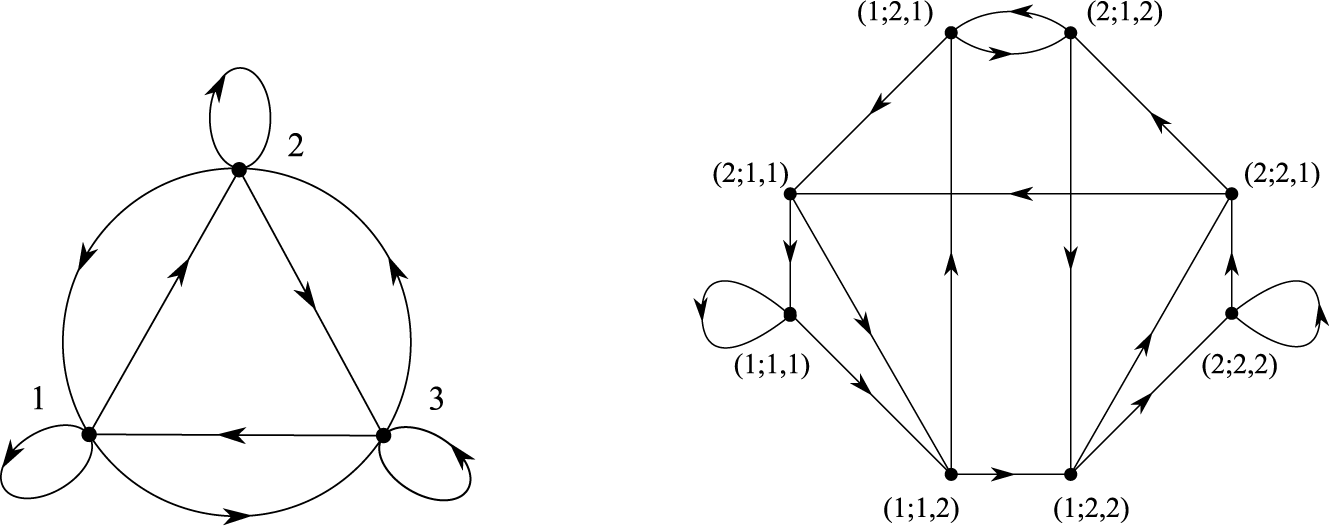
in certain graphs associated with SFTs. For a locally constant cocycle A over a subshift, depending on positions in  , One can associate a directed graph (the so-called De Bruijn graph) whose vertices correspond to elements of
$\mathcal {A}^{2k+1}$
 and for
$\underline {a},\underline {b}\in \mathcal {A}^{2k+1}$
 there is a directed edge from
$\underline {a}$
 to
$\underline {b}$
 if and only if
$b_i=a_{i+1}$
 for every
 (see Figure 1). In this viewpoint, a transition from
 to
 is a walk in this graph starting and ending in the vertices corresponding to
$\underline {a}$
 and
$\underline {b}$
 , respectively.
The left and right figures are the transition graphs for the locally constant cocycles
${A}:\Sigma _3\to \mathrm {SL}(d,\mathbb {R})$
 and
$B:\Sigma _2\to \mathrm {SL}(d,\mathbb {R})$
 depending on zeroth position, and positions in
 , respectively.

Figure 1 Long description
The image consists of two panels.
Left Panel: A directed graph with three nodes arranged in a triangle, labeled 1 at the bottom-left, 2 at the top, and 3 at the bottom-right.
* Each node has a self-loop arrow.
* Directed edges form an outer circle: 2 to 1, 1 to 3, and 3 to 2.
* Directed edges form an inner triangle: 1 to 2, 2 to 3, and 3 to 1.
Right Panel: A more complex directed graph with eight nodes labeled with coordinate triplets.
* Top nodes: (1; 2, 1) and (2; 1, 2) are connected by two opposing directed edges.
* Middle-upper nodes: (2; 1, 1) on the left and (2; 2, 1) on the right. (2; 2, 1) has a directed edge pointing left to (2; 1, 1). (1; 2, 1) points down to (2; 1, 1). (2; 1, 2) points down to (2; 2, 1).
* Middle-lower nodes: (1; 1, 1) on the left and (2; 2, 2) on the right. Both have self-loop arrows. (2; 1, 1) points down to (1; 1, 1). (2; 2, 1) points down to (2; 2, 2).
* Bottom nodes: (1; 1, 2) and (1; 2, 2). (1; 1, 2) points right to (1; 2, 2).
* Vertical connections: (1; 1, 2) points up to (1; 2, 1). (1; 2, 2) points up to (2; 1, 2).
* Diagonal connections: (1; 1, 1) points down-right to (1; 1, 2). (2; 2, 2) points up-left to (2; 2, 1). (2; 1, 1) points down-right to (1; 1, 2).
We can also define matrix transition in line with the definition of transition.
Definition 2.8. Let
$[T']$
 and
$[T"]$
 be two finite words of matrices of length
$\ell '$
 and
$\ell "$
 , respectively. By a matrix transition from
$[T']$
 to
$[T"]$
 , we mean a finite word
$[T]=(T_1,\ldots ,T_\ell )$
 of matrices, with
$\ell \geq \ell ', \ell "$
 , such that

Now, let
$(\sigma ,A)$
 be a locally constant
$\mathrm {GL}(d,\mathbb {R})$
 cocycle over the shift map, depending on positions in
 and represented by
$\phi :\mathcal {A}^{2k+1}\to \mathrm {GL}(d,\mathbb {R})$
 . Then, for every transition
$\underline {w}=(w_1,w_2,\ldots ,w_n)$
 from
$\underline {a}\in \mathcal {A}^{2k+1}$
 to
$\underline {a}'\in \mathcal {A}^{2k+1}$
 , it follows that the word
$\big (\phi (\underline {w}_{n-2k-1}),\dots ,\phi (\underline {w}_2),\phi (\underline {w}_1)\big )$
 is a matrix transition from
$(\phi (\underline {a}))$
 to
$(\phi (\underline {a'}))$
 , where
$\underline {w}_i=(w_i,w_{i+1},\ldots ,w_{i+{2k}})$
 . Note that here,
$(\phi (\underline {a}))$
 and
$(\phi (\underline {a'}))$
 are two words of length one. In this case, we denote

Note that
$2k+1$
 is the length of words
$\underline {w}_i$
 . So whenever the length
$2k+1$
 is clear from the context, we omit it from the notation and write
$A_{[{\underline {w}}\rangle }$
 instead of
$A_{[{\underline {w};2k+1}\rangle }$
 . Notice that if
$\underline {w}\in T(\underline {a},\underline {a}')$
 and
$\underline {w}'\in T(\underline {a}',\underline {a}")$
 , then

Lemma 2.9. For a locally constant
$\mathrm {GL}(d,\mathbb {R})$
 cocycle
$(\sigma ,A)$
 over the shift map, depending on positions in
 , let
$p',p"$
 be two periodic points associated to
$\underline {a}',\underline {a}"\in \mathcal {A}^{2k+1}$
 , respectively. Then, for every transition
$\underline {w}\in T(\underline {a}',\underline {a}")$
 , there exists a periodic point p such that

For the proof, it is enough to consider p to be the periodic point such that
$\sigma ^k(p)$
 is associated with a word in
$\mathcal {A}^{\mathrm {fin}}$
 starting with
$\underline {w}$
 .
3 Cocycles with quasi-conformal orbit
Recall that for the homeomorphism
$f:X\to X$
 of the compact metric space X and continuous map
$A:X\to \mathrm {GL}(d,\mathbb {R})$
 , we say that the cocycle
$(f,A)$
 admits quasi-conformal orbits if there exists
$x\in X$
 such that the condition number (i.e. ratio of norm and conorm) of all matrices
$A_n(x)$
 (
$n\in \mathbb {Z}$
 ) is bounded by a constant independent of n, in other words,

For
$\mathrm {SL}(d,\mathbb {R})$
 cocycles, the above condition is equivalent to the existence of
$x\in X$
 satisfying

Moreover, we say
$(f,A)$
 admits fiberwise bounded orbits if there exists
$x\in X$
 such that

We denote the set of all continuous cocycles
$(f,A)$
 admitting quasi-conformal orbits by
$\mathcal {Q}\mathcal {C}$
 , and the set of those cocycles admitting fiberwise bounded orbits by
$\mathcal {B}$
 . It is easy to verify that
$\mathcal {B}\subset \mathcal {Q}\mathcal {C}$
 , and if
$(f,A)$
 is a
$\mathrm {SL}(d,\mathbb {R})$
 cocycle,
$(f,A)\in \mathcal {B}$
 if and only if
$(f,A)\in \mathcal {Q}\mathcal {C}$
 .
Remark 3.1. We can also define cocycles admitting quasi-conformal or fiberwise bounded forward orbits (resp. backward orbits), by replacing
$n\in \mathbb {Z}$
 in (3.1) and (3.2) by
$n \in \mathbb {N}$
 (resp.
$-n\in \mathbb {N}$
 ).
3.1 Quasi-conformal orbits of a cocycle
Throughout this section, X is a compact metric space and
$f:X\to X$
 is a homeomorphism, and
$A:X\to \mathrm {GL}(d,\mathbb {R})$
 is a continuous map. All the results are formulated for the cocycles
$(f,A)$
 over trivial bundles.
For every
$\kappa \geq 1$
 , we denote

Clearly, the set of points
$x\in X$
 admitting quasi-conformal (forward) orbits for A, coincides with the union
$\bigcup _{\kappa \geq 1} \mathrm {QC}^+(A,\kappa )$
 . The next lemma provides the basic properties of sets
$\mathrm {QC}^+(A,\kappa )$
 .
Lemma 3.2. For every
$\kappa \geq 1$
 ,
-
(i) If for some non-negative integers $m<n$
,
$\|A_m(x)\|.\|A_m(x)^{-1}\|\leq \kappa $
and
$\|A_n(x)\|.\|A_n(x)^{-1}\|\leq \kappa $
, then
$\|A_{n-m}(f^m(x))\|.\|A_{n-m}(f^m(x))^{-1}\|\leq \kappa ^2$
. -
(ii) $\mathrm {QC}^+(A,\kappa )$
is closed. -
(iii) If $x\in \mathrm {QC}^+(A,\kappa )$
, then
$\mathcal {O}^+(x)\subset \mathrm {QC}^+(A,\kappa ^2)$
. -
(iv) If $x\in \mathrm {QC}^+(A,\kappa )$
, then for every
$y\in \omega (x)$
, and every
$n\in \mathbb {Z}$
$$\begin{align*}\|A_n(y)\|.\|A_n(y)^{-1}\|\leq \kappa^2.\end{align*}$$
In particular, $y\in \mathrm {QC}^+(A,\kappa ^2)$
.


Proof. Part (i): Since
$A_{n-m}(f^m(x))=A_n(x)A_m(x)^{-1}$
 ,

Part (ii) is a consequence of continuity of
$A_n$
 ; and Part (iii) follows immediately from part (i).
To prove part (iv), fix an element of
$\omega (x)$
 , say y and
$n\in \mathbb {Z}$
 . Then, there exists a sequence
$n_1<n_2<\cdots $
 of positive integers such that

Now, for sufficiently large j,
$n_j+n>0$
 and for such j’s, using Part (i), we get
$\|A_n(f^{n_j}(x))\|.\|A_n(f^{n_j}(x))^{-1}\|\leq \kappa ^2$
 . In view of (3.3), and since
$A_n$
 and
$A_n^{-1}$
 are both continuous, we conclude that
$\|A_n(y)\|.\|A_n(y)^{-1}\|\leq \kappa ^2$
 .
The statement of Lemma 3.2 holds for the set of points whose fiberwise forward orbit is bounded, with a similar proof. More precisely,
Lemma 3.3. If for
$\kappa \geq 0$
 , we denote

Then,
-
(i) If for some non-negative integers $m<n$
,
$\|A_m(x)^{\pm 1}\|\leq \kappa $
and
$\|A_n(x)^{\pm 1}\|\leq \kappa $
, then
$\|A_{n-m}(f^m(x))\|\leq \kappa ^2$
. -
(ii) $\mathrm {B}^+(A,\kappa )$
is closed. -
(iii) If $x\in \mathrm {B}^+(A,\kappa )$
, then
$\mathcal {O}^+(x)\subset \mathrm {B}^+(A,\kappa ^2)$
. -
(iv) If $x\in \mathrm {B}^+(A,\kappa )$
, then for every
$y\in \omega (x)$
and every
$n \in \mathbb {Z}$
$$\begin{align*}\|A_n(y)^{\pm 1}\| \leq \kappa^2.\end{align*}$$
In particular, $y\in \mathrm {B}^+(A,\kappa ^2)$
.


Remark 3.4. The statement of Lemma 3.2 and 3.3, with the same proof, holds if one replaces the set
$\mathrm {QC}^+(A,\kappa )$
 and
$\mathrm {B}^+(A,\kappa )$
 with the set of points
$x\in X$
 for which the norm of cocycle is quasi-conformal or bounded by
$\kappa $
 for every point in the full orbit of x, respectively.
3.2 Non-stability of quasi-conformal orbits
In this subsection, we consider linear cocycles on trivial bundles over an arbitrary base map (not necessarily the shift map). We will show that one can violate the quasi-conformality of a specific orbit by a small
$\mathcal {C}^0$
 perturbation of the cocycle.
Lemma 3.5. For every homeomorphism
$f:X\to X$
 , and every
$x_0\in X$
 ,
-
• If $d> 2$
and
$x_0$
is periodic for f, then the set of
$\mathrm {SL}(d,\mathbb {R})$
cocycles
$(f,B)$
for which
$\{\|B_n(x_0)\|\}_{n\in \mathbb {N}}$
is unbounded forms an open and dense subset in the
$\mathcal {C}^0$
topology. -
• If $d\geq 2$
and
$x_0$
is not periodic for f, then the set of
$\mathrm {SL}(d,\mathbb {R})$
cocycles
$(f,B)$
for which
$\{\|B_n(x_0)\|\}_{n\in \mathbb {N}}$
is unbounded forms a residual (hence, dense) subset in the
$\mathcal {C}^0$
topology.


Proof. If
$d>2$
 and
$x_0$
 is a periodic point, then the conclusion follows from Proposition A.3 applied to
$X=\mathcal {O}(x_0)$
 , and Lemma A.4.
Now, let
$x_0$
 be a non-periodic point and let
$d\geq 2$
 . For every
$k\geq 1$
 , define

It is clear that for every
$k\geq 1$
 ,
$\mathcal {B}_\kappa $
 is closed. On the other hand, the set of continuous maps
$B:X\to \mathrm {SL}(d,\mathbb {R})$
 , for which
$\{\|B_n(x_0)\|\}_{n\in \mathbb {N}}$
 is unbounded, equals to
$\bigcap _{\kappa \in \mathbb {N}} \mathcal {B}_\kappa ^c$
 .
So, it suffices to prove that for every
$\kappa \geq 1$
 , the
$\mathcal {C}^0$
 -interior of
$\mathcal {B}_\kappa $
 is empty. This implies the lemma as the set of
$\mathrm {SL}(d,\mathbb {R})$
 cocycles over f is a Baire space.
Claim. The interior of
$\mathcal {B}_\kappa $
 is empty.
Let
$\epsilon _0>0$
 and
$B \in \mathcal {B}_\kappa $
 . For every
$r>1$
 , let
$D_r:=\mathrm {Diag}(r,r^{-\frac {1}{d-1}},\ldots ,r^{-\frac {1}{d-1}})$
 be a diagonal matrix and for every vector
$v \in \mathbb {R}^d$
 choose
$R_v \in \mathrm {SO}(d,\mathbb {R})$
 such that
$R_v(e_1)={v}/{|v|}$
 , where
$(e_1,\ldots ,e_d)$
 is the standard basis for
$\mathbb {R}^d$
 .
Consider an arbitrary unit vector
$v_0 \in \mathbb {R}^d$
 and
$n \in \mathbb {N}$
 . Now, for every
$i=1,2,\ldots ,n$
 , denote
$v_i:= B_i(x_0)(B_n(x_0))^{-1}v_0$
 and define

Notice that as
$x_0$
 is not periodic,
$\hat {B}$
 is well-defined (for every n). Since
$v_n=v_0$
 , then
$\hat {B}_n(x_0)(B_n(x_0))^{-1}v_0=r^nv_0$
 . Consequently,

To complete the proof of claim, let
$\delta $
 be the positive number given by Lemma A.4 so that every
$\delta $
 -perturbation of cocycle B on a compact set can be extended to a cocycle on
$X \epsilon _0$
 -close to B.
Now, take
$r>1$
 close enough to
$1$
 , so that
$\|D_r-\mathrm {Id}\|.\|B\|<\delta $
 . Moreover, we can take n large enough to have
$r^n \kappa _0^{-(d-1)}> k$
 . We take K in Lemma A.4 equal to
$\{x_0,\ldots , f^{n-1}(x_0)\}$
 . According to Lemma A.4, there exist
$\tilde {B}:X\to \mathrm {SL}(d,\mathbb {R})$
 , with
$d_{\mathcal {C}^0}(\tilde {B},B)<\epsilon _0$
 and
$\tilde {B}(f^i(x_0))=\hat {B}(f^i(x_0))$
 . Moreover, (3.4) implies that
$\tilde {B} \notin \mathcal {B}_\kappa $
 and the proof of claim and lemma is complete.
Using Lemma 3.5, we get the following corollary regarding the interior of the set of cocycles admitting quasi-conformal orbits, when the base system is minimal.
Corollary 3.6. For every
$d>2$
 and every minimal homeomorphism
$f:X\to X$
 , the
$\mathcal {C}^0$
 -interior of the set of
$\mathrm {SL}(d,\mathbb {R})$
 cocycles admitting quasi-conformal orbits is empty.
Proof. Observe that for every
$A:X \to \mathrm {SL}(d,\mathbb {R})$
 , if
$\mathrm {QC}(A,\kappa )\neq \emptyset $
 for some
$\kappa \geq 1$
 , then, using Lemma 3.2, and minimality of f,
$\mathrm {QC}(A,\kappa ^2)=X$
 .
This implies that if there exists a
$\mathcal {C}^0$
 -open set of
$\mathrm {SL}(d,\mathbb {R})$
 cocycles over f which admit a quasi-conformal orbit, then for every
$x\in X$
 , the set of cocycles with bounded forward orbit at x has non-empty
$\mathcal {C}^0$
 -interior. But due to Lemma 3.5, this is impossible.
The following lemma clarifies the sensitivity of
$\mathrm {GL}(d,\mathbb {R})$
 cocycles with bounded orbits to the natural perturbations. The proof is straightforward and is left to the reader.
Lemma 3.7. Let
$(f,A)$
 be a
$\mathrm {GL}(d,\mathbb {R})$
 cocycle and
$Y\subset X$
 be an f-invariant compact set. Assume that for every
$y\in Y$
 , the sequence
$\{\|A_n(y)\|^{\pm 1}\}_{n\in \mathbb {Z}}$
 is bounded. If
$\lambda \in \mathbb {R}\setminus \{0,\pm 1\}$
 , then the cocycle
$( f\big |_Y,\lambda A)$
 does not admit fiberwise bounded orbits.
4 Covering condition for cocycles
In this section, we introduce a covering criterion that stably violates dominated splitting, based on the recent work [Reference Fakhari, Nassiri and RajabzadehFNR25] on the stable ergodicity of smooth expanding actions. The covering condition in [Reference Fakhari, Nassiri and RajabzadehFNR25] ensures the existence of quasi-conformal orbits for (pseudo)-semigroup action.
4.1 Covering condition in linear groups
In this section, we recall and adopt the covering condition in [Reference Fakhari, Nassiri and RajabzadehFNR25] for the action of subgroups of
$\mathrm {GL}(d,\mathbb {R})$
 on themselves and explore its implications for identifying quasi-conformal sequences of matrices.
For
$\kappa \geq 1$
 , we say a sequence
$\{D_i\}_{i=1}^\infty $
 in
$\mathrm {GL}(d,\mathbb {R})$
 is
$\kappa $
 -conformal if and only if for every
$n\in \mathbb {N}$


Also, the sequence is quasi-conformal if it is
$\kappa $
 -conformal for some
$\kappa \geq 1$
 .
For
$\kappa \geq 1$
 and
$\mathcal {G}=\{D_1,D_2,\ldots ,D_m\}\subset \mathrm {GL}(d,\mathbb {R})$
 , we say
$\langle \mathcal {G} \rangle ^+$
 , the semigroup generated by
$\mathcal {G}$
 , has a
$\kappa $
 -conformal branch, if there exists a
$\kappa $
 -conformal sequence in
$\mathcal {G}$
 .
We need the following Lemmas from [Reference Fakhari, Nassiri and RajabzadehFNR25]. Lemma 4.1 provides an equivalent condition for the existence of a quasi-conformal sequence from a given set.
Lemma 4.1 [Reference Fakhari, Nassiri and RajabzadehFNR25, Lemma 3.5]
Let
$\mathcal {G}\subseteq \mathrm {SL}(d,\mathbb {R})$
 be a finite set. Then, there exists
$\kappa>1$
 such that
$\langle {\mathcal {G}}\rangle ^+$
 has a
$\kappa $
 -conformal branch if and only if
$ ~\overline {\mathcal {U}}\subseteq \mathcal {G}^{-1}\mathcal {U}$
 for some
$\mathcal {U}\subseteq \mathrm {SL}(d,\mathbb {R})$
 with compact closure. Moreover, if
$\mathcal {U}$
 is open,
$\langle {\mathcal {G}}\rangle ^+$
 robustly has a
$\kappa $
 -conformal branch for some
$\kappa>1$
 .
The lemma, in particular, implies that if all the elements of
$\mathcal {G}$
 have a common expanding eigenvector, or more generally, if the locally constant cocycle associated with
$\mathcal {G}$
 admits a dominated splitting, then
$\mathcal {G}$
 does not satisfy the covering condition (for any open set with compact closure). Indeed, dominated splitting or common expanding eigenvector implies that every branch in
$\mathcal {G}$
 is unbounded. See §8.1 for further discussion.
In view of the statement of the above lemma, for topological group G, we say that the finite set
$\mathcal {G}=\{g_1,\ldots ,g_m\}\subset G$
 satisfies the covering condition if there exists a non-empty open set
$\mathcal {U}\subset G$
 with compact closure such that

In the next subsection, in Definition 4.6, the covering condition will be generalized to the locally constant cocycles over the shift.
The next lemma guarantees the existence of finite subsets of
$\mathrm {SL}(d,\mathbb {R})$
 with exactly
$d^2$
 elements and with elements sufficiently close to
$\mathrm {Id}$
 , satisfying the covering condition.
Lemma 4.2 [Reference Fakhari, Nassiri and RajabzadehFNR25, Lemma 3.8]
For any neighborhood
$\mathcal {U}_0$
 of the identity in
$\mathrm {SL}(d,\mathbb {R})$
 , there exists an open set
$\mathcal {U}\subseteq \mathcal {U}_0$
 and a finite set
$\mathcal {G}\subseteq \mathcal {U}_0$
 with
$d^2$
 elements such that
$\overline {\mathcal {U}}\subseteq \mathcal {G}^{-1}\mathcal {U}$
 .
We can also satisfy the covering condition in
$\mathrm {GL}(d,\mathbb {R})$
 . let
$\{D_1,\ldots ,D_{d^2}\}\subset \mathrm {SL}(d,\mathbb {R})$
 , satisfy the covering condition for some open set
$\mathcal {U}\subset \mathrm {SL}(d,\mathbb {R})$
 . Consider two maps
$t\mapsto 2t$
 and
$t\mapsto t/3$
 on
$\mathbb {R}$
 . It is easy to see that these two maps satisfy the covering condition for any bounded interval
$(a, b)\subset \mathbb {R}$
 provided that
$b>6a$
 . So, we can conclude that the family
$\{2D_1,\ldots ,2D_{d^2},\frac {1}{3}D_1,\ldots ,\frac {1}{3}D_{d^2} \}$
 , satisfies the covering condition for the open set
$\mathcal {U}':=\{\lambda D : a<\lambda ^d<b\And A \in \mathcal {U} \}$
 in
$\mathrm {GL}(d,\mathbb {R})$
 . In general, we can apply the following corollary of Lemma 4.2 to satisfy the covering condition in
$\mathrm {GL}(d,\mathbb {R})$
 .
Corollary 4.3. For any neighborhood
$\mathcal {U}_0$
 of the identity in
$\mathrm {GL}(d,\mathbb {R})$
 , there exists an open set
$\mathcal {U}\subseteq \mathcal {U}_0$
 and a finite set
$\mathcal {G}\subseteq \mathcal {U}_0$
 with
$2d^2$
 elements such that
$\overline {\mathcal {U}}\subseteq \mathcal {G}^{-1}\mathcal {U}$
 .
The next lemma comes from [Reference Fakhari, Nassiri and RajabzadehFNR25] and [Reference Homburg and NassiriHN14].
Lemma 4.4. Let
$\mathcal {G}\subset \mathrm {SL}(d,\mathbb {R})$
 be such that for some non-empty open subset
$\mathcal {U}\subset \mathrm {SL}(d,\mathbb {R})$
 with compact closure,
$\overline {\mathcal {U}}\subset \mathcal {G}^{-1}\mathcal {U}$
 . Then, there exists
$\delta>0$
 such that

where
$\mathcal {U}_{(\delta )}:=\big \{D :D'\in \mathcal {U}\; \text {for every } D'\in \mathrm {SL}(d,\mathbb {R}) \text {with }\|D-D'\|<\delta \big \}$
 .
Proof. If such a
$\delta $
 did not exist, then for every positive integer k, we would have
$\Lambda _k := \overline {\mathcal {U}} \setminus \big ( \mathcal {G}^{-1}\mathcal {U}_{(\frac {1}{k})}\big ) \neq \emptyset $
 . Since
$\{\Lambda _k\}_{k=1}^\infty $
 is a nested sequence of non-empty compact sets, it follows that

which contradicts the assumption
$\overline {\mathcal {U}}\subset \mathcal {G}^{-1}\mathcal {U}$
 .
Lemma 4.5 (covering implies immediate covering)
Let
$\mathcal {H}$
 be the semigroup generated by
$H_1,H_2,\ldots ,H_m\in \mathrm {SL}(d,\mathbb {R})$
 . Assume that there is an open subset
$\mathcal {U}\subset \mathrm {SL}(d,\mathbb {R})$
 with compact closure such that
$\overline {\mathcal {U}}\subset \bigcup _{H\in \mathcal {H}} {H}^{-1}\mathcal {U}$
 . Then there exists an open subset
$\mathcal {V}\subset \mathrm {SL}(d,\mathbb {R})$
 with compact closure such that

Proof. Since
$\overline {\mathcal {U}}$
 is compact and it is covered by the union
$\bigcup _{H\in \mathcal {H}} {H}^{-1}\mathcal {U}$
 of open sets, it can be covered by the union of finitely many of them. So,
$\bigcup _{H\in \mathcal {F}} {H}^{-1}\mathcal {U}$
 , for some finite family
$\mathcal {F}\subset \mathcal {H}$
 . We may assume that
$\mathcal {F}$
 is the set of all words of length at most
$N\in \mathbb {N}$
 . By Lemma 4.4 there exists
$\delta>0$
 such that
$\overline {\mathcal {U}}\subset \bigcup _{H\in \mathcal {F}} {H}^{-1}\mathcal {U}_{(\delta )}$
 . Since linear maps are uniformly continuous on bounded sets, there exist positive real numbers
$\epsilon _0 <\ldots <\epsilon _N<\delta /2$
 such that for every
$i\in \{1, \dots , m\}$
 ,
$j\in \{1, \dots , N\}$
 , and
$X, Y \in \bigcup _{H\in \mathcal {F}} {H}^{-1}\mathcal {U}$
 , if
$\|X-Y\|< \epsilon _{j-1}$
 then
$\|H_iX-H_iY\|<\epsilon _j/2$
 . Denote
$\epsilon :=\frac {1}{2}\min \{\epsilon _0,\ldots ,\epsilon _N\}$
 .
Fixing
$u\in \overline {\mathcal {U}}$
 , there exist positive integers
$k\leq N$
 , and
$i_1,\ldots , i_k \leq m$
 such that
$\mathrm {B}_{\delta }(H_{i_k} \cdots H_{i_1} u) \subset \mathcal {U}$
 . Let
$u_0:=u$
 ,
$\mathcal {V}_0:=\mathrm {B}_{\epsilon _0}(u_0)$
 , and
$u_j:=H_{i_j}u_{j-1}$
 ,
$\mathcal {V}_j:=\mathrm {B}_{\epsilon _j}(u_j)$
 for
$1\leq j \leq k$
 . It follows that
$H_{i_j}\mathrm {B}_{\epsilon }(\mathcal {V}_{j-1})\subset \mathcal {V}_j$
 and
$\mathrm {B}_{\delta /2}(\mathcal {V}_k) \subset \mathcal {U}$
 . Define
$\mathcal {V}_u:= \bigcup _{j=0}^k \mathcal {V}_j$
 .
Hence, the bounded open set
$\mathcal {V}:= \bigcup _{u\in \overline {\mathcal {U}}}\mathcal {V}_u$
 satisfies the covering property for
$H_1,\ldots ,H_m$
 .
4.2 Covering condition for cocycles
In this section, we extend the covering condition to include general locally constant cocycles. The concept of a cocycle with covering can be defined for cocycles taking values in more general topological groups G. However, for the purposes of this paper, we restrict our attention to cocycles taking values in closed subgroups of linear groups. The most important cases that we will consider in the next sections are when
$G=\mathrm {GL}(d,\mathbb {R})$
 or
$G=\mathrm {SL}(d,\mathbb {R})$
 .
Definition 4.6 (Cocycle with covering)
Let
$d\geq 2$
 and G be a closed subgroup of
$\mathrm {GL}(d,\mathbb {R})$
 . We say that a locally constant G cocycle
$(\sigma ,A)$
 over the shift map, depending on positions in
 and represented by
$\phi :\mathcal {A}^{2k+1}\to G$
 satisfies the covering condition if there exist
-
• a non-empty open set $\mathcal {U}\subset G$
with compact closure, -
• and a subset $\mathcal {A}'\subset \mathcal {A}^{2k+1}$
,


such that for every
$\underline {a}\in \mathcal {A}'$


Remark 4.7. We can give a few remarks on the definition of covering property for cocycles.
-
1) If the covering condition (4.2) holds for some open set $\mathcal {U}$
, we may assume that
$\mathcal {U}$
contains the identity matrix,
$\mathrm {Id}$
. Indeed, we can fix an arbitrary element
$H_0\in \mathcal {U}$
and replace
$\mathcal {U}$
in (4.2) with
$H_0^{-1}\mathcal {U}$
. -
2) Since $\mathcal {U}$
is open and
$\overline {\mathcal {U}}$
is compact, according to Lemma 4.4, we deduce that Definition 4.6 is equivalent to the following:There exists $\delta>0$
such that for every
$\underline {a}\in \mathcal {A}'$
, there is a finite set
$\Lambda _{\underline {a}}$
of transitions of the form
$T(\underline {a},\underline {b})$
for
$\underline {b}\in \mathcal {A}'$
such that (4.3) $$ \begin{align} \overline{\mathcal{U}} \subset \bigcup\limits_{\underline{w}\in \Lambda_{\underline{a}}}(A_{[\underline{w}\rangle})^{-1}\mathcal{U}_{(\delta)}, \quad \text{for every } \underline{a} \in \mathcal{A}'. \end{align} $$


Note that Definition 4.6 extends the covering condition introduced in the previous subsection in (4.1). Indeed, a locally constant cocycle
$(\sigma ,A)$
 over
$\Sigma _m$
 depending on zeroth position can be represented by an m-tuple
$(D_1,\ldots ,D_m)$
 of matrices in
$\mathrm {SL}(d,\mathbb {R})$
 . If
$(\sigma ,A)$
 satisfies the covering condition in the sense of Definition 4.6 for
$\mathcal {A}'=\mathcal {A}$
 and for some open set
$\mathcal {U}\subset \mathrm {SL}(d,\mathbb {R})$
 with compact closure, it means that

This because of Lemma 4.5 implies that there exists open set
$\mathcal {V}\subset \mathrm {SL}(d,\mathbb {R})$
 with compact closure for which we have

This is exactly the covering condition in (4.1). One can construct more sophisticated examples of locally constant cocycles over the shift map which do not depend only on zeroth position, satisfying the covering condition (see the proof of [Reference ReshadatRes25, Lemma 5.17]).
Remark 4.8. Let
$(\sigma ,A)$
 be the locally constant cocycle over the shift map, depending on positions in
 and represented by
$\phi :\mathcal {A}^{2k+1}\to \mathrm {SL}(d,\mathbb {R})$
 . If the family
$\phi (\mathcal {A}^{2k+1})$
 of matrices satisfies the covering condition with respect to some open set
$\mathcal {U}\subset \mathrm {SL}(d,\mathbb {R})$
 , then it does not necessarily imply (4.2). Indeed, it is not difficult to construct an example of a uniformly hyperbolic locally constant cocycle over the full shift
$\Sigma _2$
 , represented by some
$\phi :\mathcal {A}^3\to \mathrm {SL}(d,\mathbb {R})$
 so that the semigroup generated by
$\phi (\mathcal {A}^3)$
 is dense in
$\mathrm {SL}(d,\mathbb {R})$
 (see [Reference ReshadatRes25, Example 5.16]).
5 Criterion for stable quasi-conformality
In this section, we consider locally constant linear cocycles over the shift map and establish the existence of quasi-conformal orbits and their stability in the
$\mathcal {C}^\alpha $
 topology under the covering condition introduced in the previous section.
For the case of locally constant cocycles, we first prove the results when the cocycle depends only on the zeroth position and then give the proof for general locally constant cocycle. While the proof for general locally constant cocycles in §5.2 gives the results of §5.2 as a particular case, we initially present the results for the cocycles depending only on zeroth position to make the idea more clear and improve readability.
5.1 Cocycles depending on zeroth position
As mentioned above, our focus in this subsection is on the perturbation of IFS, namely cocycles that depend on the zeroth position. We will show that for a subgroup G of
$\mathrm {GL}(d,\mathbb {R})$
 , the establishment of the covering condition for some open set
$\mathcal {U}\subset G$
 , is a criterion that implies the existence of orbits whose associated product of matrices in the fibers remain in
$\mathcal {U}$
 .
Theorem 5.1. Let
$(\sigma ,A)$
 be a locally constant cocycle over the shift map
$\sigma :\Sigma _m\to \Sigma _m$
 , depending on zeroth position and represented by
$\phi :\mathcal {A}\to G $
 . Suppose that there exists a non-empty open set
$\mathcal {U} \subset G$
 with compact closure satisfying

Then, there exists
$\epsilon>0$
 , such that every
$\alpha $
 -Hölder cocycle
$(\sigma ,B)$
 with
$d_{\mathcal {C}^{\alpha }}(A,B)<\epsilon $
 such that there exists
$x\in \Sigma _m$
 , such that for every
$n\in \mathbb {N}$
 ,
$B_n(x)\in \mathcal {U}$
 .
Theorem 5.1, in particular, implies that the covering condition (5.1) for
$(\sigma ,A)$
 implies that for every B sufficiently
$\mathcal {C}^\alpha $
 -close to A,
$(\sigma ,B)\in \mathcal {B}$
 . A generalization of the above theorem to general locally constant cocycles will be provided in Theorem 5.5. Before going into the proof of this theorem, we provide two lemmas regarding the control of distances between finite products of matrices associated with points in a cocycle that we need in the proof of Theorems 5.1 and 5.5.
Lemma 5.2. Let
$k\in \mathbb {N}$
 and
$A,B:\Sigma _m\to \mathrm {GL}(d,\mathbb {R})$
 be continuous maps. Then, for every
$x\in \Sigma _m$
 ,

Proof. For simplicity of notation, denote
$A(\sigma ^i(x))$
 and
$B(\sigma ^i(x))$
 by
$A_i$
 and
$B_i$
 , respectively. Then,

Employing the triangle inequality and using
$\|A_i-B_i\|\leq d_{\mathcal {C}^0}(A,B)$
 , we get

Now, for
$C:=\max \{\|A\|, \|B\|\}$
 , we have
$\sum \limits _{i=1}^k \|A\|^{k-i}\|B\|^{i-1}\leq k C^{k-1}$
 , completing the proof.
Lemma 5.3. Let
$(\sigma ,B)$
 be an
$\alpha $
 -Hölder
$\mathrm {GL}(d,\mathbb {R})$
 cocycle over the shift map. Assume that there exist
$L,m\in \mathbb {N}$
 ,
$K>0$
 and a sequence
$0=n_0<n_1<\cdots <n_k=m$
 of integers such that for every
$x\in \Sigma $
 , every
$y\in \sigma ^{-m}(W^u_{loc} \sigma ^{m}(x))$
 and every
$i=1,\ldots ,k$
 ,

Then,

Proof. To prove the Lemma, we first prove a prior upper bound for
$\|B_m(x)-B_m(y)\|$
 that works for every
$x,y$
 , and for every
$\alpha $
 -Hölder cocycle. Then, we use it as a part of the proof of the main statement.
Claim. Let
$(\sigma ,B)$
 be an
$\alpha $
 -Hölder cocycle over the shift map. Then, for every
$x,y$


Denoting
$x_i:=\sigma ^{i}(x)$
 and
$y_i=\sigma ^i(y)$
 , we have

Therefore, by the triangle inequality


By Hölder regularity of B,
$\|B(x_i)-B(y_i)\| \leq |B|_{\mathcal {C}^{\alpha }}d(x_i,y_i)^\alpha $
 . Combining this with (5.5) gives (5.3) and finishes the proof of the claim.
Now, we turn to the proof of the main statement. We can write

Note that since
$B_{n_k-n_{i+1}}(x_{n_{i+1}})=B_{n_k}(x)B_{n_{i+1}}(x)^{-1}$
 , by assumption,
$\|B_{n_i}(x)^{\pm 1}\|\leq K$
 , we get
$\|B_{n_k-n_{i+1}}(x_{n_{i+1}})\|\leq K^2$
 . Therefore, applying the triangle inequality to the above equality, we get

On the other hand, by (5.3) and
$n_{i+1}-n_i\leq L$
 , we have for every i


Therefore,

Now, since
$y\in \sigma ^{-m}(W^u_{loc}\sigma ^m(x))$
 , for every
$i=0,\ldots ,m-1$
 ,
$d(x_j,y_j)^\alpha < (\frac {1}{2^{m-j}})^\alpha |B|_{\mathcal {C}^\alpha }$
 , which implies

This completes the proof.
Proposition 5.4. Under assumptions of Theorem 5.1, there exists
$\epsilon>0$
 such that for every
$\alpha $
 -Hölder cocycle
$(\sigma ,B)$
 with
$d_{\mathcal {C}^{\alpha }}(A,B)<\epsilon $
 , there is a sequence
$\{x_n\}_{n\geq 0}$
 in
$\Sigma _m$
 such that for every
$n\geq 0$
 , if
$W_n:= W^u_{loc}(\sigma ^n(x_n))$
 , then
-
(i) $\sigma ^{-(n+1)}(W_{n+1})\subset \sigma ^{-n}(W_n)$
, -
(ii) for every $i=1,\ldots ,n+1$
and
$y\in \sigma ^{-n}(W_n)$
,
$B_i(y) \in \mathcal {U}$
.


Proof. The proof is by induction. For every
$j\in \mathcal {A}$
 , denote
$D_j:=\phi (j)$
 . First, in view of Lemma 4.4, we may assume that
$\mathcal {U}$
 contains the identity matrix,
$\mathrm {Id}$
 . Additionally, there is
$\delta>0$
 such that

Since
$\mathrm {Id}\in \mathcal {U}$
 , it follows from (5.10) that there is
$i_0\in \mathcal {A}$
 such that
$D_{i_0}\in \mathcal {U}_{(\delta )}$
 . Clearly,
$A|_{\mathsf {C}[i_0]}=D_{i_0}$
 . Choose an element of
${\mathsf {C}[i_0]}$
 and denote it by
$x_0$
 . Since
$W_0=W^u_{loc}(x_0) \subset {\mathsf {C}[i_0]}$
 , we conclude that for every
$y\in W_0$
 ,
$A(y)=D_{i_0}\in \mathcal {U}_{(\delta )}$
 .
Now, if
$\epsilon \in (0,\delta )$
 and
$d_{\mathcal {C}^{\alpha }}(A,B)<\epsilon $
 , then
$d_{\mathcal {C}^{0}}(A,B)<\epsilon $
 . Consequently, for every
$y\in W_0$
 ,
$B(y)\in \mathcal {U}$
 .
The above argument proves the proposition for
$n=0$
 . Now, suppose that the proposition holds for
$n-1$
 , that is, there exists
$x_{n-1}\in \Sigma _m$
 satisfying both items of the proposition. We aim to find
$x_{n}\in \Sigma _m$
 satisfying the desired properties. Note that by (5.10),

Therefore, there exists
$i_{n}\in \mathcal {A}$
 such that
$D_{i_{n}}B_{n}(x_{n-1})\in \mathcal {U}_{(\delta )}$
 and since A is locally constant depending on the zeroth position,
$A|_{\mathsf {C}[i_n]}=D_{i_{n}}$
 . Let
$x_{n}$
 be an arbitrary element in
$\sigma ^{-(n-1)}(W_{n-1})\cap \sigma ^{-n}(\mathsf {C}[i_n])$
 . We claim that this choice of
$x_{n}$
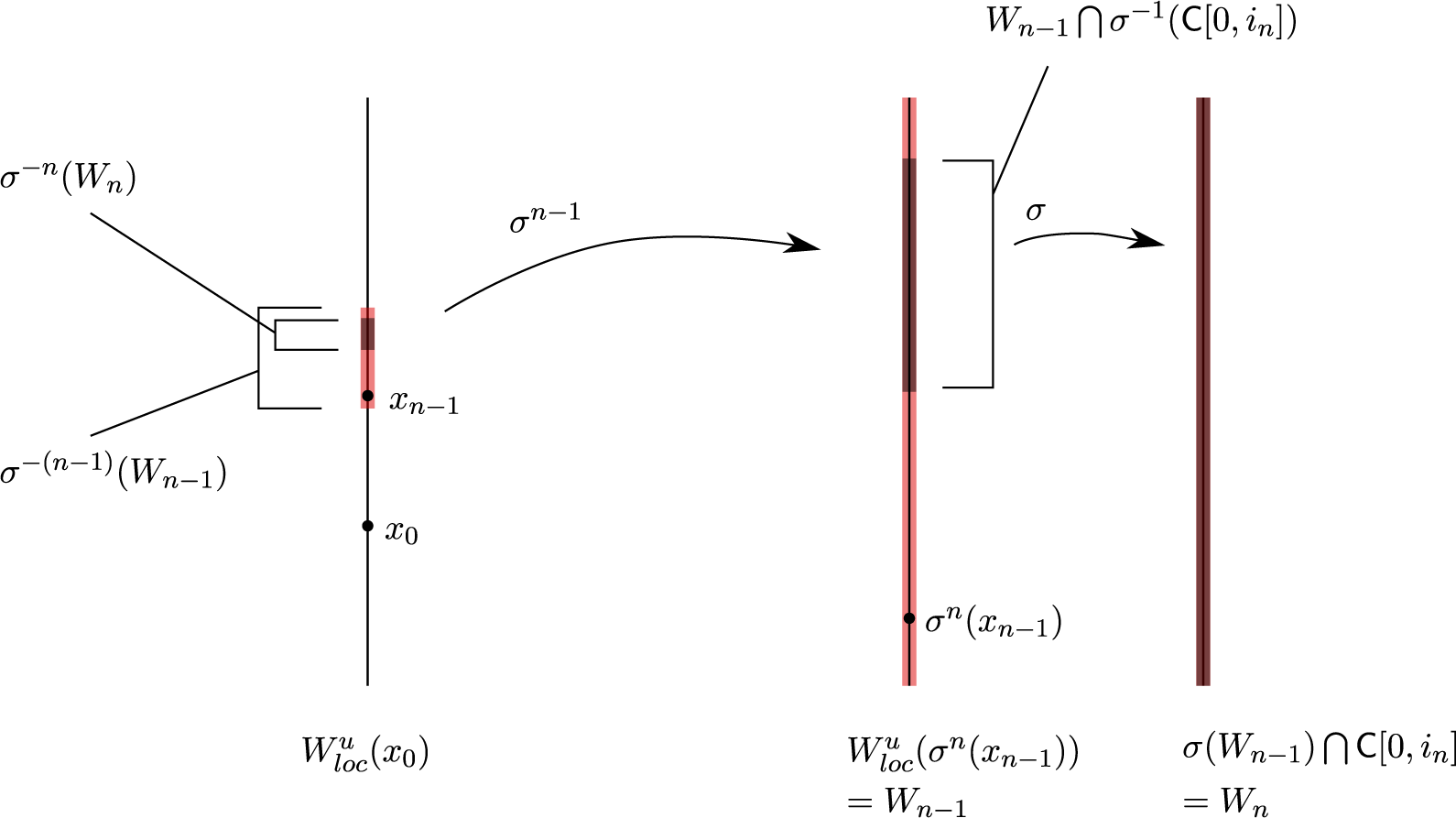
 satisfies the required properties (see Figure 2).
Proof of Proposition 5.4.

Figure 2 Long description
The diagram consists of three vertical lines representing mathematical spaces, with arrows indicating transformations between them.
* Leftmost Line: Labeled W sub loc super u (x sub 0). It contains a point x sub 0 and a point x sub n minus 1 above it. A red shaded interval surrounds x sub n minus 1, with a smaller dark brown segment nested within it. Brackets to the left identify the red interval as sigma super minus (n minus 1) (W sub n minus 1) and the dark brown segment as sigma super minus n (W sub n).
* Center Line: Connected to the first by an arrow labeled sigma super n minus 1. This line is labeled W sub loc super u (sigma super n (x sub n minus 1)) = W sub n minus 1. It shows a point sigma super n (x sub n minus 1) at the bottom. A dark brown segment is highlighted on this line, identified by a bracket as W sub n minus 1 intersection sigma super minus 1 (C [0, i sub n]).
* Rightmost Line: Connected to the center line by an arrow labeled sigma. This line is labeled sigma (W sub n minus 1) intersection C [0, i sub n] = W sub n. It shows a continuous dark brown vertical segment representing the final transformed set.
Claim. There exists
$C>0$
 depending on
$\mathcal {U},A,\alpha $
 such that for every
$z\in \sigma ^{-(n+1)}(W_n)$
 ,

To prove the claim, first using the triangle inequality, one has

Since
$D_{i_n}=A|_{\mathsf {C}[i_n]}$
 and
$\sigma ^{n}(z)\in \mathsf {C}[i_n]$
 , and
$d_{\mathcal {C}^{\alpha }}(A,B)<\epsilon $
 ,
$\|B(\sigma ^{n}(z))-D_{i_n}\|<\epsilon $
 . On the other hand,
$z\in \sigma ^{-(n+1)}(W_{n+1}) \subset \sigma ^{-n}(W_n)$
 . Therefore,

where
$K_{\mathcal {U}}:=\max \{\|D^{\pm 1 }\|:D\in \overline {\mathcal {U}}\}$
 .
To estimate the second term in (5.11), using Lemma 5.3, we get


Since all the points
$y,z$
 and
$x_i$
 ’s are in the same local unstable set, we can replace
$|B|_{\mathcal {C}^\alpha }$
 by
$\sup _{x \in \Sigma }|B\big \vert _{W^u_{loc}(x)}|_{\mathcal {C}^\alpha }$
 in (5.14). On the other hand, since A is a locally constant cocycle depending on zeroth position, it follows from Corollary 2.4,
$\sup _{x \in \Sigma }|B\big \vert _{W^u_{loc}(x)}|_{\mathcal {C}^\alpha }<\epsilon $
 . So

The estimates provided by (5.11), (5.12) and (5.15), complete the proof of Claim for
$C=K_{\mathcal {U}}+(1-2^{-\alpha })^{-1}\|A\|K_{\mathcal {U}}^{3}$
 .
To complete the proof of the proposition, it is enough to assume that
$\epsilon <C^{-1}\delta $
 , for C given by the claim. Then, according to the claim, for every
$z\in \sigma ^{-(n+1)}(W_n)$
 ,
$ \|B_{n+1}(z)-D_{i_n}B_{n}(y)\| \leq \delta $
 and since
$D_{i_n}B_{n}(y)\in \mathcal {U}_{(\delta )}$
 , we get
$B_{n+1}(z)\in \mathcal {U}$
 .
Now we can prove Theorem 5.1.
Proof of Theorem 5.1
Let
$\epsilon>0$
 be the number provided by Proposition 5.4. Take cocycle B with
$d_{\mathcal {C}^{\alpha }}(A,B)<\epsilon $
 and
$\{x_n\}_{n\in \mathbb {N}}$
 be the sequence given in Proposition 5.4. According to this proposition, for
$W_n:=W^u_{loc}(\sigma ^n(x_n))$
 ,
$\{\sigma ^{-n}(W_n)\}_{n\in \mathbb {N}}$
 forms a nested sequence of compact subsets of
$\Sigma _m$
 , ensuring that their intersection is non-empty. Now, in view of Proposition 5.4, for every point
$x^*$
 in this intersection
$B_n(x^*)\in \mathcal {U}$
 for every
$n\geq 0$
 .
5.2 General locally constant cocycles
In this subsection, we concentrate on general locally constant cocycles and show that the covering criterion (4.2) ensures the presence of quasi-conformal orbits and their stability in the
$\mathcal {C}^\alpha $
 topology.
Theorem 5.5 (Key theorem)
Let G be a closed subgroup of
$\mathrm {GL}(d,\mathbb {R})$
 . Let
$(\sigma ,A)$
 be a locally constant G cocycle over the full shift on finitely many symbols, depending on positions in
 and represented by
$\phi :\mathcal {A}^{2k+1}\to G$
 .
If
$(\sigma ,A)$
 satisfies the covering condition (for some non-empty open set
$\mathcal {U}\subset G$
 with compact closure), then there exists
$\epsilon ,K>0$
 , such that for every
$\alpha $
 -Hölder map
$B:\Sigma _m\to G$
 with
$d_{\mathcal {C}^{\alpha }}(A,B)<\epsilon $
 , the cocycle
$(\sigma ,B)$
 admits
$x\in \Sigma _m$
 with

In particular,
$(\sigma ,B)\in \mathcal {B}$
 .
The following proposition provides the main ingredient of the proof of Theorem 5.5. This is an analog of Proposition 5.4 for locally constant cocycles depending on positions in  for
$k\geq 1$
 .
Proposition 5.6. Let G,
$(\sigma ,A)$
 and
$\mathcal {U}$
 satisfy the assumptions of Theorem 5.5. Then, there is
$\epsilon>0$
 such that for every
$\alpha $
 -Hölder map
$B:\Sigma _m\to G$
 with
$d_{\mathcal {C}^\alpha }(A,B)<\epsilon $
 , there exist
-
• a positive integer L,
-
• a sequence ${0=n_0<}n_1<n_2<\cdots $
of integers, -
• a sequence $\{x_{j}\}_{j\in \mathbb {N}}$
in
$\Sigma _m$
,


such that for
$W_j:=W^u_{loc}\big (\sigma ^{n_{j}}({x_{j}})\big )$
 and every
$j\geq 0$
 ,
-
(i) $n_{j+1}-n_j\leq L$
, -
(ii) $\sigma ^{-n_{j+1}}(W_{j+1}) \subset \sigma ^{-n_j}(W_j)$
, and -
(iii) for every $y\in \sigma ^{-n_j}(W_j)$
and
$i=0,\ldots ,j$
,
$B_{n_i}(y)\in \mathcal {U}$
.


Proof. Suppose that the cocycle
$(\sigma ,A)$
 satisfies the covering condition for
$\mathcal {U}\subset G$
 and
 . In view of Remark 4.7, we may assume that
$\mathcal {U}$
 contains the identity matrix and moreover, there exist
$\delta>0$
 and finite families
$\Lambda _{\underline {a}}$
 (
$\underline {a}\in \mathcal {A}'$
 ) of transitions, such that for every
$\underline {a}\in \mathcal {A}'$
 ,
$\Lambda _{\underline {a}}\subset \bigcup _{\underline {b}\in \mathcal {A}'}T(\underline {a},\underline {b})$
 and

Now, we take
$L:=\max \{|\underline {w}| : \underline {w}\in \Lambda _{\underline {a}},\underline {a}\in \mathcal {A}'\}$
 and construct the sequence
$\{n_j\}_{j\geq 0}$
 so that
$n_0=0$
 and for every
$j\geq 0$
 ,
$0<n_{j+1}-n_j\leq L$
 . First, fix an arbitrary element
$\underline {a}_0 \in \mathcal {A}'$
 , and set
$x_0$
 as an arbitrary element in
$\mathsf {C}[-k;\underline {a}_0]$
 .
Claim. There exist
$\epsilon>0$
 and
$\underline {a}_1,\underline {a}_2,\ldots $
 in
$\mathcal {A}'$
 such that for every
$\alpha $
 -Hölder cocycle
$(\sigma ,B)$
 with
$d_{\mathcal {C}^\alpha }(A,B)<\epsilon $
 , every
$j\in \mathbb {N}$
 ,

where
$ \underline {w}_j \in T(\underline {a}_{j-1},\underline {a}_j)$
 and
$n_j:=-k+\sum _{i\leq j}|\underline {w}_i|$
 .
We prove the claim inductively. Assume that
$\underline {a}_0,\ldots ,\underline {a}_j\in \mathcal {A}'$
 have been chosen satisfying the conditions. Let
$x_j$
 be an arbitrary point in
$\mathsf {C}[-k;\underline {w}_1\vee \cdots \vee \underline {w}_j]\cap W^u_{loc}(x_0)$
 . Then, by (5.16),

Therefore, there exists
$\underline {a}_{j+1}\in \mathcal {A}'$
 and
$\underline {w}_{j+1}\in T(\underline {a}_j,\underline {a}_{j+1})$
 such that

Next, we aim to show that for every point
$z\in \mathsf {C}[-k; \underline {w}_1\vee \cdots \vee \underline {w}_{j+1}]\cap W^u_{loc}(x_0)$
 ,
$B_{n_{j+1}}(z)\in \mathcal {U}$
 , where
$n_{j+1}=n_j+|\underline {w}_{j+1}|$
 . To see this, first observe that

Therefore, by the triangle inequality,

Note that since
$\mathsf {C}[-k; \underline {w}_1\vee \cdots \vee \underline {w}_{j+1}]\subset \mathsf {C}[-k; \underline {w}_1\vee \cdots \vee \underline {w}_{j}]$
 , it follows from induction hypothesis that
$B_{n_j}(z)\in \mathcal {U}$
 and so

Therefore,

Now, since
$d_{\mathcal {C}^0}(A,B)< \epsilon $
 , one has
$\|B\|\leq \|A\|+\epsilon $
 , and so

On the other hand, it follows from Lemma 5.2 that

Meanwhile, by Lemma 5.3, we have

Since all the points z and
$x_j$
 ’s and their relevant iterations are in the same local unstable set with distance less than
$2^{-k}$
 , we can replace
$|B|_{\mathcal {C}^\alpha }$
 in (5.21) by
$\sup _{x \in \Sigma }|B\big \vert _{\sigma ^{-k}(W^u_{loc}(x))}|_{\mathcal {C}^\alpha }$
 . On the other hand, since A is a locally constant cocycle depending on positions in
 , it follows from Corollary 2.4,

Therefore, by (5.21),

Now, by (5.18)–(5.23), we have

for some constant C depending on
$\mathcal {U},L,d,\alpha ,\|A\|,k$
 and independent of j. So, due to (5.17) and (5.24), if
$\epsilon <C^{-1}\delta $
 , we deduce that
$B_{n_{j+1}}(z)\in \mathcal {U}$
 and the proof of Claim is complete.
Proof of Theorem 5.5
Let
$(\sigma ,A)$
 be a cocycle that satisfies the given assumptions. According to Proposition 5.6, there exists
$\epsilon> 0$
 such that for every
$\alpha $
 -Hölder cocycle
$(B, \sigma )$
 with
$d_{\mathcal {C}^{\alpha }}(A, B) < \epsilon $
 , we can find a sequence
$0 = n_0 < n_1 < n_2 < \cdots $
 of integers with
$L := \sup _j (n_{j+1} - n_j) < +\infty $
 , a sequence
$\{x_j\}_{j \geq 1}$
 in
$\Sigma _m$
 , and a non-empty open set
$\mathcal {U} \subset G$
 with compact closure such that for
$W_j = W^u_{loc} \big (\sigma ^{n_j}(x_j)\big )$
 ,
$\sigma ^{-n_{j+1}}(W_{j+1}) \subset \sigma ^{-n_{j}}(W_j)$
 , and for every
$y \in W_j$
 ,
$B_{n_j}(y) \in \mathcal {U}$
 .
Since
$\{\sigma ^{-n_{j}}(W_j)\}_{j \geq 0}$
 forms a nested sequence of compact subsets of
$\Sigma _m$
 , their intersection must be non-empty. We claim that for every point
$x^*$
 in this intersection, the sequence
$\{\|B_n(x^*)\|\}_{n \in \mathbb {N}}$
 is bounded by some constant depending on A.
If
$x^*$
 belongs to this intersection, then for every
$j \in \mathbb {N}$
 ,
$B_{n_j}(x^*) \in \mathcal {U}$
 and so

where
$K_{\mathcal {U}} := \sup \{\|D^{\pm 1}\| : D \in \overline {\mathcal {U}}\}$
 . Given
$n \in \mathbb {N}$
 , there exists
$j \geq 0$
 such that
$n_j \leq n < n_{j+1} \leq n_j + L$
 . We use the identity
$B_n(x^*)=B_{n-n_j}(\sigma ^{n_j}(x^*))B_{n_j}(x^*)$
 to give upper bound for
$\|B_n(x^*)^{\pm 1}\|$
 . We have,

Similarly,
$ \|B_n(x^*)^{-1}\|\leq \|B^{-1}\|^{n-n_{j}} K_{\mathcal {U}}$
 . Now, since
$\|A-B\|<\epsilon $
 , we get that if
$\epsilon $
 is sufficiently small, there exists C depending on
$\epsilon $
 and on cocycle A such that
$\|B^{-1}\|< \|A^{-1}\|+C\epsilon $
 . Hence,

for some constant
$C'$
 depending on
$\epsilon ,L$
 and the cocycle A. Finally, using Lemma 3.3 part (iv), we conclude that for every
$y^*\in \omega (x^*)$
 ,

This completes the proof.
5.3 The case of general linear group
As explained at the beginning of the section, Theorem 5.1 holds for every subgroup of
$\mathrm {GL}(d,\mathbb {R})$
 . Let
$G=\mathrm {GL}(d,\mathbb {R})$
 . Hence, to prove the Theorem A, we must find a finite family of matrices in
$\mathrm {GL}(d,\mathbb {R})$
 to satisfy the covering condition for some open subset of
$\mathrm {GL}(d,\mathbb {R})$
 .
Proof of Theorem A
Using Corollary 4.3, there exist
$\{D_1,\ldots ,D_{2d^2}\}$
 of matrices in
$\mathrm {GL}(d,\mathbb {R})$
 and open set
$\mathcal {U} \subset \mathrm {GL}(d,\mathbb {R})$
 which satisfy the covering condition. Let
$\sigma :\Sigma _{2d^2} \to \Sigma _{2d^2}$
 be the shift map. Define a locally constant cocycle
$(\sigma ,A)$
 , depending on zeroth position and associated to the IFS generated by
$\langle D_1,\ldots ,D_{2d^2}\rangle ^+$
 . Thus Theorem 5.1 proves that, there exists
$\epsilon>0$
 such that if
$d_{\mathcal {C}^{\alpha }}(A,B)<\epsilon $
 , for a
$\mathrm {GL}(d,\mathbb {R})$
 cocycle
$(\sigma ,B)$
 , then there exists
$x^* \in \Sigma _{2d^2}$
 , such that for every
$n\in \mathbb {N}$


To conclude the proof, notice that by Lemma 3.3 part (iv), for every point
$y^*\in \omega (x^*)$
 ,
$\omega $
 -limit set of orbit of
$x^*$
 , we have
$\|B_n(y^*)^{\pm 1}\| \leq \kappa ^2_{\mathcal {U}}$
 and this completes the proof.
6 Cocycles without domination after [Reference Bonatti, Díaz and PujalsBDP03]
In this section, we consider the class of cocycles called cocycles with transitions. It was introduced in [Reference Bonatti, Díaz and PujalsBDP03] and played a crucial for the perturbative arguments needed in the proofs.
6.1 Transition property
A periodic cocycle is a cocycle such that the base dynamics contain only periodic orbits. We denote by
$n(x)$
 the period of the periodic point x.
Definition 6.1 [Reference Bonatti, Díaz and PujalsBDP03, Definition 1.6]
Given
$\epsilon>0$
 , a periodic cocycle
$(\boldsymbol {E},X,F,f)$
 admits
$\epsilon $
 -transitions, if for every finite family of points
$x_1,\ldots ,x_n \in X$
 , there is a local trivialization or an orthonormal system of coordinates of the vector bundle
$(\boldsymbol {E},X,\pi )$
 (now fix some matrix representation), and for any
$(i,j) \in \{1,\ldots ,n\}^2$
 there exists a matrix transition
$[T_{i,j}]$
 from
$[F_i]:=\big (F(f^{n(x_i)-1}(x_i)),\ldots ,F(x_i)\big )$
 to
$[F_j]:=(F(f^{n(x_j)-1}(x_j)),\ldots ,F(x_j))$
 satisfying the following properties:
-
1) For every $m \in \mathbb {N}$
,
$\underline {\ell }=({\ell }_1,\ldots ,{\ell }_m) \in \{1,\ldots ,n\}^m$
, and
$\underline {a}=(a_1,\ldots ,a_m) \in \mathbb {N}^m$
consider the word $$ \begin{align*}[W(\underline{\ell},\underline{a})]=[T_{\ell_1,\ell_m}][F_m]^{a_m}[T_{\ell_m,\ell_{m-1}}] \cdots [T_{\ell_2,\ell_1}][F_1]^{a_1},\end{align*} $$
where the word $((x_{\ell _1},a_1),\ldots ,(x_{\ell _m},a_m))$
with letters in
$X\times \mathbb {N}$
is not a power of a shorter word.Then, there is $x\in X$
of period equal to the length of
$[W({\ell ,\underline {a}})]$
such that:-
– the word $(F(f^{n(x)-1}(x)),\ldots ,F(x))$
is
$\epsilon $
-closeFootnote
2
to
$[W(\underline {\ell },\underline {a})]$
, -
– there exists an $\epsilon $
-perturbation
$\tilde {F} $
of F in the
$\mathcal {C}^0$
topology such that $$ \begin{align*}[W(\underline{\ell},\underline{a})]=(\tilde{F}(f^{n(x)-1}(x)),\ldots,\tilde{F}(x)).\end{align*} $$
-
-
2) One can choose x such that the distance between the orbit of x and any point $x_{\ell _i}$
is arbitrarily small provided that
$a_i$
is sufficiently large.





The following is compatible with the one in [Reference Bonatti, Díaz and PujalsBDP03].
Definition 6.2. A cocycle
$(\boldsymbol {E},X,F,f)$
 has transitions property if the periodic points of f are dense in X and the restriction of f to its periodic points admits
$\epsilon $
 -transition for every
$\epsilon>0$
 .
Example 6.3. By Lemma 2.9, every locally constant cocycle has transitions property. Indeed, Lemma 2.9 allows us to realize a product of matrices over a periodic fiber for a locally constant cocycle using a transition. Generally speaking, a cocycle has transitions property if it can realize the product of matrices after arbitrary small perturbations.
Lemma 6.4. Let
$\sigma :\Sigma _H\to \Sigma _H$
 be a transitive subshift of finite type, then every
$\mathrm {SL}(d,\mathbb {R})$
 cocycle
$(\sigma ,A)$
 over
$\sigma :\Sigma _H\to \Sigma _H$
 has transitions property.
Proof. It is known that transitivity of
$\sigma :\Sigma _H\to \Sigma _H$
 implies that the set of periodic points is dense in
$\Sigma _H$
 . So, we need to verify the transition property.
Consider two periodic points
$p,p'\in \Sigma _H$
 of periods
$n,n'$
 , respectively. Let
$\underline {a},\underline {a}'\in \mathcal {A}^{\mathrm {fin}}$
 with
$|\underline {a}|=n$
 and
$|\underline {a}'|=n'$
 be such that
$p=(\ldots ,\underline {a};\underline {a},\underline {a},\ldots )$
 and
$p'=(\ldots ,\underline {a}';\underline {a}',\underline {a}',\ldots )$
 . Since
$\sigma :\Sigma _H\to \Sigma _H$
 is transitive, there exists
$\underline {b},\underline {c}\in \mathcal {A}^{\mathrm {fin}}$
 such that the concatenated words
$\underline {a}'\underline {c},\underline {c} \,\underline {a},\underline {a} \, \underline {b},\underline {b} \, \underline {a}'$
 are all admissible (with respect to H). This implies that for every
$i,j\in \mathbb {N}$
 , the periodic point for
$\sigma $
 associated with the following finite word is an element of
$\Sigma _H$
 :

Now, fixing
$\epsilon>0$
 , since
$A:\Sigma _H\to \mathrm {SL}(d,\mathbb {R})$
 is uniformly continuous, there exists
$k \in \mathbb {N}$
 such that
$\|A(x)-A(y)\|<\epsilon $
 whenever
$x,y\in \Sigma _H $
 with
$d(x,y)<2^{-k}$
 .
Take
$i,j>\max \{2k/n,2k/n'\}$
 and denote the periodic point associated to
$\underline {w}_{ij}$
 by
$p^*$
 . Then, it is easy to check that the following is an
$\epsilon $
 -transition from
$p'$
 to p

as required.
6.2 Cocycles without dominated splitting
Proposition 6.5 [Reference Bonatti, Díaz and PujalsBDP03, Proposition 2.1]
Let
$d\geq 2$
 and
$(\boldsymbol {E},X,F,f)$
 be a d-dimensional periodic cocycle with transitions which does not admit dominated splitting. Then, for every
$\epsilon>0$
 , there exist an
$\epsilon $
 -perturbation
$\tilde {F}$
 of F in the
$\mathcal {C}^0$
 topology and a point
$x\in X$
 such that
$\tilde {F}_{n(x)}(x)$
 is a homothety.
A main part in the proof of Proposition 6.5 in [Reference Bonatti, Díaz and PujalsBDP03] is a dichotomy in the family of linear cocycles with transitions (see [Reference Bonatti, Díaz and PujalsBDP03, Proposition 2.4]). For every
$\epsilon>0$
 ,
$d\geq 2$
 and every
$i=1,2,\ldots ,d-1$
 , every d-dimensional cocycle
$(\boldsymbol {E},X,F,f)$
 with transitions:
-
(i) either $(\boldsymbol {E},X,F,f)$
admits a dominated splitting
$\boldsymbol {E}_2\prec \boldsymbol {E}_1$
of index i. -
(ii) or there exists an $\epsilon $
-perturbation
$\tilde {F}$
of F and a periodic point
$p\in X$
such that denoting the spectrum of
$\tilde {F}_{n(p)}(p)$
in increasing absolute value by
$\lambda _1,\ldots ,\lambda _d$
, then
$\lambda _i,\lambda _{i+1}$
are non-real complex conjugate numbers and if
$1<i$
, then
$\log |\lambda _{i-1}|<\log |\lambda _{i}|$
and if
$i<d-1$
, then
$\log |\lambda _{i+1}|<\log |\lambda _{i+2}|$
.


We call a periodic point such as p in the second item above an i-elliptic periodic point (cf. [Reference GourmelonGou22]). One can easily verify that the existence of an i-elliptic periodic point is a
$\mathcal {C}^0$
 -stable property, so if a cocycle with transitions does not admit any dominated splitting, then there exists some perturbation of cocycle which has i-elliptic periodic points for every
$i=1,2,\ldots ,d-1$
 . Therefore, we can conclude the following corollary.
Corollary 6.6. Let
$\epsilon>0$
 and
$(\boldsymbol {E},X,F,f)$
 be a cocycle with transitions that does not admit any dominated splitting. Then, there exists an
$\epsilon $
 -perturbation
$\tilde {F}$
 of F in the
$\mathcal {C}^0$
 topology, such that
$(\boldsymbol {E},X,\tilde {F},f)$
 stably does not admit any dominated splitting.
Since every dominated splitting on a set of periodic points can be extended to a dominated splitting over the closure of periodic points [Reference Bonatti, Díaz and VianaBDV05, B.1] and referring to Definition 6.2, we can consider cocycles with transitions instead of periodic cocycles with transitions. By normalizing the cocycles, one obtains the following variant of this result for the volume-preserving cocycles.
Corollary 6.7. For any
$d\geq 2$
 and
$\epsilon>0$
 there is
$l>0$
 such that any d-dimensional volume-preserving cocycle
$(\boldsymbol {E},X,F,f)$
 with transitions, satisfies the following:
-
• either $(\boldsymbol {E},X,F,f)$
admits a dominated splitting of index l, -
• or there exist an $\epsilon $
-perturbation
$\tilde {F}$
of F in the
$\mathcal {C}^0$
topology and a periodic point
$x\in X$
such that
$\tilde {F}_{n(x)}(x)=\mathrm {Id} $
.


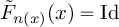
We need the following refinement of the results above, which is the aim of this section.
Theorem 6.8. Let
$d\geq 2$
 . Suppose that
$(\boldsymbol {E},X,F,f)$
 is a d-dimensional volume-preserving cocycle with transitions that stably does not admit any dominated splitting. Then, for every
$\epsilon>0$
 and
$N\in \mathbb {N}$
 there is a volume-preserving cocycle
$\tilde {F}$
 over f and periodic points
$p_1,\ldots ,p_N$
 for f with disjoint orbits such that
$d_{\mathcal {C}^0}(F,\tilde {F})<\epsilon $
 and for every
$1\leq i \leq N$
 ,
$\tilde {F}_{n(p_i)}(p_i)=\mathrm {Id} $
 .
Proof of Theorem 6.8
The assumption that the cocycle
$(\boldsymbol {E},X,F,f)$
 stably does not admit dominated splitting guarantees that there exists
$\delta _0>0$
 such that for every continuous volume-preserving cocycle
$\hat {F}$
 over f, if
$d_{\mathcal {C}^0}(F,\hat {F})<\delta _0$
 , then
$(\boldsymbol {E},X,\hat {F},f)$
 does not admit dominated splitting.
The proof is obtained by induction. The base case
$N=1$
 follows from Corollary 6.7. Now, suppose that the assertion holds for
$N-1$
 , that is, for every
$\epsilon>0$
 , there exists volume-preserving cocycle
$F^{(N-1)}$
 over f with
$d_{\mathcal {C}^0}(F^{(N-1)},F)<\epsilon $
 and
$(\boldsymbol {E},X,F^{(N-1)},f)$
 contains
$N-1$
 periodic points
$p_1,\ldots ,p_{N-1}$
 such that for every
$i=1,2,\ldots ,N-1$
 ,
$F^{(N-1)}_{n(p_i)} (p_i)=\mathrm {Id} $
 . We aim to prove the statement for N. Fix
$\epsilon>0$
 and let
$\delta _1:=\mathrm {min}\{\epsilon ,\delta _0\}/3$
 . (Note that in this proof
$F^{(i)}$
 denotes the perturbations of cocycle F and should not be mistaken with
$F_i$
 that corresponds to iterations of the cocycle.)
For every
$i=1,2,\ldots ,N-1$
 , consider the map
$\Theta _i :\mathrm {SL}(d,\mathbb {R})\to \mathrm {SL}(d,\mathbb {R}) $
 defined by

It is easy to see that
$\Theta _i$
 is an open map. Since we can approximate
$\mathrm {Id}$
 matrix with hyperbolic matrices, for every
$1\leq i \leq N-1$
 , there exists
$D_i\in \mathrm {SL}(d,\mathbb {R})$
 ,
$\delta _1$
 close to
${F}^{(N-1)} (f^{n(p_i)-1}(p_i))$
 such that
$\Theta _i(D_i)$
 is a hyperbolic matrix. Thus, applying Lemma A.5 with K equal to the union of orbits of
$p_i$
 ’s (
$1\leq i \leq N-1$
 ), we find a volume-preserving cocycle
$\tilde {F}^{(N-1)}$
 over f with
$d_{\mathcal {C}^0}(\tilde {F}^{(N-1)},{F}^{(N-1)})<\delta _1$
 such that for every
$1\leq i\leq N-1$
 ,

By this way of extension, we conclude that
$\widetilde {F}^{(N-1)}_{n(p_i)}(p_i)=\Theta _i(D_i)$
 is hyperbolic for every
$i=1,\ldots ,N-1$
 . Then, for every
$1\leq i\leq N-1$
 consider the map
$ \Phi _i :\mathrm {SL}(d,\mathbb {R})^{n(p_i)-1}\to \mathrm {SL}(d,\mathbb {R}) $
 with

Clearly,
$\Phi _i$
 is an open map. Now, since the set of hyperbolic matrices is open in
$\mathrm {SL}(d,\mathbb {R})$
 (see Remark A.2), there exists
$\delta _2>0$
 such that for every cocycle H with
$d(H,\widetilde {F}^{(N-1)}) < \delta _2$
 , all the linear maps
$H_{n(p_i)}(p_i)$
 for
$i=1,\ldots ,N-1$
 are hyperbolic.
Let
$\delta _3<\mathrm {min}\{\delta _1,\delta _2\}$
 be a positive number. Using Corollary 6.7, there is volume-preserving cocycle
$\hat {F}^{(N)}$
 over f with
$d_{\mathcal {C}^0}(\hat {F}^{(N)},\widetilde {F}^{(N-1)})<\delta _3 $
 , and a periodic point
$p_N\in X$
 for f such that
$\hat {F}^{(N)}_{n(p_N)}(p_N)=\mathrm {Id} $
 . Note that since
$\delta _3<\delta _2$
 ,
${\widetilde {F}}^{(N)}_{n(p_i)}(p_i)$
 is hyperbolic for every
$1\leq i \leq N-1$
 . This, in particular, implies that
$p_N$
 is not contained in the orbits of
$p_i$
 ’s for
$i<N$
 .
Finally, Lemma A.5, for
$K:= \mathcal {O}(p_1)\cup \mathcal {O}(p_2)\cup \cdots \cup \mathcal {O}(p_N) $
 , implies that there exists a volume-preserving cocycle
${F}^{(N)}$
 over f with
$d_{\mathcal {C}^0}({F}^{(N)},\hat {F}^{(N)})<\epsilon $
 , such that
-
• ${F}^{(N)}|_{\mathcal {O}(p_N)}=\hat {F}^{(N)}|_{\mathcal {O}(p_N)}$
, -
• and for every $i=1,\ldots ,N-1$
,
${F}^{(N)}|_{\mathcal {O}(p_i)}={F}^{(N-1)}|_{\mathcal {O}(p_i)}$
.


This completes the proof of Theorem 6.8.
7 Proof of the dichotomy: domination vs. quasi-conformality
Throughout this section, all the cocycles are
$\mathrm {SL}(d,\mathbb {R})$
 cocycles, defined on the trivial d-dimensional vector bundle over the base dynamics
$\sigma :\Sigma _m\to \Sigma _m$
 .
This section is devoted to the proof of Theorems C and D. These two theorems are direct corollaries of the following Theorem.
Theorem 7.1. Assume that the cocycle
$(\sigma ,A)$
 does not admit any dominated splitting. Then, for every
$\epsilon>0$
 , there exists a locally constant cocycle
$(\sigma ,\tilde {A})$
 with
$\|A-\tilde {A}\|_{\mathcal {C}^0}<\epsilon $
 such that
$(\sigma ,\tilde {A})$
 stably admits quasi-conformal orbits in the
$\mathcal {C}^\alpha $
 topology, that is for every
$\alpha $
 -Hölder map B, sufficiently close to
$\tilde {A}$
 in the
$\mathcal {C}^\alpha $
 topology,
$(\sigma ,B)\in \mathcal {Q}\mathcal {C}$
 .
This theorem provides the following dichotomy on approximating arbitrary Hölder continuous cocycles over the shift.
Corollary 7.2. Let
$(\sigma ,A)$
 be a Hölder continuous cocycle. Then, for any
$\epsilon>0$
 , there exists a Hölder continuous cocycle
$(\sigma ,\tilde {A})$
 such that
$\|A-\tilde {A}\|_{\mathcal {C}^0}<\epsilon $
 and
-
• either $(\sigma ,\tilde {A})$
admits a dominated splitting, -
• or $(\sigma,\tilde{A})$
stably admits quasi-conformal orbits in the
$C^{\alpha}$
topology.


7.1 Realization of arbitrary transitions
In this subsection, we give some results on realizing a family of given matrices as the transitions of a perturbation of cocycles admitting periodic orbits with the identity action on the fiber. We first state the results for the cocycles acting with identity on the fiber at fixed points, then generalize them to those acting as the identity along periodic orbits (on the period).
Proposition 7.3. Let
$m\geq 2$
 and
$(\sigma ,A)$
 be a locally constant
$\mathrm {SL}(d,\mathbb {R})$
 cocycle over the shift map
$\sigma :\Sigma _m\to \Sigma _m$
 such that A equals to the identity over the fixed points of
$\sigma $
 . Then, for every
$\epsilon>0$
 , and every
$S_1,S_2,\ldots ,S_{m-1}\in \mathrm {SL}(d,\mathbb {R})$
 , there exist
-
• a positive integer n,
-
• a locally constant $\mathrm {SL}(d,\mathbb {R})$
cocycle
$(\sigma,\tilde{A})$
depending on positions in with
$d_{\mathcal {C}^0}(\tilde {A},A)<\epsilon $
, -
• $\underline {w}_{i,j}\in T(\underline {p}_i, \underline {p}_j)$
for every
$i\neq j$
, where
$\underline {p}_i:=(\underbrace {i,i,\ldots ,i}_{2n+1})$
.


 with


such that for every
$1\leq i \leq m$


Remark 7.4. Note that equality in (7.1) is equality of multi-sets. In other words, if some of
$S_i$
 ’s are equal, both sets are the same when elements are counted with multiplicities.
We need the following well-known fact for connected Lie groups, usually called fragmentation property.
Lemma 7.5 [Reference KirillovKir17, Corollary 2.9]
If G is a connected Lie group and U is a neighborhood of the identity element, then U generates G.
Proof of Proposition 7.3
Let
$ l \in \mathbb {N} $
 be such that the cocycle
$ (\sigma ,A) $
 depends on the positions in
$ \mathbb {I}_l $
 . We aim to provide
$\tilde {A}$
 as a locally constant cocycle that depends on positions in
$ \mathbb {I}_n $
 for a sufficiently large
$ n> l $
 , which will be specified at the end of the proof.
Throughout the proof by
$A_{[{\underline {w}_{i,j}}\rangle }$
 we mean
$A_{[{2n+1;\underline {w}_{i,j}}\rangle }$
 and remove
$2n+1$
 in the notation for simplicity.
For every
$1\leq i \leq m$
 , let
$p_i:=(\ldots ,i;i,i,\ldots )$
 be the fixed point associated with
$\underline {p}_i$
 . For every distinct
$i,j\in \{1,\ldots ,m\}$
 define

Clearly,
$\underline {w}_{i,j}$
 gives a transition from
$\underline {p_i}$
 to
$\underline {p_j}$
 . For every
$1\leq i, j \leq m$
 and
$1\leq k \leq 2n$
 , let
$\phi ^{(k)}_{i,j}\in \mathrm {SL}(d,\mathbb {R})$
 be such that

A transition following a homoclinic point. On grey regions, the cocycle is identity. The dashed rectangle is zoomed in the next figure.

Figure 3 Long description
A line drawing on a white background features two large grey squares representing regions where the cocycle is identity.
* The first grey square is in the bottom-left. It is centered on a coordinate cross with arrows pointing inward along the vertical axis and outward along the horizontal axis. A small vertical rectangle sits on the right edge of this square.
* A series of curved arrows points from this rectangle to the right, hopping through two smaller vertical rectangles.
* An ellipsis indicates a continuation of this horizontal path.
* The path continues through three small square boxes on the horizontal axis, leading to a junction where the horizontal axis meets a vertical axis.
* At this junction, curved arrows transition the flow from the horizontal axis to a vertical upward direction.
* The upward path moves through two small square boxes, separated by another vertical ellipsis.
* The final curved arrow points into a dashed rectangle located at the bottom of the second large grey square in the top-right.
* This second grey square also features a coordinate cross with arrows pointing inward vertically and outward horizontally, mirroring the first square's structure.
Since
$A(p_i)=A(p_j)=\mathrm {Id} $
 , and A depends on positions in
 , for every k with
$k\leq n-l$
 or
$k\geq n+1+l$
 ,
$\phi ^{(k)}_{i,j}=\mathrm {Id} $
 . Hence,

For every
$1\leq i \leq m$
 , let
$\{D_{i,j}:1\leq j \leq m, j\neq i\}$
 be an arbitrary permutation of
$S_1,\ldots ,S_{m-1}$
 . One can apply Lemma 7.5 to each
$(A_{[{\underline {w}_{i,j}}\rangle })^{-1}D_{i,j}$
 (
$1\leq i ,j\leq m$
 ,
$i\neq j$
 ), and obtain
$n_{i,j}\in \mathbb {N}$
 and an
$n_{i,j}$
 -tuple
$(D^{(1)}_{i,j},\ldots ,D^{(n_{i,j})}_{i,j})$
 of elements of
$\mathrm {SL}(d,\mathbb {R})$
 ,
$\epsilon $
 -close to
$\mathrm {Id}$
 such that for every
$1\leq i,j\leq m$
 with
$i\neq j$
 , and
$1\leq s \leq n_{i,j}$


Note that without loss of generality, one may assume that all the numbers
$n_{i,j}$
 have equal value, say
$n_0$
 . Indeed, for given
$n_0>\max \{n_{i,j}\}$
 , one can define
$D^{(s)}_{i,j}=\mathrm {Id}$
 for
$n_{i,j}<s\leq n_0$
 . By this definition, all the properties listed in (7.2) hold. Now, we take
$n:=n_0+l$
 and define
$\tilde {A}:\Sigma _m\to \mathrm {SL}(d,\mathbb {R})$
 depending on positions in
 such that for every
$1\leq i,j\leq m$
 and
$1\leq k \leq n-l$
 ,

and for all other cylinders
$\mathsf {C}[-n;\underline {a}]$
 with
 ,
$\tilde {A}|_{\mathsf {C}[-n;\underline {a}]}:=A|_{\mathsf {C}[-n;\underline {a}]}$
 . We claim that
$\tilde {A}$
 satisfies all the required conditions. First note that since all the matrices
$D_{i,j}^{(s)}$
 are
$\epsilon $
 -close to the identity,
$d_{\mathcal {C}^0}(A,\tilde {A})<\epsilon $
 . On the other hand, for every
$1\leq i,j\leq m$
 with
$i\neq j$
 ,

Hence, by definition of
$D_{i,j}$
 ’s, for every
$1\leq i\leq m$
 ,

This completes the proof of the proposition.
Realization of arbitrary transition matrix in an identity region. The perturbed cocycle in each red region is a matrix near the identity, whose product can be an arbitrary element of
$\mathrm {SL}(d,\mathbb {R})$
 , while on the dark grey region, it remains identity.

Proposition 7.6. Let
$(\sigma , A)$
 be a locally constant
$\mathrm {SL}(d,\mathbb {R})$
 cocycle over the full shift on finitely many symbols such that there exist periodic points
$p_1,p_2,\ldots ,p_m$
 with disjoint orbits such that for every
$i=1,\ldots ,m$
 ,
$A_{n(p_i)}(p_i)=\mathrm {Id}$
 .
Then, for every
$\epsilon>0$
 , and every
$S_1,S_2,\ldots ,S_{m-1}\in \mathrm {SL}(d,\mathbb {R})$
 , there exist
-
• positive integers $n,k$
, -
• a locally constant $\mathrm {SL}(d,\mathbb {R})$
cocycle
$(\sigma ,\tilde {A})$
depending on positions in with
$d_{\mathcal {C}^0}(\tilde {A},A)<\epsilon $
, -
•
so that
$p_i$
is the periodic point associated to
$\underline {a}_i$
. -
• $\underline {w}_{i,j}\in T(\underline {a}_i, \underline {a}_j)$
for every
$i\neq j$


 with

 so that


such that for every
$1\leq i \leq m$


Proof. Take
$N:=|\underline {a}_1|.|\underline {a}_2|\cdots |\underline {a}_m|$
 . For every
$i=1,\ldots ,m$
 , let

Then,
$\underline {p}_i$
 is the periodic point associated to
$\underline {b}_i$
 . Note that for every
$i=1,\ldots ,m$
 ,
$A_N(p_i)=\mathrm {Id}$
 , as N is divisible by
$n(p_i)$
 . Define the locally constant cocycle
$B:\Sigma _m\to \mathrm {SL}(d,\mathbb {R})$
 by

Note that since A is locally constant, there exists
$T \in \mathbb {N}$
 such that A depends on positions in
 . Therefore, the cocycle B depends on positions in
 . Moreover, denoting
$p^{\prime }_i=(\ldots i; i, i, i,\ldots )$
 , we have
$B(p^{\prime }_i)=A_N(p_i)=\mathrm {Id}$
 for every
$i=1,\ldots ,m$
 .
Now, B satisfies all the conditions of Proposition 7.3 and by this proposition, there exists
$n'\in \mathbb {N}$
 , a continuous cocycle
$\tilde {B}:\Sigma _m\to \mathrm {SL}(d,\mathbb {R})$
 with
$d_{\mathcal {C}^0}(\tilde {B},B)<\epsilon \|A\|^{-Nd}$
 depending on positions in
 , and transitions
$\underline {w}^{\prime }_{i,j}$
 from
$(i,i,\ldots ,i)\in \mathcal {A}^{2n'+1}$
 to
$(j,j,\ldots ,j)\in \mathcal {A}^{2n'+1}$
 such that

Now, we define the cocycle
$\tilde {A}$
 .
-
• For any point x in a cylinder of the form $\mathsf {C}[-Nn';\underline {a}_{j_{-n'}}\ldots \underline {a}_{j_0}\ldots \underline {a}_{j_{n'}}]$
, let
$\tilde {x}$
be a point in
$\mathsf {C}[-n';(j_{-n'},\ldots; j_{0},\ldots ,j_{n'})]$
and set $$\begin{align*}\tilde{A}(x):=\tilde{B}(\tilde{x})B(\tilde{x})^{-1}A(x).\end{align*}$$
Note that the definition is independent of the choice of
$$ \begin{align*}\tilde{x}\in \mathsf{C}[-n';(j_{-n'},\ldots; j_{0},\ldots,j_{n'})]\end{align*} $$as both $B,\tilde {B}$
are constant on this cylinder.
-
• For all other point x, define $\tilde {A}(x):=A(x)$
.


We claim that this definition satisfies all the required properties for
$\tilde {A}$
 .
$\bullet \tilde {A}$
 is locally constant. It is clear from the definition that
$\tilde {A}$
 is a locally constant cocycle depending on positions in
 .
$\bullet $
 $ {d_{\mathcal {C}^0}(A,\tilde {A})<\epsilon }$
 . We only need to check that for any element x of a cylinder of the form
$\mathsf {C}[-Nn';\underline {a}_{j_{-n'}}\ldots \underline {a}_{j_0}\ldots \underline {a}_{j_{n'}}]$
 ,
$\|A(x)-\tilde {A}(x)\|<\epsilon $
 (otherwise
$A=\tilde {A}$
 ). For such x,

Hence, as we know
$d_{\mathcal {C}^0}(B,\tilde {B})<\epsilon \|A\|^{-Nd}$
 ,

where the upper bound for
$\|B(\tilde {x})^{-1}\|$
 comes from the fact that for every
$D\in \mathrm {SL}(d,\mathbb {R})$
 ,
$\|D^{-1}\|\leq \|D\|^{d-1}$
 .
$\bullet $
 Transitions. If
$\underline {w}^{\prime }_{i,j}=(j_1,\ldots ,j_n)$
 , then define

Then,
$\tilde {A}|_{[k;\underline {w}_{i,j}\rangle }=\tilde {B}|_{[2n'+1;\underline {w}^{\prime }_{i,j}\rangle }$
 , where
$k=(2n'+1)N$
 . This completes proof due to (7.4).
Corollary 7.7. Let
$\ell>d^2$
 and
$(\sigma ,A)$
 be a locally constant
$\mathrm {SL}(d,\mathbb {R})$
 cocycle over the full shift on finitely many symbols such that there exist periodic points
$p_1,p_2,\ldots ,p_\ell $
 with disjoint orbits such that
$A_{n(p_i)}(p_i)=\mathrm {Id}$
 , for every
$i=1,\ldots ,\ell $
 . Then, for every
$\epsilon>0$
 , there exists a locally constant cocycle
$(\sigma ,\tilde {A})$
 with
$d_{\mathcal {C}^0}(\tilde {A},A)<\epsilon $
 satisfying covering condition.
Proof. It suffices to take
$S_1,S_2,\ldots ,S_{\ell -1}$
 in Proposition 7.6 as the family given by Lemma 4.2. We know that for this family, there exists a non-empty open subset
$\mathcal {U}\subset \mathrm {SL}(d,\mathbb {R})$
 with compact closure such that

Then, according to Proposition 7.6, one can perturb A in the
$\mathcal {C}^0$
 topology to get a cocycle
$\tilde {A}$
 such that
$(\sigma ,\tilde {A})$
 satisfies the covering condition.
7.2 Proof of Theorem 7.1
This subsection is dedicated to the proof of Theorem 7.1.
We begin with the following lemma, which asserts that arbitrary
$\mathcal {C}^0$
 -close to every continuous cocycle, it is possible to find a locally constant cocycle whose values equal the original cocycle at a predetermined finite set of points. The proof is simple and is left to the reader.
Lemma 7.8. Let
$(\sigma ,A)$
 be a continuous cocycle over the shift map
$\sigma :\Sigma _m\to \Sigma _m$
 and
$K\subset \Sigma _m$
 be a finite set. Then, for every
$\epsilon>0$
 , there exists a locally constant map
$B:\Sigma _m\to \mathrm {SL}(d,\mathbb {R})$
 such that
$d_{\mathcal {C}^0}(A,B)<\epsilon $
 and
$B|_K=A|_K$
 .
Now, we have all the ingredients to provide the proof of Theorem 7.1.
Proof of Theorem 7.1
The proof is based on the combination of Corollary 6.6, Theorem 6.8, Lemma 7.8, Corollary 7.7 and Theorem 5.5.
According to Corollary 6.6, we can assume that
$(\sigma ,A)$
 stably does not admit dominated splitting. Now, it follows from Theorem 6.8 with
$N=d^2$
 that there exists a cocycle
$A^{(1)}$
 with
$d_{\mathcal {C}^0}(A^{(1)},A)<\epsilon /3$
 and periodic points
$p_1,\ldots ,p_N$
 (with disjoint orbits) such that for
$i=1,\ldots ,N$
 that
$A^{(1)}_{n(p_i)}(p_i)=\mathrm {Id}$
 .
Then, applying Lemma 7.8 to
$A^{(1)}$
 for K equal to union of orbits of
$p_i$
 ’s, we get a locally constant cocycle
$A^{(2)}$
 with
$d_{\mathcal {C}^0}(A^{(2)},A^{(1)})<\epsilon /3$
 such that for
$i=1,\ldots ,N$
 ,
$A^{(2)}_{n(p_i)}(p_i)=\mathrm {Id}$
 .
Finally, by Corollary 7.7, there exists a locally constant cocycle
$A^{(3)}$
 with

satisfying the covering condition with respect to some open set
$\mathcal {U}\subset \mathrm {SL}(d,\mathbb {R})$
 with compact closure. Hence,
$d_{\mathcal {C}^0}(A^{(3)},A)<\epsilon $
 and by Theorem 5.5, for every
$\alpha>0$
 , every cocycle sufficiently
$\mathcal {C}^\alpha $
 -close to
$(\sigma ,A^{(3)})$
 admits quasi-conformal orbits.
8 Further comments and questions
8.1 Iterated Function Systems
It is natural to expect a dichotomy similar to Theorem C to hold for Iterated Function Systems (IFS) generated by generic pairs (or n-tuples) of matrices in
$\mathrm {SL}(d,\mathbb {R})$
 . This can be seen as the first step toward understanding the behavior of generic cocycles with high regularity.
Question 8.1. Let
$n \geq 2$
 , and
$(H_1, \dots , H_n)$
 be a generic n-tuple of matrices in
$\mathrm {SL}(d,\mathbb {R})$
 . Assume that the IFS generated by
$H_1, \dots , H_n$
 has no bounded orbit branch. Does the IFS exhibit uniform exponential growth? Does it admit a dominated splitting?
Recall that the IFS generated by
$H_1, \dots , H_n$
 does not have a bounded orbit branch if for every
$j_1,j_2,\ldots \in \{1,2,\ldots ,n\}$
 , the sequence
$\|H_{j_k}\cdots H_{j_1}\|$
 diverges to infinity. Moreover, uniform exponential growth means that the matrices in the semigroup generated by
$H_1, \dots , H_n$
 grow uniformly exponentially with word length. More precisely, there exist
$C>0,\lambda >1$
 such that
$j_1,j_2,\ldots \in \{1,2,\ldots ,n\}$
 , the sequence
$\|H_{j_k}\cdots H_{j_1}\|>C\lambda ^k$
 .
We remark that Question 8.1 for
$d=2$
 has a positive answer due to the work of [Reference Avila, Bochi and YoccozABY10] (see also [Reference ChristodoulouChr22]). They show that if the semigroup generated by n-tuple
$(H_1,H_2,\ldots ,H_n)\in \mathrm {SL}(2,\mathbb {R})^n$
 does not contain any elliptic elements, after a sufficiently small perturbation of the generators, the action of matrices on
$\mathbb {R}^2$
 , leaves a multi-cone invariant. By a multi-cone, we mean a union of finitely many closed cones in
$\mathbb {R}^2$
 whose mutual intersection is only the origin. The existence of an invariant multi-cone implies the uniform exponential growth of norms for the cocycle. For the case
$d=3$
 , see [Reference Carvajales, Lessa and PotrieCLP24], where related questions about finitely generated subgroups of
$\mathrm {SL}(3,\mathbb {R})$
 are investigated.
8.2 Stability in low regularity
The analysis in the proof of our main theorems regarding
$\mathcal {C}^\alpha $
 stability of bounded behavior (cf. Section 5) relied crucially on Hölder estimates. Thus, asking questions regarding the prevalence of cocycles with stable quasi-conformality in
$\mathcal {C}^0$
 regularity is natural.
Question 8.2. Let
$d>2$
 . Does there exist an
$\mathrm {SL}(d,\mathbb {R})$
 cocycle which
$C^0$
 stably exhibits bounded orbits?
Even though the answer to this question may depend on the base dynamics, we expect a negative answer for any base if
$d>2$
 . Corollary 3.6 provides a negative answer to this question for minimal bases. After the first version of this paper appeared on arXiv, Bochi [Reference BochiBoc25] announced a negative answer to this question for cocycles over homeomorphisms of zero-dimensional topological spaces having finitely many periodic points of any period. Indeed, he showed that for such base systems, generic
$\mathcal {C}^0$
 cocycles admit no quasi-conformal orbits. This, in particular, shows that the regularity in Theorem A is optimal. Note that for
$d=2$
 , the question has a positive answer when the base dynamics contain periodic points, as elliptic elements over periodic points (on the period) cannot be destroyed with small
$\mathcal {C}^0$
 perturbations.
8.3 Finer classification of general linear cocycles
We expect further refinement of Theorem B should be true.
Let
$\mathcal {V}^+$
 be the set of all uniformly volume expanding
$\operatorname {\mathrm {GL}}(d,\mathbb {R})$
 cocycles over SFT, that is, the set of all cocycles
$(\sigma ,A)$
 such that
$\inf _x |\det (A_n(x))|>1$
 for some
$n\in \mathbb {N}$
 .
Given
$(\sigma ,A) \in \mathcal {V}^+$
 , by Theorem B, either it admits a dominated splitting or is
$\mathcal {C}^0$
 -approximated by an
$\mathcal {C}^\alpha $
 open set of cocycles admitting
$\kappa $
 -quasi-conformal orbits for some
$\kappa>1$
 . Moreover, such orbits are uniformly expanding.
The same dichotomy holds in the set of all uniformly volume contracting
$\operatorname {\mathrm {GL}}(d,\mathbb {R})$
 cocycles over SFT, denoted by
$\mathcal {V}^-$
 , that is, the set of all cocycles
$(\sigma ,A)$
 such that
$\sup _x |\det (A_n(x))|<1$
 for some
$n\in \mathbb {N}$
 .
We expect a positive answer to the following question.
Question 8.3. Let
$\mathcal {B}$
 be the set of
$\operatorname {\mathrm {GL}}(d, \mathbb {R})$
 cocycles over subshift of finite type that admit bounded orbits. How big is the
$\mathcal {C}^\alpha $
 -interior of
$\mathcal {B}$
 ? Is it
$\mathcal {C}^0$
 -dense in the complement of
$\mathcal {D}\cup \mathcal {V}^-\cup \mathcal {V}^+$
 ?
Whenever a cocycle is far from being either uniformly volume contracting or uniformly volume expanding, there are simultaneously volume contracting and volume expanding orbits. In this case, if, in addition, the cocycle does not admit any dominated splitting, then by [Reference Bonatti, Díaz and PujalsBDP03] arguments (i.e. Proposition 6.5 and proof of Theorem 6.8) we can show that the cocycle is approximated by another cocycle with the same properties with several periodic points which are homothety at their periods. This is not enough to address Question 8.3, and one must show that the cocycle is approximated by another cocycle with the same properties and several periodic points, which are identity at their periods.
A Appendix
A.1 Generic properties of linear cocycles
In this section, we explain how a generic cocycle over the shift map behaves at periodic orbits. Indeed, we will prove that the iterations of a generic cocycle are unbounded on every periodic fiber.
Lemma A.1. For every
$m,d\in \mathbb {N}$
 with
$d>2$
 , for a generic m-tuple
$(A_1,A_2,\ldots ,A_m)$
 in
$ \mathrm {SL}(d,\mathbb {R})^m$
 , all the elements of the semigroup generated by
$A_1,\ldots ,A_m$
 are hyperbolic.
Proof. Fix a periodic word
$\underline {w} = (w_1, \dots , w_k) \in \mathcal {A}^{\mathrm {fin}}$
 , and consider the product map

We claim the set
$ \mathcal {H}_{\underline {w}} := \{ [W] \in \operatorname {\mathrm {SL}}(d,\mathbb {R})^m : P_{\underline {w}}[W] \text { is hyperbolic} \} $
 is open and dense in
$\operatorname {\mathrm {SL}}(d,\mathbb {R})^m$
 . Note that
$P_{\underline {w}}[W]$
 is hyperbolic if none of its eigenvalues lie on the unit circle. Now, define

It is a symmetric polynomial of the eigenvalues of
$P_{\underline {w}}[W]$
 . Hence, by the fundamental theorem of symmetric polynomials,
$h_{\underline {w}}[W]$
 is a polynomial in the entries of
$W_1, \dots , W_m$
 . One can easily show that its zero set corresponds to non-hyperbolic products.
This zero set is a proper real-algebraic subset of
$\operatorname {\mathrm {SL}}(d,\mathbb {R})^m$
 , because one can explicitly choose diagonal hyperbolic matrices (e.g.,
$W_i = \mathrm {diag}(2, 1/2, 1, \dots , 1)$
 ) such that
$P_{\underline {w}}[W]$
 is hyperbolic and
$h_{\underline {w}}[W] \neq 0$
 . Therefore,
$\mathcal {H}_{\underline {w}}$
 is open and dense. Finally, since
$\mathcal {A}^{\mathrm {fin}}$
 is countable, and for every
$\underline {w} \in \mathcal {A}^{\mathrm {fin}}$
 ,
$\mathcal {H}_{\underline {w}}$
 is open and dense, the set
$\bigcap \limits _{\underline {w}\in \mathcal {A}^{\mathrm {fin}}} \mathcal {H}_{\underline {w}}$
 is a generic set.
Remark A.2. For
$d> 2$
 , hyperbolic matrices form an open and dense subset of
$\operatorname {\mathrm {SL}}(d,\mathbb {R})$
 . When
$d = 2$
 , they are open but not dense; both hyperbolic and elliptic matrices are open, and their union is dense. Also, for
$d> 2$
 , the proof Lemma A.1 implies that, for almost every
$(A_1, \ldots , A_m)$
 in
$ \operatorname {\mathrm {SL}}(d,\mathbb {R})^m$
 (with the respect to the product of Haar measures), the semigroup
$\langle A_1, \ldots , A_m\rangle ^+$
 consists only of hyperbolic matrices.
The next proposition shows that in all regularities a typical
$\mathrm {SL}(d,\mathbb {R})$
 cocycle has only hyperbolic periodic fibers if
$d>2$
 .
Proposition A.3. Let X be a compact metric space and
$f:X\to X$
 be a homeomorphism with countably many periodic points. Also, let
$d> 2$
 and
$r\in [0,1]$
 . Then, every
$\mathcal {C}^r$
 generic
$\mathrm {SL}(d,\mathbb {R})$
 cocycle
$(f,A)$
 satisfies the following: For every periodic point p for f of period
$n(p)$
 , the matrix
$A_{n(p)}(p)$
 is hyperbolic.
Proof. For periodic point p, the set of cocycles
$(f,A)$
 for which
$A_{n(p)}(p)$
 is hyperbolic is open in the
$\mathcal {C}^0$
 topology (hence open in the
$\mathcal {C}^r$
 topology for every
$r\in [0,1]$
 ), since hyperbolic matrices are open in
$\operatorname {\mathrm {SL}}(d,\mathbb {R})$
 .
To show density in the
$\mathcal {C}^r$
 topology, assume
$A_{n(p)}(p)$
 is not hyperbolic. Since
$d>2$
 , one can easily construct a smooth path
$H_t \in \operatorname {\mathrm {SL}}(d,\mathbb {R})$
 with
$H_0 = \mathrm {Id}$
 and
$A_{n(p)}(p) H_t$
 hyperbolic for all
$t> 0$
 (see [Reference ReshadatRes25, Lemma 2.20] for the details). Let
$\psi : X \to [0,1]$
 be a
$\mathcal {C}^r$
 function with
$\psi (p) = 1$
 and
$\psi \equiv 0$
 outside an
$\epsilon $
 -neighborhood of p. Define
$ A^{(t)}(x) := A(x) H_{t\psi (x)}. $
 Then for small
$t> 0$
 ,
$A^{(t)}$
 is
$\mathcal {C}^r$
 -close to A and agrees with A outside
$\epsilon $
 -neighborhood of p. Also,
$\big (A^{(t)}\big )_{n(p)}(p) = A_{n(p)}(p) H_t$
 , which is hyperbolic. Finally, since the periodic points of f are countable, the conclusion follows by the Baire category theorem.
A.2 Extending a cocycle
This subsection concerns results on extending a linear cocycle defined on a proper subset to the ambient space X.
Lemma A.4. Let X be a normal topological space. Then, for every
$\epsilon>0$
 , there exists
$\delta>0$
 , such that for every compact subset
$K\subset X$
 , whenever
$A:X\to \mathrm {SL}(d,\mathbb {R})$
 ,
$\tilde {A}_K:K\to \mathrm {SL}(d,\mathbb {R})$
 are bounded continuous maps with
$\sup _{x\in K}\|A(x)-\tilde {A}_K(x)\|<\delta $
 , there exists continuous map
$\tilde {A}:X\to \mathrm {SL}(d,\mathbb {R})$
 satisfying

Proof. For
$1 \leq i, j \leq d$
 , write
$A_{i,j}$
 and
$\tilde {A}_{K,i,j}$
 for the entries of A and
$\tilde {A}_K$
 , respectively. Define
$H_{K,i,j} := \tilde {A}_{K,i,j} - A_{i,j}|_K$
 , which is continuous on the compact set K. By Tietze’s extension theorem, each
$H_{K,i,j}$
 extends to a continuous function
$H_{i,j}:X \to \mathbb {R}$
 with
$\sup _{x\in X} |H_{i,j}(x)|=\sup _{x\in K} |H_{K,i,j} (x)|$
 .
Let
$B_{i,j} := A_{i,j} + H_{i,j}$
 , and define the matrix-valued map
$B = (B_{i,j}): X \to \mathrm {M}_{d \times d}(\mathbb {R})$
 . Then B is continuous,
$B|_K = \tilde {A}_K$
 , and for sufficiently small
$\delta>0$
 , if
$\sup _{x\in K}\|A(x) - \tilde {A}_K(x)\|< \delta $
 , then for every
$x\in X$
 ,
$\|A(x) - B(x)\| < \epsilon /2$
 and
$|\det B(x)-1|<\epsilon /2$
 . Note that
$\det B(x)$
 is not necessarily equal to 1, so we can normalize B by defining

Now,
$\tilde {A}: X \to \mathrm {SL}(d,\mathbb {R})$
 is continuous and if
$\delta $
 is sufficiently small (depending on
$\epsilon $
 and
$\|A\|$
 ), then
$\sup _{x\in X}\|\tilde {A}(x) - A(x)\| < \epsilon $
 . On the other hand,
$\tilde {A}$
 coincides with A on K, as for every
$x\in K$
 ,
$B(x)=A(x)$
 and
$\det B(x)=1$
 .
Lemma A.5. Let
$(\boldsymbol {E},X,F,f)$
 be a continuous volume-preserving cocycle defined on a normal topological space X. Then, for every
$\epsilon>0$
 , there exists
$\delta>0$
 such that for every finite set
$K\subset X$
 , invariant under f and for every volume-preserving
$\delta $
 -perturbation (in the
$\mathcal {C}^0$
 topology) of F on K, denoted by
$\tilde {F}_K$
 , there is an
$\epsilon $
 -perturbation (in the
$\mathcal {C}^0$
 topology)
$\tilde {F}$
 of F such that
$\tilde {F}_K=\tilde {F}\vert _K$
 .
Proof. Let
$K = \{x_1, \dots , x_k\}$
 and choose small numbers
$r>r'>0$
 such that if
$U_i,U^{\prime }_i$
 denote the balls of radius of
$r,r'$
 around
$x_i$
 , respectively, then
$f(U^{\prime }_i) \subset \bigcup _j U_j$
 and the bundle
$\boldsymbol {E}$
 is trivialized over
$U_i$
 via homeomorphisms
$\phi _i$
 . Define
$U := \bigcup _i U_i$
 ,
$U' := \bigcup _i U^{\prime }_i$
 . Define
$\phi : U' \times \mathbb {R}^d \to \pi ^{-1}(U')$
 so that
$\phi =\phi _i$
 on
$U^{\prime }_i\times \mathbb {R}^d$
 . Using this trivialization, F corresponds to an
$\mathrm {SL}(d,\mathbb {R})$
 cocycle
$A: \overline {U'} \to \mathrm {SL}(d,\mathbb {R})$
 via

Given
$\epsilon> 0$
 , by Lemma A.4, there exists
$\delta> 0$
 such that any
$\delta $
 -perturbation
$\tilde {A}_K$
 of A on
$K \cup \partial U'$
 extends to a continuous map
$\tilde {A}: \overline {U'} \to \mathrm {SL}(d,\mathbb {R})$
 with
$\sup _{x\in \overline {U'}}\|\tilde {A}(x) - A(x)\| < \epsilon $
 . Now, given a
$\delta $
 -perturbation
$\tilde {F}_K$
 of F on K, define
$\tilde {A}_K$
 on K (via
$\phi $
 ) similar to (A.1) and set
$\tilde {A}_K = A$
 on
$\partial U'$
 . Then, apply Lemma A.4 to an extension
$\tilde {A}:\overline {U'} \mapsto \mathrm {SL}(d,\mathbb {R})$
 of
$\tilde {A}_K$
 and define
$\tilde {F}$
 by

It is straightforward to verify that
$\tilde {F}$
 satisfies all the required properties, completing the proof.
Acknowledgement
The authors would like to thank Jairo Bochi, Sylvain Crovisier, Abbas Fakhari, Enrique Pujals and Amin Talebi for useful conversations and comments. Z.R. would also like to express her gratitude to Pierre Berger for providing an opportunity to visit the Jussieu Institute, where part of this paper was written. The authors are also grateful to the anonymous referee for valuable comments which improved the exposition of the paper.
This work is partially supported by INSF grant no. 4001845. Z.R. was supported by the IMU Breakout Graduate Fellowships.
Competing interests
The authors have no competing interests to declare.
Data availability statement
Data sharing not applicable to this article as no datasets were generated or analysed.