1. Introduction
Considering the number of ships operating worldwide and the efforts of companies to find new contracts, maritime shipping can be considered a highly competitive industry (Trucco et al., Reference Trucco, Cagno, Ruggeri and Grande2008). Moreover, it is one of the most regulated industries, where companies constantly have to comply with legislation. At the same time, the influence of third parties, such as cargo owners, classification societies, insurers and banks, puts additional pressure on shipping companies (Goodwin et al., Reference Goodwin, Lamb and Kemp1983; Bennett, Reference Bennett2001; Chauvin, Reference Chauvin2011; Ríos and Baniela, Reference Ríos and Baniela2013; Fenstad et al., Reference Fenstad, Dahl and Kongsvik2016). The above conditions are often used as criteria for decision making (DeSombre, Reference DeSombre2008; Bhattacharya, Reference Bhattacharya2012a; Størkersen, Reference Størkersen2015). In an early study, Deming (Reference Deming1986) examined the influence of ‘top management’ decisions, i.e., allocation of resources, development of policies, work methods implementation, and found their responsibility in 94% of the cases studied.
Driven by an alarming number of maritime accidents and incidents in the twentieth century, the International Maritime Organisation responded by implementing the International Safety Management (ISM) Code. The aim of ISM is to promote and improve the safety culture in the maritime industry (Anderson, Reference Anderson2003). Accordingly, the ISM Code states that each shipping company must develop and implement a safety management system (‘SMS’) to improve maritime safety. In other words, self-regulation was introduced into the industry. Following the goal of ISM – the development of a safety culture –, numerous studies have been conducted with results indicating that such a safety culture has not been widely adopted (e.g., Bhattacharya, Reference Bhattacharya2012b; Batalden and Sydnes, Reference Batalden and Sydnes2014; Teperi et al., Reference Teperi, Lappalainen, Puro and Pertulla2019).
Lappalainen (Reference Lappalainen2008) states that the foundation of ISM is largely based on the philosophy of total quality management and at the same time stresses the importance of management commitment and empowerment of personnel to achieve continuous improvement.
Numerous studies investigating the causes of marine casualties and incidents have found that the root cause was often human error and management mistakes (Hetherington et al., Reference Hetherington, Flin and Mearns2006; Kujala et al., Reference Kujala, Hänninen, Arola and Ylitalo2009; Tzannatos, Reference Tzannatos2010; Chauvin, Reference Chauvin2011). In addition, the issue of human factor and related organisational behaviour was explored by Trucco et al. (Reference Trucco, Cagno, Ruggeri and Grande2008) and a link between economic pressure and maritime accidents was found. Kuronen and Tapaninen (Reference Kuronen and Tapaninen2010) examined the issue of maritime legislation and found that the problem with the legislation is that no effective measures have been found to address the human factor. According to the available statistical data, in the period 2011 to 2018, the main causes of all reported accidents and incidents were inadequate human actions (65⋅8%), followed by system/equipment failures (20%) (EMSA, 2019). This suggests that the findings of Kuronen and Tapaninen (Reference Kuronen and Tapaninen2010) are still valid. The same authors (Kuronen and Tapaninen, Reference Kuronen and Tapaninen2010) state that the potential for improving maritime safety is more likely to be found in ‘spontaneous activities of shipping companies’ rather than in legal measures. Furthermore, additional potential can also be found in competence regimes, appropriate employment conditions for seafarers and manning levels of ships. Although the proposed safety measures sound reasonable, they all have an additional ‘price tag’ that may be unacceptable to some shipping companies. According to Størkersen et al. (Reference Størkersen, Antonsen and Kongsvik2017), the ISM Code can be considered as a ‘counterforce to a global competitive market’, but at the same time ‘cost efficiency’ remains a factor of paramount importance for shipping companies.
According to the literature, positive safety climates have a crucial role in improving workplace safety (Nahrgang et al., Reference Nahrgang, Morgeson and Hofmann2011). Moreover, management commitment to safety is considered the most important dimension of safety climate and a leading indicator of employee safety behaviour in various industries (Zohar, Reference Zohar2000; Abudayyeh et al., Reference Abudayyeh, Fredericks, Butt and Shaar2006; Zohar and Luria, Reference Zohar and Luria2010; McGonagle et al., Reference McGonagle, Essenmaacher, Hamblin, Luborsky, Upfal and Arnetz2016). Furthermore, management commitment is the most important factor in distinguishing safe and unsafe organisations (Kjellén, Reference Kjellén1982). According to McGonagle et al. (Reference McGonagle, Essenmaacher, Hamblin, Luborsky, Upfal and Arnetz2016), management commitment can be defined as ‘managers’ demonstrated value of and commitment to workers’ physical safety’ (p. 46).
Hamid et al. (Reference Hamid, Abdullah, Asmoni, Lokman and Shaari2015) conducted a literature review on the construct of management commitment to safety and found 19 elements related to occupational safety and health. Fruhen et al. (Reference Fruhen, Griffin and Andrei2018) found six categories of behavioural safety commitment in their study; four involved interactions with employees, while two involved practices without direct contact.
Perceptions of management safety commitment could represent cues through which employees create expectations about their values, beliefs and related behaviours (Bandura, Reference Bandura1986; McDougall et al., Reference McDougall, Covin, Robinson and Herron1994; Chauvin, Reference Chauvin2011; Ríos and Baniela, Reference Ríos and Baniela2013). Such perceptions may lead not only to compliance behaviours, but also to activities unrelated to formal requirements (Baniela and Ríos, Reference Baniela and Ríos2010; Ye et al., Reference Ye, Ren, Li and Wang2020). Hayes et al. (Reference Hayes, Perander, Smecko and Trask1998) found that management safety practises may be the best predictor of safety compliance. In addition, differences in individual perceptions may predict workplace safety (Hoffman et al., Reference Hoffman, Burke and Zohar2017).
McFadden et al. (Reference McFadden, Henagan and Gowen2009) concluded that top managers should prioritise safety and allocate the necessary resources to safety initiatives to achieve maximum safety outcomes. Griffin and Curcuruto (Reference Griffin and Curcuruto2016) noted that employee safety behaviour is often conceptualised as a key safety outcome. According to EMSA (2019), safety awareness was the leading contributing factor for all inadequate human actions.
Previous research looking at management safety commitment in the maritime industry showed that shipping companies prioritise safety when it is mandated (Bhattacharya, Reference Bhattacharya2012a; Lappalainen et al., Reference Lappalainen, Kuronen and Tapaninen2014). Furthermore, some organisations openly report that safety measures not directly related to regulatory requirements are unaffordable to them (Størkersen et al., Reference Størkersen, Antonsen and Kongsvik2017).
The results of previous studies have shown that safety management commitment can influence safety behaviour. Furthermore, the studies show that the allocation of safety-related resources is largely dependent on the economic conditions under which shipping companies operate and that the potential improvement of safety on board can be achieved through ‘spontaneous activities of shipping companies’.
The aim of this study is therefore to investigate the influence of general organisational resource-related safety orientation, additional spontaneous resource-related activities (programmes) and other exploratory variables on safety behaviour.
2. Methodology
A qualitative-quantitative methodological approach was used for this study; open-ended interviews were conducted to gain a deeper insight into the current situation in the maritime industry, followed by a questionnaire survey distributed to professional seafarers. Two separate exploratory analyses were conducted to uncover the underlying factor structure. In addition, several other analyses were conducted to test the applicability of the variables used. Finally, three hierarchical multiple analyses were conducted to estimate the influence of the independent variables on the dependent variables.
2.1 Interviews
For the purpose of this study, a series of open-ended interviews were conducted with 35 professional seafarers, particularly with regard to their company's safety orientation, i.e., the company's willingness to allocate resources to safety and to additional ‘spontaneous activities’. Spontaneous activities refer to safety incentives, which can be defined as techniques that provide employees with additional rewards to improve safety outcomes (Haines et al., Reference Haines, Merrheim and Roy2001). Such rewards can vary in type (financial and non-financial), amount and frequency, and can be collective or individual (Neagoe and Klein, Reference Neagoe and Klein2009). Baştuğ et al. (Reference Baştuğ, Asyali and Battal2021) suggest that, in addition to payments or bonuses, companies can offer long-term contracts for seafarers or organise entertainment events, such as an Employee of the Month competition, to encourage and motivate seafarers.
The responses received show that there is no uniformity in organisational behaviour; the extremes in organisational behaviour in relation to the allocation of safety resources persist. Some of the shipping companies do not care excessively about costs when it comes to safety, while other companies invest minimal resources to meet safety requirements. The biggest differences in observed organisational actions were found in the additional safety incentives (programmes). Some companies offer their employees the opportunity to further their education and/or attend additional training courses, with all associated costs covered. In addition, the level of education of employees emerged as an important element in the interviews; shipping companies prefer individuals with a higher level of education when it comes to initial recruitment and further career development.
Although the responses received might indicate different perceptions of safety on board, 34 respondents rated the level of safety on board as ‘good’, while only one described it as ‘questionable’. None of the respondents reported a recent experience of accidents or incidents on board. The responses indicate that the perception of organisational readiness to provide resources had no visible influence on the respondents’ perception of the level of safety on board.
2.2 Recruitment of respondents
In order to reach the desired population of seafarers, approved training institutions in Dubrovnik, Split, Šibenik and Rijeka (Republic of Croatia) were contacted and permissions for the distribution of the questionnaire were obtained. Before the questionnaires were distributed, respondents were informed about the purpose of the survey; it was emphasised that participation in the survey was voluntary and anonymity was guaranteed for all participants. In order to participate in the survey, a completed tour of duty on board, regardless of rank, was set as a minimum requirement. The administration and collection of the questionnaires was carried out by the authors. No incentives of any kind were offered to the respondents.
2.3 Measures
The measures used in this study were selected following a review of the scientific literature. To gain a deeper insight into the company's perceived safety orientation and willingness to make additional safety investments, six statements were selected from generic safety climate questionnaires (LSCAT; Zohar and Luria, Reference Zohar and Luria2005). The focus of the statements used for this study was on the company's willingness to commit resources to improve safety on board. Based on the interviews conducted, two key statements stood out. Individuals reported that their companies encourage all employees to continue with their education, while bearing the brunt of the costs. In addition, some of the companies bear all the costs arising from additional training (shore-based courses). Therefore, two additional statements were produced and included in the questionnaire: ‘The Company strongly encourages and financially supports personnel education (e.g. University attendance)’ and ‘The Company encourages and financially supports additional training (shore-based courses)’. Among the items related to safety behaviour, 14 statements were selected from the literature (Huang et al., Reference Huang, Zohar, Robertson, Gareabet, Lee and Murphy2013; LSCAT; Mišković et al., Reference Mišković, Jelaska and Ivče2019). All statements used in the questionnaire were subsequently translated into Croatian, which resulted in minor modifications to the wording of some statements. This was the form in which the questionnaire was offered to respondents. In the final stage, the statements were again translated into English. The translation process was carried out by the authors and an English language expert. The content validity of the measures used in the questionnaire was confirmed by a literature review, i.e., the measures used in this questionnaire were based on items used in previous studies.
For all statements, a five-point Likert scale (1 = strongly disagree to 5 = strongly agree) was offered and respondents were asked to indicate their level of agreement. In addition, three statements were reverse scored to facilitate the screening process. At a later stage, all reverse-scored statements were recoded to match the scale.
2.4 Survey sample
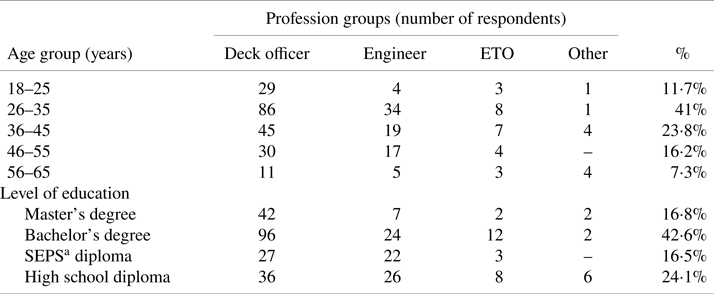
Completed questionnaires were received from 413 respondents. All responses were screened to identify possible outliers. The screening process resulted in 98 responses being discarded; the total number of accepted responses was n = 315. All respondents were of Croatian nationality and most of them were members of multinational ship crews. The demographic variables included in the questionnaire were: age, respondent's profession, level of education, length of sea service achieved and type of ship on which they are employed. Regarding respondent's profession, the majority reported being deck officers (63⋅8%), followed by engineers (25⋅1%), electro-technical officers (ETO) (7⋅9%) and other professions (3⋅2%). Regarding the length of sea service achieved, the distribution was: <1 year (12⋅4%), 1–5 years (23⋅2%), 6–10 years (21⋅3%), 11–15 years (11⋅4%) and >15 years (31⋅7%) of the respondents. Regarding the type of vessel on which the respondents work, the largest proportion (35⋅9%) declared tankers (crude, product, LNG, LPG), followed by container vessels (22⋅2%), passenger vessels (15⋅9%), bulk carriers, general cargo and Ro-Ro (15⋅5%) and other types of vessels (10⋅5%). A summary of the other demographic variables: profession, age and level of education is shown in Table 1.
Summary of the other demographic variables

Note: aSEPS (Special Education Program for Seafarers): seafarers who have obtained a high school diploma (maritime-technical) and 36 months of on-board service have the opportunity to pursue further education (two semesters) at university, enabling them to take the exams and obtain the highest maritime titles (Captain, Chief Engineer and ETO).
2.5 Data analysis
In order to reduce the number of variables and determine the factor structure of the measures used, two separate exploratory factor analyses (EFA) were conducted (Field, Reference Field2009). Factor loadings below 0⋅5 were suppressed to ensure practical significance (Hair et al., Reference Hair, William, Babin and Anderson2014). Following the EFA analyses, bivariate correlation coefficients were calculated for all identified factors and demographic variables. Bivariate correlation is a statistical technique for determining relationships between two different variables (i.e., X and Y) that is commonly used in the social and behavioural sciences. The conclusions that can be drawn from bivariate correlation analysis are the direction of the relationship between two variables, the strength of the relationship, and its statistical significance. The assumptions underlying the hierarchical multiple regression analyses were tested. Three hierarchical multiple regression analyses were conducted to examine the influence of perceived company safety orientation and willingness to make additional safety investments on seafarers’ perceived safety behaviour. Other exploratory variables (age, education level and sea service) were entered in successive steps, followed by other independent variables. All variables entered in earlier steps were automatically included in the next steps. All statistical analyses were conducted using IBM SPSS 26.0.
3. Results
3.1 Exploratory factor analysis of safety orientation and additional safety investments variables
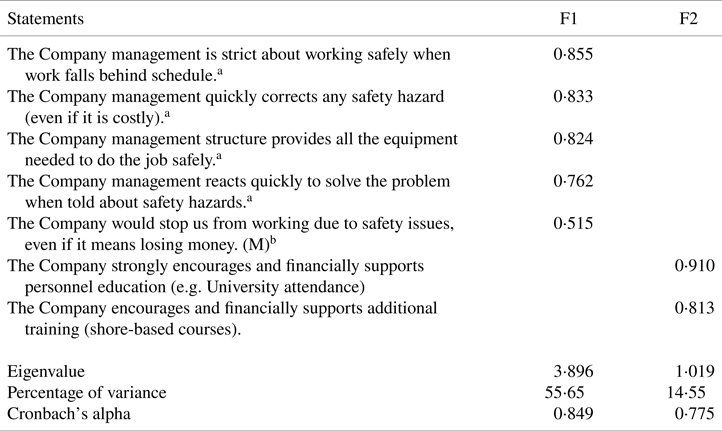
To examine the factor structure of eight statements related to perceived company safety orientation and willingness to make additional safety investments, all 315 responses were submitted to a principal component analysis with Varimax rotation. The Kaiser criterion was applied to determine the number of factors to be extracted; all factors with eigenvalues greater than one should be retained (Hair et al., Reference Hair, William, Babin and Anderson2014). Initial tests indicated that the items were suitable for factor analysis (Field, Reference Field2009); Bartlett's test of sphericity (approx. Chi-Square) was 1,111⋅564 (p < 0⋅001) and the Kaiser-Meyer-Olkin (KMO) sampling adequacy value was 0⋅863. The analysis revealed two components, while one item was found without loading. Therefore, the analysis was repeated without that item. The excluded item was: ‘Nowadays, the Company is more interested in safety than productivity’. The repeated analysis again resulted in two components, with five items loaded into the first component and two items loaded into the second component, explaining a total of 70⋅2% of variance (Table 2). Cronbach's alpha (>0⋅70) was used to assess the internal consistency and reliability of the construct, as recommended (Hair et al., Reference Hair, William, Babin and Anderson2014).
Factor analysis of company's safety orientation and readiness for additional safety investments related variables (n = 315)

Note: *M = Modified wording.
a Adopted from Zohar and Luria (Reference Zohar and Luria2005).
b Adopted and modified from LSCAT.
All five items contained in the first component related to the company's readiness for safety investments; therefore, it can be referred to as Company safety orientation. Two items contained in the second component were related to the company's readiness for additional safety investments; therefore, it can be referred to as Additional safety incentives.
3.2 Exploratory factor analysis of safety behaviour related variables
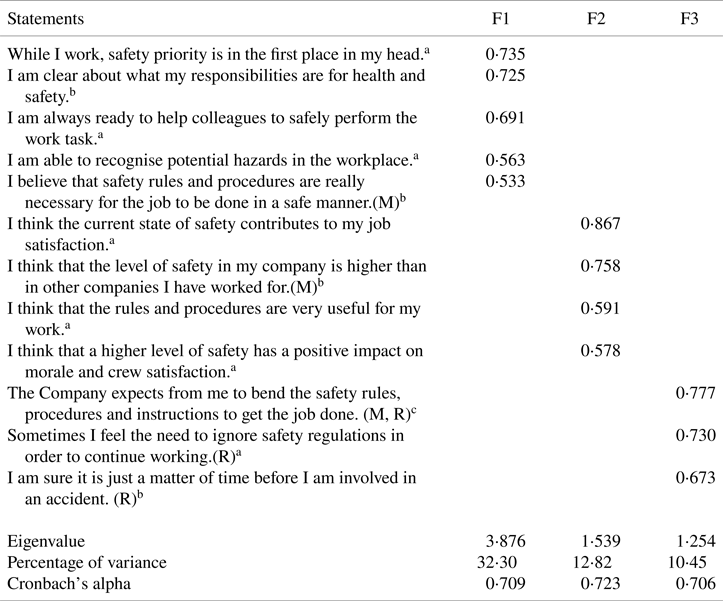
In order to detect the presence of meaningful patterns among the 14 safety behaviour related items (Table 3) and to summarise the information they contain, the same analysis criteria were set as in the abovementioned analysis. Initial tests indicated that the items were suitable for factor analysis; the Bartlett's test of sphericity (approx. Chi-Square) was 1,123⋅019 (p < 0⋅001) and the KMO sampling adequacy value was 0⋅823 (Field, Reference Field2009).
Factor analysis of safety behaviour related variables (n = 315)

Note: *M = Modified wording; R = (Reverse scored).
a Adopted from Mišković et al. (Reference Mišković, Jelaska and Ivče2019).
b Adopted and modified from LSCAT.
c Adopted and modified from Huang et al. (Reference Huang, Zohar, Robertson, Gareabet, Lee and Murphy2013).
Based on the set criteria, the analysis revealed three components with an eigenvalue greater than one as initial solution. In addition, two items were found without loadings. Therefore, the analysis was rerun excluding those items. The excluded items were: ‘We often remind each other that their actions/behaviours are not safe’ and ‘I think that compliance with rules and procedures plays a significant role in preventing accidents’. The final solution, consisting of three components explaining a total of 55⋅6% of variance, is shown in Table 3.
All five items contained in the first component related to perceived safety prioritisation, safety responsibility and readiness to comply with safety requirements; therefore, it can be referred to as Safety awareness. Four items contained in the second component were related to perceived safety level and job satisfaction; therefore, it can be referred to as Job satisfaction. Three items contained in the third component were related to perceived level of safety and readiness to violate safety rules; therefore, it can be referred to as Risk acceptance.
3.3 Bivariate correlation analysis
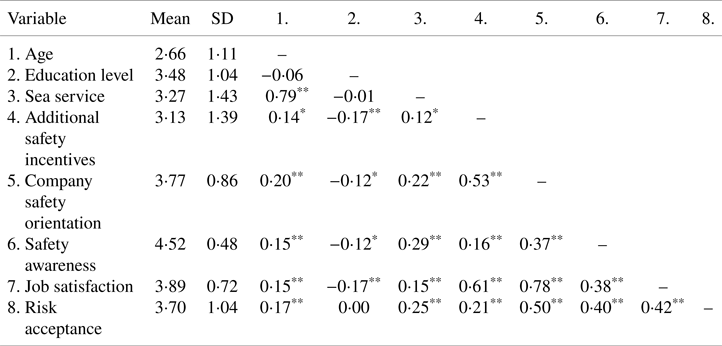
The results of the bivariate correlation analysis for three demographic variables and the variables from the EFA analyses, including means and standard deviations, are presented in Table 4.
Means, standard deviations and correlations between the variables

Note: *Correlation is significant at the 0⋅05 level (2-tailed).
** Correlation is significant at the 0⋅01 level (2-tailed).
Perceptions of Company safety orientation were found to have a strong positive correlation with perceptions of Additional safety incentives (r = 0⋅53, p < 0⋅01), a strong positive correlation between Job satisfaction and Additional safety incentives (r = 0⋅61, p < 0⋅01) and Company safety orientation (r = 0⋅78, p < 0⋅01), and a strong positive correlation between Risk acceptance and Company safety orientation (r = 0⋅50, p < 0⋅01).
3.4 Testing the assumptions
Assumptions for three hierarchical multiple regression analyses were tested. First, assumptions for linearity, homoscedasticity, and normally distributed residuals were checked by scatterplots and the plots of standardised residuals versus standardised predicted values, and it was found that all assumptions were met. The assumption of independent errors was checked using the Durbin-Watson test. Field (Reference Field2009) states that values less than one and greater than three indicate a problem (p. 236). The values obtained in all analyses were between 1⋅401 and 1⋅844, so that the assumptions were fulfilled. The assumption of no multicollinearity was tested using the variance inflation factor (VIF) and tolerance values. Tolerance values below 0⋅2 and VIF values above 10 are cause for concern, according to Field (Reference Field2009). The maximum VIF value determined was 2⋅664 and the minimum tolerance value was 0⋅375, indicating that there is no problem with multicollinearity. Furthermore, coefficients above 0⋅8 are warning signs of possible multicollinearity, according to Field (Reference Field2009). Therefore, the correlation matrix (Table 4) was examined and no coefficients above 0⋅8 were found. The assumption of no influential cases was checked by calculating Cook's distance; values greater than one have influence on the model (Field, Reference Field2009). The values obtained, ranging from 0⋅03 to 0⋅06, indicate that there are no influential cases in the data.
3.5 Predicting Safety Awareness
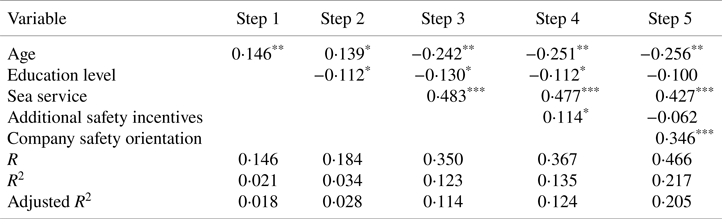
A hierarchical multiple regression analysis was conducted to examine the main effect of respondent's age, education level, sea service, perceived company readiness for Additional safety incentives and Company's safety orientation on Safety awareness. The independent variables were introduced into the analysis in successive steps, with Safety awareness as output variable. The results of the hierarchical regression analysis are shown in Table 5.
Hierarchical multiple regression analysis predicting Safety awareness. Standardised Beta coefficients

Note: *p < 0⋅05; **p < 0⋅01; ***p < 0⋅001.
In the first step, the regression analysis revealed that the age of the seafarers contributed significantly to the model and accounted for 1⋅8% of the variance in Safety awareness [F(1,313) = 6⋅795, p < 0⋅01]. In the second step, examining the effects of age and education level explained increased variance in Safety awareness by 1% [F(2,312) = 5⋅443, p < 0⋅01]. When the third variable, sea service, was introduced into the model, the amount of explained variance increased by 8⋅6% [F(3,311) = 14⋅477, p < 0⋅001]. In the fourth step, perceptions of Additional safety incentives were added to the model, increasing the amount of variance explained to 12⋅4% [F(4,310) = 12⋅085, p < 0⋅001]. In the last step, Company's safety orientation perceptions were added, which increased the explained variance in Safety awareness to 20⋅5% [F(5,309) = 17⋅163, p < 0⋅001]. The strongest predictor of Safety awareness in the model was the respondent's sea service.
3.6 Predicting Job Satisfaction
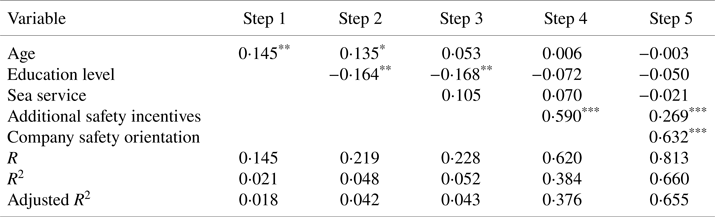
The results of the hierarchical regression analysis are presented in Table 6. The independent variables were included in successive steps to examine the main effect of respondent's age, education level, sea service, perceived company readiness for Additional safety incentives and Company safety orientation on Job satisfaction.
Hierarchical multiple regression analysis predicting Job satisfaction. Standardised Beta coefficients

Note: *p < 0⋅05; **p < 0⋅01; ***p < 0⋅001.
In the first step, the analysis revealed that respondent's age contributed significantly to the model [F(1,313) = 6⋅736, p < 0⋅01] and explained 1⋅8% of the variance in perceived Job satisfaction. Introducing the education level [F(2,312) = 7⋅835, p < 0⋅001] at the second step, and sea service [F(3,311) = 5⋅685, p < 0⋅001] at the third step, additional 2⋅4% and 0⋅1% of variance was explained. Additional safety incentives [F(4,310) = 48⋅370, p < 0⋅001] were introduced at the fourth step and company safety dedications [F(5,309) = 120⋅133, p < 0⋅001] in the last, fifth, step resulting in 65⋅5% variance explained. Although Company safety orientation was the strongest predictor of the Job satisfaction model, Additional safety incentives explained 5⋅4% more variance than Company safety orientation.
3.7 Predicting Risk Acceptance
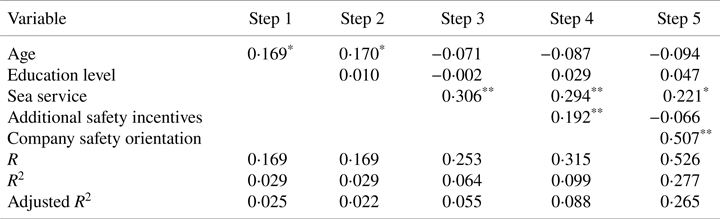
The results of the hierarchical regression analysis are presented in Table 7. As in the above analyses, independent variables are included in successive steps to examine the main effect of respondent's age, education level, sea service, perceived company readiness for additional safety incentives and company safety orientation on risk acceptance.
Hierarchical multiple regression analysis predicting Risk acceptance. Standardised Beta coefficients

Note: *p < 0⋅01; **p < 0⋅001.
Respondent's age, introduced in the first step, contributed to the model significantly [F(1,313) = 9⋅211, p < 0⋅01] explaining 2⋅5% of variance in the risk acceptance. When education level [F(2,312) = 4⋅606, p < 0⋅05] was introduced at the second step, 0⋅3% less variance was explained in the model. Introducing the sea service [F(3,311) = 7⋅111, p < 0⋅001] at the third step, the amount of explained variance increased to 5⋅5%. At the fourth step, Additional safety incentives [F(4,310) = 8⋅545, p < 0⋅001] was introduced in the model and an additional 3⋅3% of variance was explained. In the last, fifth step, Company safety orientation was added to the model [F(5,309) = 23⋅646, p < 0⋅001] explaining a total of 26⋅5% of variance. The perceived Company safety orientation was the strongest predictor of the Risk acceptance, explaining uniquely 17⋅7% of the variance in the model.
4. Discussion and conclusion
The focus of numerous studies has been on the success factors related to the implementation of the ISM Code, the development of safety systems and a safety culture, and the improvement of safety outcomes (Kuronen and Tapaninen, Reference Kuronen and Tapaninen2010; Bhattacharya, Reference Bhattacharya2012b; Batalden and Sydnes, Reference Batalden and Sydnes2014; Pantouvakis and Karakasnaki, Reference Pantouvakis and Karakasnaki2016; Karakasnaki et al., Reference Karakasnaki, Vlachopoulos, Pantouvakis and Bouranta2018; Mišković et al., Reference Mišković, Jelaska and Ivče2019; Teperi et al., Reference Teperi, Lappalainen, Puro and Pertulla2019; Baştuğ et al., Reference Baştuğ, Asyali and Battal2021).
This study differs from previous studies mainly in its approach to examine the influence of activities related to organisational safety resources on safety behaviour. Theoretically, the results of this study underscored the importance of appropriate resource allocation and the demographic characteristics of seafarers in improving shipboard safety outcomes.
4.1 Influence of organisational resource-related activities on safety behaviour
The Company's safety orientation had the strongest influence on Job satisfaction and Risk acceptance and the second level importance on Safety awareness. According to Schein (Reference Schein2004), budget planning indicates management's assumptions and beliefs about safety. These findings indicate the importance of safety-related resource allocation in the context of the maritime industry and are consistent with the finding that employees perceive adequate resource allocation as one of the most important safety motivators (Teperi et al., Reference Teperi, Lappalainen, Puro and Pertulla2019).
Additional safety incentives (programmes) were found to be a statistically significant predictor only for the perceived Job satisfaction model. For the models of Safety awareness and Rsk acceptance, the regression coefficients were rendered from statistically significant to non-significant, suggesting a mediating role of perceived organisational safety incentives. These results are consistent with previous research concluding that safety incentives do not always have the desired effect (Haines et al., Reference Haines, Merrheim and Roy2001). Nevertheless, safety incentives (programmes) can be valuable elements in organisational efforts to improve safety behaviour, especially with regard to additional training (Hsu, Reference Hsu2015). However, Baştuğ et al. (Reference Baştuğ, Asyali and Battal2021) note that such rewards are largely absent in the maritime context. To understand why there is a lack of such incentives/rewards, we can assume that many of the shipping companies are small and do not have sufficient resources.
4.2 Influence of other exploratory variables on safety behaviour
The analysis revealed that the variable of sea service had the strongest influence on the model of perceived Safety awareness. This can be explained by the fact that older respondents have more on-board work experience and consequently a higher safety awareness is to be expected. In the Risk acceptance model, the regression coefficient of sea service was reduced to a lower significance level after the introduction of the Company's safety orientation, indicating partial mediation (Table 7).
The second important variable that influenced perceived Safety awareness was the age of the respondents. The correlation analysis (Table 4) showed a strong positive correlation between respondent's age and sea service time (r = 0⋅79; p < 0⋅01), i.e., older seafarers gained more experience at sea, a result that was expected. The regression analysis (Table 5) showed that age had a positive influence on the Safety awareness model in the first two stages. Up to this stage, the result is consistent and can be compared with the results of previous studies; younger age of seafarers is related to accidents on board (e.g. Jensen et al., Reference Jensen, Sørensen, Canals, Hu, Nikolic and Thomas2004; Nævestad et al., Reference Nævestad, Philips, Størkersen, Laiou and Yanis2019). Interestingly, after the introduction of the sea service, Additional safety incentives and the Company's safety orientation in the following steps, the analysis shows a negative influence of the respondent's age on the model. This finding suggests that as seafarers grow older and/or accumulate more sea service, more doubts may arise about Company safety orientation and Additional safety incentives, which has a negative impact on Safety awareness. In addition, the mediation role of respondent age was found in the Job satisfaction and Rsk acceptance models. In the Safety awareness and Job satisfaction models, the previously negative regression coefficient of education level also decreased from significant to non-significant, indicating full mediation.
4.3 Managerial implications
The tasks of ISM implementation and development of safety culture depend on senior management and commitment throughout the organisation (Anderson, Reference Anderson2003). Successful implementation also depends on the allocation of resources of unspecified amounts when requested (Pantouvakis and Karakasnaki, Reference Pantouvakis and Karakasnaki2016). Ship safety is certainly not free, and allocating resources in this direction will inevitably have an impact on other organisational activities. The process of finding a balance between day-to-day operations and safety is crucial for any shipping organisation. The exact allocation of resources depends on management, i.e., the level of the budget for safety activities. In other words, the ‘safety at all costs’ approach is simply impossible.
Of course, sometimes the negative effects of the global economy cannot be prevented, forcing the shipping organisation to additionally cut all costs in order to survive the crisis. In such and similar situations, it is necessary for the top management of the shipping organisation to communicate its decisions clearly to the ship(s), especially to the senior officers whose job it is to pass on the message to all levels of the ship. At such times, shipping companies should consider using in-house crew management, in-house or on-board courses for their employees to improve safety outcomes and reduce additional costs. Nevertheless, the results suggest that organisational decisions on the allocation of safety resources influence safety behaviour and can be considered as one of the main motivators for safety.
Pun et al. (Reference Pun, Yam and Lewis2003) state that top management leadership and commitment generates corporate-wide safety initiatives and practices in line with the ISM Code. In addition, Lendel et al. (Reference Lendel, Moravčíková and Latka2017) state that effective management depends on employees who must be motivated to contribute innovative ideas. Baştuğ et al. (Reference Baştuğ, Asyali and Battal2021) state that organisations should develop incentive programmes that encourage innovative ideas based on employee requirements. Although some shipping companies continue to try to improve maritime safety by introducing safety incentives, these measures are out of reach of most shipping organisations. Therefore, the industry should continue to seek solutions that support and encourage shipping companies in their efforts to operate safely. Unfortunately, the shipping industry continues to face safety risks due to economic pressures and other factors that cannot be solved through shipping regulation.
In addition, the study's findings suggest that shipping companies should make maximum efforts to recruit and retain experienced seafarers and help them achieve higher levels of training on board and ashore in order to mitigate the human factor problem and minimise the number of accidents and incidents at sea. Safety awareness is positively predicted by the seafarers’ achieved sea service time and the Company's safety orientation. In addition, Job satisfaction and Risk acceptance are predicted by the Company's perceived safety orientation. Promoting a safety culture and ensuring an adequate level of safety resources combined with experienced personnel should lead to increased safety on board.
4.4 Study limitations and future research
The results of this study provide empirical evidence of the influence of organisational safety resource-related activities on safety behaviour. However, there are several possible limitations of the study. First, a survey was used as the format for data collection. Although the survey was conducted in a neutral location, all participants were assured anonymity, and a relatively large number of questionnaires were rejected, the results may be biased by the effect of social desirability. Second, the method of data collection was a self-report questionnaire. Therefore, common method variance may affect the results of the study. Third, although only seafarers of Croatian nationality were included in the study, some cross-cultural effects on the seafarers’ responses can be expected, as most of them have sailed in a multinational crew environment. However, the cross-cultural differences are not entirely known. Previous research dealing with safety behaviour in the maritime sector has shown that there are cultural differences between different nationalities (Bergheim et al., Reference Bergheim, Nielsen, Maerns and Eid2015; Nævestad et al., Reference Nævestad, Philips, Størkersen, Laiou and Yanis2019). The stated differences must also be considered in future research. Finally, the survey itself was conducted before the COVID-19 outbreak. Therefore, it would be interesting to investigate whether the newly introduced measures and organisational actions have an impact on safety behaviour.
Competing interests
None.
Funding statement
This research received no specific grant from any funding agency, commercial or not-for-profit sectors.
Ethical standards
The authors assert that all procedures contributing to this work comply with the ethical standards of the relevant national and institutional committees on human experimentation and with the Helsinki Declaration of 1975, as revised in 2008.