Introduction
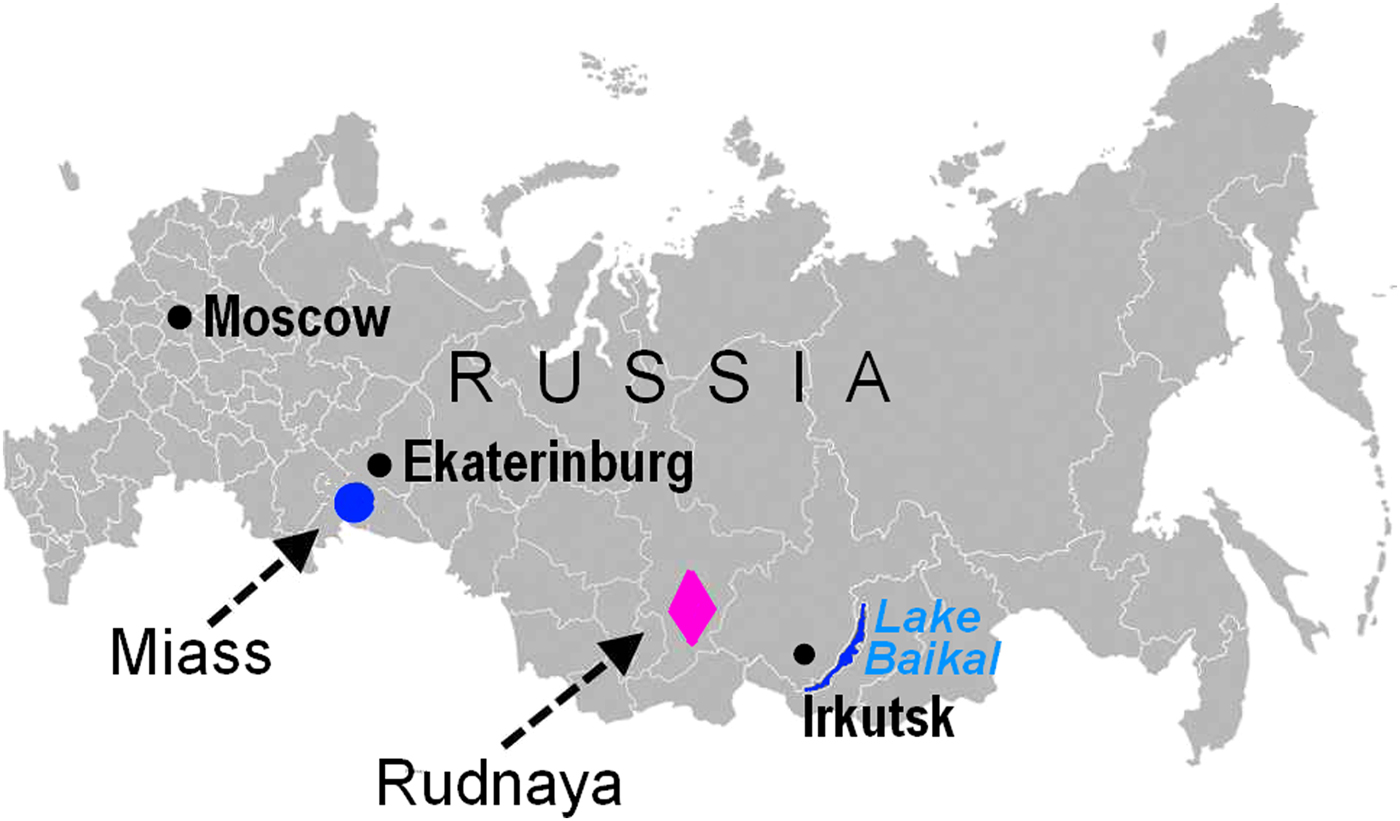
Ophiolite complexes are potential hosts for ore deposits of chromite and minerals of the platinum-group elements (PGE), especially Ru, Os and Ir (e.g. Prichard and Lord, Reference Prichard and Lord1990; Prichard et al., Reference Prichard, Ixer, Lord, Maynard and Williams1994, Reference Prichard, Economou-Eliopoulos and Fisher2008a,Reference Prichard, Neary, Fisher and O'Harab; Melcher et al., Reference Melcher, Grum, Simon, Thalhammer and Stumpfl1997; Garuti and Zaccarini, Reference Garuti and Zaccarini1997; Malitch et al., Reference Malitch, Melcher and Mühlhans2001). In this article, we report new results and explore the mineralogical implications of our findings on two placer areas in which ophiolite-type sources are clearly indicated. The first of these occurrences is located along the River Rudnaya in the Ermakovskiy district, near Shushenskoye in the Priyeniseiskiy territory of the western Sayan province, Krasnoyarskiy kray (Fig. 1). This placer is associated with a zone of collision of the northern portion of the western Sayan megasynclinorium with the south Minusinsk basin. We also include a few observations made on minerals of the Bol'shoy Khailyk placer, western Sayans; this deposit is associated with the westward flow of the Urbun (Urgun’) River into the Yenisei River.
The location of the placer localities investigated, at Rudnaya and Miass, in Russia.

The second main area pertains to the Miass placer zone (Au–PGM, platinum-group minerals) named after the River and the city of Miass, Chelyabinsk oblast, which extends toward the south for more than 100 km in the southern Urals (Zaykov et al., Reference Zaykov, Melekestseva, Kotlyarov, Zaykova and Kraynev2016 and references therein). The Miass zone is well known historically as a source for gold; in 1842, the Big Triangle nugget (36 kg) was found there. This zone is associated with the Main Uralian Fault (Savel'ev et al., Reference Savel'yev, Snachev, Savel'eva and Bazhin2008; Seravkin, Reference Seravkin2010); it separates the Paleozoic structural units of the Paleo-Uralian ocean from those of the east European continent of Precambrian age, and hosts fragmented bodies of a Paleozoic ophiolite mélange and Alpine-type complexes (Puchkov, Reference Puchkov2000). Several placers are recognized in the Miass zone, namely (north to south) Kialim, Karabash, Middle Miass, Malyi Iremel, Suleymen, and Polyakovskaya (Zaykov et al., Reference Zaykov, Melekestseva, Kotlyarov, Zaykova and Kraynev2016). In addition, there are small and still unnamed placer occurrences, such as those in which three new species of PGM, polkanovite, palladodymite and miassite, were first discovered (Britvin et al., Reference Britvin, Rudashevsky, Bogdanova and Shcherbachev1998, Reference Britvin, Rudashevsky, Bogdanova and Shcherbachev1999, Reference Britvin, Rudashevsky, Bogdanova and Shcherbachev2001). Our samples of placer material were gathered by an unknown collector and provided courtesy of L.A. Pautov, Fersman Mineralogical Museum, Moscow; their exact location is unknown within the Miass river system. In total, several hundred placer grains of PGM (0.2 to ~1 mm in size) were investigated; optical observations and the analytical data we gathered form the basis of this article. We discuss the likely source-rocks for the placer PGM assemblages; we also characterize the rare minerals and unusual textures of PGM, hitherto unreported, including crystallites and microglobules of PGM.
Analytical methods and results
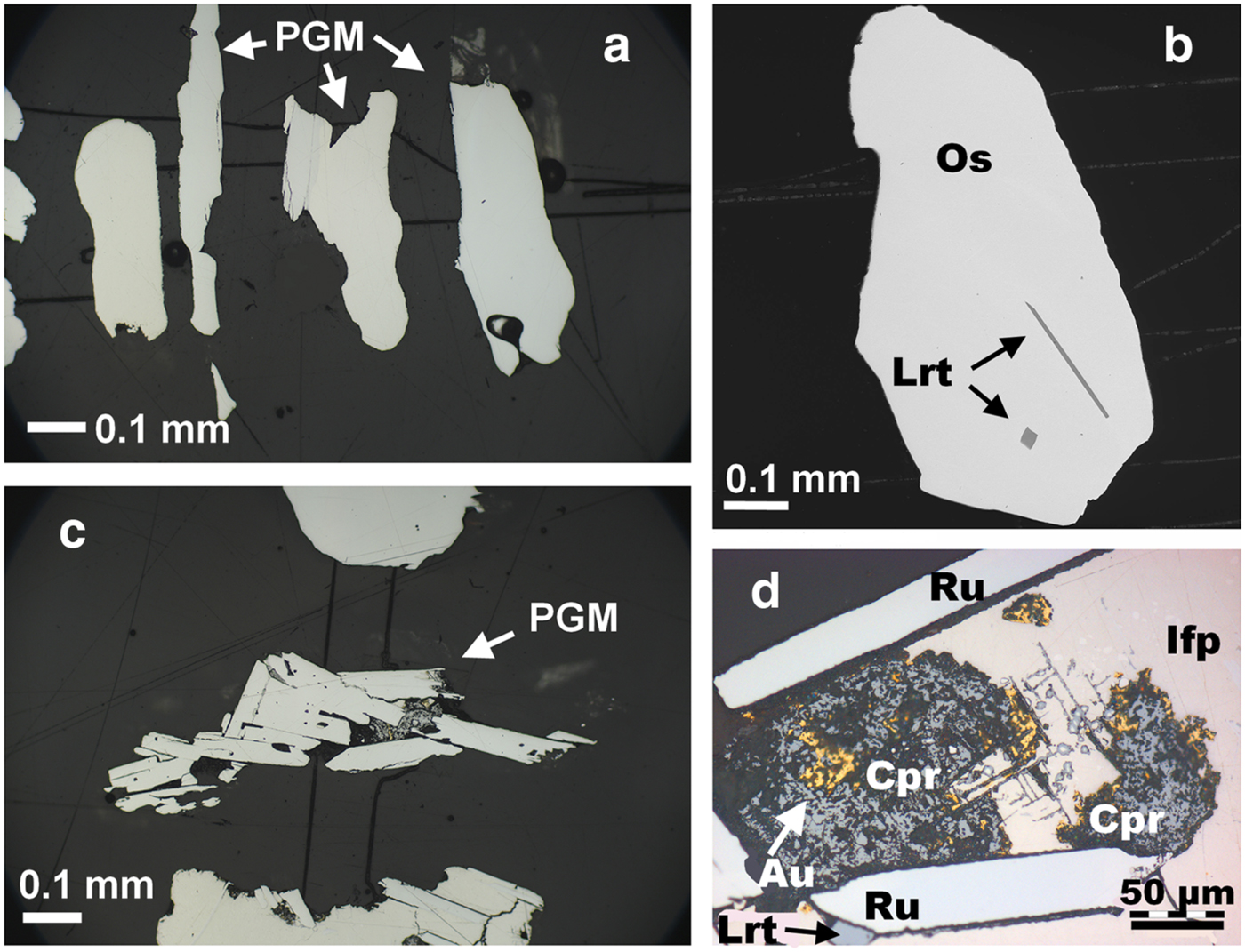
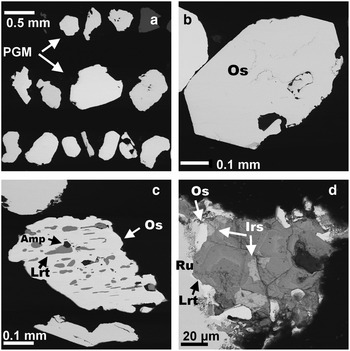
Grains of PGM and associated minerals from Rudnaya (Figs 2 and 3) and Miass (Figs 4 and 5) were analysed by scanning-electron microscopy (SEM) and energy-dispersive analysis (EDS) using a MIRA 3 LMU instrument (Tescan Ltd.) combined with an INCA Energy 450+ XMax 80 instrument (Oxford Instruments Ltd), at the Sobolev Institute of Geology and Mineralogy, Novosibirsk, Russia. Some of the minerals, such as grains of chromite and silicate minerals at Rudnaya, were characterized by wavelength-dispersive analysis (WDS). The methodological principles and analytical facilities were described in Lavrent'ev et al. (Reference Lavrent'ev, Karmanov and Usova2015a,Reference Lavrent'ev, Korolyuk, Usova and Nigmatulinab) and outlined briefly in Shvedov and Barkov (Reference Shvedov and Barkov2017), and Barkov et al. (Reference Barkov, Nikiforov, Tolstykh, Shvedov and Korolyuk2017).
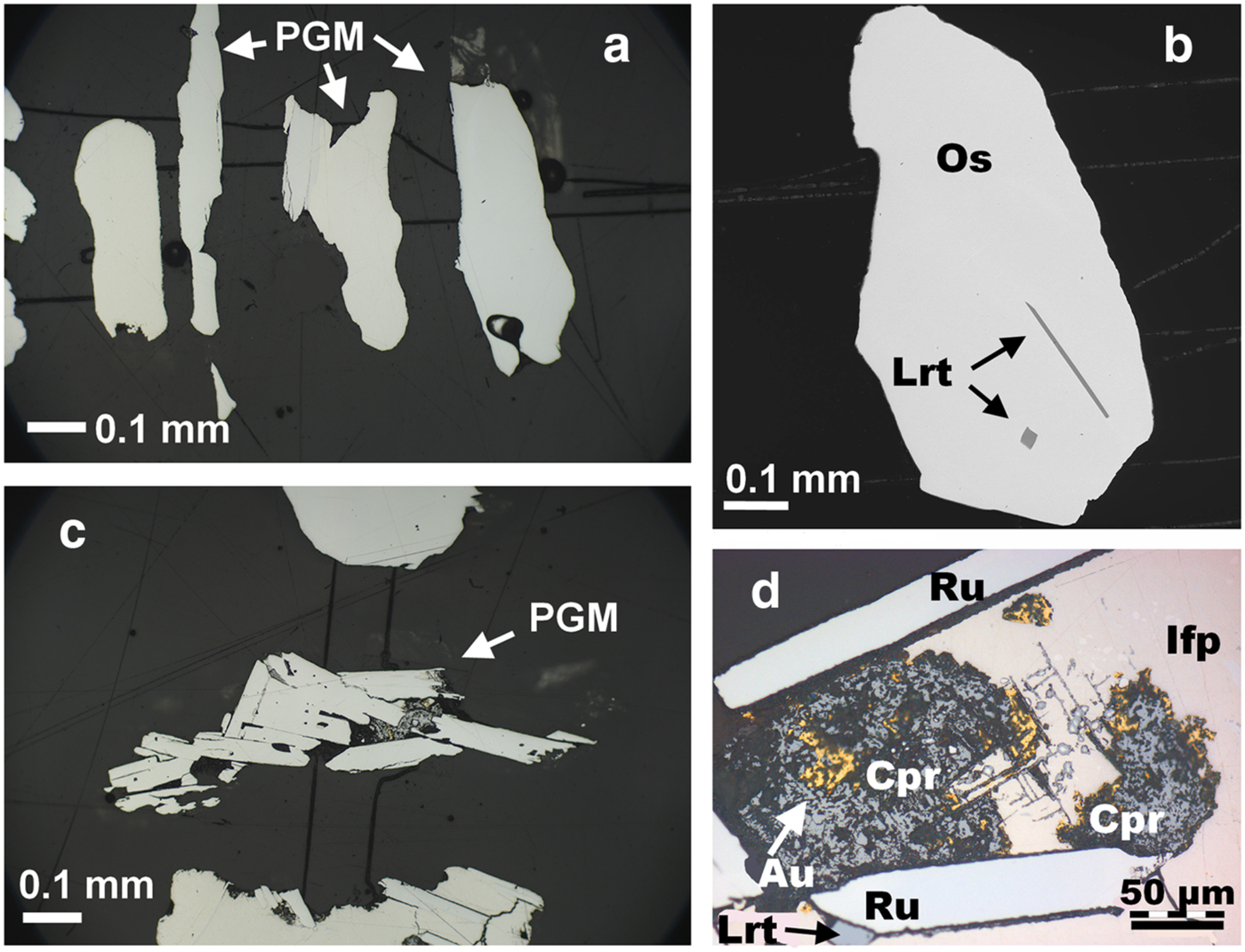
Characteristic examples of placer grains of PGM (mostly PGE alloy minerals) from Rudnaya, western Sayans. (a) Back-scattered electron (BSE) image of PGM electron images (BSE). (b) A BSE image showing a subhedral crystal of Os-dominant alloy, labelled Os [Os67.3Ir15.6Ru15.2Pt1.9], which hosts tiny inclusions of laurite, Lrt [(Ru0.91–0.94Os0.06–0.08Ir0.01)Σ1.0S1.99]. (c) BSE image of PGM. (d) Reflected-light microphotograph showing lath-shaped crystals of Ru-dominant alloy [Ru40.7Ir29.2Os22.6Rh4.6Pt3.0; labelled Ru], associated with an isoferroplatinum-type alloy, Ifp [(Pt2.47Rh0.21Ir0.14Pd0.04)Σ2.9(Fe1.05Ni0.08)Σ1.1, which is replaced by cooperite (grey), Cpr [(Pt0.96–0.98Ru0–0.02)Σ0.98S1.02] and Au–Ag alloy [Au81.5–83.2Ag16.8–18.5]. A small grain of laurite in the core (Lrt) [(Ru0.90Os0.04Ir0.04Rh0.04)Σ1.02S1.99] is mantled by a narrow rim of irarsite [Ir0.78Rh0.18Ru0.12Pt0.04)Σ1.1(As0.88Sb0.03)Σ0.9S0.96].
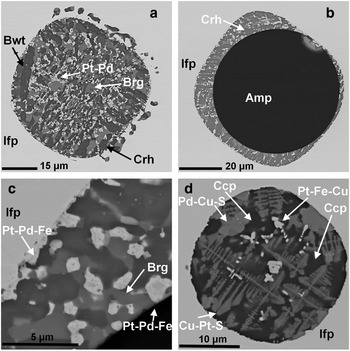
Globular inclusions with micrometric crystallites of PGM are hosted by grains of Pt–Fe alloy, which is of isoferroplatinum type (Ifp), at Rudnaya, western Sayans; BSE images. (a) The microglobule consists of polycrystalline phases including bowieite (Bwt), intermediate phases (thiospinels) of the cuprorhodsite–ferrorhodsite series (Cpr), braggite (Brg), and an alloy phase (bright; labelled Pt–Pd) of composition [Pt49.7Pd24.1Fe22.5Cu3.6]. The host is (Pt2.85Pd0.11Rh0.08)Σ3.04(Fe0.88Cu0.07)Σ0.95. (b and c) A perfectly circular micro-inclusion composed of a sodic-calcic amphibole related to ferro-barroisite [(Ca1.45Na0.39K0.04)Σ1.88(Al1.75 ${\rm Fe}_{{\rm 1}{\rm. 72}}^{{\rm 2 +}} $Mg1.17Ti0.03Mn0.02)Σ4.69[Si7.47Al0.53]O22(OH)2] in the core (Amp; Fig. 3b), which is mantled by a rim of micrometric crystallites of PGM; Cpr is cuprorhodsite–ferrorhodsite, and Brg is braggite; the label Pt–Pd–Fe (Fig. 3c) pertains to alloy phases enriched in Pd: [(Pt1.91Pd1.04)Σ2.95Fe1.05] and [(Pt2.53Pd0.38Rh0.12)Σ3.03(Fe0.89Cu0.08)Σ0.97. The placer grain that hosts this microglobule has the composition [(Pt2.85Pd0.07Rh0.06)Σ2.98(Fe0.96Cu0.08)Σ1.04]. (d) This microglobule consists of chalcopyrite (Ccp) and skeletal phases (Cu,Pt,Rh)S, labelled Cu–Pt–S and (Pd,Cu)S1–x, labelled Pd–Cu–S, as well as the alloy phase (bright) [Pt2.44Cu0.35Pd0.21Fe1.00], labelled Pt–Fe–Cu. The host of this inclusion is a Pt3Fe-type alloy of the formula [(Pt2.94Pd0.03)Σ2.97(Fe0.95Cu0.08)Σ1.03.

(a,b) Examples of placer grains of PGM (mostly PGE alloy minerals) from Miass, southern Urals. (c) Uniformly oriented inclusions of laurite (Lrt) [(Ru0.86–0.92Os0.04–0.08Ir0.04–0.07)Σ1.0(S1.96–1.97As0.02–0.03)Σ2.0], which are hosted by a placer grain of Os-dominant alloy (Os) [Os42.3–43.4Ir35.6–36.3Ru14.8–15.7Pt2.8–4.5Fe1.9–2.7]. In addition, a micro-inclusion of edenite (Amp) occurs in the osmium alloy grain. (d) A placer grain of Ru-dominant alloy (Ru) [Ru42.1Os30.4Ir26.5Fe1.1], which bears a fragment composed of Os-dominant alloy enriched in Ir (labelled Os) [Os48.4Ir45.8Ru3.0Fe2.8]. This grain of PGE alloy is replaced along its periphery by a secondary phase of laurite [grey; (Ru1.08Os0.07Ir0.04Ni0.04)Σ1.2S1.8), showing a growth zoning; small patches of antimonian irarsite (Irs) [(Ir0.68Ru0.24Os0.15Ni0.03)Σ1.1(As0.52Sb0.29)Σ0.8S1.1] are developed in the laurite.

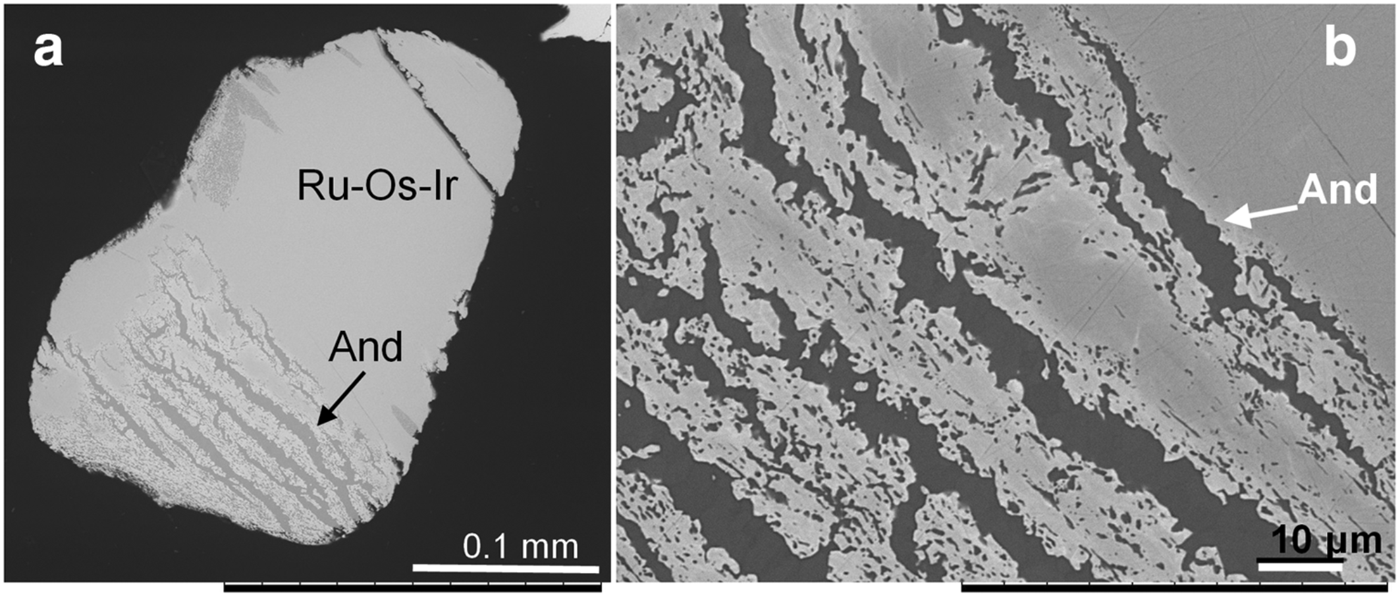
Microbands and microveinlets of RuAs2, probably anduoite (And), which are developed in a placer grain of Ru-dominant alloy from Miass; BSE image.

Mineralogical associations at Rudnaya and Miass
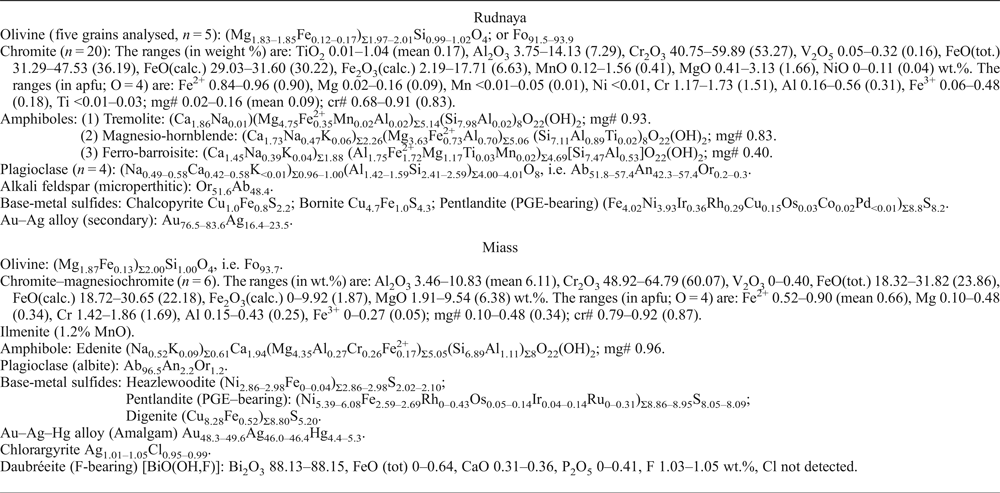
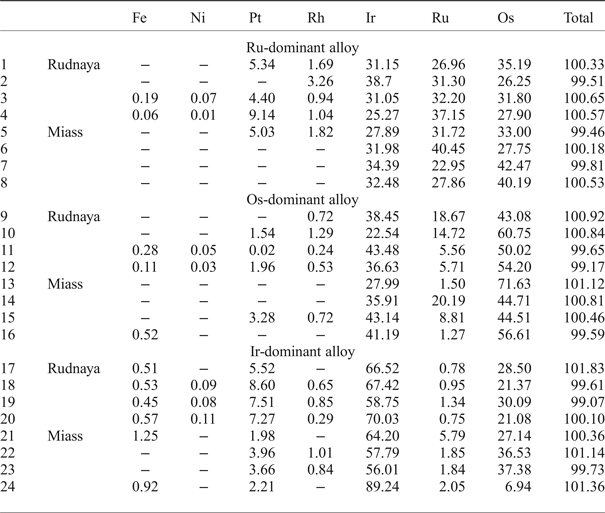
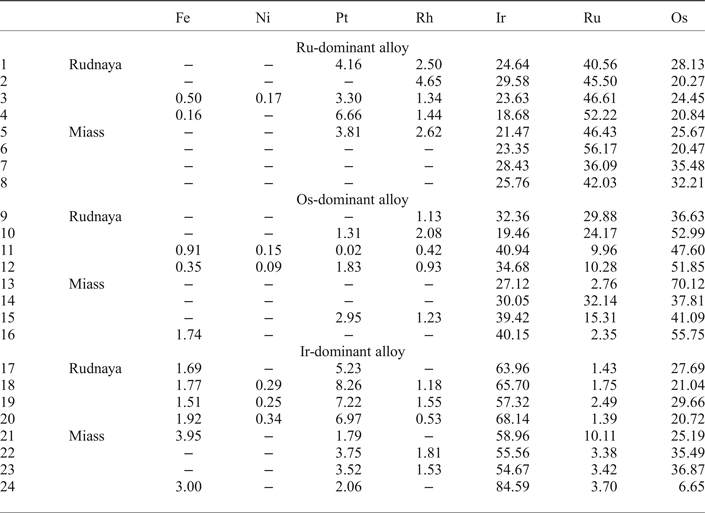
In Table 1, compositional data are provided for various minerals and phases that accompany grains of placer PGM at Rudnaya and Miass; these are present as separate grains or inclusions in grains of PGM. Characteristic textures and compositions of grains of PGM are presented in Figs 2, 3, 4 and 5 and in Tables 2 to 6.
Mineral associations observed in placer deposits at Rudnaya, western Sayans, and Miass, southern Urals*

*These results of the SEM/EDS and WDS analyses were acquired at the Sobolev Institute of Geology and Mineralogy, Siberian Branch of the RAS, Novosibirsk, Russia. The quoted indexes are: Mg# [Mg/(Mg + Fe2+ + Mn)]; Cr# [Cr/(Cr + Al)]; apfu – atoms per formula unit.
Representative compositions of Ru–Os–Ir alloys in placer deposits at Rudnaya, western Sayans, and Miass, southern Urals.*

*These results of the SEM/EDS and WDS analyses (quoted in wt.%) were acquired at the Sobolev Institute of Geology and Mineralogy, Novosibirsk, Russia. Copper and Pd were sought, but not detected. ‘–’ is not detected.
The grains of olivine are notably high in Mg in both of these placer zones; they correspond to Fo91.5–93.9 in the association at Rudnaya, and Fo93.7 at Miass (Table 1). In contrast, the chromite grains are notably low in magnesium (Mg# ≤0.2) at Rudnaya; these compositions are in contrast with those of chromian spinel at Miass, in which the values of Mg# attain ~0.5 (Table 1). On the other hand, in terms of their Cr# index, which is high (0.83 and 0.87, mean results of analyses), the grains of chromite are fairly similar at Rudnaya and Miass.
Unusually high values of Mg# are present among the analysed amphiboles: tremolite (Mg# 0.93) and magnesiohornblende (0.83) at Rudnaya, and edenite (0.96) at Miass. In contrast, a low-Mg amphibole related to ferro-barroisite (Mg# 0.4) occurs as microglobular inclusions hosted by grains of PGE alloy minerals at Rudnaya (Fig. 3b). In addition, inclusions of compositionally intermediate plagioclase (An42–57) and microperthitic feldspar were observed, which formed from microportions of highly fractionated melt. Rudnaya and Miass are not the only locations where silica-rich inclusions in PGM have been reported; for instance, euhedral quartz was described as an inclusion in a placer grain of Ir-dominant alloy from British Columbia, Canada (Barkov et al., Reference Barkov, Fleet, Nixon and Levson2005b).
Base-metal sulfides are very rare in the placer materials investigated; low-sulfide environments thus existed at both localities. The observed associations include chalcopyrite, bornite and pentlandite at Rudnaya, and heazlewoodite, digenite and pentlandite at Miass. Note that pentlandite is strongly enriched in the PGE in both placer zones; however, it has a much higher Ni content at Miass (Table 1).
The other grains encountered in the PGM-rich heavy-mineral concentrates presumably were derived from non-ophiolitic sources; these include chlorargyrite (AgCl), daubréeite BiO(OH,F), and an Au–Ag amalgam from Miass that may have an anthropogenic origin (cf. Barkov et al., Reference Barkov, Nixon, Levson and Martin2009). Our compositions of daubréeite at Miass (88.2 wt.% Bi2O3) are similar to those from Cerro Tasna, Bolivia (89.6%), its type locality, and from Canada (89.1–91.4%: Barkov et al., Reference Barkov, Martin, Shi, LeBarge and Fedortchouk2008b), but different owing to the presence of substantial F (1.1%), not previously noted in this species. In addition, occurrences of secondary gold (Au77–84) are observed in some placer grains of PGE alloys, e.g. in association with cooperite at Rudnaya (Fig. 2d).
Solid solutions in the Ru–Os–Ir alloys at Rudnaya and Miass
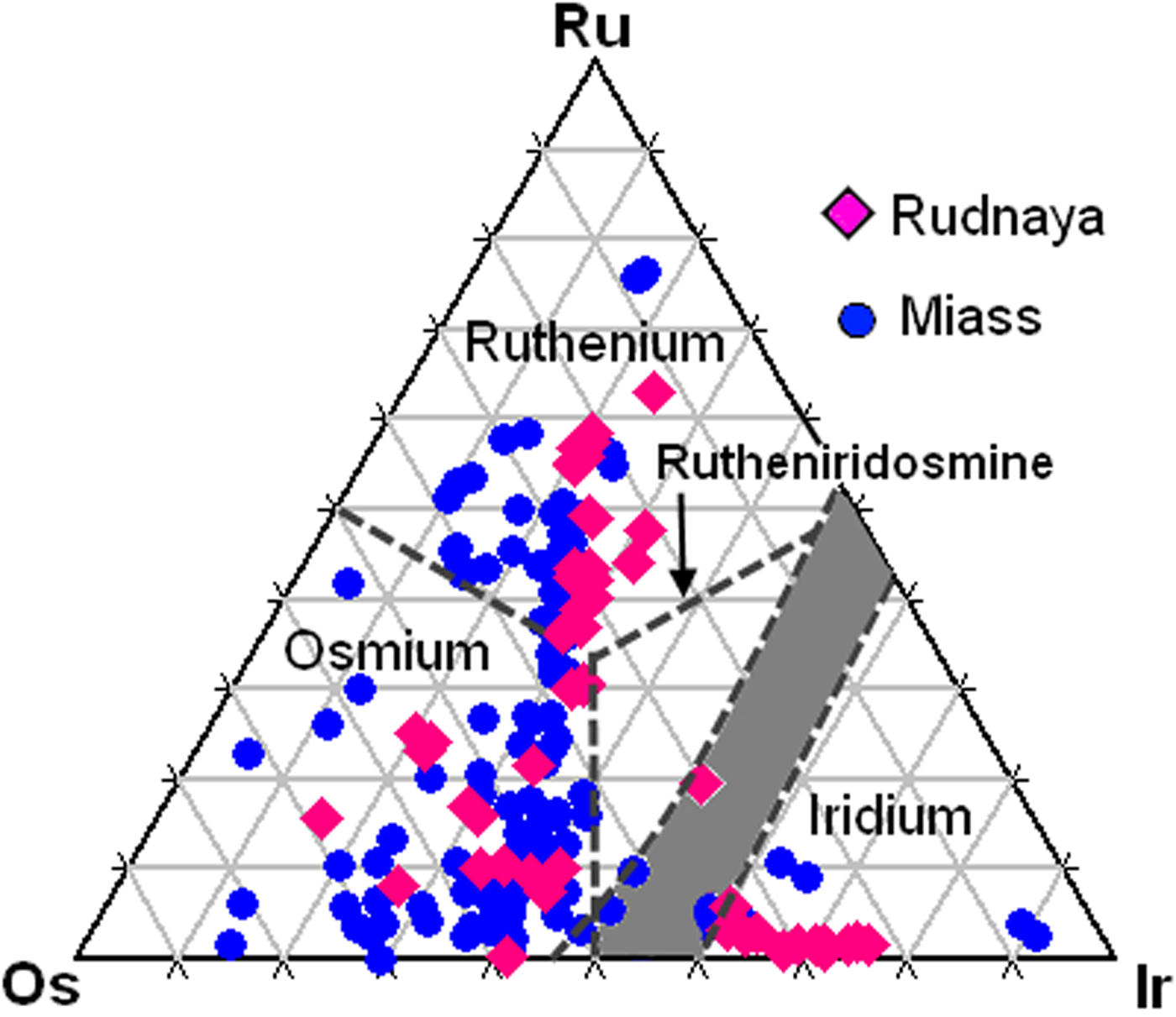
Alloy minerals of the system Ru–Os–Ir strongly dominate over other species in samples from the placer localities investigated (Fig. 6, Tables 2, 3). At Rudnaya, the modal amount of these alloys is estimated to be up to 90%; grains of Pt–Fe alloy and sperrylite constitute ~10% of the mode. Relative amounts of the Ru–Os–Ir alloys are even greater (>95%) in the Miass samples.
Compositional variations of Ru-, Os- and Ir-dominant alloys from Rudnaya and Miass in terms of Ru–Os–Ir space (atomic %). The nomenclature and miscibility gap are after Harris and Cabri (Reference Harris and Cabri1991).

Atom proportions of Ru–Os–Ir alloys in placer deposits at Rudnaya, western Sayans, and Miass, southern Urals.*

*These values, calculated for a total of 100 atom%, pertain to results of the SEM/EDS and WDS analyses listed in Table 2. ‘−’ is not detected.
Several species are known in the system Ru–Os–Ir: the mineral ruthenium is hexagonal, with Ru being the major element; rutheniridosmine is hexagonal with Ir predominant over Os or Ru; osmium is hexagonal with Os as the major element, whereas iridium is cubic with Ir dominant (Harris and Cabri, Reference Harris and Cabri1991). On the basis of our compositions (Fig. 6), we infer that (1) three species of alloy minerals, i.e. ruthenium, osmium and iridium, are quite common in the Rudnaya and Miass placers; only a few point-analyses plot close to the boundary of the rutheniridosmine field. (2) The observed field of compositions of the Ru–Os–Ir alloys has a similar extent at both placer localities. (3) The trend of Ru-enrichment clearly is characteristic, and points to an ophiolitic origin of these alloy phases.
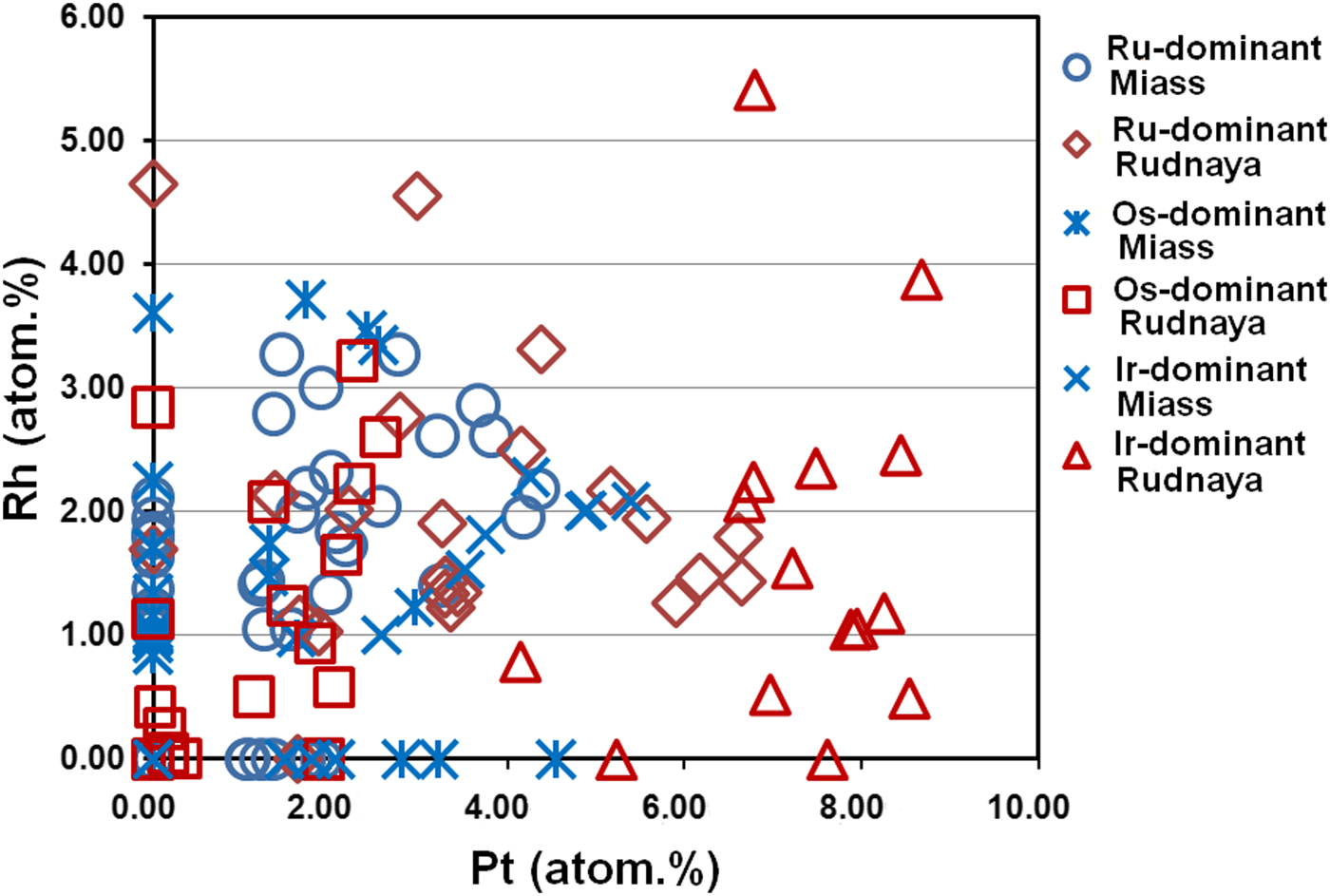
In Fig. 7, we examine variations in contents of Pt and Rh, present in solid solution in the Ru–Os–Ir alloys. We find that the alloy minerals at Rudnaya are generally richer in Pt, which may reflect a primary characteristic of the mantle reservoir (Pt-enriched). In addition, note that the Ir-dominant alloy is more enriched in Pt than the Ru- and Os-dominant alloys. This feature may be ascribed to a closer affinity of Pt and Ir, leading to a greater extent of Pt incorporation into the solid solution.
Compositional variations of Ru-, Os- and Ir-dominant alloys from Rudnaya and Miass in the Pt–Rh diagram (atomic %).

The Pt–Fe alloys are not unusual in the placer material; they generally correspond to Pt3Fe, typically with minor Cu, Rh and Pd, and represent isoferroplatinum or ferroan platinum (or both). Some of the inclusions of Pt-rich alloys (isoferroplatinum-type alloy and ferronickelplatinum) are notably enriched in Ir, compared to the other PGE species (Tables 4, 6).
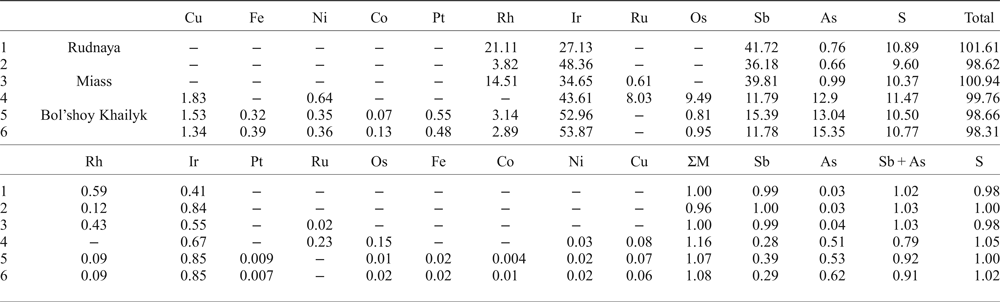
Compositions of solid-solution phases from Rudnaya, Miass, and Bol'shoy Khailyk, Russia, that involve the components (Rh,Ir)SbS [unnamed PGM], (Ir,Rh)(Sb,As)S [tolovkite] and (Ir,Rh)(As,Sb)S [irarsite].*

* These results of the SEM/EDS (no. 1–4) and WDS (5 and 6) analyses were acquired at the Sobolev Institute of Geology and Mineralogy, Novosibirsk, Russia. ‘−’ = not detected. Compositions are listed in wt.%, then recalculated on the basis of three atoms per formula unit.
PGE sulfides, sulfarsenides and arsenides
The PGE sulfides are late-crystallizing or secondary phases; they are considered to have formed at the expense of the alloys (e.g. Figs 2d, 4c,d). Members of the laurite–erlichmanite series are the main sulfide species. Samples from both localities are stoichiometric: (Ru,Os,Ir,Rh)Σ0.99–1.03(S,As)Σ1.97–2.01. A set of twenty data-points (n = 20) were obtained on grains of laurite at Rudnaya; one of these specimens revealed a very high content of Ir (0.35 atoms per formula unit, apfu, for a formula of three atoms), which is anomalous for this species. The observed ranges (in wt.%), including the Ir-rich composition, are: Ir 0–26.6 (mean 7.52 wt.%), Rh 0–2.49 (0.36%) and As 0–3.15 (0.27%). In terms of apfu values, these ranges are: Ru 0.09–1.01 (mean 0.75), Os 0–0.59 (0.18), Ir 0–0.35 (0.08), Rh 0–0.04 (<0.01), S 1.87–2.01 (1.98) and As 0–0.11 (<0.01 apfu). The Ir-rich phase has the following composition: Ru 3.46, Os 44.46, Ir 26.60, Rh not detected, S 24.58, As 0.86 and a total 99.96 wt.%, which corresponds to iridoan erlichmanite: (Os0.59Ir0.35Ru0.09)Σ1.03(S1.94As0.03)Σ1.97.
The limited nature of the [Irx(Ru,Os)1–x]S2 solid solutions is well recognized in natural samples. A complete and continuous series of solid solutions has been established between the RuS2 and OsS2 end-members (laurite–erlichmanite series), whereas the content of ‘IrS2’ is less than 20 mol.% in these samples worldwide (cf. Cabri et al., Reference Cabri, Harris and Weiser1996). This limit may well result from the existence of vacancy-type defects and of related complications arising from the incorporation of Ir (Barkov et al., Reference Barkov, Fleet, Martin and Alapieti2004). There are two possible explanations of the enrichment of the disulfide phase from Rudnaya in Ir: (1) nanometric particles of orthorhombic IrS2 (cf., Jobic et al., Reference Jobic, Deniard, Brec, Rouxel, Drew and David1990), exsolution-induced, may exist in the grains analysed; (2) iridium enters in true solid solution as a result of unusual conditions of crystallization.
The OsS2 component is strongly subordinate in the laurite grains at Miass (n = 20). We note the incorporation of Rh (0–1.42; mean 0.27 wt.%), Ir (0–12.8; 5.06 wt.%) and As (0–1.35; 0.37 wt.%). In terms of apfu, these compositions yield the ranges: Ru 0.72–0.99 (mean 0.90), Os 0–0.23 (0.06), Ir 0–0.07 (0.05), Rh 0–0.03 (<0.01), S 1.95–2.01 (1.98) and As 0–0.03 (<0.01 apfu). Thus, except for the Os–Ir-rich composition, these ranges at Rudnaya and Miass display low to subordinate OsS2 contents, which may reflect relatively low levels of sulfur fugacity ( $f_{{\rm S}_{\rm 2}}$) in the systems.
Compositionally, cooperite is virtually stoichiometric PtS at Rudnaya [e.g. Pt 84.54, Ru 0.87, S 14.87, for a total of 100.28 wt.%, or (Pt0.96Ru0.02)S1.02]; commonly, it occurs as an alteration phase after a Pt3Fe-type alloy, and is accompanied by native gold (Fig. 2d). According to results of twenty point-analyses (WDS), sperrylite grains are represented by almost pure PtAs2 at Rudnaya.
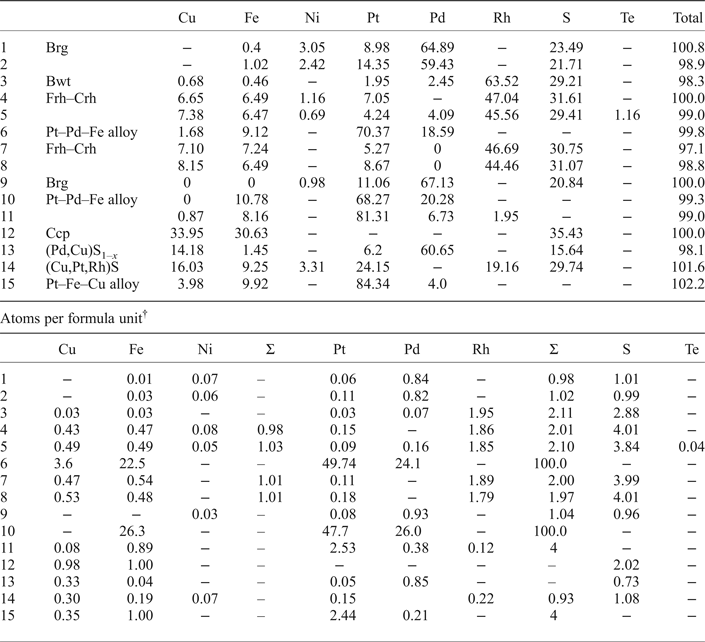
At Rudnaya, micrometric phases of PGE-bearing sulfides are also observed in globular inclusions (Table 5), described below, in which the following PGM occur: bowieite (Rh2S3), braggite (or ‘vysotskite’) and Cu–Fe–PGE thiospinels (cuprorhodsite–ferrorhodsite series). At Miass, Ir-rich species are more abundant, such as kashinite (Ir2S3) and irarsite (Table 6). Interestingly, microbands or microveinlets of Ru diarsenide (Ru1.0As1.9), probably anduoite, are developed in a small placer grain of Ru-dominant alloy from the Miass suite, i.e. the mineral ruthenium (Fig. 5). These textures clearly imply a trend of increasing arsenic fugacity during crystallization (cf. Prichard et al., Reference Prichard, Fisher, McDonald, Knight, Sharp and Williams2013).
Compositions of microphases in globular inclusions hosted by placer grains of PGE alloy minerals at Rudnaya, western Sayans.*

*These results of the SEM/EDS analyses were acquired at the Sobolev Institute of Geology and Mineralogy, Novosibirsk, Russia. ‘−’ stands for not detected. Brg = braggite, Bwt = bowieite, Frh = ferrorhodsite, Crh = cuprorhodsite and Ccp = chalcopyrite.
†The values of atoms per formula unit are based on a total of two for Brg, (Cu,Pt,Rh)S and (Pd,Cu)S1–x, five (bowieite), seven (Frh–Crh), four for Ccp and Σ =100 (or Σ = 4: no. 11 and 15) for the alloy minerals. Entries 1 to 6 pertain to Fig. 3a, 7 and 8 to Fig. 3b, 9 to 11 to Fig. 3c and 12 to 15 to Fig. 3d.
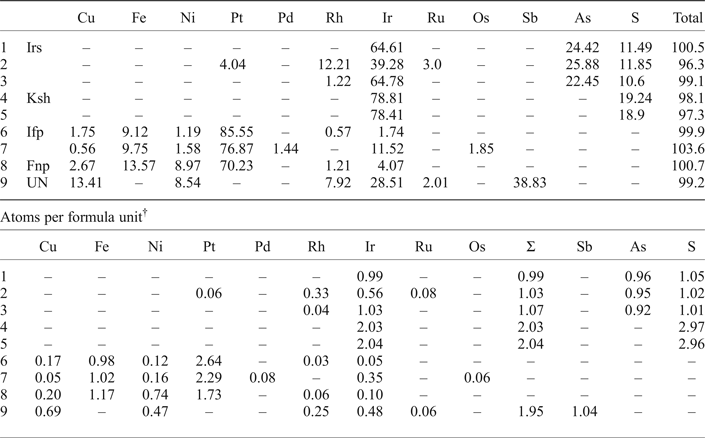
Composition (wt.%) of Ir-rich species of platinum-group minerals from the placer deposit at Miass, southern Urals.*

*These results of the SEM/EDS analyses were acquired at the Sobolev Institute of Geology and Mineralogy, Novosibirsk, Russia. ‘–’ stands for “not detected”. Irs = irarsite, Ksh = kashinite, Ifp = isoferroplatinum (or ferroan platinum), Fnp = ferronickelplatinum and UN is unnamed [(Cu,Ni)1+x(Ir,Rh)1–x]Σ2Sb, where x = 0.2.
†On the basis of three atoms per formula unit (apfu) for Irs and UN, five apfu for Ksh, and four apfu for Ifp and Fnp.
Solid-solution phases (Rh,Ir)SbS [unnamed PGM] – (Ir,Rh)(Sb,As)S [arsenian tolovkite] – (Ir,Rh)(As,Sb)S [antimonian irarsite] at Rudnaya, Miass and Bol'shoy Khailyk
Complex compounds of Ir–Rh sulfo-arsenoantimonides are rare and unusual (Table 4). In addition to occurrences in the Rudnaya and Miass placers, these phases also were found as inclusions in a Pt–Cu–Au alloy in samples from the Bol'shoy Khailyk placer. All of them form small inclusions (≤10 µm) in PGE alloy minerals; they appear to be related closely to tolovkite, IrSbS, which is a member of the cobaltite group (Bayliss, Reference Bayliss1989). This species, discovered in alluvial placers along the Tolovka River (Razin et al., Reference Razin, Rudashevskiy and Sidorenko1982), was probably derived from the Alpine-type Ust’-Bel'skiy gabbro massif, Magadan oblast, northeastern Russia, although it could be associated with more primitive and ultramafic lithologies, rather than with gabbro, consistent with observations in the present study.
At Rudnaya, the first of two phases analysed corresponds to (Rh0.59Ir0.41)Σ1.00(Sb0.99As0.03)Σ1.02S0.98, i.e. to an unnamed species with the formula (Rh,Ir)SbS. The second compound [(Ir0.84Rh0.12)Σ0.96(Sb1.00As0.03)Σ1.03S1.00] presumably is a variant of rhodian tolovkite. One of the two phases from Miass is (Ir0.55Rh0.43Ru0.02)Σ0.99(Sb0.99As0.04)Σ1.03S0.98, which also corresponds to rhodian tolovkite. The second phase is compositionally different; it is an example of a ruthenian-antimonian variety of irarsite: (Ir0.67Ru0.23Os0.15Cu0.08Ni0.03)Σ1.2(As0.51Sb0.28)Σ0.8S1.05.
In addition, the presence of two phases of antimonian irarsite is inferred in the Bol'shoy Khailyk deposit: (Ir0.85Rh0.09Cu0.07Fe0.02Ni0.02Pt0.01Os0.01)Σ1.07(As0.53Sb0.39)Σ0.92S1.00 and (Ir0.85Rh0.09Cu0.06Os0.02Ni0.02Fe0.02Pt0.01Co0.01)Σ1.07(As0.62Sb0.29)Σ0.91S1.02 (Table 4).
Interestingly, we point out an unnamed Ir–Rh antimonide of secondary origin (45 µm × 25 µm), potentially a new species of PGM, at Miass in the replacement assemblage associated with an Ir-rich alloy. Its composition (an. 9, Table 6) corresponds to the formula (Cu,Ni)1+x(Ir,Rh)1–xSb, where x = 0.2.
Comparison with other tolovkite-type phases, and implications for two series of natural solid solutions
Sulfoantimonides of Ir–Rh were reported previously from a placer at Yubdo, Ethiopia (Cabri et al., Reference Cabri, Criddle, Laflamme, Bearne and Harris1981), in the Shetland ophiolite complex (Tarkian and Prichard, Reference Tarkian and Prichard1987), the Tulameen Alaskan-Uralian complex, British Columbia, Canada (Nixon et al., Reference Nixon, Cabri and Laflamme1990), in placers associated with the Filippa clinopyroxenite–dunite massif, Kamchatka, and at Fadeevka, Russian Far East (Sidorov et al., Reference Sidorov, Tolstykh, Podlipskiy and Pakhomov2004, Shcheka and Lehmann, Reference Shcheka and Lehmann2007). Because of their rarity and minute grain-sizes, many tolovkite-type phases could only be analysed semi-quantitatively. At its type locality, tolovkite is, in fact, close to being a pure IrSbS end-member (Razin et al., Reference Razin, Rudashevskiy and Sidorenko1982). Zaccarini et al. (Reference Zaccarini, Pushkarev, Garuti, Krause, Dvornik, Stanley and Bindi2013) documented minor amounts of Rh and As (up to 1.6 and 4.1 at.%, respectively) in specimens of tolovkite from the concentrically zoned Uktus complex in the Central Urals. Similarly, low levels, up to 2.6 at.% Rh and 0.3 at.% As, were reported for phases related to tolovkite from chromitite in southern Iran (Jannessary et al., Reference Jannessary, Melcher, Lodziak and Meisel2012). In contrast, rhodian tolovkite [(Ir0.77Rh0.21Pt0.02Ru0.01)Σ1.01(Sb0.91As0.02)Σ0.93S1.07] occurs in chromitite in the Osthammeren ultramafic body of Norway (Nilsson, Reference Nilsson1990). Note that all of these phases are fairly poor in As, as is also the case in the phase (Rh0.49Ir0.27)Σ0.8Sb0.8S1.00 from the Miass placer zone (Zaykov et al., Reference Zaykov, Melekestseva, Kotlyarov, Zaykova and Kraynev2016).
The only compounds that are enriched in As, and are more closely related to the As-dominant phases from Miass and Bol'shoy Khailyk, have been reported from the Svetlyi Bor complex in the Urals: [(Ir0.91Rh0.08Fe0.02)Σ1.01(As0.59Sb0.38)Σ0.97S1.02] and [(Ir1.01Rh0.03Fe0.03)Σ1.07(As0.73Sb0.20)Σ0.93S1.00] (Tolstykh et al., Reference Tolstykh, Telegin and Kozlov2011).
The compositional variations observed among all of the above phases related to tolovkite imply the existence of two series of natural solid-solutions. The first extends from tolovkite, IrSbS, to its Rh counterpart (unnamed RhSbS). The second series involves intermediate phases in the tolovkite–irarsite (IrAsS) solid solution.
Crystallites of PGM in microglobular inclusions in Pt–Fe alloy at Rudnaya
Composite and unusual micro-inclusions of spheroidal shape (Figs 3, Table 5) are enclosed within grains of Pt–Fe alloy. Three types of inclusions are present. The first (Fig. 3a) is composed of aggregates of micrometric crystallites of Pd–Pt sulfide (braggite), Rh-rich sulfide (bowieite), Cu–Fe–Rh sulfide (thiospinel PGM of the cuprorhodsite–ferrorhodsite series), and an uncommon Pt–(Pd)–Fe alloy rich in Pd [e.g. Pt49.7Pd24.1Fe22.5Cu3.6]. The host phase is here close to Pt3Fe [Pt2.85Pd0.11Rh0.08)Σ3.04(Fe0.88Cu0.07)Σ0.95].
The second type of micro-inclusion exhibits a perfectly circular shape (Figs 3b,c); amphibole forms the core, and it is mantled by a heterogeneous rim of variable thickness consisting of a micrometric aggregate of the first type. The SEM/EDS analysis of the core indicates a sodic-calcic amphibole related to ferro-barroisite: SiO2 52.16, TiO2 0.30, Al2O3 13.53, FeO (tot.) 14.36, MnO 0.18, MgO 5.46, CaO 9.46, Na2O 1.42, K2O 0.19 and a total 97.06 wt.%; its formula is (Ca1.45Na0.39K0.04)Σ1.88(Al1.75 ${\rm Fe}_{{\rm 1}{\rm. 72}}^{{\rm 2 +}} $ Mg1.17Ti0.03Mn0.02)Σ4.69(Si7.47Al0.53)O22(OH)2; Mg# 0.40. The phases in the rim are: cuprorhodsite–ferrorhodsite, braggite and the Pt–Fe–Pd alloy. Also, the host PGM corresponds to an isoferroplatinum-type phase; i.e. Pt 89.70, Pd 0.89, Rh 0.60, Fe 8.64, a total of 99.83 wt.%, or (Pt2.93Pd0.05Rh0.04)Σ3.02Fe0.98.
The third type of inclusion consists of chalcopyrite, which is the main phase that hosts the skeletal, perpendicularly oriented micrometric phases represented by the monosulfide-like compounds (Cu,Pt,Rh)S and (Pd,Cu)S1–x (Fig. 3d, Table 5). These sulfides, related to crystallization of globules of melt, are associated with a Pt–Pd–Fe–Cu alloy phase (Table 5), which is unusual and, again, enriched in Cu and Pd [Pt2.44Cu0.35Pd0.21Fe1.00]. In contrast, the host alloy is poor in Cu and Pd, and represents a Pt3Fe-type phase, isoferroplatinum or ferroan platinum [Pt2.94Pd0.03)Σ2.97(Fe0.95Cu0.08)Σ1.03].
Conclusions
The placer materials investigated at Rudnaya and Miass display striking similarities. (1) The PGE mineralization is mostly represented by alloy minerals of the system Ru–Os–Ir. They are notably Ru-enriched, and their fields of composition and extents of solid solutions are comparable. (2) The coexistence with exceptionally high-Fo olivine, which attains the same supermagnesian composition, Fo94, coexisting with supermagnesian amphiboles, is characteristic of these placer assemblages. An even more Mg-enriched composition of olivine (Fo95) was documented in inclusions hosted by a ternary Os–Ru–Ir alloy associated with W-rich osmium, in a placer in the Trinity ophiolitic complex, in northern California, USA (Barkov et al., Reference Barkov, Martin, Lang and Feinglos2008a). These supermagnesian compositions probably result from a high-temperature hydrothermal reaction in the cooling ophiolitic complex involving coexisting olivine, which becomes more strongly magnesian, and chromian spinel, which becomes enriched in Fe, including Fe3+ (cf. Johan et al., Reference Johan, Martin and Ettler2017). Alternatively, compositions of supermagnesian olivine, ranging up to Fo96 in the Monchepluton complex, Kola Peninsula, Russia, are caused by a highly oxidized state of melt prevailing locally during olivine-chromite crystallization (Barkov et al., upubl. data). (3) The associated chromite shows similar values of the Cr# index, with a mean of 0.83 at Rudnaya and 0.87 at Miass (Table 1). However, the latter is notably richer in Mg (Mg# up to 0.5). An enhancement of the Cr# of spinel has been attributed to the hydrothermal conversion of enstatite to forsterite in the ophiolitic complex, and the necessary mobilization of the Cr once held by the orthopyroxene (cf. Johan et al., Reference Johan, Martin and Ettler2017). We raise the possibility that the enrichment of the PGM suite in Ru, Os and Ir also is a result of high-temperature (>800°C) mobilization accompanying the metasomatic reactions that affected the ophiolitic complex as a whole.
The terrane affinities point to an ophiolitic origin of these placer associations. Crystal faces are well preserved in some of the Os–Ir–Ru alloy grains in these placers (e.g. Figs 2b, 4b). The distances of transport thus were probably not great in both these cases. The data based on the regional geology of the placer zones are also consistent with the inferred ophiolite sources. Indeed, outcrops of ophiolitic serpentinite are exposed along the Kandatskiy fault; about eighty of such bodies are known in the Rudnaya River area (K.V. Lobanov, unpubl. data); they probably belong to the Aktovrakskiy complex of harzburgite–dunite–lherzolite–pyroxenite, which represents the eastern arm of the northern portion of the western Sayan Ultrabasic Belt.
The Miass placer deposits of PGM are also inferred to have been derived from ophiolite complexes, mostly from the Karabash and Talovka (Talovskiy) complexes. The Nurali lherzolite–gabbro complex could well represent an additional source of placer PGM (Zaykov et al., Reference Zaykov, Melekestseva, Kotlyarov, Zaykova and Kraynev2016), as it hosts significant deposits of PGM-bearing chromitite (Zaccarini et al., Reference Zaccarini, Pushkarev, Fershtater and Garuti2004). Makeyev et al. (Reference Makeyev, Kononkova, Kraplya, Chernukha and Bryanchaninova1997) suggested a bimodal origin (ophiolite and Alaskan type) for PGM assemblages that occur in placers of the northern Urals and Timan Ridge in Russia. Interestingly, the Uktus complex is the most prominent representative of the Alaskan-type complexes located out of the Platinum Belt in the eastern Uralian zone of the central Urals (Garuti et al., Reference Garuti, Pushkarev, Zaccarini, Cabella and Anikina2003).
The observed compositions, textures and associations are indicative of low-sulfide environments, in which fairly low levels of  $f_{{\rm S}_{\rm 2}}$ prevailed in the ophiolite systems during the early stages of crystallization at Rudnaya and Miass. Laurite notably poor in the erlichmanite (OsS2) component appeared at a late stage as a result of a solution-and-redeposition reaction involving the original grains of osmium-rich alloy (e.g. Fig. 4c) in an environment of increasing
 $f_{{\rm S}_{\rm 2}}$. We infer that a further build-up in values of
 $f_{{\rm S}_{\rm 2}}$ and
 $f_{{\rm A}{\rm s}_{\rm 2}}$ occurred at late subsolidus stages, followed by a relative increase in the content of Sb, which behaves incompatibly, and is characteristic of the mineralized ophiolites in both localities investigated. Thus, the majority of the observed PGE species, such as Ru–Os–Ir disulfide, Ir–Rh sulfarsenide (Fig. 4d), Pt sulfide (and associated gold: Fig. 2d), Ir–Rh–(Cu) sulfo-arseno-antimonides and Ru diarsenide (Figs 5a,b), formed during the late subsolidus stages of cooling and transformations, involving processes of replacement of the primary Ru–Os–Ir and Pt–Fe alloys (host). A moderately low-temperature crystallization of laurite is consistent with findings from the Pados–Tundra ultramafic complex, Kola Peninsula (Barkov et al., Reference Barkov, Nikiforov, Tolstykh, Shvedov and Korolyuk2017).
We document the existence at Rudnaya of unusual microglobular inclusions, hitherto unreported, which are hosted by the Pt–Fe alloy and involve micrometric crystallites of PGM (Fig. 3). The latter PGM, represented by sulfide species of Pd (and Rh) and Cu–Fe–Rh thiospinels, appear to be low-temperature phases (cf. Cabri et al., Reference Cabri, Laflamme, Stewart, Turner and Skinner1978, Barkov et al., Reference Barkov, Fleet, Martin and Halkoaho2005a), associated with unusual alloys rich in Pd and Cu, and also with the core-like phase of ferro-barroisitic amphibole that nucleated before the rim-like aggregate of these crystallites (Figs 3b,c). These microvolumes of evolved melt were unlikely to have been trapped casually from the surroundings; instead, they appear to have precipitated in situ as a consequence of closed-system evolution, and at a final stage of crystallization of the host alloy, followed by build-up in contents of S, Cu, lithophile components (incompatible), H2O, and less refractory PGE (Rh and Pd).
The observed monosulfide-like compounds (Cu,Pt,Rh)S and (Pd,Cu)S1–x formed by exsolution from the chalcopyrite matrix (Fig. 3d). Therefore, high levels of PGE (Pd–Rh–Pt) may have been dissolved in the microvolume of sulfide-saturated melt. The micrometric associations present in these microvolumes (Fig. 3) probably crystallized well below the temperature of crystallization of the host Pt3Fe-type alloy.
Acknowledgments
This article is dedicated to the memory of the late Professor Hazel M. Prichard, in recognition of her contributions to studies of ophiolite complexes and their PGE potential in various regions of the world. R.F.M. edited seven of Dr. Prichard's articles on that theme that were submitted to The Canadian Mineralogist.
We thank the referees, G. Garuti and M. Economou-Eliopoulos, Associate Editor J. Bowles and B. O'Driscoll, Principal Editor, for their reviews and constructive comments. We are grateful to L.A. Pautov, Fersman Mineralogical Museum, for the supply of samples from the Miass placer zone. Thanks are due to the staff of the analytical centre at the V.S. Sobolev Institute of Geology and Mineralogy, Novosibirsk, for their expert assistance with the EMP analyses.
A.Y.B. gratefully acknowledges the partial support of this investigation by the Russian Foundation for Basic Research (project # RFBR 16-05-00884).