Introduction
Background
As the population ages, the number of individuals caring for a person with dementia is rising. Worldwide, 35.6 million people have dementia with 7.7 million new cases each year with an estimated cost to the economy in 2010 of US$ 604 billion (Wortmann, Reference Wortmann2012). Carers of people with dementia experience greater strain and distress than carers of other older people (Moise et al., Reference Moise, Schwarzinger and Um2004). When carers are well-supported, they provide better care (Ablitt et al., Reference Ablitt, Jones and Muers2009) and report greater well-being (Alzheimer's Society, 2012).
Legal frameworks provide structure for decision-making when an individual loses the ability to decide for themselves such as the Mental Capacity Act (2005) for England and Wales and the Adults with Incapacity Act (2000) in Scotland. All individuals have the right to be as actively involved in decision-making about their own healthcare preferences and treatment as they can be. Most people with dementia lose capacity to make some important decisions, as the disease progresses, so friends and family carers who know their wishes and preferences are often involved in decision-making and advocating for their wishes.
Healthcare professionals usually agree that involving carers in decisions to consider what the patient would have wanted improves care, although some question the accuracy of surrogate decision makers (Shalowitz et al., Reference Shalowitz, Garrett-Mayer and Wendler2006; Torke et al., Reference Torke, Alexander and Lantos2008). Carers’ level of involvement is, however, often dependent on the individual staff member approaching them about decisions and lacks consistency (Walker and Dewer, Reference Walker and Dewar2001). Carers often report feeling strained and confused when making proxy decisions and needing more information, support, person-centered guidance, and constructive discussion (Samsi and Manthorpe, Reference Samsi and Manthorpe2013).
We systematically reviewed the literature around dementia family carer decision-making to identify (1) barriers and facilitators to carer proxy decision-making and (2) interventions designed to help carers make proxy decisions and their effectiveness.
Methods
Search strategy
We searched Medline with no restrictions on date of publication for papers published in English using the terms “dementia” or “Alzheimer,” combined with “carer” or “caregiver” and “decision” or “decide” or “substitute judgment,” up to February 1, 2014. References of included papers were hand searched for further papers meeting the inclusion criteria.
Inclusion and exclusion criteria
All primary research, both qualitative and quantitative, that reported barriers or facilitators to decision-making around health and social care interventions by informal (family and friend) carers of people with dementia or reported the effectiveness of an intervention that sought to facilitate the decision-making process were included. Meeting abstracts, letters, literature reviews, editorials and correspondence were excluded. Titles and abstracts of studies were read and screened by KL. KL and CC then independently read all retained papers. The decision to include or exclude papers was agreed by consensus.
Assessment of quality
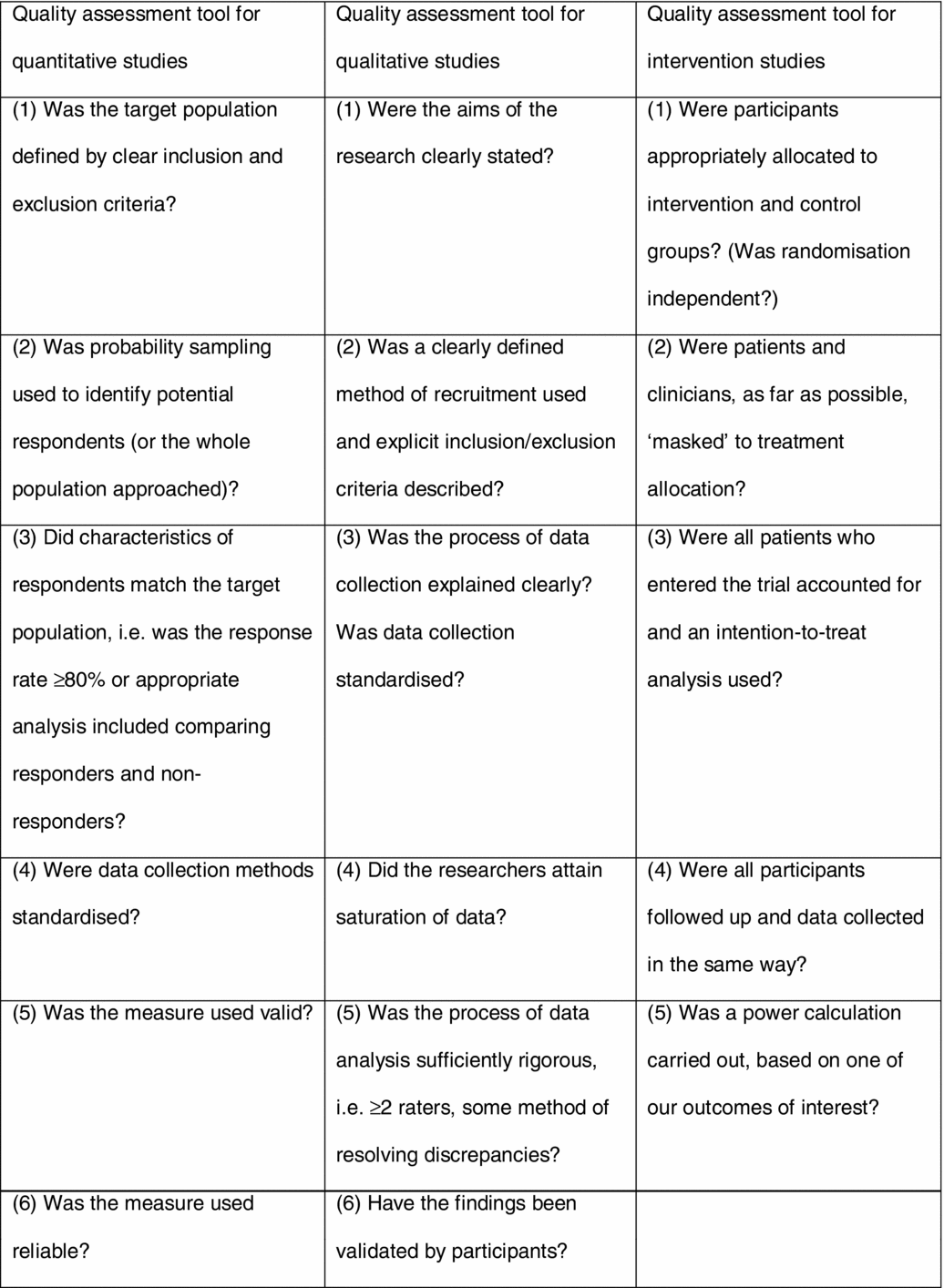
KL and CC rated the quality of papers independently, using operationalized checklists for qualitative and quantitative papers previously developed by our group (Mukadam et al., Reference Mukadam, Cooper and Livingston2011) from standardized assessment tools (Boyle, Reference Boyle1998) to assess quality (Figure 1). Each item on the checklists scored one point so the possible quality scores were 0–6 with higher scores indicating better quality. KL and CC discussed discrepancies in quality scores and reached a consensus.
Tools used to rate validity of qualitative and quantitative studies.
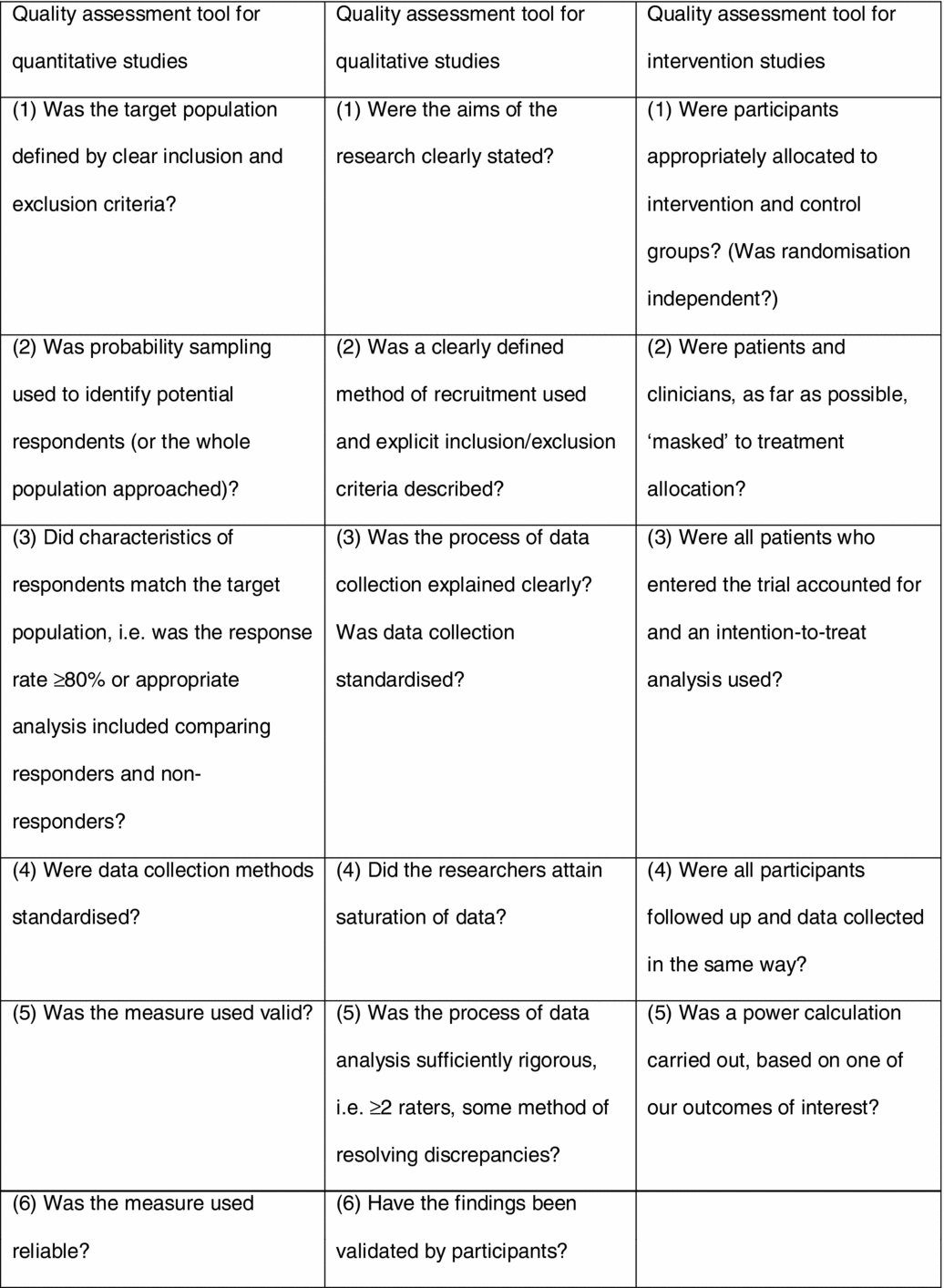
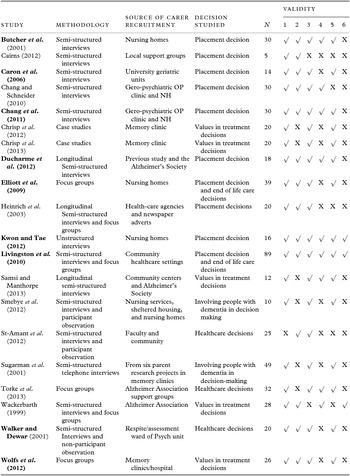
The authors decided a priori on the criteria for defining higher quality studies. For qualitative studies we categorized papers as higher quality if they: used a clearly defined recruitment method and clearly stated inclusion and exclusion criteria, standardized data collection and involved two or more independent raters in data analysis (Figure 1, criteria 2, 3, and 5). For quantitative studies we categorized papers as higher quality if they: clearly defined the target population, used standardized data collection methods and the measure(s) of decision-making relevant to our review were valid and reliable (Figure 1, criteria 1, 4, 5, and 6). For intervention studies we categorized papers as higher quality if they: appropriately allocated participants to intervention and control groups, all participants who entered the trial were accounted for and they collected data and followed up all participants in the same way (Figure 1, criteria 1, 3, and 4).
Results
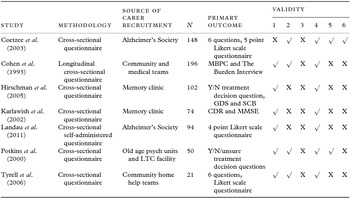
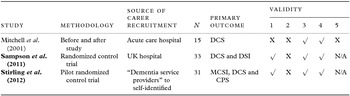
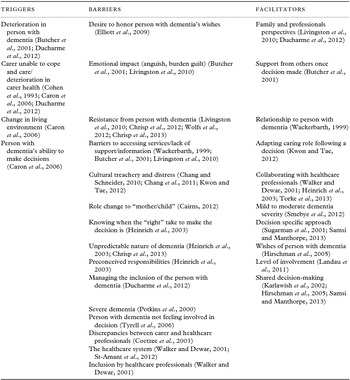
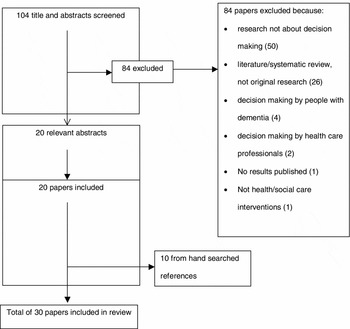
We found 104 results from our search and included 30 relevant papers (Figure 2). We categorized 9/20 of the qualitative papers and 2/10 quantitative papers as higher quality. These are summarized in Tables 1–3. Triggers, barriers, and facilitators to decision-making are detailed below and summarized in Table 4.
Methodological characteristics and quality ratings of qualitative papers included (higher quality papers are given in bold)

Methodological characteristics and quality ratings of included quantitative papers

Methodological characteristics and quality ratings of included intervention papers (higher quality papers are given in bold)

Summary of triggers, barriers, and facilitators to decision-making

PRISMA diagram.

Factors that trigger decision-making by family carers
Four of the higher quality studies interviewed family carers about making decisions on long-term 24-hour care and identified factors that triggered the decision-making process. Ducharme et al. (Reference Ducharme, Couture and Lamontagne2012) conducted 52 semi-structured interviews with 18 family carers who had considered placement of their relative in Canada during the past year. Decision-making was sometimes considered because of the deterioration in the person with dementia and at other times because the carer found it difficult to continue caring and/or deterioration in the carer's health. If the carer decided that the family member should remain at home they could reconsider this when the care situation changed. Butcher et al. (Reference Butcher, Holkup, Park and Maas2001) interviewed 30 family carers who had already made the decision to move their relative with dementia into a nursing home in the United States of America (USA). Similarly to Ducharme et al. (Reference Ducharme, Couture and Lamontagne2012) they found that the decision-making process was often triggered by a decline in the person with dementia and increased caring responsibilities.
One study explored what predicted decisions carers made about placements. More than half (51%) of 196 Canadian dementia carers who initially planned on maintaining their relative at home had moved them to a care home 18 months later; and doing so was associated with poorer carer health, greater burden and less enjoyment of caring (Cohen et al., Reference Cohen, Gold, Shulman, Wortley, McDonald and Wargon1993). Spouses were significantly more likely to opt for community care over placement.
Finally, Caron et al. (Reference Caron, Ducharme and Griffith2006) interviewed 14 carers who had considered moving their relative with dementia to long-term care, in the preceding six months in Canada and identified three central processes in decision-making. These comprised: the carers’ perceptions of their ability to provide care, their evaluations of their relatives’ ability to make care decisions, and contextual factors, such as, the living environment, crises such as a fall or hospitalization and interactions with healthcare professionals. The average time from carers’ initial thoughts about placement to their relative moving to a care home was two years.
Barriers to decision-making
Emotional impact of decision-making on family carers
Many carers struggled to decide whether to move their relative into a nursing home and experienced anguish and guilt (Butcher et al., Reference Butcher, Holkup, Park and Maas2001). Two studies asked focus groups of family carers making decisions for people with dementia which decisions were the most difficult, and in both deciding about long-term placement was identified. The first interviewed family carers of USA nursing home residents with severe dementia. Many carers reported that the decision was against the care recipient's wishes, and signaled a major carer role transition. They felt a responsibility and desire to honor the care recipient's “life story” and their previously expressed wishes and preferences. Reluctance to move the person was weighed against longer term benefits (such as, safer environment and better care) (Elliott et al., Reference Elliott, Gessert and Peden-McAlpine2009). In the second study, Livingston et al. (Reference Livingston2010) used focus groups of United Kingdom (UK) family carers to identify what were the most challenging proxy decisions, and then explored these in more depth in individual interviews. Carers discussed the responsibility of making a decision for another adult, denial, resistance by the person with memory problems, and barriers to accessing services. In many cases, the journey toward a decision was directed by a mixture of fatigue and a lack of obvious or available alternatives. Although carers often knew that the person with dementia never wanted to live in a care home, as circumstances changed they often felt compelled to act against this knowledge. Most families decided to keep someone at home as long as possible. The sense of guilt and failure seems to be particularly distressing for people obliged to cope alone.
There are also cultural issues that impact on carers emotional strain when decision-making around future place of care. Two studies interviewed Asian family carers who had recently placed a relative in a nursing home. Kwon and Tae (Reference Kwon and Tae2012) interviewed 16 Korean adult child carers individually. Some described feeling this decision was “treachery.” They struggled to find necessary information and gain family consensus. In the second study, Chang et al. (Reference Chang, Schneider and Sessanna2011) interviewed 30 family carers in China individually, who described high levels of decisional conflict when trying to balance their needs and those of their relative. Placement was perceived to violate Chinese filial piety and as abandonment by some. Distress continued after placement, often compounded by concerns about nursing home quality, and care received. Chang and Schneider (Reference Chang and Schneider2010) explored decision-making of family carers in China around placement, and found, similarly to the higher quality study described above, that they experienced ambivalence, uncertainty, indecisions, and distress. It was often a whole family decision but this could make consensus harder. Disturbing the family's quality of life was often a primary reason for placement, especially for carers with children in the same household.
Role transitions and perceptions
A further barrier in the decision-making process is a role change between carers and their relative with dementia. Cairns (Reference Cairns2012) interviewed five family carers in the UK individually to explore unconscious processes that might be involved in placement decisions. Carers report a shift in the dynamic to a “mother/child” type relationship and once they had decided to place their relative, being expected to relinquish their caregiver role and that friends and relatives felt the carer/person with dementia relationship to be over. They struggled to know when the “right” time to place their relative was. Heinrich et al. (Reference Heinrich, Neufeld and Harrison2003) interviewed 20 Canadian female carers. They also described difficulty knowing when to seek care home placement due the dementia being unpredictable and wait lists of institutions. Many believed that they as women were responsible for caring; worried about the perceptions of others and wanted to show that they have tried everything before seeking help.
Care recipient factors
A further potential barrier for carers when trying to make decisions around place of care may also be the person with the dementia. Following interviews with family carers who had considered placement of their relative during the past year, Ducharme et al. (Reference Ducharme, Couture and Lamontagne2012) concluded that the person with dementia was sometimes included in decision-making, and often those who were included were reluctant to move to a care home. This frequently led to the carer either delaying deciding or excluding the person with dementia from decision-making.
Two studies asked dementia carers about the process of deciding to access care and treatment for the dementia, in the Netherlands (Wolfs et al., Reference Wolfs2012) and the UK (Livingston et al., Reference Livingston2010). The Dutch dementia carers described this process as often emotional rather than rational and influenced by carers’ personal preferences. In both studies, the person with dementia's refusal and denial was experienced as a major interfering and hampering factor in a continuously changing process as dementia progressed.
The severity of dementia impacts carers end of life care decisions for people with dementia. Potkins et al. (Reference Potkins, Bradley, Shrimanker, O’Brien, Swann and Ballard2000) found that carers of people with more severe dementia were less likely to want intravenous antibiotics for life-threatening infection but equally likely to want oral antibiotics, resuscitation following cardiac arrest and intravenous fluids for severe dehydration.
Finally, Tyrell et al. (2006) interviewed 21 people with dementia and their primary carers in France about recently made decisions (to accept home services, a day center, or residential care). Five aspects of decision-making were explored: information received; being listened to; expression of opinion; time allowed to reflect on decision; and possibility of changing one's mind. Carers tended to be more satisfied than patients on most criteria and many patients felt they had not been listened to sufficiently with limited freedom to participate in decision-making.
Healthcare professionals, the healthcare system, and access to information
Information was crucial to making decisions, but after diagnosis the quality, quantity, and timing of information about dementia provided by professional services was sometimes considered unhelpful (Livingston et al., Reference Livingston2010). Feelings of guilt and distress carers experienced having decided to move their relative into a care home were exacerbated by perceived lack of support which could sometimes hinder decision-making (Butcher et al., Reference Butcher, Holkup, Park and Maas2001). Coetzee et al. (Reference Coetzee, Leask and Jones2003) found clinicians valued less “active” treatment approaches than carers; carers valued patients’ wishes, best interests, and dying with dignity more than professionals.
Chrisp et al. (Reference Chrisp, Tabberer, Thomas and Goddard2012; Reference Chrisp, Tabberer and Thomas2013) identified influences on carers’ decision to contact services to seek a dementia diagnosis and services. Similarly to Livingston et al. (Reference Livingston2010), they found that this was often resisted by the person with dementia and thus only happened when necessitated by a crisis. In a USA study, 28 family carers currently considering a proxy-decision were interviewed. Six carers felt that decisions were not made but dictated by the dementia. These caregivers were less likely to make decisions until the situation was intolerable. Carers report a lack of information necessary to inform their decision-making (Wackerbarth, Reference Wackerbarth1999).
The healthcare system itself can also impact on carers’ decision-making. In a Canadian ethnographic study, St-Amant et al. (Reference St-Amant2012) explored proxy decision-making by dementia family carers for people receiving homecare through face-to-face interviews and participant observations with clients, family carers, and home care providers (n = 52). They found that the home care system at times imposed untimely decisions, with placement dictated by availability rather than the person's needs, and excluded some family from decision-making by requiring individual rather than collective decisions.
One study by Walker and Dewar (Reference Walker and Dewar2001) interviewed UK carers on their involvement in decisions about hospital care of people with dementia, including discharge planning. Carers generally felt healthcare professionals did not involve them sufficiently in decision-making, and unable to raise and discuss issues that were concerning them. Barriers to involvement included hospital system processes, such as lack of resources and nature of the time pressured hospital environment, and a poor relationship with nursing staff.
Facilitators to decision-making
Role and support of healthcare professionals
Healthcare professionals have been shown to effectively facilitate the decision-making process. Collaborating with staff helped carers with the process of deciding when to place their relative into a care home (Heinrich et al., Reference Heinrich, Neufeld and Harrison2003) and where carers felt involved in decision-making, this was facilitated by a trusted healthcare professional who consulted them and advocated effectively (Walker and Dewar, Reference Walker and Dewar2001).
Torke et al. (Reference Torke, Schwartz, Holtz, Montz and Sachs2013) asked a focus group of USA carers about decision-making around cancer screening for people with dementia. Carers felt that clinician's raising discussion around this decision-making and being expert and knowledgeable helped them with the decision-making process. Carers’ decision-making was based on negotiating a trade-off between quality and duration of life, and reducing burdens (i.e. number of tests/investigations).
Severity of dementia/decision specific approach
The severity of the individuals’ dementia is a facilitating factor to their inclusion in the decision-making process. Two studies described the extent to which carers involved people with dementia in decision-making. In a small study that interviewed and observed Norwegian carers, individuals with moderate dementia were still actively involved in decision-making, especially decisions about daily activities rather than more complex decisions (Smebye et al., Reference Smebye, Kirkevold and Engedal2012).
Samsi and Manthorpe (Reference Samsi and Manthorpe2013) interviewed 12 UK people with dementia and their carers four times in a year about everyday decision-making. Carers adopted a decision-specific approach, and the decision context and the person with dementia's abilities to decide were key. As dementia advanced there was a move from shared to “substitute” decision-making. Carers use strategies to keep relatives involved such as taking responsibility for smaller everyday decisions thus allowing the person with dementia to “save” their decision-making capacities for bigger, more important decisions such as healthcare decisions.
Whole family shared decision
Carers generally found it helpful to hear the perspectives of other members of the family or professionals when making decisions on behalf of the person with dementia. This “gave permission,” alleviated guilt, and re-conceptualized care homes as providing safety, either for the carer or the person with dementia (Livingston et al., Reference Livingston2010). Family, friends, and neighbors often helped the family carer decide whether the present living environment met the person's needs. The authors concluded that the decision-making process is complex and nonlinear and could be activated and ceased several times without the person with dementia necessarily moving (Ducharme et al., Reference Ducharme, Couture and Lamontagne2012). Once the decision had been made, many carers sought reassurance from others about their decision (Butcher et al., Reference Butcher, Holkup, Park and Maas2001).
Carers’ tolerance of situations was important, with spousal carers tolerating more difficulties than adult children before resorting to a care home (Wackerbarth, Reference Wackerbarth1999). Carers reported emotional distress after the decision, which they sought to manage by adapting their caring role to visitor to the nursing home and seeking support for their decisions from others (Kwon and Tae, Reference Kwon and Tae2012).
Two studies investigated the extent to which people with dementia were, or would be likely to be involved in decision-making. In a USA study, Sugarman et al. (Reference Sugarman, Cain, Wallace and Welsh-Bohmer2001) examined proxy decision-making for clinical research, and also found that decisions with more serious perceived consequences were less likely to be shared. While carers may aim to act in the “best interest” of the person with dementia, carers are in a position to readily veto the patient's decision if he or she does not agree with it. Hirschman et al. (Reference Hirschman, Joyce, James, Xie, Casarett and Karlawish2005) asked 102 USA dementia family carers about a hypothetical treatment decision to take an Alzheimer's disease slowing medication. Carers of people with mild or moderate dementia, over 12 year's education, not residing in a nursing home and who were their spouse, were more likely to involve them in the decision. Sixty-two percent of carers said any disagreement would be resolved in favor of what the person with dementia wanted, the rest, in favor of what the family wanted for the patient, highlighting the need for discussion around the decision-making process between the carer and person with dementia. Female carers were more likely to say they would resolve a disagreement in favor of the patient's wishes.
In an Israeli study, Landau et al. (Reference Landau, Auslander, Werner, Shoval and Heinik2011) asked 94 carers who would decide about the use of a GPS tracking device. The spouse, the next most involved family carer and the person with dementia were most commonly ranked as the most involved (first, second, and third respectively). Karlawish et al. (Reference Karlawish, Casarett, Propert, James and Clark2002) asked 74 USA carers about the degree to which care recipients with dementia participated in medical decisions. In most cases the carers made the final decisions about medical care (64%), a quarter reported an equal role, and a small number (8%) reported that the care recipient made the final decisions. Patients with mild dementia were unsurprisingly most likely to be involved.
Care recipients previous wishes
Livingston et al. (Reference Livingston2010) reported that carers found end of life decisions particularly difficult to make, including those about resuscitation and artificial nutrition. Carers recognized the importance of making decisions about wills and power of attorney when the person with dementia retained capacity, however, sometimes only with hindsight. They were helped by knowing the person's previous wishes and experiences with other people they had known with dementia or another illness. Carers considered the person with dementia's previous wishes when deciding about participation in research.
Intervention studies
We found a lack of evidence regarding whether manualized interventions can improve the decision-making experience for family carers. Three studies described interventions that sought to improve decision-making. Two, higher quality studies, were pilot randomized control trials (RCT). In the first, Stirling et al. (Reference Stirling2012) used a decision-making aid for dementia family carers deciding whether to use community services, particularly respite care in Australia. Thirty-one carers were randomly assigned to either receive the GOLD (Guiding Options for Living with Dementia) book decision aid or no additional support. Outcomes were measured at baseline, two and 12 weeks. There was a non-significant trend for those in the intervention group to report less carer burden (the study primary outcome), decisional conflict (measured using the decisional conflict scale, DCS), and increased knowledge of dementia at 12 weeks. In the second RCT, Sampson et al. (Reference Sampson2011) piloted a palliative care assessment and Advanced Care Planning (ACP) discussion intervention with UK carers of hospitalized people with severe dementia. Participants were randomly assigned to the intervention (ACP) or usual care. Decisional conflict increased in the intervention group. The authors reported that although discussions around the completion of Advanced Care Plans with carers were well received, many were unwilling to make decisions about hypothetical future scenarios and few carers’ formalized decisions made despite intensive healthcare professional support.
The third, lower quality intervention study, was a single group study evaluating the use of a decision aid (Making Choices: long-term tube feeding placement in elderly patients) for long-term feeding in people with dementia in a Canadian hospital (Mitchell et al., Reference Mitchell, Tetroe and O’Connor2001). Fifteen carers who were deciding about whether a percutaneous endoscopic gastrostomy (PEG) tube should be sited were given an audio booklet decision aid. After using the decision aid, carers’ knowledge about the decision feed was significantly increased and their decisional conflict reduced. No carers changed their decision after using the aid but they reported feeling more comfortable with their decision, finding the decision aid highly acceptable, helpful, and they were prepared to recommend it to others.
Discussion
Main findings
Several studies described the decision-making process, often initiated by person with dementia or carer's deteriorating health; it was nonlinear and was often started and stopped several times before actual placement. Carers felt a responsibility to honor the person with dementia's previous wishes, but care recipients who were involved in the decision presented barriers by mostly resisting this, and were consequently excluded from the decision-making. As the caring situation changed, moving to long-term care was often inevitable and carers felt burdened and guilty; Asian carers reported particular distress as moving to a care home conflicted with traditional cultural expectations.
The decision to access services for diagnosis, care, and treatment of dementia was the healthcare proxy decision most frequently studied. Resistance from the care recipient was a frequent barrier to this, which could mean help seeking was delayed until a crisis occurred. End of life decisions, including those around resuscitation and artificial nutrition were particularly difficult. Carers often felt excluded from decisions made in hospital and those who felt unsupported by professionals found decision-making more difficult.
Collaboration with trusted, informed healthcare professionals facilitated the decision-making process for carers as did consulting with other family members in order to seek reassurance following a decision.
Decision-specific manualized aids have been developed, and while results for those supporting decisions about respite and PEG feeding have shown promising results in pilot trials, no intervention has yet been shown to significantly reduce decisional conflict or carer burden, or increase knowledge in RCTs. The two pilot RCT intervention studies were conducted with small numbers of participants. In the first, there was a non-significant trend toward a reduction in decisional conflict for carers deciding about respite, and this study may well have been underpowered. In the second, the intervention to assist with decisions around advanced care planning actually increased decisional conflict, perhaps because carers were being asked to consider decisions they were not previously actively making.
Not only does the evidence seem to suggest a decision specific approach to manualized aids but also targeting these toward specific carer characteristics. Resources for carers need to be culturally specific (Kwon and Tae, Reference Kwon and Tae2012) and it may be that asking families who they consider to be important in the decision-making process can improve this process with an understanding that they all provide support to each other once decisions have been made.
Further investigation is required in order to establish at what point these interventions should be delivered to people with dementia. Feedback from the delivery of the START manualized intervention (Sommerlad et al., Reference Sommerlad, Manela and Cooper2014) showed that use of this early on in course of the dementia disease would help carers to improve their communication and equip them with the knowledge to make major social care decisions for their relative.
Limitations
Most studies asked convenience or purposive samples of family carers about decision-making, and inevitably those that volunteer to discuss their experiences may differ systematically from carers who did not. For example, they might have found the experience particularly distressing, or have been relatively better informed about services and how to access information.
Conclusions
Family carers want practical support with decision-making but often report this is not readily available from healthcare professionals. Decision-making is time sensitive; options and opinions can change over time, usually in parallel with the advancement of the dementia disease. Carers want professionals to raise issues relating to decision-making, and have demonstrated high levels of decisional conflict emphasizing the potential benefit of decision-making support in this group. No intervention has yet been shown to significantly reduce decisional conflict in a RCT, but results from preliminary studies suggest that family carers find manualized decision aids useful and acceptable, and further development and evaluation of such aids is warranted. These could usefully focus on decisions around placement and accessing services, and end of life care decisions, as these have been reported in higher quality qualitative studies to be associated with considerable conflict and distress. Being provided with information to make decisions which have not previously been considered may increase feelings of conflict, suggesting these aids should be carefully targeted.
Conflict of interest
None.
Description of authors’ roles
Kathryn Lord conducted the literature searches, data extraction, study quality appraisal, and prepared the first draft of the paper. Claudia Cooper independently conducted study quality appraisal and resolved any disagreements with Kathryn Lord. All authors revised the manuscript critically and approved the final version for publication.
Acknowledgments
None.