The immune system of the neonate is immature, the gut is devoid of microflora and the stomach hardly able to deal with pathogens, which explains the infant's need for exogenous protection (Newburg, Reference Newburg2005). Nutrition with human milk has been demonstrated to facilitate the optimal development of important physiological functions and prevent the neonate from infection (Lönnerdal, Reference Lönnerdal2003; Walker, Reference Walker2004). Several mechanisms are responsible for this protective effect, including elements of both an innate and an acquired immune system: specific antibody targeted protection against pathogens and broad-spectrum of non-specific protection, such as the bactericidal effects of some milk proteins (Hamosh, Reference Hamosh1998).
Most of the proteins related to the protective effects of human milk are found in the whey fraction. Immunoglobulins, consisting of 90% secretory immunoglobulin A (sIgA), provide passive immunity based on previous maternal exposure to microbial pathogens. IgA is glycosilated in the mammary epithelial cell and secreted into the milk. The sIgA, which is resistant to digestion, enters the digestive tract of the infant and binds to enteric pathogens inhibiting their ability to produce infection (Hanson et al. Reference Hanson, Korotkova, Haversen, Mattsby-Baltzer, Hahn-Zoric, Silfverdal, Strandvik and Telemo2002). Lactoferrin (LF) is a major protein considered as part of the innate immune system of human milk. Its antibacterial effect may be multiple, as it has been reported to exert a bacteriostatic effect through iron sequestering, as well as a direct antibacterial and fungistatic effect (Lönnerdal & Iyer, Reference Lönnerdal and Iyer1995; Andersson et al. Reference Andersson, Lindquist, Lagerqvist and Hernell2000; Ward & Conneely, Reference Ward and Conneely2004). Lysozyme (LZ) is present in human milk at a higher concentration than in the milk from other species. LZ plays an important role in the protection of breast-fed newborns due to its bacteriolytic function by hydrolyzing the β−1,4 linkages between N-acetylglucosamine and N-acetylmuramic acid in peptidoglycan heteropolymers of the prokaryote cell walls (Goldman, Reference Goldman, Ham Pong and Goldblum1985; Newman, Reference Newman1995). The effect of other human milk protective factors is developed in vivo after gastrointestinal digestion and occasionally they act in an additive or a synergistic way (Liepke et al. Reference Liepke, Zucht, Forssmann and Ständker2001; Isaacs, Reference Isaacs2005).
While it is recognized that individual proteins, such as sIgA, LF and LZ, could offer antibacterial protection to the infant, not much research has been conducted to evaluate the antibacterial activity of whole human milk or human milk whey. Dolan et al. (Reference Dolan, Boesman-Fikelstein and Finkelstein1986; Reference Dolan, Boesman-Fikelstein and Finkelstein1989) investigated the antibacterial spectrum of human whey against a wide range of pediatric pathogens. The results of their experiments demonstrated the antibacterial capacity of human whey against several Gram-positive and Gram-negative microorganisms. Human milk diluted with Stainer and Scholte medium was also shown to have a bacteriostatic effect against Bordetella pertusis when compared with bovine milk (Redhead et al. Reference Redhead, Hill and Mulloy1990). Furthermore, bactericidal activity against Eschericia coli, Shigella sonnei and Klebsiella pneumoniae was also found in whey from human colostrum (Solórzano-Santos et al. Reference Solórzano-Santos, Castellanos-Cruz, Echaniz-Avilés and Arredondo-García1993). However, to our knowledge there are no studies on the antibacterial activity against Listeria monocytogenes of human milk during the course of lactation. It is important to remark that the composition of human milk is not static, but changes considerably as a function of the nutritional needs of the infant and this may lead to changes in its antibacterial activity. On the other hand, little is known of the effect of gastrointestinal digestion on the antibacterial activity of human milk. Digestion could affect the half-life of biologically active milk proteins, changing their biological activity or, conversely, releasing biologically active fragments which could have new biological properties when compared with the intact protein (Chatterton et al. Reference Chatterton, Rasmussen, Heegaard, Sorensen and Petersen2004).
The aim of this work was to evaluate the antibacterial activity of human milk against List. monocytogenes and its evolution throughout lactation. In addition, the activity against an Esch. coli strain was also measured. The antilisterial activity was correlated with the content of different individual whey proteins with known antimicrobial activity. The effect of gastrointestinal proteases at different pHs on human milk proteins and antilisterial activity was also evaluated.
Materials and Methods
Samples
Human milk samples were obtained from three volunteer lactating women. The samples were collected by manual expression once a week, from the first to the 18th week of lactation, after nursing. Milk was skimmed and kept at −20°C until used.
Microorganisms
Esch. coli ATCC 25922 was from the American Type Culture Collection (ATCC) (Rockville, MD, USA) and List. monocytogenes CECT 934, was from The Spanish Type Culture Collection (Colección Española de Cultivos Tipo, CECT, Valencia, Spain).
Antibacterial assays
Antibacterial assays were performed by a modification of the method described by López-Expósito et al. (Reference López-Expósito, Gómez-Ruiz, Amigo and Recio2006) using microdilution trays. A total of 25 μl bacterial suspension was mixed with 100 μl human milk in a sterile 96-well microplate (Greiner Labortechnik, Frickenhausen, Germany). The control was performed by adding 100 μl trypticase soy broth (TSB) or brain hearth infusion (BHI) to 25 μl bacterial suspension. The mixture was incubated at 37°C for 2·5 h, and then plated on trypticase soy agar (Esch. coli) or brain heart agar plates (List. monocytogenes). The plates were incubated at 37°C 24 h and plate counts were performed. The assays were conducted in duplicate.
In vitro simulation of infant gastrointestinal digestion
Digestions with pepsin and pancreatin were carried out following the conditions used by Hernández-Ledesma et al. (Reference Hernández-Ledesma, Quirós, Amigo and Recio2007), with some modifications. Five different aliquots from a human milk sample were adjusted to different pHs (2·0, 3·0, 3·5, 4·0 and 6·5) with 1 m-HCl. These samples were hydrolyzed by pepsin (E.C. 3·4·23·1; 1:10,000, 1750 U/mg protein; Sigma Chemical, St. Louis, MO, USA) with an enzyme-substrate ratio of 1/20, for 30 min at 37°C and with a stirring speed of 150 rev/min. The digests were placed in ice-water to stop hydrolysis and the pH was adjusted to 7·0 with 0·5 m-NaHCO3. Pancreatin from porcine pancreas (Sigma) was added at an enzyme-substrate ratio of 1/20 and the samples were incubated for 60 min at 37°C with stirring as for pepsin. The hydrolysis was stopped by rapid cooling and the samples were held at −20 C prior to use.
SDS-PAGE
SDS-PAGE analyses was conducted with a PhastSystem® electrophoresis apparatus from Pharmacia (Uppsala, Sweden), using pre-cast PhastGels Homogeneous 20%, and PhastGel SDS buffer strips (Pharmacia). Electrophoretic conditions, Coomassie and silver staining followed the procedures indicated by the manufacturer. A molecular weight marker kit (Pharmacia), containing a mixture of proteins from 14·2–94 kDa, was used. Human milk samples (300 μl) were mixed with 700 μl 10 mm-Tris HCl buffer, pH 8·0, containing 25 g SDS/l, 10 mm-EDTA, and 50 g 2-mercaptoethanol/l, and heated at 95°C for 10 min.
Immuno-enzymatic assays (ELISA)
The concentration of the major antibacterial whey proteins: LF, LZ and sIgA was determined in each of the human milk samples using commercial sandwich ELISA kits with monoclonal antibodies and horse-radish peroxidase conjugated antibodies. For LF determinations a Bioxytech® Lactof EIA™ kit form Oxis (Portland, USA) was used. The kits from Immunodiagnostik (Bernstein, Germany) were used for LZ and sIgA determinations. In all cases, detection was at 450 nm using a Multiskan Ascent plate reader and quantification was performed by interpolation in the corresponding protein standard curve.
Statistical analysis
Statistical correlations were evaluated by lineal regression and principal component analysis using Statistica data analysis software system v. 7.1 (StatSoft Inc.). LSD test for mean comparison was performed using also the same software.
Results and Discussion
Antibacterial activity in human milk samples
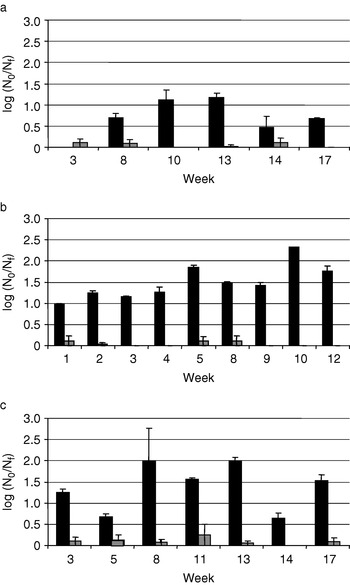
Figure 1 illustrates the results corresponding to the antibacterial activity of human milk samples from three different healthy donors against List. monocytogenes and Esch. coli ATCC 25922. The results clearly reflected a great variability in the antibacterial activity among the different donors. Human milk exhibited antibacterial activity against List. monocytogenes, particularly when compared with bovine UHT milk (log N0/Nf=0, data not shown). To our knowledge, this is the first time that the antilisterial activity of human milk is reported. Neonatal listeriosis is usually a very severe disease that involves a febrile syndrome accompanied by meningitis and, in some cases, gastroenteritis and pneumonia. The mortality is not high, but it may have sequels such as hydrocephalus or psychomotor retardation (Vazquez-Boland et al. Reference Vazquez-Boland, Kuhn, Merche, Chakraborty, Dominguez-Bernal, Goebel, González-Zorn, Wehland and Kreft2001).
Antibacterial activity of human milk, expressed as log N0/Nf (average value±standard deviation), from three healthy donors, a, b and c during the first 17 weeks after birth, against Escherichia coli ATCC25955 ( ) and Listeria monocytogenes (■). The bars indicate the antibacterial effect of each week. N0 refers to the initial number of colonies and Nf to the number of colonies after a 2 h incubation with human milk. Antibacterial assays were performed in triplicate.

In the conditions assayed, human milk did not produce a remarkable inhibition against Esch. coli ATCC 25922. Nevertheless, it is known that milk possesses antimicrobial compounds in high concentration, such as LF and the lactoperoxidase system, that are active against Gram negative microorganisms (Dolan et al. Reference Dolan, Boesman-Fikelstein and Finkelstein1989; Pakkanen & Aalto, Reference Pakkanen and Aalto1997; Floris et al. Reference Floris, Recio, Berkhout and Visser2003).
The concentration of the potentially antimicrobial whey proteins sIgA, LF and LZ was determined. The average content of sIgA through the 17 weeks of the study was 0·643 g/l, a result very similar to that obtained by Weaver et al. (Reference Weaver, Arthur, Bunn and Thomas1998), who reported a value of 0·708 g/l in a trial performed with 1590 human milk samples. LF average level was 1·76 g/l, which was higher than the value of 1·00 g/l reported by Hennart et al. (Reference Hennart, Brasseur, Delogne-Desnoeck, Dramaix and Robyn1991) in a study carried out with 20 Belgian mothers. In the case of LZ, it was observed that values were highly variable between donors (0·1–14·51 mg/l). LZ has been reported to be one of the human milk proteins with the highest variability in concentration (Montagne et al. Reference Montagne, Trégoat, Cuillière, Béné and Faure2000). This could be due to individual differences, but factors like age and infections in the mammary gland could also influence it greatly (Emmett & Rogers, Reference Emmett and Rogers1997; Ferranti et al. Reference Ferranti, Traisci, Picariello, Nasi, Boschi, Siervo, Falconi, Chianese and Addeo2004).
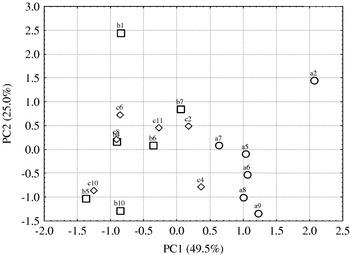
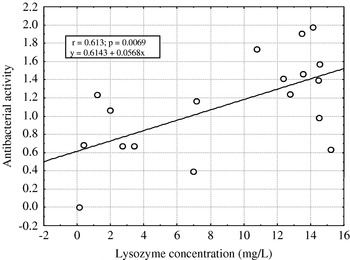
To identify possible grouping of the samples or correlation among variables (antilisterial activity and concentration of the various proteins), principal component analysis (PCA) was applied. PCA revealed the existence of two principal components that explained 74·5% of the total variance of the data. The first component, that explained 49·5% of the data variance, was negatively correlated with LZ concentration (−0·86) and antibacterial activity (−0·82); whereas the second component, that explained 25% of the total of the data variance, was slightly correlated with LF (0·67) and sIgA concentration (0·67). From Fig. 2 it can be seen that samples from mother A appeared as a separated group according to the high values of PC1, indicating a low concentration of LZ and low antibacterial activity. The correlation between the antibacterial activity and LZ concentration is represented in Fig. 3. The correlation coefficient (0·61) was significantly different from zero (P<0·05).
Plot of the human milk samples in the plane defined by the first two principal components from the data of concentration of sIgA, LZ, LF and antibacterial activity. Letters a, b and c symbolize the three donors employed in the study. Numbers represent the lactation week.

Correlation curve between the variables LZ concentration and antibacterial activity, using all samples throughout lactation from donors a, b and c.

Digestion of milk with gastrointestinal proteases
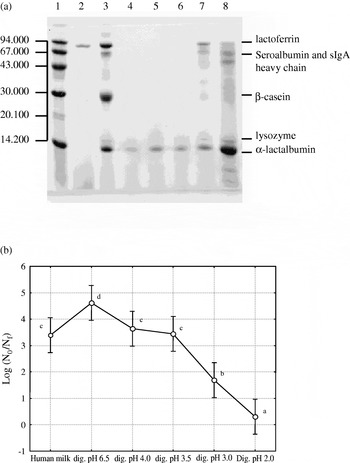
As previously mentioned, the gastrointestinal digestion process could change the antibacterial activity of a protein, either by releasing inactive fragments, or active peptides which could improve the antibacterial capacity by itself or by acting in synergy with the undigested protein. With the aim of evaluating the antibacterial activity after digestion with gastrointestinal proteases, a human milk sample with a remarkably high antibacterial activity was subjected to hydrolysis with pepsin at gastric pH values that represent those existing in the stomach of newborn infants during normal feeding, followed by hydrolysis with pancreatin. Gastric pH of term infants has been reported to rise shortly after feeding human milk, reaching values of 6·4 within 30 min, and to subsequently decrease with time to 4·0–3·0 (Mason, Reference Mason1962; Fig. 4). To assess protein hydrolysis, each digest was analysed by SDS-PAGE and its antibacterial activity was measured as illustrated in Fig. 4.
(a) SDS-PAGE of human milk hydrolysates. Lane 1, molecular weight marker; Lane 2, human LF; Lane 3, human milk corresponding to the 10th week of lactation; Lane 4, suckling′s gastrointestinal digestion simulation at pH 2·0; Lane 5, simulation at pH 3·0; Lane 6, simulation at pH 3·5; Lane 7, simulation at pH 4·0; Lane 8, simulation at pH 6·5 (b) Antibacterial activity of each hydrolysate at different pH against Listeria monocytogenes. The curve indicates the antibacterial effect of each hydrolysate expressed as log (N0/Nf) and their 95% confidence intervals. Mean values with different lowercase letters indicate statistically significant differences (P<0·05) Antibacterial assays were performed in triplicate.

Figure 4a shows the results of the analysis by SDS-PAGE of the digests. Protein identification was carried out according to the relative masses of human milk proteins (Afify et al. Reference Afify, Mohamed, Abdel-Salam and Abd El-Azim2003). SDS-PAGE results showed that in the hydrolysis with pepsin, the higher the pH, the lower the degree of digestion. Thus, simulation of the infant gastrointestinal digestion at pH 2·0, 3·0 and 3·5 yielded complete hydrolysis of all the proteins identified, with the exception of LZ and α-lactalbumin. At pH 4·0 and 6·5, digestion of milk proteins was diminished and electrophoretic bands corresponding to LF, sIgA and seroalbumin were also detected. Usually, the pH of the stomach in a healthy suckling baby is not under 4·0 (Mitchell et al. Reference Mitchell, McClure and Tubman2001), which is not favorable for optimal activity of pepsin (with a optimum pH of about 2·0 for most proteins). It is accepted that, at pH 4·0, LF is slightly digested by gastric proteases in vivo (Troost et al. Reference Troost, Stejins, Saris and Brummer2001). In addition, it is known that through the first weeks of life, a percentage ranging from 2–6% of the ingested LF is excreted in the faeces (Davidson & Lönnerdal, Reference Davidson and Lönnerdal1987). All these observations agreed with the results obtained, as electrophoretic bands corresponding to LF were detected in the digest carried out at pH 4·0.
Fig. 4b shows the results corresponding to antibacterial activity of each digest, as compared with the activity of the undigested human milk sample with a log (N0/Nf) value of 3·40 against List. monocytogenes. The antibacterial activity of the hydrolysates ranged between 0·31–4·04. Results revealed that the antibacterial activity decreased as the pH of the simulated gastric digestion decreased. That may be due to the higher effectiveness of the enzymatic hydrolysis at low pHs when compared with higher pHs, that would degrade antimicrobial proteins active against List. monocytogenes.
The antilisterial activity in the human milk after digestion at pH 6·5 was significantly (P<0·05) higher than before the hydrolysis. This could be explained by the incomplete digestion of some antimicrobial proteins like LF or LZ and the subsequent generation of antimicrobial peptides that could interact synergistically with antimicrobial proteins. Synergism was previously observed in human milk between LZ and LF (Ellison & Giehl, Reference Ellison and Giehl1991). While each protein alone was bacteriostatic, together they were bactericidal for strains of Vibrio cholerae, Salmonella typhimurium and Esch. coli. Recently, in our group, a synergistic effect between bovine LF and lactoferricin-B, a peptide produced from LF by hydrolysis with pepsin, was identified (Bellamy et al. Reference Bellamy, Takase, Wakabayashi, Kawase and Tomita1992; López-Expósito et al. Reference López-Expósito, Pellegrini, Amigo and Recio2008). If a similar synergism is established between lactoferricin and LF from human milk, it could play an important role from a physiological point of view. In fact, Kuwata et al. (Reference Kuwata, Yip, Tomita and Hutchens1998) identified, in the human stomach, significant amounts of fragments that contained lactoferricin in their sequence, and, as mentioned above, LF hydrolysis is incomplete at pH ⩾4·0. Thus, it could be likely that, after a gastrointestinal digestion process, when the gastric pH is high, LF coexists with the antimicrobial peptide lactoferricin or derived fragments.
To sum up, human milk showed antibacterial activity against List. monocytogenes that changed within the donors studied and during lactation in a way that was significantly related with LZ concentration. In the conditions tested, antibacterial activity against Esch. coli ATCC 25922 was hardly detected. Digestion with gastrointestinal enzymes, using a high pH in the hydrolysis with pepsin, showed that pH 4·0–6·5 resulted in a decreased hydrolysis and enhanced antibacterial activity. The impaired protein degradation under the conditions typical of the stomach of infants could be important in the defence against infection. It is suggested that partial degradation of certain milk proteins at the gastrointestinal level may produce peptides that could act synergistically with the remnant intact proteins.
We gratefully thank the mothers that participated in this study. This work received financial support from the Projects GR/SAL/0379/2004 and CM-S0505-AGR-0153. I. López-Expósito was the recipient of a fellowship from the Ministerio de Ciencia y Tecnología, Spain. The authors would like to thank Dr. PJ Martinez for his help with statistical analysis.