INTRODUCTION
The nannastacid cumacean Campylaspis laevigata Jones, Reference Jones1974 was originally described from material collected during the ‘Sarsia' cruise (Marine Biological Association of the United Kingdom) in the Bay of Biscay and the ‘Atlantis II' cruise (Woods Hole Oceanographic Institution (WHOI), United States) off the south-west coast of Africa, at depths between 119 and 1427 m (Jones, Reference Jones1974). Subsequently, Jones (Reference Jones1984) also reported this species off the Argentine coast between 497 and 518 m depth (WHOI ‘Atlantis II cruise 60'). No more records have been published since.
A recent re-examination of cumacean collections from the Bay of Biscay (Corbera & Sorbe, in preparation) and the Levantine Sea revealed that some Campylaspis specimens have been erroneously ascribed to C. glabra Sars, 1879 (see Elizalde et al., Reference Elizalde, Sorbe and Dauvin1993; Corbera & Galil, Reference Corbera and Galil2001) due to the smooth appearance of their carapace. These specimens are herein identified as C. laevigata. Their confusion with C. glabra demonstrates the need for a detailed redescription of this rare bathyal species. The present study aims to fill this gap, using specimens from the Bay of Biscay and the Levantine Sea.
MATERIALS AND METHODS
The specimens from the Bay of Biscay were collected at 8 stations located on a bathymetric transect from 484 to 1099 m depth during the ‘ESSAIS I', ‘ESSAIS II' and ‘ECOFER I' surveys carried out between April and July 1989. Stations were sampled with a modified Macer-GIROQ suprabenthic sledge (see Corbera & Sorbe, in preparation for further information on the sledge, on the study area and the collected cumacean fauna). The Mediterranean specimens were collected during monitoring surveys of a deepwater dumping site off the Israeli coastline. Sampling was carried out with a 0.062 m2 box-corer (Ocean Instruments model 700 AL). The material is deposited in the National Zoological Collections, Tel Aviv University (TAU) and in the Biological Reference Collection of the Institut de Ciències del Mar, CSIC, Barcelona.
For morphological observations, the cumacean specimens were dissected in lactic acid and stained with chlorazol black. The dissected parts were mounted in Fauré medium and conserved in permanent glass slides sealed with nail varnish. Drawings were prepared using a camera lucida on an Olympus microscope. Selected specimens were examined with a Hitachi H-2300 scanning electron microscope after dehydration through graded ethanol, critical point drying, stub mounting and sputter-coating with gold. Seta terminology follows Watling (Reference Watling1989) and Garm (Reference Garm2004).
RESULTS
SYSTEMATICS
Order CUMACEA Kröyer, Reference Kröyer1846
Family NANNASTACIDAE Bate, Reference Bate1866
Genus Campylaspis Sars, Reference Sars1865
Campylaspis laevigata Jones, Reference Jones1974
(Figures 1–3, 4A)
Campylaspis laevigata: Jones (Reference Jones1974), pp. 260–261, figure 3; Jones (Reference Jones1984), p. 272.
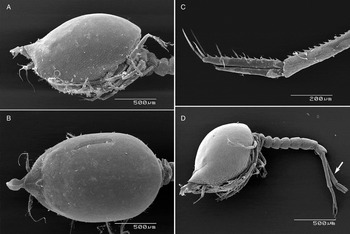
Campylaspis laevigata Jones, Reference Jones1974, scanning electron microscopy images. Preadult male from the southern Bay of Biscay: (A) carapace in lateral view; (B) carapace in dorsal view; (C) distal part of peduncle and rami of uropod. Immature female from the Levantine Sea (off Israel): (D) whole animal.

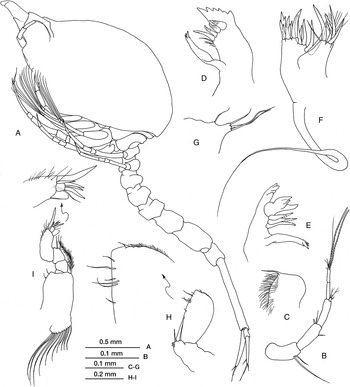
Campylaspis laevigata Jones, Reference Jones1974, adult female from the southern Bay of Biscay: (A) whole animal in lateral view; (B) antenna 1; (C) labrum; (D) right mandible; (E) left mandible; (F) maxillula; (G) maxilla; (H) maxilliped 1; (I) maxilliped 2.

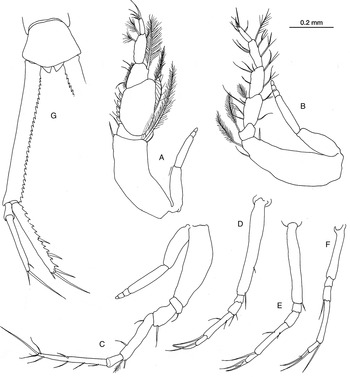
Campylaspis laevigata Jones, Reference Jones1974, adult female from the southern Bay of Biscay: (A) maxilliped 3; (B) pereopod 1; (C) pereopod 2; (D) pereopod 3; (E) pereopod 4; (F) pereopod 5; (G) abdominal somite 6 and uropods.

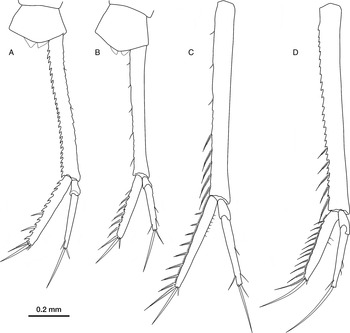
Comparative structure and setation of uropods in three species of Campylaspis: (A) C. laevigata Jones, Reference Jones1974, preadult male; (B) C. glabra Sars, 1878, adult female; (C) C. glabra Sars, Reference Sars1879, adult male; (D) C. nitens Bonnier, Reference Bonnier1896, preadult female.

Campylaspis glabra: Elizalde et al. (Reference Elizalde, Sorbe and Dauvin1993), p. 251 (in part); Corbera & Galil (Reference Corbera and Galil2001), pp. 135–146 (in part).
MATERIAL EXAMINED
Levantine Sea: 1 immature female (TAU AR29054), 32°55.816′N 34°38.018′E, 1268 m, 25 July 2011. 1 immature male (TAU AR29055), 1 immature female prepared for scanning electron microscopy (SEM) examination, Atlit, Station AT7, 32°53.8′N 34°10.8′E, 1557 m, October 1999.
Bay of Biscay: 1 immature male prepared for SEM examination, ECOFER I, haul TS05, 44°35.57′N 2°11.21′W, 522–523 m, 1 July 1989; 3 mancas, 2 immature females, 2 immature males, 9 preadult females, 9 ovigerous females, one of them dissected in two slides (ICMU 20120403), ESSAIS I, haul TS06, 44°33.57′N 2°10.70′W, 608–611 m, 21 April 1989.
DIAGNOSIS
Campylaspis with carapace smooth, lacking ridges, tubercles or lateral depressions. Eyelobe slightly triangular, shorter than half length of pseudorostrum. Uropodal peduncle as long as the last three pleonites combined, inner margin serrate. Uropodal endopod with inner margin serrate and bearing two setae (only one seta in mancas and some juveniles).
DESCRIPTION
Adult female 2.95 mm body length (from the tip of pseudorostrum to the end of last pleonite). Carapace (Figures 1A, B & 2A) smooth (microscopic observation), with weak scaly microstructures on lateral margins (SEM observations), 0.55 times total length, rounded dorsally, produced backwards and covering two subsequent free pereonites. Eyelobe slightly triangular, shorter than half length of pseudorostrum. Antennal notch shallow.
Antennula (Figure 2B), peduncle 3-articulate; articles of decreasing length toward apex; main flagellum longer than the apical peduncle article, with two aesthetascs and a long simple seta; accessory flagellum rudimentary with a simple and two articulate setae. Right mandible (Figure 2D) with incisor dentate, with four cuspidate setae and few simple setae between incisor and molar, molar styliform. Left mandible (Figure 2E) with incisor dentate, with three setae between incisor and lacinia mobilis, molar styliform. Maxillula (Figure 2F) palp apparently with a single filament, inner endite with five setae, one cuspidate, one pappose, two serrulate and one simple; outer endite with cuspidate and bifid setae. Maxilla (Figure 2G) with a single endite and four simple setae.
Maxilliped 1 (Figure 2H) reduced, basis with two hooked setae and two simple setae, mero-carpus with six simple setae on inner margin, distal article minute. Maxilliped 2 (Figure 2I) basis longer than rest of appendage, with a long pappose seta on distal inner corner; carpus longer than merus with two simple setae on inner margin; propodus longer than carpus, with two cuspidate setae distally; dactylus with three cuspidate setae, the inner one the longest. Maxilliped 3 (Figure 3A) with well-developed exopod, basis shorter than rest of appendage, wider than ischium, with two long pappose setae on distal outer corner and a simple small seta on distal inner corner; merus with simple setae and hyaline serrations on inner margin and a long pappose seta on distal outer corner; carpus shorter than merus, as wide as long, with simple setae on inner margin and a long plumose seta on distal outer corner; propodus longer than carpus with two pappose setae on inner margin; dactylus shorter than propodus with four terminal simple setae.
Pereopod 1 (Figure 3B) with well-developed exopod, basis as long as the following four articles, with a pappose and a simple seta distally on inner margin; ischium with a long pappose seta on inner margin; merus slightly longer and broader than carpus, with simple setae on inner margin and a pappose one on distal inner corner; carpus with simple setae on inner margins; propodus as long as carpus and longer than dactylus, with two simple setae on inner margin and pappose setae on outer margin. Pereopod 2 (Figure 3C) with well-developed exopod, basis a third of total appendage length; ischium very short, with a simple seta; merus half length of carpus, with a simple seta; carpus with simple setae on margins and a pappose seta on distal inner corner; propodus less than half length of carpus; dactylus as long as carpus and propodus combined lengths, with four simple setae on inner margin, two on upper margin and three terminally (the longest longer than dactylus half length). Pereopods 3–5 without exopods. Pereopod 3 (Figure 3D) basis longer than the rest of appendage, with a simple seta on distal corner; merus twice as long as ischium, with two simple setae on distal corner; carpus 3 times as long as merus, with a long simple seta on distal corner; propodus shorter than half length of carpus with a long simple seta on distal corner. Pereopod 4 (Figure 3E) basis as long as the rest of appendage, with a simple seta on distal corner; merus twice as long as ischium; carpus 3 times as long as merus, with a small simple seta on each margin and a longer one on distal corner; propodus shorter than merus, with a long simple seta on distal corner. Pereopod 5 (Figure 3F), basis shorter than combined length of three subsequent articles; carpus 3 times as long as merus, with a long simple seta on distal corner; propodus as long as merus, with a long simple seta on distal corner.
Uropodal peduncle (Figure 3G) as long as combined length of last three pleonites and twice as long as endopod, with inner margin serrate. Endopod 1-articulate, inner margin serrate (Figure 1C), with two setae on inner margin and three distally; exopod 2-articulate, slightly shorter than endopod, with two simple setae distally and a small one subdistally.
REMARKS
The closely allied and co-occuring congeners Campylaspis laevigata, C. glabra Sars, Reference Sars1879 and C. nitens Bonnier, Reference Bonnier1896 share a smooth carapace, lacking ridges or lateral depressions. However, C. glabra differs from C. laevigata (Figures 3G & 4A) in lacking the serrate inner margin of uropodal peduncle, and showing a higher number of setae on the inner margin of uropodal endopod (6–7 versus 2) (Figure 4B, C). Campylaspis nitens is easily differentiated from C. laevigata and C. glabra by its rudimentary eyelobe and higher number of setae (10) on the inner margin of uropodal endopod (Figure 4D).
ECOLOGICAL NOTES
Campylaspis is one of the most speciose genera within the Cumacea with more than 160 species (Anderson, Reference Anderson2010). Consequently, due to the high diversity of this genus in the deep sea, some species have been used to determine boundaries of deep zoogeographical units in the Atlantic Ocean (Watling, Reference Watling2009).
Records of C. laevigata show that its bathymetric distribution is between 280 and 2000 m in the Bay of Biscay (Jones, Reference Jones, Laubier and Monniot1985), a bathymetric range shared with C. sulcata Sars, Reference Sars1870 (same depth-range), C. glabra and C. verrucosa Sars, Reference Sars1865 (280–3000 m), C. valleculata Jones, Reference Jones1974 (280–4000 m), C. mansa Jones, Reference Jones1974 (280–5000 m), but also partially with C. intermedia Hansen, Reference Hansen1920, C. nitens Bonnier, Reference Bonnier1896 and C. rubicunda (Lilljeborg, Reference Lilljeborg1855) (1000–3000 m), C. alba Hansen, Reference Hansen1920 (1000–4000 m) and C. squamifera Fage, Reference Fage1929 (1000–5000 m) (Jones, Reference Jones, Laubier and Monniot1985). However, only C. glabra, C. nitens, C. squamifera and C. sulcata Sars, Reference Sars1870 were sampled in the upper bathyal of the southern Bay of Biscay during the aforementioned surveys, with the addition of C. rostrata Calman, Reference Calman1905 (Corbera & Sorbe, in preparation). In the Levantine Sea, C. laevigata is now known between 1200 and 1500 m, a bathymetric range where it co-occurs with C. alba, C. glabra, C. horridoides Stephensen, Reference Stephensen1915 and C. vitrea Calman, Reference Calman1906 (Corbera & Galil, Reference Corbera and Galil2001; Mühlenhardt-Siegel, Reference Mühlenhardt-Siegel2009).
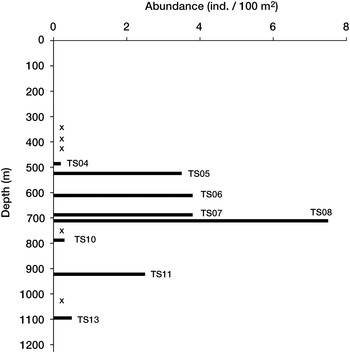
The study of the cumacean fauna collected in the Cap Ferret area (Corbera & Sorbe, in preparation) revealed that the highest abundance of C. laevigata was observed on the upper slope between 500 and 800 m depth, reaching a maximum value of 7.5 ind./100 m2 in sample TS08, 708–714 m depth (Figure 5). As suggested for other Campylaspis species (Kaestner, Reference Kaestner and Kaestner1967; Jones, Reference Jones1976; Blazewicz-Paszkowicz & Ligowski, Reference Blazewicz-Paszkowycz and Ligowski2002; authors, unpublished observations), C. laevigata probably feeds on foraminiferans and small benthic crustaceans, in relation to the structure of their mandibules and maxillipeds 2 modified as piercing organs (carnivory). Such a feeding behaviour was demonstrated in the case of the isopod asellote Munnopsurus atlanticus (Bonnier, Reference Bonnier1896), a dominant bathyal suprabenthic species in the same area of the southern Bay of Biscay, mainly consuming small agglutinant foraminifers (Elizalde et al., Reference Elizalde, Weber, Pascual, Sorbe and Etcheber1999). Therefore, the observed distributional pattern of this cumacean in the upper bathyal is probably related to food availability, i.e. abundance of benthic foraminiferans and small crustaceans in the near-bottom environment.
Bathymetric distribution and abundance of Campylaspis laevigata Jones, Reference Jones1974 on the southern margin of the Cap Ferret Canyon (southern Bay of Biscay). TS04-TS13: hauls carried out with a suprabenthic sledge; x, hauls without C. laevigata.

From a biogeographical viewpoint, the presence of C. laevigata off the Israeli coast is of great interest. Surprisingly, this species had not been previously reported from the western Mediterranean, although its deep-water cumacean fauna had been well studied (Calman, Reference Calman1906; Stephensen, Reference Stephensen1915; Reyss, Reference Reyss1972; Ledoyer, Reference Ledoyer1983, Reference Ledoyer1987; Cartes & Sorbe Reference Cartes and Sorbe1993, Reference Cartes and Sorbe1996, Reference Cartes and Sorbe1997). The low mobility of cumaceans and their lack of a free larval stage in pelagic waters would restrict dispersal of these small crustaceans into the Mediterranean bathyal, effectively separated from the Atlantic Ocean by the shallow Strait of Gibraltar (~300 m). However, the present finding demonstrates that both the Gibraltar and Siculo–Tunisian Strait did not represent unbridgeable barriers for the colonization of the whole Mediterranean Sea by this eurybathic cumacean from Atlantic populations. Further investigations on the deep Mediterranean benthic fauna are needed to ascertain the presence of this species in the western basin.
ACKNOWLEDGEMENTS
The authors thank the captains and crew of the RVs ‘Shikmona’, ‘Côte d'Aquitaine’ and ‘Le Noroît’ for their untiring efforts during samplings at sea. The ‘Shikmona’ cruise was funded by Israel Ports Company. Thanks are also due to R. Fontarnau and collaborators for their assistance during scanning electron microscopy sessions in the Serveis Cientificotècnics—University of Barcelona, as well as to Sarah Gerken (Anchorage, Alaska) and an anonymous referee for their comments that improved the manuscript.