

1. Describe the type of service you provide in your Anaesthetic/Recovery Room.
The recovery rooms in the main theatres at Aberdeen Royal Infirmary provide a 24 hour a day service to 15 theatres and an endoscopy suite. Aberdeen Royal Infirmary provides theatre services for all major specialties (burns and plastics, gastrointestinal, general surgery, vascular, urology, gynaecology, ENT/maxillofacial, neurosurgery, trauma orthopaedics and cardiothoracics), as well as acting as a regional trauma centre for half a million people spread over 3000 square miles across the North East of Scotland. The recovery unit accepts admissions from all of these specialties except invasive cardiac surgery and direct admissions to the intensive care unit (ICU); however, recovery can act as a holding facility for critically ill patients before transfer to the ICU. Patients are discharged following Association of Anaesthetists of Great Britain and Ireland (AAGBI) criteria to either their parent ward or a designated high dependency unit or ICU bed.
2. How is your unit set up?
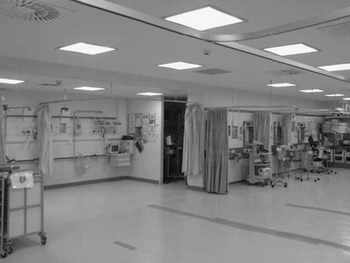
There are 2 recovery rooms within the theatre complex. Recovery 1 has 6 minor bays and 5 major bays for patients who have undergone complicated or extended surgery and/or require invasive monitoring (Arterial or Central Venous Pressure monitoring) or occasional use of Vigelo cardiac output monitoring. Recovery 2 has 7 bays and can cater for either major or minor patients. Depending on staff levels recovery 2 can be opened as an additional resource between 10:00 and 17:00 hours. At night (after 20:00 hours) and at weekends, staff base themselves in recovery 2 due to the close proximity of the 3 emergency/trauma theatres. Each bay is equipped to national AAGBI standards with Dash® monitoring. As far as possible patients are transferred through to recovery on their hospital bed to prevent unnecessary moving and handling. The nurse’s stations are strategically placed to observe the room as a whole.
Recovery One – Minors Bays

Recovery One – Majors Bays

Recovery Two

3. Introduce us to your team.
The nursing team consists of 1 band – 7 Senior Nurse, 2 band – 6 Team Leaders, 10 band – 6 Senior Staff Nurses, 18 band – 5 Staff Nurses and 2 Health Care Assistants. There is a permanent night staff contingent of 4 band – 6 Senior Staff Nurses and 1 Health Care Assistant. Year 3 nursing students from the Robert Gordon University regularly rotate through the unit on clinical placement. Sixty-four Consultant or Associate Specialist Anaesthetists with up to 40 trainee Anaesthetists of different grade are attached to the theatre department.
A number of Theatre Orderly Staff are involved in the safe transfer of patients to and from theatre.
4. What are the daily clinical or managerial challenges you cope with in your unit?
With 15 theatres operating 5 days a week, we can expect upwards of 70 patients to pass through the recovery per day. Due to the vast range of surgical procedures undertaken with times ranging from 30 minutes to over 8 hours, the workload can be sporadic and challenging, requiring excellent organisational skills and strong leadership.
5. What part of your working day do you find the most rewarding?
Achieving optimal patient care for each individual patient is what all staff within the unit strives to deliver. Seeing patients leave the unit with minimal discomfort is always satisfying. Encouraging and mentoring new staff to the unit, seeing them learn and develop into competent practitioners able to nurse their patients with confidence is very rewarding.
6. How do you orientate learners to your unit and what provision do you have for ongoing education?
New Staff Nurses to the unit receive a standardised orientation package delivered by the staff within the unit, in cooperation with the in house professional education department. On arrival each nurse is allocated 2 mentors with whom they will work with closely and they benefit from a period of supernumerary practice depending on their levels of previous experience. All staff nurses undertake Immediate Life Support Training yearly. Encouragement is given to staff to take on link nurse roles within the unit. We currently have link nurses for acute pain and Post Operative Nausea and Vomiting, infection prevention and control, health promotion, health and safety, basic life support, risk assessment, pharmacy and moving and handling. Staffs from the unit are also involved in the preparatory work for the implementation of the OPERA patient management system within the department. Once the nurse is confident and has demonstrated competence in post-anaesthetic care, they can be trained and assessed to administer intravenous opiate drugs.
7. What was the last audit/research your unit took part in, and what were the outcomes?
The recovery unit has been a part of several audits in conjunction with the Anaesthetic Department of NHS Grampian (pain/post-operative nausea and vomiting following wisdom tooth extraction). It is our intention in the future to undertake a more nursing focused audit with regard to privacy and dignity within recovery. We audit waiting times for patients being collected by the ward staff from theatre to improve the service we provide. As part of the Scottish Patient Safety Programme, we audit the temperature of all patients and the blood glucose of diabetic patients on arrival with regard to maintaining normothermia and normoglycaemia perioperatively.