1. INTRODUCTION
Trygve Haavelmo is widely known for his “Probability Approach in Econometrics” (Haavelmo, 1944), which “founded modern econometrics.”1
Spanos (1989, p. 405). Morgan (1990) calls the publication of Haavelmo (1944) a “probabilistic revolution” in econometrics (p. 229); Qin (1993) uses similar words and quotes contemporary authors calling it the logical foundations of econometrics, the manifesto of econometrics, etc. (pp. 20–21). See also Christ (1994).
Koopmans (1950); Hood and Koopmans (1953). But 50 years later there are also dissenting voices: “those who read [Haavelmo, 1944] after learning … that a revolution has taken place in econometrics and that the Probability Approach was the catalyst of this revolution will probably be disappointed by the lack of empirical support and the absence of a compelling justification for the fundamental assumptions of the stochastic method” (Tryfos, 2004, p. 121).
In the preface to his thesis Haavelmo used a succinct metaphor to describe his task: “The method of econometric research aims, essentially, at a conjunction of economic theory and actual measurement, using the theory and technique of statistical inference as a bridge-pier. But the bridge itself was never completely built.” Haavelmo went on to say that the tools of statistical inference should be considered “legitimate” to support statements about whether an economic theory was “good” or “bad,” while at the same time “adoption of definite probability models” was not only to be avoided but “deemed a crime in economic research, a violation of the very nature of economic data.”3
Quotes from Haavelmo (1941c, p. ii).
The literature on the history of econometrics gives relatively little precise information about the genesis of Haavelmo's “Probability Approach” and the process that led the small research outfit known as the Cowles Commission to adopt what an authoritative source has called the “Haavelmo–Cowles programme” and the “Haavelmo–Cowles agenda.”4
De Marchi and Gilbert (1989).
In considering the genesis of “The Probability Approach” we will be restricting ourselves to Trygve Haavelmo's personal intellectual endeavor. We will try to trace elements in the intellectual baggage he brought with him from Europe that can be linked directly to the content of “The Probability Approach,” in addition to accounting for the major influences that affected him while writing his treatise. Our working hypothesis is, foremost, that Haavelmo's work was rooted to a greater extent in Europe than the impression one gets from the literature on the history of econometrics. Haavelmo's general outlook and research experience in economic and econometric research came overwhelmingly from Frisch, above all the concern with the implications of simultaneous equations in economics. Another important influence on Haavelmo was exerted by Jerzy Neyman. In our view Neyman's role has been misrepresented in the literature. Neyman can be credited with having initiated Haavelmo's quest for the role of probability in economics, but his influence in that direction was exerted in 1936 in the United Kingdom, rather than during their second meeting in the United States during the war. We also aim at elaborating upon the interaction between Haavelmo and Abraham Wald and its importance for Haavelmo's treatise. Haavelmo was familiar, at least to some extent, with the early American tradition in econometrics, but it does not seem to have played much role in his work. Our aim is also to consider Haavelmo's role, if any, with regard to the direction the economic research at the Cowles Commission took from 1944 onward. Did the Cowles Commission team find “The Probability Approach” just what they needed and so embrace it, or if Haavelmo had not written his treatise, would their research have gone in some other direction? In this connection we find the relationship and mutual influence between Haavelmo and Jakob Marschak to be of utmost importance.
We may already be running too far ahead, so let us retrace our steps a little and draw up a timetable for Haavelmo's stay in the United States. Trygve Haavelmo arrived in the United States in June 1939 to study statistics and economics for a year or so. It was not his intention to enroll in a study program or to take a doctoral degree at an American university.5
The Royal Swedish Academy of Sciences, which awarded Haavelmo the Nobel Memorial Prize in Economics in 1989, was, as is apparent from the initial press releases, under the misapprehension that Haavelmo had been a doctoral student at Harvard and completed his degree there with Haavelmo (1941c), a misapprehension also shared by others.
Frisch submitted his doctoral dissertation when he was 31 years old, and he may well have advised Haavelmo not to rush it. Certainly, it would have been in line with his later advice to Haavelmo not to submit until he had acquired sufficient mathematical and statistical knowledge.
“My further plans for scientific work are to take up the general problem of connecting economic theory and statistical observations. Besides this I wish to treat some special oscillation problems in economics dynamics. I have also planned a study of individuals' economic behaviour, particularly dealing with the problems of individuals planning over time.” Quoted from his application to the Rockefeller Foundation, Haavelmo/T.B. Kittredge, April 15, 1939.
But things turned out differently from the way he had expected, and his plans had to be revised. World War II broke out two months after Haavelmo arrived in the United States. Once Norway had been attacked and occupied by Germany in the spring of 1940, to go home was no longer a viable option. In the end, Haavelmo did not return until March 1947, after nearly eight years in the United States. His extended stay can be divided up in phases as in Table 1, which indicates his status, location, and research activity at the time.
Trygve Haavelmo's stay in the United States, 1939–1947

As indicated in Table 1, Haavelmo wrote his major work in the course of his first two years in the United States. It was hectographed and distributed as “On the Theory and Measurement of Economic Relations” (Haavelmo, 1941c) in August 1941. The 1941 version was reworked, reedited, and retitled during the second period of Haavelmo's stay when prospects emerged for a proper publication of the treatise. It was published, eventually, in the third period as “The Probability Approach in Econometrics” (Haavelmo, 1944). The differences between the two versions were after all small; it is thus substantially correct to say that “The Probability Approach” treatise was written by August 1941. Our interest in Haavelmo's activities in the second period is also that these may have played a role in the chain of events that led to the Cowles Commission's emphasis on research into econometric methods from 1944–1945 onward.
In Section 2 we will consider briefly what Haavelmo brought with him from Europe, particularly from Ragnar Frisch, in terms of theoretical conceptions and experiences for the work he would embark upon. Section 3 considers Haavelmo's activities in the period he wrote his treatise and his interaction with other econometricians, particularly Jerzy Neyman and Abraham Wald. Section 4 summarizes main points about the genesis of “The Probability Approach.” Section 5 deals with how the ideas outlined in “The Probability Approach” were spread within the econometric circle. Section 6 looks in particular at the contact with and connection between Jakob Marschak and Haavelmo, with regard to the influence Haavelmo's work had for the research program at the Cowles Commission. Section 7 concludes. Section 8 fills out the picture of Haavelmo's stay in the United States with incidental details about his contact with the Rockefeller Foundation and the Econometric Society, together with other professional activities.
2. PREPARATIONS
Since graduating in 1933, Haavelmo had worked for four years with Ragnar Frisch at the Institute of Economics at the University of Oslo, spent one autumn term studying statistics at the University of London and another half year traveling for study purposes in Europe, and taught statistics for one year at Aarhus University in Denmark. His background as Frisch's assistant and co-worker had made him a highly experienced econometrician, although he had not published much before the war.8
See Bjerkholt (2005).
What had he learned from Frisch? Haavelmo assisted him when Frisch was at the very peak of his scientific achievements and creativity. He was familiar with Frisch's ideas and theoretical concepts and had studied his major publications thoroughly. As his “chief computer” he had taken part in most of Frisch's numerical experiments, which covered a wide range of theoretical and applied work. This broad general background is relevant for understanding Haavelmo's motivation and also his abilities. If we were to try to pin down specific strands in the intellectual approach that Haavelmo brought with him from Frisch's laboratory, the following items would be of particular interest:
(1) the “scientification” of economics; the quantification program;
(2) the implications of simultaneity of econometric relations, a.k.a. “multiple collinearity”; confluent relationships;
(3) Frisch's approach to business cycle analysis, a.k.a. “shock theory”;
(4) the welfare implication of improved econometric methods, the “astronomer” versus the “planner.”
With regard to item 1, Frisch's entry into economics was marked by a combination of harsh criticism of economics as it was practiced for lack of scientificity and a demonstration of how to proceed. His maxims were well formulated, but perhaps it is fair to say that his metatheory remained on the level of slogans and catchphrases. Starting from generalities such as “For any science the object of which is the outer world there comes a moment when the logical need awakens, when the immediate, more or less emotional conception of the basic concepts must yield to an objective and exact definition,” he developed his programmatic quantification formulations that a few years later became embedded in the constitution of the Econometric Society. He repeated catchphrases such as “theoretical economics is about to enter the phase of development at which natural sciences, particularly theoretical physics, have long been, the phase in which theory gets its concepts from the observational technique.” He thus compared economics to the natural sciences but also pointed out differences, in particular that economics was by and large deprived of access to experimental data and had to cope with “passive observations.” This recognition was closely associated with his assertion of the primacy of theory, in statements such as “Economic statistics tell us nothing if not viewed against the background of a broad theoretical-economic analysis” and “The observation material is and remains a dead mass until it is animated by constructive theoretical speculation.”9
In his metatheoretical considerations Frisch hardly touched upon the problem of how to test theories in economics, but it may have become a natural question for his assistant to pose.10Cf. Bjerkholt (2005, Sect. 3).
With regard to item 2, among Frisch's earliest work was his data analysis, set out in Frisch (1929). The core issue was simultaneity: i.e., more than one relationship holding between the same set of variables. In Frisch's terminology, the set of observations would then be “multiply collinear.” The simultaneity problem led to identification concerns in estimation. Frisch wrote two insightful essays that dealt with identification. One, the “Pitfalls” essay, had just been published when Haavelmo started to work for him in 1933; the other was the famous memorandum for the conference on the Tinbergen volumes in 1938, written just weeks before the end of Haavelmo's assistantship.11
Frisch's attempt to develop operational tools to diagnose the presence of simultaneity, the inventive graphic method of “bunch map analysis,” grew to a book-length paper, the Confluence Analysis monograph.12Frisch (1934). See Bjerkholt (2005, Sect. 4); Morgan (1990, pp. 183–187, 125–127); Qin (1993, pp. 99–102); Epstein (1987, Ch. 2.1); Aldrich (1994).
Confluence Analysis started out rather straightforwardly with a geometric consideration, assuming a great number of observations of variates between which “there exist not only one, but two independent equations…. From the distribution of points it would be absurd to try to determine the coefficients of any of the two equations that we know a priori should exist between the variates. Indeed a set of points lying in a line does not contain enough information to determine a plane.” But with data contaminated by errors of measurement or stochastic shocks, it might seem as if the plane could still be determined, an illusion Frisch called “fictitious determinateness created by random errors.” In focusing on this problem Frisch argued explicitly for disregarding “sampling theory” (probability) in order to have the problem “laid bare.”13
Quotes from Frisch (1934), pp. 5–7. The last section of Frisch (1934) was devoted to explaining why “classical sampling theory” was inadequate for the problems encountered in confluence analysis: i.e., simultaneous equations.
A verdict on Frisch's confluence analysis was concisely given 40 years later by Zvi Griliches: “It is fair to say that, while his questions turned out to be very fruitful, his solutions were often rather unsatisfactory and inelegant, the latter being perhaps the ultimate sin in the eyes of the more rigorous generation that followed him. He tried to do too much; he tried to solve simultaneously the errors-in-variables problem, the simultaneity (confluence) problem, and the model choice problem” (Griliches, 1974, p. 972).
With regard to item 3, Frisch's approach to business cycle analysis was his most important project throughout the 1930s. It became known internationally mainly as a result of his “Propagation-Impulse” paper in the Cassel Festschrift (Frisch, 1933a), published just shortly after Haavelmo's assistantship began. In this widely known and discussed work, Frisch explained persistent and gradually changing cycles as an outcome of the interaction between economic structure, represented as a dynamic deterministic model, and stochastic shocks, the “rocking-horse” simile borrowed from Wicksell.15
But Frisch never got around to publishing a more complete version of his approach. As only hinted at in the “Propagation-Impulse” paper, Frisch aimed at quantifying the cycle properties (frequency, amplitude, phase) generated by the combined effect of structural properties and shock distribution. Furthermore, he worked hard with his assistant, Haavelmo, to crack the “inversion problem”: namely, how to derive the (damped) solution of the theoretical dynamic system from an observed shock-maintained series, thus determining both the structure and the size of the shocks for a given time series. His method was a combination of theoretical time series analysis and numerical analysis of constructed data.Thus Frisch's involvement with probabilistic elements in economics was profound, making it a little puzzling that he has ended up being labeled “antiprobabilist” in the history of econometrics.16
Haavelmo's central involvement in “shock theory” and confluence analysis must be considered of key importance in his probability quest. One might even see Haavelmo's probability approach as a new angle from which to look at Frisch's paradigms.With regard to item 4, the potential welfare implication of improved econometrics may seem somewhat remote from the probability approach, but in fact it is not. Frisch was deeply concerned about improvements in the human condition being the ultimate aim of scientific economics, although he was seldom successful when he attempted to exert direct influence upon politicians and policymakers. Haavelmo obviously took over this rationale or had adopted it already when he chose to study economics in the depths of the Depression. The importance of the concept of “autonomy” was the potential use of econometrics for policy analysis, as Haavelmo explained in 1943, contrasting the needs of “astronomer” and “planner” for information (Haavelmo, 1943a), although Jakob Marschak gave more striking formulations in distinguishing between the “engineering” and the “meteorological” types of econometric inference (See Sect. 6).17
The purposiveness in Frisch's conception of what econometrics was about came through on many occasions, not least in his Poincaré lectures in 1933 (Bjerkholt, 2005, p. 502). On that occasion he also used “autonomy” in the title and text of his sixth lecture. Even before that Frisch had elaborated upon the simultaneity problem and the possibility of estimating the autonomous relations of a structural model in a lecture to a meeting of Nordic economists in June 1931. This suggests that “autonomy” may have been in oral use in the laboratory.
Frisch also told Haavelmo again and again that he needed more mathematics to do well as an econometrician—between them the message was shortened to “Carthage!”18
From “Carthago delenda est” (Carthage must be destroyed).
Tinbergen's work was much discussed in econometric circles, particularly after the sharp criticism it received from Keynes and others; see Morgan (1990, Ch. 4). Haavelmo wrote two papers related to Tinbergen's work during the war (Haavelmo, 1941b, 1943b).
During his year as a teacher in statistics in Denmark in 1938–1939 Haavelmo reviewed for Weltwirtschaftliches Archiv both Koopmans's and Wold's dissertations and also work by Tinbergen (Haavelmo, 1938b, 1939a). (The Wold review appeared in an issue of the Weltwirtschaftliches Archiv with laudatory greetings from Generalfeldmarschall Göring. Politics ruled in Germany, also in the scientific journals!) Haavelmo also met with Wold at Christmas 1938 to discuss Wold's dissertation.
To the extent that Haavelmo had a plan for his visit to the United States, it was strongly influenced by advice from Frisch. In 1937, after Haavelmo's first trip abroad to study with Jerzy Neyman in London, Frisch drew up a two-year study plan for Haavelmo: one year in Europe and one year in the United States. His advice was to “read a considerable amount of mathematics before leaving Norway” and then take up mathematical statistics by going back to Jerzy Neyman and staying there “as long as you think is necessary in order to get a good foundation in sampling theory.” Half a year with Neyman and a similar period with Jakob Marschak and the group he had put together in Oxford might be worthwhile. At the time of Haavelmo's departure for the United States, both Neyman and Marschak had moved across the Atlantic. Frisch also advised a visit to the U.S. Department of Agriculture. He mentioned Theodore Yntema at the University of Chicago and Charles Roos, one of the founders of the Econometric Society, and Harold Hotelling at Columbia University, adding that Haavelmo ought to go out to Colorado Springs to see the work of the Cowles Commission.21
Frisch/Haavelmo, July 12, 1937. Frisch was attending the third Cowles Commission Research Conference, and his recommendations mostly included people attending the conference. From these remarks Haavelmo worked out his list of places to visit, including Colorado Springs, the University of Chicago, Columbia University, and the USDA in Washington, DC.
3. WRITING “THE PROBABILITY APPROACH”
After arriving on the SS Oslofjord in Brooklyn, New York, on June 26, 1939, Haavelmo made his way as directly as he could to Colorado Springs, where the Cowles Commission had been located since its foundation by Alfred Cowles in 1932 as a support organization for the Econometric Society.22
Cowles originally wanted his proposed foundation to be called the Econometric Foundation, but the name was turned down by European Council members, who were afraid that an American businessman would steal the name “econometrics” from them. It was after all a European idea. See Cowles Commission (1952); Bjerkholt (1998).
The fifth Cowles Commission Research Conference, which ran from July 3 to 28, 1939, had 50–60 out-of-town participants, most of them members of the Econometric Society. Among those present whom Haavelmo knew from Europe were Jakob Marschak, near the end of a one-year leave from his institute in Oxford as Rockefeller fellow, and Horst Mendershausen, until shortly before the conference a research associate at the commission. From Frisch's 1937 list, in addition to Marschak, there were also Charles F. Roos and Theodore Yntema.23
C.F. Roos and T. Yntema were the first and second research directors of the Cowles Commission. H.T. Davis was “acting research director” in the interregnum between their tenures, when the 1939 conference took place. Roos seems to have faded out of academic econometrics from around the time of the conference. Yntema was succeeded by Jakob Marschak in 1943 (see the discussion in text).
The attendees thus included half of those Frisch had recommended that Haavelmo see on his study tour abroad. Jerzy Neyman, who had moved permanently from London to Berkeley in 1938, had been invited but in the end chose not to come. Instead he sent Francis Dresch, who worked with Neyman (and also with G.C. Evans). With Dresch as an intermediary, Haavelmo could arrange to visit Neyman in Berkeley as his next stop in the United States.
Harold Hotelling was not at the conference, but he had a co-worker there. Abraham Wald had fled Europe in 1938 and got a position as a research associate at the Cowles Commission.24
Frisch was an intermediary in arranging a position for Wald at the commission (Cowles Commission, 1952, p. 46). He was in touch with Wald at the time he left Vienna after the Anschluss and tried to persuade him to leave Europe via Oslo, but Wald was in too much of a hurry.
The USDA was also represented at the conference by Mordecai Ezekiel, and so Haavelmo was able to establish contact immediately with the USDA on his arrival in the United States. But as it turned out, Haavelmo never made much effort to get in touch with the USDA later, which was perhaps a reflection of his reorientation toward principles of econometrics rather than practical applications.
Close to 40 lectures were given by the participants over the period of the conference. Apart from Wald's paper, nothing much was close to Haavelmo's main field of interest. There were Keynes-inspired contributions by Abba Lerner, Mordecai Ezekiel, and Jakob Marschak; the latter also discussed the use of market, budget, and income data in demand analysis with references to recent work in the field. H.T. Davis spoke on problems in the theory of business cycles, in a vein of limited appeal to Haavelmo, who might have been more interested in Edward Dobb's attempt at estimating the length of Slutsky effect cycles created by taking moving averages.26
Abraham Wald's contribution to the conference, “The Fitting of Straight Lines If Both Variables Are Subject to Error,” showed that consistent estimates could be arrived at in this problem close to the heart of confluence analysis, although only two variables were dealt with.27
Cowles Commission (1939, pp. 25–28). Wald's paper was later published as Wald (1940b). R.G.D. Allen had dealt with the same problem in his paper presented at the 1936 Oxford meeting of the Econometric Society, published as Allen (1939), and arrived at some expressions similar to those of Wald, who had reached his conclusions independently of Allen's work.
Frisch/Haavelmo, August 17, 1939. Frisch had most enthusiastically read Wald's paper for the Annecy meeting of the Econometric Society in 1937 and Wald's contribution for the fourth Cowles Commission conference in 1938 and accepted both for Econometrica (Wald 1939a, 1940a). I have not found any trace in correspondence between them of the problem of the paper Wald presented at the 1939 conference.
Haavelmo presented “Statistical Testing of Dynamic Systems If the Series Observed Are Shock Cumulants.”29
The paper exists only as an abstract; see Haavelmo (1939b).
Haavelmo sent Frisch a letter on the last day of the conference. He felt his four weeks there had been well spent and expressed satisfaction with most of the presentations and discussions. He even seemed to have tolerated a few chatterboxes at an event that had so much to offer. He also found the conference of enormous practical value, as he met most of the individuals on the list of people he wanted to see and made arrangements for visiting Berkeley, Chicago, and Columbia.
Of those Haavelmo had met so far, he was in no doubt about ranking Wald and Marschak most highly. At this stage he had read hardly anything by Wald, who at the time of the conference had barely started his publishing in the field of theoretical statistics. Haavelmo's impression from the time they spent together was that Wald was a brilliant mathematician and statistician from whom he could learn a lot. He had also picked up at the conference that Wald would take over Hotelling's job at Columbia.30
That Wald would take over Hotelling's job at Columbia was not stated as a secret. Wald did not become full professor at Columbia until 1944, and Hotelling did not leave Columbia until 1946. It was not clear from Haavelmo's letter who his specific source was.
After the conference ended Haavelmo stayed on for some weeks in Colorado Springs with Wald, Marschak, Tintner, and a few others for hiking and further discussions on statistical testing and estimation. The smaller group gave Haavelmo a better opportunity to introduce his own scientific ideas, and he used it. Wald showed immediate interest in Frisch's irreducibility problem, set out in Frisch (1938). It was a mathematical problem rather than a statistical problem. Marschak had posed, perhaps provocatively, the following question with reference to Frisch's business cycle theory: Suppose an observed time series displays marked cycles of a certain length, and further that we have constructed a dynamic theory implying a differential equation for the observed variable of such a general form that it may have a cyclical solution. What then is the point of fitting this differential equation to the observed series and solving it for the time path of the variable? Won't it just give us a solution corresponding to the observed cycles?31
Haavelmo/Frisch, March 27, 1940.
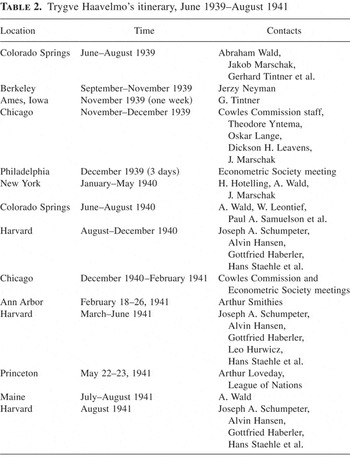
To help the reader keep track of Haavelmo's movements during the first two years he spent in the United States, the period in which he wrote “The Probability Approach,” Table 2 shows where he was, when, and with whom, though the text must be consulted for more precise information about the contacts.
Trygve Haavelmo's itinerary, June 1939–August 1941

After the Cowles Commission conference, Haavelmo left for Berkeley at the end of August 1939, arriving on the ominous day of the outbreak of World War II. One may presume that his stay in Berkeley was of great importance for his future work, as he chose in his Nobel speech in 1989 to mention his Berkeley visit 50 years later in the following passage:
I then had the privilege of studying with the famous statistician Jerzy Neyman in California for a couple of months. At that time, young and naïve, I thought I knew something about econometrics. I exposed some of my thinking on the subject to Professor Neyman. Instead of entering into a discussion with me, he gave me two or three numerical exercises for me to work out. He said he would talk to me when I had done these exercises. When I met him for that second talk, I had lost my illusions regarding the understanding of how to do econometrics. But Professor Neyman also gave me hopes that there might be other more fruitful ways to approach the problem of econometric methods than those, which had so far caused difficulties and disappointment.32
Haavelmo (1989, p. 285).
From the context this is clearly significant and intriguing information about Haavelmo's progress, but presented as anecdotal evidence after 50 years it must be interpreted with caution. The importance of the quote is underlined by the fact that in this speech Haavelmo mentioned no one else as having furthered his scientific progress.
The meeting between Haavelmo and Neyman in Berkeley in 1939 figures prominently in the history of econometrics and in fact as a conversion of Haavelmo from “Frisch's thinking to Neyman's.”33
There is, however, another possible, and much more likely, interpretation of Haavelmo's Nobel speech statement, namely, that the “numerical exercises” and the ensuing loss of illusions took place in London in 1936. Neither probability theory nor Neyman–Pearson testing was new to Haavelmo in 1939; he had studied both for years, even for three months with Neyman in London in 1936.In 1939 Haavelmo was a mature statistician and econometrician, rather than a novice. After his visit to London he had also taught statistics for one year at Aarhus University. As an econometrician he had reached the conclusion, unlike several other practitioners, that Neyman–Pearson testing was fully applicable to economic relations.34
This is apparent from his Copenhagen lecture in 1939 (cf. Bjerkholt, 2005, pp. 518–520), but only as programmatic statements. Haavelmo had not demonstrated how it could be applied.
Why then was Haavelmo not more precise about the timing of events in his Nobel speech? The events were 50 and 53 years ago, respectively, but it is unlikely that Haavelmo's memory failed him. Knowing Haavelmo's habit of not wasting words needlessly (and never talking about himself), it seems more likely that he saw no point in bothering the dressed-up audience in Stockholm with itinerary details from his early years. Haavelmo's point was that Neyman had exerted a major influence on his scientific career; he had led Haavelmo onto the road of modern probability reasoning. That explained why he gave Neyman such prominence in the Nobel speech. It also explains why he was eager to meet with Neyman again in the United States, namely, because he had ideas to present and certainly would appreciate Neyman's reactions to them (cf. his seminar lecture, which is discussed later in this section).35
Haavelmo's suppression of detail thus created difficulties for the historians. Morgan (1990) curiously does not give either time or place for the meeting between Neyman and Haavelmo. The direct source for Morgan (1990) and Qin (1993) about the Haavelmo–Neyman encounter appears not to be the Nobel lecture but oral information from D.F. Hendry based upon conversation with Haavelmo in 1987. Haavelmo may quite likely have been equally imprecise in this conversation. Qin (1993) dates the meeting to “around 1940,” which may well be Hendry's guess after the conversation. From Hendry's interview with Haavelmo comes also the anecdotal story that Neyman's influence on Haavelmo toward probability reasoning was exerted while Haavelmo tried to convert Neyman to confluence analysis. This just corroborates the interpretation set out in the text that the important meeting took place in 1936, as it was then that Neyman was introduced to confluence analysis. Frisch spent a long evening with Neyman after the Econometric Society meeting in Oxford, discussing both Neyman–Pearson testing and the merits of confluence analysis (Bjerkholt, 2005, p. 510). Haavelmo and Neyman discussed confluence analytic ideas during the autumn. Neyman in fact showed considerable interest in confluence analysis; he dealt with Frisch's approach in his “Lectures and Conferences on Mathematical Statistics” (Neyman, 1938a). In the second edition in 1952 he omitted this part because of the “extraordinary development of the econometric school.”
Thus we should consider Neyman's influence as exerted in 1936 but with great effect on Haavelmo's work over the next 10 years. We might even put forward the hypothesis that without Neyman's influence Haavelmo might well have remained a theoretician and an applied and empirical economist, rather than the fully fledged econometrician he was for a period of 10 years or so.
This reinterpretation of the Haavelmo–Neyman relationship is not meant to deprecate the importance of their second meeting in Berkeley in 1939. Haavelmo attended Neyman's lectures.36
Francis Dresch told Neyman's biographer, Constance Reid, years later that Neyman that autumn also held a seminar in economics at the house of Griffith C. Evans, chairman of the mathematics department and responsible for bringing Neyman to Berkeley (Reid, 1982, p. 168). Haavelmo might possibly have been there too, but the dating of the seminar is highly uncertain, as, according to Dresch, Lawrence Klein was present, which he could not have been in 1939.
Haavelmo/Frisch, November 15, 1939. There is no trace of Haavelmo in Reid (1982), which was written in cooperation with Neyman about 40 years later. It is also to be noted that September–October 1939 cannot have been the most convenient time to study with Neyman. The brutal German attack on Poland on September 1, 1939, made Neyman very worried about his brother, other family, and friends in Poland, and he engaged immediately in activities to assist family and colleagues in Poland and refugees who arrived in the United States. Neyman must in 1939 also have been very busy in establishing his department and at the same time arguing with Ronald Fisher.
Haavelmo had a chance meeting with Harold Hotelling when he happened to pass through Berkeley on his way to India. As Hotelling was the reason why Columbia University was on Haavelmo's list of places to visit in the United States, it was a fortuitous meeting. Haavelmo knew that Frisch considered Hotelling one of very few outstanding theoretical statisticians in the United States and an excellent economist too. He also went down to Palo Alto one day at the invitation of Holbrook Working of the Food Research Institute, Stanford University, who wanted to discuss his recent work with Haavelmo.
Haavelmo gave a seminar lecture at Neyman's Statistical Laboratory at the very end of his stay. He spoke on the frameworks for econometric analysis of Frisch and Koopmans, respectively, starting out with a quite general formulation of pure theory with a (theoretical) variable y as a function of number of variables x and then moving to alternative statistical formulations, the most general of which was

where the (y′′,x′′) variables were measuring errors and y1t represented neglected variables. The Ait's were parameters; the t subscript represented the idea, he explained, that the parameters could be shifted as a result of variable changes.38
Cf. the similar specification in Haavelmo (1944, pp. 17–21), Section 6, “The Reversibility of Economic Relations.”
(a) If the theory is a statement about the connection of observable variables, then, if no deviations are allowed, all theories will be deemed wrong.
(b) On the other hand, if the theorist has no preference for the different types of “deviations from theory” which may occur, one theory may be just as good as any other.
(c) Hence the problem of statistical testing is completely indeterminate unless the theory states explicitly what sorts of errors are allowed to be in accordance with theory.
(d) The errors allowed may be of different kinds. Suppose the errors are specified as certain given functions. Then again in most cases data will contradict theory.
(e) It may be that the theory states that the deviations have maximum value, and that the variation within the allowed range is simply unknown. That of course does not mean that the errors are random.
(f) Theory [is] unsatisfactory as long as deviations are of such regular character that it seems possible to explain them by one or a few regular factors.
(g) Therefore it is more or less natural to consider a theory about the connection between observational variables as “good” only if the errors made by using the theory are irregular.
(h) Taking irregular deviations to mean random variation, the problem of comparing theory with observations becomes a statistical problem. The problem of statistical testing of economic theory has no meaning unless the errors are specified as random variations, and it must also be specified how great they are allowed to be before the theory is rejected.39
Handwritten note for seminar lecture on November 2, 1939, at the Statistical Laboratory, University of California, Berkeley. Haavelmo Archive.
The assertions reflected Haavelmo's main concern: the possibility of statistical testing of economic theories and what it required of the formulation of theoretical statements to be tested.
Errors of observation had been a general topic among econometric practitioners in the late 1920s and early 1930s. Frisch took it up in his Confluence Analysis. In the lecture Haavelmo elaborated on the implications of such errors, mainly by reference to Frisch's assumptions of measuring errors in all variables: namely, that the moment matrix of the observable variables would not tend to zero in the limit and thus minimizing the residual variance would not give unbiased estimates. He also recapitulated Koopmans's application of Fisher's maximum likelihood principle in some detail, adhering to Koopmans (1937).
Shortly after Haavelmo left Berkeley he sent Frisch a progress report on his research. His general idea of what he was after had changed since coming to the United States. As he told Frisch, he had originally thought he would go looking for a new technical method, such as a new regression approach, but had found it necessary to take up the entire question of testing economic relations on a broader basis. It is near at hand to see in this broadened perspective an influence from Neyman, but a close reading of Haavelmo's Cowles Commission contribution, not least the title he had given it, leaves little doubt that he had brought the idea of “testing economic relations” with him from home. On the other hand, the scope of the statistical testing may well have been broadened in Berkeley.
Haavelmo's approach, he intimated to Frisch, would be to write out, at least for himself, “a survey of the terrain”: namely, that economic theory had come quite a long way with regard to the construction of rational systems and in drawing correct conclusions from strictly defined assumptions but little had been done with regard to building “rational theories about the gap between theory and observations.” As soon as there was a discrepancy between theory and data—i.e., practically always—one was completely at a loss as to whether a theory was “good” or “bad,” whether the deviations were “large” or “small,” etc. One could hold a personal opinion about it and reach valuable conclusions that way, but it was useless to try to convince others on that basis. The missing “rational theory” here is obviously just a less poetic expression for the “bridge [that] was never completely built.”
Haavelmo also reported to Frisch that he had observed during his few months in the United States that the inevitable subjective element in such assessments was frequently used as an argument against Tinbergen's work. He recognized that there could be dubious aspects connected with the introduction of probability statements, but he had nevertheless come to the conclusion that this was the only possible, rational way out. When considering macroeconomic relationships, it was hardly useful to add more or less arbitrary assumptions about the nature of the random deviations. In that case one would not know which “fundamental probability set” (referring to Neyman) one was dealing with, and the probability concepts would be floating in the air.40
The source for this and the preceding paragraphs in the text is Haavelmo/Frisch, November 15, 1939, transl. by the author. The concept of the “fundamental probability set” appears in Haavelmo (1944), Section 9. On reading the letter Frisch scribbled enthusiastically in the margin: “There is no doubt that Haavelmo is on the right path!” (transl. by the author). (So much for Frisch's antiprobability position!) After thus bringing Frisch up to date with this current thinking, Haavelmo added obediently, but jokingly, that he had indeed struggled to destroy Carthage!
Haavelmo had thus come to the conclusion, with or without Neyman's help, that testing implied more than just bringing the economic relationships formally into a probabilistic framework; prior to that probability had to be brought into the economic relationships. He elaborated to Frisch further on how to do just that:
One can take into consideration each macro variable's character as being an aggregate or average of individual actions, and then make some assumptions about random variations in the individuals' behavior. These assumptions can be made in a barely restrictive way when the purpose is simply to deduce the nature of the random variations that will result about the average of a large group. In this way one can give a concrete interpretation of “errors.” If one does not start here, but just keeps the average (at every point in time) as one observation, one will lose the information inherent in each such observation being a sum (average) of a known number of random variables. The assumptions then made about random movements in the macro series can be inconsistent with the concrete information one has about the possible variations in the single individual's behavior.41
Haavelmo/Frisch, November 15, 1939, transl. by the author. The statement can be linked rather directly to what would later appear in Haavelmo (1944), Sections 11 and 13.
From Berkeley Haavelmo moved on to Chicago, stopping en route for a week in Ames, Iowa, where he had been invited by Gerhard Tintner to give a seminar lecture on problems in the statistical testing of economic relations. He started out as if taking a cue from Neyman's lecture to the Econometric Society meeting in Oxford in 1936 (cf. Bjerkholt, 2005, p. 509):
The testing proceedings used in statistical analysis of economic theory are today in a phase very much the same as that of mathematical analysis during the first inventions of the calculus methods, when deliberate integration of divergent series, unfounded passings to limits, etc., flourished in the literature. In modern econometric literature we find all sorts of funny regression methods, curve fitting procedures, etc. Shortly there has been a real hunting for close correlations. Afterwards it is always rather easy to put up a nice theory “explaining” the relationships.
This is not very much of a scientific proceeding. It also represents a bad misuse of modern statistical theory, which really in many cases provides theoretically consistent methods for dealing with economic testing problems in a scientific manner.
The first requirement for the possibility of statistical testing of economic relations is that the theory be formulated as a statistical hypothesis. In order to become a statistical hypothesis a theory must be so formulated that it becomes a problem in random variables, i.e., variables which allow the applicance of probability calculus.
Now it is often said that for instance in economic time series we do have systematic variations with time, and hence the successive observations are not independent. But this does not mean that we may not have a problem in random variables. The point is that the variations which are not accounted for by the theory should be random variations.
Shortly: the requirement for the purpose of statistical testing is that the theory be so formulated that it is sufficient to add at some points in the theory random variables in order to make complete agreement between theory and observations. Before this state is reached the theory may not be considered as complete.
Hence it becomes a very important part of the theory itself to indicate where the random variables come into the theory and of what kind they are. Unless the theory is completed in this way the whole problem of statistical testing is indeterminate.42
The quote is the opening paragraphs of Haavelmo's handwritten notes for the seminar on November 9, 1939, at Iowa State College with the title “Problems in the Statistical Testing of Economic Relations.” Haavelmo Archive.
Thus in Ames Haavelmo spoke out against the opinion that probability theory could not be applied to economic time series, indicating that this viewpoint was a thing of the past. Although there was widespread skepticism about bringing probability into economic theory, all that was needed was persuasive arguments.43
Cf. Morgan (1990, pp. 230–238).
He also expounded a somewhat pluralistic view on the foundation of probability: “The kind of probability statements wanted may be a matter of taste, but once these questions are settled the probability calculus leads in point of principle to definite testing and estimation proceedings.”44
Haavelmo used similar formulations in “The Probability Approach,” Section 10, perhaps an outcome of having studied probability fundamentals in different sources.
In Chicago Haavelmo spent much of his time in the library of the Cowles Commission, which was located in the Social Science Building of the University of Chicago. Theodore Yntema had become research director. There were ten people on the research staff of the commission at the time, including Oskar Lange, who was professor in the Department of Economics, and Dickson H. Leavens, the managing editor of Econometrica.45
The other staff members at the time were Edward N. Chapman, Forrest Danson, Harold T. Davis, Joel Dean, Herbert E. Jones, H. Gregg Lewis, Francis McIntyre, and Jacob L. Mosak.
Haavelmo/Frisch, November 17, 1939, transl. by the author.
Marschak also showed up in Chicago. On one occasion Haavelmo took part in a discussion of the Tinbergen–Keynes debate in Yntema's office with Marschak and Lange. As an outcome of this discussion, Marschak and Lange wrote a rather strongly worded response to Keynes's highly controversial review of Tinbergen (1939) and submitted it to the Economic Journal at the beginning of 1940.47
Keynes (1939). The Marschak–Lange paper titled “Mr. Keynes on the Statistical Verification of Business Cycle Theories” was not accepted by the editor of the Economic Journal, none other than Keynes himself; see Morgan (1990, p. 128). The unpublished typescript of the paper eventually was published in Hendry and Morgan (1995, pp. 390–398). An initial note acknowledges that “many points are due to discussions with T. Haavelmo, Oslo” as if he was expected to be back in Oslo by the time the paper was published. Cf. also Marschak/Haavelmo, February 19, 1940.
From Chicago Haavelmo traveled via Philadelphia to Columbia University, New York, where Wald was teaching. Haavelmo and Wald had respected each other from their first meeting in Colorado Springs. Haavelmo would have felt that he had much to learn from Wald, who also took a great interest in Haavelmo's concerns and ideas. At Columbia Haavelmo attended Wald's lectures on statistics. Wald had not written much on modern statistics when he took up his post at Columbia. His first work in the field was Wald (1939b), held by Wolfowitz (1952) to be his most important paper. The lectures he gave at Columbia in 1939–1940, some of which Haavelmo attended, were “noted for their lucidity and rigor.” Lecture notes taken by students later introduced many of the new generation of American statisticians to the theory of the analysis of variance.48
Wolfowitz (1952). Haavelmo kept copies of Wald's lecture notes prepared by Ralph J. Brookner on the topics “Statistical Estimation” (139 pp.) and “Analysis of Variance” (145 pp.).
Early on in the term Haavelmo started to write sections of the treatise he wanted to produce during his stay. (It cannot be ruled out that he had sketched plans for the treatise and drafted sections already in Berkeley.) A little later he gave it the title “Theory and Measurement of Economic Relations.” He planned to finish it by the end of 1940. The outline of the treatise did not change much over time, the overall structure and sections remaining very much as drawn up at Columbia that spring. To make his argument, Haavelmo found it necessary to include a brief introduction to modern statistics for fellow econometricians.49
He even provided an introduction to set theory and measure theory, which may have repelled more than it attracted. Frisch had the same experience when he included an introduction to linear algebra in Frisch (1929).
In addition, Haavelmo worked with Wald on the “determination of coefficients”—i.e., identification—in simultaneous structural relations with reference to the “irreducibility” problem in Frisch (1938). Clearly, this was a continuation of the discussions at the 1939 Cowles Commission conference. Haavelmo reported to Frisch that their discussions so far had led to the conclusion that it was possible to come up with rules that were sufficiently general for practical application. Wald found the mathematical problem far from trivial and seemed quite convinced that there were no theorems in the general mathematical literature that would be of any help. The problem could be stated as one of ascertaining the rank of certain matrices once the unknown coefficients were entered. The rank could thus be insufficient for “critical” values of the coefficients. It seemed, according to Haavelmo, “not always possible to give rules—in the form of a finite number of steps—wherewith one can verify if just these critical values of the coefficients are possible values with regard to a set of observations constrained by the simultaneously fulfilled relations.”50
Haavelmo/Frisch, March 27, 1940; cf. Haavelmo (1944), Section 19.
Haavelmo also reported to Frisch on his attempt to introduce probability distributions into theoretical relations to represent the different behavior among individuals in similar situations. He applied this to the consumption–saving decisions of individuals and nicknamed the project “Distribution-Dynamics.” The general idea was to assume an initially given joint probability distribution of consumption, income, and wealth and a stochastic relation between growth in income and growth in consumption for each individual. It would then be possible to study the change in the distributions of consumption, income, and wealth resulting from the saving process (for given wages and interest rates). The focus was on the consequences of random differences in individual behavior. When an individual one year “by random” saves more than usual it will “systematically” influence his income next year, etc. At any point in time the market relation between consumption, income, and wealth could be found as the expectation of consumption for given income and wealth in the current simultaneous distribution of consumption, income, and wealth. Haavelmo was insistent about including wealth in the explanation of the propensity to consume, on the grounds that it would influence the stability of the consumption under year-to-year variations in income. During the spring Haavelmo had contact with Frederick C. Mills at Columbia and the National Bureau of Economic Research and was invited to spend some time at NBER to explore data that could be used for his Distribution-Dynamics project.51
Haavelmo/Frisch, March 27, 1940. He expressed to Frisch that he planned to use this topic as his contribution to the forthcoming Cowles Commission conference but chose instead to speak on identification issues (without using the term).
From around the end of February Haavelmo and Marschak were in touch again in New York. Marschak, whose fellowship had expired, had decided to stay instead of returning to his Institute of Statistics in Oxford when offered a position at the New School for Social Research in New York. Marschak had sent Haavelmo the paper he and Lange had written in response to Keynes's review of Tinbergen and looked forward to discussing it with him. He intimated to Haavelmo that he and Lange had found one or two further difficulties with Tinbergen's work, but had chosen not to elaborate upon them in the paper as they were not touched upon by Keynes.52
Marschak/Haavelmo, February 26, 1940.
At the time Marschak was working on his contribution to a memorial volume for Henry Schultz. This volume was not published until 1942, but Marschak dated his contribution very precisely to March 1940.53
See Marschak (1942, p. 135).
See equations (1.1) and (1.2) in Haavelmo (1943a).
Morgan (1990, p. 216) considered the ideas in Marschak (1942) based on a development of suggestions in Haavelmo (1938a), the published version of his presentation at the Oxford meeting in 1936. Qin (1993, pp. 102–104) considered it an “insightful breakthrough” in identification theory and treated Marschak's paper as a more original contribution taking place concurrently with Haavelmo's approach to identification. Both seem to have overlooked the somewhat unusual acknowledgment Marschak (1942) gave to Haavelmo.
That the simple two-equation model is used for discussion of identification in both Marschak (1942) and Haavelmo (1943a) can, however, be traced back to Frisch's “Pitfalls” essay, which Haavelmo knew well from his early years with Frisch but which was also well known to Marschak, who had intervened to calm the “acrimonious debate” between Frisch and Leontief in 1933–1934.56
Frisch (1933b). See Morgan (1990, pp. 186–187); Hendry and Morgan (1995, pp. 38–40). The graphical discussion in Working (1927) is based upon the same model.
Haavelmo had by that time done some work on the “Theory and Measurement” treatise but had also spent time drafting two papers inspired by discussions in Colorado Springs the previous summer. One was on the question Marschak had raised. Haavelmo showed in the paper “The Inadequacy of Testing Dynamic Theory by Comparing Theoretical Solutions and Observed Cycles,” eventually published as Haavelmo (1940a), that a “shock-cumulant” in the Frisch–Slutsky sense—i.e., a dynamic equation with stochastic shocks added to it, with a weight system consisting of two exponentials—could well result in cycles. Fitting a second-order linear difference equation to the shock-disturbed constructed series without trend elimination would recover the exponential functions with exponents close to the true values. Fitting after trend elimination resulted in a cyclical solution. Therefore letting the apparent properties of the observed time series—i.e., cycles—influence the ex post specification of the dynamic properties of the theory would give little insight by fitting to data. As Marschak had quipped, one would just get a description of what one already had observed.57
Leavens suggested that Haavelmo could submit the “Inadequacy” manuscript to Econometrica after letting Wald and Marschak read it as referees. After incorporating some changes suggested by Wald, he submitted it to Leavens at the beginning of May 1940. The German attack on Norway blocked mail transfers for two to three months. Frisch and Leavens had arranged that Schumpeter would step in as relief editor if communications failed. Thus Schumpeter accepted the paper not seen by Frisch when it appeared in the October issue.
The other paper inspired by discussions in Colorado Springs the previous year was completed by Haavelmo in the early spring of 1940 and titled “Some Generalizations of the ‘Cobweb’ Theory.” The basic model looked like a simplified version of Frisch's propagation model and was simply
(I) x(t) = f(p(t)) Demand,
(II) z(t) = g(p(t)) Production starting,
(III) y(t) = z(t − θ) Output (θ = production period = constant),
(IV) x(t) = y(t) Market equilibrium.
In the paper Haavelmo first studied the effect of autonomous cyclical shifts in demand and supply functions to reflect business conditions. Then he went on to study “stock regulation policy” to stabilize prices within the model.58
Haavelmo, “Some Generalizations of the ‘Cobweb Theory,’” typescript, 20 pp. The analysis led to a mixed difference and differential equation of exactly the same type as discussed in Frisch and Holme (1935), which Haavelmo of course was very familiar with. The paper also applied the model to durable goods, e.g., dwellings, and using the estimate in Tinbergen (1939) for the production period lag he arrived at a building cycle of 16.5 years as, he asserted, commonly observed.
Haavelmo left New York late in June 1940 to attend the sixth (and last) Cowles Commission Research Conference, which ran from July 1–26, 1940. Although the commission had moved to Chicago the previous year, the conference was still held in Colorado Springs. Haavelmo and Wald had decided early on that they would both attend and also this time stay on for awhile under the shadow of Pike's Peak.
Among those who took part again were Davis, Dresch, Mendershausen, Roos, Wald, Holbrook Working, and Yntema. Among the newcomers were Oskar Lange, Wassily Leontief, and Paul Samuelson. Haavelmo had even arranged for a couple of Norwegian economists to be invited too. Irving Fisher, who was in his seventies, showed up to speak on the velocity of circulation of money and to give a public lecture, “Which Way to Peace?” On his first sabbatical Leontief was en route to California and Mexico and spoke with reference to his forthcoming book, The Structure of American Economy 1919–1929, which launched input-output economics. On the same day Samuelson spoke on the correspondence principle; his paper on the subject was soon to appear in Econometrica (Samuelson 1941).
By 1940 Wald had gone deeply into statistical theory. In his paper “A New Foundation of the Method of Maximum Likelihood in Statistical Theory” he had succeeded in showing how, under quite general assumptions, all maximum likelihood estimators tended toward a normal distribution.59
Cowles Commission (1940, pp. 33–35). Wald had started the enormous outpouring of theoretical statistical papers that in the period 1939–1944 resulted in more than 20 papers in Annals of Mathematical Statistics, three in Econometrica, and several in other journals.
Haavelmo's paper “The Problem of Testing Economic Theories by Means of Passive Observations” dealt with what would become a core issue in “Theory and Measurement.” He posed the key question in the lecture: “Can we measure economic structure relations by means of data which satisfy simultaneously a whole network of such relations—i.e. data obtained by a passive watching of the game and not by planned experiments?” This was clearly an outcome of the discussions he had had with Wald about Frisch's “irreducibility” problem.60
Haavelmo (1940b). The paper, which exists only as a two-page abstract, dealt only with static simultaneous equations but indicated that the lecture also discussed dynamic systems such as those in Frisch (1938).
Haavelmo was again satisfied with the time he spent in Colorado Springs, as there had been several good lectures, if fewer than the year before. The discussions in 1940 had been more “vacation-tainted,” and there had been no afternoon sessions as in 1939. The most valuable aspect of his entire stay in Colorado Springs that summer was probably the chance to discuss various topics at length with Wald. After the conference, which turned out to be the last Cowles Commission summer conference, Haavelmo and Wald went hiking in Colorado together with Arne Skaug, Haavelmo's colleague from Oslo.61
Arne Skaug belonged to the institute circle in Oslo and was at the time a Ph.D. student at the University of Wisconsin. After the war the well-connected Skaug became, in succession, head of the Norwegian Statistical Bureau, ambassador to the OEEC and NATO, and minister of trade.
Haavelmo left Colorado and went back to Columbia University with Wald at the end of August and remained in New York during September 1940. From October he settled in at Harvard. Among the teachers he had the most contact with were Joseph Schumpeter, Gottfried Haberler, and Alvin Hansen, with all three of whom he had “innumerable interesting discussions and informal talks.”62
Haavelmo's report to the Rockefeller Foundation, June 17, 1943.
At Harvard Haavelmo got his treatise typed up. This was also an opportunity to go over the argument and improve the presentation. Time became less pressing when he was notified that his fellowship would be extended to cover 1941. He wanted one or two qualified readers to look at his manuscript, not so much the technical sections as his entire argument. He gave a carbon copy to Schumpeter.
Also at Harvard was the German-born Hans Staehle, whom Haavelmo had met a few times in Europe.63
Hans Ludwig Staehle (1903–1961) worked before World War II for the International Labour Organization in Geneva on price indices and moved to the United States in 1939. Neither the entry on Staehle in the New Palgrave Dictionary of Economics nor the obituary in Econometrica (29, pp. 801–810) gives precise information about Staehle's place of birth, nationality, or education. His best known work while at Harvard was his study of cost functions, Staehle (1942), which is also the first paper referring to Haavelmo (1941c).
Staehle/Haavelmo, November 10, 1940 and November 28, 1940. Staehle had compiled nine time series 1923–1938 for consumption and the price of butter and related data.
In 1941 Haavelmo received his first formal appointment at the University of Oslo. He was given “universitetsstipend,” a kind of research fellowship comprising limited teaching duties, which he each year dutifully asked permission to be relieved from.65
Frisch sent congratulations in January 1941 when he found Haavelmo's name in the university lecture catalog, adding: “Study mathematics. It is more necessary now than ever. Would you not consider taking a real mathematics exam at an American university?” Frisch/Haavelmo, January 28, 1941, transl. by the author.
Haavelmo remained in Chicago until after the middle of February. In the meantime he had been invited by Arthur Smithies to come to the University of Michigan, Ann Arbor, to give lectures on confluence analysis. Smithies indicated to Haavelmo that he had heard from others that “your missionary zeal will lead you to accept such a suggestion.” This turned out to be perfectly correct, but Haavelmo tried to limit the visit to “a few days” on his way from Chicago to Harvard. Smithies pushed for him to stay “as long as you can and at least long enough to do justice to your subject,” and in the end they settled on one week, during which Haavelmo offered to “take part in as many group meetings as you could arrange.” He came to the university and lectured each day for one week on “statistical regression techniques,” presumably giving the students a taste of his own ideas in addition to the Frischian confluence analysis.
Haavelmo obviously liked being at Harvard, not least because of the presence of the many econometricians there and at nearby MIT.66
There is an irony here as the troika who ruled in the Econometric Society after its foundation, namely, Irving Fisher, Frisch, and Schumpeter, could not agree on a single person in Harvard's Department of Economics who qualified for membership in the Econometric Society (Bjerkholt, 1998, pp. 40–41). Perhaps no other department of economics had gained so much from the transatlantic inflow of gifted economists.
Haavelmo and Staehle (1941). Staehle's contribution was hardly more than to provide the examples related to the demand for butter in the United States, 1923–1938. The booklet was completed at the end of the spring term.
In writing to Frisch about his missionary activity, Haavelmo commented that it was strange how few people really understood the importance of “multi-collinearity” for the question of numerical determination of structural equations. He suggested to Frisch that even Koopmans, who gave a lecture as part of Staehle's course, was confused on this point.68
Koopmans had left Europe in June 1940, when his term at the League of Nations had come to an end. In the United States he had temporary work in 1940–1941 as a research assistant at Princeton while at the same time teaching a course in statistics at New York University. Koopmans worked from 1942 in Washington for the British Merchant Shipping Mission. His published papers during the war until he joined the Cowles Commission in 1944 were Koopmans (1940, 1941a, 1941b, 1942); see Scarf (1992).
That a set of variables “exploded” when one more variable was added meant in Frisch's bunch map analysis that the regression coefficients from regressions taken in different directions became less “tight” and was a sign of “multiple collinearity,” i.e., simultaneity (Frisch, 1934, p. 103).
Haavelmo/Frisch, undated but probably mid-March 1941.
Haavelmo could tell Frisch in the middle of the term that he was nearing completion of his manuscript, which he described as being on “statistical verification of economic relations.” Schumpeter was still reading it, and Haavelmo intended to let Wald look at the more technical parts. Haavelmo may have considered the manuscript practically completed when he dated the preface April 1941.
Shortly afterward he also let Leonid Hurwicz read the manuscript. Hurwicz had come to the United States in 1940 and had been hired as a research assistant by Paul Samuelson at MIT. It seems likely that Hurwicz and Haavelmo were brought into contact with Samuelson as an intermediary. Hurwicz had frequent contact with Haavelmo at the end of the spring term, and Haavelmo received comments on his manuscript in June 1941.
Haavelmo was keen to spend another summer with Wald. The two previous summers they had spent together in Colorado Springs had been very productive periods for Haavelmo. He had used them to air a lot of ideas with Wald, who had offered much constructive criticism. Haavelmo told Wald in May 1941: “I have learnt more during our previous summers together than during all the time I have spent elsewhere in this country.”
Wald, who had spent every summer he had been in the United States at Colorado Springs, wanted to go there again. Haavelmo, however, much preferred the forests and lakes of Maine, which were closer to his favorite landscape. He checked out a number of possible locations, Millinocket on Pemadumcook Lake and Greenville near Moosehead Lake, among others. He knew he would have to put pressure on Wald to tempt him away from Colorado Springs and went to some lengths to achieve this: “Maine has got everything that Colorado Springs has, and it has got more … to choose Colorado Springs instead of Maine would definitely be to give up something for something inferior”!71
Haavelmo spent three days at tourist bureaus and railway offices to gather practical information to make Maine seem the most attractive choice, admitting to Wald also that “I could satisfy my desire for fishing.” Haavelmo may also have had some worries that the Rockefeller Foundation might frown upon a trip to Colorado. Wald was not so impressed with Maine; he went back to Colorado Springs for three months in the summer of 1942 (and left without mentioning it to Haavelmo). Haavelmo/Wald, May 8, 1941; Wald/Haavelmo, August 20, 1942.
According to Wolfowitz (1952) Wald was an “indefatigable walker” with hiking as his chief diversion, and some of his joint papers were worked out on long hikes. As co-author of several papers with Wald, Wolfowitz spoke from experience. For Wald Colorado was surely much preferred to Maine as a hiking ground, but working with Haavelmo might have been an attraction.
For Haavelmo it was a valuable opportunity to go through the complete treatise with Wald. Their summer discussions resulted in lots of changes to the manuscript, including the correction of a number of errors in the statistical formulas, but not in any major rewriting of the treatise. The time together gave Haavelmo a chance to scrutinize the presentation of the more mathematical parts, and it may have inspired Wald to do work in a direction that would complement and support Haavelmo's argument, which was perhaps one motivation behind Mann and Wald (1943).
While in Maine Haavelmo wrote to Olav Reiersøl, his old friend in Oslo, congratulating him on a piece on confluence analysis he had published as the lead paper in the January 1941 issue of Econometrica. It was a major breakthrough in an attempt to develop econometrics further within Frisch's confluence analysis paradigm and introduced the ideas of instrumental variables (without using the term) that Reiersøl would develop in his doctoral dissertation.73
Reiersøl (1941, 1945). In the 1941 paper Reiersøl promised a larger work in confluence analysis in the near future, but for him also war intervened. He had to flee to Sweden and completed his doctoral work in Stockholm. Haavelmo surely noted that in the same issue of Econometrica Frisch in a brief editorial note promised a paper “Structural and Estimational Regression Coefficients” to appear in an early issue. It was a much discussed topic among them, Frisch had also discussed it with Neyman in 1936. The paper never appeared.
Haavelmo/Reiersøl August 8, 1941, transl. by the author. Among the unnamed “others” was Gerhard Tintner, but surely Haavelmo himself also (Tintner/Haavelmo, January 21, 1941).
Haavelmo also reminded Reiersøl of their many conversations about Neyman's and Pearson's disregard for Fisher's maximum likelihood method as having no foundation with regard to the most powerful tests, shortest confidence intervals, etc., and gave him advance notice that Wald had shown in a series of papers that the maximum likelihood method could be firmly grounded on the basis of Neyman–Pearson's scheme and thus Fisher was right after all!
Haavelmo came back to Harvard with a revised manuscript toward the end of August 1941. In the preface, he acknowledged debts to two people: Ragnar Frisch (“his influence can be traced at almost every point”) and Abraham Wald, whose suggestions and help had clearly been comprehensive, particularly in the formulations of the “statistical sections.”75
He thanked the two founding Econometric Society members Joseph Schumpeter and Edwin B. Wilson jointly for reading “parts of the manuscript and for making critical remarks.” It turned out later that these two elder statesmen among econometricians held very different views about the completed treatise; Wilson (1946) was the first to review Haavelmo (1944) and a chillingly negative one it was. Haavelmo also thanked Leonid Hurwicz, at the time a research assistant at MIT, for reading and commenting.
One of the latest changes to the manuscript was that Haavelmo dropped the idea of placing a quote at the start of each part of the treatise. For the first three parts he carefully selected quotes by Pareto, Poincaré, and Chuprov but for unknown reasons struck them out again.76
The quote for part I was from V. Pareto: “Pour ne pas nous exposer à perdre du temps à étudier des théories inutiles, il nous faut examiner les faits concrets et rechercher quels types des théories abstraites leur conviennent,” Manuel (2nd ed., 1927, p. 162). The quote for part II was from Henri Poincaré: “Douter de tout ou tout croire, ce sont deux solutions également commodes, qui l'une et l'autre nous dispensent de réfléchir,” La Science et l'hypothèse (Paris, 1927, p. 2). The quote by A.A. Chuprov for part III would certainly have won Frisch's approval: “The calculations in which statisticians are engaged achieve their purpose only if there is complete comprehension of what it is they are computing,” Principles of the Mathematical Theory of Correlation (1939, p. VIII).
It also appears from his manuscript that he had played around with three alternative titles for it: “Foundations of Economic Research,” “Foundations of Econometric Research,” and “New Foundations of Econometric Research.”
The distribution list is not known; perhaps it was not that widely distributed outside Harvard. Some acknowledged receiving it, e.g., Harold Hotelling, calling the treatise “a grand piece of work which I want to read in the fullest detail,” and W. Edwards Deming, who called it “one of the best examples of exposition that I have ever seen.”
In a letter he sent to Frisch that did get through, Haavelmo explained that the more he had worked on the questions of statistical verification of economic laws, of structural versus confluent relationships, etc., the more convinced he had become about the necessity and value of studying such problems from the viewpoint of probability and random variables. In the treatise he had decided to go the whole way and put all the problems on a probabilistic basis. It turned out that they could all be formulated so that they fell under the Neyman–Pearson scheme for testing statistical hypotheses.
In the treatise he had tried to give the general principles for such a formulation. At the beginning he had thought that this would cover only a special group of econometric research problems and that other kinds of apparatus would be needed for a whole group of problems “where probability considerations do not apply.” But he decided to abandon that way of looking at things. Problems might arise for which another technique was better, but with regard to the problems then being discussed in econometric research, they could, as far as Haavelmo could see, be formulated—precisely and also generally—as questions about testing statistical hypotheses in the Neyman–Pearson sense.79
Haavelmo/Frisch, August 31, 1941, transl. by the author. Frisch acknowledged receipt of Haavelmo's letter in a postcard he sent back and added as his last words until 1945: “Keep on with the mathematics. Without serious knowledge of functional theory and algebra you will experience disappointments. You will be stuck halfway, where you ought to have come the entire distance and done really great” (Frisch/Haavelmo, September 23, 1941; trans. by the author).
4. TREATISE COMPLETED
Let us try to determine which elements of the treatise Haavelmo brought with him from Europe and also make some observations on the process of writing the treatise.80
Needless to say, there is awkwardness on the author's side about the pretension of reconstructing the creative process of a tight-lipped man like Trygve Haavelmo and also about the impression the presentation may give of everything in “The Probability Approach” having “come from” some source.
Despite Haavelmo's statement in the preface that the idea of undertaking the study that resulted in the treatise “developed during my work as an assistant to Professor Ragnar Frisch” no evidence has been found that he brought with him any kind of outline of what he was going to do or even a working title for it. On the other hand we cannot rule out that he brought with him from Europe notes that later were destroyed. In fact, this seems likely, as he had had ample time to prepare during his year in Aarhus prior to departure. Also notes related to his Copenhagen lecture and the 1939 Cowles Commission conference are missing. Hence, we are somewhat at a loss in discerning pieces of his treatise brought from Europe.81
Haavelmo was observed just after his retirement by a much younger colleague moving trolley loads of papers to the shredder, mumbling something about not wanting anybody trying to figure out what he had been doing.
The wording in his application of “connecting economic theory and statistical observation” was decidedly vague. When he was offered a fellowship by the Rockefeller Foundation in late 1939 he gave as his research program “problems of statistical testing of economic relations.” As in his original application, there was also a second part of the program: namely, “problems of individual economic behavior in relation to saving.”
Surely, Haavelmo must have started thinking about the report he would put together on his scientific results early on during his stay. He had studied modern statistics for several years, adding to the training in premodern statistics he had obtained from Frisch's lectures and seminars. He had not read Kolmogorov, but, judging from his references, he had studied a considerable number of books on modern statistics, particularly Jerzy Neyman's works. He had in fact studied in three phases: first in London in 1936; then in the last year or two before leaving for the United States, when he was teaching in Denmark; and, finally, he dug even deeper into probability fundamentals after he got to the United States, thanks to the direct contact he had with Neyman but, perhaps more importantly, with Abraham Wald.82
They included inter alia Neyman (1938a, 1938b); Levy (1937); Uspensky (1937); and Wilks (1937, 1943).
While still in Europe he seemed to have reached the firm conclusion that the only way of testing economic theory and hypotheses was to formulate them in such a way that the Neyman–Pearson theory of statistical testing could be applied. That the hypotheses of economic theory were of a statistical nature was his main theme in the Copenhagen lecture he gave just before he left (Bjerkholt, 2005, pp. 518–520). On the same occasion he also seemed fully convinced and argued forcefully that the widespread opinion among economists that hypotheses about economic time series did not lend themselves to statistical testing had no merit. He repeated this position in Ames, in a lecture perhaps partly based on the Copenhagen paper.
With regard to his reliance on the Neyman–Pearson theory of testing he did not seem to have considered alternatives, supposedly for the simple reason that he did not know of any alternative and thus did not reflect on it either. Hence, we cannot predict how he would have reacted to the criticism of the Neyman–Pearson paradigm that came long after Haavelmo had left the econometric field for good. We just note here that a leading antagonist, James J. Heckman, found it “unfortunate that the Neyman-Pearson paradigm continues to be so influential in econometrics” and that “the Neyman-Pearson theory espoused by Haavelmo and the Cowles group takes a narrow view of science.”83
Heckman (1992, p. 884). Heckman also stated that “that the Haavelmo program as interpreted by the Cowles Commission scholars refocused econometrics away from the act of empirical discovery and toward a sterile program of hypothesis testing and rigid imposition of a priori theory onto the data” (p. 884).
We may note here also his somewhat pluralistic conception of probability. In Ames he had talked about the kind of probability statements one preferred being a matter of taste. This pluralism is also very evident in “The Probability Approach.” He said there that to interpret probability of “frequency of occurrence” will in many cases seem “rather artificial.” He mentioned, alternatively, probability as a measure of “a priori confidence,” apparently liking it better(?). He then moved on to deplore the “futile discussion” of what probabilities really are and wound up by arguing that the common “logical consistency requirements” of the various probability concepts were all we needed.84
All quotes from Haavelmo (1944, p. 48).
This is, however, not the opinion of Ted Anderson, who had the opportunity to know better than most what Haavelmo thought on this issue. Anderson states: “I think Trygve was ‘hardboiled’ about the concept of probability. I don't think he was leaning towards the Bayesian point of view” (communication to the author, December 2005).
Haavelmo kept three manuscript versions of the treatise in his files. (For the discussion that follows, we will use TM as an abbreviation for Haavelmo (1941c) and number the three manuscripts chronologically.) TM-1 is handwritten and comprises all sections except those of part 1. The bulk of it was very likely written at Columbia between January and June 1940, although some sections may have been written later. TM-2 was typewritten (by a typist at Harvard?) and comprised all sections. It was basically just a typewritten version of TM-1 with the addition of the six sections of part 1 and various typewritten insertions, including the preface. On the first page Haavelmo wrote his name and “Harvard 1940,” but that was the only date in the manuscript. It seems reasonable to see TM-2 as the manuscript Haavelmo planned to complete within 1940 but then got a chance to improve when the time constraints were relaxed. TM-3 is clearly the manuscript from which TM was typed at Harvard in August 1941. It is based on the carbon copy of TM-2 with insertions of handwritten and typewritten pieces and represents a substantially revised version of TM-2. The improvements from TM-2 to TM-3 are of interest for the progress of Haavelmo's thinking but cannot be dealt with in more detail here.
An argument can be made for thinking that Haavelmo's investigation was limited at the outset to testing and verification or, more generally, to the scientification of economics, whereas the problem of estimation of simultaneous equations was not included. Simultaneity, confluence, or anything in that direction was not mentioned in his brief study-purpose formulations. Neither was the topic taken up in the two lectures Haavelmo gave in 1939 (see the preceding discussion). Haavelmo's report to Frisch just after leaving Berkeley, when he said that he had widened his horizon from looking for a new regression method to taking up testing of economic relations on a broader basis, with no mention of confluence problems, also supports this argument. This is consistent with Haavelmo's letter to Frisch when the treatise was just finished, saying that he had expected to work out principles for the testing of economic hypotheses for only a special group of problems but found that he could encompass in his approach all those problems currently being discussed—i.e., also problems with confluent relations. Finally, the introductory paragraph of the preface, which characterizes his treatise as “an attempt to supply a theoretical foundation for the analysis of interrelations between economic variables,” was not in the original draft but was inserted in the TM-3 version. There is no other, even remote, reference to simultaneity in the general introductory part of the preface.
On the other hand, the confluence problem of simultaneous equations and the ensuing identification problem were included in the TM manuscript from the beginning. From the preceding narrative we can easily see why. Haavelmo had chosen at the Colorado Springs conference in 1939 to speak about Frisch's inversion problem as a single-equation problem, as a highly relevant case for discussing estimation and testing. After the conference he took up the irreducibility problem in Frisch (1938), which resulted in Wald and Haavelmo discussing and working on it early in 1940. It is quite likely that the incorporation of simultaneity in the treatise started here, with Wald's suggestion that it was a nontrivial but still solvable problem, at least to some extent. Wald pointed to the rank condition as one approach to resolving the coefficient indeterminacy and may also have guided Haavelmo toward the use of the Gramian criterion. Haavelmo wrote all of this into TM-1 and most likely drew considerably on Wald also when he went over and rewrote these sections in Maine in 1941, making the argument more general and also more elegantly formulated. Thus after telling Frisch that he would present his “distribution-dynamics” idea at the 1940 Cowles conference, Haavelmo instead changed his mind and discussed for the first time the identification problems arising in a simultaneous model under passive observations and the need for a constructive approach to cope with them.
Why then did Haavelmo continue as a missionary for confluence analysis and bunch maps long after he had drafted his treatise with all the ideas that went into “The Probability Approach”? He lectured on confluence analysis on a number of occasions, well into 1941. His booklet with Staehle was hectographed only two or three months before “Theory and Measurement” was completed. His two-page paper, written in the autumn of 1940 to explain Tinbergen's findings that the rate of interest had little influence on investment (Haavelmo, 1941b), had a two-page appendix not only explaining but also exalting Frisch's confluence analysis as “a really powerful tool.” The explanation is simple, despite the view taken in much of the literature on the history of econometrics that confluence analysis and the probability approach represented alternative and irreconcilable paradigms. To Haavelmo, as indeed to Frisch, confluence analysis—cum bunch maps—provided an exploratory and diagnostic tool in data analysis whose (main) function was to discover “multi-collinearity,” for which purpose Haavelmo had used it to advantage on a great number of occasions. That this was the case follows directly from a remark Haavelmo made in his lecture notes with Staehle:
[Earlier] it was pointed out that the main purpose of bunch analysis was to discover possible multi-collinearity in the linear relation to be studied, and that it was necessary to settle this question before any attempt to find “best” estimates. We repeat that this is the purpose of bunch analysis. It is intended to prevent the adoption of a model of estimation which might lead to meaningless results.
… This is important because, in order that the problem of estimation should have any meaning, one must adopt a stochastical model. And in order to obtain non-trivial estimates, it is always necessary to restrict the class of possible alternatives included in this model. Such a restriction is a personal risk the statistician has to take in order to arrive at non-trivial results. But in choosing these restrictions, he must not fail to take advantage of all the information furnished by the data (and also, of course, any outside knowledge he might have).86
Haavelmo and Staehle (1941, p. 25).
The first two chapters of “The Probability Approach” deal very little with probability but can rather be said to represent Haavelmo's philosophy of science. These parts of “The Probability Approach” have been more or less neglected in the literature on the history of econometrics. In the second chapter Haavelmo discusses what is meant by an economic law, and in the first chapter he establishes concepts and terminology for discussing “how the bridge is to be built.” An interesting assessment of Haavelmo's approach to the philosophy of science is given by Davis (2000), who finds it very modern, easy to fit into the “semantic approach to the philosophy of science” that has emerged in the last two to three decades. There is no obvious source or influence one can point to as having inspired Haavelmo in this regard. He could have given his main results from chapters III and IV without the philosophy of science framework (but the work would have been much poorer for it). One can read into Haavelmo's approach an attempt to take Frisch's quantification banner beyond the level of slogans. Apart from Davis (2000), this part of Haavelmo's work has been little studied. There are a number of significant changes in the relevant parts between the 1941 and 1944 versions of the treatise, suggesting that he gave them considerable attention when he reworked the treatise in 1943, perhaps because he was not fully satisfied with the original version.87
In the correspondence he had with Haberler toward the end of 1942, in connection with his contribution to a Festchrift issue for Schumpeter of the Review of Economic Statistics (see Section 8), Haberler expressed an interest in discussing such issues with him and advised that “in the writings of the logical positivist school you will find many interesting remarks which would help to clarify the issues” (Haberler/Haavelmo, December 7, 1942).
5. ADJUSTMENT TO EXILE AND PROMOTION OF “THE PROBABILITY APPROACH”
At the outbreak of World War II Haavelmo may well have shared the opinion of many Norwegians that Norway could not stay out of a war between Germany and Great Britain for long. On April 9, 1940, Norway was attacked by the German war machine. Resistance lasted only a few weeks, and the Norwegian government left Norway on 7 June 1940 on the British cruiser H.M.S. Devonshire and became a government in exile in London. Haavelmo had enrolled in the Norwegian army in 1932 and was part of a field artillery unit. He had got permission from his military unit to study in America until January 1, 1941. If he had been in Norway on April 9, 1940, he would most likely have taken part in military skirmishes against the Blitzkrieg. People he met in the United States said that he was lucky to be out of the country, but Haavelmo may have looked at it differently.
A few months after the German invasion of Norway the Norwegian government in exile had its consulates in the United States draw up lists of Norwegians who were willing to do wartime work. Haavelmo signed on, but nothing happened. He kept well informed about developments in Oslo, though, mainly through the grapevine of Norwegians in the United States, among whom were a couple of fellow economists from Oslo. There was more bad news than good, and as 1940 turned into 1941, beyond the time he had ever considered staying in the United States, Haavelmo despaired.
This must have been obvious to others, and Paul Samuelson put it succinctly many years later: “[Haavelmo] was prepared to row back to Europe but that proved to be impractical.”88
Samuelson (1991), p. 332.
K. Getz Wold/Haavelmo, August 15, 1941; Haavelmo/Getz Wold, August 31, 1941.
Postal communication with Norway was possible until the attack on Pearl Harbor. In his last letter to Frisch before this interruption, Haavelmo reflected on the wartime situation, concluding that theoretical work was more important than ever before:
It can't be denied that one asks oneself these days about the worthwhileness of such purely theoretical work…. there are so many other more pertinent tasks one could do, and perhaps more appreciated for the moment. I have nevertheless, until now at least, tried to keep on with the work I have started, in case anyone would be interested when the world stands on its feet again. There are many now who think that this war and what comes afterwards will bring the “practical problems” up front, do away with purely theoretical economic research, etc. I have rather the opposite view, that the time ahead will place greater demands on theoretical economic research than ever before.90
Haavelmo/Frisch, August 31, 1941, transl. by the author.
But the letter to Frisch did not really reveal how upset Haavelmo was about the war situation or rather about the situation that the war had put him in. The autumn term of 1941 may in retrospect be viewed as a period of adjustment for Haavelmo—adjusting to exile.
Unlike Wald, Haavelmo chose not go to the Econometric Society meeting held in Chicago on September 2–4, 1941. It was a special meeting in connection with the fiftieth anniversary of the University of Chicago, with papers that would certainly have been of interest to Haavelmo. Koopmans spoke on the applicability of sampling theory to time series and Wald on large-scale distribution of the likelihood ratio. Among other participants were Marschak, Oskar Lange, Jacob Mosak, and R.L. Anderson. Instead Haavelmo prepared to go to Washington, DC, to meet a diplomat in the Norwegian Legation in Washington, a man he did not know personally but who was an acquaintance of Frisch. In a letter he sent in advance, Haavelmo explained the situation and expressed his belief that what he was working on was something that could be of some value after the war. He was confident that it would not be particularly difficult for him to get a teaching position but said that he was willing to put everything aside for meaningful work in one of the institutions or organizations working for the Norwegian government.91
Haavelmo/O. Colbjørnsen, September 2, 1941. He asked Colbjørnsen to pass on the letter to someone else who might have something to offer.
But the trip to Washington in mid-September was a disappointment. In the Norwegian Legation Haavelmo was politely but firmly rebuffed—for the time being there was no work suitable for him, either in the United States or in London. He was advised that it would be better if he kept on with whatever he was doing and learned as much as possible in the United States that could be of postwar use but also avoided becoming a financial burden and refrained from causing trouble. On top of that he heard through the grapevine that people in London were saying that he and others in similar situations should really be doing something “for the Norwegian cause.” Haavelmo reacted with anger and despair, but the official rebuff also meant a kind of release from such worries.92
Haavelmo/Getz Wold, December 25, 1941, transl. by the author; Haavelmo/A. Skaug, September 26, 1941.
Haavelmo also had another unpleasant experience in Washington, to say the least. He visited the immigration authorities about his visa, necessitated by new regulations from July 1, 1941. The new regulations meant that the State Department had to approve his visa, and this required affidavits from two independent persons, who, according to Haavelmo, had to guarantee his maintenance for the rest of their life. And not only that, for each of the two persons letters of reference from others were needed to vouch for them. The affidavits, furthermore, were to be given on forms “that I personally would feel very ashamed to ask anyone to fill out,” because of the questions about communist activity, etc. Haavelmo thus was confronted with the anticommunism rampant within the FBI at this time. He and the circle he moved within were hardly pursued and wiretapped to the same extent as, say, J. Robert Oppenheimer and his circle of friends in the Bay Area.93
Cf. Bird and Sherwin (2005).
Haavelmo/A. Skaug, September 26, 1941. Jakob Marschak had for a brief period in 1918 been labor minister in the Menshevik government in Georgia.
In the autumn at Harvard, Haavelmo devoted himself to studies not least to Keynesian theories of savings and investment. He had completed his treatise and thus fulfilled his main study purpose. He could hope for some feedback from the people who chose to read his treatise. In the meantime, he attempted to “dynamize” Keynes and took part in lectures and discussions on economic and monetary policy. He increased his contact with Harvard faculty members further in this third term in Cambridge. His lecture notes on confluence analysis were used as teaching materials in Staehle's course, and Haavelmo would drop by occasionally.
He was, however, facing a practical problem. His fellowship expired at the end of 1941, and he needed a job. Toward the end of October 1941 he decided to contact Marschak in New York to inquire about a temporary teaching or research post at the New School. Marschak was, as always, able to conjure up some ideas. One was to get Haavelmo onto the teaching staff at the New School, another that his Rockefeller Foundation–financed research project on demand studies could be broadened in scope to include Haavelmo as a researcher. In both cases his ideas presupposed that the Rockefeller Foundation would foot the bill, which made sense as the foundation had, under the circumstances, at least a moral obligation to look after Haavelmo beyond the current fellowship term.95
Haavelmo/Marschak, November 23, 1941; Marschak/Haavelmo, November 25, 1941.
Marschak was excited about the prospects of getting Haavelmo to the New School and went into detail about his teaching program for the forthcoming term. A considerable part of the teaching staff of the New School had been hired under a special “Refugee Scholar” program, financed by the Rockefeller Foundation. This program was not meant for people like Haavelmo but rather for scholars arriving as refugees from Europe. Marschak figured, however, that the statutes could be bent a little to accommodate Haavelmo. He raised the issue with the Rockefeller Foundation and with the management of the New School. He had no trouble convincing the New School that hiring Haavelmo would be a good idea. In the middle of November, Haavelmo received a letter from the dean, Hans Simons, offering him an appointment as lecturer in economics, which Haavelmo accepted immediately.96
H. Simons/Haavelmo, November 14, 1941; Haavelmo/Simons, November 17, 1941. Haavelmo was fully aware of the small print at the end of Simons's letter stating that “the financial side of the question is subject to current negotiations with the Rockefeller Foundation.”
Marschak pursued his other idea of research cooperation with equal enthusiasm. He suggested that Haavelmo should come down to New York to discuss the matter fully and meet with faculty members. Before he left, Haavelmo sent a two-page note outlining under five headings research ideas he would like to pursue, one of which was demand functions, thus matching what Marschak had to offer.97
Haavelmo/Marschak, October 26, 1941; Marschak/Haavelmo, October 30, 1941; Haavelmo/Marschak with two-page note, October 31, 1941. The other headings of Haavelmo's research ideas were as follows: (1) production functions (referring to the Douglas–Mendershausen controversy in Econometrica and that the confusion had come about by lack of clarity in the formulation of the hypothesis to be tested); (2) the propensity to consume and to save (stating that “some econometrics in this section of economic theory is most urgently needed,” referring to discussions at Harvard); (3) measurements of indifference surfaces and money utility (combining Wald's theoretical apparatus and new budget data “some real numerical measurements” could be achieved); and (4) the effect of interest rates on production activity (mentioning that the figures for interest rates given in the current official statistics gave an entirely wrong picture of the real situation).
Even an authority on statistics like Wold does not see that there are here at least two different problems: 1) To determine the demand elasticities that would be the response to autonomous (say, government) price changes, and 2) To obtain a “best” prediction of future changes in consumption from prices which continue to be determined in the natural course of events in the market.98
He referred to Sections 9 and 21 of Haavelmo (1941c), corresponding to Sections 6 and 21 of Haavelmo (1944). Haavelmo also suggested a study of some commodities for which government price controls had been in place, to see “what regression method applied to the pre-regulation period would give the best predictions for the post-regulation period.”
This distinction had become a key element in Haavelmo's thinking, not least when he considered postwar applications of his work, but it had not been much accentuated in his treatise. After meeting and discussing with Haavelmo in New York, Marschak immediately sent the Rockefeller Foundation a three-page note, the bottom line of which was a proposal for the foundation to finance Haavelmo to work on the project for the first six months of 1942. Marschak elaborated on Haavelmo's qualifications, emphasizing his considerable expertise in practical econometric work with Frisch and his more recent acquisition of “statistical and logical fundamentals of econometrics (application of probabilities to economic time series),” and stated that
he is one of the very few men who understand the distinction between two types of econometric problems: prediction of uncontrollable events, and estimation of effects of a given government policy—the “meteorological” and the “engineering” type of econometric inference. Instead of applying blindly traditional statistical techniques we have to adapt our techniques to the special type of problem in hand…. In particular, it is our common intention to check the results of our analysis of demand by scrutinizing the effects of actual policies…. Any practical recommendations of policy … must, if they are to be based on any measurements, be based on measurements appropriately made; the regression coefficients relevant to such problems of “social engineering” are often numerically quite different from the regression coefficients obtained for “meteorological” forecasts.99
J. Marschak: Note on the continuation of a research project in econometrics, November 6, 1941 (3 pp.), typewritten, Haavelmo Archive. Marschak further added that Haavelmo's recent studies with Neyman and Wald had stimulated his thought in this very important direction.
In short, this was the first application for funding research applying the methods that Haavelmo had introduced.
The distinction between the “meteorological” and “engineering” aspects of econometric inference had become an equally important idea with Marschak, although his understanding of it was not yet as fundamental as Haavelmo's. For both Marschak and Haavelmo, economic and statistical research had little meaning unless it was for the betterment of society, perhaps something that was so obvious it was taken for granted. But how was one to get at the autonomous relations required for (social) “engineering”? As Haavelmo could elaborate, passive observations of changing “economic weather” might, using the most appropriate methods, reveal information about parameters of autonomous relations.100
There also is in Marschak's note to the Rockefeller Foundation (1941) a passage that may seem to foreshadow the simultaneity problem of Haavelmo (1943a): “The interaction between the variables, even in the most simplified form of the ‘three Keynesian equations,’ makes it necessary to be very cautious in applying the techniques of statistical estimation and forecasting to any general ‘macroeconomic model.’”
Haavelmo left Cambridge for good early in December 1941 to go to New York, where he started to cooperate with Marschak immediately on the statistical demand functions project, drawing up a plan for the work ahead. Again he could also take part in the annual Econometric Society meeting, which was held in New York between Christmas and the new year. He expected to start teaching at the New School in the spring term. Everything was, however, dependent upon Rockefeller Foundation approval.
Haavelmo could still not stop thinking about his role—or lack of role—in the war effort, but the despair was gone. He thought about the situation in more constructive ways, influenced perhaps by his involvement with economic policy issues for postwar use at Harvard the previous term. He put it to a friend in London as follows:
As you know, the argument regarding people like Skaug and myself has been this: It is useful that we continue our studies here, follow the economic developments, and prepare for work later, on the enormous and intricate reconstruction problems that are bound to come. Now, my own feeling is this: I feel somewhat fed up with the role of being a passive observer. Moreover, I feel that it would be a better preparation for my future work, if any, on reconstruction problems, if I came into this business right now…. Let me make it more specific: The economic developments here are bound to influence profoundly our own economic program after the war. They ought to be observed very closely, not only what is happening day by day, but the broader plans for the post-war period, that are so much discussed here. As you know, Washington is now influenced by economic experts, even pure theorists, to an extent as never before, and more than anywhere else. That means that there is going to be more system (and more logic, maybe) in the economic developments here…. In short, if one has followed the scientific and semi-scientific economic work here lately, one is almost an insider…. we who have been here during this period might be of some aid … if we were drawn into active work right now.101
Haavelmo/Getz Wold, January 7, 1942. Haavelmo wrote in English to speed the letter through censorship.
Two weeks later Haavelmo was asked to take up a position as statistician at the Norwegian Shipping and Trade Mission (Nortraship). He told his friends: “I have been drafted for civil service at the Norwegian Government's Shipping Ministry in New York.” The nature of the “draft” was not quite clear, as it was hardly something he had to accept, but it was what Haavelmo really wanted, what he had been begging for.102
Before the war Norway had one of the world's largest commercial fleets. After the German occupation of Norway the commercial fleet was operated by a consortium, called Nortraship, established by the government in exile in cooperation with Norwegian shipowners, with its main office in New York. At the outset Nortraship comprised close to 1,000 ships and was thus the world's largest shipping company. The fleet was commanded to take part in the Allied nations' war effort. The statistics Haavelmo helped to produce was not least statistics on lost ships and lost sailors on the dangerous convoys to Murmansk and Archangel.
In addition to compiling and analyzing statistics, Haavelmo worked in a small research division, following developments of the international shipping market and trying to get some idea of what the postwar shipping situation would be. The workload was not too heavy, and the location gave him an opportunity to keep in touch with Marschak and his fellow econometricians.103
Expecting to live in New York for some time Haavelmo and Arne Skaug, who had obtained a position with the Norwegian Government Office for Social Security Administration, rented a flat together. Thus started a two-year stationary period for Haavelmo, with most of his time spent at the office of the Norwegian Shipping and Trade Mission on 80 Broad Street (Room 1205) and in the flat on 419 W. 119 Street (Apt. 7A).
In 1940 Jakob Marschak had initiated a seminar group on economic and econometric topics that met once a month at the National Bureau of Economic Research. In addition to Marschak, originally the participants were Koopmans, Mendershausen, Wald, and J.J. Polak, plus some of Marschak's students and occasional guests. Haavelmo might well have been there as a guest in 1940. After a long break, Marschak reconvened the group with a seminar on December 6, 1941, which Haavelmo attended. From then on it met regularly on Saturdays every second month, usually at the NBER's Hillside retreat in Riverdale, where people could stay overnight. Haavelmo, Paul Samuelson, Hans Staehle, and Wassily Leontief were among those invited to join, as was Joseph Schumpeter. Abraham Wald arranged for graduate student Kenneth Arrow to attend some of the seminars.
In February 1942 Haavelmo addressed Marschak's seminar group with a lecture entitled “The Nature and Logic of Econometric Inference” at Hillside. According to the invitation that went out the meeting would address
the validity of some current objections to the use of statistical inference in economic research. The main emphasis will be centered on the following, with an attempt to define them precisely and to clarify their content:
1. Is there any danger in considering economic data as stochastic variables? Is there any use in so doing?
2. Is it always objectionable to use free-hand methods of curve-fitting?
3.
(a) What is the meaning of a “spurious result”?
(b) What are “economically meaningful” results as contrasted with “statistically significant”?
4. Is it more dangerous, in general, to draw inference from economic time series than from other kinds of statistical information?104
The invitation, signed by Sidney S. Alexander, promised that “Mr. Trygve Haavelmo will introduce the discussion by suggesting answers to these questions. Professor A. Wald will participate in the discussion.” The invitation gave references to Haavelmo (1941c), Koopmans (1937), and Neyman (1938a); the latter was later republished as Neyman (1938a). The seminar took place on February 14, 1942, at 10 a.m.
Haavelmo's opening paragraphs put these questions from current discussions in perspective:
They are questions which, I believe, bother modern economic research workers a great deal. And when the economists ask modern statisticians for help, they are often shown away at the door, so to speak. For the statisticians say, these questions are just imprecise phrases; they are not scientific. And, why should we bother, when you economists cannot even ask clear and intelligent questions? Well, I agree to the first part of this statement: The questions are unclear and imprecise. But I do not agree that they are not worth bothering about, because:
First, I don't believe that so many serious research workers would discuss these questions time and again without there being some real profound ideas contained underneath.
Secondly, even if this were not the case, it would be worthwhile to search for a clarification to save efforts for other purposes, and
Thirdly, to those who, correctly to be sure, scorn the economists for their imprecise formulations, I would say this: In economics, as it stands today, the biggest problem is in fact the very formulation of the problems we are interested in. When we succeed in this, we are, in many cases, very close to the solution also.
He then went on in characteristic philosophical manner to convince the audience to look at the economic data as produced by “observation-producing mechanisms” about which little was known but which could be exhaustively classified by the notions of probability distributions and stochastic variables. He gave questions 1 and 4 the most attention before he focused on “the nature of the relationships we operate with in economic theory,” particularly behavioristic relations, which are approached “imagining a certain kind of experiment.” Then came the key question: “Can we get at these relations, if they are really true, by a passive observation of the game?” He demonstrated, using a two-equation example, that there were indeed limits to the possibility of our rejecting false hypotheses imposed by passive observations of simultaneous equations. He made passing remarks on questions 2 and 3(a) and seemed to throw up his hands at question 3(b), stating, “No matter how refined our analytic tools become, there will always be a difference between good economists and bad ones.” He ended with a joke:
Two fellows, somewhat unsteady on their feet, were making a raid on the icebox in their apartment, and inspired by a few additional stimuli from the box, they got into an argument as to whether actually the light in the box went out when the door was closed. From the outside, of course, it is impossible to reject either the light hypothesis or the blackout hypothesis. Finally, finding it impossible to test either hypothesis by passive observation, one of the fellows entered the box while the other closed the door. And they proved the theorem.
If economists could do something of that sort, I think many of their arguments could be cooled off too.105
T. Haavelmo, “The Nature and Logic of Econometric Inference,” handwritten manuscript, 1942. Haavelmo Archive. Reissued as Haavelmo (2007).
One of those present, Kenneth Arrow, wrote many years later:
I can still recall the meeting of the seminar where Haavelmo presented his new methods: Marschak in the chair, probing, questioning, and stimulating; Koopmans, even more ascetic-looking and soft-spoken than he is today, obviously understanding the issues better than anyone else; and Schumpeter, somehow ensconced more comfortably than the rest and treating the whole matter with the benevolent condescension of a lord among well-meaning and deserving but necessarily limited peasants. Many of us knew that an important turning-point had been reached, and Marschak saw the need for effective leadership.106
Arrow (1978, pp. 70–71).
Later in April 1942 Haavelmo became acutely ill with appendicitis and had to go to the hospital for an operation. Lying in bed gave him an unexpected opportunity to rethink some of the problems he had dealt with in his treatise. Recovering from the operation, he drafted the “Statistical Implications” paper (Haavelmo, 1943a), which brought out a core part of his argument in a more concise form and also discussed how to make predictions, which had been only touched upon in the 1941 treatise. He finished a draft in June 1942 and gave it to Marschak for comments. A little later he sent it to Schumpeter, who in August 1942 passed it on to the managing editor of Econometrica with his own and Marschak's recommendations. For the third year in a row there were only three issues of Econometrica, so it had to wait to be published until the first issue of 1943.107
Haavelmo (1943a).
Around this time Haavelmo heard from Marschak that Koopmans was doing similar work for the British Merchant Shipping Mission in Washington. He contacted Koopmans soon after, suggesting that there was too little contact between these units and complaining that meetings between shipping missions of various Allied countries “never get down to a cold discussion of specific technical research problems.” Koopmans made it plain that he would welcome a visit, and Haavelmo went to Washington for a few days in July 1942. They were both bound by secrecy rules not to discuss facts and figures, but to Haavelmo that was irrelevant for the contact he wanted, namely, to discuss with Koopmans what kind of research related to their work would be most important. As he had just recently read Koopmans (1942), the visit also gave him an opportunity to discuss econometric problems.108
Haavelmo/Koopmans, June 8, 1942; Koopmans/Haavelmo, June 18, 1942; Haavelmo/Koopmans, June 25, 1942.
Haavelmo addressed Marschak's seminar group a second time in 1942. His lecture took place on December 12 at the New School and was entitled “Problems of Estimation and Prediction in Economic Dynamics.”109
No notes from this seminar have been found. The references Haavelmo gave as a background for his talk were Hotelling (1942), Koopmans (1942), and Marschak (1942).
Econometrica listed later the abstracts of the papers for the canceled meeting, but Haavelmo's abstract was just a reference to Haavelmo (1943a).
In March 1943 Haavelmo was invited to speak “on econometrics or another statistical problem” to a group of students of economic statistics and mathematics at MIT. The weekly seminars in mathematical statistics were organized by two graduate students, Joseph Ullman and Lawrence Klein.111
The invitation came from Joseph Ullman, who indicated that many of the participants had read “On the Theory and Measurement of Economic Relations,” and that the interest was in Haavelmo's work introducing the Neyman theory of testing hypotheses and estimation into econometrics (Ullman/Haavelmo, March 5, 1943).
Klein/Haavelmo, March 20, 1943. The seminar took place at MIT, March 31, 1943 at 4 p.m. Klein recounted the history of the seminar and published abstracts of the seminar lectures in Klein (1991) See also Samuelson (1991).
The aim of econometrics, as you may read it on the cover of every issue of Econometrica, is “the advancement of economic theory in its relation to statistics and mathematics.” That is, econometrics should be an attempt, not only towards more precision in the formulation of economic theories, but perhaps still more an attempt to reach such formulations that the theories lend themselves to testing against actual observations.
What “should be” was, however, far from what actually was the case. Much energy was spent on constructing rational models, involving exact relationships that were much too rigid to identify the theoretical variables involved with some actually observable economic quantities. The relationship between such exact economic models and economic reality was similar to the relationship between rational mechanics and the bodies and motions observed in the real physical world. But the difference in the degree of precision was (and would always be) tremendous. In economics it was not sufficient to set up a system of exact relationships first and then allow for certain small deviations in the applications to facts. One had to start from scratch with a probabilistic formulation of models; otherwise one would have to either declare all theories wrong or call almost any theory right by allowing for sufficiently large discrepancies (in a subjective manner).
Economists had been reluctant to give rigorous stochastic formulations of their theories. Many argued that economic quantities showed variations of a more general and complex type than those of which stochastic variables were capable. Comparing their theoretical relationships with facts, they thought they had a better case if they spoke about “errors,” “unexplained residuals,” etc., in a more vague and general manner instead of introducing the idea of probability distributions. This was a grave misunderstanding. Haavelmo attempted to show
first, that no objection can be made against calling economic variables random or stochastical variables,
second, that the introduction of these notions will clarify the meaning of testing economic theories, and
third, I shall discuss some problems of statistical inference in relation to economics when a stochastical formulation is adopted.113
T. Haavelmo: “Some Problems of Statistical Inference in Relation to Econometrics,” handwritten manuscript, 1943, Haavelmo Archive. Shortly after the seminar Klein wrote to Haavelmo that a problem had arisen in which there was a need to estimate parameters in a simultaneous system of difference equations. Did Klein conduct the first application of Haavelmo (1943a)? Klein (1943) seems to have been the first paper indicating how Haavelmo's methods could be applied and how they differed from classical methods with references to Haavelmo (1941c, 1943a).
He then elaborated on the implications of simultaneous equations as set out in Haavelmo (1943a).
6. THE HAAVELMO–MARSCHAK NEXUS AND THE PUBLICATION OF “THE PROBABILITY APPROACH”
Over a period from the end of 1942 and into the first half of 1943 Haavelmo reworked his 1941 treatise in his free time.114
Haavelmo may well have thought at the time that the treatise could become his doctoral thesis. Frisch had in fact sent a postcard a few months earlier and encouraged him to submit the manuscript (which Frisch had not yet seen) as a doctoral dissertation in the United States if he got an opportunity, even if “it would take away from me one of the pleasures I have looked forward to, namely, being your opponent in the university's ‘Gamle Festsal’” (Frisch/Haavelmo, September 21, 1941). There is no evidence that he considered submitting a dissertation to an American university or that he discussed such an idea with others.
One of them put it like this: “After [Haavelmo] typed it out and sent it to a few dozen experts he felt no need to publish it. We coaxed it out of him and Econometrica was honored to publish it” (letter to the author from Paul Samuelson, September 2004.) Haavelmo was throughout his life reticent with regard to promoting his ideas to make them better known, if he already had made them accessible once. Hence, the title of Section 5 runs a bit counter to this.
In the revised treatise he added a chapter VI, “Problems of Prediction,” drawing upon the paper for the canceled Econometric Society meeting and the “Statistical Implications” paper. He then set out to rearrange the sections in “a more logical order.” This resulted in a considerably modified, improved, and shortened chapter I, “Abstract Models and Reality,” where he set out his scientification approach, the metalanguage terms he introduced, etc. Chapter II, “The Degree of Permanence of Economic Laws,” was left virtually unchanged, and a new chapter III, “Stochastical Schemes as a Basis for Econometrics,” was put together from sections cut out of other chapters, with the addition of a completely new section, “The Practical Meaning of Probability Statements.” The key chapter in the treatise changed its title from “The Verification of Economic Theories Treated as a Problem of Testing Statistical Hypotheses” to just “The Testing of Hypotheses.” Was there in this perhaps a slight withdrawing from the aim of verifying theories?
The preface was virtually unchanged. He added an acknowledgment of indebtedness to Jakob Marschak for “stimulating conversations,” and, in addition to thanking Leonid Hurwicz, he also thanked Edith Elbogen of the NBER for reading and commenting on the manuscript.116
Edith Durand (née Elbogen) was a doctoral student at Columbia. She later became vice president of the First National Bank of Boston and was married to Professor David Durand of MIT and NBER.
The revision was complete by the beginning of June. Haavelmo gave the only version of the manuscript to Oskar Lange, the acting editor of Econometrica, when he met him in New York. After reading it, Lange returned the manuscript with the remark that “the book should be published by all means.” Before returning it, Lange had discussed the question of publication with Cowles and Leavens. As the manuscript was much too long for an ordinary paper, a separate issue of Econometrica was one possibility (although paper shortage was an obstacle), a Cowles Commission monograph another (although the monograph series was exclusively for Cowles Commission staff, which Haavelmo was not). Lange had also mentioned other possibilities.117
Lange/Haavelmo, June 29, 1943; Haavelmo/Marschak, June 30, 1943.
Marschak had moved to Chicago at the beginning of the year to become research director of the Cowles Commission. Haavelmo (1943a) had shortly afterward appeared in the January issue of Econometrica. After a couple of months of adjusting to his new environment and new tasks, Marschak sat down with Hurwicz, who had been recruited shortly before by Yntema as a research associate, to study Haavelmo's article. Unfortunately, they found mistakes in Haavelmo's formulas! Marschak somewhat rashly instructed Leavens to contact Haavelmo to ask for an erratum slip to be inserted in the next issue of Econometrica. Haavelmo saw at a glance that Marschak and Hurwicz had acted a little too quickly.118
The asserted mistake was in the key result (3.16) for maximum likelihood estimates for coefficients of a general simultaneous equation system. Marschak and Hurwicz had tracked Haavelmo's steps by recalculating the log likelihood function but overlooked or did not grasp that in the estimate expression the variances of the error term had been replaced by estimates. Leavens/Haavelmo, April 20, 1943; Haavelmo/Leavens, April 24, 1943.
After further studies of Haavelmo (1943a), in May 1943 Marschak entered into correspondence with Haavelmo to clarify the meaning of various sections of the paper. Assisted by Hurwicz, Marschak must at the time have represented the Cowles Commission's total pool of econometric expertise. He was apparently primarily motivated not so much by thinking about the Cowles Commission's future research program as by short-term concerns about applying Haavelmo's new ideas to his practical research work. He was involved in demand studies with George Garvy and was about to start work with William Andrews on the estimation of production functions. In these applications Marschak's concern was again the “meteorological versus engineering” types of econometric inference. Marschak wanted policy conclusions, and he wanted to be sure to get the “engineering” answers.119
The demand project with George Garvy does not seem to have resulted in publications. The work with William Andrews resulted in Marschak and Andrews (1944), which has a passage elaborating upon the situation of the meteorologist and the economist, respectively (pp. 150–151).
Much of the discussion in the exchange of letters revolved around the merits of least squares estimation versus maximum likelihood in problem examples that Marschak provided and when and why “indeterminacy” (= unidentifiability) occurred. The problems turned out to be a little more difficult to resolve than Marschak had originally thought. Marschak and Haavelmo wrote four letters in May–July 1943.120
Marschak/Haavelmo, May 10, 1943; Haavelmo/Marschak, May 13, 1943; Marschak/Haavelmo, June 4, 1943; Haavelmo/Marschak, June 7, 1943; Marschak/Haavelmo, June 30, 1943; Haavelmo/Marschak, July 2, 1943; Marschak/Haavelmo, July 8, 1943; Haavelmo/Marschak, July 9, 1943. Marschak's letters, neatly typed by a secretary at the Cowles Commission, were answered in longhand in replies written after work in his office or perhaps more likely at night from home. The letter dates indicate that Haavelmo answered each of Marschak's letters on the same day he received them.
When the dialogue started, both Marschak and Haavelmo were eagerly waiting for Mann and Wald (1943) to appear in the next issue of Econometrica. Mann had presented their results at the Marschak seminar (not attended by Marschak) earlier in the year. Haavelmo, who had been there, got the impression that Wald and Mann “had cleared up everything, practically speaking, at least for large samples, and that the maximum likelihood method seemed to be a good method in all cases.”
By the time the letter exchange ended, Marschak had still not seen the revised manuscript. He had no qualms about its importance and conveyed to Haavelmo that the best solution would have been to print and distribute it as a free supplement to Econometrica, but that was, alas, precluded by war regulations. Marschak also suggested that it would be easier to publish the manuscript as a Cowles Commission monograph if it was a little longer.121
The Cowles Commission went for heavy monographs. The previous issues averaged close to 500 pages each, with the Tintner monograph (no. 4) an almost embarrassing exception of only 175 pages.
Haavelmo did not like this suggestion much, partly for the reason that he did not think he could find time for a major rewrite, not even the addition of an extensive summary. He had been through a revision and put in all he had to say on the matter, adding that it seemed to him that “the whole thing now hangs rather nicely together as one compact argument, and such that it can—and must—be read in one stretch, which I would consider an advantage.”122
Marschak/Haavelmo, July 2, 1943; Haavelmo/Marschak, July 6, 1943.
In mid-July Marschak came up with the neatly thought out idea that Haavelmo's treatise and Mann and Wald (1943), which had still not appeared, could be published together as a Cowles Commission monograph. Given the importance of Mann and Wald (1943) for the procedures Haavelmo recommended, this was a very sensible proposal. Marschak had already got around the obstacle of Haavelmo not being a Cowles Commission staff member by getting approval from members of the commission to offer Haavelmo a research associateship. There had never been a research associate not in residence before, but Marschak used his recent correspondence with Haavelmo to convince the commission that there was de facto intensive cooperation between the commission and Haavelmo. The appointment did not involve any salary and was, as Marschak said, “a purely moral tie.”123
Marschak/Haavelmo, July 19, 1943.
Haavelmo liked Marschak's idea for publishing the treatise and accepted the appointment as research associate. He soon found out from Wald that he had no objection either. It would perhaps have been better if the Mann and Wald paper had been rewritten for the monograph, but Wald had no time for that and suggested a direct reprint with a Cowles Commission foreword explaining that the paper had been added because it dealt “directly and more explicitly with a group of fundamental statistical problems that have been raised” in Haavelmo's study.124
Haavelmo/Marschak, July 22, 1943.
After some further discussion of practical issues, such as the insertion of more cross-references and compiling a common list of relevant literature, etc., Marschak suggested that the book title should be The Theory of Economic Measurements, with all three names listed as authors. Haavelmo suggested that the overall title be amended to Contributions to the Theory of Economic Measurements. For Haavelmo's part Marschak's suggestion was “The Stochastic Analysis of Economic Relations.” Haavelmo turned this down, arguing, “I would like the title of my part to express the fact that my analysis deals not only with methods of statistical analysis but also with the foundations for this, namely the probabilistic formulation of economic models.” He suggested either “The Probability Approach in the Theory and Measurement of Economic Relations” or merely “The Probability Approach in Econometrics.” The latter appealed immediately to Marschak.125
Marschak/Haavelmo, September 21, 1943; Haavelmo/Marschak, September 24, 1943; Marschak/Haavelmo, September 28, 1943.
In mid-October Marschak received and read Haavelmo's revised manuscript and sent editorial comments. He suggested several minor changes and the addition of a conclusion “instead of stopping in the midst of details.” Haavelmo accepted the idea, but what he wrote was more like an afterthought. He started it out rather apologetically:
The patient reader, now at the end of our analysis, might well be left with the feeling that the approach we have outlined, although simple in point of principle, in most cases would involve a tremendous amount of work. He might remark, sarcastically, that “it would take him a lifetime to obtain one single demand elasticity.” And he might be inclined to wonder: Is it worth while? Can we not get along, for practical purposes, by the usual short-cut methods by graphical curve-fitting, or by making fair guesses combining our general experiences with the inference that appears “reasonable” from the particular data at hand.
But he ended it by raising the flag on behalf of economic research:
In other quantitative sciences the discovery of “laws,” even in highly specialized fields, has moved from the private study into huge scientific laboratories where scores of experts are engaged, not only in carrying out actual measurements, but also in working out, with painstaking precision, the formulae to be tested and the plans for the crucial experiments to be made. Should we expect less in economic research, if its results are to be the basis for economic policy upon which might depend billions of dollars of national income and the general economic welfare of millions of people?
Unfortunately, the entire book-publishing plan collapsed because of the wartime rationing of paper.126
Leavens/Haavelmo, October 15, 1943; December 18, 1943. The publisher of the monograph series was a small publishing company in Indiana originally established by H.T. Davis. It had published only one book in 1942, the base year for wartime quotas, and thus had no capacity. An attempt to publish in cooperation with another publisher also failed. An appeal to the War Production Board had already been refused.
At the beginning of 1944 a new idea about publishing the book came from Chicago: namely, as a supplement in Econometrica, which had published less than 300 pages in 1943 and thus had a quota that could be carried over to 1944. But Mann and Wald (1943) would have to be dropped, partly for paper quota reasons and partly because it would hardly be proper under the circumstances to reprint in Econometrica what had been published the year before. Instead a two- to three-page summary of Mann and Wald (1943) could be added (but it was not). Haavelmo's treatise would be listed also as an issue in the monograph series of Cowles Commission monographs.127
It never was listed as an issue in the monograph series; instead it was included in the Cowles Commission Papers, new series, as no. 4.
Leavens/Haavelmo, February 29, 1944; Haavelmo/Leavens, March 1, 1944; Leavens/Haavelmo, March 3, 1944.
On March 15, 1944, Haavelmo was transferred to the Norwegian Legation in Washington, DC, with an assignment to work for the Royal Norwegian Purchasing Company, an agency directly under the Norwegian government in exile. The new assignment gave him the title of commercial secretary and diplomatic status. Haavelmo was not particularly happy about these frills of his new position or about the access it gave to the cocktail party circuit. He also knew that the transfer meant there was little chance of being released until half a year after the war had ended. In an interim period of a couple of months Haavelmo traveled repeatedly between New York and Washington.
An editorial note by the acting editor of Econometrica in the April 1944 issue announced that “[i]n view of the deficiency of material, it has been decided to publish, instead of the July issue, a special supplement containing an extensive monograph by Trygve Haavelmo, ‘The Probability Approach in Econometrics.’ A preliminary version of this was privately circulated by the author.”129
Econometrica 12, 142. The note also impressed upon the reader that “The Probability Approach,” together with Mann and Wald (1943), “gives the foundations for a rigorous statistical testing of economic theory applied to time series and should be very helpful to those working in that field.”
The last discussion about the contents of “The Probability Approach” was another brief exchange with Chicago. Marschak was still studying Haavelmo (1941c) and had difficulties reassuring himself that the argument in Section 21, “An Illustration of the Problems of Estimation,” was “mathematically watertight.” He had been to New York in April and discussed this with Haavelmo. After that he had studied the chapter with Koopmans, who in the meantime had become a research associate at the Cowles Commission, and was now convinced that it was correct after all. But he found the presentation unfortunate, as in Haavelmo's example the least squares estimation of the reduced form gave the same results as maximum likelihood estimation, as the number of parameters in the original and in the reduced form was exactly the same. Marschak was afraid that the reader would assign great importance to the apparent conclusion and not notice that it was not valid generally.130
This was indeed the same mistake Marschak had made himself in his 1943 correspondence with Haavelmo. The relevant page is Haavelmo (1944, p. 104).
Koopmans added on the same occasion that one of the footnotes seemed to imply that before Wald's work there were no established reasons to prefer the maximum likelihood estimates over other estimates.131
See Haavelmo (1944, p. 103, note 7).
Haavelmo brushed off the idea of making changes at this late stage. Instead he pointed out that the exchanges between Marschak and himself almost made a whole little book by themselves. Thus instead of making some explanatory notes in Haavelmo's treatise, it would be better to write a separate monograph on regressions and least squares estimates, dealing in particular with
- The general theory of least squares estimation and least squares prediction formulae.
- The relation between maximum likelihood estimates and least squares estimates.
- The questions regarding determinacy of coefficients.
- The meaning of dependent and independent variables.
If a few people could get together on this, to write what would amount to a new textbook on regression theory, I would be interested in taking part in the work.132
Marschak/Haavelmo, May 24, 1944; Haavelmo/Marschak, June 14, 1944.
It read like a proposal to produce the famous Monograph 10 (Koopmans, 1950)!
Soon after, the special July issue of Econometrica with “The Probability Approach” appeared. At the end of July Haavelmo received a double set of reprints, one with an Econometrica cover and one with a Cowles Commission cover.133
Neyman, who had heard G.C. Evans praise Haavelmo's treatise, wrote, on receiving the Econometrica supplement in 1944, a curiously distant letter of congratulation. He thanked Haavelmo “for giving a considerable amount of attention to my work,” adding that he felt sure Haavelmo deserved the compliments he had heard from others! (Neyman/Haavelmo, August 9, 1944).
Later in the year, in December 1944, Haavelmo was notified that he had been elected a fellow of the Econometric Society.134
No election of fellows had been held since 1939. For the announcement in Econometrica Leavens wanted to know Haavelmo's official title. Haavelmo asked for it to be used only if it was deemed “absolutely necessary,” which Leavens apparently found it was. Thus Commercial Secretary Trygve Haavelmo was elected as fellow, together with Colin Clark, Paul H. Douglas, M. Kalecki, and Paul A. Samuelson (Leavens/Haavelmo, December 16, 1944; Haavelmo/Leavens, December 20, 1944; Econometrica 13, no. 1, 87–91).
7. CONCLUSION
This paper belongs perhaps more to the genre of “biography in economics” than to the “history of econometrics.” But the aim has nevertheless been to shed light on a particularly important period in the history of econometrics and show through the use of hitherto unexploited archival material that some assertions in the history of econometrics are not warranted. We have tried to steer away from “personal biography,” although the borderline is admittedly thin, and put emphasis on the interaction within the community of economists, statisticians, and econometricians. The source material is to a large extent based on Trygve Haavelmo's archival remains from the war years.
Looking back at Haavelmo's trail, one cannot avoid being struck by the fact that he was quite lucky in being in the right place at the right time. No less striking is the impact of the war on his scientific career. World War II and the preparation for it in Europe brought havoc to individuals, not least people of Jewish extraction; it also caused a flow of gifted scientists to cross the Atlantic, and Haavelmo happened to be traveling in the middle of this.
The archival material has allowed us to elaborate in much more detail upon the genesis of Haavelmo's “Probability Approach” than can be found in the major works of the history of econometrics, which otherwise pay very much attention to his achievement. We believe we have corroborated that Haavelmo in his quest for scientification of econometrics drew more on his intellectual baggage from Europe than generally assumed. The baggage comprised above all what he had learned from Frisch's two ambitious, mutually related, but incomplete projects of shock theory and confluence analysis. But Haavelmo also brought with him his cumulated studies in statistics and his thinking over some years on how economic theory could be formulated so as to be subjected to statistical testing.
With regard to the latter we argue that the influence of Jerzy Neyman upon Haavelmo's quest, to which he drew attention in his Nobel speech in 1989, was exerted in 1936, rather than in California some years later, which admittedly was the obvious interpretation from Haavelmo's speech. We believe that Neyman through a somewhat Socratic teaching method convinced Haavelmo that probability had to be studied more seriously and more deeply if he were to have any hope of achieving his aim of exposing economic theory to statistical testing. And this was what Haavelmo did; in the ensuing years he studied probability theory and statistics, not least Neyman's works. Despite the apparent contradiction between Haavelmo's anecdotal story and our own interpretation, the evidence seems convincing.
Haavelmo's project was primarily to build a foundation (“bridge-piers”) for exposing economic theory statements to the Neyman–Pearson theory of statistical testing as a verification procedure for the underlying theory. The celebration of his work puts as much emphasis on his contribution to identification and estimation of simultaneous relationships when controlled experiments are not an option. While Frisch never showed much interest in pursuing statistical testing procedures in economic theory, he had been concerned with simultaneity since the 1920s.135
But Frisch was certainly not indifferent to the issue of statistical testing and to denote him an “antiprobabilist” seems out of place. Frisch took it upon himself to write an unusually long report in Econometrica about Neyman's lecture at the Econometric Society meeting in Oxford in 1936, and he encouraged his student and assistant to keep on with statistics.
We have further posed the question of how important the Marschak–Haavelmo nexus was for the probabilistic revolution. We have tried to provide some evidence that the personal connection between the two men in 1942–1944 was instrumental in determining the direction in which Jakob Marschak took the research at the Cowles Commission.
The “social engineering” for which both Marschak and Haavelmo had such high hopes turned out, however, to be more difficult to put into practice than it may have seemed in 1943. Haavelmo stated later on various occasions that economic theory needed further development for the econometric methods to become fully applicable. Haavelmo's attempts to apply “The Probability Approach” after the war and his return to theory building are, however, another story.
8. INCIDENTAL DETAILS ON HAAVELMO'S STAY IN THE UNITED STATES
8.1. Rockefeller Foundation
Looked at from afar one can hardly avoid the impression that the Rockefeller Foundation through fellowships and grants played a very significant role in the probabilistic breakthrough in econometrics. This can be exemplified by the support it gave to Haavelmo's career. In the years that Haavelmo worked there Frisch's institute was completely dependent upon Rockefeller funds. The foundation also wholly or partly funded institutions Haavelmo had visited in Europe: e.g., Tinbergen's work in Geneva and Marschak's Institute of Statistics in Oxford. A Rockefeller fellowship financed Haavelmo while he wrote “The Probability Approach.” The foundation gave or had given substantial financial support to some of the institutions Haavelmo visited in the United States, such as the NBER, and the University of Chicago had indeed been founded by none other than John D. Rockefeller, who later described the university as “the best investment I ever made.” The foundation had also given fellowships for a period of time to a considerable number of the economists and statisticians Haavelmo met on his way. Finally, the Rockefeller Foundation would be the major source of financial support for the Cowles Commission research, leading up to the famous Monograph 10. It seems clear that without Rockefeller Foundation support it is very unlikely that Haavelmo would have got the chance to write “The Probability Approach” and even less to promote it, as set out previously.136
It seems equally unlikely that, without the Rockefeller support that brought him to the United States in 1938, Jakob Marschak would ever have been chosen to direct econometric research at the Cowles Commission.
Before he left Norway Haavelmo had applied for a Rockefeller Foundation fellowship for one year from 1940, which he did not get despite Frisch's attempts to persuade the Paris office of the foundation both before and after Haavelmo left.137
Haavelmo got to the United States thanks to a travel grant from Nordmannsforbundet, a grant of Nkr 4000 (= $900) to cover travel and subsistence costs. Although this was the biggest grant he could get in Norway, it was hardly sufficient to last longer than until the end of 1939. By comparison the fellowship stipend was $150 a month.
Shortly after arriving in Chicago in November 1939, Haavelmo was notified that a one-year Rockefeller fellowship would be granted from the beginning of 1940. As it turned out the fellowship would be extended twice and continue into 1942, because of the war. Thus, for most of the time Haavelmo was a student in the United States and worked on his treatise, he had a Rockefeller fellowship. Haavelmo's horizon during his stay in the United States was always limited: e.g., at the beginning of 1940 it was only till the end of the year; at the beginning of 1941 it was only about half a year ahead.
The Rockefeller Foundation monitored its fellows in the United States very closely through frequent interviews and quarterly reports of work done. It approved short-term plans and all travels within the United States and gave advice it expected to be adhered to. The information about each fellow was kept on file cards. The Haavelmo file, opened in 1940, summarized his study purpose as “(a) statistical testing of structural relations in economic theory; (b) individual economic behavior in planning-over-time” and his prospective position as “will be appointed Teacher in Econometrics at the University of Oslo.” The prospective position, which turned out to be perfectly accurate, was based on Frisch's assertion; the foundation needed it to fit Haavelmo, who had no formal university affiliation, into its program.
In an interview with a Rockefeller Foundation official early in January 1940 Haavelmo recounted his experiences so far in the United States.138
Interviews were mostly with either Stacy May or Tracy B. Kittredge.
In an interview at the end of September 1940, Haavelmo submitted a formal application for a renewal of his fellowship. He had then just learned that the University of Oslo had reopened after the German attack and that Frisch was teaching and interested in knowing when Haavelmo would be back. Haavelmo told the foundation representative that it was unlikely he would be able to stay throughout 1941; his personal inclination was to stay until July 1941. He also reported that he had completed certain of his statistical studies and was now “anxious to return to a re-examination of the problems of economic theory which may be susceptible to solution or verification by statistical methods.” He wished accordingly to go to Harvard for the rest of the year to work with Schumpeter, Haberler, and Hansen and also with Harvard specialists in statistics. The shift may be interpreted as a preference for macro theory (at Harvard) rather than the agricultural economics of the USDA. Princeton and Wilks also dropped out quietly.
In December 1940 the fellowship for 1941 was approved. Haavelmo gave as his chosen locations for the first half of the year the Cowles Commission in Chicago and the NBER at Columbia University. But at the end of the month Hans Staehle went to Rockefeller to ask for permission for Haavelmo to give some lectures at his seminar at Harvard. The foundation had no objections but advised that Haavelmo ought to stay more than just a few days at Harvard. Thus in the end the Cowles Commission and NBER/Columbia dropped out, and Haavelmo, after his lecture week in Ann Arbor in February 1941, also duly approved, went back to Harvard and stayed until the end of the spring term.
Toward the end of May 1941 Haavelmo made a short trip to Princeton to meet with Alexander Loveday, who still was in charge of the Economic Analysis unit of the League of Nations, which had moved there from Geneva at the outbreak of the war. The contact had been established by the Rockefeller Foundation. Loveday had indicated by letter the possibility of doing some research work at his unit. Haavelmo was interested, as he knew that Loveday's unit had worked on Tinbergen's project. He had in fact applied for a job there in 1937 and been turned down. Any such “economic dynamics” project seemed a highly attractive option. However, it turned out when he got there that the research work Loveday had to offer concerned demographic studies of a kind that had little application for the methodology Haavelmo had been working on, and thus it came to nothing. The whole meeting may have been set up by Kittredge at Rockefeller Foundation in an effort to “unload” Haavelmo onto someone else from 1942 on. The foundation naturally became somewhat overburdened by the many fellowships it had to prolong because of the war.
In May 1941 Haavelmo also asked permission to spend the summer with Abraham Wald to go through the finished manuscript of “The Theory and Measurement of Economic Relations,” and this was approved. After the summer he went back to Harvard to have his treatise hectographed. Immediately afterward he asked permission to go to Washington “to discuss certain aspects of his research project on savings.” This was probably an invention, as his real purpose was to visit the Norwegian Legation to volunteer for war service. The foundation asked Haavelmo to stop for conferences with foundation officials in New York City both on the way to Washington and on his return!
At the end of November 1941 Haavelmo again asked for permission to travel, this time to attend the Marschak seminar in New York in December and remain there to plan research work on demand studies with Marschak. By this time Marschak had also presented the foundation with his plan to get Haavelmo a position at the New School for Social Research financed by the foundation. In the end the Rockefeller Foundation chose to extend Haavelmo's fellowship for another half year into 1942, this time with “provision for statistical and secretarial assistance.” This was an exceptional extension after two years of fellowship. The foundation assumed that Haavelmo would spend the time at the New School and Harvard University and noted in its decision that Haavelmo “at the termination of this exceptional extension has reasonable assurance of a position either at Harvard University or at the New School for Social Research.”
At the New School he would cooperate with Marschak, but regular teaching was ruled out by the fellowship conditions. Thus in January 1942 Haavelmo began his third fellowship year, but shortly after mid-January he notified the foundation that he had received an urgent request from the official Norwegian Shipping and Trade Mission in New York to work there. Haavelmo said that he expected to be able to continue to some extent his research and his direction of computational work on Marschak's project. He suggested postponing four months of the fellowship and using the February fellowship for computational assistance, which was accepted by the foundation. One year later Haavelmo acknowledged the termination of the (postponed) fellowship.
8.2. Econometric Society and Econometrica
Haavelmo had been a member of the Econometric Society since 1937. He appreciated his membership and considered his field “econometrics.” The people he met, befriended, or mixed with in the United States were overwhelmingly members of the same society. Not that their numbers were that large: in 1939–1940 there were about 200 members of the Econometric Society in the United States.
The Cowles Commission in Chicago was, from Haavelmo's point of view, an integral part of the Econometric Society. The commission was formally a private nonprofit research facility, but its owner, Alfred Cowles, was both treasurer and secretary of the society and, indeed, the underwriter of its debts. The society's journal, Econometrica, also had its editorial office in the commission, with a managing editor, while Ragnar Frisch in Oslo was the editor.
Dickson H. Leavens was Alfred Cowles's office manager and did the practical work related to Cowles's functions as treasurer and secretary. Furthermore, he was the managing editor of Econometrica.139
Leavens was also a scholar and the author of the Cowles Commission monograph 4, Silver Money.
Haavelmo had attended only one Econometric Society meeting before going to the United States. In the United States the annual Econometric Society meetings were normally held at the end of December, as part of a large gathering of all the social science associations. The Econometric Society meetings were small and seldom involved more than 20–30 presentations. To a considerable extent it was the same crowd who met at each meeting.
On his way from Chicago to New York in December 1939 Haavelmo attended the Econometric Society meeting in Philadelphia, December 27–29, 1939. The meeting placed great emphasis on macro issues. In the opening session Louis H. Bean spoke on “National Income, Production, and Unemployment,” with forecasts of the national income in 1940. In a session entitled “Monetary Processes in a War Economy” Joseph Schumpeter, whose Business Cycles had just come out, spoke pessimistically about the effects of war booms (strongly opposed by Paul Sweezy), and Horst Mendershausen argued that the “prophylactic” policies used in the present war made possible a more rational distribution of war burdens. In the joint session with the Institute of Mathematical Statistics Haavelmo must surely have paid attention to Merrill Flood speaking on “Recursive Methods in Business-Cycle Analysis” with reference to Wold (1938), a book Haavelmo knew well. In the same session Gerhard Tintner critically reviewed the business cycle theories of Frisch, Tinbergen, and Kalecki and criticized particularly the statistical verification attempted by Tinbergen “because of the difficulties involved in correlating time series” and characterized his findings as little more than “a very rough description of historical data.” Among other speakers at the meeting were Gottfried Haberler, J.B.D. Derksen, Hans Staehle, J.M. Clark, and Arthur Smithies, and Seymour Harris, Abba Lerner, Abram Bergson, and George Stigler were among those who took part in discussions.
In 1940 Haavelmo again chose to spend Christmas in Chicago, which that year was the venue for the Econometric Society meeting on December 27–28, 1940. The subject for the opening session was the statistical analysis of the demand for steel. In the final session Koopmans spoke on the “significance of regression between time series,” recapitulating some of the insights of his 1937 book. Another Econometric Society meeting in New Orleans, not attended by Haavelmo, commemorated the founding of the Econometrics Society by a decennial luncheon with speeches by Irving Fisher and Joseph Schumpeter, who had played key roles in 1930, and also by F.C. Mills, who characterized the econometrician as the “austere modern Puritan,” and Marschak, who spoke about the European society members' ideal of “long thinking and short speaking,” a description that fitted Haavelmo well.
After his move to New York in December 1941 Haavelmo took part in the meeting of the Econometric Society there on December 27–30, 1941. The old crowd met again. Marschak, Tintner, Davis, Lange, and Leontief were all presenting papers. This time Haavelmo also presented a paper, on Wicksell's theory of interest rates and prices, which aimed at giving more precision to Wicksell's cumulative process as a dynamic model.140
Haavelmo (1942). Only 20 papers were presented at the meeting.
The special meeting of the Econometric Society in Chicago in September 1941 was not attended by Haavelmo for reasons explained in Section 5. In 1942 the annual meetings were planned to take place in Cleveland and New York but were canceled after a government request for civilians to curtail holiday travel. Haavelmo had planned to deliver a paper entitled “Statistical Derivation of Prediction Formulae.” In 1943 no meetings were scheduled.
Haavelmo had planned to take part in the Econometric Society meeting in Cleveland on September 13–15, 1944, with a paper entitled “Some Remarks on International Comparisons of Standard of Living.”141
Haavelmo set out some ideas he had for the paper in a letter to Staehle (Haavelmo/Staehle, July 7, 1944).
“I feel unhappy about this turn of events, both because I had been looking forward to attending such a meeting again and, more specifically, because in the paper I suggested I had hoped to ask a few questions to which I would very much like to have the answer for the work I am now doing here” (Haavelmo/Leavens, August 13, 1944).
Dickson Leavens enlisted Haavelmo as an Econometrica referee in 1940 and in September 1940 sent him a manuscript by Koopmans, “Distributed Lags in Dynamic Economics.” It was familiar material for Haavelmo as the paper and an earlier paper in Econometrica, Koopmans (1940), dealt with the determination and properties of cycles in Frisch's final equation. Haavelmo found Koopmans's conclusions of “considerable importance to research work in economic dynamics.” It represented work in a paradigm within which Haavelmo had worked for years but that he was now perhaps about to abandon.143
The paper appeared as Koopmans (1941a). Both papers may be viewed as outcomes of Koopmans's Geneva work in continuation of Tinbergen's project.
On reading the January 1941 issue of Econometrica, Haavelmo noticed that there was quite a long paper that contained “mostly old news about the diagonal regression” without using the term and with no reference to Frisch's work. It could not possibly have been accepted by Frisch! Out of curiosity he questioned Leavens about it and had his suspicions confirmed. The paper had passed through while Frisch was out of reach in 1940. He mentioned the matter in passing to Frisch, suggesting that “things seem to be accepted here now just a little too smoothly.”144
The paper was E.B. Woolley (1941). Woolley recommended the use of the diagonal regression. Haavelmo/Frisch, undated but probably mid-March 1941. Another who reacted to it was Paul A. Samuelson, who wrote a note for Econometrica clarifying the issues involved entirely; see Samuelson (1942).
In April 1943 Haavelmo refereed a paper for Econometrica that contained, according to Haavelmo, “an extensive collection of arguments—good and bad ones—in the confused discussions of the economic regression equations. I have personally often looked for such a publication in order to have a concrete target for attack.” One of the author's assertions was, e.g., “Under no circumstances must we allow ourselves to formulate our hypothesis after inspection of the whole sample.” Haavelmo disagreed:
He seems to share the view, held by many economists, that one could discover more by “hiding the sample” for the hypothesis maker. This may be good sport, but does not lead to any gain in scientific inference. From the theory of testing hypotheses it is apparent that it is irrelevant how and why one happens to choose the hypothesis to be tested (e.g., by looking at the sample). What matters is the choice of the set of admissible hypotheses to be considered as possible alternatives.145
Haavelmo/Oskar Lange, April 23, 1943. The paper by F.H. Sanderson, called “The Validity of a Forecasting Formula,” was rejected.
The war interrupted communications between the United States and Norway for a few weeks in 1940, and Schumpeter took over temporarily as relief editor. Postal links between Oslo and Chicago then broke down completely from December 1941 until the end of the war in Europe.
In mid-October 1944 Haavelmo could pass on to Econometrica news he had heard from Norway that Frisch had been released.146
Econometrica 12, nos. 3 and 4, 258.
8.3. Other Professional Activities
Shortly before Haavelmo left for Colorado Springs in June 1940 he received for review from the New School journal Social Research Gerhard Tintner's book The Variate Difference Method, published as Cowles Commission monograph 5 (Tintner 1940). It was, naturally, Marschak's suggestion. Haavelmo submitted a review towards the end of his stay, but he had not been aware that the journal's readers were a general audience of students of social science and so not the right one for Haavelmo's incisive criticism. In the end it became a short paper in Econometrica instead.147
Haavelmo took issue with Tintner on an important point. Tintner assumed that a time series could be modeled as wi = mi + xi, with mi deterministic and the xi's independently and identically distributed, but Haavelmo found this unsatisfactory:
In modern economic dynamics a simple scheme of additive random elements, like the x's above, takes a secondary place as compared with the schemes where the random elements form an integrating part of the fundamental system of dynamic relations. Random events, whether they be “from outside” or resulting from characteristic random spreads in the behavior of different individuals, firms, or groups, usually strike deep into the very structure of economic movements, they change velocities, accelerations, and so forth; they create new initial conditions. Only in very particular schemes would the result be additive—independent random errors “pasted” on the top of some “true” smooth curve.148
Another topic Haavelmo was thinking about during his stay at Colorado Springs in 1940 was Tinbergen's ideas about the effect of the rate of interest on investment. Tinbergen got insignificant regression coefficients and concluded that the rate of interest had little or no influence upon investment. This was contrary to theory and made Haavelmo suspicious until he had worked out “some sort of explanation.” The rate of interest might well have considerable influence upon investment in spite of its insignificant regression coefficient, because Tinbergen used net profit as an explanatory variable and net profit was, through one or more of its components, quite closely related to the rate of interest. He wrote a short note with an appendix making extensive use of Frisch's bunch map analysis, making clear his enthusiasm for the usefulness of confluence analysis.149
Haavelmo (1941b), Haavelmo/Marschak, August 9, 1940. The appendix was found hard to digest, even for interested readers such as Hans Staehle (Staehle/Haavelmo, November 10, 1940).
After settling in New York from 1942 on Haavelmo also found an outlet for his thinking about postwar preparations for Norway. In April 1942 Arne Skaug initiated an informal study group to work on postwar reconstruction among Norwegians living in New York. The group comprised three or four economists, medical doctors, trade unionists, and others. Haavelmo's field within the group was “employment problems from a theoretical viewpoint and the monetary system.” He wrote a series of short notes on policy issues for the immediate postwar period and sent them off to a friend working for the Norwegian government in London.
In October 1942 Gottfried Haberler wrote Haavelmo to invite him to contribute to a special issue of Harvard's Review of Economic Statistics to honor Schumpeter on his sixtieth birthday. The constraints were a topic “in the field cultivated by the Review” and “connected in some way with Schumpeter's work,” a limit of five thousand words, and submitted not later than December 15, 1940. The reason for the short notice was that “[w]e recently discovered that Schumpeter is going to have his sixtieth birthday next February.” Haavelmo answered yes right away and offered a simple, nonmathematical exposition of problems in the statistical testing of business cycle theories as he had had many interesting discussions on such problems with Schumpeter and had been planning for some time to write about them. Alternatively, he could make something out of one of several half-finished articles on more specific technical problems.
Haberler liked the topic and, knowing Schumpeter's disappointment over the reception of his Business Cycles, he admonished Haavelmo “to stress somehow the fact that the paper grew out of discussions with Schumpeter and stems from suggestions he makes in his book.” Haavelmo submitted a draft in the beginning of December. Haberler liked it and passed on Lloyd Metzler's advice that the section entitled “Remarks on a Probability and Time Series” should be expanded somewhat. He was prepared to give Haavelmo time to revise until after Christmas. Haavelmo took Metzler's hint and submitted one day later two more pages to be fitted into the manuscript, adding that “if I should have done more, I would have to rewrite, more or less, the whole thing to make it sufficiently smooth, and I am afraid it would have taken me more time than I have.”150
Haavelmo/Haberler, October 22, 1942; Haavelmo/Haberler, October 22, 1942; Haberler/Haavelmo, October 23, 1942; Haberler/Haavelmo, December 7, 1942; Haavelmo/Haberler, December 9, 1942. The paper appeared as Haavelmo (1943b).
In the spring of 1943 Haavelmo spent increasing amounts of time thinking and writing about postwar problems, both reconstruction in Norway and the international situation in the postwar period. He followed political developments in the United States, which he diagnosed as tending toward agreement on the overall goals, at least on the surface, but with increasing divisions as to means. He worried about the surge in popular opinion against the New Deal “and all it stands for,” as those who argued this way seemed to think that it was the theoreticians in Washington who had created all the problems by tying the hands and feet of private business.151
Haavelmo/K. Getz Wold, March 16, 1943.
Haavelmo (1945). He sent the draft to Marschak, adding: “My contact with professional economists has been very poor now for a long time, so I am not sure whether my remarks in the enclosed notes are trivial or perhaps wrong, or, if they are not, whether the matter then has not already been dealt with more adequately by others” (Haavelmo/Marschak, October 28, 1944).