Why are some politicians guided by a sense of obligation toward international law but others are not? Why are some politicians dutiful compliers, tolerant of the costs of compliance, while others are instrumental compliers guided by the strategic costs and benefits of compliance? Despite the obvious importance of these questions, an explanation for why some actors are moved by a sense of legal obligation and defer to international law still eludes us. We owe this question due deference.
Legal obligation represents a subjective belief in the legitimacy of international law. Its defining characteristic is the belief that international law has the right to rule over states, and thus ought to be obeyed.Footnote 1 Law scholar Lon Fuller called legal obligation “fidelity” to the law.Footnote 2 I argue that this obligation toward international law has a behavioral foundation shaped by cosmopolitan social identity.Footnote 3 Although cosmopolitan and similar forms of collective identity have attracted considerable attention in the international relations literature in recent decades,Footnote 4 no research has systematically examined how decision makers' cosmopolitan identities shape their beliefs and preferences regarding compliance with international law. In particular, the existing literature neglects the heterogeneity in decision makers' propensities to personally believe in the legitimacy of international law, which explains who is more or less likely to be driven by legal obligation.
As the introductory essay and Powell's contribution to this special issue indicate, both the instrumental rational choice model and the normative perspective on compliance make the “research bet” that the structural features of the compliance environment shape preferences.Footnote 5 Neither explores the variation in decision makers' positions on law and compliance under the same structural conditions.Footnote 6 While some actors may evaluate compliance with international law in cost-benefit terms, others respond to very similar compliance structures and payoffs out of obligation and may even exhibit a non-egoistic—and nonstandard—preference for compliance. Of course, scholars recognize that self-interest and obligation are not mutually exclusiveFootnote 7 but the inclination to emphasize the compliance environment often puts strategic rationality in opposition to obligation.
Turning to psychology and to the individual level is a more promising approach to understanding compliance preferences. Drawing upon a large body of psychological research on social identity and social influence, I argue that obligation toward international law has a psychological foundation shaped by cosmopolitan social identity.Footnote 8 Cosmopolitan social identity is characterized by attachment to the world community. It captures the part of an individual's self that transcends national boundaries and is tied to the international community as a whole. My argument connects social identity theory to the “two-level” model of cognition outlined in the introductory essay.Footnote 9 I maintain that a high degree of cosmopolitan social identification elicits “system 1” processing, defined as a reflexive, rapid, and heuristic reasoning style, by which actors develop an intuitive belief in the legitimacy of international law.Footnote 10 Legal obligation emerges from this belief and results in a non-egoistic preference for compliance.
I test my argument using data from an original survey of German parliamentarians that includes two novel experiments on compliance and is replicated in a second study with a convenience sample of American college students. To my knowledge, the parliamentarian survey is one of the first surveys that focus on actual politicians' postures on international law and compliance. Since cosmopolitan identity generates an intuitive belief in the legitimacy of international law, I hypothesize that the extent of cosmopolitan identification explains the heterogeneity in decision makers' feelings of legal obligation, which in turn affects how actors respond to the incentives presented by the strategic context of compliance. I find that actors with a high degree of cosmopolitanism are driven by a sense of legal obligation, and this normative respect for international law moderates the impact of costs on their support for compliance. Cosmopolitans are dutiful compliers who give due deference to the law. In contrast, parliamentarians with a low degree of cosmopolitan identification lack the same sense of normative respect. They are instrumental compliers highly sensitive to compliance costs.
My results complement the conclusions reached by several other contributors to this special issue and show that exploring the heterogeneity in rationality is a worthwhile undertaking. Like Rathbun, Kertzer, and Paradis; Tingley; and Renshon, Lee, and Tingley, I demonstrate that strategic rationality in compliance applies, but only to a particular set of actors, thus generating different policy outcomes than might be expected from a purely instrumental model that emphasizes compliance costs.Footnote 11 I provide the first politician-level evidence that cosmopolitan social identity generates obligation toward international law that leads to a social preference for compliance. While Rho and Tomz find that social preferences for trade are contingent upon information about costs and benefits, similar to Kertzer, I show that cost sensitivity varies by individuals and demonstrate that cosmopolitan politicians' preferences for compliance are robust to information about compliance costs.Footnote 12
Legal Obligation and Compliance in International Politics
A key puzzle in the study of international relations is why governments comply with international treaties and agreements.Footnote 13 The instrumental model grounded in the rationalist approach to international relations views compliance as a strategic decision based on calculations of material costs and benefits. States comply when compliance is in their self-interestFootnote 14 or when there is a credible enforcement mechanism.Footnote 15 Since countries are more likely to sign onto international agreements that already reflect their interests, the costs of compliance that emerge after ratification are central for understanding whether international law in fact constrains state behavior.Footnote 16 The dominant assumption in the instrumental approach is that the costliness of an agreement increases the likelihood of its violation. If it occurs, compliance in the face of such costs is explained by states' desire to maintain a reputation for trustworthiness to secure the benefits of future cooperationFootnote 17 or to please powerful domestic constituencies that may have material interests in compliance.Footnote 18 The instrumental approach does not deny that international law possesses legitimacy. Yet because it takes strategic rationality as axiomatic, it tends to characterize all actors as instrumental compliers who lack a sense of obligation.
Criticizing the instrumental model, international law scholars and some constructivists have argued that the legitimacy of international law leads politicians to perceive a sense of obligation to comply with the law, which thus produces a “compliance pull.”Footnote 19 This normative approach to compliance offers a sociological explanation that emphasizes social learning, persuasion, and shared understandings, and expects conformity to international rules.Footnote 20 Because it stresses the legitimacy of international law as a structural constraint upon states that leads to a non-instrumental preference for compliance, the normative perspective tends to characterize all actors as dutiful compliers motivated by a sense of obligation.
Both the instrumental approach and the normative perspective offer significant insights. Neither, however, examines the heterogeneity in belief and behavior across individual decision makers under the same structural conditions.Footnote 21 There is no reason to believe that a given interest structure renders all decision makers instrumental compliers who see international law merely as a strategic tool and pay no heed to its legitimacy. Nor should we assume that a given social structure uniformly imprints the legitimacy of international law into all politicians' minds, making them dutiful compliers. The payoff structure of compliance and the legitimacy of international law are subjectively interpreted by individual actors. Their importance depends on agent-level cognition.
Psychology can serve as a via media between the instrumental and normative traditions and help reconcile their differences.Footnote 22 Some politicians are motivated by a sense of legal obligation; others are not. Some have a social preference for compliance; others have an egoistic one. These differences depend on whether an actor subjectively believes in the legitimacy of international law. Neither rational choice theorists nor constructivists and law scholars have to date explored the heterogeneity in decision makers' subjective beliefs in the legitimacy of international law.
As Weber and others have noted, obligation denotes internalized legitimacy.Footnote 23 Thus, legal obligation forms when an individual personally believes that international law has legitimate power over states and thus ought to be obeyed.Footnote 24 What follows is a theory that focuses on the role cosmopolitan social identification plays in shaping the style in which politicians develop beliefs about international law's legitimacy.Footnote 25 By unpacking the psychology of how individual decision makers respond to the systemic and normative legitimacy of international law, my argument explains who is more or less likely to be driven by a sense of legal obligation and have a non-egoistic preference for compliance, adding scope conditions to instrumental and normative theories of compliance.
Psychology of International Legal Obligation
Cosmopolitan Social Identity, Legitimacy Beliefs, and Legal Obligation
Individuals derive their identity—their sense of who they are—from different social groups, ranging from the family to the nation and all the way up to the world.Footnote 26 These psychological group memberships constitute their social identities. According to Henri Tajfel, social identity refers to “that part of an individual's self-concept which derives from his knowledge of his membership in a social group together with the value and emotional significance attached to that membership.”Footnote 27
Social identity guides how individuals think, make decisions, and act. When people categorize themselves as part of a group, they think and act in terms of group norms.Footnote 28 This happens because of cognitive self-stereotyping, defined as a “cognitive shift from perceiving oneself as unique and differentiated to perceiving oneself in terms of the attributes that characterize the group.”Footnote 29 Social identification triggers a process of self-stereotyping whereby individuals adopt or internalize the norms, characteristics, and interests of the group as their own and therefore think and behave in terms of the group identity.Footnote 30 This is the core insight of research on social identity.
Research from social psychology has found that individuals vary in how they relate to social institutions. Some believe that an institution has legitimacy and defer to its rules and decisions out of a sense of obligation. Others take an instrumental approach. They rely on strategic calculations when making compliance decisions.Footnote 31 A sizeable body of work has persuasively demonstrated that social identity plays a critical role in shaping these individual differences.Footnote 32 Social identity is an important source of actor heterogeneity because the degree of social identification influences the extent to which a person relies on intuition versus analytical thinking when judging the validity of the social norms that legitimate an institution.Footnote 33
The concept of legitimacy cuts across levels of analysis. While it denotes obligation at the individual level, at the structural level, legitimacy is part of a social system of norms. An institution is legitimate because there are legitimizing norms or “a legitimizing ideology” in a society that justify its right to rule.Footnote 34 As psychologist Tom Tyler points out, “the legitimacy of authorities and institutions is part of the overall climate or culture of a group.”Footnote 35
Social identity links legitimacy at the system level to legitimacy at the individual level. Social identification not only serves as a lens through which individuals interpret the validity of social messages that justify an institution's legitimacy; it also elicits a “heuristic-like reasoning process in which people are persuaded by the seeming validity of in-group positions (e.g., my kind of people believe X) consistent with the ‘system 1’ style of processing.”Footnote 36 Because social identity leads individuals to ascribe the norms of a group to themselves through self-stereotyping, those with a sense of group identification are persuaded by legitimizing ideologies as reflecting the collective will of the group or the in-group consensus without much conscious thinking.Footnote 37 Their legitimacy beliefs are formed in a fast, reflexive manner based on heuristic identity cues.
Conversely, those who do not identify with the group are guided by a more analytical and rational mode of thinking consistent with the “system 2” style of reasoning characterized by slow, deliberate, and systematic thought. When ascertaining the validity of legitimizing norms, they ask whether these norms are fair, reasonable, and consistent with other principles such as personal autonomy and interests. Instead of forming a quick belief in legitimacy, individuals without a group identification reflectively question legitimizing ideologies and calculate their responses based on their personal interests and principles.
Therefore, the extent of social identification explains the heterogeneity in individuals' propensity to personally believe in the legitimacy of an institution, which lies at the core of a sense of obligation. Because they are driven by easily accessible identity cues, those with a high degree of group identification form intuitive legitimacy beliefs, leading to a reflexive sense of obligation. Since they are guided by analytical thinking rather than cognitive shortcuts, those with a low degree of group identification are less likely to do so. Their reflective reasoning style allows for the possibility of rejecting deference to authority.
Applying these insights, I argue that obligation toward international law is shaped by a specific kind of social identity—cosmopolitan identity. Cosmopolitan social identity captures the part of an actor's sense of self that is tied to the international community as a whole. Cosmopolitans are those who have a psychological sense of belonging to the world. Simply put, cosmopolitan identity is a “global we” identity.Footnote 38
Cosmopolitan identity is at the cutting edge of psychological research today. A bourgeoning literature has demonstrated that world community is a meaningful category of social identification for some individualsFootnote 39 and cosmopolitan identity predicts a series of political beliefs and preferences.Footnote 40
I hypothesize that the extent of cosmopolitan identification predicts the heterogeneity in decision makers' feelings of obligation toward international law, and this variation in turn explains who has a social and who has an egoistic preference for compliance. Cosmopolitan social identity anchors the behavioral basis of legal obligation because it transfers the legitimacy of international law at the macro level to a belief in legitimacy at the micro level, namely obligation. International law is a foundational institution of the international system.Footnote 41 Its legitimacy is grounded in the established norms and principles of the international community.Footnote 42 Specifically, consent and pacta sunt servanda constitute the legitimizing ideology of international law. Since the core feature of cosmopolitan identity is the categorization of oneself as a member of the international community, cosmopolitan identification involves a process of self-stereotyping whereby actors adopt the principles, values, and customs of the international community as their own. As a result, cosmopolitan identification induces a fast and an intuitive reasoning style in which decision makers are easily persuaded by the norms legitimizing international law as a regulatory institution and accept these norms as their personal ethics.
Therefore, the extent of cosmopolitan identification should affect the style in which decision makers acquire beliefs about the legitimacy of international law. High cosmopolitan identifiers should assess the validity of the norms legitimizing international law in a fast and reflexive manner without much conscious thinking or cognitive effort, leading them to form an intuitive belief in the legitimacy of international law. Because their legitimacy beliefs are based on heuristic identity cues, high cosmopolitan identifiers should be more likely to acquire a normative belief in the legitimacy of international law and thus exhibit a sense of obligation.
Low cosmopolitan identifiers, by contrast, should ascertain the validity of the normative messages about the legitimacy of international law in a systematic and analytical manner, “system 2” processing, considering the origins and content of these messages as well as their consistency with other principles and values. Their beliefs should be based on conscious thinking that allows for the critical examination of the legitimacy of international law. Even though it is created by states, international law by design limits the sovereign authority of the state.Footnote 43 It restricts political independence and autonomous decision making and thus affects how a country's national interest is defined and pursued. A systematic and analytical reasoning style exhibited by low cosmopolitan identifiers allows for the rejection of international law's right to rule over states in favor of sovereignty. Therefore, low cosmopolitan identifiers should have a lower propensity to believe in international law's legitimacy and manifest a sense of obligation. These arguments are reflected in the cosmopolitanism hypothesis.
Cosmopolitanism hypothesis (H1):
The higher the degree of cosmopolitan identification, the stronger a politician's sense of obligation toward international law.
A possible objection to this analysis could be that cosmopolitan identity and legal obligation are one and the same thing. But this confuses the two concepts. Cosmopolitan identity is in fact sufficiently removed from obligation toward international law or any kind of compliance pull it is claimed to explain. Cosmopolitan identity is a self-understanding of the extent of one's community; legal obligation is a belief that international law should be followed. Empirically, we know that cosmopolitanism does not have a one-to-one relationship with support for the expansion of international law and in fact can be altogether orthogonal. For instance, anti-globalization activists have a strong sense of global identity but simultaneously work against more binding rules in the world economy, which they see as deleterious to their cosmopolitan interests.Footnote 44
Legal Obligation, Cost Tolerance, and Compliance Preferences
Cosmopolitan social identity can exert a direct and an indirect effect on compliance preferences. Elsewhere, I have shown the direct effect of cosmopolitan identity on support for compliance with European Union (EU) law, using European identity as a regional proxy for cosmopolitanism.Footnote 45 In this study, I focus on the indirect effect of cosmopolitan identity on compliance, namely the effect that is transmitted or works through legal obligation to shape compliance preferences.
Feelings of obligation by definition have a behavioral component.Footnote 46 Individuals guided by a sense of obligation wish to perform the action they perceive as required. In the case of legal obligation, that action is compliance. We should therefore expect legal obligation to increase politicians' propensity to support compliance with international law.
Yet analyzing the effect of legal obligation on preferences allows us to move beyond this basic expectation and explain why some actors are less sensitive to the material costs and benefits of the compliance game. A rich body of psychological research has demonstrated that individuals impose cognitive and behavioral constraints on themselves to act consistently with their feelings of obligation and refrain from actions they believe are undesirable.Footnote 47 As Kertzer and Herrmann also point out in their contributions to this volume, self-regulation takes place because individuals have a psychological need for cognitive consistency and positive self-evaluation.Footnote 48 This claim is compatible with International Relations (IR) scholars' emphasis on the logic of appropriateness.Footnote 49
In the context of compliance with international law, the most obvious self-imposed constraint elicited by legal obligation is tolerance for compliance costs. For actors moved by a sense of legal obligation, compliance is as much of a reward as the material benefits it offers.Footnote 50 Therefore, decision makers with a sense of obligation will refrain from advocating policies that violate international law even when doing so is costly, both personally and nationally. We should expect politicians driven by a sense of legal obligation to have a greater willingness to tolerate compliance costs to avoid violating international law.
In contrast, because they are not normatively committed to upholding international law, actors who lack a sense of legal obligation will be more sensitive to the costs of compliance, as the instrumental model predicts. Strategically adjusting their preferences according to the payoff structure of compliance, they will prefer compliance when it does not require costly changes in the existing policies of their country. The compliance and cost-tolerance hypotheses reflect these arguments.
Compliance hypothesis (H2):
The stronger the sense of legal obligation, the stronger a politician's support for compliance with international law.
Cost-tolerance hypothesis (H3):
The stronger the sense of legal obligation, the greater a politician's tolerance for compliance costs.
Data and Measurement
To test my hypotheses, I use data from an original survey of German parliamentarians fielded through mail questionnaires written in German (N = 68). The response rate was about 11 percent. Since surveying political elites is prohibitively challenging and expensive, this sample, though small in size, provides a fertile ground for the first test of my argument. Because it is conducted with actual politicians, the survey I employ has much greater external validity relative to those drawn from non-elite samples, such as the mass public or undergraduate students. To offset the limitations of the politician sample, I also test my hypotheses using data from a larger sample of college students. The results are consistent across the two samples.
The parliamentarian survey also scores high on internal validity. I harness the advantages of experiments to analyze politicians' sensitivity to the material payoff structure of compliance. Two experiments embedded in the survey instrument manipulate the costs of compliance while holding all other features of the context of compliance constant. I can thus identify the causal effect of costs on compliance preferences and detect how felt obligation, measured independently of the compliance experiments, interacts with costs to shape preferences.
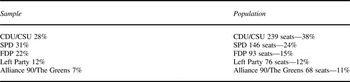
Surveying parliamentarians is a useful starting point because their preferences ultimately get aggregated into national policy. In parliamentary systems national legislatures ratify international treaties and enact national laws to implement these treaties and executive decision makers are drawn from parliamentary groups. A winning coalition of cosmopolitan parliamentarians in the government will produce different policy outcomes than a coalition of noncosmopolitans. I am mindful that generalizing from my sample to the entire population of German politicians would be ill-advised. My primary objective therefore is to unpack the relationship between cosmopolitan social identity, obligation, and compliance. Since there is no apparent reason to think that the data-generating process linking cosmopolitan identity to normative respect for international law would be different among those parliamentarians who did not participate in the study, the present survey provides a practical starting point.Footnote 51 Importantly, the distribution of respondents in the sample with respect to the parliamentary groups is roughly representative of the population of German parliamentarians, as shown in Table 1.Footnote 52
The distribution of respondents with respect to parliamentary group is roughly representative of the population of German parliamentarians

Germany is a suitable case for three reasons. First, it is a powerful country. If state power leads to instrumental rationality in compliance decision making, then it should be harder to find variation in German decision makers' willingness to tolerate compliance costs, which in turn should make it harder to find evidence of the role legal obligation plays in cost tolerance. Second, the case of Germany partly stacks the deck against my claim that cosmopolitan identity leads to legal obligation. Some commentators have suggested that Germany has a domestic culture of law-abidingness.Footnote 53 If this is the case, cosmopolitan identity or any other psychological variable will have little effect on actors' feelings of obligation toward international law because these feelings will be shaped by an environmental constraint. Finally, because cosmopolitanism and nationalism are juxtaposed there, Germany promises to offer meaningful variation in cosmopolitan identification.Footnote 54
Dependent Variables: Legal Obligation and Support for Compliance
My goal is to explain who is most likely to be driven by a sense of legal obligation and how legal obligation affects support for compliance. Thus, the first dependent variable is how much obligation parliamentarians perceive toward international law. I use a five-item index constructed with questions tapping the analytical dimensions of legal obligation developed elsewhere.Footnote 55 This index has high internal consistency (α = 0.718) and strongly correlates with psychologist Tyler's well-established legal obligation scale, which I adopted to international politics (r = 0.848, p < 0.05).Footnote 56 As described in detail in the online appendix, responses to each of the items making up the legal obligation index are measured on five-point scales ranging from low (coded 1) to high (coded 5).
The first item measures the moral significance of compliance in politicians' minds.Footnote 57 It asks participants how much importance they personally place on Germany's compliance with its international legal duties. The second item gauges a respondent's belief in international law's right to rule. Participants are first told that there are several reasons that countries might comply with international law and subsequently asked about how much value they place on upholding international law for its own sake, namely because laws need to be upheld. Actors guided by a sense of legal obligation should express a commitment to upholding international law even when the law is at odds with their country's self-interest.
The next item measures the extent of this commitment. First, parliamentarians are told that compliance with international law is sometimes difficult and hurts a country's material interests. Subsequently, they are asked about their support for costly compliance. The fourth question on the legal obligation scale is a measure of cognitive dissonance. I assume that individuals motivated by a sense of legal obligation will experience cognitive discomfort in case of a violation. Parliamentarians are asked how uncomfortable they would feel if Germany were to break international law.
Finally, I employ a measure of accountability. It is likely that actors who perceive a sense of obligation toward international law feel accountable to other countries and the international community for their state's compliance behavior. To capture this logic, I asked parliamentarians to indicate how justified other countries would be in criticizing Germany if it were to break international law. A respondent's final legal obligation score is the average of the five items I described earlier.
Hypotheses 2 and 3 respectively predict that legal obligation fosters support for compliance and reduces a politician's sensitivity to compliance costs. Therefore, the second dependent variable is support for compliance. To test the compliance and cost-tolerance hypotheses, I have designed two 2 × 1 between-subject experiments that manipulate the material costs of compliance with a specific legal instrument, holding all else constant. Each experiment employs a compliance scenario that imposes costs on Germany. I used a two-group randomized design to assign parliamentarians to high- and lost-cost conditions. Half of the parliamentarians in the population randomly received the high-cost versions of both experiments and the other half received the low-cost versions. Forty-six of those assigned to the high-cost condition and twenty-two of those assigned to the low-cost condition participated in the survey.
Independent Variable: Cosmopolitan Social Identity
Cosmopolitan social identity is the primary independent variable hypothesized to engender a sense of legal obligation. I measure it with four items. Response options for each item range from low (coded 1) to high (coded 5) identification, as explained in the appendix. Because cosmopolitan identity is conceptually far removed from international law, obligation, or compliance, its measurement does not include any reference to these constructs.
Since self-categorization is the precondition for the development of any social identity,Footnote 58 the hallmark of cosmopolitan identity is the categorization of oneself as a member of the world community. To measure cosmopolitan self-categorization, I asked respondents about the degree to which they identify with the international community. Perception of interdependence consisting of a belief in sharing a common fate, future, and common goals with other people and countries in the world is the second dimension of cosmopolitan social identity.Footnote 59 Belief in common fate is measured by “How much do you feel that what happens to other countries and people around the world in general affects your and your country's fate as well?” Belief in a common future is measured by “How strongly do you agree that countries and people around the world, including you and your country, in general share a common future”? Finally, belief in common goals is captured by “How united do you think you and your country and other countries and people around the world are in the pursuit of joint purposes and interests?” The index of cosmopolitan identity (α = 0.91) represents participants' average scores on self-categorization and interdependence items.
Control Variables
I control for a series of political factors that might be associated with a sense of normative respect for international law. First is nationalism. Even though laws are created by states and bind consensually, they impose “sovereignty costs” upon states.Footnote 60 Nationalists might be less comfortable with these costs, leading them to question the legitimate power of law above the nation. Nationalism is a dummy variable coded “1” if a participant indicates feeling tremendously or very much hurt on a personal level when someone says something bad about Germans, “0” if the participant indicates feeling only somewhat hurt or not hurt at all.Footnote 61
Second, I take into account the influence of a multilateralist foreign policy disposition that has been shown to facilitate international cooperation.Footnote 62 The variable multilateralism is measured on a four-point scale by asking whether “German interests are usually best served by cooperating with our allies and with international institutions even if this means we cannot do all the things we want to do.”Footnote 63 I also control for political party affiliation. Doing so allows me to consider the domestic interests parliamentarians represent, and to examine the effect of cosmopolitanism on legal obligation among actors motivated by similar political constraints. The authoritarian personality trait, borrowed from Adorno's F-Scale, serves as another control item.Footnote 64 Those who score high on authoritarian personality may be predisposed to defer to the authority of law. The variable authoritarianism measures responses to the question “Obedience and respect for authority are the most important virtues children should learn” on a four-point scale. Other controls include ideology from extreme right to extreme left (ideology), age in years (age), and respondent's gender (female).
Results
Differences in Legal Obligation
There is considerable heterogeneity in parliamentarians' sense of obligation toward international law. About 53 percent of the respondents express a weak sense of obligation toward international law, compared to the 28 percent who indicate a moderate and 19 percent who express a strong sense of obligation.Footnote 65 This result shows that participants in the sample clearly differ in their feelings of legal obligation. This finding also suggests that social desirability was not a significant concern for the parliamentarians because over half of them felt comfortable with articulating a weak sense of obligation.
Cosmopolitan Social Identity and Legal Obligation
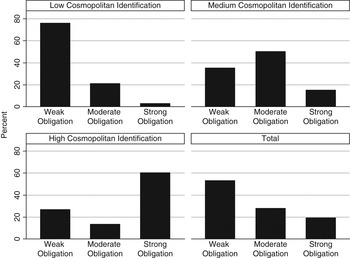
If the cosmopolitanism hypothesis is correct, parliamentarians who see themselves as a member of the international community should exhibit a strong sense of obligation toward international law. Results strongly support this expectation (Figure 1). There is a positive relationship between cosmopolitan identity and obligation toward international law (r = 0.65, p < 0.000) and a highly statistically significant difference in levels of legal obligation across high, medium, and low cosmopolitan identifiers (χ2 (2, N = 68) = 14.81, p = 0.006).Footnote 66 Sixty percent of high cosmopolitan identifiers express a strong sense of obligation toward international law, relative to the 13 and 27 percent who articulate a moderate and a weak sense of obligation respectively. Similarly, about 76 percent of low cosmopolitan identifiers express a weak sense of legal obligation. Among those with a low degree of cosmopolitan identification, only a very small minority, 3 percent, indicates a strong sense of obligation toward international law. Medium cosmopolitan identification largely maps onto a moderate sense of legal obligation. Among medium identifiers, only 15 percent of the respondents express a strong sense of legal obligation.Footnote 67
Cosmopolitans exhibit stronger feelings of obligation toward international law

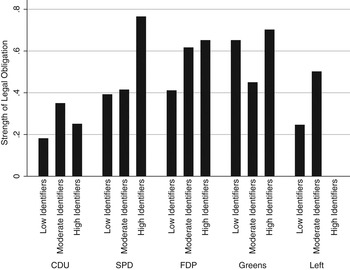
The effect of cosmopolitan identity on obligation remains largely stable when we take into account respondents' political party affiliation so the findings cannot be reduced to partisan differences. Figure 2 displays the mean level of legal obligation across different levels of cosmopolitan identification for members of each political party. A high degree of cosmopolitanism corresponds to stronger feelings of obligation among Liberals, Social Democrats, and those from the Left Party. For Christian Democrats and Greens, the relationship between international identity and legal obligation appears a little more complex in the sample. Christian Democrats with weaker attachments to the world community report a weaker sense of legal obligation than moderate and high international identifiers. Compared to moderate identifiers, however, high identifiers express a weaker sense of legal obligation. Among the members of the Green Party, moderate identifiers articulate a weaker sense of legal obligation than both low and high identifiers. However, as predicted, a high degree of cosmopolitanism associates with stronger fidelity to international law.
Cosmopolitans exhibit stronger feelings of obligation toward international law, controlling for their political party affiliation

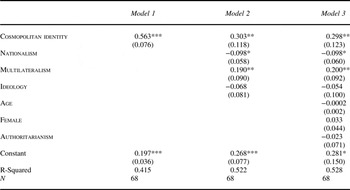
Table 2 reports the results of three linear models. Model 1 regresses participants' sense of obligation toward international law on cosmopolitan social identity. Model 2 adds the measures for nationalism, multilateralism, party affiliation, and ideology to the analysis. Model 3 expands the analysis by controlling for respondents' age, gender, and authoritarian personality scores. The results lend credence to the cosmopolitanism hypothesis. I find that cosmopolitan identity has a statistically significant and substantively large effect on obligation toward international law in all estimations. Parliamentarians who see themselves as a member of the international community are considerably more inclined to express a sense of obligation toward international law. This finding is robust to the inclusion of political and demographic control variables in the analysis. As Model 2 and 3 show, multilateralists are more and nationalists are less likely to be guided by a sense of legal obligation. However, cosmopolitan social identity continues to exert a highly significant effect on obligation toward international law. The coefficients for ideology, age, gender, party, and authoritarianism variables are not significant in any of the models. Reported in the supplementary online appendix, results from two experiments conducted with a convenience sample of American college students similarly show that a high degree of cosmopolitanism strongly and significantly associates with a sense of obligation toward international law.
Cosmopolitan identity is positively and significantly associated with parliamentarians' sense of obligation toward international law

Notes: Table entries are regression coefficients with robust standard errors in parentheses. All variables have been standardized. Female is a dummy variable with male as the reference group. The dependent variable is the extent to which participants perceive a sense of obligation toward international law. Indicator variables for party identification are not significant and have been excluded. *p ≤ .1; **p ≤ .05 ; ***p ≤ .001
Legal Obligation, Costs, and Compliance
I have hypothesized that a sense of legal obligation leads decision makers to be more tolerant of compliance costs, thereby leading to a non-egoistic preference for compliance. To test this claim, I now turn to the experimental part of the data. Results from two compliance experiments reveal that parliamentarians who feel a sense of legal obligation are more supportive of compliance and more willing to tolerate higher compliance costs to fulfill Germany's treaty commitments.
Each compliance experiment presented parliamentarians with a scenario in which compliance imposed material costs on the German government. Parliamentarians randomly received either the high-cost or the low-cost versions of the experiments. Other than the level of costs, all aspects of the compliance payoff structure were kept constant across experimental conditions.
In the first experiment, Defect to Reduce Unemployment, parliamentarians received the following preamble (in German): “These days, there are many economic challenges countries face. Imagine that some German experts have proposed developing a new economic plan. This plan will give a [tremendous or slight] boost to the German economy and bring down the current unemployment rate from around [8.5% to 3.3 or 7.8 %].Footnote 68 If Germany implements this plan, however, it will be violating international law. Germany has signed on international treaties that prohibit the proposed economic measures.” After reading this scenario, parliamentarians expressed their likelihood of supporting this economic plan (that is, defecting on Germany's international legal responsibilities). Responses are coded on a five-point scale anchored by “Extremely strongly (coded 5)” and “Not at all (coded 1).”
The overall model is significant (F (5, 62) = 46.33, p < 0.000) and an analysis-of-variance test shows that there is a statistically significant main effect for compliance costs (F (1, 62) = 24.95, p < 0.000; effect size = 0.08). When forgoing the economic plan to uphold international law imposes large material costs on Germany, decision makers are less likely to advocate it. As the costliness of compliance increases, mean support for the illegal economic plan rises by 31 percent (Mean 2.30 Sd.0.16, p < 0.000 in the low-cost condition, Mean 3.25 Sd.0.09, p < 0.000 in the high-cost condition).
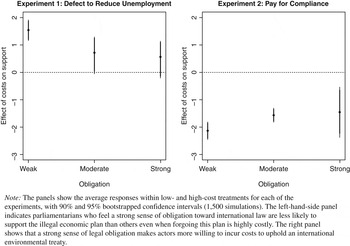
This finding supports the instrumentalist claim. However, the results also reveal a statistically significant main effect for legal obligation (F (2, 62) = 69.91, p < 0.000, effect size = 0.47) and, more importantly, an interaction effect between obligation and compliance costs (F (2, 62) = 3.71, p < 0.5, effect size = 0.03). This indicates that legal obligation both predicts how strongly participants support compliance and diminishes the impact of costs on actors' willingness to uphold international law. The left panel of Figure 3 plots the average responses for the cost treatment, with 90 and 95 percent bootstrapped confidence intervals (1,500 simulations). The results show that the effect of compliance costs on support for the illegal economic plan is conditional on respondents' level of obligation. First, strong obligation holders are significantly less inclined to favor the illegal economic plan than others regardless of costs. Second, even though a rise in costs reduces all actors' support for compliance, a sense of obligation moderates the impact of costs. Those who have a strong sense of obligation toward international law resist the urge to defect even when compliance is highly costly. Those who lack fidelity to international law give in to costs.
The effect of costs on support for compliance is moderated by respondents' sense of legal obligation

Results of the “Pay for Compliance” experiment largely parallel these findings. Parliamentarians were given this vignette: “Given increasing concerns over the environment, countries are developing new environmental protection plans and turning them into international law. Imagine that Germany has recently signed onto an international environmental agreement. Compliance with this treaty, however, will cost Germany [90 million Euros or 900 million] Euros.” After reading this scenario, parliamentarians were asked about their likelihood of supporting compliance with the environmental treaty in question. Responses were coded on the five-point scale explained earlier. The estimated model is significant (F (5, 62) = 47.80, p < 0.000) and shows significant main effects for the degree of legal obligation (F (2, 62) = 47.45, p < 0.000, effect size = 0.31) and the degree of compliance costs (F (1, 62) = 87.66, p < 0.000, effect size = 0.29). In this experiment, the interaction effect fails to reach statistical significance (F (2, 62) = 1.82, p < 0.171). While this finding implies that strong and weak obligation holders are not differentially influenced by compliance costs, it can also be a function of the small sample size.
Plotting the average responses for the cost treatment, the right panel in Figure 3 shows that parliamentarians who have a strong sense of obligation toward international law seem to be more willing to pay for compliance with a costly environmental treaty than those who have a weak or a moderate sense of legal obligation. Results from two additional experiments, reported in the online appendix, similarly reveal that legal obligation not only reinforces compliance support but also decreases sensitivity to costs.
Despite a relatively small sample size that limits statistical power, I find support for the compliance and cost-tolerance hypotheses. The results show that the variation in parliamentarians' compliance preferences is shaped not only by the material payoff structure of compliance but also by actors' dispositions to defer to international law as a result of a sense of obligation. Those who feel a sense of obligation are not only more supportive of compliance in low- and high-cost situations but they are also significantly less sensitive to the material costs of compliance. They are dutiful compliers. In contrast, those who lack a sense of legal obligation are guided by utilitarian processing and strategically adjust their preferences according to the payoff structure of compliance. They are instrumental compliers. Paralleling one of the primary contributions of this special issue, my findings indicate that instrumental rationality in compliance decision making varies across individual politicians.
Causal Mediation Analysis
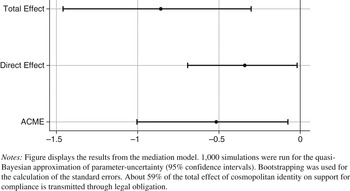
How much of cosmopolitan social identity's effect on compliance is transmitted through legal obligation, and how much of it is direct? To illustrate the role legal obligation plays in mediating the relationship between cosmopolitan identity and compliance, I estimate a mediation model using the methodology developed by Imai and colleagues.Footnote 69 The outcome variable captures parliamentarians' support for launching an economic plan that will reduce unemployment in Germany yet violate international law, as measured in the first international law experiment. The mediation model defines cosmopolitan identity as the treatment variable, legal obligation as the mediator, and controls for compliance costs and multilateralism.
Figure 4 reports the results. The average causal mediation effect (ACME) shows the effect of cosmopolitan identity on support for the illegal plan (e.g., violate international law) that is transmitted through legal obligation. The direct effect refers to the influence of cosmopolitan identity on compliance support independent of mediating mechanisms, and the total effect reports the overall effect of cosmopolitan identity on compliance support. Both cosmopolitan identity and legal obligation decrease support for the illegal economic plan, that is, increase support for compliance. Consistent with my argument, about 59 percent of the effect of cosmopolitan identity is transmitted through legal obligation (ACME = −0.50). The total effect of cosmopolitan identity on support for the illegal plan is −0.84, but only a small portion of this effect, −0.34, is direct. Sensitivity tests imply that the mediation effect is relatively stable. While there is no substitute for an experimental design to test the direction of causality, these findings nevertheless suggest that a substantial proportion of cosmopolitan identity's effect on support for compliance is transmitted through legal obligation.
Legal obligation mediates the relationship between cosmopolitan identity and compliance

Conclusion
Obligation-based compliance created by the legitimacy of international law is typically used to challenge the rationalist model of instrumental compliance. Missing from the debate between rationalists and their counterparts is the substantial heterogeneity in decision makers' subjective beliefs in the legitimacy of international law, which explains who is more or less likely to exhibit a sense of obligation. I argued that obligation toward international law has a psychological foundation shaped by the level of an actor's cosmopolitan social identification. Testing this argument with an original survey of German politicians, I showed that the extent of cosmopolitan social identification predicts the heterogeneity in actors' feelings of obligation toward international law, and this variation maps onto different degrees of sensitivity to compliance costs, explaining social and egoistic compliance preferences.
This study makes several contributions to the study of international relations. First, my findings indicate that both strategic rationality and normative reasoning are at play with respect to compliance, but vary across groups of politicians. Utilitarian thinking is only one kind of decision making, and it is not operative in predictable instances. Cosmopolitan identity and legal obligation lead to deferential behavior toward international law that deviates from the rationalist model of instrumental compliance. While this finding complements rationalist theories, it also shows that the extent of instrumental rationality in compliance decision making depends on an actor's psychological identification with the world community.
Second, this study adds microfoundations to sociological constructivist arguments that have long postulated a connection between group identities and cooperation. I seek to clarify how the psychological processes of self-stereotyping and “system 1” processing associated with cosmopolitan identity engender normative respect for international law by shaping actors' legitimacy beliefs. While constructivism has advanced our understanding of how identities affect state behavior, many of the constructivist perspectives on identity, especially those of the structural variant, have remained separate from psychological models of social identity.Footnote 70 As the introductory essay notes, by emphasizing the psychology of identity, this study opens new opportunities for dialogue between the behavioral revolution and constructivism.Footnote 71
My findings also have a number of policy implications. Voters, civil society organizations, lobby groups, and other domestic and international players interested in the role of law in world affairs should take into account the extent of politicians' cosmopolitanism. Because they have normative respect for international law, cosmopolitan leaders might be particularly likely to push for properly enacting international treaties in group decision-making environments and select advisers who are less inclined to use international law strategically. Noncosmopolitans might do the opposite. While a cosmopolitan foreign policy toward international law will appeal to constituencies interested in strengthening the rule of law in the international system, its opposite will attract the “new sovereigntists.”Footnote 72
Politicians' identities can also affect the enforcement and design of international legal instruments.Footnote 73 Since they have normative respect for international law and a higher tolerance for compliance costs, cosmopolitan leaders might place more weight on public commitments to an existing bargain, as Tingley's article discusses, and thus be more inclined to advocate sanctioning violators than noncosmopolitan leaders.Footnote 74 Group identities of government officials can also influence treaty design and negotiation. Cosmopolitan negotiators might be reluctant to sign onto “softer” treaties and prefer the inclusion of enforcement mechanisms in treaty design to increase the prospects of compliance. Precisely because of their normative respect for international law, cosmopolitans might be less flexible negotiators.
This article is a “first cut” on the psychological underpinnings of compliance preferences. Further research needs to be conducted to provide more conclusive tests of my argument with different samples of politicians and to explore group decision-making dynamics. For example, scholars can examine how identity choice and complexity might moderate the role cosmopolitan social identity plays in creating normative respect for international law.Footnote 75 Analyzing the identity-obligation-compliance link across different policy areas and types of laws will also improve our grasp of how law operates in world politics.
Paralleling the second route of aggregation discussed in Powell's concluding article, social identity theorists have explored some of the ways in which individual identities might scale up to groups and organizations and ultimately connect to policy outcomes.Footnote 76 We can use these insights to provide a somewhat different foundation for the preferences that ultimately get aggregated into national policy decisions. Most obviously, we should expect deference toward international law in German foreign policy to increase if a strong coalition of cosmopolitans were to come to office but decrease if right-wing nationalists, such as the Alternative for Germany (AfD), prevail. More complex models of aggregation, following Saunders's contribution to this volume, might explore how top party leaders with different dispositions interact with advisers and other party members.Footnote 77
Since the publication of George Akerlof and Rachel Kranton's seminal work on “identity economics,”Footnote 78 a growing body of research has incorporated psychological models of social identity into the standard expected-utility framework.Footnote 79 By turning to behavioral approaches to identity, we can incorporate more realistic assumptions about individual beliefs and preferences into our analysis of international relations, and compliance with international law in particular. With this study I hope to inspire additional research linking behavioral models of identity to the study of international politics.
Supplementary Material
Supplementary material for this article is available at https://doi.org/10.1017/S0020818316000485.