Attention regulation is highly sensitive to early life conditions. Increases in attention regulatory problems are observed for infants born prematurely and young children who experience neglect and multiple changes in primary caregivers (Hildyard & Wolfe, Reference Hildyard and Wolfe2002). Consistent with these findings, children adopted from institutions (e.g., orphanages) are at high risk of attention regulatory problems that are often severe enough to be classified as attention-deficit/hyperactivity disorder (ADHD; e.g., Gunnar & van Dulmen, Reference Gunnar and van Dulmen2007). Attention regulatory problems in postinstitutionalized children appear to be influenced by deprivation in care, in addition to heritable factors and family background (Roy, Rutter, & Pickles, Reference Roy, Rutter and Pickels2000). It is argued that attention regulatory deficits and hyperactivity problems among children reared in institutions constitute part of a deprivation-specific syndrome (Kreppner, O'Connor, & Rutter, Reference Kreppner, O'Connor and Rutter2001; Stevens, et al., Reference Stevens, Sonuga-Barke, Kreppner, Beckett, Castle and Colvert2008). Duration of exposure to early deprivation increases risk of attention problems, with evidence that children placed in a supportive family by 6 to 7 months of age may show few effects of institutional rearing, whereas those placed later and especially beyond 2 years of age show attention problems that do not resolve with time (Gunnar & van Dulmen, Reference Gunnar and van Dulmen2007). Prevalence estimates of clinically significant attention problems in postinstitutionalized children vary from 20% to 40%, depending on the strictness of the criteria and the duration and severity of the early deprivation. This is much higher than the worldwide estimate for ADHD of 5%–6% in children (Polanczyk, de Lima, Horta, Biedereman, & Rohde, Reference Polanczyk, de Lima, Horta, Biederman and Rohde2007). Nonetheless, it is clear that not all children exposed to prolonged early institutional care develop significant attention regulatory problems.
It has been argued that ADHD due to deprivation has a different etiology and developmental mechanisms than ADHD more generally (Stevens et al., Reference Stevens, Sonuga-Barke, Kreppner, Beckett, Castle and Colvert2008); however, because ADHD behaves as a multifactorial disorder in which different combinations of genetic and environmental factors contribute to risk (Poelmans, Pauls, Buitelaar, & Franke, Reference Poelmans, Pauls, Buitelaar and Franke2011), deprivation-induced attention regulatory problems may simply reflect a larger environmental contribution than observed when these problems arise among children with more advantageous early life histories. Nonetheless, genetic variations among children might help explain variations in the vulnerability of attention regulatory functions to early deprivation.
Most researchers expect that the genetic model for attention regulatory problems will be one in which multiple genetic factors of small to moderate effect sizes contribute (Faraone et al., Reference Faraone, Perlis, Doyle, Smoller, Goralnick and Holmgren2005). Furthermore, because complex behaviors result from the interplay between genetic and environmental factors, Gene × Environment interactions are expected (Wermter et al., Reference Wermter, Laucht, Schimmelmann, Banaschweski, Sonuga-Barke and Rietschel2010). Nonetheless, despite high heritability estimates, the search for genes associated with ADHD risk has been elusive, whether one adopts a candidate gene or genome-wide association approach (Branaschewski, Becker, Scherag, Franke, & Coghill, Reference Branaschewski, Becker, Scherag, Franke and Coghill2010; Faraone et al., Reference Faraone, Perlis, Doyle, Smoller, Goralnick and Holmgren2005). Gene–environment interaction (GEI) approaches have had some success. As with main effect candidate gene analyses, most GEI studies of attention regulatory problems have focused on genes regulating the activity of dopamine. The Mannheim Study of Risk Children reported that the dopamine transporter 1 (DAT1) haplotype comprising the 6-repeat and 10-repeat alleles resulted in increased risk of ADHD among youth growing up under conditions of high but not low psychosocial adversity with a moderate genetic effect size among the high adversity group (Laucht et al., Reference Laucht, Skowronek, Becker, Schmidt, Esser and Schulze2007). Studying postinstitutionalized children to index early deprivation, again the DAT1 but not the dopamine receptor D4 polymorphism was associated with increased ADHD symptoms with more prolonged early deprivation (Stevens et al., Reference Stevens, Kumsta, Kreppner, Brookes, Rutter and Sonuga-Barke2009).
In candidate gene studies of ADHD risk, there has been only slight attention to genes involved in brain growth and repair (see for review, Branaschewski et al., Reference Branaschewski, Becker, Scherag, Franke and Coghill2010). However, given the sensitivity of attention systems to early adverse experience, an exploration of the role of such genes as moderators of early adversity effects is warranted. Here we focus on the gene coding for brain-derived neurotrophic factor (BDNF). BDNF's neurotrophic actions are essential for brain development (Bartkowska, Turlejski, & Djavadian, Reference Bartkowska, Turlejski and Djavadian2010), and activity-dependent transcription of the BDNF gene is critical in neural plasticity (Kuczewski, Porcher, & Gaiarsa, Reference Kuczewski, Porcher and Gaiarsa2010). Because of its role in cell differentiation, cell survival, neurotransmission, and synaptic plasticity, BDNF has been the focus of a number of studies examining early adverse care, brain development, and behavioral outcomes. Over a wide variety of animal models of early life adversity, results indicate that altered outcomes are associated with changes in BDNF gene transcription and protein expression, which typically are decreased in a graded fashion with the level of adverse early care (see for review, Roth & Sweatt, Reference Roth and Sweatt2011).
Stress is believed to play a role in mediating the impact of early adversity on BDNF activity. In adult and juvenile mammals, acute stressors tend to facilitate BDNF expression, whereas chronic stressors exert the opposite effects (see the review of Calabrese, Molteni, Racagni, & Riva, Reference Calabrese, Molteni, Racagni and Riva2009). During development BDNF activity responds differentially to early adverse care depending on brain region. Thus, for example, timing and intensity appear to affect how and whether early maternal separation affects the development of hippocampal BDNF activity (Lippmann, Bress, Nemeroff, Plotsky, & Monteggia, Reference Lippmann, Bress, Nemeroff, Plotsky and Monteggia2007; Roceri et al., Reference Roceri, Cirulli, Pessina, Peretto, Racagni and Riva2004; Roceri, Hendriks, Racagni, Ellenbroek, & Riva, Reference Roceri, Hendriks, Racagni, Ellenbroek and Riva2002). In the prefrontal cortex, duration of adverse care appears to matter more than timing, with longer durations being associated with larger reductions in BDNF activity (see Calabrese et al., Reference Calabrese, Molteni, Racagni and Riva2009). Glucocorticoids, via transcriptional activity of the glucocorticoid receptor, acutely increased tropomyosin-related kinase receptor signaling, including activity of the tropomyosin-related kinase receptor with high-affinity binding for BDNF. The impact of chronic stress in down regulation of glucocorticoid receptor is believed to be one mechanism in shifting stress-BDNF effects from increases in response to acute stress to decreases in response to chronic stress (Numakawa et al., Reference Numakawa, Yokomaku, Richards, Hori, Adachi and Kunugi2010). Epigenetic changes in the BDNF gene are also suspected, which has been demonstrated for rodents using several early adverse care paradigms (see Roth & Sweatt, Reference Roth and Sweatt2011). Repeated bouts of adverse care lasting throughout early development produce hypermethylation of the BDNF gene in the rat prefrontal cortex but not in the hippocampus that lasts through adolescence and into adulthood (Roth, Lubin, Funk, & Sweatt, Reference Roth, Lubin, Funk and Sweatt2009). The effect was specific to exon IV, which plays a critical role in GABAergic transmission and synaptic plasticity in the prefrontal cortex (Sakata et al., Reference Sakata, Woo, Martinowich, Greene, Schloesser and Shen2009).
In addition to epigenetic changes in the BDNF gene induced by chronic stress, a single nucleotide polymorphism (SNP) in the human gene has been examined as a source of greater or lesser resilience to adverse life conditions. This guanine to adenine SNP at nucleotide 196 (rs6265) results in a substitution of methionine (Met) for valine (Val) at codon 66 (i.e., Val66Met). This appears to be a functional polymorphism that affects the 5′ proregion of the protein and reduces activity-dependent secretion of BDNF (Egan et al., Reference Egan, Kojima, Callicott, Goldberg, Kolachana and Bertolino2003). Most of the work on the role of the Val66Met BDNF genotype in moderating early adversity has focused on risk for depression (Aguilera et al., Reference Aguilera, Arias, Wichers, Barrantes-Vidal, Moya and Villa2009; Kaufman et al., Reference Kaufman, Yang, Douglas-Palumberi, Grasso, Lipschitz and Houshyar2006) or endophenotypes of depression (Gatt et al., Reference Gatt, Nemeroff, Dobson-Stone, Paul, Bryant and Schofield2009; Hayden et al., Reference Hayden, Klein, Dougherty, Olino, Dyson and Durbin2010). However, in addition to depression, there is some evidence of GEI effects on impulsivity and self-regulatory behavior (Gatt et al., Reference Gatt, Nemeroff, Dobson-Stone, Paul, Bryant and Schofield2009; Nederhof et al., Reference Nederhof, Bouma, Riese, Laceulle, Ormel and Oldehinkel2010). For example, Gatt and colleagues (2009) studied adults with varying (zero to five plus) stress indicators (abuse, neglect, exposure to violence) prior to age 18 years. Those who were Met carriers and who had more than two indicators exhibited decreases in hippocampal, lateral prefrontal cortex, amygdala, and associated medial prefrontal cortex gray matter. These effects were associated with increased depressive symptoms, working memory impairments, and decreased sustained attention. Using a large sample of adolescents in the Tracking Adolescents’ Individual Lives Survey, researchers found that carrying one or two copies of the Met allele was associated with poorer effortful control (e.g., attention regulation and inhibitory control) scores as a function of childhood adversity (Nederhof et al., Reference Nederhof, Bouma, Riese, Laceulle, Ormel and Oldehinkel2010). However, gene–gene interactions were also noted in that study such that an anomalous enhancement of effortful control was noted with childhood adversity for those adolescents who also carried one of two short-repeat versions of the serotonin transporter gene.
In addition to this complexity, in both the Gatt and colleagues (2009) and the Hayden and colleagues (2010) studies, the opposite pattern of BDNF Val66Met findings was noted for individuals with no or few childhood adversities. That is, in these cases those with one or more Met versions of the gene functioned better than those with Val/Val genotypes under no or low early life adversity conditions. Such a pattern is consistent with the argument that genetic polymorphisms that are common in the population, like the BDNF Val66Met, may function as plasticity or differential susceptibility genes, increasing the child's sensitivity to variations in the environment, which can mean better than average functioning under supportive conditions and worse than average functioning under adverse or chronically stressful conditions (Belsky, Bakermans-Kranenburg, & van IJzendoorn, Reference Belsky, Bakermans-Kranenburg and van IJzendoorn2007; Belsky et al., Reference Belsky, Jonassaint, Pluess, Stanton, Brummet and Williams2009; Belsky & Pluess, Reference Belsky and Pluess2009).
The following study examined internationally adopted children who had lived for some period of time prior to adoption in institutional care. We examined parent-reported attention and impulsivity problems when the children were 8 to 13 years of age. We chose to focus on attention problems rather than depression because, at this age, attention regulatory problems are far more prevalent than problems with depression in postinstitutionalized samples (e.g., Colvert et al., Reference Colvert, Rutter, Beckett, Castle, Groothues and Hawkins2008; Rutter, Kreppner, & O'Connor, Reference Rutter, Kreppner and O'Connor2001). Institutional rearing for infants and young children is a chronic stressor. It is associated with a decrease in the amplitude of the diurnal cortisol rhythm, consistent with chronic or prolonged stress (Carlson & Earls, Reference Carlson and Earls1997), with a slowing of linear growth, a reflection of allostatic load in young children (Johnson, Bruce, Tarullo, & Gunnar, Reference Johnson, Bruce, Tarullo and Gunnar2011), and marked delays in cognitive and social development (for a review, see Gunnar, Reference Gunnar, Nelson and Luciana2001). Although adoption produces a marked rebound in physical, cognitive, and social development, problems with attention regulation, among other deficits, often continue (Pollak et al., Reference Pollak, Nelson, Schlaak, Roeber, Wewerka and Wiik2010). These finding are consistent with evidence of altered frontal–striatal development and development of monoaminergic fiber tracks in the frontal cortex following early life stress as noted in animal models (e.g., Bock, Gruss, Becker, & Braun, Reference Bock, Gruss, Becker and Braun2005; Braun, Lange, Metzger, & Poegoel, Reference Braun, Lange, Metzger and Poegoel2000). We predicted that attention problems would increase with the duration of early institutional care and thus with older ages at adoption. We further predicted that these effects would be greater for those children carrying the Met version of the Val66Met polymorphism. Given questions about genes that confer differential susceptibility to the environment, we also entertained the possibility that the Met version of the gene might be associated with fewer attention problem symptoms when children were adopted quite earlier but with more attention problem symptoms when they were adopted later and thus spent longer periods in institutional care.
The sample consisted of children from many regions of the world, including Asia. This created challenges in analysis. Population genetic studies of the Val66Met polymorphism reveal striking variation in frequency of the Met allele (Val/Met and Met/Met combined), ranging from near zero in sub-Saharan Africa and some indigenous groups in the Americas, to approximately 20% in European populations, to roughly 44% in Asia (Petryshen et al., Reference Petryshen, Sabeti, Aldinger, Fry, Fan and Schaffner2010). In addition, children of Asian descent are sometimes advanced on attention regulatory task performance, particularly tasks involving inhibitory control (e.g., Oh & Lewis, Reference Oh and Lewis2008). Thus, we needed to control for potential confounding of ethnic differences in both attention and impulsivity scores and gene allele frequency. We did this by including Southeast (SE) Asian as a factor in our analyses and analyzing interactions that addressed whether the Met allele bore functionally different relations to attention regulatory functioning in SE Asia, where the allele predominates, relative to other regions of the world where it is less frequent.
Methods and Materials
Participants
The participants were 612 youth (M = 11.82 years, SD =1.48 years). The majority (66%) had spent their entire (M = 93%, SD = 13%) preadoption lives in institutional care. All but 3% were adopted by 72 months of age (M = 18.63, SD = 18.35). They came from 25 different countries in different regions of the world, including Russia, Eastern Europe, and India (108 boys, 158 girls), South America/Caribbean (36 males, 41 girls), Africa (4 males, 3 girls), and SE Asia (32 males, 230 girls). The majority resided in homes with parents who had completed a 4-year college degree or more (78.7%) and who earned $85,000 or more in the preceding year (63.4%).
Procedures
The sample was recruited from a registry of families of internationally adopted children who were interested in being contacted about research. The registry was formed by contacting all of the families who had adopted internationally into the state of Minnesota between 1990 and 1998, in a study designed in conjunction with the state's department of human resources (see Hellerstedt et al., Reference Hellerstedt, Madsen, Gunnar, Grotevant, Lee and Johnson2008), and then subsequently continuing to contact all families adopting internationally through the major agencies in the state. Families joining the registry reflected approximately 60%–75% of all families adopting from countries using institutions to care for wards of the state over the period reflected in this manuscript.
The present analysis constituted part one of a two-part study, where part one involved the collection of genetic material and parent-reported behavior problems and part two involved collecting behavioral and neuroimaging data on a subset of the sample based on their genotype and eligibility for magnetic resonance imaging. The youth were included in part one if they would be 12–13 years of age during the funding period and were adopted from institutional care. Parents were contacted by phone, and those agreeing to participate were mailed consent forms, questionnaires, and a gene collection kit. These materials were returned through the mail. Of the children who met the criteria, 82% agreed to participate and 70% returned the completed questionnaire and gene sampling material.
The study was reviewed and approved by the university's institutional review board. During the phone recruitment, the goals of the study were described along with a detailed description of the procedures used to maintain each family's anonymity. Parents were asked to answer questions that probed their understanding of the procedures. The gene collection kit and questionnaire packet that was mailed to the homes included a detailed letter describing the study along with two copies of the consent form, one for the family to keep. A child-assent letter and form were also included. Both had to be signed prior to analysis. Participants were identified by participant number only.
Measures
Demographics and background
Parents provided information about family income, parent education, family composition, and child's adoption history (birth country, age at adoption, and time in institutional care). Age at adoption and time in institutional care were positively skewed and thus were log10 transformed. These two variables were almost perfectly correlated (r = .95, n = 612, p < .0001). In subsequent analyses, because institutionalized children may also be deprived prior to institutionalization, age at adoption was used to index duration of deprivation.
DNA collection, extraction, and analysis
Saliva samples (~4 ml total) were collected and DNA extracted using the Oragene system (DNA Genotek). A TaqMan 5′ exonuclease assay (ABI) was used to genotype DNA samples at the BDNF Val66Met (rs6265) SNP. Assays were performed on a 7900HT apparatus (ABI) in real-time polymerase chain reaction mode using standardized cycling parameters for ABI Assays-on-Demand. Fluorescence intensities were also collected in Allelic Discrimination mode after thermal cycling. Visual inspection of the amplification curves and endpoint ratios for each allele of rs6265 led to determination of the genotype. All samples were required to give clear and concordant results in real time, and endpoint analyses that were in agreement and all samples that did not were rerun and/or reextracted until they provided clear genotype calls. No template controls and a panel of samples with known genotypes at rs6265 representing both homozygote and heterozygous genotypes were run in parallel with experimental samples.
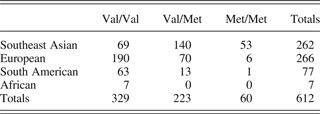
Preliminary analyses indicated that the distribution of alleles in each of the three major racial/geographic groups were in Hardy–Weinberg equilibrium. As expected, few (<10%) of the sample were Met/Met genotypes. We therefore grouped Met/Mets with Val/Mets and analyzed Val/Val genotypes compared to Met/Met genotypes. Table 1 shows, as expected, that for the youth from SE Asia, the Val/Met genotype was the most common genotype, whereas this was not the case for youth from other regions of the world. Using 2 (region) × 3 (genotype) analyses, we noted that youth adopted from SE Asia differed significantly in genotype distribution from those adopted from Russia and Indo-European countries, χ2 (2) = 117.3, p < .001, as well as from those adopted from Central and South American countries, χ2 (2) = 78.5, p < .001; however, youth adopted from the latter two regions did not differ, χ2 (2) = 3.37, p = .18. There were too few African youth to examine in these analyses. For some analyses (see below), we controlled for being from SE Asia, and we also reexamined our results for SE Asian versus youth adopted from other regions of the world. We considered excluding the 1% of the sample adopted from Africa from these analyses because they only exhibited the Val/Val genotype, but decided against it, because with so few participants (n = 7), it would be unlikely to affect the results either way.
Frequency counts of Val66Met Genotype × Region of origin
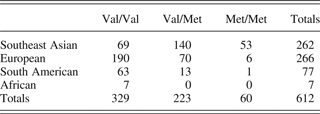
Note: Val, valine; Met, methionine.
ADHD symptoms
Parents completed the mental health symptomatology section of the MacArthur Health and Behavior Questionnaire (HBQ; Essex et al., Reference Essex, Boyce, Goldstein, Armstrong, Kraemer and Kupfer2002). Both parents completed the questionnaire for 73% of the youth. Only one parent completed the form in the remaining cases. The HBQ was derived from the Ontario Child Health Study measure designed to map onto DSM symptom criteria (Boyle, Offord, Racine, Szatmari, & Sanford, Reference Boyle, Offord, Racine, Szatmari and Sanford1993). The HBQ has strong psychometric properties and has been used to assess child mental health across multiple ages from 4.5 years into adolescence (Ablow et al., Reference Ablow, Measelle, Kraemer, Harrington, Luby and Smider1999; Shirtcliff & Essex, Reference Shirtcliff and Essex2008). The HBQ is administered in questionnaire format and assesses symptoms on a 0 (never or not true) to 2 (often or very true) scale. We analyzed the ADHD symptoms scale, as well as its two subscales, inattention and impulsivity. When both parents completed the scale, the interparent correlation was .81 (p < .001). Responses were averaged so that each child had one score for the ADHD scale and for each of its two subscales. Reliability for the ADHD scale in our sample was α = 0.96. We also identified youth who met or exceeded the clinical cutoff for ADHD symptoms (≥1.2; Lemery-Chalfant et al., Reference Lemery-Chalfant, Schreiber, Schmidt, Van Hulle, Essex and Goldsmith2007). The ADHD symptoms scale and its subscales were log10 transformed to improve normality of the distribution.
Analysis plan
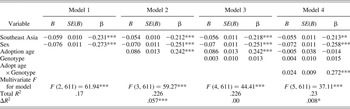
The hypothesis that the BDNF genotype would interact with duration of deprivation to predict symptoms of attention regulatory problems was tested using hierarchical linear regression with the HBQ ADHD scale as the dependent measure. Control measures (child sex and whether the child was born in SE Asia) were entered in Step 1. In Step 2, age at adoption was entered as an index of duration of deprivation. Genotype (Val/Val vs. Met/Met) was entered in step three. In Step 4, the centered interaction of age at adoption and genotype was entered. Significant interactions were plotted and tested using procedures described by Aiken and West (Reference Aiken and West1991). To determine whether a similar pattern of findings would be noted for the two subscales, this analysis was repeated twice, once with impulsivity and once with inattention as the dependent measure.
Several analyses were computed to examine whether genotype bore different associations with ADHD symptoms as a function of birth region. First, two additional steps were added to the regression model. Step 5 examined the interaction of genotype and whether or not the child was born in SE Asia in predicting ADHD symptoms. Step 6 examined the three-way interaction among age at adoption, genotype, and SE Asian or not. Finally, we split the file by SE Asian birth status and recomputed the regression analysis, removing SE Asian as a control variable and examining the effects of sex, genotype, age at adoption, and the centered interaction of genotype and age at adoption.
Results
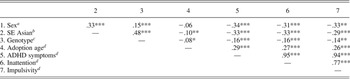
Table 2 presents the correlations among all of the variables used in the regression analyses. Table 3 presents the results of the regression predicting ADHD symptoms. As shown, being a girl and being born in SE Asia were associated with fewer ADHD symptoms. Having controlled for the variance associated with these factors, age at adoption was still positively correlated with ADHD symptoms. For descriptive purposes, we also examined the percentage of children meeting clinical cutoff as a function of age at adoption (before 12 months of age, between 12 and 24 months, or over 24 months). The results were 9%, 16%, and 28%, respectively, χ2 (2) = 23.56, p < .001.
Correlations among variables in the regression equation (N = 588)

Note: SE, southeast; ADHD, attention-deficit/hyperactivity disorder.
aScored boys = 1, girls = 2.
bScored as other areas of the world = 1, SE Asia = 2.
cScored Val/Val = 1, any methionine allele = 2.
dlog10 transformed variables.
*p < .05. **p < .01. ***p < .001. Pearson product-moment correlations.
Summary of hierarchical regression predicting attention-deficit/hyperactivity disorder symptoms (N = 588)

*p < .05. **p < .01. ***p < .001.
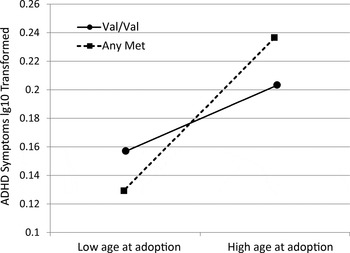
Genotype had no main effect on ADHD symptoms. However, there was a significant interaction between age at adoption and genotype. As shown in Figure 1, age at adoption was more closely associated with ADHD symptoms for youth with at least one Met allele than for youth with the Val/Val genotype. It is notable that, at younger ages at adoption, youth with at least one Met allele had fewer ADHD symptoms than those with the Val/Val genotype, whereas the reverse was the case at later ages of adoption. The analysis was repeated for the two subscales. All factors that were significant for the combined ADHD scale were significant when inattention and impulsivity were analyzed separately. For inattention, the full model explained 17% of the variance and the β value for the interaction of age at adoption and genotype was 0.39 (p < .01). For impulsivity, the full model explained 16% of the variance and the interaction of age at adoption and genotype was β = 0.32 (p < .01).
The interaction of the Val66Met polymorphism (Val/Val vs. Met/Met alleles) and duration of institutional care in predicting attention-deficit/hyperactivity disorder symptoms. The results of the hierarchical regression analysis controlling for sex and whether the child was from Southeast Asia are plotted using procedures described by Aiken and West (Reference Aiken and West1991).

The regression predicting ADHD symptoms was recomputed adding the centered interaction of genotype and SE Asian birth and the centered three-way interaction of age at adoption, genotype, and SE Asian birth. Neither of these equations was significant (ps > .10). We then split the data set by whether the child was born in SE Asia or not and recomputed the regression analysis. For non-SE Asians, the interaction of age at adoption and genotype yielded β = 0.31 (p < .05); whereas for SE Asians, this interaction yielded β = 0.57 (p < .05). Thus, the Met allele appeared to be similarly related to ADHD symptoms as a function of duration of deprivation in both children from SE Asia and those from other areas of the world.
Discussion
As expected, attention regulatory problems increased with the duration of deprivation. ADHD scores were lower for children adopted within the first year of life and increased as adoption age increased. This was true even though, in the regression equation, variance-associated sex (boys exhibited more ADHD symptoms) and birth region (SE Asian children displayed fewer ADHD symptoms) had already been removed. However, the Val66Met genotype moderated the association between duration of deprivation and ADHD scores. Individuals with at least one Met Allele exhibited a more marked positive association of age at adoption and ADHD symptoms than did individuals with no Met alleles (i.e., Val/Val genotype). This pattern of findings held for the ADHD symptoms scale as well as for its two subscales.
The pattern of this interaction was not consistent with a diathesis–stress model in which at low duration of adversity little or no impact of the polymorphism would be noted, whereas with increasing duration of adversity those with Met alleles would exhibit increasing symptoms of regulatory problems. Instead, the pattern conformed to a differential-susceptibility model in which the Met allele serves as a plasticity gene, supporting the development of attention regulatory competence at low durations of adversity and suppressing it at high durations of adversity. Although the pattern is clearly a differential-susceptibility pattern, it is challenging to identify a biologically plausible explanation for why carrying one or more Met alleles might be advantageous for attention regulation under conditions of brief early adversity. Another way to state this is why carrying one or more Met alleles might be more encouraging of attention regulatory development than having two Val alleles for children who spend the majority of infancy in the context of a supportive, high resourced, adoptive home.
As noted earlier, activity-dependent transcription of the BDNF gene is critical for neuroplasticity, and the Met allele is associated with reduced availability of BDNF (Bartkowska et al., Reference Bartkowska, Turlejski and Djavadian2010). Biologically plausible models thus would involve reduced sculpting of attention regulatory circuitry in response to stimulation, particularly when the stimulation needed to sculpt developing attention regulatory circuits is meager. In that vein, one possibility is that for children adopted earlier, carrying the Met allele resulted in less sculpting of the attention circuits while the children were in institutional care, permitting the longer period in supportive care to have a bigger influence on their developing attentional systems. Viewed this way, the Met allele did not increase sensitivity to the rearing context but rather reduced it. For children adopted later, those carrying the Met allele had lived in the institutional setting long enough to be influenced by it and were less able than children with the Val/Val genotype to benefit from the enriching context of the adoptive home once they arrived there. According to this interpretation, had we been able to follow the children longitudinally, we would have seen that children with the Val/Val genotype would have become more rapidly impaired in attention regulation than those with Met alleles with time spent in institutional care, but they would have rebounded more rapidly and fully following adoption.
The present results add to a growing body of literature suggesting differential susceptibility effects of the Val66Met BDNF polymorphism. Hayden and colleagues (2010) found that Met allele carriers of the BDNF polymorphism functioned better than those with the Val/Val genotype at low levels of adversity and worse at high levels with respect to negative emotionality. Gatt and colleagues (2009) found very similar genotype by early life stress interactions for hippocampal volume and working memory accuracy. Suzuki and colleagues (Reference Suzuki, Matsumoto, Shibuya, Sadahiro, Kamata and Goto2011) likewise noted that adults with one or more Met alleles were differentially susceptible to variations in childhood maternal care with regard to the harm avoidance and self-directedness aspects of personality. Studying institutionally reared children randomly assigned to care as usual compared to study-designed foster care, Drury and colleagues (Reference Drury, Gleason, Theall, Smyke, Nelson and Fox2011) found that indiscriminately friendly behavior, a problem correlated with attention regulatory difficulties (e.g., Bruce, Tarullo, & Gunnar, Reference Bruce, Tarullo and Gunnar2009), was elevated for children with one or more Met alleles if they were in the care as usual group, but it was exhibited less than for Val/Val genotypes if they had been randomly assigned to leave the institution and enter foster care. In all of these studies, as in the present one, no main effects of the BDNF polymorphism were noted. In a differential-susceptibility pattern, the genotype would not likely exhibit a main effect because the susceptible version of the gene would be associated with better functioning than the nonsusceptible version under some conditions and worse under others.
The present results also add to growing evidence that genes are involved in the variations in outcomes for children adopted from conditions of adversity. As noted, with regard to attention, both the Mannheim Study of Risk Children (Laucht et al., Reference Laucht, Skowronek, Becker, Schmidt, Esser and Schulze2007) and the English and Romanian Adoption Study (Stevens et al., Reference Stevens, Kumsta, Kreppner, Brookes, Rutter and Sonuga-Barke2009) found that the DAT1 genotype was associated with increased attention regulatory problems, particularly among those who experienced more severely adverse or more prolonged exposure to adversity during childhood. Neither of these studies yielded evidence of a differential-susceptibility pattern, although other studies that included the DAT1 genotype have (e.g., Pluess & Belsky, Reference Pluess and Belsky2010).
The results also confirmed previous evidence that carrying at least one BDNF Met allele is common among SE Asians (Petryshen et al., 2000). If carrying one or more Met alleles impaired attention regulation, we would have expected the youth from SE Asia to have had more attention problems than youth from other regions. In contrast, and consistent with other findings (Oh & Lewis, Reference Oh and Lewis2008), they had fewer attention regulatory problem symptoms. However, we were concerned that there might be functional differences in the Met allele with regard to moderating the impact of early adversity in SE Asians, perhaps because other polymorphisms in the BDNF gene might have emerged to counter the impact of the Met allele. We tried several methods of determining whether the association among the Met allele, attention, and duration of deprivation differed among SE Asian adoptees versus youth adopted from other regions. In all cases, we found no evidence to suggest differential effects. First, we found no significant interaction between genotype and SE Asian birth in predicting ADHD symptoms. Nor was the three-way interaction of genotype, SE Asian birth, and age at adoption significant. When we split the children into two groups and repeated the regression analysis, we found significant interactions of the same pattern between genotype and age at adoption among both the SE Asian children and those from other regions of the world. Thus, despite the marked difference in frequency, the present results suggest that with regard to attention regulatory problems and early institutional care, the Val66Met polymorphism functions similarly in individuals from populations where carrying a Met allele is less frequent than the Val/Val genotype and in populations where it is the more frequent genotype.
Although there are a number of strengths to the present analyses, including the large sample size, there are also limitations. First, we are dealing with parent report, which can be biased. Second, although we know the children were adopted from institutions overseas, we do not have objective measures of the quality of those institutions. There was likely a great range of care represented in the sample that, along with duration of exposure, contributed to the effects observed. Our lack of information would have added noise to the analysis, making it more rather than less difficult to obtain significant effects. Third, it is very likely that some, but not all, of the children were born prematurely or at low birth weight, and those from Russia/Eastern Europe were likely exposed to some level of alcohol prenatally (Johnson, Reference Johnson2000). These are also factors that impair attention regulatory competence and are unaccounted for in our analysis. Again, however, this should have added noise to the analysis, reducing rather than increasing our ability to detect GEI effects on attention regulatory problems. Fourth and finally, we were working with a sample of volunteers, and thus one must always wonder what segment of the population agreed to participate. In the case of the present study, we do have some idea of sample bias because the registry grew out of an epidemiological study during which all of the families who adopted internationally through agencies in our state were identified. We know from analyses of the characteristics of who did and did not respond that we do have a small bias to better educated parents, even among a population with generally highly educated and higher income people who have the resources to adopt internationally (Hellerstedt et al., Reference Hellerstedt, Madsen, Gunnar, Grotevant, Lee and Johnson2008). We also know that parents adopting children from orphanages/institutional care were more likely to respond (70%) than those who adopted children from foster care overseas (50%). Because in the present study we only attempted to recruit those families with children adopted from institutions, the bias in the registry likely worked in our favor to increase the representativeness of our sample.
Even with these limitations, the results indicate that genetic variations may help explain some of the variation in outcomes for children adopted from institutions and, perhaps, other contexts of adverse early care. That the effects were consistent with a differential-susceptibility model indicates the complexity we are likely to find as we incorporate research on gene–behavior relations into studies of early life stress and deprivation. Findings such as those in the present study strongly argue against ever using common genetic variations as selection factors in adoption. For genes with variations common in the population, all the variants are likely to be advantageous under some conditions and disadvantageous under others.
However, the results also indicate that institutional care has significant main effects on the development of attention regulatory skills. For both genotypes, being older at adoption was associated with poorer attention regulation. When we examined the percentage of children meeting or exceeding the clinical cutoff by age at adoption, 9% of those adopted by 12 months, 16% of those by 24 months, and 28% of those adopted between 2 and 6 years appeared clinically impaired according to parent report. The expected frequency in the population is around 5%–6%; thus, institutional rearing is associated with marked increases in the risk of clinically significant attention regulatory problems (Kreppner et al., Reference Kreppner, O'Connor and Rutter2001). Although the BDNF Val66Met and likely other polymorphisms may moderate the effect of duration of institutional care, clearly time spent in deprived institutional rearing conditions early in life is a highly significant factor in these children's attention regulatory difficulties.