Speech perception can be defined as the decoding of the acoustic signal of speech into meaningful information for the listener. When processing continuous speech in our native language (L1), our perception is shaped by its language-specific constraints, including its phonotactic rules. Therefore, we ignore context-dependent variations in the signal to focus on those primary cues that are necessary to identify and distinguish sounds in our L1, and to understand the meaning of the message (Johnson, Reference Johnson2012; Strange, Reference Strange2011). As native listeners, we can compensate for the variability that can be found in the signal, such as interspeaker variability, coarticulation, and L1 dialect variation, precisely because this process is robust and ruled by the principle of maximal efficiency, by which “human speech affords the maximum possible imprecision in articulation and thus conveys acoustic information in the most efficient manner possible” (Syrdal, Reference Syrdal and Lass2014, p. 318).
In principle, second language (L2) speech perception is not guided by the same rules as L1 speech perception (Flege, Reference Flege and Strange1995). The perception of nonnative sounds is said to depend on several factors related to the listener (L1, age of learning, L2 experience) and to the characteristics of the L2 sounds. Initially, L1 listeners will have difficulty with L2 sounds that are not phonologically contrastive in their L1. Contrasts that are given in the L2 but absent in the L1 may not be distinguished by the listeners. A classic example of this is the perception of English /r/ and /l/ by L1 Japanese listeners as one single L1 category (Best & Strange, Reference Best and Strange1992; Polka & Strange, Reference Polka and Strange1985, among others). As this contrast is not given in their native language, L1 Japanese listeners are generally unable to distinguish these L2 sounds as separate phonemes. As also found by Flege, Bohn, and Jang (1997), L1 Spanish listeners assimilate English /i/ and /ɪ/ to Spanish /i/. Because this contrast is not present in their L1, they matched them to the only phoneme available in their native language. However, English /ɛ/ was assimilated to Spanish /e/ and English /æ/ was assimilated to Spanish /a/, which are two distinct categories in Spanish. L1 Korean and Mandarin listeners also confused /i/ and /ɪ/, as this contrast is not given in their L1 either. However, that was not the case for L1 German listeners, whose L1 does possess this contrast. Several studies have pointed out that L1 Spanish listeners rely on durational cues in the perception of L2 English vowel contrasts, rather than on spectral cues inexistent in their L1 (Escudero & Boersma, Reference Escudero and Boersma2004; Escudero, Benders, & Lipski, Reference Escudero, Benders and Lipski2004). This serves as evidence that L1 experience may determine the way certain phonetic cues are used in L2 speech perception. Nevertheless, features that are shared by L1 and L2 on certain segments may not be transferred to new L2 sounds automatically. Consequently, the fact that L1 and L2 share the same features may not necessarily favor perception or learning.
Especially at the initial stages of learning, when learners can be considered naïve listeners (Strange, Reference Strange2011), the influence of the L1 background and its language-specific constraints is greater than at later developing stages. As García Lecumberri, Cooke, and Cutler (Reference García Lecumberri, Cooke and Cutler2010) point out, research shows “that native listeners use different cues and cue weightings and that non-natives’ cue use comes to resemble the native pattern as competence in the L2 advances” (p. 879). With more competence in the L2, perception starts to reflect L2 patterns and to display decreasing L1 influence (Major, Reference Major2001). Therefore, as L2 competence increases, difficulties found at initial stages can be overcome. Bohn and Flege (Reference Bohn and Flege1990) investigated the perception of English vowels /i, ɪ, ɛ, æ/ by experienced and inexperienced L1 German listeners. While experience was not an influential factor for the perception of vowels that had similar or identical counterparts in German (/i, ɪ, e/), it proved to be crucial for the perception of /æ/, which was a new sound for the listeners. The inexperienced listeners performed significantly lower than the experienced listeners in the identification of this L2 sound and seemed to resort to durational cues to distinguish it from /ɛ/. However, some studies have pointed out that experience may not render higher accuracy in some cases. Levy and Strange (2008) found that experience was influential in the perception of L2 French contrasts /u, œ/, /i-y/, and /y-œ/ for L1 American English listeners. However, no differences were found between experienced and inexperienced listeners for the perception of the contrast /u-y/, suggesting that “native language allophonic variation influences context-specific perceptual patterns in second-language learning” (Levy, Reference Levy2009, p. 1138).
To account for these results, two additional factors need to be taken into consideration in the perception of nonnative sounds: the type of contrast under study and the type of acoustic cues of the L2 sounds (Barreiro Bilbao, Reference Barreiro Bilbao2002). Not all contrasts are similarly difficult; other than the L1 background and the L2 experience of the listeners, we should also look at the psychoacoustic salience of the sounds under study, that is, the sounds we perceive and experience as more salient in relation to our physiological capacity (auditory perception) and our phonetic knowledge (categorical perception). As pointed out by Strange and Shafer (Reference Strange, Shafer, Hansen Edwards and Zampini2008):
[I]n general, place-of-articulation contrasts in consonants, cued primarily by spectral differences of short duration, may be considered less salient than voicing contrasts, cued primarily by temporal parameters…. Contrasts in manner of articulation (e.g., fricative vs. stop) may be considered very salient in that they are differentiated by differences in sound source characteristics. (p. 175)
A study by Wagner, Ernestus, and Cutler (Reference Wagner, Ernestus and Cutler2006) focused on the role of L1 fricative inventory in the identification of L2 fricatives. They studied how German, Dutch, English, Spanish, and Polish listeners identified spectrally similar fricatives /θ/ and /f/ in terms of formant transitions with and without manipulation. Because German and Dutch do not have spectrally similar fricatives, they were not affected by the changes in transitions, while listeners of the remaining three languages did. Their conclusion is that all listeners “may be sensitive to mismatching information at a low auditory level, but that they do not necessarily take full advantage of all available systematic acoustic variation when identifying phonemes” (p. 2267).
In a similar study, Cutler, Cooke, Garcia Lecumberri, and Pasveer (Reference Cutler, Cooke, Garcia-Lecumberri, Pasveer, van Hamme and van Son2007) investigated the identification of General American English (GAE) consonants in noise by native listeners, as well as by Spanish and Dutch listeners. With respect to fricatives /f, θ/, due to the similarities between their native inventories, Spanish and English listeners used the same cues, while Dutch listeners deviated more from native performance. Nevertheless, in the presence of noise, when transitional cues are difficult to distinguish, both English and Spanish listeners’ identification was affected negatively. In this case, the performance of Dutch listeners was not so affected because they did not rely on formant transition information in the first place, “but relied on the steady-state information in the fricative noise” (p. 1588). Similar results were found in Barreiro Bilbao (Reference Barreiro Bilbao1999), who also researched the perception of fricatives by L2 listeners. In particular, she studied the effect of voicing and place of articulation in the categorization of two English contrasts that are not present (phonemically) in standard Peninsular Spanish, that is, /s, z/, and /s, ʃ/. For the first pair of sounds, when the voice bar was removed, the results were random. Thus, Spanish listeners made use of voice to distinguish these two sounds. In the case of the second contrast, Spanish listeners relied on the frequency and amplitude of the fricatives, and not on the F2 transitions, just as Dutch listeners did in the study described in the preceding text.
As we have seen in this section, numerous research studies cover the perception of categorical sounds of standard languages. The following section is dedicated to research concerning the perception, categorization, and identification of dialectal variations of a language.
SOCIOPHONETIC VARIATION IN SPEECH PERCEPTION
Research indicates that speech perception varies across L2 contrasts and across L1s. L2 learners’ perception of L2 contrasts systematically depends on the phonotactic, allophonic, and coarticulatory patterns of their L1. In this sense, when faced with L1 dialect variants, even native listeners may find certain difficulty and perceptual adjustment may need to take place, particularly if not familiar with the specific features of the variant. Studies show that preference is given to unmarked dialects or standard varieties of a language. Clopper and Bradlow (Reference Clopper and Bradlow2006, Reference Clopper and Bradlow2008) studied the intelligibility of dialect variation in noise, by L1 listeners familiar and unfamiliar with the variants. In favorable conditions, GAE and Southern English were better identified than Northern and Mid-Atlantic English. However, in unfavorable noise conditions, the intelligibility of GAE was greater than that of the other three dialects, suggesting that dialect information may be conveyed by aspects of the signal that are relatively vulnerable to perceptual disruption by noise. Sumner and Samuel (Reference Sumner and Samuel2009) also demonstrated this higher accuracy in identification of standard features of a language. Furthermore, they also found that being familiar with a dialect renders greater identification of its features. They researched word recognition in dialectal variation and the role of experience in perception and representation. With a series of tasks involving priming they targeted the perception and production of r-dropping in New York City (NYC) dialect, opposed to GAE full realization of –er > [ɚ]. Listeners in this study were (a) speakers of NYC dialect, (b) speakers familiar with the dialect, and (c) speakers of GAE unfamiliar with the dialect. They came to the conclusion that dialect production is not always representative of dialect perception and representation; listeners familiar with but not speakers of NYC dialect performed similarly to speakers of the dialect in perception tasks. Thus, experience seems to strongly affect a listener’s ability to recognize spoken words, although variants that are not regionally marked are preferred overall.
If we take this to the domain of L2 acquisition, differences in phoneme inventory between L1 and L2 pose a higher difficulty than L1 differences. One of the most recent works on L1 cross-dialectal perception is the study by Tuinman, Mitterer, and Cutler (Reference Tuinman, Mitterer and Cutler2011), which focused on the perception of British English intrusive [ɾ] by speakers of American English, who accurately perceived vowel-initial words despite intrusive [ɾ]. Nevertheless, these results are in contrast with the findings for the same materials presented to proficient L2 listeners (Tuinman, Mitterer, & Cutler, Reference Tuinman, Mitterer, Cutler, Trouvain and Barry2007), whose responses showed that they perceived intrusive [ɾ] as word-initial /r/. Although L1 dialect variation is not equivalent to L1-L2 differences, the results broadly showed a robust ability by L1 listeners to adjust to variation within the same language. A study by Cutler, Smits, and Cooper (Reference Cutler, Smits and Cooper2005) had also explored this dialect variation within the same L1 with the addition of subjects from an L2. They studied the identification of American English vowels in open and closed syllables by listeners of American English, Australian English, and Dutch. Both groups of English speakers clearly outperformed Dutch speakers; nevertheless, vowel tenseness judgment was more variable for Australian English speakers due to cross-dialectal differences. When differences are found among variants of the same L1, perception is less difficult than when those differences occur among languages.
WORD-FINAL /S/ ASPIRATION IN WESTERN ANDALUSIAN SPANISH
Considering the factors mentioned previously, this study focuses on the perception of one variety of Spanish as L2: Western Andalusian Spanish, found in the southwestern region of Spain. One of the best-known features of this variety is its /s/ realizations and the linguistic phenomena concerning this phoneme. Standard Peninsular Spanish /s/ is realized by placing the tip of the tongue in the alveolar region, with the tongue in a concave position. Western Andalusian /s/, especially in Seville, is dental and usually uttered with the tongue in a convex position, with the actual blade of the tongue and not the tip touching the teeth. Being uttered with less articulatory force, as is the case of all Spanish word-final consonants, /s/ can either be maintained or derive into aspiration, assimilation to the following consonant, gemination, or deletion. This depends on the context, whether /s/ is placed before consonant, vowel, or pause, and on geography and socioeconomic status. As Alvar López (Reference Alvar López2004) found out in his study of speakers from Seville (educated and uneducated), aspiration of coda /s/ before consonant was constant among all speakers, with a tendency toward the gemination of the consonant observed more frequently in the less educated speakers. Before a vowel sound, speakers generally linked /s/ to the following sound.
Aspiration of word-final /s/ occurs before any consonant sound in all geographical areas and social levels, and it is also characteristic of the varieties in the Canary Islands and some countries in South America (Hualde, Reference Hualde2014; Lipski, Reference Lipski, Gutiérrez-Rexach and Martínez-Gil1999; Ruch & Peters, Reference Ruch and Peters2016). The morphology of the language is also affected by aspiration because the morphological marker –s in Spanish signals plural nouns and second-person verbs; thus, it distinguishes plural from singular nouns and second-person from third-person verbs, just like English. Nevertheless, “[I]n most dialects the deletion proceeds despite the potential loss of morphological information” (Bybee, Reference Bybee2002, p. 219). In fact, when distinctions may become problematic due to this ambiguity, speakers recover the meaning either from context or by resorting to the cues of aspiration.
Although traditionally transcribed as [h], aspiration of coda /s/ is not only a matter of /s/ → [h] in Western Andalusian Spanish. In this case, aspiration tends to affect neighboring sounds in ways that may differ from other aspirating dialects of Spanish. In absolute final position, deletion is the most common solution. In word-final position followed by a vowel onset, this coda is commonly realized as [h] or even [s], giving way to resyllabification, as in mis amigos (my friends) /mihamíɣ̞o/ /misamíɣ̞o/ (in our Andalusian stimuli, only [h] is present in these cases). After aspiration, voiceless stops become aspirated [ph, th, kh] (Alvar, Reference Alvar1996; Gerfen, Reference Gerfen2002; Torreira, Reference Torreira, Prieto, Mascaro and Solé2007a, Reference Torreira2012). However, in Western Andalusian Spanish, these stops are characterized by longer postaspiration (aspiration after stop closure) and shorter preaspiration (aspiration before stop closure) than in other Spanish aspirating dialects (Ruch & Peters, Reference Ruch and Peters2016; Torreira, Reference Torreira, Sagarra and Toribio2007b). Voiced stops, which are voiced approximants [β̞, ð̞, ɣ̞] in general Spanish connected speech, become fricatives after Andalusian aspiration [v, ð, x]. When followed by nasal, lateral, and other fricative sounds, aspiration can be accompanied by gemination (Romero Gallego, Reference Romero Gallego1995).
Research on the Perception of /s/-Aspiration
Even though aspiration of syllable-final /s/ is reported in diverse Spanish dialects, the study of the perception of this feature seems to be limited, especially as an L2. So far, studies that have covered the perception of Andalusian aspiration are mainly restricted to listeners who are speakers of this variant (O’Neill, 2005; Ruch & Harrington, Reference Ruch and Harrington2014; Ruch & Peters, Reference Ruch and Peters2016). Concerning Andalusian Spanish as L2, one study (Del Saz, Reference Del Saz and Cabedo Nebot2015) explored the perception of aspiration in quiet by American English learners, inexperienced in the variant, at low levels of proficiency, when given before voiced and voiceless stops according to their place of articulation. As aspiration of coda /s/ is not a phonotactic possibility in English and listeners were unfamiliar with this Spanish variant, it is not surprising that they identified this variant with less than 15% of accuracy, whereas they identified sibilance with more than 90% of accuracy. Nevertheless, in both cases, phonetic context seemed to have played a role in identification, particularly as far as the dental context is concerned. Before /t/ and /d/, listeners identified aspiration significantly better, and sibilance significantly worse, than before bilabial and velar stops.
Apart from this study, research on the perception of L2 Spanish aspiration has been dedicated to other Spanish varieties. Schmidt (Reference Schmidt2018) studied the aspiration of coda /s/ in citation-form words of Argentinian and Venezuelan Spanish by speakers of GAE, in relation to their level of proficiency (levels 1–5). Results indicate that not until level 3 do listeners start to identify this dialectal feature and not until level 5 do listeners perform similarly to native speakers of the dialect. Previously, Schmidt (2009) had explored American English listeners’ perception of L2 Dominican Spanish aspiration before and after a three-week stay abroad program in the Dominican Republic. She found not only a general improvement in the perception of aspiration and other dialect-specific features but also in the perception of standard characteristics of the language.
As far as we are concerned, no previous study has addressed the perception of Spanish aspiration in noise, whether Andalusian or other Spanish-aspirating dialect. It is the aim of this study to try to understand the challenges that L1 American English students may face in their daily life when dealing with input from a L2 variant that they initially are unfamiliar with, during their stay abroad program at the University of Seville (Spain). Listeners in this study are presumed to know that /s/ is phonologically distinctive in the L2, as it differentiates plural nouns from singular nouns and second-person verbs from third-person verbs in the present tense. What remains to be known is whether they can gather that [h] is a legitimate allophone of word-final /s/ in Western Andalusian Spanish and that it marks the same distinctions as [s] in word-final position. A similar sound to the variant under study [h] occurs in English as a contrastive sound in initial position but not as a legitimate variant of /s/ in word-final position. Even when Spanish [h] and English [h] are acoustically and articulatorily similar to each other (Widdison, Reference Widdison1993), listeners may not assimilate these two sounds, precisely due to the phonotactic biases of their L1. Furthermore, the stimuli in this study are embedded in sentences; thus, the variations derived from aspiration are the result of connected speech processes, which can “pose similar problems in learning a second language as new phonemes do” (Mitterer & Tuinman, Reference Mitterer and Tuinman2012, p. 12), particularly when these are unique to the L2.
By means of two experiments, this study addresses the influence of exposure to the L2, L2 competence, and noise on the perception of Western Andalusian aspiration by nonnative and native listeners of Western Andalusian Spanish. We pose the following research questions:
RQ1: Can American English learners of Spanish extract enough information from Western Andalusian Spanish aspiration to identify it as functionally equivalent to [s]?
RQ2: What effect does noise have on the perception of Western Andalusian Spanish aspiration by American English learners of Spanish?
EXPERIMENT 1: SPEECH PERCEPTION IN QUIET
Exposure to the language and familiarity with certain language features facilitate the perception and identification of these characteristics, both in L1 and L2 speech perception. This first experiment explores the effect of length of exposure to Western Andalusian Spanish on the perception of word-final /s/ aspiration in quiet. The stimuli, the procedure, and part of the statistical analysis follow Del Saz (Reference Del Saz and Cabedo Nebot2015).
METHODS
Participants
Fifty-six American English college students of intermediate level of Spanish as a foreign language volunteered to take part in this experiment: (a) 18 listeners before their arrival in Spain; (b) 14 listeners, within the third week of their arrival in Seville; and (c) 20 listeners, after 2 months of stay in Seville. Recruitment took place in the United States and Spain by means of personal contact with the experimenter and arrangements with the Spanish instructors of the participants. All participants in the experimental groups satisfied the following general requirements: (a) native speakers of American English, (b) students of intermediate Spanish at college level, (c) no reported speech or hearing disorder, and (d) no previous stay in a Spanish-speaking country. The first group was tested in the United States, while groups 2 and 3 were tested in Spain. Their level of Spanish was assessed by their respective institutions by means of placements tests. Likewise, all their instructors were native Spanish speakers who, regardless of their country of origin, employed no aspiration in their input to the students during the time they were observed, as also reported by themselves.
Materials
The target sound was word-final /s/, present in Spanish second-person verbs and plural nouns, recorded by Western Andalusian speakers. As a contrast, Castilian speakers were also recorded, who realized /s/ as [s]. Twenty singular nouns (e.g., niño, boy), 20 plural nouns (e.g., niños, boys), 20 third-person verbs (e.g., bebe, he/she/it drinks), and 20 second-person verbs (e.g., bebes, you drink) embedded in sentences were used for the task (see Online Supplementary Materials). These words in this case were not controlled for difficulty or frequency. The sentences used were based on those produced by Cervera and González-Álvarez (Reference Cervera and González-Álvarez2011), which in turn were based on the speech perception in noise (SPIN) sentences elaborated by Kalikow et al. (Reference Kalikow, Stevens and Elliott1977). Their sentences consist of several sets, in which the target word is in final position, and contain interspersed high-probability and low-probability sentences, that is, sentences in which the target word can be predicted from the context and sentences in which the target word cannot be predicted from the context, respectively. Cervera and González-Álvarez tested the perception of their sentences in three levels of signal-to-noise ratio (SNR): 0 dB SNR, +5 dB SNR, +10 dB, and as hypothesized, perception was the highest for words in high-predictability sentences at the highest SNR.
In our study, nouns are embedded in carrier sentences, while verbs are part of meaningful sentences. The novelty in our present experiment is that target words are in initial or medial position within the sentence, not in final position, to avoid the loss of aspiration and thus neutralization previously described in O’Neill’s study (2005). Target words consist of two or three syllables, in which the nucleus of the last syllable is /a, e, o/. They were followed by a word starting by either one voiced stop /b, d, g/, one voiceless stop /k, p, t/, one nasal or liquid /m, n, l/, or by a vowel. There were two sentences for each of these phonetic contexts (see Appendix).
Figures 1 and 2 show waveforms and spectrograms of the extract bebes agua from the sentence Siempre bebes agua mineral (You always drink mineral water) from a Castilian speaker and a Western Andalusian speaker, respectively.
Spectrogram and waveform for Castilian Spanish [ $$]

Spectrogram and waveform for Andalusian Spanish [ $$]

The four sets of sentences were recorded twice by four speakers of Castilian Spanish (two males, two females) and four speakers of Western Andalusian Spanish (two males, two females) at the Phonetics Laboratory of the University of Seville, under the presence of the experimenter. The recording was done at a 44.1 kHz and 16 bps sampling rate in a soundproof booth, using a Marantz Professional PMD671 solid-state recorder and a Shure SM48 microphone. Sentences were then normalized to –6 dB and set to 70 dB with Adobe Audition CS5.5. Speakers were instructed to read as naturally as possible, as if they were talking to a friend at a normal conversational rate. For this experiment, we selected one female and one male speaker from Seville (Western Andalusia), one female speaker from Bilbao (Basque Country), and one male speaker from Cuenca (Castile) (Mage = 37.5). One set of 80 sentences were employed out of the 160 that each of the four speakers recorded, after being double-checked acoustically and auditorily by two experts. No noise was added for this experiment. The resulting 320 sentences were then included in a test specially designed for the study, mounted in the author’s university webpage.
The experimental task was devised by a computer technician specifically for the purpose. This application developed in the Laboratory of Phonetics at the University of Seville is used to gather a great amount of data, which would not be possible otherwise. Participants must go through five sections to complete the test. The first section gathers general information for the sampling attributes of the experiment, such as age and gender. The second section gathers linguistic information about the listeners’ L1 use in informal conversation, and aims at compiling data on L1 dialect use. The third section is a training exercise in which five samples of stimuli from the corpus appear, one at a time, with their corresponding correct answer. In the fourth and final section of the experiment, participants listen to each individual stimulus twice before choosing an answer. The number of stimuli that appear in each test is fixed (60 sentences, in this case) but the order and type of stimulus is randomly presented by the application. The experimental task is programmed within a single webpage; therefore, during the completion of the task, the participant does not browse from one page to the next. This simple detail makes participants unable to use the browser to go back or go next, and lose the information provided up to that moment. Additionally, the Javascript functions that manipulate the webpage are invisible to the user, even to experienced programmers. Thus, this web application was able to originate a different test for each of the participants in the study. Thanks to this randomness, we were able to include an unlimited number of stimuli in the corpus because they all have the same probability to be pooled by the program. Furthermore, the application records the listener’s reaction times to each stimulus.
The use of an identification task ensures that the stimuli are “compared against internal representations of phonetic/phonological categories” (Strange & Shafer, Reference Strange, Shafer, Hansen Edwards and Zampini2008, p. 183). The use of real words instead of nonsense items, despite the fact that lexical and phonetic effects might be confounded, ensued from the assertion that “experiments using real world materials more accurately reflect the receptive problems of L2 learners” (p. 163). Embedding target words in sentence contexts instead of using citation-form stimuli avoids the problem of the results not being easily generalizable to real-world situations of understanding continuous speech. The fact that stimuli were not conversational per se, but rather read in a conversational tone, still can render results that “may be generalized to some real-world situations, such as the language classroom” (p. 163). This type of task emulates what native speakers of a language do when decoding the acoustic signal they receive from continuous L1 speech: it requires the identification and categorization of phonetic segments according to their internalized language-specific categories to access meaning (Hawkins, Reference Hawkins, Lee and Zee2011; Strange & Shafer, Reference Strange, Shafer, Hansen Edwards and Zampini2008). Studies have shown that experiments that address basic auditory capabilities and trigger language-general patterns of perception yield similar results for native, inexperienced, and experienced L2 listeners. As the cognitive demands of the task and the stimuli increase, language-specific patterns of perception are more likely to be reflected.
Procedure
Experiments were run in computer rooms with individual stations and headphones. Participants first signed an informed consent form and, subsequently, received oral and written instructions in English that they would listen to sentences in Spanish and would need to select the one they heard from the two forced-choice written options given (Ruch & Peters, Reference Ruch and Peters2016). For example, if the sentence played was Siempre bebes agua mineral (You always drink mineral water), the two options given were Siempre bebe agua mineral (He/She always drinks mineral water) and Siempre bebes agua mineral (You always drink mineral water), without the overt subject, so the correct option could not be inferred from reading the sentences alone. As a training method, the test played five sentences and showed the correct answer, so that they became familiar with the task and could adjust volume settings. Participants had to listen to each sentence twice to proceed to the next one, and were allowed unlimited time to complete the test, although the average time of completion was 20 minutes.
Statistical Analysis
The dependent variables in this experiment were the identification of aspiration of word-final /s/ and the identification of word-final [s], while the independent variable was the length of stay in Seville. Accuracy results were obtained by dividing the number of correct answers per listener and variable (aspiration, sibilance) by the number of stimuli they received from each variable. Thus, a participant that identified 20 out of 30 of these sentences correctly had an accuracy score of 66.67%. A general level of significance of p = .05 was assumed for all tests.
For this study, we initially performed a Kolmogorov-Smirnov test to check for normal distribution. In the absence of normal distribution in all the groups, and given the uneven number of informants per group, we proceeded to run nonparametric tests to analyze the results. For comparisons of the dependent variable across more than two groups, Kruskal-Wallis tests were used (analogous to parametric one-way ANOVA); for comparisons between two groups, Mann-Whitney U tests were employed (equivalent to unpaired Student’s t-tests); for comparisons of two variables within the same group of listeners, Wilcoxon Signed Rank tests were done (equivalent to paired Student’s t-tests); and finally, for comparison of more than two variables within the same group, Friedman tests were employed (analogous to parametric one-way ANOVA). Additionally, by means of one-sample Wilcoxon Signed Rank tests (equivalent to parametric one-sample Student’s t-tests), we determined how the groups performed concerning chance level. In this regard, chance level was calculatedFootnote 1 to be 37% to 63% of right answers (Roseano, Fernández Planas, Elvira-García, Cerdà Massó, Martínez Celdrán, 2015). Likewise, a generalized linear mixed model (GLMM)Footnote 2 test for binomially distributed outcomes was carried out (Jaeger, Reference Jaeger2008).
RESULTS 1
The three groups of nonnative listeners identified word-final [s], the standard variant, with 100% accuracy regardless of their length of stay in Seville. However, their identification of word-final [h] progressively increased with amount of exposure to the dialect. The first group, without prior stay in a Spanish-speaking country nor familiarity with Andalusian aspiration, identified word-final [h] with 26.98% accuracy (rates between 0% and 57.14%). From the 18 listeners in this group, 11.1% were unable to identify aspiration at all, meaning they identified target plural nouns as singular and target singular second-person verbs as singular third-person verbs. The second group, within the third week of their arrival in Seville for their study abroad program, identified word-final [h] with 32.65% accuracy (rates between 14.29% and 57.14%). The identification of aspiration for the listeners in the third group was, after two months of stay in Seville, 57.13% (rates between 25% and 89.47%). As shown in Table 1, there was an evolution in accuracy as length of exposure to the L2 dialect increased. However, all groups still identified word-final [s] significantly better than word-final [h].
Mean accuracy (M) and standard deviations (SD) for word-final [h] and [s] identification according to amount of exposure

GLMM tests revealed that with 3 weeks of exposure the odds of identifying the correct answer were 1.747 times higher than without exposure (SE = 0.484; t = 3.613; p = .000; 95% CI [0.798–2.696]), while the odds of success with 2 months of exposure were 1.549 times higher than with 3 weeks of exposure (SE = 0.515; t = 3.006; p = .003; 95% CI [0.537–2.560]). Nevertheless, the overall effect of length of stay on identification accuracy was not significant (B = –0.572; SE = 0.328; t = 10743; p = .082; 95% CI [–1.217–0.072]). While Mann-Whitney tests showed that the identification of word-final [h] by the third group (2 months) was significantly more accurate than the identification by the second group (3 weeks) (p = .005), Wilcoxon tests revealed that none of the groups performed above chance level. In fact, the first and the second groups performed below chance level (no stay: p = .001; 3 weeks: p = .000), while the third group performed at chance level (p = .231). The identification rates of L2 aspiration of word-final /s/ seem to increase with time of exposure to the L2 variant; nevertheless, group 3, with the longest stay in Seville, still performed at chance level, so more time seems to be needed to effectively identify Andalusian Spanish aspiration of word-final /s/. Their performance after 2 months of stay in the city could imply that they are less biased toward [s] responses, maybe because they are in the process of learning that [h] can be a variant of [s] in coda position.
EXPERIMENT 2: SPEECH PERCEPTION IN NOISE
According to past research, both exposure and competence can exert a positive influence on speech perception in the L2. This second experiment explores the perception of Western Andalusian Spanish /s/ aspiration in noise, in relation to the listeners’ competence in the target language.
METHODS
Participants
There were 68 volunteer participants in this study. Twenty-eight were American English learners of Spanish in a study abroad program, who performed an identification task in noise after two months of residence in Seville: 12 were L2 learners of Spanish at elementary level (EL), 8 were L2 learners of Spanish at intermediate level (INT), and 8 were L2 learners at advanced level (ADV). These L2 listeners complied with the requirements established for the previous experiment, with the exception of one participant in the advanced group, who had stayed in a Spanish-speaking country for more than three months. In any case, the Spanish spoken in the reported country (Ecuador) is not an aspirating variety. Additionally, a group of eight L2 listeners of INT of Spanish with 8 months of exposure (INTER+), a group of 10 proficiency-level listeners with more than a year of exposure to Western Andalusian Spanish (PRO), and 22 native listeners (NL) of Western Andalusian Spanish also participated in the study for comparison purposes. The proficient listeners also reported a stay over 3 months in regions of Spain other than Andalusia or countries other than Spain. Only two of these listeners reported a stay in other coda-/s/ aspirating countries (Chile and Argentina). In any case, aspiration in these countries is not realized in the same manner than in Seville, as we saw in the introduction.
Materials
The stimuli in this experiment were obtained from the same corpus as those employed for the previous task, with two differences: number of speakers and noise. For this task, we used stimuli from the eight speakers that recorded the original corpus: two male and two female speakers of Andalusian Spanish, and two male and two female speakers of Castilian Spanish. The additional four speakers were one male speaker from Toledo (Castile); one female speaker from northern Cordova (Northern Andalusia, at the border with Castile), who retained sibilance; and one male speaker and one female speaker from Seville (Western Andalusia) (Mage = 28.25). Subsequently, we added three levels of white noiseFootnote 3 (65 dB, 55 dB, and 30 dB) to the sentences using Praat (Boersma & Weenik, Reference Boersma and Weenik2009) and Akustyk for Praat (Plitcha, Reference Plitcha2010), resulting in three SNRs (+5 dB, +15 dB, +40 dB), which correspond to diverse background noise levels that the students may encounter in their everyday life: intrusive (65 dB), comfortable hearing level (55 dB), and very quiet (30 dB).
Procedure
The same procedure as the first experiment was followed: the number of stimuli that appeared in each test was 60 and the order and type of stimulus was randomly presented by the application, with the exception that only one sentence was played as an example, and there were an unlimited number of times a listener could play the sentences prior to selecting an answer. The task had an estimated duration of 30 minutes.
RESULTS 2
As with the previous study, only the results obtained for word-final [h] and word-final [s] were considered. Results are first described based on the overall identification accuracy by each group of listeners and then according to the levels of noise in the stimuli. The three groups with 2 months of exposure achieved very high rates of identification of word-final [s], but their overall perception of word-final [h], in turn, seemed to be directly correlated with their level of L2 competence and inversely correlated with the level of noise in the stimuli.
The EL group identified word-final [h] with 5.56% accuracy, the INT group identified it with 29.16% accuracy, while the ADV group did so with 38.02% accuracy. There was a progressive evolution in accuracy as L2 competence increased; however, all groups identified word-final [s] significantly better than word-final [h], as shown in Table 2.
Mean accuracy (M) and standard deviations (SD) for word-final [h] and [s] identification according to level of L2 competence

Despite this increase in accuracy, Mann-Whitney tests revealed that no differences were found between the INT and the ADV groups, but only between the EL and the INT groups for both aspiration (U = 9; p = .002) and sibilance (U = 24, p = .022). Likewise, both the EL and INT groups performed below chance level in this experiment, while the ADV group performed only at chance level.
With a longer stay in Seville, the INT group with 8 months of exposure (INTER+) identified aspiration with 34.82% (SD = 31.03) of accuracy and sibilance with 100% of accuracy, which was statistically significant (p = .014). A comparison between this group and the INT group with only 2 months of exposure, revealed no significant differences between both groups for either variable, despite their different lengths of exposure to the Spanish variant.
Finally, the group of proficient L2 learners with at least 1 year of exposure and the group of native listeners also showed interesting results (Table 3). As was the case with the other groups of listeners, both groups identified the standard variant significantly more accurately than aspiration. Proficient listeners identified aspiration with 81.11% of accuracy and native listeners with 94.32% of accuracy. Upon comparing their identification rates, we found a statistically significant difference in their perception of aspiration, in favor of the native listeners (U = 39, p = .003).
Mean accuracy (M) and standard deviations (SD) for word-final [h] and [s] identification for proficient listeners and native listeners

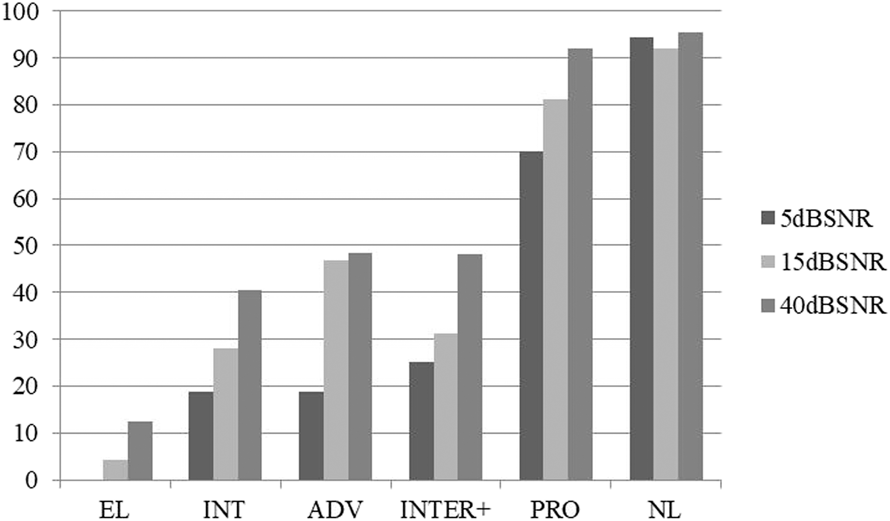
When looking at the identification percentages of the six groups in relation to the level of noise in the stimuli, there was a general tendency for the groups of L2 listeners to identify aspiration more accurately as SNR increased (Figure 3).
Identification of [h] according to noise level and listener group

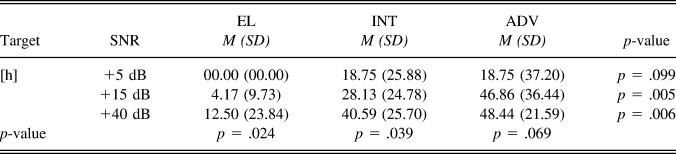
Despite this tendency, within-group differences due to the effect of noise were only statistically significant for the EL and INT listeners. In this case, the effect of noise was particularly negative for their identification of word-final [h] at +5 dB SNR, with respect to their identification at the other two levels (Table 4).
Mean accuracy (M) and standard deviations (SD) for word-final [h] identification according to level of L2 competence and SNR

A further cross-analysis between groups, according to their perception of word-final [h] by level of SNR, revealed that the significant differences between the EL group and the INT group happened at each of the three SNRs (+5 dB SNR: U = 30, p = .025; +15 dB SNR: U = 18, p = .008; +40 dB SNR: U = 16, p = .010). Likewise, differences were also found between these two groups concerning the perception of sibilance (+5 dB SNR: U = 24, p = .020; +40 dB SNR: U = 24, p = .022). In this case, noise seemed to be particularly relevant for the identification of the L2 dialect variant by those listeners in the developing stages of the L2, that is, higher noise implied lower identification. For those learners in the initial and final stages of learning, identification seemed to be more influenced by factors related to their L2 competence than to noise.
For the INT group with longer exposure (INTER+), their identification rate was 25% (SD = 28.87) at +5 dB SNR; at +15 dB SNR, it was 31.25% (SD = 37.5), while at +40 dB, it was 48.22% (SD = 30.83). Unlike the INT group, the effect of noise was not statistically significant in this case (χ2 (2) = 5.600, p = .061); thus, while both groups still performed at chance level, longer exposure seemed to mitigate the effect of more adverse levels of noise on L2 speech perception.
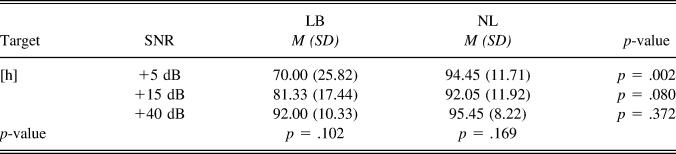
Looking at the performance of proficient listeners and native listeners according to noise level, we see that the first group’s identification rates of aspiration improve as level of noise decreases. Nevertheless, this improvement was not statistically significant (Table 5).
Mean accuracy (M) and standard deviations (SD) for word-final [h] identification for proficient and native listeners according to level of SNR

Native listeners show a more homogeneous performance despite noise level, which was not significant either. Upon comparing both groups, the significant differences found between them were given at +5 dB SNR, the highest level of noise.
DISCUSSION
To our knowledge, this is the first study that addresses native and nonnative perception of Western Andalusian Spanish aspiration in noise. The University of Seville receives American English students yearly for their study abroad program in Spain, many of whom are initially unaware of the variant spoken in the region. This study, then, offers an exploratory picture of how these students face aspiration in favorable and adverse conditions that they may encounter.
NATIVE LISTENERS
Generally, the perception of an allophonic contrast is less accurate than the perception of a phonemic contrast (Boomershine, Hall, Hume, & Johnson, Reference Boomershine, Hall, Hume, Johnson, Avery, Dresher and Rice2008), even for native listeners. The two experimental tasks presented in this study allowed reliance on preexisting mental representations of sounds, by which native listeners should be able to discriminate allophones of the same category (Celata, Reference Celata, Rauber, Watkins and Baptista2007). Nevertheless, [h] and [s] are very different in terms of acoustic energy so adverse conditions indicate that aspiration can be easily masked by noise. The intensity of [h] is substantially lower than that of [s]. Therefore, the effective SNR within the fricative is likely to be larger, that is more beneficial, for the words with the [s] variant of the phoneme that those with the [h] variant. The likelihood of this outcome is supported by the much lower identification rates for [h], even for the native Spanish speakers. These differences in SNR are likely to be representative of what listeners would experience in the real world.
In comparison with Clopper and Bradlow’s study (2008) of native listeners on speech perception in noisy conditions using stimuli from four different regional varieties of English (Mid-Atlantic, North, South, and GAE), we see that listeners, with and without exposure to the varieties, could adjust to regional variation at moderate levels of noise. In the most adverse conditions, listeners identified GAE the most accurately and Mid-Atlantic English the least accurately, regardless of their native variant. While the SNR levels they used were harder than ours, in both studies dialect variation seemed to be subject to perceptual disruption by noise. However, while they did not specify which characteristics of each variant accounted for the outcome, we specifically targeted word-final /s/ realizations.
NONNATIVE LISTENERS
There are many factors that influence L2 speech perception, such as L1 constraints, competence in the L2, exposure to the L2, and noise in the signal. The results of these experiments support these claims. As mentioned in the introduction, the phonotactic rules and the specific constraints of our L1 shape the way we perceive L2 sounds. Therefore, it is not surprising to find that most groups of listeners performed at or around 100% when identifying Spanish word-final [s], despite their amount of exposure to the target language, their L2 competence, and the presence of noise in the stimuli. Word-final [s] is not only phonotactically possible in English as well as in Spanish but also a morphological marker for plural nouns and verb-person agreement in both languages. Additionally, the acoustic characteristics of [s] prove to be very robust in noise (García Lecumberri et al., Reference García Lecumberri, Cooke and Cutler2010), as corroborated by the results in the second experiment. For EL listeners, nevertheless, noise seemed to be relevant in their perception of the standard variant, although the outcome could be due to their low level of competence in Spanish.
The findings for the identification of word-final [h] showed a different outcome. For nonnative listeners in the first experiment, accurate identification was directly linked to their amount of exposure to the L2 variant. These results are consistent with those obtained by Schmidt (2009), indicating that a stay in a country where a Spanish dialect variant is spoken positively affects the identification of its features. However, the author found positive effects after only 3 weeks of study abroad in the Dominican Republic, while in our study those with 3 weeks were not significantly different from those with no exposure, but there was a significant difference from those who had been in Seville for 2 months. Thus, exposure to the L2 variant increases the chances of accurate identification (Sumner & Samuel, Reference Sumner and Samuel2009), as it aids in the integration of acoustic cues from the multiple exemplars that the L2 listener receives from L1 input. In this case, inexperienced and less experienced listeners seemed to lack the phonotactic and contextual knowledge yet for the identification of word-final [h] and performed below chance level. Experienced listeners, however, only performed at chance level despite exposure; therefore, more than 2 months of exposure is necessary to become accustomed to this variant of Spanish.
In the second experiment, the overall identification of word-final [h] in noise seemed to be linked to both competence in the target language and exposure. Competence matters, generally, for the perception of L2 sounds that have no similar or identical counterparts in the listener’s L1 (Bohn & Flege, Reference Bohn and Flege1990). Nevertheless, in this case, even when English and Spanish may both have a similar sound [h] in their repertoires, their phonotactic rules are different. English [h] is a phoneme, not allowed in word-final position or as a valid representation of /s/. Spanish [h] is an allophone of /s/ in word-final position; thus, subject to identification with increasing competence in the language. In this case, L2 learners need to learn the allophonic relationship between /s/ and [h] in Spanish and the new phonotactic rules to govern a familiar sound.
Listeners with elementary competence in Spanish in this second experiment also showed a very low identification of aspiration in their performance, despite their two-month exposure to the language, and significant differences were found with respect to intermediate listeners, both for aspiration and sibilance. No difference was found between INT and ADV learners on the listening task in noise, in spite of their different L2 competence, or between INT learners with 2 months of exposure and INT learners with 8 months of exposure, in spite of their different length of exposure to the variant. However, in this last case we found evidence of how the effect of more adverse levels of noise seems to lessen with amount of exposure. Proficient learners, with a higher level of proficiency and longer exposure to the variant than the other groups of L2 learners, achieved very high rates of identification. It was at +5 dB SNR that their performance suffered in comparison to that of native listeners, in agreement with Tabri, Smith Abou Chacra, and Pring’s (2010) study. These authors found that monolinguals and bilinguals showed similar identification accuracy in quiet conditions; however, in noise, bilingual listeners showed greater difficulty, especially at +5 dB SNR. While it is said that late bilinguals are at greater disadvantage than monolingual native speakers due to their age of learning, Schmidtke (Reference Schmidtke2016) came to the conclusion that proficiency is directly related to SPIN performance, which is in line with the present results.
As we have seen, differences in phoneme inventory between L1 and L2 pose a higher difficulty in speech perception than differences among L1 varieties. Even when listeners have enough experience in the L2, “immersion experience alone may not be sufficient for L2 learners” (Strange, Reference Strange2011, p. 464), especially when the L2 presents a pattern that strongly violates L1 phonotactics, because it is “less likely to be learned fast” (Hawkins, Reference Hawkins, Lee and Zee2011, p. 12). This L1 phonotactic principle is that [h] does not legitimately represent /s/ in English and thus, to be acquired, it must first be noticed. We then suggest specific training and explicit instruction in the L2 variant. Training seems to involve changes at a higher order level, which implies that listeners draw on memory and attention to improve the detection of the most reliable cues in the L2. When attention is directed toward sound cues that are relevant to perform the task, the distance between the tokens is said to be increased, whereas irrelevant cues are minimized (Iverson & Evans, Reference Iverson and Evans2009). Explicit instruction can help L2 learners attune their perception at difference stages of learning (Kissling, Reference Kissling2015). As Mora and Rochdi (Reference Mora, Rochdi and Fernández Planas2016) point out, “[L]earners’ ability to notice and develop perceptual awareness of such differences may lead them to shape L2 phonetic categories more accurately” (p. 397). Therefore, we also see the need to provide dialectal variation in the L2 classroom, especially given that a great number of Spanish dialects make use of aspiration. Learners use variability in the signal to “contour online mappings to lexical candidates” (Cebrián & Chambers, 2001, p. 427), independent of whether they make later use of these variants in production.
METHODOLOGICAL ISSUES
Some factors concerning the setting and procedure in both tasks must be acknowledged. One possible limitation was the two-forced choice alternatives offered as possible answers. Schmidt (Reference Schmidt2018), other than a lexical identification task, employed a categorization task with nonsense words in her study, in which she provided further response alternatives to [s] and [V]. Even when she used citation-form words, the fact that she included [f] as a possible answer enabled her to see that aspiration was noticed, although not associated to /s/. In our study, using real words made it difficult to insert an option that was not valid in real Spanish, at least in the content sentences. A possible solution could have been the inclusion of a third option suggesting “none of the above” or “the speaker said something different.”
The number of speakers in the second task was twice the number of speakers in the first one. While the use of multiple talkers provides variability in the signal and makes perception more difficult, the extent to which the number of speakers can affect perception was not measured in this study. Likewise, speaker gender was not considered in this case. While the female speakers were better understood than the male speakers (45.37% and 35.42%, respectively), the differences were not statistically significant (p = .067), unlike in Clopper and Bradlow’s study (2008). Thus, we deemed it irrelevant for consideration in the interpretation of results. In the second task, there were an unlimited number of times a listener could replay the stimuli. Nevertheless, this fact did not guarantee that listeners made use of this opportunity, although this factor was not controlled for. Despite these limitations, differences between the results obtained in quiet and noise were apparent: “[L]isteners do indeed suffer more from increasing noise levels than natives when the task involves word or sentence processing in fixed or variable noise levels” (García Lecumberri et al., 2010, p. 877). In our case, even for nonnative listeners that had nativelike proficiency in Western Andalusian Spanish, their perception still suffered in the most adverse condition (+5 dB SNR) with respect to the native listeners.
CONCLUSION
The findings from these two experiments yield evidence of the influence of exposure to and competence in a foreign language on speech perception, particularly in terms of language variants and the allophones of standard features. In noisy conditions, listeners at the beginning stages of learning, considered naïve listeners in reality (Strange, Reference Strange2011), are affected by their limited competence in the L2. Those at intermediate stages of L2 learning seem to be especially sensitive to noise and suffer under more adverse SNRs. Likewise, also in more adverse conditions listeners at the final stages of L2 learning are at a disadvantage with respect to native listeners. All in all, these findings support the claim that perception of L2 regional or dialectal speech suffers in adverse conditions, as opposed to standard speech, although we can say it is not clear if the differences between perception of word-final [h] and [s] in our study are due to the fact that [s] is the standard variant, that it is also present in English both as a phoneme and as a morphological marker, or because of its acoustic characteristics. These findings also suggest that the identification of aspiration in Western Andalusian Spanish seems to require both extensive exposure and competence in the language; therefore, for future research we suggest exploring the integration of explicit instruction and specific training in this type of Study Abroad Programs to encourage noticing and promote language awareness for L2 speech perception.
SUPPLEMENTARY MATERIAL
To view supplementary material for this article, please visit https://doi.org/10.1017/S0272263119000056