Facilitation among plants has been found in various tropical environments and can increase diversity under stressful environmental conditions (He & Bertness Reference HE and BERTNESS2014). Positive effects of one species on another may be direct, such as reducing water stress (Espeleta et al. Reference ESPELETA, WEST and DONOVAN2004), increasing shade (Deckmyn et al. Reference DECKMYN, CAYENBERGHS and CEULEMANS2001) or enhancing soil fertility (Thorpe et al. Reference THORPE, ARCHER and DELUCA2006), or indirect, such as increasing defence against herbivores by plants with spiny leaves (Fidelis et al. Reference FIDELIS, OVERBECK, PILLAR and PFADENHAUER2009). At the periphery of the Atlantic Forest, positive interactions not only maintain plant diversity but also promote the encroachment of the forest into the surrounding ecosystems (Scarano Reference SCARANO2009). Studies addressing facilitation in these environments have been performed on rocky outcrops, highlighting several limiting factors for the establishment of tree species, such as drought, high temperatures, elevated transpiration rates, and the absence or poor development of soils (Carlucci et al. Reference CARLUCCI, DUARTE and PILLAR2011).
Rosettes of bromeliads can be important microsites to trap and accumulate tree seeds (Barberis et al. Reference BARBERIS, BOCCANELLI and ALZUGARAY2011), allowing germination and seedling establishment within tanks (Zaluar & Scarano Reference ZALUAR, SCARANO, Esteves and Lacerda2000) and increasing the amount of nutrients and organic matter in the soil (Hay et al. Reference HAY, DELACERDA and TAN1981). Thus, the aim of this study was to evaluate the association between the cover of Bromelia balansae Mez (Bromeliaceae) and the richness and abundance of tree seedlings on rocky habitats surrounded by a large forest remnant. Our hypotheses were that (1) the presence of B. balansae is positively correlated with the richness and abundance of tree seedlings and (2) species positively associated with B. balansae cover are responsible for forest expansion into the herbaceous vegetation on rocky outcrops.
Bromelia balansae is a terrestrial species native to South America (Smith & Downs Reference SMITH and DOWNS1979), with numerous spiny leaves arranged in dense rosettes but not forming tanks. It reproduces vegetatively from stolons and can exhibit dense and extensive cover both at the edges and inside forest habitats (Reitz Reference REITZ and Reitz1983).
The study was conducted in the Turvo State Park (TSP), in the north-west of Rio Grande do Sul, south Brazil (27°–27°20′S, 53°40′–54°10′W), between July and November 2008. The park has an area of roughly 175 km2 and altitudes between 100 and 400 m asl. There are three large flat (more or less horizontal) rocky outcrops within the study area, surrounded by seasonal Atlantic Forest (SEMA 2005). The outcrops are from 200 and 250 m long and have irregular widths, with a maximum width of approximately 100 m. The climate is humid subtropical, with average annual rainfall between 1250 and 2000 mm and average annual temperature around 19ºC (SEMA 2005).
The park's vegetation is predominantly covered by a tall forest with a discontinuous emergent layer, formed by trees that usually reach heights over 30 m and an upper canopy with trees reaching 20–25 m (Ruschel et al. Reference RUSCHEL, NODARI and MOERSCHBACHER2007). The forest marginal areas are often dominated by Bromelia balansae (SEMA 2005). On the rocky outcrops, vegetation is predominantly herbaceous and meadow-like, with sparse shrub and tree patches.
To evaluate the association between bromeliad cover and species richness and abundance of tree seedlings in forest and on rocky outcrop ecotones, we established four transects at the edges of the forest (N, S, E and W), in each of the studied outcrops. In each transect, we established five contiguous 1.5 × 1.5-m plots, totalling 20 plots per outcrop. In each plot, the following variables were recorded: (1) percentage of area covered by bromeliad rosettes, visually estimated in three cover classes (1 = 0%; 2 = 1–50%; 3 = 51–100%), (2) richness and (3) abundance of tree seedlings. We defined as seedlings all individuals 10–30 cm in height.
To assess the relationships among species potentially benefitting from B. balansae cover, and therefore the expansion of forest on rocky outcrops, we extended transects toward the forest interior. In each transect, we established five contiguous 1.5 × 1.5-m plots, totalling 20 plots per site. In each plot, we recorded the abundance and composition of tree species with height greater than 1 m. To detect differences between cover classes of B. balansae in relation to richness and abundance of tree seedlings, we used ANOVAs based on randomization tests, using Euclidean distance as a dissimilarity measure (Pillar & Orlóci Reference PILLAR and ORLÓCI1996). All analyses involved three factors: transect, site and bromeliad cover. To avoid bias caused by spatial autocorrelation of contiguous plots, we removed the effect of the transect factor from the analyses using residuals (observed value of a variable in a plot minus the mean for same variable in the transect of the plot) to calculate the dissimilarity matrix (Anderson & ter Braak Reference ANDERSON and BRAAK2003).
To assess the relationship among species potentially benefiting from B. balansae cover and the expansion of forest on rocky outcrops, we sorted the forest species and calculated the relative importance (RI) based on average abundance and relative frequency of each species. For each species with RI ≥ 5% in the forest, we evaluated the association between bromeliad cover and seedling abundance with ANOVAs, following the procedure described for analysis of richness and abundance of tree seedlings. For all analyses, we performed 10000 resampling iterations, using the MULTIV software (Pillar Reference PILLAR2006).
ANOVA with permutation test showed a positive correlation between the cover of Bromelia balansae and the richness of tree seedlings (P = 0.0001). Seedling richness was significantly higher in plots with 51–100% bromeliad cover (mean ± SE = 3.29 ± 0.5; N = 14), compared with plots without bromeliads (mean ± SE = 0.07 ± 0.07; N = 15) or with 1–50% cover (mean ± SE = 1.9 ± 0.27; N = 31) (P = 0.0001 and 0.014, respectively). Similarly, richness was significantly higher in plots with 1–50% bromeliad cover, compared with plots without bromeliads (P = 0.0003). In all cases, the differences in tree seedling richness were independent of the differences in richness between sites, and there was no interaction between site and bromeliad cover (P = 0.127 and 0.148, respectively).
There was a significant positive relationship between bromeliad cover and tree seedling abundance per plot (P = 0.0001). Plots with greater bromeliad cover (51–100%) had a larger number of seedlings (mean ± SE = 5.43 ± 1.0), compared with plots without bromeliads (mean ± SE = 0.07 ± 0.07) or with less cover (1–50%) (mean ± SE = 2.65 ± 0.04) (P = 0.0001 and 0.003, respectively). Plots with the lowest bromeliad cover (1–50%) also had significantly more tree seedlings than those without Bromelia balansae (P = 0.0003). No significant differences in abundance were found among the three sites analysed (P = 0.678), and no significant interaction was found between site and bromeliad cover factors (P = 0.201 and 0.397, respectively).
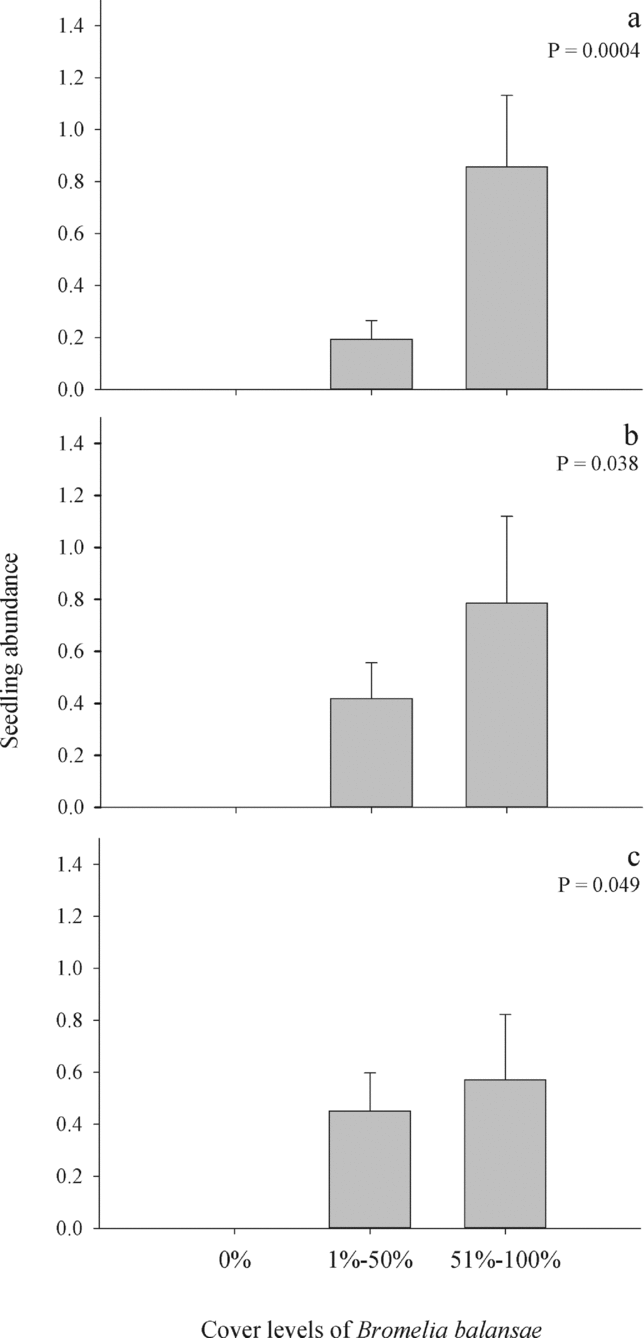
Only five species sampled in the forest interior (from 37) had a RI above 5% (Helietta apiculata Benth., Eugenia hiemalis Cambess., Trichilia elegans A. Juss., Erythroxylum cuneifolium (Mart.) O.E. Schulz and Eugenia uniflora L.); however, these were responsible for 48.3% of the total value. The analysis of relative importance of seedlings from these five species on the rocky outcrops indicates that they are jointly responsible for more than 50% of the total value. The correlation analysis of B. balansae cover with seedling abundance of the five species with RI ≥ 5% in the forest indicated a significant increase in the number of seedlings in plots with greater bromeliad cover for H. apiculata (P = 0.0004) (Figure 1a), E. cuneifolium (P = 0.038) (Figure 1b) and E. uniflora (P = 0.049) (Figure 1c), and no significant differences for E. hiemalis (P = 0.125) and T. elegans (P = 0.672). In all analyses, the effects of site and the interactions among site and bromeliad cover were not significant (P > 0.1).
Relationship between seedlings (individuals 10–30 cm in height) abundance of Helietta apiculata (a), Erythroxylum cuneifolium (b) and Eugenia uniflora (c) and three cover levels of Bromelia balansae: 0% (N = 15), 1–50% (N = 31) and 51–100% (N = 14) in plots (1.5 × 1.5 m) on three rocky outcrops at the seasonal forest, Turvo State Park, south Brazil. The vertical bars represent mean values, and the vertical lines represent standard errors. Probabilities are calculated using ANOVAS with randomization tests (10000 resampling iterations).

Although it has been shown that mechanical defences against herbivores can maintain and increase species diversity (Callaway et al. Reference CALLAWAY, KIKODZE, CHIBOSHVILI and KHETSURIANI2005, Espinosa et al. Reference ESPINOSA, LUZURIAGA, DE LA CRUZ and ESCUDERO2014), this is apparently not the explication of the association between the cover of B. balansae and the diversity of forest tree species in forest-outcrop ecotones, given that our results indicate that the bromeliad cover is positively correlated only with some tree species. Despite an increase in the species richness of tree seedlings recorded in plots with greater B. balansae cover, there is apparently a high mortality rate associated with these species because the forest established in this ecotone is dominated by only a few species, while more than 64% of all species have a RI < 2%, and thus possibly representing late colonization.
Although our study is essentially correlative we can speculate that the bromeliad may play a major role in improving environmental conditions and a secondary effect of mechanical protection to species already facilitated. Similar effects were reported for tree seedlings in the Mediterranean (Gomez-Aparicio et al. Reference GOMEZ-APARICIO, ZAMORA, CASTRO and HODAR2008) and in sclerophyllous forest in Peru (Aragon & Woodcock Reference ARAGON and WOODCOCK2010). However, manipulative experiments are needed to confirm our finds and to quantify the importance of each of these factors. It is possible that direct facilitative effects of B. balansae on forest plants in grasslands may involve hydraulic lift and redistribution (Yoder & Nowak Reference YODER and NOWAK1999), increase in soil fertility (Hay et al. Reference HAY, DELACERDA and TAN1981) and shade, decreasing the incidence of ultraviolet radiation and evapotranspiration pressure.
Our results suggest that the pioneer B. balansae might increase plant diversity at forest margins and provide sites from which pioneer tree species can colonize the grassland vegetation of the outcrops. The presence of stolons allows B. balansae to encroach steadily over the open vegetation adjacent to the forest and thus create new microsites to propagules accumulation in a species-specific relationship. Of the five tree species (13.5% of the total) with higher relative importance in the forest, only three (8% of the total) have a positive association with bromeliad cover. Eugenia hiemalis and Trichilia elegans, the two species that had no positive correlations with B. balansae cover, are early secondary colonizers. Possibly, environmental improvements that can be provided by B. balansae are not enough to guarantee the survival of the seedlings of these species. The three species associated with bromeliads are pioneer species, and together they account for more than 30% of the relative importance in the forest adjacent to rocky outcrops, so the long-term implications of this association for the conservation of both forests and grasslands present on rocky outcrops need to be better understood.