Introduction
The Eurasian native wild grapevine is taxonomically classified as Vitis vinifera L. ssp. sylvestris (Gmelin) Hegi. This sub-specific taxon constitutes the dioecious ancestor of grapevine cultivars belonging to V. vinifera L. ssp. sativa (DC.) Hegi (De Candolle, Reference De Candolle1883; Arnold, Reference Arnold2002). Currently, this strain is considered a threatened plant genetic resource, and it is quickly disappearing through direct and indirect human intervention (Red Book, 1982; Arnold et al., Reference Arnold, Gillet and Gobat1997). The causes are mainly attributed to deforestation and building activities in deforested locations. In the past, wild grapevines were used for the production of juice, wine, vinegar, tartaric acid, medicines, fishing traps and rootstocks among other things. These traditions have been carried out by different cultures throughout centuries, from the Hindu Kush mountain range in Asia to the Iberian Peninsula in Europe (Ocete et al., Reference Ocete, Cantos, López, Gallardo, Pérez, Troncoso, Lara, Failla, Ferragut and Liñán2007).
Wild vines are woody lianas that through their tendrils climb up on the nearby vegetation in order to obtain the best canopy architecture. The resulting adaptive advantage contributes to enhanced exposure to direct solar radiation and reducing competition disadvantage with other surrounding species.
Georgia is situated between the Caucasian mountain range, with some peaks over 5000 m in height, and the Black Sea. Due to its particular geographical location, the area constituted a unique refuge habitat for several plants, including Vitis, during Pleistocene ice ages (Ramishvili, Reference Ramishvili2001).
The main natural habitats of the wild grapevine populations are river-bank forests and some colluvial positions situated on the slopes of hills and mountains (Ramishvili, Reference Ramishvili1998; Arnold, Reference Arnold2002; Maghradze et al., Reference Maghradze, Ocete Rubio, Pérez Izquierdo, Chipashvili, Osete Pérez and Ocete Rubio2010), where soils are often renewed by flooding or by gravity.
Wild vines show a high foliar polymorphism. The fruiting plants produce small inflorescences with feminine flowers with reflected stamens. The male plants have bigger inflorescences constituted only by staminate flowers. Wild berries are usually small, roundish and black (Arnold, Reference Arnold2002). These plants have some interesting features of biotic and abiotic stress resistance that could be transferred, by selective breeding, to cultivars and rootstocks (Ocete et al., Reference Ocete, Cantos, López, Gallardo, Pérez, Troncoso, Lara, Failla, Ferragut and Liñán2007).
Ocete et al. (Reference Ocete, Arnold, Failla, Lovicu, Biagini, Imazio, Lara, Maghradze and Angeles-Lopes2011) carried out an investigation of the current state of phylloxera infestation in European countries. Data from the Caucasus region were not available at that time. Studies assaying microsatellite (short sequence repeat (SSR)), chloroplast microsatellite (cpSSR) and single nucleotide polymorphism markers on the genetic sequence of the wild grapevine from the South Caucasus region, which also includes Georgia, have stressed a high genetic drift compared with European populations (Arroyo-García et al., Reference Arroyo-García, Ruiz-Garcia, Bolling, Ocete, Lopez, Arnold, Ergul, Söylemezoglu, Uzun, Cabello, Ibañez, Aradhya, Atanassov, Atanassov, Balint, Cenis, Costantini, Gorislavets, Grando, Klein, McGovern, Merdinoglu, Pejic, Pelsy, Primikirios, Risovannaya, Roubelakis-Angelakis, Snoussi, Sotiri, Tamhankar, This, Troshin, Malpica, Lefort and Martinez-Zapater2006; Imazio et al., Reference Imazio, Maghradze, Bacilier, De Lorenzis, Scienza, This and Failla2010; Myles et al., Reference Myles, Boyko, Owense, Browna, Grassi, Aradhya, Prins, Reynolds, Chia, Ware, Bustamante and Buckler2011). This increases the interest in the study of the main pests and diseases affecting the wild grapevine populations in this geographical area. In addition, this would contribute to the evaluation of their sanitary status after 150 years of infestation of phylloxera and American fungal diseases. Thus, the main aim of this study was to survey the sanitary status of this taxon in Georgia, with particular interest in the incidence of pests and diseases, and an evaluation of the possible competition from North American species.
Materials and methods
Field expeditions were organized to characterize the wild grapevine populations in the eastern regions of Georgia during the summer in 2008. Each population had previously been observed at the flowering time in May–June. Differentiation between V. vinifera wild vines and North American species was carried out by observing the main morphological discriminant descriptors. Attention was particularly focused on leaves and flowers, following the methods of Larrea (Reference Larrea1978) and Ocete et al. (Reference Ocete, Gallardo, Lara, López and Pérez2006). Plant classification, including the supporting trees of the wild vines and the accompanying vegetation, was determined following the local Florae (Grossgeim, 1937–1967; Makashvili, Reference Makashvili1991; Flora Georgia, 1971–2007) and then validated by Dr Benito Valdés from the Botanical Department of the University of Sevilla (Spain).
The observation of symptoms caused by pests and diseases was carried out on shoots, leaves and bunches of up to 3 m of canopy height. To detect any possible subterranean phytophagous and pathogens, roots were unearthed down to 40–50 cm of depth. They were evaluated as done previously by Ocete et al. (Reference Ocete, Cantos, López, Gallardo, Pérez, Troncoso, Lara, Failla, Ferragut and Liñán2007) in the case of mite infestation and according to the OIV (2009) descriptors in the case of mildews.
Results
Ecological aspects
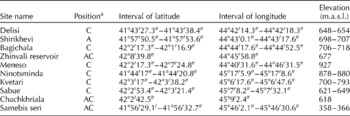
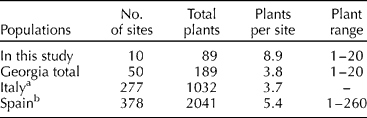
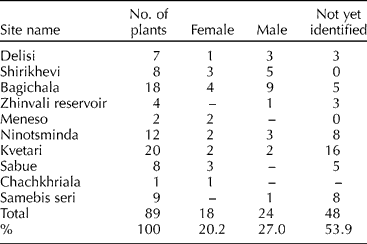
In this study, ten locations were surveyed (Table 1). They were considered independent populations when the distance between two sites was more than 10 km. It has to be taken into account that the male pollen grain of the studied species has a medium weight, hence it cannot be transported by wind over long distances as described by Arnold (Reference Arnold2002). The number of vines varied between 1 and 20 plants in the different sites, with an average value of 8.9 (Table 2). The number of vines of each sex from each population is indicated in Table 3.
Location of the wild populations in Georgia

m.a.s.l., metres above sea level.
a Positions are defined as follows: A, alluvial position; C, colluvial position; AC, both alluvial and colluvial positions.
Status of wild populations in their natural habitat

a Data from Biagini (Reference Biagini and Biagini2011).
b Data from Ocete et al. (unpublished).
Sex of flowers of wild vines

The data demonstrated that 18 out of 89 observed wild plants had female-type flowers (20.2%), and 24 plants had male-type flowers (24.0%). A large group of plants (48) are still unidentified, because of the short flowering period which impeded the complete field observation over the large area to survey.
The main non-vinifera grapevines were classified as American rootstock hybrids escaped from cultivation. Vitis rupestris and Vitis riparia like-to-type plants were detected in the Bagichala and Kvetari region sites. Vitis × labruscana cultivar Isabella like vines were found only in the Kvetari region.
The plant supporters and the accompanying vegetation are listed in Supplementary Table S1 (available online only at http://journals.cambridge.org).
Evaluation of pests
Data on the presence of phytophagous arthropods are reported in Table 4.
Number of affected plants and evaluation of infestation/infection by parasitesa

a For each species, the number of affected plants and level of infestation (in parentheses) are indicated, following the scale of Ocete et al. (Reference Ocete, Cantos, López, Gallardo, Pérez, Troncoso, Lara, Failla, Ferragut and Liñán2007) for mite infestation, and the OIV (2009) descriptors for mildews. In the case of mites, the evaluation situated between 1 and 3 means that the mite affected 10–25% of the leaves.
The observations carried out on roots demonstrated that, in natural habitats, no damage caused by phylloxera, Daktulosphaira vitifoliae (Fitch) (Homoptera, Phylloxeridae), was found on roots and leaves. All roots showed a complete absence of symptoms caused by root-knot nematodes, such as galls and secondary rootlets (Raski, Reference Raski, Pearson and Goheen1994). Damages caused by Meloidogyne were not found.
Concave felty galls situated in the lower leaf surface, which induce swellings on the lower leaf side, caused by the erineum strain of Colomerus vitis (Pagenstecher) (Acari, Eriophyidae), were observed on all the populations studied in the present survey. Symptoms were very frequent, affecting almost all of the vines, but damages caused by this pest were not serious (levels 1–3), and did not affect the viability of the liana.
Another mite found on the leaves of most of the prospected populations was the grape rust mite, Calepitrimerus vitis (Nalepa) (Acari, Eriophyidae). Its distribution and level of infestation, usually scored at level 1, was lower compared with C. vitis.
Evaluation of diseases
Data on the presence of symptoms caused by diseases are shown in Table 4. Symptoms of root rot were absent on all samples.
On the parts of the plants above ground level, symptoms of infection were caused by North American fungal species which included powdery and downy mildews, Erysiphe necator (Schweinitz) Burrill and Plasmopara viticola (Berkeley and Curtis) Berlease and de Toni, respectively.
Symptoms of powdery mildew on wild vines were found on leaves, shoots (Chleistotecia) and, far more rarely, on the bunch. These symptoms affected virtually all the populations studied in Georgia. The degree of intensity of the infection on wild vines was rated between 1 and 3 through observing the leaves according to the descriptors. This corresponds to a low infection.
Typical symptoms of downy mildew were found in Georgian wild vines on leaves (similar to oil spots) and shoots longer than 10 cm; this also occurs in the case of cultivars. Damage on bunches was less frequent. Finally, symptoms caused by this fungal species were less frequent than those caused by powdery mildew, as indicated by the degree of infection rated as 1 on average.
Discussion
The evaluation of the status of wild populations in this survey demonstrated a higher density of plants per site (8.9) compared with data from the whole of Georgia (3.8 plants per site) (Maghradze et al., Reference Maghradze, Failla, Imazio, Bacilieri, Chipashvili, Quattrini, This and Scienza2011), Italy (3.7) and Spain (5.7) (Table 2). In both Western European countries, the number of populations is higher than in Georgia and, as a consequence, a higher number of vines have been identified. This is probably also due to the fact that in the Italian and Spanish surveys, several natural reserves have been involved, whereas the investigation in Georgia was done outside the boundaries of protected areas.
Usually, the number of males identified in each population was higher than the number of females. In the sites of Zhinvali and Sabue, there are no female plants. This makes seed reproduction impossible. In general, populations are very small so their short- and medium-term viability is expected to be very low (Table 3).
It is necessary to underline that in the Caucasian region, where Vavilov (Reference Vavilov1926) found the highest diversity of vines in the cradle of viticulture, there were 55 productive female cultivated varieties (13.3% of total germplasm; Ampelography, 1970; Maghradze et al., Reference Maghradze, Ocete Rubio, Pérez Izquierdo, Chipashvili, Osete Pérez and Ocete Rubio2010). Among these, the two cultivars ‘Asuretuli Shavi’ and ‘Tavkveri’ are included in the official list of cultivated varieties of Georgia (Law, 1998) and are spread throughout the Kartli province of East Georgia. The female cultivars can be pointed as a relict step in the history of Georgian viticulture: they show the passage from the domestication of wild vines to the cultivation of selected hermaphrodite varieties during an early development phase of this crop.
The accompanying vegetation of the vines is the characteristic flora of the Caucasian natural areas under 1000 m of altitude with low human impact, where several species of fruit trees took refuge during the Quaternary ice age. This flora is typical of temperate forests in the Palaearctic ecozone, where there is great biodiversity due to the confluence of Central European, Central Asian and Middle Eastern botanical provinces. This alluvial formation with deciduous species constitutes the Euxine–Colchic forest of the South Caucasus, which stretches eastward towards the shores of the Caspian Sea, where the Tertiary botanical species took refuge (Moore, Reference Moore1982).
Supported trees and bushes with thorns (such as Crataegus ssp. and Prunus ssp.) are supposed to have played an important role in the protection of wild vines from wild or domestic animals.
As in Europe, some of the American rootstock hybrids and Vitis × labruscana are gradually colonizing the river banks and slopes of the hills in Georgia, taking over the niche of autochthonous wild vines (Cholokashvili, Reference Cholokashvili1983), as it was observed in several European populations (Arrigo and Arnold, Reference Arrigo and Arnold2007). Such is the situation in the Bagichala and Kvetari sites. Such plants are more invasive and show a higher resistance to North American imported mildews compared with native wild vines: this is why they are involved in the extinction of wild autochthonous grapevines in the Valencia region (Spain; Laguna, Reference Laguna2003a, Reference Lagunab), Têt river valley (France), Montseny Reserve of the Biosphere (Spain), and in several parts of the Rhone, Rhine, Danube, Ebro, Guadalquivir, Duero and other important European rivers and their tributaries (Terpó, Reference Terpó1969, Reference Terpó1974; Ocete et al., Reference Ocete, Cantos, López, Gallardo, Pérez, Troncoso, Lara, Failla, Ferragut and Liñán2007). This is another reason for the urgent need of protection of the biodiversity of the Georgian wild grapevine, which is the earliest known domestication centre of the vine. In the Eastern part of the Iberian Peninsula, it was one of the main causes for wild grapevine disappearance (Laguna, Reference Laguna2003a, Reference Lagunab).
The absence of phylloxera infestation is due to the temporary flooding of soil profiles in all of the European locations. These lianas grow in sites where edaphic conditions such as permanent or temporary anoxic conditions caused by flooding make them unsuitable for the development of phylloxera. Meanwhile, laboratory experiments with artificial infestation indicated that Eurasian wild grapevines exhibited nodosities and tuberosities on roots caused by a homopteran under induced artificial infestation in pots (Ocete et al., Reference Ocete, Arnold, Failla, Lovicu, Biagini, Imazio, Lara, Maghradze and Angeles-Lopes2011).
In spite of considerations on the infestation of roots of wild grapevines found in France by Camille St. Pierre and included in De La Branchere (Reference Saint Pierre1876), phylloxera had little direct impact on the remaining wild vines (Ocete et al., Reference Ocete, Gallardo, Lara, López and Pérez2006).
Around Georgia, a homopteran was detected in Southern Russia in 1863 (Negrul, Reference Negrul1952). In 1881, it was cited in the West Georgian province of Abkhazeti, close to the city of Sokhumi located on the Black Sea coast. Between 1889 and 1891, the vineyards situated in Western Georgia were infested. In Eastern Georgia, the pest was found in Tbilisi in 1884 (but it was immediately eliminated) and in the province of Kartli in 1893. Later, between 1906 and 1910, the symptoms were found in the province of Kakheti (Kantaria and Ramishvili, Reference Kantaria and Ramishvili1983; Ramishvili, Reference Ramishvili2001). The damage throughout the country was extensive, and losses were so high that viticulture and winemaking ceased to be prosperous activities. The vineyard acreage was dramatically reduced. To control phylloxera and other diseases, the ‘Caucasus Phylloxera Committee’ was established in 1880, playing an important role in the detection of infested vineyards, introducing innovative methods to fight against parasites and describing local varieties under the threat of extinction. The method of grafting local varieties on American rootstocks was introduced in the last decade of the 19th century, playing a very important role in saving Georgian viticulture and winemaking (Lomineishvili and Gaprindashvili, Reference Lomineishvili and Gaprindashvili1990).
The absence of damage caused by nematodes is probably due to the action of water contained in the profile of the soil mentioned previously, according to Palm and Walter (Reference Palm and Walter1991).
The erineum strain of C. vitis caused symptoms on 100% of the studied vines, with a low (1–3) intensity of attack, as occurred in the case of the Spanish and French populations (Lara and Ocete, Reference Lara and Ocete Rubio1992; Ocete et al., Reference Ocete, Cantos, López, Gallardo, Pérez, Troncoso, Lara, Failla, Ferragut and Liñán2007, Reference Ocete, López, Gallardo and Arnold2008). It is a monophagous species (Arnaud and Arnaud, Reference Arnaud, Arnaud, Lechevalier and Fils1931), widely distributed in the vineyards of both hemispheres (Keifer et al., Reference Keifer, Baker, Kono, Delfinado and Styer1982; Dennil, Reference Dennil1986). This mite has two strains which are more commonly found on cultivars: the bud strain and the leaf curl strain (Reyes, Reference Reyes2004). Through the genetic research approach and characterization, the two strains would belong to distinct species (Carew et al., Reference Carew, Goodisamn and Hoffmann2004). In those nests, several natural enemies of the erineum strain mite can be found, mainly Phytoseiidae, Tydeidae and Cecidomyida, and all of them constitute a new target to be investigated in the future. Some predatory species belonging to the cited families cannot be found in vineyards due to the use of pesticides (Ferragut et al., Reference Ferragut, Gallardo, Ocete and López2008).
C. vitis is another monophagous species detected in 62% of the European populations sampled between Portugal and Hungary (Ocete et al., unpublished data). It caused a low level of infestation on 30.3% of the vines found in Georgia belonging to eight populations observed, with an overall lower level of infestation compared with other mite species. After bud burst (D phenophase according to Baggiolini (Reference Baggiolini1952)), females that have broken the diapausa begin to feed, resulting in small spots that can be seen against light. Symptoms caused by this phytophagous were found in different vineyards of Europe, America, South Africa and Australia. Usually, it is considered as a secondary pest (Sazo Rodríguez et al., Reference Sazo Rodríguez, Agurto, Contador and Mondaca2003). Injuries caused by a high infestation of both cited mites on Australian vineyards were referred to as restricted spring growth (Bernard et al., Reference Bernard, Horne and Hoffmann2005).
Because of the impossibility of long migrations of the two obligatory monophagous parasitic eriophyids and their wide presence on the majority of wild grapevines, we can assume that these mites have always coexisted with their primary host since ever and were transferred to cultivars during the domestication processes.
Several support trees, belonging mainly to the Populus and Quercus genera, are infected by Armillaria mellea (Vahl: Fr.) Kummer in Georgia. This fungal disease caused the hyphae to produce abundant white mats between the hardwood and the bark, but it is absent in the roots of the vines. It is an interesting fact when focusing on the possibility of getting new rootstocks using wild vines in breeding programmes.
Powdery mildew symptoms were detected in 55% of the studied vines. This percentage is similar to Southern Spanish populations, according to data from Ocete et al. (Reference Ocete, Cantos, López, Gallardo, Pérez, Troncoso, Lara, Failla, Ferragut and Liñán2007). Its level of infestation varied between low and medium. Only one population was free from the disease, perhaps due to the fact that it contained only one vine.
In the Old World, the first damages caused by powdery mildew were discovered in England by Berkeley (Reference Berkeley1847), and were later detected on cultivars situated in France (Cortés, Reference Cortés1854; Müller, Reference Müller1882). Eight years later, the fungal disease had invaded the vineyards of Europe, Northern Africa and Asia Minor (Le Canu, Reference Le Canu1862). In Georgia, this disease was discovered in the middle of the 19th century (1857 in Guria province) in Western Georgia: it destroyed high vineyards in the provinces of Guria and Samegrelo (Kantaria and Ramishvili, Reference Kantaria and Ramishvili1983; Ramishvili, Reference Ramishvili2001). Nowadays, the pathogen can be found in all wine-producing areas, under dry weather conditions and average temperatures between 15 and 35°C (Pérez de Obanos, Reference Pérez de Obanos1992; Pearson and Goheen, Reference Pearson and Goheen1996).
On the other hand, downy mildew affected 18% of the vines, usually with a lower intensity than E. necator. No symptoms were found in the three populations with a lower number of vines. In the case of Southern Spanish populations, this disease affected about 60% of the 200 populations studied by Ocete et al. (Reference Ocete, Cantos, López, Gallardo, Pérez, Troncoso, Lara, Failla, Ferragut and Liñán2007).
Downy mildew was detected in the south of Western France, near Bordeaux in about 1878 (Millardet, Reference Millardet1885). Four years later, the disease affected all French vineyards and adjacent countries (Urien de Vera and Diego-Madrazo, Reference Urien de Vera and Diego-Madrazo1891) and reached South Caucasus in the last two decades of the 19th century (Kantaria and Ramishvili, Reference Kantaria and Ramishvili1983; Ramishvili, Reference Ramishvili2001).
The presence of both North American mildews on Georgian populations and in the rest of the Eurasian wild grapevines studied in Europe is a legacy from cultivars infected by the massive importation of American vines occurred in the 19th century. All cultivars of V. vinifera are susceptible to this fungus. Only the North American species, mainly V. rupestris and Vitis rotundifolia, exhibited an important level of resistance because they had evolved with this pathogen (Leroux and Clerjeau, Reference Leroux and Clerjeau1985). The easy transportation of the spores from vineyards to natural habitats induces the infections of wild vine populations situated in remote sites.
This phytosanitary study demonstrates that, today, parasitic organisms are not the main problem for the survival of relic populations. This is a very important conclusion, as it was widely believed that phylloxera was one of the main causes of the reduction of wild grapevine populations in Georgia. Despite this fact, the fungal diseases probably had a heavy impact on wild grapevine individuals, leading to the death of many plants growing in sites which are more suitable for the development of these pathogens. The remaining wild plants could be descendants of those that exhibited a higher tolerance or were situated in habitats under conditions which were not suitable for heavy mildew infection.
Acknowledgements
This study is a joint publication of the COST Action FA1003 ‘East-West Collaboration for Grapevine Diversity Exploration and Mobilization of Adaptive Traits for Breeding’ (http://w3.cost.eu/index.php?id = 181&action_number = FA1003). The authors wish to thank Dr Nicole Ortega and Dr Agnes Minnery for the critical review of the manuscript, Dr Marina Olwen Fogarty and Adolfo Molejón-García for the accurate and passionate revision of the English text, and Dr Benito Valdes (Botanical Department of the University of Sevilla, Spain) for helping with the determination of vegetation.