Introduction
“Social policy means public management of social risks. Some risks are perennial, some come and go with the flow of history”. (Esping-Andersen, Reference Esping-Andersen1999: 36).
This article proposes a novel theoretical model and validation process that intends to unveil global contemporary welfare state patterns. Scholars argue that the welfare state is a complex and evolving system, with changing goals, functions, and institutions (Hemerijck, Reference Hemerijck2012). At times, these changes are more profound, dictating the designs and trajectories of welfare states across the globe. In response to 21st-century socio-economic needs and demands, contemporary welfare systems have undergone significant ‘restructuring, recalibration, and transformation’ (Mares and Carnes, Reference Mares and Carnes2009; Hall, Reference Hall, Chwalisz and Diamond2015; Shahidi, Reference Shahidi2015). Notably, two waves of welfare research have examined some of these major shifts. The first wave, the ‘era of austerity’, refers to changes in welfare state policy – namely, the retrenchments of existing benefits in all key social policy areas (Pierson, Reference Pierson2001). At the center of this era are government initiatives designed to tighten eligibility requirements and decrease benefit amounts, which resulted in sweeping changes to old social policiesFootnote 1 . Welfare scholars have taken a keen interest in these policy changes and country differences, focusing mostly on common risks such as income and job loss, particularly old age, illness or disability, and unemployment benefits (Häusermann, Reference Häusermann, Bonoli and Natali2012). The second wave reflects the emergence of new social risks and needs in recent decades, which has led to the expansion of welfare state instruments and areas of intervention, such as social investment and activation programs (Taylor-Gooby, Reference Taylor-Gooby2004; Bonoli and Natali, Reference Bonoli and Natali2012; Morel et al., Reference Morel, Palier and Palme2012). These welfare policy measures are designed and implemented to address new welfare risks such as atypical employment, (long-term) unemployment, lack of opportunities for labor market participation, gender and income inequality, and climate-change-related risks (Häusermann, Reference Häusermann, Bonoli and Natali2012; Diamond and Chwalisz, Reference Diamond and Chwalisz2015; Gough, Reference Gough2013a).
Existing research shows consistent findings among scholars that modern welfare states are not ‘frozen landscapes’, but rather “a patchwork mixes of old and new policies and institutions” (Hemerijck, Reference Hemerijck2012: 12). On the contrary, wide-ranging perspectives on the drivers and the direction patterns of the welfare state change are also evident (Palier, Reference Palier2006; Häusermann, Reference Häusermann, Bonoli and Natali2012). The principal objective of this study is to shed light on global (or ‘extensively internationalist’, Yeates, Reference Yeates2014) contemporary welfare state patterns and to contribute to a better understanding of the pathways that welfare states may take. When I speak about welfare state patterns, I am focusing on countries’ varying instruments and priorities for responding to old and new social risks, rather than the varying degrees at which governments intervene. As I would argue, the latter is closely linked to a country’s degree of development, i.e. financial opportunities, and should therefore not be at the core of a global perspective on welfare states. In this study, I depend heavily on and also depart from prior theoretical methods aimed at explaining global welfare state policy differences. Findings in the respective literature suggest that welfare states in developed and developing countries follow ‘systematically divergent paths’, implying that they are neither ‘extremely divergent’ nor ‘universal’ (Esping-Andersen, Reference Esping-Andersen1990; Rudra, Reference Rudra2007). In essence, they show that global welfare state patterns belong to certain peer groups.
Most studies on welfare regimes depart from Esping-Andersen’s seminal work, “The Three Worlds of Capitalism” (1990). An important finding of this contribution is that “welfare-state variations are not linearly distributed, but clustered by regime types,” i.e. ‘Liberal, Corporatist and Social Democratic’ (ibid: 26). This conceptualization of the welfare state solidified the idea of a ‘welfare state regime’, which includes traditional social services and transfers, macroeconomic management, and employment (Powell and Barrientos, Reference Powell and Barrientos2011). Esping-Andersen’s (Reference Esping-Andersen1990) welfare regime paradigm has produced an immense amount of ‘empirical work, critical commentary, and theoretical reworking’ (i.e. Rudra, Reference Rudra2007; Sharkh and Gough, Reference Sharkh and Gough2010; Gough, Reference Gough and Kennett2013b; Kühner, Reference Kühner2015; Mkandawire, Reference Mkandawire2016). In so doing, this study contributes to the existing research in three ways. First, theoretically, to my knowledge, this is the first piece of research on the field to develop an extensively internationalist comparative conceptual framework for unveiling the patterns of contemporary welfare states. It is particularly significant since it clarifies the theoretical controversy surrounding the systematic variation of global welfare states and provides a new but comprehensive framework for future research in this area. Second, empirically, this study is important since it brings together 150 countries, a sample size that allowed many countries to be included in this literature for the first time. Moreover, it addresses specifically the existing methodological and variable selection gaps in this area of research. Third, these findings will inform policymakers and regional and international organizations on the global direction of contemporary welfare states.
Imagining a comprehensive global picture of contemporary welfare state patterns illuminates my motivation and interest to shed some light on this research gap. As a result, this paper sets out to answer the following question:
How can we conceptualize, operationalize, and measure the global contemporary welfare state patterns?
Previous research sets the groundwork for this study based on two assumptions. First, it assumes that the welfare states consistently change, but the patterns on a global scale remain unclear. Second, looking through the lens of divergence, it assumes that welfare states across the world could follow systematically divergent paths. In this vein, I propose and validate a comparative welfare state conceptual framework, taking into account the strengths and weaknesses of current welfare state models.
This study proceeds as follows. In the second part, it reviews the existing literature on welfare regimes and transformations. In the third part, it proposes a formal and comprehensive three-stage comparative conceptual framework. In the fourth and fifth parts, it introduces a uniquely assembled comparative dataset for 150 countries across six continents. This data is utilized to statistically verify the conceptual framework using model-based cluster analysis. In the final part, it summarizes the key results and provides recommendations for future research.
Previous research: What do we know?
Theoretical review
As stated above, recent comparative welfare policy research has relied heavily on Esping-Andersen’s work on welfare state typology, published in 1990. This book, titled “Three Worlds of Welfare Capitalism,” sought to provide “reconceptualization and re-theorization of existing inadequate theoretical models of the welfare state” (1990: 2). It sparked extensive research on welfare regimes (Powell and Barrientos, Reference Powell and Barrientos2004; Wood and Gough, Reference Wood and Gough2006; Rudra, Reference Rudra2007; Sharkh and Gough, Reference Sharkh and Gough2010; Hudson et al., Reference Hudson, Kühner and Yang2014; Gough, Reference Gough and Kennett2013b; West and Nikolai, Reference West and Nikolai2013), also known in the literature as the ‘welfare modeling business’ (Abrahamson, Reference Abrahamson1999). This diverse body of research has generated theoretical and conceptual frameworks that have led to numerous welfare typologies.
Nonetheless, distinct frameworks that intend to explore global welfare state patterns cannot ensure a level playing field for welfare state comparison on a global scale (see Wood and Gough, Reference Wood and Gough2006; Sharkh and Gough, Reference Sharkh and Gough2010). These frameworks imply that the welfare state typologies proposed by Esping-Andersen (Reference Esping-Andersen1990) are mainly found in developed nations. Whereas developing nations in Sub-Saharan Africa, South Asia, and parts of East Asia are considered welfareless states since they are classified as ‘Insecurity Regimes’ or ‘Informal Security Regimes’ (Wood and Gough, Reference Wood and Gough2006). Recent comparative welfare studies, however, highlight the limitations of existing theories for integrating and understanding the development and transformation of social policy in Sub-Saharan Africa, the Middle East, and North Africa (e.g. see Midgley, Reference Midgley1995; Kpessa and Béland, Reference Kpessa and Béland2013: 326; Plagerson et al., Reference Plagerson, Patel and Hochfeld2019; Jawad, Reference Jawad2019). It is thus critical to include these countries in systematic theoretical models that aim to explain welfare state policy variations. According to Kpessa and Béland (Reference Kpessa and Béland2013: 326), these models may assist academics and policymakers to map and understand the diverse institutional configurations of the developing countries’ welfare state landscape.
Another shortcoming is that the theoretical models aimed at explaining the welfare variations across countries have mostly concentrated on old social risks and policies, although rightly in line with their time-relevance. Such policies include social assistance (non-contributory and regular transfers) and social insurance (insurance schemes), as the two most essential sub-categories of social protection. The objective of these policies is to offer health care and income security, particularly in the events of illness, work injury, invalidity, unemployment, old age, and maternity or loss of main income earner (World Social Protection Report 2017–19). However, numerous new universal social risks and demands have emerged in recent years. The majority of them are concerned with the issues pertaining to the new knowledge economy, income and gender inequality, and climate change. Low or insufficient levels of schooling, reconciliation of family responsibility and paid labor, single parenthood, long-term care dependence of a family member, and climate change-related threats, among other things, are the new social risks and demands (Armingeon and Bonoli, Reference Armingeon and Bonoli2006; Gough, Reference Gough2010; Vandenbroucke, Reference Vandenbroucke2012; Kowalewska, Reference Kowalewska2017). Several new social policy instruments and areas of intervention, including but not limited to social investment and activation policies, are recognized and examined in contemporary welfare state research (see Morel et al., Reference Morel, Palier and Palme2012; Bonoli and Natali, Reference Bonoli and Natali2012; Eriksen, Reference Eriksen2018). However, the existing theoretical frameworks barely include any of the new social policies and risks, leaving critical welfare state developments unexplained.
As a consequence, any effort to piece together the existing literature on welfare typologies falls short in unveiling and explaining the patterns of global contemporary welfare states. For illustration, systematic theoretical approaches are employed to capture commonalities and differences of developed welfare states, i.e. OECD18+ and EA-18 countries (Esping-Andersen, Reference Esping-Andersen1990; Powell and Barrientos, Reference Powell and Barrientos2004; Starke et al., Reference Starke, Obinger and Castles2008; Danforth, Reference Danforth2014). Other studies attempt to identify region-specific welfare variations, i.e. Powell and Barrientos (Reference Powell and Barrientos2004) and Martínez-Franzoni (Reference Martínez-Franzoni2008) on Latin America; Haggard and Kaufman (Reference Haggard and Kaufman2008) on Latin America, East Asia, and Eastern Europe; Wood and Gough (Reference Wood and Gough2006), Rudra (Reference Rudra2007), Sharkh and Gough (Reference Sharkh and Gough2010) on non-OECD nations; Mkandawire (Reference Mkandawire2016) on Africa; and Kuypers (Reference Kuypers2014) on East Asia. Several welfare regimes emerge from this collection of research. Esping-Andersen’s (Reference Esping-Andersen1990) classification of regimes as ‘liberal, corporatist, and social democratic’ was subsequently extended to include ‘welfare state regimes, informal security regimes, and insecurity regimes’ (Wood and Gough, Reference Wood and Gough2006). Rudra (Reference Rudra2007) proposes the concepts of ‘productive and protective welfare regimes’, while Martínez-Franzoni (Reference Martínez-Franzoni2008) expands on these concepts by introducing the concept of a ‘nonstate familiarist regime’.
Methodological review
Empirical methods aimed at explaining variations in welfare states seem to be fraught with statistical, variable, and country selection issues. As new and advanced quantitative research techniques develop, the results of basic and traditional quantitative approaches are increasingly being questioned (Ahlquist and Breunig, Reference Ahlquist and Breunig2012). Powell and Barrientos (Reference Powell and Barrientos2015: 263) conduct a review of the welfare regimes literature following Esping-Andersen’s (Reference Esping-Andersen1990) ‘Three Worlds of Welfare Capitalism’ and classify it into three subgroups, based on their methodological development: data reduction, regression analysis, and qualitative comparative analysis. They find that the most frequently used technique is data reduction, which includes cluster methodologies such as hierarchical cluster analysis and K-means cluster analysis, both of which have been extensively used in the literature on distinct welfare regimes (i.e. Rudra, Reference Rudra2007; Martínez-Franzoni, Reference Martínez-Franzoni2008). Nonetheless, since I intend to include in this paper different welfare institutions in developed and developing countries, the use of a more ‘sophisticated data reduction technique’ will be essential for attaining high clustering accuracy (Barrientos, Reference Barrientos2015: 264). Hence, I use the newly developed advanced mixture model-based clustering technique − which has notable advantages over traditional clustering methodsFootnote 2 − to validate the comparative conceptual framework (Ahlquist and Breunig, Reference Ahlquist and Breunig2012).
Another shortcoming that characterizes current empirical research of welfare regimes is known as the ‘variable selection’ issue. Yörük et al. (Reference Yörük, Öker, Yıldırım and Yakut-Çakar2019) collect, categorize, and statistically evaluate all variables utilized in the literature on welfare regimes. The results of this study revealed three key findings, which my analysis carefully examines and addresses. First, scholars choose variables mostly based on data availability and depend less on theoretical frameworks. Second, welfare policy variables are typically utilized in OECD country studies, while in non-OECD countries with insufficient data, researchers use development outcome variables as proxies. Third, Esping-Andersen variables are rarely utilized in non-OECD research, which weakens reliability and comparability with OECD studies (ibid: 1). This trend in the current research could hurt genuine attempts to properly conceptualize, operationalize, and measure welfare state patterns (ibid: 1). In light of these limitations, I develop a formal variable selection criterion in this study, which takes into account the representation of all major welfare policies and risks, and combines input, output, and outcome variables, a similar approach to the one adopted by Rudra (Reference Rudra2007: 386) and Gough (Reference Gough2013a: 42) (see the ‘Operationalization’ section for details).
The conceptual framework of contemporary welfare states
In this part, I construct a global yet comparative conceptual framework for unveiling the patterns of contemporary welfare states. I take three critical factors into account to ensure a clear and consistent comparative analysis of welfare states across the globe. First, unlike most existing ones, the proposed conceptual framework follows a formal development process and complies with the operationalization and measurement processes (Yörük et al., Reference Yörük, Öker, Yıldırım and Yakut-Çakar2019). Second, the majority of countries, regardless of economic level, are welfare states; therefore, this framework adheres to the guiding principles of inclusion and a level playing field. The main criterion for comparing this diverse collection of countries is a functioning government. This implies that formal institutions are in charge of a social welfare system and are accountable for addressing various ‘new’ and ‘old’ social risks. Third, it is critical to incorporate contemporary social policies and risks aimed at responding to global demands and needs resulting from the new knowledge economy, gender and income inequalities, and climate change (Armingeon and Bonoli, Reference Armingeon and Bonoli2006; Bonoli and Natali, Reference Bonoli and Natali2012; United Nations, 2015; Stiglitz, Reference Stiglitz, Ocampo and Stiglitz2018). Accordingly, I design and deploy a novel framework, which applies to both “policy mechanisms and outcomes achieved in all welfare states” (Taylor-Gooby, Reference Taylor-Gooby2004). This framework defines and measures concepts using a three-stage formal process known as conceptualization, operationalization, and measurement (DeCarlo, Reference DeCarlo2018).
First Stage: Conceptualization
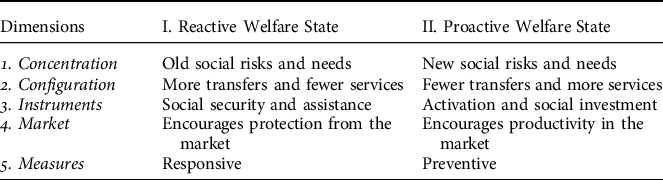
“A concept is the notion or image that we conjure up when we think of some cluster of related observations or ideas” (DeCarlo, Reference DeCarlo2018: 228). Conceptualization, moreover, is a clear and concise definition of a concept (ibid: 228). My goal in this stage is to examine the main nuances of contemporary welfare states. I identify five dimensions that are presented chronologically, around which I build the new concepts that assist in unveiling global welfare state patterns (Table 1). ‘Concentration’ emphasizes the presence of both old and new social risks and needs. Countries worldwide may direct their resources toward one category of risks and policies or the other, or in certain cases, they may devote an equal amount of effort to both categories (Esping-Andersen, Reference Esping-Andersen2002; Bonoli and Natali, Reference Bonoli and Natali2012). ‘Configuration’ emphasizes the differences in the forms of welfare provision. According to the existing research, welfare states that prioritize new social risks and needs provide fewer transfers but more services. Those who concentrate on older social hazards and needs, on the other hand, offer more transfers and fewer services (Häusermann, Reference Häusermann, Bonoli and Natali2012). The ‘Instruments’ dimension delves into the main policy areas/instruments that dominate contemporary welfare state policy. Existing research links activation and social investment policies with new social risks and demands, while social security and assistance policies are associated with old social risks and needs (Esping-Andersen, Reference Esping-Andersen2002; Morel et al., Reference Morel, Palier and Palme2012; Bonoli and Natali, Reference Bonoli and Natali2012; Hemerijck, Reference Hemerijck2017). ‘Market’ stresses the relationship between distinct welfare state policies and the market. It emphasizes that some welfare programs seek to encourage productivity and market participation (i.e. activation and social investment), while others aim to shield individuals from market failures (i.e. social security and assistance). The last component, ‘Measures’, underlines the kinds of measures intended to either prevent social risks from occurring or to respond to an undesirable result (Esping-Andersen, Reference Esping-Andersen2002).
Conceptualization

Based on the summary of the dimensions, I identify and conceptualize two concepts, Reactive and Proactive Welfare States (Table 1). My rationale for naming these concepts differently from the existing ones that circulate in the current literature is appropriate for two reasons. First, the concepts I propose, particularly the second one, include policy areas that go beyond employment-related issues, such as civil rights, climate change, public order, and gender development. As a result, the fundamental definitions of these concepts vary from the existing ones. Second, the usage of the new concepts avoids readers’ confusion about whether this study is aligning more with or endorsing one set of existing typologies over the others. In fact, I firmly believe that the most prominent welfare regimes studies bring to this body of literature invaluable and unique insights.
The first concept, Reactive Welfare State, derives from the dimensions listed in the first group (I). In this set, I perceive a higher tendency of welfare policy design to prioritize old social risks and needs, offer welfare provision and protection after the market has failed, encourage de-commodification, and use more responsive measures. On the other hand, the second concept, Proactive Welfare State, reflects on the dimensions presented in the second group (II). Here, I observe a higher tendency of welfare state policy design to respond to new social risks and needs, offer more services, encourage productivity and commodification, and use more preventive measures. I assume that these welfare state concepts are two ideal types, forming a spectrum of welfare states, with actual welfare states falling somewhere in between these two types. However, given the changing nature of welfare state priorities, certain countries may unveil a Dual welfare state pattern. This may arise as a result of the shift from Proactive to Reactive welfare state priority, or vice versa, or even as a result of particular countries’ lack of clear and concise welfare state designs.
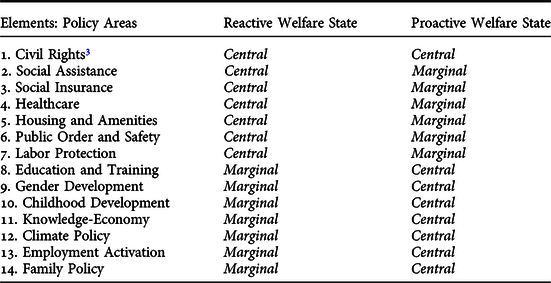
The framework then continues to identify the elements of conceptualization based on the concepts and dimensions in Table 1. In this case, elements refer to critical policy areas that are present in some form or another in the majority of contemporary welfare states. As discussed previously, traditional welfare policies (i.e. Table 2: 1-7) account for the majority of components in the existing frameworks. Nonetheless, contemporary policy areas (i.e. Table 2: 8-14) relating to gender and income inequality, new knowledge economy, and climate change, for numerous reasons need further attention in the newly developed theoretical methods. First, policy changes affecting new work/welfare relationships have changed at various levels across the globe (Hall, Reference Hall1993; Lewis, Reference Lewis2010). From a gender viewpoint, more precisely, the masculinist paradigm of labor and welfare has shifted, indicating a trend toward generalization to women (Lewis, Reference Lewis2010). These modifications to the gender-centered model tackle time constraints and emphasize the need of developing welfare policies that address and value care work, equality of opportunity, and so forth (Lewis, Reference Lewis2010; United Nations, 2015). Second, during the last three decades, socioeconomic developments have influenced the construction of different welfare states. Hall (Reference Hall, Chwalisz and Diamond2015: 256) argues that the emergence of revolutionary new technologies, economic and cultural globalization, and significant global shifts toward service-based employment call into question the capacity of traditional welfare programs to address the challenges posed by the new knowledge economy. Third, researchers of welfare policy see climate change as a systemic threat that is “novel, big, global, long-term, persistent, and uncertain” (Stern, Reference Stern2007: 25; Gough, Reference Gough2010, Reference Gough2013a). Indeed, climate change-related hazards have numerous consequences for welfare policy. Several of these include precautionary policies on housing, increased insurance costs, and increased health needs in the event of severe climatic disasters (Gough, Reference Gough2013a). Further, climate migration may exacerbate social integration difficulties and increase demand for housing, employment, education, social protection, services, and health care (ibid: 328). Synergies between climate change and social policy are gaining prominence and should be included on the list of elements of conceptualization (Koch and Fritz, Reference Koch and Fritz2014). Fourth, in terms of public order and safety, I am more concerned with corruption and property rights enforcement, a policy area influenced by the studies of Lambsdorff (Reference Lambsdorff2001) and Rothstein (Reference Rothstein2021). The first contends that corruption leads governments to be unable or unwilling to maximize welfare services, while the latter argues that different kinds of malpractice in social program execution have a significant effect on the potential for gaining peoples’ support for social policy. Finally, other mentioned policy areas appear often in the welfare states literature (i.e. see Table 3 sources for details), with the majority of these indicators fairly accurately also reflecting a country’s fiscal policy efforts in terms of social policy (i.e. expenditure variables).
Elements of Conceptualization

Note: The Central and Marginal rankings indicate the degree of priority and use according to certain policies by each regime.
Indicators of Elements

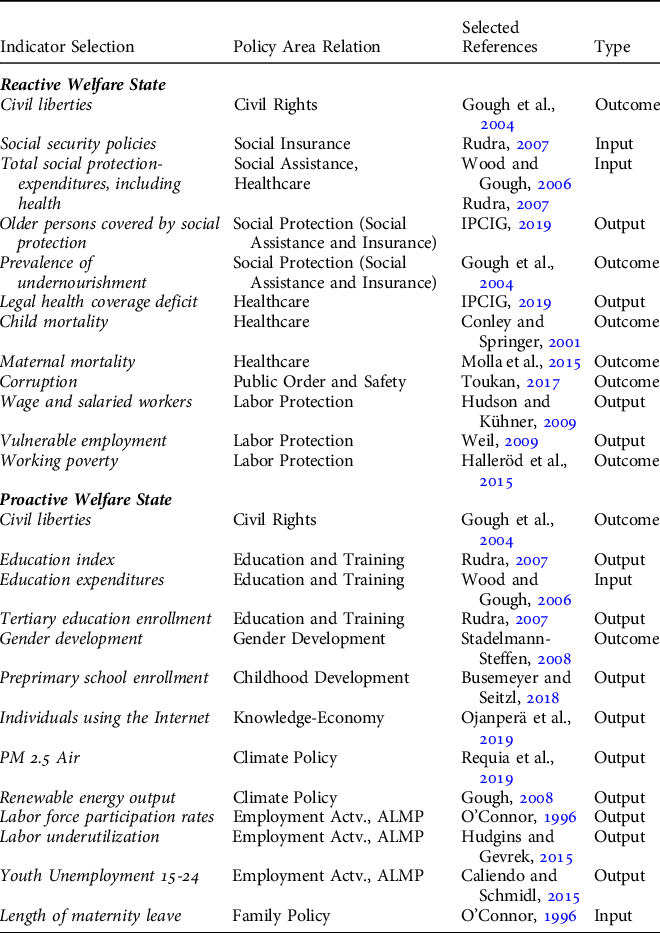
Note: This list illustrates the range of indicators that scholars may use in other similar studies. In this paper, I used indicators that generated robust empirical findings.
Table 2 compiles a list of fourteen policy areas that dominate contemporary welfare state architecture. These policies are neither mutually exclusive nor are they substitutes; rather, they complement one another. Based on the concepts derived from Table 1, I propose that contemporary welfare states follow either a Reactive or a Proactive path, or in specific cases a Dual path. The Reactive Welfare State pattern represents welfare designs that prioritize policy areas 2-7, whereas the Proactive Welfare State pattern reflects welfare designs that prioritize policy areas 8-13 (Table 2).
Second Stage: Operationalization
In quantitative research, the operationalization process is concerned with ‘how a concept will be measured’ (DeCarlo, Reference DeCarlo2018: 236). It includes the identification of indicators that represent each concept. In this stage, I do so by identifying at least one indicator for each element of conceptualization (Table 3). In the indicator selection process, I closely consult the existing welfare regimes’ scholarship and mix input, output, and outcome indicators. Fundamentally, I construct my rationale based on the arguments, experiences, and results deriving from two prominent studies on welfare regimes, Rudra (Reference Rudra2007) and Gough (Reference Gough and Kennett2013b). The term ‘input’ refers to legislation and expenditure, ‘output’ refers to the implementation rate of legislation and provision, and ‘outcome’ refers to the final effect on individuals. Indeed, input, output, and outcome variables are expected to be related. In practice, and according to Rudra and Gough, these connections may vary in different country contexts. As a result, it is critical to consider all three dimensions. The combination of these types of indicators generates substantial explanatory power as it captures the welfare states’ efforts and results in several areas, as listed in Table 3.
Third Stage: Measurement
Following conceptualization and operationalization, this stage focuses on ensuring the validity of these concepts via accurate measurement. As a result, the dataset I constructed includes only indicators of elements deriving from Table 3. Based on the current literature, data reduction, and more specifically, cluster analysis, is an appropriate quantitative technique for validating the proposed framework (Barrientos, Reference Barrientos2015). Cluster analysis groups countries with comparable characteristics and demonstrates feature variations across country groups. Cluster results unveil patterns of contemporary welfare states as I suggested, if they confirm that some countries’ welfare designs are prioritizing one group of welfare policies (i.e. Proactive Welfare State policies) over another (i.e. Reactive Welfare State policies), and vice versa. However, if the cluster analysis shows just one cluster, it would imply that the attempts to find welfare state patterns across the world are pointless and that the efforts to tackle the existing new and old social risks are relatively similar in every country. Alternatively, if cluster analysis reveals a much larger number of clusters (e.g. 7-10 clusters), it would imply that global welfare state efforts to address new and old social risks are considerably more diverse than this study suggests.
Data and empirical approach
Data
I assembled a unique and comparable dataset for the year 2015Footnote 4 , including nineteen input, output, and outcome variables for 150 countries across six continents (see note 4 and Appendix A for details). The country sample is highly comprehensive and covers the welfare states of more than ninety percent of the world’s population. The other omitted information predominantly includes small islands characterized by a substantial lack of data and some extreme country cases, i.e. ruthless dictatorships or countries in massive ongoing wars. The sources of the selected data include international organizations such as the United Nations, World Bank, World Health Organization, International Labor Organization, and International Institute for Democracy and Electoral Assistance (see Appendix B and C for details). The large sample size, the period it covers, the mix of variables, and the comparability and credibility of data, provide sufficient statistical power to detect global contemporary welfare state patterns.
Method: Model-based cluster analysis
Cluster analysis is an unsupervised learning method used to examine homogenous groups of observations within a multivariate dataset (García-Escudero et al., Reference García-Escudero, Gordaliza, Matrán and Mayo-Iscar2010; Kumar, Reference Kumar2019). In unsupervised learning, hierarchical clustering, partitioning methods, and model-based clustering are the most popular methods. In this study, I used model-based clustering (or Gaussian Mixture Model), a formal and sophisticated method that relies entirely on statistical models and creates the prospects to make formal inferences (Kumar, Reference Kumar2019; Fraley and Raftery, Reference Fraley and Raftery2002). Recently, model-based cluster analysis has advanced considerably in terms of methods, software, and interpretation of the output (Fraley and Raftery, Reference Fraley and Raftery2007). It is a ‘well-established’ tool for clustering multivariate data and is gradually preferred over heuristic methods (Fop and Murphy, Reference Fop and Murphy2018; Fraley and Raftery, Reference Fraley and Raftery2007).
According to Ahlquist and Breunig (Reference Ahlquist and Breunig2012), the model-based clustering method has four unique advantages over the heuristic clustering methodsFootnote 5 . Firstly, the partition of data in model-based clustering develops from an estimated statistical model. Secondly, it enables us to choose the clustering method relying on a formal model selection. In this article, I used the Bayesian Information Criterion (BIC) to select the best model. Thirdly, model-based clustering detects the number of clusters in a dataset, unlike the K-means approach, which requires a prior selection, or the hierarchical approach that requires post-subjective selection of the number of clusters. Fourthly, model-based clustering currently has available numerous cluster shapes, unlike the other methods (ibid: p.96). In this analysis, I assume a Gaussian Mixture Model for data X, with D variables and N observations. For G clusters, the likelihood is:
 $$\mathop \prod \limits_{i = 1}^N \mathop \sum \limits_{k = 1}^G {\rm{{\rm T}}}\kappa \emptyset k(xi\mid uk,\;\Sigma k),$$
where
 ${\rm{\;{\rm T}}}\kappa $
represents the probability that an observation belongs to cluster k,
 $\emptyset k{\rm{\;}}$
is the normal probability distribution centered at
 $uk$
with variance-covariance matrix
 $\sum k$
(Evans et al., Reference Evans, Love and Thurston2015: 67). In this approach, “clustering is formulated in a modeling framework, and the data generating process is represented through a finite mixture of probability distributions” (Fop and Murphy, Reference Fop and Murphy2018: 2). This study uses multivariate data, and I conduct model-based clustering analysis via GMMs in R (R Core Team, 2017), using mclust package. The data is standardized since the ranges of the variables vary significantly. Using the model-based clustering method, I was able to attain an optimal number of clusters and a smooth interpretation of the results.
Validation of the conceptual framework
In Figures 1 and 2, as well as Table 4, I show model-based cluster findings. I converted the data to percentiles to facilitate a smooth comparison between countries and variable averages. The values of all variables are computed in ascending order from 0 to 100. The higher the percentile rating, the stronger the corresponding indicators are in a country/cluster, and vice versa. First, I determine the number of clusters identified by the data reduction technique. Second, I evaluate the features of each cluster and compare the findings to the conceptual framework developed in this study. Third, I use a suitable robustness technique to assess the confidence of the chosen model (see Appendix D for details).
Model selection.
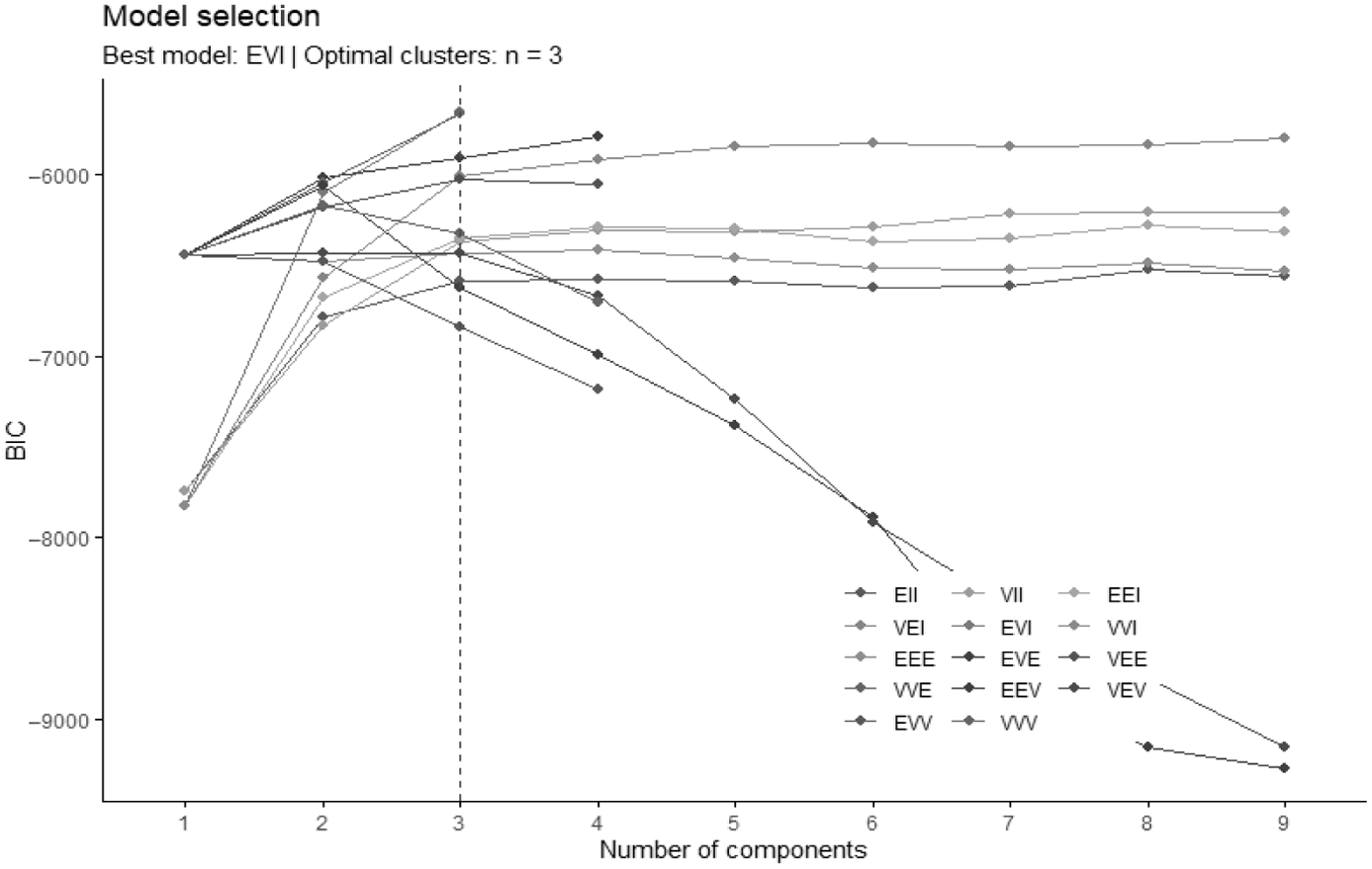
Note: Figure 1 shows the selection of the best model using the Bayesian Information Criterion (BIC). The optimal number of clusters representing the best model is three.

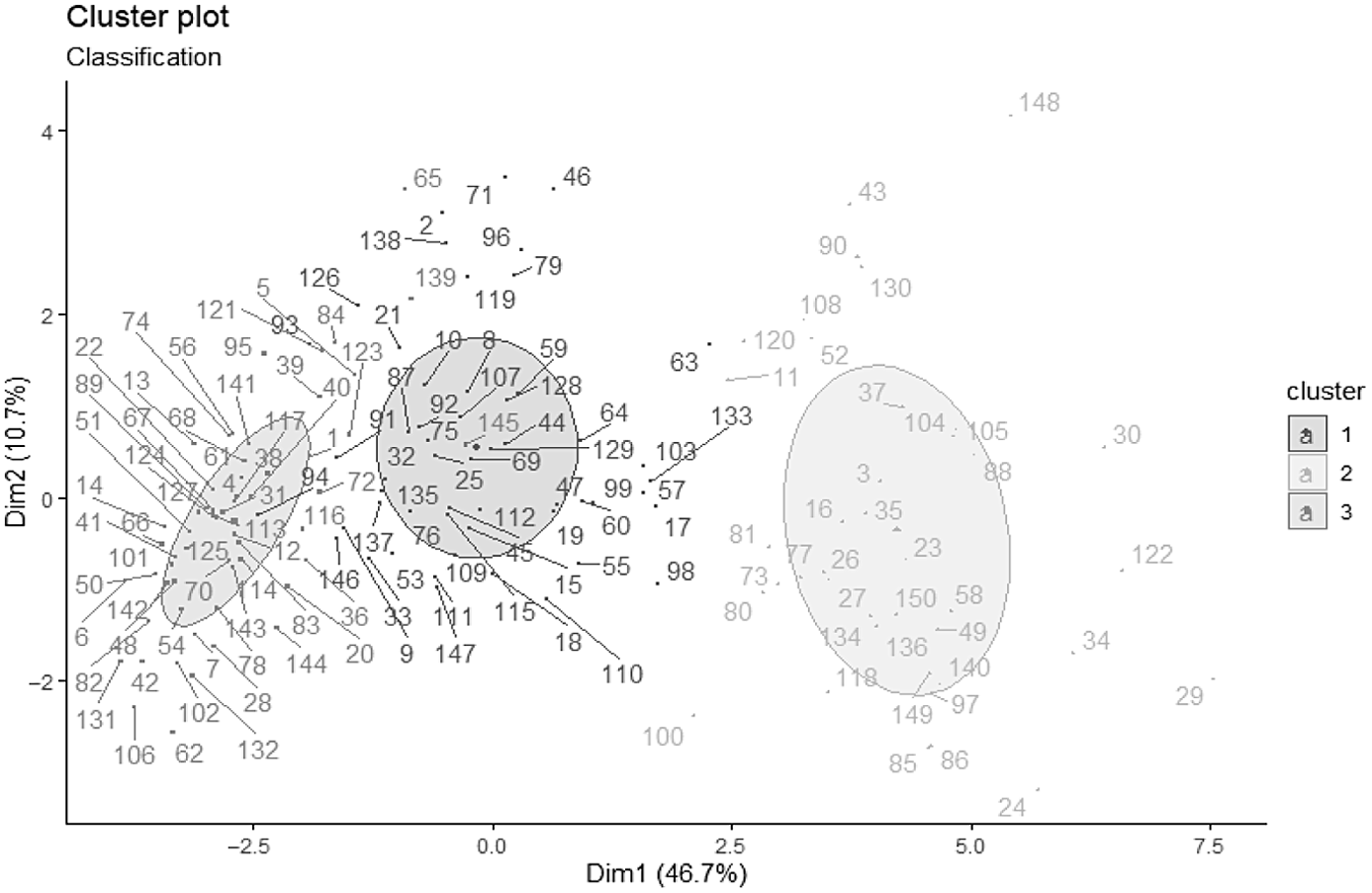
Cluster plot.
Note: Figure 2 figure shows the three cluster plots. Cluster one (center) represents the group of countries with the Dual Welfare States, cluster two (right) represents the group with the Proactive Welfare States, and cluster three (left) represents the group with the Reactive Welfare States.

Cluster Analysis Results

The model-based cluster analysis reveals three clusters, demonstrating the presence of different patterns of welfare states throughout the world (see Figure 1). The highest BIC score indicates the strongest evidence in favor of the optimal model. The cluster findings show three groupings made up of 53, 39, and 58 countries, respectively (see Figure 2). Analyzing variable or country averages may provide micro information about how a variable compares to a country group, or how one country compares to a set of variables. However, in this study, I am primarily concerned with extracting information from a macro perspective. Do the cluster findings, in particular, validate the new conceptual framework that this study proposes? If that is the case, what does the global picture of contemporary welfare state patterns tell us?
Model-Based Cluster Analysis Results
In Cluster 1, the indicators capturing the Reactive and Proactive Welfare State concepts have almost identical cluster averages (46th and 45th percentiles, respectively) (see Table 4). This finding reveals a hybrid pattern or a ‘Dual Welfare State’, which means that, from a macro viewpoint, this group of countries puts equal efforts in both Proactive and Reactive welfare programs and risks. However, from a micro perspective, the results show that several countries have individual average welfare state patterns that lean toward Reactive (i.e. Algeria, Egypt, and South Africa), Proactive (i.e. Bhutan, Ghana, and Peru), or Dual (i.e. Dominican Republic, Malaysia, and Kyrgyz Republic) welfare state patterns.
Cluster 2 has the lowest welfare state performance of the three clusters (19th and 32nd percentiles, respectively) (see Table 4). Nonetheless, the results indicate that the welfare state structure of this set of countries is characterized as a Proactive Welfare State pattern. Cluster analysis reveals that the average of the variables representing the Proactive Welfare State dimension is considerably higher in nearly all countries than the indicators representing the Reactive Welfare State. As a result, in accordance with the proposed conceptual framework, I refer to this group of countries as the Proactive Welfare States, since they devote a relatively greater amount of attention to the policies and risks upon which this regime is built. A thorough causal analysis is necessary to elucidate why this group of emerging countries with low-level welfare states adheres to the Proactive pattern. However, current literature provides some indications. According to Kuitto (Reference Kuitto2016), the main components of the Proactive Welfare State, social investment and activation policies, are less costly than compensatory programs such as social protection policies; hence, they are more affordable and attractive for poorer countries (Kuitto, Reference Kuitto2016). Furthermore, new welfare policies are simpler to modify than conventional ones since they do not have substantial ‘path-dependent’ consequences (ibid: p.5). Finally, I believe that the impact of international organizations in bringing Proactive Welfare State ideas to the top of the social policy agenda may be another explanation.
Cluster 3 has the strongest welfare state performance of the three clusters (72nd and 65th percentiles, respectively) (see Table 4). As I am interested in the primary directions and strategies of the welfare state rather than on the level, cluster averages show that this group of countries has especially high values for Reactive Welfare State policies and risks. Such a finding is also mirrored in nearly all country-level averages. This cluster mostly consists of nations that feature often in the current literature on welfare regimes yet are classified as having distinct welfare regimes (e.g. Norway, Sweden, United States, United Kingdom, and Germany). The clustering of this group in the current study is most likely due to path dependence and the fact that the majority of these nations have well-established social safety systems built over decades. In this regard, it is worth noting that the cluster analysis may still assist in identifying differences within this cluster that correlate to traditional typologies. To illustrate, if we compare Sweden (Social-Democratic), Germany (Corporatist), and the United Kingdom (Liberal) using Esping-Andersen’s (Reference Esping-Andersen1990) traditional (Reactive) welfare state instruments, their national average still shows this difference through percentiles, 84th, 81st, and 77th, respectively.
Conclusion
In recent years, welfare states across the world have undertaken substantial reforms, mostly in response to new social risks and needs posed by the new knowledge economy, gender and income inequality, and climate change. The objective of this study was to develop – for the first time – a comparative welfare state conceptual framework that takes into account the re-focusing of welfare states in recent years and is capable of capturing welfare state patterns on a global scale. As a result, I designed and deployed a novel and systematic theoretical framework for detecting such patterns. Following that, I moreover assembled a unique dataset for 150 countries, onboarding many of them for the first time in the literature, and ultimately used this information to validate the proposed framework utilizing a sophisticated data reduction technique. This study’s most significant results may be summarized as follows.
First, I can show, using my conceptualization and model-based cluster analysis, that welfare states worldwide may be classified into three groups. One cluster identifies a group of countries with a greater welfare commitment/response to new social risks than to old social risks. As a result, I refer to this group’s welfare states as the Proactive Welfare States. Another cluster identifies a group of welfare states that perform comparatively better on problems relating to old social risks, and I refer to them as the Reactive Welfare States. Additionally, my research identifies a third cluster, comprised of nations with almost equal levels of commitment/response to both old and new social risks, and I refer to them as the Dual Welfare States. Thus, I can demonstrate that – from a global comparative viewpoint – there is systematic variation in how welfare states prioritize their responses to existing and emerging social hazards.
Second, although the extent to which the welfare state is engaged is not an essential feature of this conceptualization, empirical evidence indicates that the proposed framework may provide such information within and across clusters. In terms of the latter, the Proactive Welfare State cluster exhibits, on average, the lowest welfare state engagement, followed by the Dual Welfare State cluster. The Reactive Welfare State cluster, however, exhibits the highest degree of welfare state effort. Clearly, these distinct levels seem to be linked to the disparities between developed and developing countries. However, while the level of development is rather logically related to the level of welfare state engagement, the results show that richer and poorer countries also differ with respect to the orientation of their welfare states. The majority of developed countries have long-established a comprehensive welfare state to guard against traditional social risks, which has been extended but not supplanted by measures addressing emerging social hazards. This results in a high level of total welfare state engagement. By contrast, developing nations often lack the resources necessary to establish a compact social security net, preferring instead to concentrate on social investment and activation programs, which are usually less costly than social protection measures (Kuitto, Reference Kuitto2016). This is reflected in these countries’ much lower total level of welfare state involvement, as shown in this study.
Third, the comparative framework has a stated goal of identifying welfare state patterns on a global scale. To some degree, this comes at the expense of data constraints with indicators that are not always ideal representations of some specific countries’ different welfare state dimensions. Nonetheless, my research demonstrates that the conceptual framework could be extended to a subsample of established democracies as well. The methodology, when concentrating on these nations, shows the various degrees to which these traditional welfare states have been re-focusing their policies on new social risks. Future research may dig further into these disparities using this approach and benefit from the fact that better and more comprehensive data is available for subsamples of countries. Additional disaggregated data for different policy instruments, for example, may allow for the use of more input variables (expenditures and policies) to identify more fine-grained welfare state changes.
Supplementary material
For supplementary material accompanying this paper visit https://doi.org/10.1017/S0047279421001033
Acknowledgments
This paper was presented at the Swiss Political Science 2020 Annual Meeting at the University of Luzern. I am thankful to the anonymous reviewers, discussants, and participants for their insightful comments. Furthermore, the author wishes to express gratitude for the financial support provided by UniBern Forschungsstiftung, Grant Number 38/2018.
Competing interests
The author declares none.